
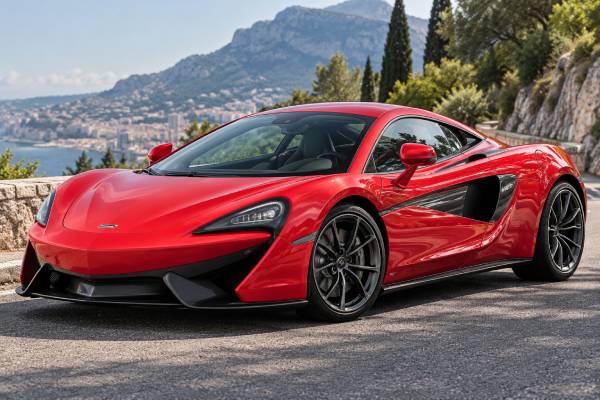
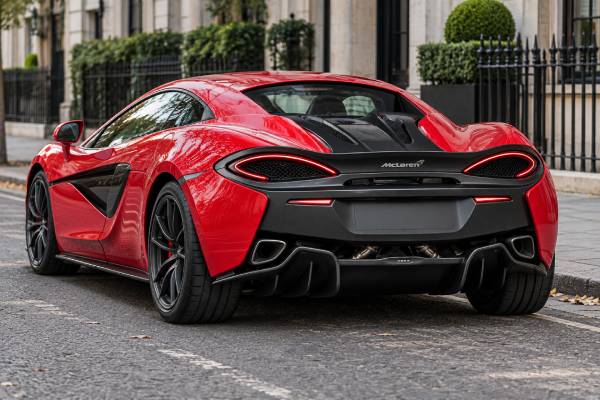
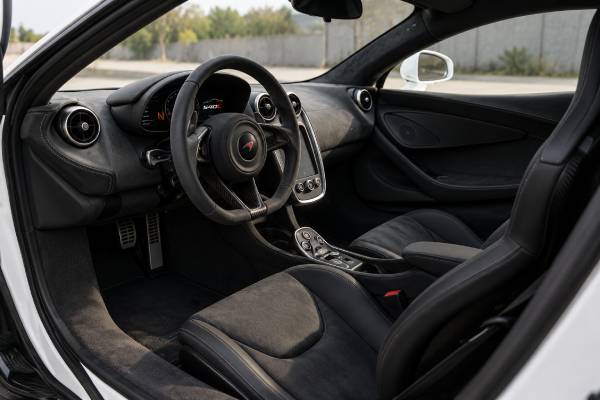
The McLaren 540C is the least powerful member of the original Sports Series, but that does not make it a stripped-down or fundamentally lesser McLaren. It uses the same basic carbon-fiber MonoCell II architecture, mid-mounted 3.8-liter twin-turbo V8 layout, seven-speed dual-clutch SSG, rear-wheel drive, adaptive double-wishbone suspension, and electro-hydraulic steering philosophy that define the P13 family. Its 540 PS output is simply calibrated for a more accessible, road-focused role.
That positioning gives the 540C an interesting place in the used market. It delivers 533 bhp, a factory 0–100 km/h time of 3.5 seconds, and a 320 km/h top speed, yet its standard cast-iron brakes and less extreme setup can make normal road ownership more straightforward than an LT derivative. Buyers still need to treat it as a low-volume supercar: annual servicing, battery health, cooling-system condition, suspension hardware, body repairs, and electronic diagnostics all matter. This guide focuses on what is specific to the 540C rather than treating it as a detuned 570S.
Table of Contents
- Where the 540C fits in the Sports Series
- 540C specs and technical data
- Everyday performance and road manners
- P13 engineering details that matter
- Maintenance priorities for long-term health
- Service bulletins and problem areas
- 540C used-buying checklist
Where the 540C fits in the Sports Series
The 540C was conceived as the most approachable route into McLaren’s Sports Series, not as a conventional entry-level coupe. It keeps the exotic construction and mechanical layout while trading some output and ultimate track hardware for a slightly more road-oriented character.
The model name reflects its metric power rating: 540 PS. In imperial terms McLaren publishes 533 bhp, with 540 Nm of torque from the M838TE 3.8-liter twin-turbo V8. That is less than a 570S, but the 540C is still capable of performance that exceeds most traditional sports cars. The important distinction is how it deploys that performance.
Standard brakes are cast-iron rather than the carbon-ceramic setup fitted to more extreme derivatives. For a driver who spends almost all of the car’s life on public roads, that is not automatically a disadvantage. Iron discs warm predictably in daily conditions and can be less financially intimidating to replace. Carbon ceramics may appear on cars through market options or later modifications, so the actual hardware should be verified rather than assumed from the badge.
The body is less visually aggressive than an LT, but the underlying carbon tub is the same kind of advanced architecture that made the Sports Series unusual at its price point. The MonoCell II weighs under 80 kg according to McLaren’s period material and forms the rigid central passenger cell. Aluminum and composite outer panels attach around it.
That construction shapes the used-car inspection. A scratched or repaired outer panel is one question; damage to the carbon tub, sill structure, or bonded mounting areas is another. A car with accident history should be inspected by someone who understands McLaren composite construction rather than judged solely by paint depth.
Market history can also be confusing. The 540C was sold in many regions but was not offered everywhere in the same way or for the same period. The assignment scope covers 2015–2021; actual registration dates, model-year labels, and local availability vary. Always treat the VIN and original build information as the authoritative identity of a particular car.
A 540C also rewards careful attention to factory options because two apparently similar examples can feel quite different in normal use. Nose lift, parking assistance, seating, audio, wheel design, exhaust specification, and trim choices matter more to everyday satisfaction than a small difference in mileage. A front-lift system is especially useful where steep ramps and speed humps are common, but it should raise and lower cleanly with no warning messages or hydraulic leaks. Lightweight wheels are attractive, yet replacement cost and evidence of curb or pothole damage deserve more weight in a purchase decision than appearance alone.
The same principle applies to modifications. An aftermarket exhaust, wheel set, suspension part, or engine calibration is not automatically a problem, but it changes what must be verified. Ask who supplied and installed the part, whether the original components remain with the car, and whether the change affects emissions compliance, warranty eligibility, or diagnostic software. For a car whose appeal comes from the integration of a light carbon chassis, adaptive damping, steering calibration, and turbocharged response, a well-preserved standard specification is often easier to evaluate than a heavily altered example. A complete build sheet therefore belongs beside the service invoices during a serious inspection.
540C specs and technical data
The 540C is a gasoline-only P13 coupe with a longitudinal mid-mounted V8, seven-speed SSG, and rear-wheel drive. Its specification is notable for combining supercar acceleration with conventional road-oriented features such as adaptive dampers, a usable front luggage compartment, and cast brakes.
| Specification | Value |
|---|---|
| Powertrain type | Gasoline ICE |
| Engine code | M838TE |
| Engine configuration | 90-degree V8, longitudinal mid-engine |
| Displacement | 3,799 cc (3.8 L) |
| Valvetrain | 32-valve DOHC with variable valve timing |
| Induction | Twin turbochargers |
| Lubrication | Dry sump |
| Maximum power | 540 PS (533 bhp / 397 kW) at 7,500 rpm |
| Maximum torque | 540 Nm (398 lb-ft) at 3,500–6,500 rpm |
| Maximum engine speed | 8,500 rpm |
| Transmission | 7-speed Seamless Shift Gearbox (SSG) plus reverse |
| Drive | Rear-wheel drive |
| Specification | Value |
|---|---|
| 0–100 km/h (0–62 mph) | 3.5 seconds |
| 0–60 mph | 3.4 seconds |
| 0–200 km/h (0–124 mph) | 10.5 seconds |
| Quarter mile | 11.3 seconds |
| Top speed | 320 km/h (199 mph) |
| 100–0 km/h braking distance | 32 m (105 ft) |
| 200–0 km/h braking distance | 138 m (453 ft) |
| Specification | Value |
|---|---|
| Body structure | Carbon-fiber MonoCell II |
| Suspension | Double wishbone with adaptive dampers |
| Differential strategy | Open differential with Brake Steer |
| Driver aids | ABS, traction control, electronic stability control, launch control |
| Standard brakes | Cast discs with 4-piston aluminum calipers front and rear |
| Front wheel size | 19 × 8J |
| Rear wheel size | 20 × 10J |
| Front tires | 225/35 R19 |
| Rear tires | 285/35 R20 |
| Original tire family | Pirelli P Zero |
| Specification | Value |
|---|---|
| Body style | 2-door, 2-seat coupe |
| Length | 4,530 mm (178.3 in) |
| Width at widest point / with mirrors | 2,095 mm (82.5 in) |
| Height | 1,202 mm (47.3 in) |
| Wheelbase | 2,670 mm (105.1 in) |
| Minimum dry weight | 1,353 kg (2,983 lb) |
| DIN kerb weight | 1,449 kg (3,193 lb) |
| U.S.-style curb figure in period data | 1,454 kg (3,206 lb) |
| Front luggage capacity | 150 L (5.3 cu ft) |
| Fuel-tank capacity | 72 L (19.0 U.S. gal) |
| Test or specification | Published value |
|---|---|
| EU NEDC urban | about 16.7 L/100 km |
| EU NEDC extra-urban | about 7.9 L/100 km |
| EU NEDC combined | about 11.0 L/100 km |
| EU NEDC combined CO₂ | 249 g/km |
| Later EU WLTP combined | 12.2 L/100 km |
| Later EU WLTP combined CO₂ | 276 g/km |
Fuel figures changed with the regulatory test procedure, so NEDC and WLTP numbers should not be compared as though the car itself suddenly became less efficient. They are different laboratory methods. Used listings often mix them, which is why the test cycle should stay attached to the number.
Everyday performance and road manners
The 540C is still extremely fast, but it is calibrated to make that performance easier to live with than the more track-focused P13 variants. Its value lies less in chasing the last few tenths of acceleration and more in combining a carbon supercar chassis with tolerable everyday road behavior.
At low and medium speeds, the adaptive dampers allow a degree of compliance that fixed-rate track suspension would not. That does not make the car soft; short tire sidewalls, low ride height, and direct steering still transmit road texture. A healthy 540C should feel controlled rather than crashy. Sharp knocks from one corner, a persistent float after bumps, or a car that sits unevenly merit suspension inspection.
Electro-hydraulic steering is one of the platform’s defining features. The hydraulic assistance communicates changes in front-tire load with more texture than many later fully electric systems. That also makes poor alignment, uneven tire pressures, worn tires, or bent wheels easy to feel. Do not assume nervous steering is “just a McLaren trait.”
The engine has a broad torque plateau beginning at 3,500 rpm, so normal driving does not require constant high revs. When pushed, it continues to build toward its 7,500-rpm power peak. Turbo response is quick for the era, but there is still enough progression to make throttle position useful for balancing the chassis in a corner.
The SSG can operate automatically, but the car feels more coherent when the driver uses the fixed paddles. Shifts should be clean when warm, and selection of drive or reverse should not be accompanied by repeated warnings, severe delay, or abnormal mechanical noise. Battery voltage can influence electronic behavior, so diagnostic work should start with a healthy electrical supply rather than random component replacement.
Cast brakes suit road use well. They can produce dust and wear like any high-performance iron system, but they avoid the replacement cost and specialized wear assessment of carbon-ceramic discs. Inspect for lip, scoring, cracking, vibration, pad taper, and evidence of overheating. A car with upgraded carbon ceramics should be evaluated as a modified specification unless factory documentation confirms otherwise.
The 540C can be driven on track, but it is not an LT. If circuit use is planned, pay close attention to tire choice, brake-fluid condition, pad material, cooling-system health, and post-event inspection. The car’s capability is high enough that consumables can heat quickly even if the setup is nominally more road biased.
P13 engineering details that matter
The 540C’s most important engineering feature is not its horsepower figure; it is the way the carbon tub, aluminum substructures, double-wishbone suspension, and mid-engine layout work together. Those fundamentals explain both the car’s driving character and several ownership priorities.
The MonoCell II forms the passenger cell and includes deep sills that contribute stiffness and side-impact structure. Dihedral doors hinge upward and forward, reducing the space needed beside the car once the initial outward sweep is clear. The unusual sill and door geometry means buyers should inspect hinges, latches, gas struts, seals, and the sill surfaces that often get scuffed during entry.
The mid-mounted engine centralizes mass, while the rear-biased weight distribution improves traction. Cooling radiators and ducting are distributed through the body, so keeping intakes and heat exchangers clean matters. Leaves, road debris, and accumulated dirt can reduce airflow or trap moisture. A specialist can inspect radiators and condensers without damaging delicate fins.
Brake Steer substitutes electronic brake intervention for a traditional limited-slip differential in certain cornering situations. The system uses the car’s brake and stability-control hardware to manage an inside rear wheel and help rotation. That makes correct wheel-speed sensing, brake condition, and stability-control operation integral to the handling system rather than separate conveniences.
The adaptive dampers provide Normal, Sport, and Track-oriented responses through the active dynamics controls. A failed damper or sensor can affect more than ride comfort. Scan the car for stored chassis faults even if the dashboard is clear at the time of inspection.
The 150-liter front luggage compartment is another example of road usability built into the layout. Its drain paths and seals deserve inspection because water at the front of the car can migrate into areas containing electrical components. A manufacturer technical bulletin for P13 cars addresses water ingress into the driver or passenger foot area related to the HVAC distribution box and drain hose, so damp carpets should never be dismissed as a harmless detailing issue.
Maintenance priorities for long-term health
A 540C should be maintained by calendar as well as mileage. Sports Series guidance recommends service every 12 months or 10,000 miles (15,000 km), whichever comes first, and low annual mileage is not a reason to defer fluids and inspection.
Engine oil, filters, brake fluid, coolant condition, tires, and battery health all age while the car is parked. A frequently used car that reaches full operating temperature may actually be easier to assess than a garage queen that spends months on a weak battery and old fuel.
Focus on the following areas:
- Engine and turbo system: Check for oil seepage, abnormal smoke, boost-related warnings, intake leaks, and unusual noises after full warm-up.
- Cooling system: Look for dried coolant traces, odor, level changes, damaged radiators, deteriorated hoses, and debris in cooling inlets.
- SSG transmission: Verify smooth operation in automatic and manual modes, both cold and hot, and scan for stored faults.
- Suspension: Inspect adaptive dampers, wishbone joints, bushes, wheel bearings, and alignment-related tire wear.
- Brakes: Measure disc and pad condition rather than relying on appearance through the wheel spokes.
- Tires: Check age codes, matched specification, sidewalls, flat spotting, and inner shoulders.
- Battery: Use an approved maintainer during storage and test a battery that repeatedly drops voltage.
- Climate control and drainage: Confirm strong cooling, dry footwells, and unobstructed drains.
Warm the engine and transmission before sustained high load. Turbocharged supercars generate significant local heat, so repeated cold starts followed by short trips are not ideal. After hard driving, allow operating temperatures to stabilize rather than immediately shutting the car down at peak thermal load.
Keep records detailed. A chronological folder of annual services, batteries, tires, alignment, software updates, repairs, and diagnostics helps distinguish normal age-related work from a recurring unresolved fault. It also makes the car easier to sell because a future buyer does not have to reconstruct its history from isolated stamps.
Service bulletins and problem areas
The useful way to discuss 540C “common problems” is to separate documented manufacturer guidance from anecdotes. McLaren technical bulletins hosted in the NHTSA service-information database identify several P13 inspection areas without implying that every car will suffer them.
One bulletin covers water entering the driver or passenger foot area, particularly when the HVAC system is operating. The guidance points technicians toward the HVAC distribution box and drain hose. For a buyer, the practical lesson is simple: lift the mats, feel the carpet and underlay, smell for dampness, and test the air conditioning long enough for condensate to form.
Another bulletin addresses a low washer-fluid warning even when the reservoir is full. The manufacturer procedure directs technicians to check the level sensor and its seating before replacing the bottle. A persistent warning may therefore be a sensor installation or resistance issue rather than evidence that the entire washer assembly has failed.
A separate glazing bulletin gives detailed windscreen replacement care, including the sealant bead specification. That matters because the windscreen is bonded into a low-volume composite/aluminum body structure. If a car has replacement glass, ask who installed it and check for wind noise, water leakage, trim damage, adhesive inconsistency, or stress cracking around the glass.
Beyond those documented items, buyers should inspect the usual P13 age points: battery condition, door operation, lift system if fitted, adaptive dampers, air conditioning, coolant hoses, radiator cleanliness, interior switches, infotainment, camera and parking systems, and cosmetic wear around the sills.
A clean diagnostic scan is valuable but not enough by itself. Some problems are mechanical, some are intermittent, and some faults may have been recently cleared. Compare the scan with service invoices, readiness state, battery history, and what the car actually does during an extended test drive.
540C used-buying checklist
A good 540C purchase begins with provenance, not price. Confirm the exact car first, then inspect its condition, then decide what the specification is worth to you.
Verify the VIN, original market, build date, options, and factory colors. Market differences can affect equipment and documentation, and imported cars may have a history that is harder to trace. Confirm that the title, registration, and service records all describe the same vehicle identity.
Review servicing year by year. Long gaps on a low-mileage car are still gaps. Look for evidence of oil service, brake-fluid attention, tires, battery replacement, alignment, cooling-system work, air-conditioning repairs, and any repeated warning lights. Ask for invoices rather than accepting a verbal summary.
A specialist pre-purchase inspection should include:
- Full diagnostic scan with battery voltage verified first.
- Cold start followed by a complete warm road test.
- Cooling-system pressure and leak inspection.
- SSG operation in automatic and manual modes.
- Adaptive damper, wishbone, bearing, and alignment checks.
- Brake-disc and pad measurement.
- Tire age and inner-shoulder inspection.
- HVAC operation and a dry-footwell check.
- Windscreen bonding, glass condition, and evidence of prior replacement.
- Door hinges, latches, window indexing, weather seals, and sill condition.
- Underbody, splitter, jacking points, floor panels, and carbon tub visible areas.
- Paint-depth and panel-fit review for previous accident repairs.
Do not overvalue a low odometer reading. A car that was serviced annually, exercised regularly, and repaired correctly can be a better ownership proposition than one stored for years with old fluids and tires. Likewise, do not automatically reject a repaired cosmetic panel; determine whether the repair was limited to replaceable bodywork or involved the carbon structure.
The 540C’s lower position in the range can be an advantage for an owner who wants the core P13 experience without paying for track-focused equipment that will rarely be used. Its cast brakes, road bias, and 533-bhp output are still more than enough to make it feel like a true mid-engine supercar. The smart purchase is not the cheapest 540C available, but the one whose history and condition let you enjoy that engineering without immediately funding years of deferred maintenance.
References
- McLaren 540C – Performance Sports Car with Smart Storage 2026
- Official Authorized McLaren | Certified Pre Owned CPO 2026 (Certified Pre-Owned Program)
- McLaren Ownership – Owner’s Handbooks | McLaren Automotive 2026 (Owner’s Handbooks)
- This document is uncontrolled when printed. Before use, check the Knowledge Base within the McLaren Retailer Portal to verify that this is the current version. 2020 (Technical Service Bulletin: HVAC water ingress)
- This document is uncontrolled when printed. Before use, check the Knowledge Base within the McLaren Retailer Portal to verify that this is the current version. 2019 (Technical Service Bulletin: washer level warning)
- This document is uncontrolled when printed. Before use, check the Knowledge Base within the McLaren Retailer Portal to verify that this is the current version. 2019 (Technical Service Bulletin: windscreen replacement)
Disclaimer
This article is for informational purposes only and does not replace professional diagnosis, inspection, or repair. Specifications, torque values, service intervals, fluids, parts, and procedures can vary by VIN, market, production date, and equipment; verify all work against the official McLaren service information for the exact vehicle.
Please share this guide on Facebook, X/Twitter, or another platform if it helped you; doing so supports our work.