


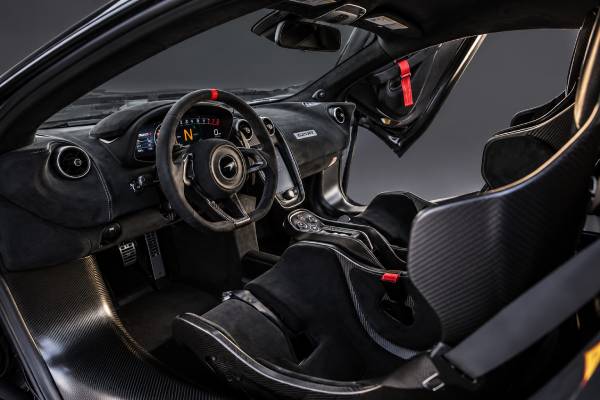
The McLaren 620R is the closest the Sports Series came to putting a customer GT4 car on public roads. Built around the carbon-fibre MonoCell II chassis and the M838TE 3.8-litre twin-turbo V8, it combines 620 PS (456 kW, roughly 612 hp) with a seven-speed dual-clutch transmission, rear-wheel drive, manually adjustable motorsport dampers, centre-lock wheels, carbon-ceramic brakes, and an aero package derived from the 570S GT4. It is quick in a straight line, but its real purpose is repeatable circuit performance and unusually direct chassis feedback.
For buyers, the important point is that a 620R should be judged differently from a low-mileage road-focused supercar. Track history is not automatically a negative; undocumented damage, poor setup work, neglected fluids, old tyres, and missing original equipment are. This guide covers the P31 620R sold across the 2020–2021 period, explains the verified technical data, and shows what matters when maintaining, inspecting, or buying one today.
Table of Contents
- What the 620R is and why it is different
- Powertrain, performance, and aerodynamic engineering
- McLaren 620R specifications and technical data
- Road and track chassis setup
- Maintenance, track care, and storage
- What to inspect before buying a 620R
- Who the 620R suits as an ownership proposition
What the 620R is and why it is different
The 620R is not simply a 570S with a larger wing. McLaren developed it as the road-legal expression of the 570S GT4, retaining the Sports Series carbon tub while adding race-derived suspension, aero, braking hardware, wheel fitment, and a powertrain calibration freed from GT4 balance-of-performance restrictions.
That distinction matters because the 620R sits in an unusual place between a conventional road supercar and a competition car. The 570S GT4 was designed around regulated racing, where power can be restricted to balance different cars. The 620R could use the same basic M838TE architecture without those race-series limits, so McLaren recalibrated the engine management and turbocharger control for 620 PS and 620 Nm.
McLaren originally announced a run of up to 350 customer cars. In practice, 225 production cars were completed, which is why period material can show references to “1 of 350” while later documentation and the market commonly describe a 225-car production total. A buyer should therefore verify the dedication plaque, VIN, factory build sheet, and retailer history together rather than judging authenticity from the denominator on the plaque alone.
The 620R also closed an era. It was the final and most circuit-focused derivative of the Sports Series family that had included the 540C, 570S, 570GT, and 600LT. Its character is more uncompromising than the 600LT’s: the cabin can omit carpeting, air-conditioning and navigation were not part of the stripped standard specification, and the suspension uses manually adjustable motorsport dampers rather than relying solely on road-oriented adaptive control.
There is still enough road equipment to make the car usable. Air-conditioning, IRIS navigation and audio could be specified, and McLaren Track Telemetry was standard. The car also has normal road belts in addition to its six-point harnesses. The result is a machine that can be driven to a circuit, run hard with the correct preparation, and driven home, but it asks more of its owner than a normal Sports Series model.
For that reason, condition should be read in context. Stone chips, tyre replacement and brake wear can be natural evidence of use. Bent aero hardware, poorly repaired carbon, mismatched suspension settings, expired or damaged harnesses, unresolved fluid leaks, or missing setup records are much more important warning signs.
Powertrain, performance, and aerodynamic engineering
The 620R’s defining engineering theme is balance rather than peak output. The 3.8-litre twin-turbo V8 is powerful, but the car’s lap-time advantage comes from combining that output with low mass, downforce, braking capacity, mechanical grip, and a suspension that can be tuned for the surface.
The M838TE is a mid-mounted, twin-turbocharged V8 driving the rear wheels through McLaren’s seven-speed Seamless Shift Gearbox. Official launch data gives 620 PS (456 kW) at 7,000 rpm and 620 Nm at 3,500 rpm. Converting 456 kW gives about 612 mechanical horsepower, which is why 612 hp is commonly used in North American specifications even though McLaren’s European material leads with 620 PS.
McLaren also used stiffer powertrain mounts to reduce drivetrain movement under hard acceleration. The dual-clutch transmission includes very fast shift logic and, in Track mode, McLaren’s Inertia Push strategy, which uses stored drivetrain energy during an upshift to help maintain acceleration. The sensation is more immediate than the raw output number suggests because the car’s lightest quoted dry weight is only 1,282 kg.
Official performance figures are 0–100 km/h in 2.9 seconds, 0–200 km/h in 8.1 seconds, and 322 km/h (200 mph) flat out. The quarter mile was quoted at 10.4 seconds. The maximum speed is not unusually high for a McLaren with this power because the 620R carries far more aerodynamic load than a normal road car.
The rear wing is the obvious part of that package, but it works with a redesigned front bumper, splitter, bonnet nostrils and dive planes. McLaren stated that the complete car could generate 185 kg of downforce at 250 km/h, with the frontal package contributing up to 65 kg. The carbon-fibre rear wing has three positions and is delivered in the lowest-angle road setting to preserve front-to-rear aero balance and limit drag.
Changing the wing is not a casual styling adjustment. McLaren’s 620R supplement states that the wing angle changes handling and high-speed stability and specifies retailer adjustment. A steeper rear-wing setting increases rear downforce but also increases drag and can alter the balance relative to the front axle. On a car capable of 200 mph, setup symmetry and correct fastener procedures matter.
The same principle applies to tyres. The road tyre is the Pirelli P Zero Trofeo R in 225/35 R19 front and 285/35 R20 rear sizes. McLaren and Pirelli also engineered the car to accept bespoke track-only slicks on the same 19-inch front and 20-inch rear wheel diameters without additional chassis changes. Slicks can deliver a larger contact patch and substantially more grip, but they demand disciplined pressure management, warm-up, track-only use and suitable weather.
McLaren 620R specifications and technical data
The 620R is a conventional gasoline ICE vehicle: there is no hybrid motor, traction battery, external charging system, or regenerative-braking hardware. Its technical identity is a longitudinal mid-engine V8, seven-speed dual-clutch gearbox and rear-wheel drive, packaged in a two-seat carbon-monocoque coupé.
The tables below prioritize factory or closely corroborated figures for the P31 620R. Values that depend heavily on market or options are identified by condition rather than treated as universal.
| Specification | Value | Notes |
|---|---|---|
| Engine | M838TE 3.8-litre twin-turbo V8 | Longitudinal, mid-mounted |
| Displacement | 3,799 cc | Factory launch specification |
| Maximum power | 620 PS / 456 kW / about 612 hp at 7,000 rpm | Conversion explains differing hp conventions |
| Maximum torque | 620 Nm (457 lb-ft) at 3,500 rpm | Factory launch specification |
| Cylinder count | 8 | V8 |
| Induction | Twin turbochargers | Recalibrated from GT4 application |
| Recommended fuel | 99 RON for maximum performance | European owner supplement |
| Fuel-tank capacity | 72 L (19.0 US gal; 15.8 UK gal) | Factory technical specification |
| Specification | Value | Standard or condition |
|---|---|---|
| 0–60 mph | 2.8 seconds | Factory claim |
| 0–100 km/h (0–62 mph) | 2.9 seconds | Factory claim |
| 0–200 km/h (0–124 mph) | 8.1 seconds | Factory claim |
| Quarter mile | 10.4 seconds | Factory claim |
| Maximum speed | 322 km/h (200 mph) | Factory claim |
| 100–0 km/h braking | 29.2 m (95.8 ft) | Factory claim |
| 200–0 km/h braking | 115.5 m (379 ft) | Factory claim |
| EPA fuel economy | 15 city / 22 highway / 18 combined mpg US | 2020 U.S. rating |
| Specification | Value |
|---|---|
| Transmission | 7-speed Seamless Shift Gearbox (dual clutch) |
| Drive type | Rear-wheel drive |
| Chassis | Carbon-fibre MonoCell II monocoque with aluminium front and rear crash structures |
| Steering | Electro-hydraulic power assistance |
| Front suspension | Aluminium wishbones and uprights, coil springs, anti-roll bar, manually adjustable motorsport dampers |
| Rear suspension | Aluminium wishbones and uprights, coil springs, anti-roll bar, manually adjustable motorsport dampers |
| Damper adjustment | Two-way manual compression and rebound adjustment |
| Powertrain mounts | Stiffer mounts than regular Sports Series applications |
| Specification | Value |
|---|---|
| Body style | 2-door, 2-seat coupé |
| Length | 4,557 mm (179.4 in) |
| Width including mirrors | 2,095 mm (82.5 in) |
| Height, doors closed | 1,193–1,194 mm (about 47.0 in) |
| Wheelbase | 2,670 mm (105.1 in) |
| Ground clearance | 92 mm (3.6 in) |
| Lightest dry weight | 1,282 kg (2,826 lb) |
| DIN kerb weight | 1,386 kg (3,056 lb) |
| Front luggage capacity | 120 L (4.2 cu ft) |
| Specification | Value | Notes |
|---|---|---|
| Front brakes | 390 mm carbon-ceramic discs, 6-piston aluminium calipers | Track-focused factory system |
| Rear brakes | 380 mm carbon-ceramic discs, 4-piston aluminium calipers | Track-focused factory system |
| Front wheels | 8J × 19 | Centre-lock |
| Rear wheels | 11J × 20 | Centre-lock |
| Road tyres | 225/35 R19 front; 285/35 R20 rear | Pirelli P Zero Trofeo R |
| Road tyre pressure | 2.0 bar (29 psi) front and rear | Normal-use handbook setting |
| High-speed road pressure | 2.5 bar (36 psi) front and rear | For speeds above 270 km/h (165 mph) |
| Maximum quoted downforce | 185 kg (408 lb) at 250 km/h (155 mph) | Complete aero package |
| Rear wing | Three adjustable positions | Factory lowest-angle setting recommended for balanced road use |
| Use case | Front compression / rebound | Rear compression / rebound |
|---|---|---|
| Road and track | 20 / 13 clicks from fully closed | 20 / 24 clicks from fully closed |
| Bumpy road | 23 / 16 clicks from fully closed | 22 / 28 clicks from fully closed |
| Smooth track | 18 / 9 clicks from fully closed | 10 / 17 clicks from fully closed |
The setup table is a starting reference, not a substitute for competent chassis setup. The 620R supplement says damper changes must be symmetrical, and tyre pressure, ambient temperature, surface condition, alignment, fuel load and driver preference can all change what works best on a particular circuit.
Road and track chassis setup
The 620R rewards careful setup more than casual adjustment. Its manual dampers, semi-slick tyres, high downforce and carbon-ceramic brakes can make the car exceptionally precise, but an owner can also make it worse by changing several variables at once or copying another car’s circuit settings without context.
The dampers are adjustable in compression and rebound. McLaren’s supplement lists 32 compression positions and 35 rebound positions at the hardware, along with recommended click settings for road/track, bumpy-road and smooth-track use. The useful ownership lesson is not the exact number of clicks; it is that changes should be recorded, made symmetrically side to side, and evaluated one stage at a time.
Noise is also part of the design. McLaren explicitly notes that knocking and hydraulic-valve sounds from the motorsport suspension can be normal. That does not mean every clunk should be ignored. A pre-purchase inspection should still check damper bodies for leaks, verify mounts and joints, inspect wheel bearings and wishbone bushes, and compare left-to-right behaviour. The manual’s note simply prevents a buyer from treating all mechanical sound as proof of a fault.
The Trofeo R tyres deserve the same respect. They deliver strong dry grip but are less forgiving in cold or wet conditions than ordinary performance road tyres. Age matters as much as tread depth on a lightly driven 620R, because a car can show ample tread while the rubber has hardened. Confirm the DOT date codes, inspect for heat cycling or track pickup, and make sure all four tyres are the correct specification.
If slicks are used, McLaren requires the tyre type to be selected in the instrument-cluster menu so the monitoring logic changes appropriately. The supplement sets 1.7 bar as the minimum cold pressure for slicks and gives a 2.1-bar target when they are at operating temperature. Those values are track-use references, not road pressures and not a universal setup for every circuit or weather condition.
The carbon-ceramic brakes are another area where visual condition and history beat mileage. Inspect the disc surfaces for chips, impact damage and abnormal wear, check pad thickness, and ask whether the car has run long circuit sessions. A road car with 8,000 miles can have easier brakes than a 1,500-mile car that has spent much of its life on track.
Finally, look at the aero as working hardware. The splitter, dive planes, underbody edges and large rear wing are exposed to kerbs, loading ramps and debris. Repairs to carbon components should be documented. The rear wing should be securely mounted and free from cracking around the supports, and any non-factory angle should have a clear reason and a record of who set it.
Maintenance, track care, and storage
The best maintenance strategy for a 620R is time-based and use-based, not mileage-only. A low odometer reading does not capture heat cycles, circuit hours, repeated high-speed braking, tyre aging, battery storage or the number of times the car has been loaded onto a trailer.
McLaren’s 620R supplement specifically recommends an inspection before and after track use. It also calls for engine oil and coolant to reach normal operating temperature before hard circuit driving and advises a cool-down period after high-load running. Rather than stopping immediately after a hot session, the guidance is to reduce speed and braking demand so airflow can remove heat from the brakes and transmission, then allow temperatures to normalize before shutdown.
Current McLaren service-plan documentation states a general scheduled-service interval of 12 months or 9,000 miles (15,000 km), whichever comes first. For a 620R, however, the car’s own service and warranty documentation, VIN, market and actual track use should take priority. An owner who does frequent circuit days should expect additional inspections and fluid or consumable work beyond a normal annual road schedule.
A practical maintenance file should contain invoices, inspection reports, alignment sheets and setup notes. It should also record tyre installation dates, brake measurements and any replacement of centre-lock hardware, dampers, aero pieces or underbody panels. With such a small production run, detailed provenance can make the difference between a car that merely looks clean and one whose condition is understandable.
Watch for fluid evidence rather than relying only on warning lights. McLaren issued manufacturer technical information covering a possible clutch-oil leak from the breather on the transmission used across P13/P31 applications. The diagnostic process calls for correcting fluid levels, cleaning the area, road testing to operating temperature and then rechecking for leakage; confirmed cases can require a catch-tank solution. A technical communication is not the same thing as a safety recall, but it is useful inspection context.
Cooling-system condition also deserves attention on any hard-used twin-turbo McLaren. Check for dried coolant traces, low-level warnings, hose or joint seepage and evidence of repeated top-ups. A pressure test and scan performed by a McLaren specialist can reveal more than a quick visual look at a warm engine bay.
Storage is equally important. Cars that sit for long periods should have proper battery support and should not be left on old, underinflated semi-slick tyres. Exercise the car correctly, keep fuel fresh according to the storage period, and avoid repeated short starts that never bring the drivetrain to temperature. If the car has exterior decals, McLaren’s supplement recommends hand washing and care around decal edges rather than aggressive pressure-washing.
One detail often missed is recovery procedure. The front tow strap is intended for track use, while road recovery uses the standard towing eyes. McLaren warns against towing the car in a way that drives the gearbox; recovery should be by appropriate winching onto a transporter. That is worth communicating to a roadside operator before anyone starts attaching equipment.
What to inspect before buying a 620R
Buy the history and condition before you buy the colour or mileage. A properly maintained 620R that has seen responsible track use can be a better purchase than a supposedly untouched example with old tyres, weak service records, storage problems, or unexplained cosmetic work.
Start with identity and provenance. Match the VIN across the vehicle and paperwork, confirm the dedication plaque, obtain the original factory specification, and check that the listed options are physically present. Because production ended below the originally announced 350-car ceiling, plaque numbering can create confusion; retailer documentation is the better authentication tool.
Then work through the car systematically:
- Carbon and aero: inspect the splitter, dive planes, side areas, diffuser, rear wing and visible carbon for cracks, abrasion, delamination, poor refinishing or mismatched weave. Check the underside for ramp and kerb contact.
- Wheels and centre locks: look for rim damage, corrosion, evidence of careless tool use and missing factory tools. Wheel changes and centre-lock work should be treated as specialist tasks.
- Tyres: confirm correct sizes and specification, date codes, even wear and absence of track damage. Old Trofeo Rs should be budgeted for replacement even when tread remains.
- Brakes: inspect carbon-ceramic discs and pads carefully. Ask for measurements or specialist assessment rather than assuming the odometer predicts remaining life.
- Suspension: check damper bodies, mounts, wishbones and alignment. Confirm all four corners are set consistently and ask for any circuit setup records.
- Powertrain: cold-start the car, scan all modules, inspect for coolant or oil traces, and verify smooth gearbox operation when fully warm. Investigate any transmission-breather leakage rather than cleaning it away.
- Lift, electronics and options: test the nose-lift system where fitted, cameras, Track Telemetry, air-conditioning, navigation, audio, windows, door latches and battery condition.
- Cabin safety equipment: inspect the race seats, mounting hardware, six-point harnesses and road belts. Harness age and event rules matter if the car will be used on circuit.
- Service and campaign status: confirm annual servicing, track inspections and any applicable campaigns or technical updates by VIN with an authorised retailer or specialist.
A professional pre-purchase inspection is especially valuable because much of the expensive hardware is difficult to evaluate from photographs. Carbon repairs can be concealed, brake wear can be misread, and a car can be cosmetically excellent while its alignment or damper settings are far from where they should be.
Also inspect the front luggage area with realistic expectations. The 620R uses open ducts through the luggage compartment for aerodynamic purposes, and the handbook notes that occasional water droplets can enter when the lid is opened in wet conditions. Evidence of normal droplets is different from persistent water ingress, damaged seals or signs of flood exposure.
Do not assume every modification adds value. Aftermarket ECU tuning, non-standard exhaust parts, altered suspension hardware, different wheel fitment or aero changes can compromise provenance and may create service, emissions, insurance or warranty complications. On a low-production car whose appeal rests on its factory GT4 relationship, reversible and documented changes are generally easier to assess than permanent ones.
Finally, check how the car was actually used. Ask where it ran, how often slicks were fitted, who performed setup work, whether it was transported or driven to events, and what was replaced after heavy track days. A coherent answer supported by invoices is more useful than a vague claim that the car was “never raced.”
Who the 620R suits as an ownership proposition
The 620R makes most sense for an owner who wants a factory-developed track-biased McLaren and accepts the compromises that come with it. It is road legal, but its low ground clearance, semi-slick tyres, cabin noise, manual chassis adjustment and expensive consumables make it a very different proposition from a 570GT or a more road-oriented supercar.
On the road, the carbon tub keeps the basic structure exceptionally rigid, the electro-hydraulic steering remains rich in feedback, and the compact Sports Series dimensions make the car easier to place than many larger exotics. Yet the same features that make it special on circuit can become chores in poor weather or dense traffic. The front end sits low, the aero surfaces are vulnerable, visibility around a large rear wing needs acclimatization, and Trofeo R tyres deserve caution when temperatures fall.
For a circuit-focused owner, the depth is the attraction. You can change damper settings for different surfaces, run factory-developed slicks where permitted, use Track Telemetry, and exploit brakes and aero that were engineered for repeated high-load use. The car’s 620 PS is only one part of the experience; steering precision, body control, braking confidence and high-speed stability are the greater reasons to choose it.
As a collectible, originality and documentation matter because only 225 production cars were completed. But preservation should not be confused with neglect. A regularly inspected car with fresh tyres, correct fluids, proper battery care and transparent track history is easier to understand than a static display car that has missed time-based maintenance.
The central buying question is therefore simple: do you want the most race-derived version of the original Sports Series, or merely the fastest-looking one? If the answer is the former, prioritize a car with complete McLaren documentation, sound carbon and aero, correct wheels and tyres, healthy carbon-ceramic brakes, consistent suspension setup and a specialist inspection. The 620R is at its best when its motorsport hardware is maintained as hardware, not treated as decoration.
References
- McLaren 620R 2020 (Owner’s Manual Supplement)
- Factory Service Plan 2026 (Service Plan)
- Knowledge Article: Knowledge Article for Interactive experience: Transmission Clutch Breather Oil Leak – Dynamics 365 2024 (Manufacturer Communication)
- McLaren 620R (2018 – 2020) review – McLaren’s ultimate road racer made the 600LT look soft 2025
- 2021 McLaren 620R Trades Civility for Quicker Lap Times 2020
- First Drive: 2021 McLaren 620R Review | GRR 2020
Disclaimer
This article is for informational purposes only and is not a substitute for professional diagnosis, inspection, maintenance, or repair. Specifications, torque values, service intervals, tyre requirements, setup data, and procedures can vary by VIN, market, equipment, software level, and later factory updates. Verify all work against the official service documentation for the exact vehicle and consult a qualified McLaren technician where appropriate.
If this guide helped you, please consider sharing it on Facebook, X/Twitter, or another enthusiast community to support our work.