


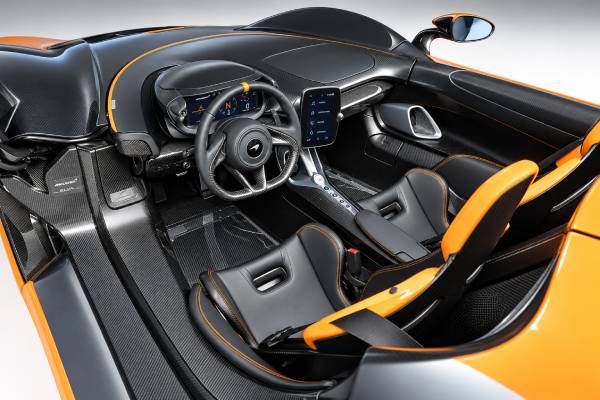
The McLaren Elva is an unusually focused Ultimate Series road car: a carbon-fibre, rear-wheel-drive two-seater built around the 3,994 cc M840TR twin-turbo V8 and, in its original form, no roof, windscreen, side windows, or rear screen. McLaren rated the engine at 815 PS, equivalent to 804 bhp, with 800 Nm of torque, while the lightest screenless specification was quoted at just 1,148 kg dry. Its defining feature is the Active Air Management System (AAMS), which redirects air over the cockpit instead of relying on a conventional windscreen. A fixed-windscreen derivative followed for markets and owners that wanted more physical protection. This guide covers the 2020–2023 assignment window, but buyers should not assume four separate model-year revisions: production began in late 2020, official service records concentrate mainly on 2021–2022 cars, and registration dates can differ from build dates. For any individual Elva, the VIN, build record, exact body configuration, software history, and completed campaigns matter more than the year printed in an advert.
Table of Contents
- What the Elva is and how the 2020–2023 range should be read
- McLaren Elva specifications and technical data
- AAMS and open-cockpit engineering
- Performance, braking, and road manners
- Maintenance, storage, and routine care
- Service campaigns and inspection points
- How to evaluate an Elva before purchase
What the Elva is and how the 2020–2023 range should be read
The Elva is a limited-production McLaren Ultimate Series speedster built around a carbon-fibre structure, the M840TR V8, and an exceptionally low-mass open cockpit. The main configuration split is not a yearly engine change but the choice between the original screenless AAMS car and the later fixed-windscreen version.
McLaren named the car after the lightweight McLaren-Elva sports racers of the 1960s. The modern car follows that idea more than it follows conventional grand-touring logic. Its body is formed from large carbon-fibre sections, the cabin is deliberately exposed, and the car uses a deployable rollover protection system rather than a roof structure. McLaren describes the screenless Elva as its lightest road car of the period, with a lightest dry figure of 1,148 kg and a DIN kerb figure of 1,269 kg.
The production story also needs context. The project was initially announced at a higher volume, but McLaren later stated that no more than 149 cars, with or without windscreens, would be specified and built to customer order. Production started in late 2020, and the windscreen version entered production in 2021. That makes simplistic year labels less useful than they are on a mass-market model. A car advertised as a 2022 or 2023 example may reflect a later delivery, registration, title, or local model-year convention rather than a new drivetrain specification.
The windscreen derivative changes the ownership experience more than the basic mechanical package. It keeps the same 4.0-litre twin-turbo V8 and comparable performance, but adds a heated glass screen in a carbon-fibre surround plus wipers, washers, and sun visors. AAMS is deleted because the physical screen performs the airflow-management role that the active system was created to address. McLaren targeted only about 20 kg of additional mass for this configuration. Neither version gains a roof, side windows, or a rear screen, so both remain weather-exposed cars that require more planning than a conventional convertible.
That distinction should guide both valuation and inspection. A screenless car should be checked carefully for correct AAMS operation, condition of the airflow surfaces, and the complete equipment supplied for open-cockpit use. A windscreen car instead brings glass, wiper, washer, sealing, and screen-mounting items into the inspection. Neither should be judged only by mileage, because storage conditions, battery support, heat cycles, software status, paint-protection work, tyre age, and carbon-fibre repairs can matter just as much on a low-use collector car.
McLaren Elva specifications and technical data
The Elva uses a 3,994 cc twin-turbocharged 90-degree V8 with dry-sump lubrication, a seven-speed Seamless Shift Gearbox, rear-wheel drive, double-wishbone suspension, and ProActive Chassis Control II. McLaren’s technical specification gives 815 PS/804 bhp, 800 Nm, 326 km/h, and 2.8 seconds from 0–100 km/h for the screenless reference specification.
| Item | Specification |
|---|---|
| Engine code | M840TR |
| Configuration | 90-degree V8, twin turbocharged |
| Displacement | 3,994 cc (4.0 L) |
| Induction | Twin electrically actuated twin-scroll turbochargers |
| Lubrication | Dry sump |
| Valve gear | 32-valve DOHC with variable valve timing |
| Maximum power | 815 PS / 804 bhp / 600 kW at 7,500 rpm |
| Maximum torque | 800 Nm (590 lb-ft) at 5,500 rpm |
| Maximum engine speed | 8,500 rpm |
| Transmission | 7-speed plus reverse Seamless Shift Gearbox (SSG) |
| Item | Specification |
|---|---|
| Drive layout | Mid-engine, rear-wheel drive |
| Front suspension | Double wishbone |
| Rear suspension | Double wishbone |
| Damping | Adaptive dampers |
| Chassis control | ProActive Chassis Control II |
| Differential | Open differential with Brake Steer |
| Stability systems | ABS, traction control, ESC |
| Performance aids | Launch Control and Variable Drift Control |
| Item | Specification |
|---|---|
| Front wheel | 19 × 9.0 J |
| Rear wheel | 20 × 11.0 J |
| Front tyre | 245/35 R19 |
| Rear tyre | 305/30 R20 |
| Original tyre family | Pirelli P Zero |
| Body structure | Bespoke carbon-fibre body structure with deployable ROPS |
| Length | 4,611 mm (181.5 in) |
| Width at widest point | 1,944 mm (76.5 in) |
| Height, doors closed | 1,088 mm (42.8 in) |
| Item | Specification |
|---|---|
| Lightest dry weight | 1,148 kg (2,531 lb) |
| DIN kerb weight | 1,269 kg (2,798 lb), fluids and 90% fuel |
| U.S. curb weight | 1,274 kg (2,809 lb), fluids and 100% fuel |
| Maximum speed | 326 km/h (203 mph) |
| 0–100 km/h | 2.8 s |
| 0–200 km/h | 6.8 s |
| 0–60 mph | 2.7 s |
| Quarter mile | 9.9 s |
| 100–0 km/h braking distance | 29.5 m (96.8 ft) |
| 200–0 km/h braking distance | 100 m (328 ft) |
| WLTP phase | Fuel consumption | CO2 |
|---|---|---|
| Low | 20.6 L/100 km | 468 g/km |
| Medium | 10.7 L/100 km | 242 g/km |
| High | 10.2 L/100 km | 231 g/km |
| Extra-high | 10.8 L/100 km | 246 g/km |
| Combined | 11.9 L/100 km | 270 g/km |
These are published reference figures rather than guarantees for every customer configuration. MSO personalisation, the windscreen package, equipment, fluids, tyre temperature, road surface, weather, and vehicle condition can alter mass or real-world performance.
AAMS and open-cockpit engineering
AAMS is the screenless Elva’s defining system: it takes air through the front of the car and redirects it upward ahead of the occupants to reduce the direct high-speed airflow entering the cabin. It improves comfort, but it is not a physical windscreen and should never be treated as protection from stones, insects, or other debris.
The engineering challenge is obvious once the roof and screen are removed. A conventional open car still relies on a windscreen to split and guide the oncoming air. The Elva’s original body instead uses a central intake and internal ducting to move part of that airflow through the nose. Air exits ahead of the cockpit, where an active carbon-fibre deflector rises into the flow. The resulting air curtain is intended to send the main stream over the driver and passenger while the exterior surfaces manage the rest around the cabin.
This is why the screenless Elva should be understood as an integrated aerodynamic system rather than simply a Spider with its glass removed. The nose opening, duct, outlet, deployable element, software, and surrounding body shape all have to work together. Damage, contamination, obstruction, or incorrect operation in that area deserves attention during a pre-purchase inspection. The system also has moving components in a region exposed to dirt and road debris, so careful cleaning is more appropriate than aggressive pressure washing around openings and mechanisms.
The driver can control AAMS rather than treating it as an invisible passive feature. Owner guidance describes system activation from the cabin and cautions users to keep hands and objects clear of the moving aero element. The same guidance makes an important practical point: AAMS manages airflow, not impacts. In an open cockpit, suitable eye protection is sensible even at moderate road speeds, and helmet requirements or recommendations can vary by market, road rules, event rules, and intended use.
The windscreen version solves the problem differently. McLaren removed AAMS and fitted a fixed heated screen with rain-sensing wipers, washer jets, and sun visors. The manufacturer said the target weight increase was only about 20 kg, and that the fundamental dynamic performance and structural stiffness remained comparable. For a buyer, the decision is therefore less about engine performance than about experience and operating environment. The screenless car delivers the purest version of the original concept; the windscreen car offers more protection and can be easier to use where local regulations make a bare cockpit difficult.
Performance, braking, and road manners
The Elva’s performance comes from combining 600 kW with very low mass, a fast seven-speed gearbox, and a chassis designed for immediate response rather than isolation. Its 2.8-second 0–100 km/h and 6.8-second 0–200 km/h claims show that the car’s real strength is sustained acceleration, not only a dramatic launch number.
The M840TR is related in broad architecture to other McLaren 4.0-litre twin-turbo V8 applications, but the Elva’s calibration, intake and exhaust installation, cooling package, and vehicle mass create a distinct result. Peak torque arrives at 5,500 rpm and peak power at 7,500 rpm, with an 8,500 rpm maximum engine speed. In practice, that spread means there is substantial mid-range force but still a reason to carry the engine toward the top of the rev range when conditions allow.
A seven-speed Seamless Shift Gearbox sends that output to the rear wheels. The Elva does not use an all-wheel-drive launch to disguise traction limits; tyre temperature, road cleanliness, and throttle application remain important. Launch Control can produce the headline acceleration in suitable conditions, but repeated standing starts add heat and load to tyres, driveline, brakes, and cooling systems. On a collector car with expensive age-sensitive consumables, reproducing a brochure number is rarely the most informative test of health.
ProActive Chassis Control II is central to the car’s character. The suspension uses double wishbones with adaptive damping and a hydraulically linked control strategy rather than relying only on conventional anti-roll hardware. The aim is to support the body under braking and cornering while preserving wheel control over imperfect surfaces. That gives the Elva a broader range than its appearance suggests, although its low body, wide tyres, exposed cockpit, and limited weather protection still define where it is comfortable to use.
The published stopping figures are as serious as the acceleration numbers: 29.5 m from 100 km/h and 100 m from 200 km/h. The car’s carbon-ceramic braking system is designed for high thermal capacity, but ceramic hardware does not remove the need for inspection. Disc surface condition, chips at the edges, pad thickness, sensor wiring, fluid age, and evidence of track heat all matter. A car that has covered few road miles can still have consumed meaningful brake life if those miles included repeated high-energy stops.
Tyres deserve the same caution. The original sizes are 245/35 R19 front and 305/30 R20 rear, and McLaren specified Pirelli P Zero tyres in the technical sheet. Matching size alone is not enough on a car this fast. Confirm the exact approved tyre specification, speed/load rating, manufacture dates, tread condition, sidewall condition, and whether all four tyres have been heat-cycled or stored correctly. Old tyres can look visually excellent on a garage-kept car while delivering significantly less grip than their tread depth suggests.
Maintenance, storage, and routine care
An Elva should be maintained by schedule, condition, and manufacturer procedure rather than by mileage alone. Low annual use does not stop engine oil, brake fluid, tyres, battery condition, seals, software, and corrosion-prone interfaces from ageing.
The first rule is to follow the service information linked to the specific VIN and market. A hand-built limited model can receive technical updates or campaign instructions during its life, and a workshop should check these before treating it as an ordinary low-mileage McLaren. Ask for invoices, digital or paper service history, campaign records, software updates, and documentation of any work performed by McLaren Special Operations or an authorised repair centre.
Engine oil deserves regular attention even when the car is not driven far. The dry-sump system means level checking is procedure-sensitive; it should not be guessed from a cold car that has been standing. Owner instructions use a controlled warm-engine process and the driver display to obtain a valid reading. If the owner is unfamiliar with that process, the correct response is to consult the vehicle handbook for the VIN/market or have a McLaren technician demonstrate it, not to add oil until an arbitrary dipstick-style level is reached.
Storage is a major part of maintenance. These cars often spend long periods indoors, which can be benign if the environment and battery support are correct. A compatible battery conditioner, clean and dry storage, moderate temperature and humidity, and periodic inspection for fluid leaks or pest activity are more useful than simply starting the engine briefly in a garage. Short stationary runs may not bring all fluids fully to operating temperature and can add condensation or repeated cold-start wear without giving the car the exercise it needs.
Brake maintenance should account for time as well as wear. Brake fluid absorbs moisture over time, and a low-mileage car still needs fluid service according to McLaren’s schedule. Carbon-ceramic discs should be inspected for damage using the manufacturer’s criteria rather than judged by ordinary iron-disc habits. Pad sensors and wheel-speed wiring also deserve visual inspection, particularly because McLaren issued an Elva campaign concerning clearance near the rear wheel-arch liner on certain cars.
Cooling and heat management are important around the M840TR. Check coolant level only by the prescribed procedure, inspect visible hoses and reservoirs for staining, and investigate any sweet smell, persistent fan activity, temperature warning, or dried residue. The engine bay contains tightly packaged hot-side turbo and exhaust components; heat shields, clips, and harness routing should be intact. One Elva service campaign specifically addressed possible engine wiring-harness contact with an adjacent exhaust heat shield, so routing should be confirmed rather than casually assumed correct.
Service campaigns and inspection points
Public McLaren communications filed with NHTSA show several Elva-specific service campaigns that are useful during inspection, including software, engine-harness routing, and rear wheel-arch liner work. These documents do not mean every Elva is affected, and a manufacturer service campaign is not automatically the same thing as a safety recall.
| Campaign/document | Date | What it addressed | Buyer check |
|---|---|---|---|
| Install Platform 4.3, SCB 26 M 001 | 24 June 2021 | Software updates covering HVAC fault detection, suspension-control messaging, instrument-cluster behaviour, ADI display behaviour, and body-controller logic | Confirm current software level and campaign completion in retailer records |
| Engine Wiring Harness Routing Inspection and Rework, SCB 26 F 001 | 4 November 2021 | Potential contact between engine wiring-harness sleeving and a neighbouring exhaust heat shield | Verify inspection/rework status and examine the area for heat or abrasion damage |
| Rear Wheel Arch Liner Rework, SCB 26 A 010 | 20 January 2022 | Possible insufficient clearance between the inboard rear liner and brake-pad sensor wiring, wheel-speed sensor wiring, or brake hose under suspension bump | Confirm whether the VIN was listed and whether the prescribed liner rework was completed |
The software campaign is a good example of why a clean dashboard during a five-minute showroom visit is not enough. Platform 4.3 included corrections for several behaviours, one of which involved a “Suspension Control Unavailable” message and another an occasional blank Active Dynamics Interface display. A buyer should ask an authorised retailer to confirm the installed software and any outstanding updates for the actual VIN. That is more reliable than deciding that a car is current because no warning appears at the moment.
The engine-harness campaign is mechanically more tangible. McLaren documented the possibility that an engine wiring harness could contact a nearby exhaust heat shield and damage its insulation sleeve. The campaign called for inspection of routing, clips or ties, clearance, and rework where necessary. On a pre-purchase inspection, evidence of scorched sleeving, chafing, non-standard ties, disturbed shielding, or improvised routing should prompt closer examination even if the car has no fault code.
The rear wheel-arch campaign concerned specific VINs rather than the entire population. McLaren identified a possibility that the inner rear liner could sit too close to brake-pad sensor wiring, wheel-speed sensor wiring, and a brake hose during suspension movement. The prescribed action involved trimming/reworking the carbon liner to achieve clearance. A technician inspecting a car should check that any required work looks deliberate and documented, not confuse a factory-directed modification with accidental damage, and still inspect the adjacent hose and wiring for marks.
Recall checking needs a two-part approach. NHTSA explains that its VIN search can show unrepaired safety recalls for participating manufacturers, but also notes that some small-volume manufacturers, specialty applications, completed recalls, international vehicles, and manufacturer customer-service campaigns may not appear in the same way. For an Elva, use the public database where applicable and separately ask a McLaren retailer to query the VIN for outstanding recalls, service campaigns, software actions, and market-specific bulletins.
How to evaluate an Elva before purchase
The safest way to buy an Elva is to inspect the exact car as a unique specification, verify its VIN history with McLaren, and commission a specialist pre-purchase inspection that includes composite structure, software, campaigns, tyres, brakes, hydraulics, and open-cockpit equipment. Mileage and cosmetic presentation should be secondary to provenance and condition.
Start with identity. Match the VIN on the car to the title/registration documents, service invoices, build sheet, and retailer record. Ask for the original specification, including MSO options and whether the car left the factory as screenless or windscreen-equipped. Because build, delivery, registration, and advertised model year may not align, record all four rather than trying to force the car into a simple annual-change narrative.
Then establish the body configuration and inspect the systems that follow from it. On a screenless car, cycle AAMS according to the proper procedure, check that the moving element deploys cleanly, and inspect the intake, duct outlet, surrounding carbon, and mechanism for damage or contamination. On a windscreen car, inspect the heated glass, carbon surround, wipers, washers, rain-sensing function, and visible seals. On either version, remember that the absence of a roof makes water exposure history relevant. Musty trim, tide marks, corroded fasteners, intermittent switchgear, or unexplained electronic faults deserve investigation.
Carbon-fibre inspection should be done under strong, even light and, where needed, with the underbody accessible. Look for impact marks, cracks, resin whitening, delamination clues, mismatched weave, overspray, altered fasteners, or paint/film edges that suggest prior repair. Cosmetic carbon parts can be replaced, but repairs involving the body structure or suspension mounting areas require documentation from a qualified repairer. An ordinary paint-depth gauge alone cannot establish the integrity of a composite structure.
Next, evaluate age-sensitive consumables. Record tyre date codes, approved specification, tread, sidewalls, pressure history if available, and signs of flat spotting. Inspect carbon-ceramic discs and pads using McLaren criteria and check sensor wiring. Review brake-fluid age and any track-use history. The car’s capability makes a low odometer reading compatible with high thermal use, so condition should overrule assumptions.
A cold start is more revealing than seeing the car already warmed. With seller permission and the correct procedure, observe initial warning lights, idle stability, smoke, unusual mechanical noise, fluid leaks, and whether faults remain after systems complete their checks. During the road test, assess gearbox take-up, shift quality, steering assistance, suspension response, brake feel, cooling behaviour, and warning messages. Use enough road variety to find intermittent issues, but there is no need to approach the car’s performance limits to establish basic health.
Have the retailer or specialist run diagnostic checks and confirm software. Ask specifically about Platform 4.3 or later applicable software, the engine-harness routing campaign, the rear wheel-arch liner campaign, and any additional actions tied to that VIN and market. Do not assume a U.S. public database is complete for a car that lived elsewhere. If a campaign is shown as complete, documentation should identify when and where it was performed.
A well-documented Elva offers something few modern road cars attempt: very high performance with almost no physical barrier between the occupants and the environment. That purity also creates its ownership obligations. The strongest example is not necessarily the lowest-mileage or most vividly specified one; it is the car whose identity, configuration, campaign status, maintenance, composite condition, and storage history can all be explained without gaps.
References
- McLaren Elva – Powerful Roadster & Lightest McLaren Road Car | McLaren Automotive, 2026 (official model page).
- McLaren Elva, 2020 (technical specification).
- McLaren Elva – Install Platform 4.3, 2021 (service campaign SCB 26 M 001).
- McLaren Elva – Engine Wiring Harness Routing Inspection and Rework, 2021 (service campaign SCB 26 F 001).
- McLAREN ELVA REAR WHEEL ARCH LINER REWORK, 2022 (service campaign SCB 26 A 010).
- Check for Recalls: Vehicle, Car Seat, Tire, Equipment | NHTSA, 2026 (recall and manufacturer-communication database).
Disclaimer
This article is for general informational purposes only and is not a substitute for professional diagnosis, repair, inspection, or manufacturer service information. Specifications, software, torque values, service intervals, procedures, equipment, and campaign applicability can vary by VIN, market, build configuration, and later technical updates. Verify all work against the current official McLaren service documentation for the exact vehicle and use a qualified McLaren technician where appropriate. If this guide is useful, share it with another Elva owner or buyer who wants a more careful technical reference.