


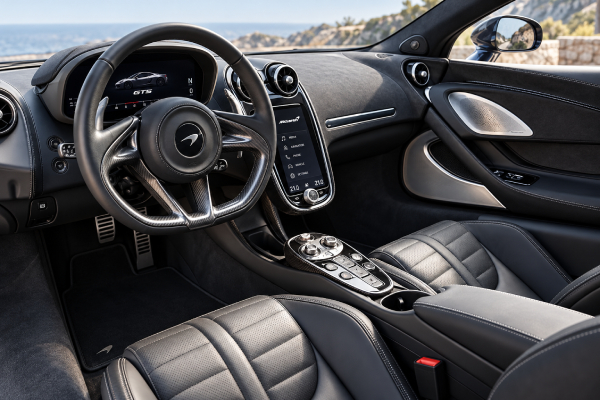
The McLaren GTS is the more usable side of a modern McLaren without giving up the layout or responses that make the brand distinctive. Introduced for 2024 as the successor to the McLaren GT, it keeps the P22 architecture and M840TE 4.0-liter twin-turbo V8 but raises output to 635 PS (626 bhp), trims weight, sharpens several chassis systems, and retains unusually generous luggage space for a mid-engine supercar. It is still rear-wheel drive, still uses a seven-speed Seamless Shift Gearbox, and still puts a carbon-fiber MonoCell II-T at the center of the car.
The important ownership point is that the GTS is not simply a softer supercar. Its carbon-ceramic brakes, low-profile staggered tires, specialist servicing, and limited-production electronics demand the same care as more overtly track-focused McLarens. This guide covers the exact 2024-present GTS, including its technical data, driving hardware, practical strengths, maintenance schedule, documented campaigns, and the checks that matter before buying.
Table of Contents
- Where the GTS Fits and What Changed
- McLaren GTS Specifications and Technical Data
- Performance and Chassis Engineering
- Cabin, Cargo, and Daily Usability
- Maintenance and Service Planning
- Campaigns, Reliability, and Inspection Points
- Buying a New or Used McLaren GTS
Where the GTS Fits and What Changed
The GTS is an evolution of the McLaren GT rather than a clean-sheet replacement. That matters because buyers get a familiar, mature P22 package with meaningful revisions instead of an entirely new powertrain or electrical architecture.
McLaren revealed the GTS in December 2023 for 2024 delivery. It replaced the GT in the grand-touring position of the road-car range, and McLaren continues to list the GTS as its current Grand Tourer. Depending on market, registration timing, and local model-year conventions, early cars may be described differently, but the covered generation is the 2024-onward GTS; current 2026 examples confirm that production has continued through the present model year.
The basic recipe stayed deliberately recognizable. The longitudinally mounted M840TE V8 remains behind the passenger cell, driving only the rear wheels through a seven-speed dual-clutch SSG transmission. The MonoCell II-T carbon-fiber monocoque and carbon-fiber rear upper structure continue to provide the stiffness and packaging needed for both a mid-engine layout and the large rear luggage bay.
The changes are concentrated where they produce a useful difference. Engine output rose by 15 PS over the outgoing GT to 635 PS, or 626 bhp, at 7,500 rpm. McLaren attributes the increase to greater crankshaft torque enabled by revised combustion phasing and ignition timing. DIN weight fell by 10 kg to 1,520 kg, giving a claimed 418 PS per tonne. The 0–200 km/h time improved to 8.9 seconds, while 0–100 km/h remains 3.2 seconds and maximum speed is 326 km/h (203 mph).
There are also chassis and usability revisions that are easy to overlook on a spec sheet. Steering calibration, adaptive damping, and the carbon-ceramic braking system were tuned specifically for the GTS. The nose-lift system raises the underbody clearance from 110 mm to 130 mm and completes the movement in about four seconds, more than twice as quickly as the previous GT system. Revised front intakes and taller rear-fender scoops improve cooling airflow, while new wheel designs and trim choices distinguish the newer car visually.
For a buyer, the result is best understood as a refined final form of the GT concept: more power and response, but without sacrificing the 570 liters of combined front and rear luggage capacity that gives the car its unusually broad operating range.
McLaren GTS Specifications and Technical Data
The GTS is a conventional gasoline ICE vehicle: there is no traction motor, high-voltage battery, or external charging system. Its engineering centers on a 3,994 cc twin-turbo V8, seven-speed dual-clutch transmission, rear-wheel drive, adaptive double-wishbone suspension, and a carbon-fiber passenger structure.
| Specification | Value |
|---|---|
| Engine | M840TE 4.0-liter twin-turbocharged V8 |
| Displacement | 3,994 cc |
| Induction | Twin electrically actuated twin-scroll turbochargers |
| Lubrication | Dry-sump system |
| Maximum power | 635 PS (626 bhp / 467 kW) at 7,500 rpm |
| Maximum torque | 630 Nm (465 lb-ft) at 5,500–6,500 rpm |
| Transmission | 7-speed + reverse Seamless Shift Gearbox (SSG), dual clutch |
| Drive | Rear-wheel drive |
| Differential | Open differential with McLaren Brake Steer assistance |
| Specification | Value |
|---|---|
| 0–60 mph | 3.1 seconds |
| 0–100 km/h (0–62 mph) | 3.2 seconds |
| 0–200 km/h (0–124 mph) | 8.9 seconds |
| Quarter mile | 11.0 seconds |
| Top speed | 326 km/h (203 mph) |
| 100–0 km/h braking | 32 m (105 ft) |
| 200–0 km/h braking | 127 m (417 ft) |
| EU WLTP combined fuel consumption | 11.9 L/100 km |
| EU WLTP combined CO₂ | 270 g/km |
| Fuel tank | 72 L (19 US gal) |
| Specification | Value |
|---|---|
| Body structure | Carbon-fiber MonoCell II-T monocoque with carbon-fiber rear upper structure |
| Front suspension | Aluminum double wishbones with adaptive dampers |
| Rear suspension | Aluminum double wishbones with adaptive dampers |
| Damping system | Proactive Damping Control; Comfort, Sport, and Track modes |
| Steering | Electro-hydraulic power assistance |
| Front brakes | 390 mm carbon-ceramic discs, six-piston aluminum calipers |
| Rear brakes | 380 mm carbon-ceramic discs, four-piston aluminum calipers |
| Standard wheel sizes | 20 × 8.0 in front; 21 × 10.5 in rear, forged alloy |
| Front tires | 225/35 R20 |
| Rear tires | 295/30 R21 |
| Specification | Value |
|---|---|
| Body style | 2-door, 2-seat mid-engine coupe |
| Length | 4,683 mm (184.4 in) |
| Width, excluding mirrors | 2,045 mm (80.5 in) |
| Height | 1,213 mm (47.8 in) |
| Wheelbase | 2,675 mm (105.3 in) |
| Lightest dry weight | 1,466 kg (3,232 lb) |
| DIN kerb weight | 1,520 kg (3,351 lb) |
| Ground clearance | 110 mm; 130 mm with vehicle lift raised |
| Front luggage capacity | 150 L |
| Rear luggage capacity | 420 L |
| Item | Published reference |
|---|---|
| Scheduled service interval | Every 12 months or 15,000 km (9,000 miles), whichever comes first |
| Service 1 | 1 year or 15,000 km (9,000 miles) |
| Service 2 | 2 years or 30,000 km (18,000 miles) |
| Service 3 | 3 years or 45,000 km (27,000 miles) |
| Annual service content | Engine oil and filter, cabin filter, and engine air filter |
| Service 2 additional content | Brake fluid and key-fob batteries |
| Standard vehicle warranty | 3 years, unlimited mileage |
These figures should be treated as configuration-specific reference data, not permission to substitute generic workshop values. McLaren changes equipment and service content by region, model year, and VIN, so fluid specifications, capacities, tightening torques, tire pressures, and detailed procedures should come from the handbook or service information for the individual car.
Performance and Chassis Engineering
The defining engineering feature of the GTS is not its 626 bhp alone; it is the combination of that output with low mass, rear-wheel drive, hydraulic steering assistance, and a chassis calibrated to work on ordinary roads. The car is fast enough to operate in full supercar territory, but its hardware is intentionally less single-purpose than a track-led model.
The M840TE V8 delivers 630 Nm from 5,500 to 6,500 rpm and makes peak power at 7,500 rpm. That relatively high power peak encourages the driver to use the upper rev range, while the twin-turbo arrangement provides the mid-range thrust needed for overtaking and long-distance driving. Launch Control is standard, but the more relevant road characteristic is that the SSG can behave very differently depending on mode. Comfort favors smooth, early shifts; Sport increases urgency and uses ignition-cut strategies for faster changes; Track minimizes torque interruption further.
McLaren did not replace the GTS’s open differential with a heavy mechanical limited-slip unit. Instead, Brake Steer can apply braking to the inside rear wheel to help the car rotate and reduce understeer. That solution fits the company’s emphasis on mass reduction and steering response, although it also means tire condition, brake condition, and correct stability-control operation are central to how the car behaves at the limit.
The suspension is equally important. The GTS uses conventional anti-roll bars with aluminum double wishbones and continuously variable dual-valve adaptive dampers. That is different from the hydraulically cross-linked suspension architecture used on some more extreme McLarens. Proactive Damping Control adjusts the dampers using control software that evaluates vehicle behavior and road inputs, with Comfort, Sport, and Track settings changing the balance between compliance and body control.
For road use, Comfort is not merely a soft setting. It allows the lightweight structure and long-travel-for-a-supercar suspension to absorb broken surfaces without isolating the driver from what the front tires are doing. Sport is the logical fast-road setting when the surface is good; Track is better reserved for smooth roads or circuit use because the increased damping control can make poor surfaces more abrupt.
The electro-hydraulic steering deserves attention because it is increasingly unusual. Electric assistance dominates the wider market, but the GTS retains hydraulic feel while increasing assistance at low speeds for parking. That gives the car a useful split personality: light enough to maneuver in town, yet detailed enough to communicate load and grip once speed rises.
Standard carbon-ceramic brakes reinforce the same dual-purpose theme. The 390 mm front and 380 mm rear discs provide exceptional heat capacity and help reduce unsprung mass, but they are expensive components. A buyer should not judge them only by whether the car stops straight. Chips around disc edges, abnormal surface condition, uneven pad wear, or evidence of impact require specialist assessment because carbon-ceramic replacement costs can be substantial.
The staggered 20-inch front and 21-inch rear wheel package uses much narrower front tires than rear tires. That geometry is part of the car’s steering character and traction balance, so changing tire model, mixing axle pairs, or fitting non-approved sizes can alter the way Brake Steer, stability control, and damping calibration feel. Correct matching tires matter more here than chasing the lowest replacement price.
Cabin, Cargo, and Daily Usability
The GTS is unusually practical for a two-seat, mid-engine car because its carbon structure was designed around luggage space rather than having storage added as an afterthought. The 150-liter front compartment and 420-liter rear bay provide 570 liters in total, although the shape and heat exposure of the rear area matter as much as the headline volume.
The rear luggage bay sits above and behind the engine and is accessed through a large front-hinged glass tailgate with soft-close operation. It works well for garment bags, soft luggage, helmets, or long, shallow items. Heat-sensitive objects are better placed in the front compartment, especially after sustained high-load driving. The front space is deeper and more isolated from the powertrain but, like most supercar luggage compartments, rewards soft-sided bags rather than rigid suitcases.
Visibility is another part of the GTS brief. A low scuttle and narrow forward structure make the front corners easier to place than the shape suggests, while the glazed C-pillars and rear quarter areas improve the view through the back of the cabin. At 2,045 mm wide before mirrors, narrow spaces and curbs still demand care.
The vehicle-lift system addresses the other obvious usability problem. Standard underbody clearance is about 110 mm, rising to 130 mm when the nose is lifted. The GTS system completes the raise or lower cycle in roughly four seconds, which makes it practical to use for ramps, speed humps, and steep garage entrances rather than something owners are tempted to ignore because it is slow. Before buying, operate the system repeatedly and check for warning messages or uneven movement.
Inside, the GTS mixes familiar McLaren controls with a grand-touring specification. A 10.25-inch driver display works with a 7-inch central touchscreen, and the cabin keeps physical controls where they matter. Comfort seats and leather trim suit the car’s mission, while Performance and TechLux themes change materials and presentation rather than the engine or basic chassis.
Options can materially change both the atmosphere and future desirability of a used example. The panoramic electrochromic roof adds light and can vary its tint, while the standard composite roof is lighter. A Bowers & Wilkins audio system, sports exhaust, carbon-fiber trim packs, and different forged wheel designs appear frequently on highly specified cars. None transforms the core performance, so buyers should prioritize condition and service history over a long options list.
One practical detail is easy to miss: the GTS uses dihedral doors. They need less side clearance at lower-door level than a conventional long coupe door, but they need clear space above and around the hinge path. Test them in the garage or parking environment where the car will actually live. The same applies to the tailgate; confirm that it can open fully beneath shelves, low ceilings, or automated garage doors.
Maintenance and Service Planning
A GTS should be maintained by time as seriously as by mileage. McLaren’s published factory service-plan terms specify service every 12 months or 15,000 km (9,000 miles), whichever comes first, which is especially relevant because many examples cover very low annual mileage.
The first three scheduled services are defined at one year/15,000 km, two years/30,000 km, and three years/45,000 km. In the published plan, engine oil and filter, cabin filter, and engine air filter are included in the annual service content; the second service also includes brake fluid and key-fob batteries. Regional service-plan eligibility and exact included items can change, so the car’s own service record and current retailer information take precedence.
For a lightly used car, age-related maintenance can be more important than odometer distance. Brake fluid absorbs moisture even if the car is rarely driven. Tires age, flatten during storage, and can develop cracking or hardening long before the tread is worn out. A battery can discharge far enough to create access or electronic problems. Engine oil still sees condensation, fuel dilution, and additive aging. Skipping an annual service because a car covered only a few thousand miles is therefore poor economy.
A sensible owner routine between scheduled services includes:
- Check tire pressures cold and inspect the inner as well as outer shoulders for cuts, bubbles, punctures, or abnormal wear.
- Keep the car on a suitable manufacturer-approved battery maintainer when it will sit for an extended period, following the handbook procedure for the fitted battery type.
- Inspect the front splitter, underbody edges, wheel faces, and brake discs after unfamiliar ramps or poor roads.
- Keep the radiator and intake openings free of leaves and road debris without using aggressive pressure washing near vulnerable components.
- Exercise the vehicle lift, tailgate, door latches, windows, climate control, cameras, and infotainment regularly so a weak battery or intermittent actuator is identified before a trip.
- Record every service, campaign, tire replacement, alignment, and repair invoice; documentation materially improves confidence when the car is sold.
Carbon-ceramic brakes deserve their own maintenance mindset. They can last a long time in road use, but visual condition and measured wear matter more than mileage alone. Track use changes the equation because repeated high-temperature cycles can consume pads and discs much faster. If a car has circuit history, ask for brake measurements and invoices rather than accepting the phrase “ceramics last forever.”
Alignment is another area where specialist attention pays. A supercar can drive acceptably while still wearing the inner shoulders of expensive tires rapidly. Any steering pull, off-center wheel, vibration, or uneven tread should lead to a geometry check after confirming that wheels are straight and tires are sound. Correct ride height and suspension calibration should be verified before attempting to cure symptoms with alignment alone.
McLaren gives the GTS a three-year unlimited-mileage vehicle warranty. Warranty terms, extensions, additional coverage, and service plans vary by country, so a used buyer should confirm the remaining coverage against the VIN rather than assuming that an advertisement accurately describes what transfers to the next owner.
Campaigns, Reliability, and Inspection Points
The GTS is still too new for a mature long-term failure pattern to be established across high-mileage cars. The strongest evidence available today is therefore the documented service campaigns and recall material, which should be checked by VIN instead of being treated as proof that every GTS has the same defect.
In October 2024, McLaren issued a service campaign covering certain 750S and GTS vehicles for the rear displacement-sensor ball stud. The concern was inconsistent fitment; affected cars were to be inspected, the ball stud re-torqued if required, and the adaptive damper system calibrated when necessary. On a used GTS, the practical check is documentation that any VIN-specific campaign has been completed, not a visual guess from underneath the car.
A separate April 2025 GTS campaign addressed the bonnet latch and a wheel-arch-liner bracket. McLaren’s bulletin states that a flat 12-volt battery could inhibit manual bonnet opening on some vehicles. The remedy uses an updated latch and bracket. This is particularly relevant to cars that spend long periods stored, because access to the front compartment can become important when the low-voltage battery is depleted.
The U.S. NHTSA recall record 25V-216 is narrower but more safety-critical. It covered 29 potentially involved vehicles across several 2020–2025 McLaren model lines, including the GTS; the report gives combined production dates from April 17, 2019 to July 9, 2024. The issue was incorrect routing of rear brake pipes into the ABS/ESP hydraulic control module, which could cause the system to brake the opposite rear wheel during an intervention and increase the risk of loss of control. The tiny population is exactly why a VIN lookup matters: the existence of the recall does not mean all GTS cars are affected.
Beyond campaigns, inspect a GTS as a low-volume carbon-chassis supercar, not as a conventional luxury coupe. A pre-purchase inspection should include these areas:
- Service and campaign history: Match dates, mileage, invoices, and retailer records. Check for open recalls and campaigns using the VIN.
- Carbon and bodywork: Look for impact marks beneath the front, damage around jacking points, mismatched paint, poor panel alignment, or repair evidence. Carbon-structure repairs require specialist methods.
- Wheels and tires: Check all four forged wheels for bends or curb damage and confirm a coherent set of correctly sized, suitably rated tires. Inspect date codes as well as tread depth.
- Brakes: Have carbon-ceramic discs and pads assessed for condition and wear, especially if the car has track use or visible heat stress.
- Suspension and lift: Test every damping mode, the nose lift, and low-speed steering. Warning messages, knocking, uneven ride height, or calibration faults need diagnosis.
- Electrical operation: Start with a fully charged battery and test doors, bonnet release, tailgate, windows, cameras, infotainment, climate control, seat functions, and every key supplied with the car.
- Cold and hot behavior: A specialist inspection should include a cold start, full warm-up, road test, and post-drive scan for stored diagnostic codes or leaks.
Do not confuse a clean dashboard with a clean diagnostic history. Low-volume cars can store intermittent faults without leaving a permanent warning visible to the driver. A McLaren-capable diagnostic scan, combined with a physical inspection, is more valuable than a generic code reader.
Buying a New or Used McLaren GTS
The best GTS to buy is the one with verifiable history, correct maintenance, clean structural condition, and the options you will actually use. Color and trim matter in this market, but they should come after mechanical and documentary quality.
Start by confirming what the car actually is. The GTS uses the P22 family architecture and M840TE V8, but advertisements sometimes mix GT and GTS terminology or quote 635 “hp” when the manufacturer figure is 635 PS/626 bhp. Check the VIN, model year, registration date, and factory build specification. In markets where model-year naming differs from calendar-year delivery, do not reject a car solely because its paperwork does not follow another country’s convention.
Next, separate appearance themes from hardware. Performance and TechLux specifications mainly change cabin materials and presentation. The powertrain remains the same 626 bhp V8. Similarly, the optional Turbine forged wheels, sports exhaust, visual carbon packages, and electrochromic roof affect look, sound, weight, or ambience rather than creating a faster mechanical variant.
For frequent road use, several features are worth prioritizing for practical reasons. A functioning vehicle lift reduces anxiety around steep ramps. Front and rear parking assistance and a clear rear camera help with the car’s width. A panoramic roof brightens the cabin, while the lighter standard roof may appeal to buyers who value the purest specification. The upgraded audio system makes more sense for long-distance use than for owners who mainly drive on short, high-intensity routes.
When comparing used cars, mileage alone is a weak ranking tool. A 3,000-mile car that has missed time-based services, sat on old tires, suffered repeated battery discharge, or received cosmetic repairs can be a poorer purchase than a 12,000-mile car with annual retailer history and regular exercise. Low mileage is valuable only when storage and maintenance were equally careful.
Ask the seller for the service invoices before you travel to view the car. Confirm the date of the last annual service, brake-fluid history, tire age, any wheel refinishing, alignment work, battery replacement, paintwork, insurance repairs, and campaign completion. If the seller cannot provide documents, obtain authorization for a retailer or recognized McLaren specialist to inspect the car and read its diagnostic history.
Also budget beyond the purchase price. The GTS consumes premium fuel at a rate consistent with a 626 bhp twin-turbo V8, and 20/21-inch performance tires are not inexpensive. Carbon-ceramic brake replacement, damaged forged wheels, glass, body panels, lift-system repairs, and specialist labor can turn a small purchase-price saving into a poor trade. Insurance, secure storage, paint-protection choices, and transport to a qualified service center may be significant depending on where the car lives.
For buyers choosing between a late GT and a GTS, the GTS offers the stronger factory output, lower official DIN weight, faster 0–200 km/h time, quicker nose lift, newer styling details, and later production. A well-kept GT can still deliver much of the same architecture and luggage concept for less money, but the GTS is the more developed version of the P22 idea. That distinction is worth paying for when the price difference is reasonable and both cars are equally strong on condition and history.
Finally, treat the test drive as confirmation rather than entertainment. The car should start cleanly, track straight, shift smoothly in Comfort, become noticeably more urgent in Sport and Track, hold stable temperatures, brake without vibration, and complete the drive without warning messages. Once it is fully warm, recheck for odors, leaks, fan behavior, and stored faults. A GTS that passes those checks and has complete documentation offers something rare: genuine McLaren steering and supercar performance with enough ride quality and luggage space to make long journeys part of the ownership plan rather than an exception.
References
- McLaren GTS – Interior, Specs, Top Speed, HP, 0-60, Engine 2026
- Grand Tourer 2026
- Factory Service Plan 2026
- McLaren 750s, McLaren GTS – Displacement Sensor Ball Stud Check 2024 (Service Campaign)
- Microsoft Word – SCB 22 A 002 – McLaren GTS – Bonnet Latch and Wheel Arch Liner Replacement 2025 (Service Campaign)
- Part 573 Safety Recall Report — 25V-216 2025 (Recall Database)
Disclaimer
This article is for informational purposes only and is not a substitute for professional diagnosis, inspection, or repair. Specifications, torque values, service intervals, procedures, warranty terms, and campaign applicability can vary by VIN, market, model year, and equipment. Verify all work and vehicle-specific data against the current official McLaren handbook, service documentation, and retailer information for the exact car.
If you found this guide useful, please consider sharing it on Facebook, X/Twitter, or another platform to support our work.