


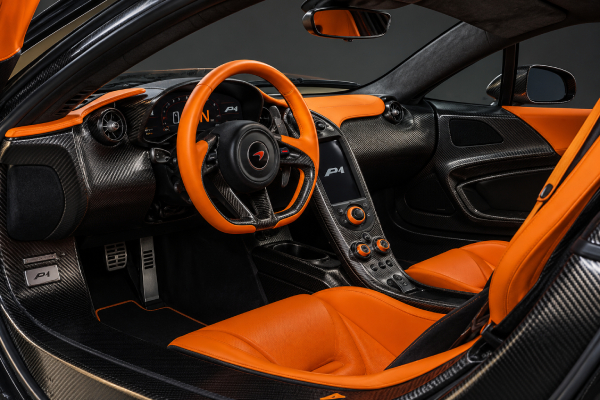
The McLaren P1 (P12) is a rear-wheel-drive plug-in hybrid hypercar built around a carbon-fibre MonoCage, a 3.8-litre twin-turbo M838TQ V8, and a single high-output electric motor. McLaren rated the combined system at 916 PS (903 bhp) and 900 Nm, but the headline numbers explain only part of the car. The electric system was designed mainly to sharpen response and add power, while active aerodynamics and the hydraulic RaceActive Chassis Control system were engineered to make the P1 work on both public roads and a circuit. Production ran from 2013 to 2015 and was limited to 375 road cars, making condition, history, and correct specialist care especially important today. This guide focuses on the production road-going P1, not the later track-only P1 GTR or subsequent conversions. It covers verified specifications, how the hybrid hardware works, performance, maintenance and storage needs, and the checks that matter most when evaluating a car to buy.
Table of Contents
- Model scope and production
- P1 specifications and technical data
- How the hybrid system delivers performance
- Aerodynamics, chassis, and braking
- Maintenance, battery care, and storage
- Buying inspection, provenance, and recalls
- What ownership demands in practice
Model scope and production
The road-going P1 covered here is the 375-car production model built from 2013 to 2015, with the P12 development code and the M838TQ petrol-electric powertrain. It should not be mixed with the P1 GTR, P1 LM, or later specialist conversions, because those cars can have different power, chassis settings, bodywork, and road-registration status.
McLaren developed the P1 as a technology-led successor in spirit to the F1, but its engineering solution was very different. Instead of relying on a large naturally aspirated engine and extreme lightness alone, the P1 used a heavily revised version of McLaren’s 3.8-litre twin-turbo V8 together with a compact electric motor. The motor was not treated as a fuel-saving accessory. Its instant torque was used to fill the response gap that can occur while large turbochargers build boost, making the combined powertrain react more like a very large naturally aspirated engine.
The P1 is properly classified as a plug-in hybrid electric vehicle, or PHEV. It has a traction battery, an electric motor capable of driving the car on its own, an external charging connection, and an official electric-driving range. That matters when comparing it with other early-2010s hybrid hypercars: the P1 can be plugged in and can run in an E-mode, while its hybrid system is also integral to full-performance operation.
The production car remained a two-seat coupé throughout the run. McLaren completed the 375th and final road P1 before P1 GTR production began, so a claimed “road P1” should have documentation consistent with the original limited series. For collectors, chassis identity, factory specification, original paint and trim records, and documented McLaren Special Operations work can matter as much as mileage.
Year labels also need context. The assignment scope is 2013–2015, reflecting the road car’s production period, while registration and model-year conventions differ by market. In the United States, official recall material commonly identifies affected P1s as 2014–2015 model-year cars. A buyer should therefore use the VIN and factory build record rather than assuming a car’s legal model year from its build date alone.
P1 specifications and technical data
The P1 combines a mid-mounted 3,799 cc twin-turbo V8 with one electric motor, a lithium-ion traction battery, a seven-speed dual-clutch transmission, and rear-wheel drive. Its battery is small by modern PHEV standards because the system was optimized for rapid power delivery, low mass, and repeatable performance rather than long electric range. The same philosophy carries through the carbon structure, active aerodynamics, hydraulic chassis control, and bespoke braking system.
| Specification | Value |
|---|---|
| Powertrain type | Plug-in hybrid; petrol V8 plus one electric traction motor |
| Engine code | M838TQ |
| Engine | 3,799 cc (3.8L) twin-turbocharged V8, dry-sump lubrication |
| Petrol-engine output | 737 PS (727 bhp / 542 kW) at 7,500 rpm |
| Petrol-engine torque | 720 Nm (531 lb-ft) from 4,000 rpm |
| Electric-motor output | 179 PS (176 bhp / 131 kW) |
| Electric-motor torque | 130 Nm at the motor; 260 Nm effective through its gearing |
| Combined system output | 916 PS (903 bhp) |
| Combined system torque | 900 Nm (664 lb-ft) |
| Traction battery | 4.7 kWh lithium-ion, 324 cells in six modules |
| Battery-pack weight | 96 kg (212 lb) |
| Battery location | Behind the cabin, within the MonoCage structure |
The quoted 903 figure is McLaren’s 903 bhp value, paired with 916 PS. It is often written simply as “903 hp” in listings and enthusiast material, but PS, bhp, and metric-to-imperial horsepower labels are not perfectly interchangeable. For identifying this assignment’s variant, 903 hp is the accepted shorthand; for technical work, use the manufacturer’s stated units.
| Specification | Value | Standard or condition |
|---|---|---|
| 0–100 km/h (0–62 mph) | 2.8 seconds | Manufacturer figure |
| 0–200 km/h (0–124 mph) | 6.8 seconds | Manufacturer figure |
| 0–300 km/h (0–186 mph) | 16.5 seconds | Manufacturer figure |
| Maximum speed | 350 km/h (217 mph) | Electronically limited |
| 100–0 km/h braking | 30 m (98 ft) | Manufacturer figure |
| 200–0 km/h braking | 116 m (381 ft) | Manufacturer figure |
| Combined fuel consumption | 8.3 L/100 km (34.0 mpg UK) | EU NEDC |
| Combined CO₂ emissions | 194 g/km | EU NEDC |
| Electric range | 11 km (6.8 mi) | NEDC combined cycle |
The NEDC consumption figure needs careful interpretation. Like other plug-in-hybrid test results, it depends on the standardized test beginning with usable battery energy. It is useful for comparing homologated figures from the period, but it is not a promise that a P1 driven hard, or driven after its battery charge has been depleted, will return 8.3 L/100 km.
| Specification | Value |
|---|---|
| Transmission | 7-speed Seamless Shift Gearbox (SSG), dual clutch |
| Drive type | Rear-wheel drive |
| Electric-drive path | Electric motor drives through the same dual-clutch transmission |
| External charging | Off-board plug-in charger |
| Normal charge time | Up to about 2 hours from the lowest usable charge state on a 240 V AC supply at 25°C (77°F) |
| Engine-assisted charging | Driver-selectable Charge function can replenish the battery using the V8 |
| Energy recovery | Motor harvests energy on throttle lift; the system avoids strong brake-pedal regeneration to preserve consistent pedal feel |
| E-mode | Electric propulsion where conditions and battery state permit |
| IPAS | Instant Power Assist System deploys electric assistance for response and peak performance |
Charging hardware was designed for the car’s original markets and period, so a used example should be checked for the correct charger and compatible cable rather than assumed to use the same connector arrangement as a current PHEV. The owner handbook also notes that charging time and attainable charge can change outside moderate battery temperatures.
| Specification | Value |
|---|---|
| Primary structure | Carbon-fibre MonoCage with aluminium front and rear structures |
| Suspension | Hydro-pneumatic RaceActive Chassis Control with adaptive damping, roll and heave control, and variable ride height |
| Race-mode ride-height change | 50 mm lower than road setting |
| Peak downforce | 600 kg (1,323 lb) at 257 km/h (160 mph) in Race mode |
| Active rear wing | Deploys up to 120 mm on road and up to 300 mm in Race mode |
| DRS effect | Reduces drag by about 23 percent when activated under permitted conditions |
| Front brakes | 390 mm carbon-ceramic discs, 6-piston Akebono monoblock calipers |
| Rear brakes | 380 mm carbon-ceramic discs, 4-piston Akebono monoblock calipers |
| Front wheels and tires | 19 × 9J; 245/35 ZR19 Pirelli P Zero Corsa |
| Rear wheels and tires | 20 × 11.5J; 315/30 ZR20 Pirelli P Zero Corsa |
The P1’s brake discs are not generic carbon-ceramic parts. Akebono developed a special disc with silicon-carbide-treated friction surfaces, paired with dedicated pads and calipers. That makes brake condition a specialist inspection item rather than something to judge only by a visual glance at remaining pad thickness.
| Specification | Value |
|---|---|
| Body style | 2-door, 2-seat coupé |
| Length | 4,588 mm (180.6 in) |
| Width | 1,946 mm (76.6 in) without mirrors; 2,144 mm (84.4 in) with mirrors |
| Height | 1,188 mm (46.8 in) in road configuration |
| Wheelbase | 2,670 mm (105.1 in) |
| Front / rear track | 1,658 / 1,604 mm (65.3 / 63.1 in) |
| Lightest dry weight | 1,395 kg (3,075 lb) |
| DIN kerb weight | 1,490 kg (3,285 lb) |
| Front luggage volume | 120 L (4.2 cu ft) |
Dry weight and kerb weight should not be compared as though they are the same measurement. McLaren publishes both, and the 95 kg gap is one reason a buyer should always check the definition behind a quoted weight rather than treating the lowest number in an advertisement as curb mass.
How the hybrid system delivers performance
The P1’s electric hardware is primarily a performance system: it fills torque gaps, sharpens throttle response, and adds up to 179 PS to the V8’s output. The small battery can also propel the car in E-mode, but the engineering priority is rapid energy delivery and repeatable acceleration rather than maximizing electric-only distance.
The M838TQ V8 uses larger, higher-output turbocharging hardware than the contemporary 12C. A large turbo can make excellent peak power but normally responds less immediately at low exhaust flow. McLaren used the electric motor to cover that transient period. Because an electric motor produces useful torque instantly, software can add electric assistance while the turbos are building boost and around gearchanges. The result is the “torque fill” effect that defines the P1’s character.
IPAS adds another layer. In its normal hybrid strategy the car manages assistance automatically, while the driver can configure Boost so the steering-wheel IPAS button becomes a deliberate deployment control. Maximum available hybrid performance still depends on battery state of charge and component temperatures. A P1 with a depleted or temperature-limited battery may therefore drive normally but not offer the same full-system response as one with the hybrid system in its preferred operating window.
E-mode sends electric power through the same seven-speed transmission rather than using a separate axle motor. McLaren quoted more than 10 km of electric driving in development material and 11 km on the NEDC cycle. It is enough to demonstrate that the P1 is a genuine PHEV, but it is not comparable to the long electric ranges of modern plug-in hybrids.
The way the car recuperates energy is also unusual by today’s standards. McLaren chose not to make heavy brake-pedal regeneration a defining feature because it wanted consistent brake feel during performance driving. The motor can recover energy when the driver lifts off the accelerator, particularly in higher gears, while the friction brakes remain central to deceleration. This is why a driver should not expect the strong one-pedal sensation common in modern electrified cars.
At full performance the official acceleration figures remain startling: 0–100 km/h in 2.8 seconds, 0–200 km/h in 6.8, and 0–300 km/h in 16.5. The 350 km/h top speed is electronically limited. Those numbers are meaningful only with the car in correct mechanical condition, suitable tires, adequate battery charge, and the required thermal state; they are not sensible targets for an unfamiliar used car on public roads.
Aerodynamics, chassis, and braking
The P1 achieves its track capability by making the aerodynamic platform and suspension work as one system. Race mode lowers the car, changes hydraulic spring and damping behavior, and extends the active aerodynamic surfaces so the body can produce very high downforce without requiring road settings that are permanently harsh or impractical.
RaceActive Chassis Control uses hydraulically linked elements to manage roll and heave separately. In simple terms, the system can resist body roll and aerodynamic compression when the car is cornering at high speed while remaining more compliant over road irregularities in normal use. McLaren did not need conventional anti-roll bars for the same job, which helped it avoid one of the usual compromises between ride quality and roll stiffness.
Race mode is the most dramatic transformation. The body drops by 50 mm, the suspension stiffens substantially, and the rear wing can rise by as much as 300 mm. McLaren quoted 600 kg of downforce at 257 km/h, not at maximum speed. The car then adjusts its aerodynamic surfaces as speed increases so it does not continue piling on unnecessary aerodynamic load.
The DRS button works in the opposite direction. It reduces rear-wing drag when the control system allows it, with McLaren quoting a roughly 23 percent drag reduction. The active front flaps and rear wing are coordinated, so their condition should be considered part of the chassis inspection rather than treated as cosmetic theater. Warning messages, slow movement, unusual noises, or asymmetrical behavior deserve proper diagnosis.
Braking was developed specifically for the aerodynamic loads the P1 can generate. The 390 mm front and 380 mm rear carbon-ceramic discs use Akebono’s dedicated material and calipers. The system is extremely capable, but replacement parts and specialist labor can be expensive. On a prospective purchase, the correct question is not simply whether the discs “look good.” A P1-qualified technician should assess disc condition, pad condition, caliper operation, hydraulic fluid condition, and any evidence of track heat cycling or physical damage.
Tires deserve the same discipline. The original P Zero Corsa sizes are staggered and were developed around the P1’s loads and chassis behavior. On a low-mileage collector car, tread depth alone can be misleading because tire age, storage conditions, flat spotting, sidewall condition, and heat history may matter more. A ten-year-old tire with deep tread is not a performance tire simply because it has not worn out.
Maintenance, battery care, and storage
The most important maintenance rule for an aging P1 is to treat the high-voltage battery as an actively managed component, not as something that can be ignored while the car sits in a collection. McLaren’s owner guidance calls for regular charging during storage and warns that excessive discharge or inappropriate temperature exposure can shorten battery life or cause damage.
For extended storage, the handbook advises charging the high-voltage battery every three to four weeks. It also recommends a temperature-controlled environment between 0°C and 25°C (32°F to 77°F) for storage beyond roughly four weeks and keeping the off-board charger connected as directed. The car may occasionally request an overnight plug-in charge so the battery can complete an extended conditioning process. These are unusually important instructions on a P1 because battery health affects not only EV operation but also the availability of full hybrid performance.
A useful ownership routine is therefore based on condition and documentation rather than odometer mileage alone:
- Keep a record of high-voltage battery checks, charging behavior, warning messages, and any battery or power-electronics work.
- Follow the car’s service display and its market-specific service booklet instead of substituting a generic McLaren schedule found online.
- Preserve invoices for fluid services, brake work, hydraulic-suspension work, tires, software updates, and hybrid-system diagnostics.
- Use the correct charger and follow the handbook’s charger-status instructions; do not improvise high-voltage charging equipment.
- Investigate any recurring hybrid warning, reduced-power condition, charging failure, or unexplained change in usable electric operation before assuming it is normal battery aging.
- Keep both the high-voltage and 12-volt electrical systems in healthy condition, because the car’s control systems depend on stable low-voltage power as well as the traction battery.
The P1’s complexity also changes what “routine service” means. The fixed rear clamshell is removed for some workshop access, while normal checks use dedicated service flaps. The powertrain combines a high-output dry-sump V8, a high-voltage motor and inverter system, a dual-clutch gearbox with additional cooling, multiple thermal circuits, hydraulic chassis hardware, active aero, and carbon-ceramic brakes. This is not a sensible platform for trial-and-error diagnosis.
For cars driven rarely, exercise should be purposeful rather than symbolic. A short start-and-idle session does not bring every fluid, bearing, seal, battery system, gearbox component, and brake surface through a complete operating cycle. Follow the owner documentation and specialist advice for storage, warm-up, charging, and recommissioning. If a car has been static for a long period, inspect it before driving at speed rather than using a hard drive as the recommissioning procedure.
Track use is not automatically a negative; the P1 was engineered for it. What matters is whether track running was accompanied by appropriate inspection and replacement of consumables. Repeated heat cycles can affect tires, pads, brake fluid, and other components even when mileage stays low. Service records that show proactive care are more informative than a low odometer reading with long undocumented gaps.
Buying inspection, provenance, and recalls
A P1 should be bought on verified condition and history, not on mileage, color, or auction description alone. The pre-purchase inspection should be performed by a McLaren retailer or an independent specialist with real P1 experience and access to the diagnostic information needed to assess the hybrid system.
Start with identity and provenance. Confirm the VIN against factory documentation, service records, market registration history, and any McLaren Special Operations specification. Check whether body panels, paint, trim, wheels, software, battery hardware, or exhaust components have been replaced or modified, and make sure those changes are documented. For a collector-grade car, undocumented alterations can create both technical and provenance questions later.
The hybrid system deserves its own written assessment. Ask for the battery’s current diagnostic condition, stored faults, charging behavior, and history of battery or power-electronics replacement. A car that has spent years stationary without proper charging can be a higher-risk proposition than a regularly serviced car with more mileage. If a battery has been replaced or upgraded, verify exactly what was installed, by whom, when, and under what warranty or support arrangement.
A thorough inspection should also cover these areas:
- Carbon structure and body: inspect the MonoCage, mounting points, clamshells, underbody, aero surfaces, and prior repair areas for impact damage or poor repair work.
- Hydraulic chassis: test normal height changes and the functions required for the car’s handling modes; investigate leaks, pressure faults, or warning messages.
- Active aerodynamics: verify rear-wing and front-flap operation and check that DRS-related functions behave normally.
- Brakes: measure and assess discs and pads using the correct P1 procedures; review brake-fluid history and track-use records.
- Wheels and tires: check for wheel damage, correct sizes, tire age and condition, pressure-monitoring faults, and evidence of prolonged static loading.
- Powertrain and gearbox: verify clean hot and cold operation, smooth gear engagement, correct hybrid transitions, no persistent warning messages, and no unexplained fluid leakage.
- Accessories and documentation: confirm the correct charging equipment, keys, handbook pack, service records, and any original supplied equipment that matters to the specific car.
Recall completion must be checked by VIN. In the United States, NHTSA campaign 15V-836 covered certain 2014–2015 P1s because the secondary hood latch might not re-engage correctly; the remedy was a redesigned latch. U.S.-market P1s also appear in the Takata passenger frontal airbag inflator recall population. A recall campaign’s existence does not tell you whether a specific car still has an open remedy, so obtain VIN-specific confirmation from the appropriate McLaren retailer and recall database.
Do not assume a non-U.S. car has the same recall scope or documentation. Safety campaigns are administered by market, and imported cars can have complicated histories. The correct approach is to check the VIN with the manufacturer or authorized retailer in the car’s original and current markets.
Finally, distinguish the road P1 from later derivatives in advertisements. A P1 GTR is a different factory model, and road-converted GTRs or specialist P1-based cars can have extensive changes. They may be desirable in their own right, but their maintenance, parts, legality, and valuation questions are not identical to those of an original 375-car road P1.
What ownership demands in practice
Owning a P1 is less about coping with its 903 bhp than about maintaining a tightly integrated set of systems so that all 903 bhp can be available as intended. The car rewards disciplined charging, regular specialist inspection, correct tires and brakes, and complete records; neglect is especially risky because electrical, hydraulic, aerodynamic, and combustion-engine systems all contribute to the same performance envelope.
The P1 can still be surprisingly usable for a hypercar. It has a 120-litre front luggage compartment, a road-oriented Normal setting, an automatic transmission mode, and the ability to move quietly in E-mode when battery conditions allow. Yet none of that makes it a conventional used performance car. Parts availability, specialist access, insurance requirements, transport, secure storage, and the time needed for diagnosis should be considered before purchase.
For a buyer, the most useful hierarchy is straightforward: establish identity and provenance, confirm recall status, obtain a P1-specific diagnostic inspection, understand the high-voltage battery’s history, evaluate the hydraulic chassis and active aero, then review brakes, tires, gearbox operation, fluids, and cosmetic condition. A pristine paint finish should not move ahead of any of those items.
The result is a car whose engineering still feels purposeful rather than decorative. The motor is there to make the turbocharged V8 respond faster; the battery is sized around power delivery; the suspension changes the aerodynamic platform; the wing and front flaps manage load; and the brakes were developed for that load. Keeping those systems healthy is the central ownership task. When the documentation and inspection support the car’s condition, the P1 remains one of the clearest examples of early plug-in-hybrid technology being used to expand performance rather than merely reduce fuel consumption.
References
- McLaren P1™ – Specs, HP, Top Speed, 0-60, Engine, Interior 2026 (Manufacturer model page)
- McLaren P1 full press kit – PistonHeads UK 2013 (Manufacturer press-kit reproduction)
- The Hypercar Blueprint – Motor Trend 2013
- Optimizing Battery Life And Performance – McLaren P1 Owner’s Handbook Manual [Page 173] | ManualsLib 2013 (Owner’s Manual)
- SAFETY RECALL CAMPAIGN 2015 (Recall Campaign)
- Takata Air Bag Recall Spotlight | NHTSA 2026 (Recall Database)
Disclaimer
This article is for informational purposes only and is not a substitute for professional diagnosis, inspection, maintenance, or repair. Specifications, torque values, service intervals, parts, charging equipment, and procedures can vary by VIN, market, production change, and installed equipment. Verify all work against the official McLaren service documentation for the specific vehicle and use appropriately qualified personnel for high-voltage, hydraulic, structural, and safety-system work.
If this guide was useful, please consider sharing it on Facebook, X/Twitter, or another automotive community to support our work.