
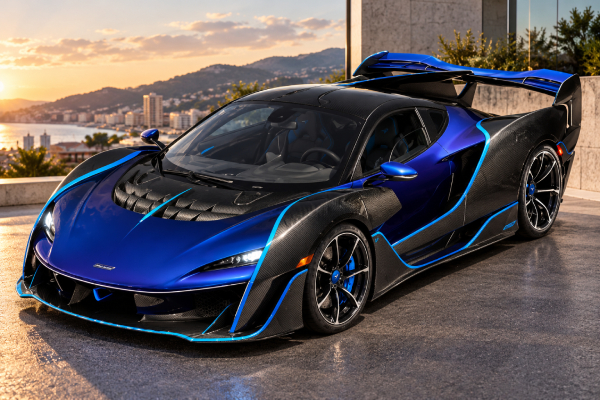
The McLaren Sabre is one of the rarest road cars produced by McLaren Special Operations: a 15-car, U.S.-market bespoke commission built around a 4.0-liter twin-turbocharged V8, rear-wheel drive, dramatic carbon-fiber aerodynamics, and a claimed 218 mph (351 km/h) top speed. Developed under the BC-03 project designation, it was not simply a higher-output Senna with different bodywork. The customer program itself was unusual, with owners involved in development feedback and each finished car configured as an individual commission. That makes the Sabre harder to research than a normal production McLaren, because public factory data is deliberately limited and equipment can differ from car to car. This guide separates confirmed Sabre facts from assumptions based on related McLarens, explains what its 824 bhp output and U.S.-only homologation mean in practice, and focuses on the records, condition checks, service support, and provenance that matter most when evaluating one today.
Table of Contents
- Origin, production, and the BC-03 project
- Sabre specifications and technical data
- Aerodynamics, chassis, and engineering
- Performance and driving character
- Maintenance, service, and storage
- Buying, authenticity, and provenance
- Value, model-year, and ownership context
Origin, Production, and the BC-03 Project
The Sabre is best understood as a 15-car MSO bespoke program for U.S. clients, not as a conventional catalog model with a long option list and standardized global specification. Its pre-reveal BC-03 designation referred to a “Bespoke Commission,” and the final Sabre retained that project’s central idea: a small group of owners would receive individually configured cars developed outside the normal global-series process.
McLaren Beverly Hills publicly revealed the first completed Sabre in December 2020. Contemporary reporting described all 15 cars as allocated to U.S. customers and homologated specifically to U.S. federal requirements. McLaren said that limiting the homologation brief to one market allowed ideas and innovations that a global approval program would not permit. That point is important when comparing the Sabre with a Senna, 720S, Elva, or Speedtail. The Sabre shares McLaren design and engineering DNA with those cars, but the reason it exists is the freedom of a tightly controlled commission.
The customer-development process was also unusually direct. Owners were given access to a development prototype at the Thermal Club in California, where they drove the car with coaching and then provided feedback to the engineering and design team in Woking. That does not mean every chassis received a wholly unique suspension geometry or engine calibration. It does mean the program treated clients as development participants, while MSO individualized colors, trims, and equipment.
Only 15 Sabres were produced. The first delivery occurred at the end of 2020, while contemporary coverage and later registrations often identify cars as either 2020 or 2021 examples. For that reason, a buyer should rely on the individual VIN, title, factory documentation, and build records rather than assuming every Sabre shares one uniform model-year label.
The BC-03 name is useful for historical identification, but “Sabre” is the finished model name. For parts, service, insurance, import/export, and valuation work, the car’s actual VIN and MSO build documentation matter more than the development code.
Sabre Specifications and Technical Data
The Sabre is a gasoline-only, rear-mid-engine, rear-wheel-drive hypercar with a 4.0-liter twin-turbocharged McLaren V8 and a 7-speed dual-clutch transmission. Publicly confirmed figures center on its 824 bhp output, 800 Nm (590 lb-ft) of torque, 218 mph top speed, carbon-fiber structure, and extreme aerodynamic package; many ordinary specifications such as curb weight, dimensions, fuel economy, and service capacities were not comprehensively published for the model.
| Specification | Value |
|---|---|
| Final model name | McLaren Sabre |
| Development designation | BC-03; “BC” was reported as “bespoke commission” |
| Powertrain class | ICE gasoline hypercar; no hybrid system |
| Body configuration | Two-seat coupe with dihedral doors |
| Market scope | Designed and homologated for the United States |
| Production | 15 examples |
| Program | McLaren Special Operations bespoke commission |
| Public debut and first delivery | December 2020 |
The engine belongs to McLaren’s M840T 4.0-liter twin-turbo V8 family. Some specialist sources describe the Sabre-specific derivative as M840TR, while public launch material focused on capacity and output rather than publishing a complete Sabre workshop specification. For that reason, an owner or buyer should confirm the exact engine designation from factory documentation for the individual car instead of relying on a database entry.
| Specification | Value |
|---|---|
| Engine layout | Rear-mid-mounted V8 |
| Displacement | 4.0 L class; 3,994 cc is documented in auction records |
| Induction | Twin turbochargers |
| Maximum power | 824 bhp (835 PS; approximately 614 kW) |
| Maximum torque | 800 Nm (590 lb-ft) |
| Hybrid assistance | None |
| Exhaust | Inconel system documented on publicly offered examples |
The Sabre’s published performance headline is top speed, not acceleration. McLaren and contemporary launch reports repeatedly cited 218 mph, while a factory 0–60 mph or 0–100 km/h time was not part of the core public specification. Quoting an estimated acceleration number as though it were official would therefore be misleading.
| Specification | Value |
|---|---|
| Transmission | 7-speed dual-clutch |
| Driven wheels | Rear-wheel drive |
| Claimed top speed | 351 km/h (218 mph) |
| Performance distinction at launch | Fastest two-seat McLaren by claimed top speed |
| Powertrain distinction at launch | Most powerful non-hybrid McLaren road-car engine then offered |
Structurally, the Sabre follows McLaren’s carbon-intensive approach. Later auction documentation for individual cars identifies a carbon-fiber monocage, carbon-fiber bodywork, carbon-ceramic brakes, center-lock wheels, and Pirelli P Zero tires. Those are useful confirmed hardware clues, but buyers should still verify the exact wheel, tire, brake, and trim specification of the chassis being inspected.
| Specification | Value |
|---|---|
| Primary structure | Carbon-fiber monocage construction documented on public cars |
| Body material | Carbon-fiber bodywork |
| Brake type | Carbon-ceramic disc brakes |
| Wheel attachment | Center-lock |
| Documented tire family | Pirelli P Zero on a publicly auctioned example |
| Door type | Dihedral |
| Seating | Two occupants |
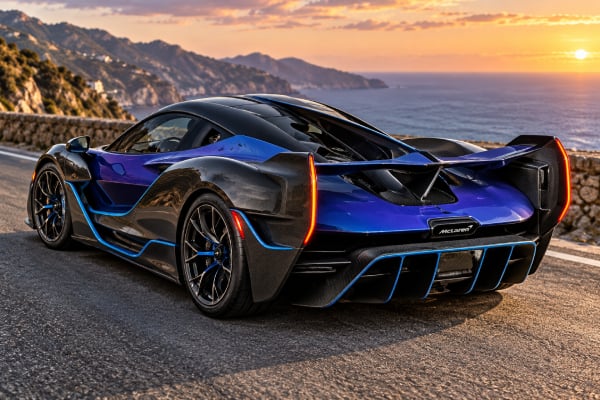
The most visually obvious Sabre components are aerodynamic. The nose, vented body surfaces, large rear diffuser, tall center fin, and full-width wing distinguish it from McLaren’s regular road cars. A later Mecum listing for one car also identified an active-aero rear diffuser, while the wing itself was described as fixed.
| Feature | Confirmed description |
|---|---|
| Rear wing | Large fixed wing |
| Center fin | Full-height dorsal fin integrated into the rear aero form |
| Rear diffuser | Large diffuser; active-aero function documented on a public example |
| Body philosophy | MSO-specific carbon-fiber aerodynamic body |
| Engine cover glazing | Gorilla Glass documented on publicly offered cars |
| Personalization | Individual MSO paint, trim, and interior specifications across the run |
Several commonly repeated Sabre numbers should be treated cautiously. Public databases disagree on curb weight and acceleration, while McLaren did not release a full technical sheet comparable with a normal series-production model. The same caution applies to brake-disc dimensions, suspension settings, fuel capacity, oil capacity, wheel offsets, tire pressures, and service torque values. These should come from the exact car’s official service information, not from a Senna or 720S specification assumed to be interchangeable.
Aerodynamics, Chassis, and Engineering
The Sabre’s engineering emphasis is not simply more power; it is the combination of high-speed stability, low-volume body freedom, and a road-legal package shaped around a single homologation market. Its most important visual parts are therefore functional-looking airflow devices rather than decorative add-ons, even though McLaren did not publish a complete downforce map or drag coefficient.
At the front, the Sabre uses a low, projecting nose, deep splitter treatment, pronounced fender forms, and multiple openings to manage airflow around and through the body. Along the sides, the sculpted surfaces channel air toward the rear. The dorsal fin then visually and aerodynamically connects the roofline with the huge fixed rear wing, while the diffuser occupies a large portion of the rear view.
This layout explains why the Sabre looks more like a road-going prototype than a conventional supercar. A center fin can help stabilize airflow in yaw, while a large wing and diffuser can generate rear downforce. However, without McLaren-published downforce figures, pressure maps, or test conditions, it is better to describe the hardware and its intended role than assign numerical effects.
The carbon-fiber structure is equally significant. Carbon construction gives a car like the Sabre a stiff central safety cell and allows the exterior aerodynamic shapes to be formed with relatively low mass. On a collector car, though, carbon fiber also changes how accident damage should be assessed. A cosmetic scuff, a repaired outer panel, and damage to a structural carbon section are very different issues. Any purchase inspection should distinguish between them rather than treating “carbon repair” as one category.
The powertrain is notable because the Sabre reached its 824 bhp output without hybrid assistance. At launch, that made it the most powerful non-hybrid McLaren road-car engine yet. The 800 Nm torque figure is substantial but not unusual in isolation; the important part is how that torque is delivered through a rear-wheel-drive chassis with a dual-clutch transmission and very high aerodynamic performance.
The Inconel exhaust seen on documented cars fits the same philosophy. Inconel is a nickel-based high-temperature alloy valued in motorsport and aerospace applications for retaining strength in severe heat. Its use can reduce material thickness and cope with high exhaust temperatures, although the exact Sabre system specification should still be verified against the individual build record.
Performance and Driving Character
The Sabre’s defining performance number is 218 mph (351 km/h), and that speed made it the fastest two-seat McLaren when launched. The distinction matters because the faster McLaren F1 and Speedtail use three-seat layouts; the Sabre’s claim was specifically about two-seat McLarens.
Its 824 bhp output also placed it above the non-hybrid McLaren road cars available at the time. What the factory did not do was publish the normal full set of acceleration, braking, lap-time, and aerodynamic figures. That absence should shape how the car is discussed. A credible guide should not fill the gaps with performance estimates from the Senna, even if the cars are related in concept or hardware.
Rear-wheel drive is central to the driving experience. With 800 Nm available and no front-axle motor to share traction, tire condition, temperature, surface quality, and electronic-control settings all become especially important when using large throttle openings. The 7-speed dual-clutch transmission helps keep the engine in its useful range without interrupting power for long manual shifts.
The customer prototype program also suggests that McLaren was concerned with more than one headline speed. Owners drove a development car at the Thermal Club and fed comments back to the Woking team. That kind of process can influence steering feel, damping, powertrain response, cabin details, and calibration priorities even when those changes are not published as a list of numerical revisions.
For owners today, the practical lesson is simple: the Sabre should be evaluated as a complete system, not a dyno number. A car with fresh correct-spec tires, properly functioning dampers, healthy carbon-ceramic brakes, current fluids, accurate alignment, and no aerodynamic damage is more meaningful than an example that merely presents well at rest.
Maintenance, Service, and Storage
A Sabre should be maintained from its VIN-specific McLaren documentation and service history, not from generic internet specifications. Because the run contains only 15 cars and each was individually commissioned, parts identification, software status, trim pieces, wheel hardware, and even some equipment can require chassis-specific confirmation.
Start with the service record. A low-mileage hypercar can still need meaningful work because time affects fluids, seals, batteries, tires, adhesives, hydraulic components, and brake systems even when the odometer barely changes. The ideal file should show dated maintenance, invoices, diagnostic reports where available, recall or campaign checks, and evidence that storage did not replace scheduled inspection.
Tires deserve special attention. Check all four date codes, exact sizes, load and speed ratings, tread condition, flat spotting, cracking, and evidence of heat cycling. A tire can look nearly new yet be unsuitable for high-speed use because of age. Since the Sabre’s performance envelope is extreme, replacing aged tires should be viewed as a safety decision rather than a cosmetic deduction.
Carbon-ceramic brakes also need expert inspection. Look for edge damage, chips, abnormal surface condition, excessive wear, and any history of track use. Pad thickness alone does not tell the whole story. If the car has been driven on circuit, ask what cooling laps, pad compounds, fluid changes, and post-event inspections were performed.
Carbon bodywork and the monocage require a specialist eye. Inspect the underside, splitter, diffuser, wheel areas, jacking points, door apertures, and mounting points for signs of impact. Paint-depth readings are less straightforward on composite panels than on steel, so a pre-purchase inspection should include visual and structural methods appropriate to carbon construction.
The active and fixed aerodynamic components should operate and align as intended. Confirm that the rear diffuser system, any relevant actuators or sensors, and related control modules show no faults. Even a small impact can affect brackets, panel gaps, fasteners, or underbody aero.
Battery care is another basic but important point. Collector cars often spend long periods parked, so verify that the correct maintainer has been used and that the 12-volt system remains healthy. Low system voltage can create misleading electronic faults and may complicate diagnosis.
Finally, do not publish or rely on unverified oil capacities, fluid grades, wheel-nut torque, center-lock procedures, ride heights, or alignment settings. Those values can be safety-critical and may differ from related McLarens. The correct source is the official documentation for the specific VIN and the current McLaren service system.
Buying, Authenticity, and Provenance
Buying a Sabre is primarily a provenance and condition exercise because every genuine car is rare by definition and individually specified. The first question is not “Which trim is this?” but “Exactly which of the 15 cars is this, what was its original MSO specification, and can the seller document its history from delivery to today?”
Begin with the VIN and original paperwork. One publicly auctioned 2020 Sabre carried VIN SBMBC3CA3LW000007 and was described as car No. 7 of 15. Another earlier auction example was documented with a different serial. These records demonstrate why buyers should use full VIN evidence rather than infer production order from a final chassis digit or an enthusiast list.
The most valuable documentation package should include as much of the following as possible:
- Original MSO build specification and color/trim description.
- Purchase and delivery documentation.
- Service and warranty supplement or handbooks supplied with the car.
- Both keys and any original charger, cover, tools, or accessories.
- Invoices for maintenance, tires, brakes, repairs, and software work.
- Records of paint protection film, cosmetic work, or carbon repairs.
- Photos from delivery, commissioning, events, or factory/customer experiences when provenance is claimed.
- Title history and mileage records that reconcile with the odometer.
- Written confirmation of any non-original parts retained with the car.
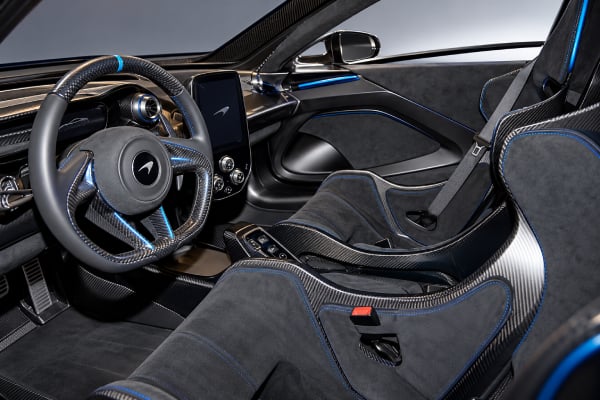
Individuality makes originality more complicated than on a normal production car. A different seat color, unusual exposed-carbon treatment, custom pinstriping, or special interior hardware may be factory MSO content rather than later modification. For example, a publicly offered Sabre was described as the only car in the run fitted with bespoke GT comfort seats. A buyer should therefore avoid judging a configuration against another Sabre without first checking the build sheet.
Conversely, rarity does not make every change desirable. Non-factory paint, replacement carbon panels, aftermarket electronics, modified exhaust parts, wheel changes, or removed personalized details should be documented. The question is not whether a modification is attractive; it is whether the next owner can understand what changed, who performed the work, and whether the original components remain available.
A pre-purchase inspection should be performed by a McLaren-qualified specialist with access to appropriate diagnostics. The inspection should include a fault scan, fluid condition, cooling system, transmission behavior, suspension and lift functions, brake condition, tire age, carbon structure, aero hardware, underbody, wheel damage, battery health, cabin electronics, and evidence of overheating or track-related stress.
Ask for a cold start. Observe warning lights, idle quality, smoke, fluid leaks, unusual turbo or accessory noise, and exhaust behavior before the car is warmed up. Then verify gearbox engagement, steering, brakes, ride-height or lift operation if fitted, and all driver displays. Because public technical data is limited, a clean diagnostic scan and coherent service history carry more weight than comparing sensor values with figures from a related model found online.
Because no two Sabres should be assumed identical, a buyer should also create a chassis-specific inventory before money changes hands. Photograph the exterior from every angle, record wheel and tire markings, note seat type and trim, capture visible MSO plaques or personalization, and list every loose accessory supplied with the car. Then compare that inventory with the original specification and service invoices. This is especially useful when a car has changed hands through a dealer or auction, where marketing descriptions may compress years of history into a few lines. If a factory-specific component has been replaced, ask whether the original part accompanies the car and whether the replacement was installed through an authorized channel. The same approach applies to paint-protection film and cosmetic refinishing: neither is automatically a problem, but both should be documented. On a 15-car commission, a missing bespoke component can be more consequential than the same issue on a normal series-production McLaren because replacement supply and exact finish matching may be far less straightforward.
Also check recall and campaign status by VIN. A low-production model may not appear cleanly in every public year/make/model search, so VIN-specific checking through McLaren and the U.S. safety-recall system is the safer route.
Value, Model-Year, and Ownership Context
The Sabre’s market value cannot be reduced to a normal price guide because only 15 exist and public transactions are rare. Auction bids, asking prices, and dealer advertisements are useful evidence, but they are not the same thing as a completed sale.
A good example is a 2020 Sabre offered at Mecum Monterey in 2022 that reportedly reached a $3.5 million high bid without selling. That data point is informative because it shows real bidder interest, yet it does not establish a $3.5 million market value. A later car with different mileage, color, ownership history, service record, or factory specification can command a different result.
The 2020/2021 labeling also deserves care. The first car was delivered in December 2020, while many articles and databases refer to the Sabre as a 2021 model. Individual U.S. titles and auction records can identify specific cars as 2020. For insurance, appraisal, registration, and sale documentation, the VIN and title should control rather than a general model-year claim copied from a website.
Usage affects value in two directions. Ultra-low mileage can appeal to collectors, but a car that has been stored poorly may need tires, fluids, battery work, and recommissioning. A moderately used car with complete maintenance and careful ownership can be mechanically easier to trust. The strongest Sabre is therefore not automatically the one with the smallest odometer number; it is the one whose mileage, condition, originality, and records make sense together.
Ownership also requires planning for logistics. Transport, low-clearance loading, secure storage, correct battery maintenance, specialist servicing, insurance agreed value, and tire availability should all be considered before purchase. With only 15 cars, a damaged bespoke panel or trim piece may involve a very different sourcing process from an ordinary McLaren replacement part.
For collectors, the Sabre’s significance is clear: it captures a specific period of McLaren’s carbon-monocoque, twin-turbo V8 era while showing how far MSO could push a client-led road-car commission. Its rarity is fixed, but the quality of each surviving car’s history will increasingly determine how buyers distinguish one chassis from another.
References
- McLaren Special Operations (MSO) – Bespoke McLaren Cars 2026
- 824-HP Sabre Is the Most Powerful Nonhybrid McLaren Yet 2020
- The McLaren Sabre: Just 15 of These 824-HP Supercars Will Be Built 2020
- Mecum Auctions, Del Monte Golf Course, Monterey, August 18-20, 2022 – Rick Carey’s Collector Car Auction Reports 2022
- 2020 McLaren Sabre For Sale At Auction – Mecum Auctions 2025
- Check for Recalls: Vehicle, Car Seat, Tire, Equipment | NHTSA 2026 (Recall Database)
Disclaimer
This article is for informational purposes only and is not a substitute for professional diagnosis, inspection, or repair. Specifications, torque values, service intervals, parts, software, and procedures can vary by VIN, market, and equipment; verify all safety-critical information against the car’s official McLaren service documentation before work is performed.
If this guide was useful, please consider sharing it on Facebook, X/Twitter, or another platform to support our work.