
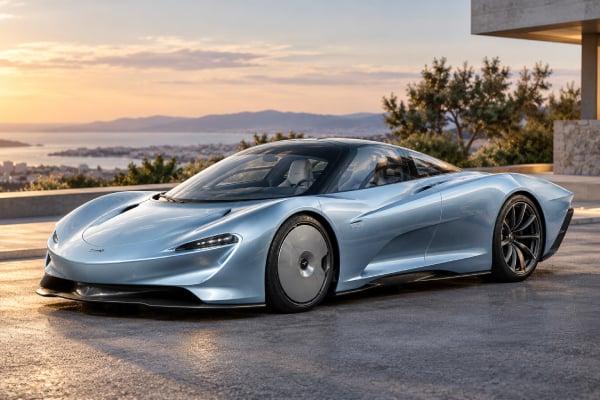
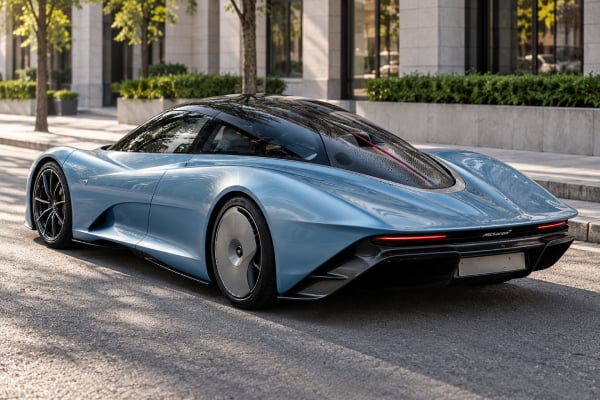
The 2020 McLaren Speedtail is a three-seat hybrid Hyper-GT built around one unusual goal: sustained, effortless speed rather than lap-time aggression. Its M840TQ powertrain combines a twin-turbocharged 4.0-liter V8 with a high-output electric motor, sending power to the rear wheels through a seven-speed dual-clutch gearbox. McLaren quotes a 403 km/h (250 mph) maximum speed and a combined 1,150 Nm (848 lb-ft), while the car’s central driving position, long-tail body and flexible rear aero make it unlike any other modern McLaren road car.
Ownership is equally unusual. Only 106 Speedtails were produced, many cars have highly individualized McLaren Special Operations specifications, and the hybrid battery is maintained through a dedicated wireless charging system rather than a conventional plug-in port. This guide explains the 2020 car’s validated specifications, how its hybrid hardware works, what its aerodynamics and chassis are designed to do, how to store and maintain one, and what buyers should verify before purchasing a car whose provenance can matter as much as its mileage.
Table of Contents
- What Makes the Speedtail Different
- 2020 Speedtail Technical Data
- How the M840TQ Hybrid System Works
- Aerodynamics and High-Speed Engineering
- Cabin Layout and Real-World Road Use
- Maintenance, Charging, and Storage
- Buying a 2020 Speedtail
What Makes the Speedtail Different
The Speedtail is best understood as a high-speed grand tourer, not a conventional track-focused hypercar. McLaren designed its powertrain, seating position, body length and active aerodynamics around stable, low-drag performance while retaining enough comfort and luggage capacity for road travel.
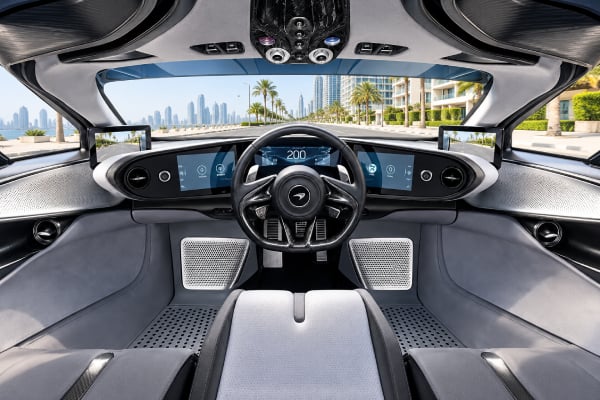
Its most obvious link to the McLaren F1 is the three-seat cabin. The driver sits on the centerline, with two passenger seats positioned slightly behind and to either side. That arrangement is not just nostalgic theater. It gives the driver a symmetrical view forward, removes the usual left- or right-hand-drive compromise, and allows the body to taper cleanly around the cabin. It also changes everyday habits: toll booths, parking barriers, curbside interaction and getting in or out all feel different from a normal two-seat supercar.
McLaren limited Speedtail production to 106 cars. Each was extensively configurable through McLaren Special Operations, so paint, trim, carbon treatments and personalized details can differ sharply from one chassis to another. The original build specification is therefore part of the car’s identity and should be documented rather than guessed from photographs.
The Speedtail also sits apart from the Senna in purpose. The Senna prioritizes circuit downforce and braking performance; the Speedtail pursues aerodynamic cleanliness and very high terminal speed. Its 5,137 mm body is exceptionally long for a McLaren, and the tail narrows gradually instead of ending in a large fixed wing. The result is a car whose engineering story is as much about reducing drag and controlling airflow as producing four-figure power.
For the 2020 car covered here, differences between examples are driven more by commissioning choices, market specification, software status, service history and import status than by a conventional trim ladder.
2020 Speedtail Technical Data
The 2020 Speedtail uses a rear-mid-mounted 4.0-liter twin-turbo V8 and an electric drive unit in a parallel hybrid system, with rear-wheel drive and a seven-speed dual-clutch transmission. Its battery is tiny by EV standards because it is engineered for intense power delivery rather than long electric-only range, and McLaren does not present the Speedtail as a conventional plug-in hybrid with an advertised EV driving range.
| Item | 2020 McLaren Speedtail |
|---|---|
| Powertrain code | M840TQ |
| Combustion engine | 4.0 L twin-turbocharged V8 |
| Hybrid architecture | Parallel gasoline-electric hybrid |
| V8 output | 757 PS (556 kW) and 800 Nm (590 lb-ft) |
| Electric motor output | More than 230 kW |
| Combined maximum power | 1,070 PS / 787 kW; McLaren’s current model page also labels this as 1,036 bhp |
| Combined maximum torque | 1,150 Nm (848 lb-ft) at 5,500–6,500 rpm |
| High-voltage battery | 1.647 kWh, high-power cylindrical-cell lithium-ion pack |
| Battery peak output | 270 kW |
| Battery thermal management | Dielectric liquid cooling with cells immersed in electrically insulating oil |
McLaren has published the Speedtail’s power in more than one form. Early launch material gave 1,050 PS and 1,036 bhp, while later powertrain material stated 1,070 PS and 787 kW; the current model page shows 1,070 PS while also displaying 1,036 bhp. Because those labels are not exact conversions, this guide keeps McLaren’s published units separate rather than inventing a new combined figure.
| Measure | Published figure |
|---|---|
| 0–100 km/h (0–62 mph) | 3.0 seconds |
| 0–200 km/h (0–124 mph) | 6.6 seconds |
| 0–300 km/h (0–186 mph) | 12.8 seconds |
| Maximum speed | 403 km/h (250 mph) |
| 100–0 km/h braking | 32 m (105 ft) |
| 200–0 km/h braking | 132 m (433 ft) |
| WLTP weighted combined fuel consumption | 15.6 L/100 km (18.1 mpg Imperial) |
| WLTP weighted combined CO2 | 357 g/km |
The signature performance number is the run to 300 km/h. It shows that the electric system, low-drag body and powertrain calibration are meant to keep acceleration strong well beyond the traction-limited launch phase.
| Item | Specification |
|---|---|
| Transmission | 7-speed dual-clutch Seamless Shift Gearbox |
| Drive layout | Rear-wheel drive |
| Engine position | Rear-mid, longitudinal |
| Body structure | Carbon-fiber monocoque with carbon-fiber body construction |
| Suspension concept | Independent double-wishbone layout with adaptive damping and adjustable ride height |
| Brakes | Carbon-ceramic discs |
| Front tires | 235/35 ZR20 |
| Rear tires | 315/30 ZR21 |
| High-speed setting | Velocity mode lowers the car and changes aerodynamic configuration |
| Item | Figure |
|---|---|
| Body style | 2-door Hyper-GT coupe |
| Seating | 3; central driver with two offset passenger seats |
| Length | 5,137 mm (202.2 in) |
| Wheelbase | 2,728 mm (107.4 in) in owner documentation |
| Width, doors closed including camera system | 2,032 mm (80.0 in) |
| Height, normal mode | 1,182 mm (46.5 in) |
| Ground clearance, normal / Velocity mode | 85 / 50 mm (3.3 / 2.0 in) |
| Current McLaren minimum dry-weight figure | 1,499 kg (3,305 lb) |
| DIN kerb weight | 1,597 kg (3,521 lb) |
| Maximum rear-compartment load | 30 kg (66 lb) |
Weight deserves caution. McLaren’s overview copy has also cited 1,430 kg dry, while its current specification table lists 1,499 kg minimum dry and 1,597 kg DIN kerb weight. Do not mix “dry,” “unladen,” and DIN figures; use the exact vehicle documentation when weight matters for transport or setup.
| Item | Practical reference |
|---|---|
| Preferred fuel for maximum performance | 98 RON / 88 MON unleaded meeting EN 228 |
| Ethanol limit | Do not use fuel containing more than 10% ethanol; E85 is not suitable |
| High-voltage battery charging | Use the dedicated Wireless Charging System (WCS) |
| 12-volt battery support | Use the supplied 12 V battery charger when the WCS is unavailable and the car is not used regularly |
| Battery storage environment | McLaren supplement recommends roughly 17–25°C (63–77°F) for retaining usable high-voltage battery capacity |
| Brake fluid | Pentosin DOT 5.1 where specified by Speedtail owner documentation |
How the M840TQ Hybrid System Works
The Speedtail’s hybrid system is a performance booster first and an efficiency device second. Its 1.647 kWh battery stores far less energy than a modern plug-in hybrid pack, but it can deliver extremely high power for its size, feeding an electric motor rated at more than 230 kW while the V8 supplies the majority of sustained propulsion.
The combustion side of the M840TQ evolved from McLaren’s familiar 4.0-liter twin-turbo V8 architecture but received changes for Speedtail duty, including revised cooling and piston design. McLaren stated 757 PS and 800 Nm for the V8 alone. The electric drive then adds immediate torque and power, particularly valuable when the car is already traveling at speeds where aerodynamic drag rises sharply and continued acceleration demands enormous energy.
The battery is the more unusual component. McLaren used high-power cylindrical cells in a compact 1.647 kWh pack capable of 270 kW output. Instead of relying on a conventional cold plate alone, the cells are immersed in an electrically insulating dielectric oil that carries heat away. The objective is not a large energy reserve for silent commuting; it is repeatable, high-rate deployment without the pack becoming the weak thermal link during maximum-performance use.
That distinction also explains why the Speedtail does not fit neatly into familiar hybrid labels. It is a parallel hybrid, and its high-voltage battery can be maintained externally, but the car has no conventional charging socket and McLaren does not advertise an electric-only range like a normal PHEV. The dedicated Wireless Charging System uses a floor pad to maintain the high-voltage battery while the car is parked. In ownership terms, it is better viewed as an externally supported performance hybrid than as an EV-capable plug-in commuter.
McLaren Applied also contributed motorsport-derived inverter and DC/DC converter technology. The important comparison is not battery capacity alone, but power density, thermal control and how quickly the system can deliver energy when requested.
For the driver, there is no need to manage the car as if it were a battery-electric vehicle. The practical priority is keeping both the high-voltage and 12-volt systems healthy during periods of non-use. A Speedtail that spends months displayed without its intended charging support can create a very different ownership problem from one exercised regularly and stored according to McLaren’s battery guidance.
Aerodynamics and High-Speed Engineering
The Speedtail reaches 403 km/h by minimizing drag while keeping the car stable, not by adding the largest possible wings. Its long teardrop-like profile, retractable camera system, smooth front-wheel treatments, adjustable ride height and flexible rear body surfaces all serve that low-drag strategy.
The rear ailerons are the signature feature. Rather than hinging a separate wing element into the airflow, portions of the rear carbon-fiber body flex to alter the aerodynamic load and can also contribute an air-brake effect. The continuous surface avoids gaps and hardware that would disturb airflow around the elongated tail. It is an elegant solution, but it also means body condition and correct operation deserve specialist attention: these are active structural aerodynamic surfaces, not ordinary cosmetic panels.
McLaren also replaced conventional exterior mirrors with a Camera Monitor System. Small camera pods provide the side view and can retract in the car’s high-speed configuration, reducing frontal disturbance. In ordinary road use, that means the driver relies on screens rather than glass mirrors. A pre-purchase check should therefore confirm image quality, camera deployment, screen operation and software behavior, because an apparently minor electronic fault directly affects rearward visibility.
Velocity mode changes several systems together. Ground clearance drops from about 85 mm to 50 mm, a reduction of 35 mm, and the car adopts its low-drag high-speed state. Fifty millimeters is exceptionally little clearance for a road car, so the mode is not something to treat casually around road crowns, ramps or debris. Equally, a lift or ride-height fault is not merely inconvenient on a vehicle more than five meters long with expensive carbon bodywork at both ends.
The chassis philosophy supports fast road travel rather than maximum circuit downforce. Wide rear tires, carbon-ceramic brakes, adaptive damping and rear-wheel drive have to deal with immense performance while preserving steering feel and ride quality. At the claimed maximum speed, tire condition becomes a safety-critical engineering constraint. Age, heat history, storage flat-spotting, sidewall damage and correct specification matter even when tread depth looks generous.
Maximum-speed operation is a separate category from normal road driving. A car capable of 250 mph may spend its entire life far below that speed, and the existence of a top-speed number does not make an unrestricted run routine. Proper venue, tire approval, vehicle inspection, weather, surface length and trained support all become relevant. Owners interested in high-speed events should follow McLaren’s current requirements rather than assuming a low-mileage car is automatically ready because its odometer shows little use.
Inspect the underside and leading edges as carefully as the visible paint. The low nose, long wheelbase and extended tail increase exposure to ramps and debris, while paint-protection film can hide marks. A specialist should distinguish cosmetic film damage from damage to carbon panels or mounts.
Cabin Layout and Real-World Road Use
The central driving position is the Speedtail’s greatest everyday advantage and its biggest adjustment. Forward sightlines are naturally balanced, but access, passenger placement, controls and rearward visibility are unlike a normal McLaren, so a buyer should evaluate the car from the driver’s seat rather than treating the three-seat layout as a collectible detail.
Entry requires moving past the outer passenger position toward the center. Once seated, the driver faces a wide digital display arrangement, while important controls are placed around the cockpit, including overhead switchgear. The two passengers sit rearward of the driver’s shoulders. Three adults can therefore travel together, but the cabin is not a conventional three-abreast bench; the architecture is shaped around the driver and the carbon structure.
The car’s 5.14-meter length is more noticeable in tight spaces than its central seat suggests. The camera system helps, yet curb placement and the long rear body demand care. Door clearance also deserves attention in a garage. Owners should measure the actual parking bay, charging-pad position and approach angle rather than assuming a space suitable for another McLaren will automatically work for a Speedtail.
Luggage capacity is divided rather than presented as a large conventional trunk. The rear compartment has a stated maximum load of 30 kg, and bespoke luggage was part of the Speedtail’s grand-touring idea. For a collector car, a complete luggage set can be more than a practical accessory: it may also be part of the original delivery specification worth documenting with the vehicle.
The cabin can be highly bespoke, so compare it with the build sheet. A retrim or replacement part may look excellent yet differ from the documented commission, while an unusual factory color or material may be completely original.
A road test exposes issues that static display cannot. Check low-speed gearbox engagement, ride-height operation, every camera view, climate control, infotainment and warning messages through repeated starts. A few hundred miles on the odometer does not prevent age- or storage-related battery, tire, seal, software or hydraulic problems.
Fuel quality matters when the car is used infrequently. McLaren owner information calls for 98 RON/88 MON fuel for maximum performance and warns against fuels containing more than 10% ethanol. Long storage adds another variable because fuel ages. Instead of improvising additives or alternative blends, owners should follow current McLaren guidance for their market and plan storage so the car is periodically exercised under appropriate conditions.
Maintenance, Charging, and Storage
The safest maintenance strategy for a Speedtail is specialist, time-based care even when mileage is tiny. The car combines a highly stressed V8, carbon-ceramic brakes, active chassis and aero hardware, two battery systems and bespoke electronics, so preserving function requires more than changing engine oil after a certain number of miles.
Battery care comes first because it affects whether the car wakes up normally after storage. The Speedtail has a 12-volt battery and a separate high-voltage lithium-ion battery. McLaren’s Speedtail supplement says the high-voltage battery is charged through the dedicated Wireless Charging System and identifies regular driving plus the WCS as the preferred way to care for both batteries. When the WCS is unavailable and the vehicle is not regularly used, the supplied 12-volt maintainer should support the low-voltage system.
The supplement gives a storage-temperature target of about 17–25°C (63–77°F) for retaining usable high-voltage battery capacity. Long-term heat or cold is therefore relevant to battery condition, while humidity control still matters for brakes, electronics and trim.
A practical storage routine should include the following:
- Position the car correctly over its Wireless Charging System and confirm normal charging/maintenance status rather than assuming the pad is active.
- Keep tire pressures within the current McLaren specification and inspect for flat-spotting, cracking or age-related degradation before meaningful road use.
- Avoid repeatedly starting the engine only for brief stationary warm-ups. If the vehicle is exercised, use an appropriate drive cycle that brings systems to operating condition without unnecessary high load while cold.
- Keep records of battery-support equipment, software updates and service actions with dates and mileage. Sparse mileage makes chronology especially important.
- Inspect the underside, front splitter area, wheel surfaces and carbon components after transport or unfamiliar road use.
Fluid maintenance should follow the vehicle’s current service documentation rather than generic intervals copied from a 720S or another McLaren. Speedtail documentation specifies details such as Pentosin DOT 5.1 brake fluid, but exact change intervals, capacities and procedures can vary by market, campaign status and service revision. A specialist should identify the requirements against the VIN before work begins.
Recent market evidence shows why service history matters. A 2020 Speedtail sold by RM Sotheby’s at Monterey in 2026 had a documented $32,704 McLaren service shortly before auction. That is not a standard annual-service price; it demonstrates how costly thorough recommissioning of a low-mileage car can become.
Software belongs in the maintenance conversation as well. Ask the servicing dealer to check outstanding campaigns and confirm the installed software state. Do not clear a warning or dismiss an odd message merely because the vehicle seems to drive correctly; on a car with tightly integrated electronic systems, the cause may be calibration, low voltage or a genuine hardware fault.
Finally, preserve the correct specialist tool chain. A Speedtail’s body, hybrid system and active aerodynamics are not sensible areas for exploratory work by a shop unfamiliar with the model. Routine cosmetic care can be widely available, but diagnosis, high-voltage service, structural repair and calibration should be handled by appropriately qualified McLaren personnel or a specialist whose Speedtail capability can be demonstrated.
Buying a 2020 Speedtail
Buy the history and legal status before the odometer. With only 106 cars built and extensive bespoke commissioning, two Speedtails with similar mileage can differ materially in originality, service condition, accessories, import restrictions and market value.
Start with identity. Match the VIN and serial details across the car, title/registration documents, invoices and build records. Obtain the original MSO specification if possible and inventory everything delivered with the car: keys, manuals, charging hardware, bespoke luggage, tools, covers and any presentation items. Missing Speedtail-specific equipment can be inconvenient to replace and may matter to future collectors.
Then establish a continuous service narrative. A useful file shows when the car was maintained, where it was stored, how the batteries were supported, whether campaigns were completed and why any major work was performed. Gaps deserve questions even if the mileage is extremely low. A 200-mile car can have six years of calendar age on tires, fluids, seals and batteries; a somewhat higher-mileage example with disciplined servicing may present a clearer mechanical story.
Inspect the car dynamically and structurally. Important checks include:
- high-voltage and 12-volt battery health, plus correct WCS operation;
- all camera-monitor displays and deployment functions;
- ride-height changes and Velocity-mode-related systems;
- flexible rear aero surfaces and surrounding carbon bodywork;
- carbon-ceramic disc condition and evidence of impact or abnormal heat damage;
- correct tire type, date codes, pressures and signs of long-term flat-spotting;
- gearbox engagement, driveline behavior and warning messages from cold and warm starts;
- underside contact, transport damage, repaired carbon and paint-protection-film condition;
- software/campaign status confirmed against the VIN by an appropriate McLaren service source.
Price evidence should be dated and specific rather than treated as a universal “Speedtail value.” RM Sotheby’s sold chassis 072/106 at Monterey in 2026 for $2.260 million; it showed 231 miles and had recent documented McLaren service. Color, provenance, mileage, options, geography and legal status can move an individual result, so one auction is not a substitute for a current appraisal.
U.S. buyers have an additional issue: some Speedtails entered the country under NHTSA’s “show or display” framework rather than ordinary federal certification. NHTSA states that an approved Show or Display vehicle used on public roads is limited to no more than 2,500 miles in a 12-month period, and agency permission can be relevant to a transfer before the vehicle reaches the age at which the restrictions cease. The 2026 Monterey auction listing specifically warned that its car’s ownership transfer required NHTSA approval. This is therefore a title-and-import due-diligence item, not fine print to address after purchase.
Rules differ outside the United States, so buyers should verify registration, taxes, homologation and any local operating restrictions in the jurisdiction where the car will actually live. Do not assume that because a Speedtail is road registered in one country it can be imported and registered in another without additional steps.
The strongest purchase is the car whose identity, legal status, MSO configuration, battery care, service history and present condition can all be demonstrated. Arrange a model-specific pre-purchase inspection, and treat unresolved warnings, missing charging equipment or uncertain import paperwork as real problems rather than quirks of rarity.
For an owner who will maintain it properly, the Speedtail offers something no later McLaren has duplicated in exactly the same form: a central driving position, three-seat road usability and a hybrid system engineered around 250 mph capability. Its rarity makes preservation important, but the engineering makes careful use equally meaningful. The best-kept examples are likely to be those treated as functioning machines—with correct charging, regular inspection and documented exercise—rather than sculptures that happen to contain fluids and batteries.
References
- McLaren Speedtail – Hyper-GT & The Fastest McLaren 2026 (Model Specifications)
- McLaren Owners 2026 (Owner’s Manual Portal)
- McLaren hybrid Hyper-GT uses motorsport technology to supplement twin-turbo V8 2020 (Powertrain Technical Report)
- Importation and Certification FAQs | NHTSA 2026 (Show or Display Guidance)
- McLaren Speedtail Owner’s Handbook Supplement 2020 (Owner’s Manual Supplement)
- 2020 McLaren Speedtail | The Monterey Auction 2026 | RM Sotheby’s 2026 (Auction and Service Record)
Disclaimer
This article is for informational purposes only and is not a substitute for professional diagnosis, maintenance, repair, legal, import, or registration advice. Specifications, torque values, service intervals, fluids, procedures, software requirements, and equipment can vary by VIN, market, service revision, and individual vehicle configuration. Verify all work and operating requirements against the official documentation for the specific Speedtail and consult an appropriately qualified McLaren service provider.
If this guide helped you understand the Speedtail, please consider sharing it on Facebook, X/Twitter, or another automotive community to support our work.