


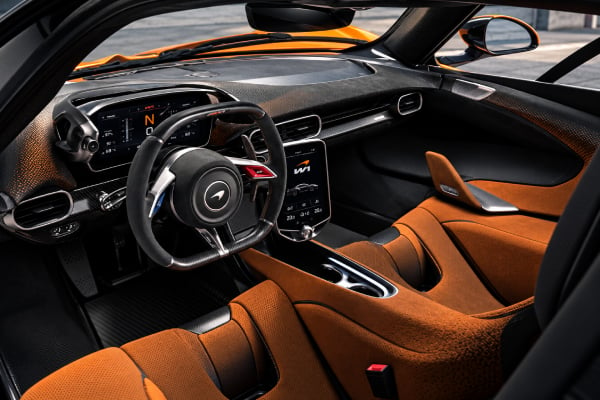
The McLaren W1 is the company’s new halo road car, a 1,258-bhp rear-wheel-drive hybrid built to follow the F1 and P1 rather than simply replace an existing series model. Its defining idea is not electrification for long-distance EV driving; it is using a compact electric system to sharpen a new 4.0-litre twin-turbo V8 while keeping mass low. The result pairs 1,275 PS (1,258 bhp) and 1,340 Nm with a lightest dry weight of 1,399 kg, active ground-effect aerodynamics, hydraulic steering and an eight-speed dual-clutch transmission. McLaren also designed the carbon-fibre Aerocell, suspension and cockpit around the airflow requirements, so the W1 is unusual even by modern hypercar standards: its structure is part of the aero system. This guide explains the P18 W1’s verified specifications, how its hybrid and aerodynamic systems work, what its performance figures mean, what owners should protect in service, and what matters when assessing one as a purchase.
Table of Contents
- What the W1 Changes in McLaren’s “1” Lineage
- McLaren W1 Specifications and Technical Data
- How the MHP-8 Hybrid Powertrain Works
- Aerocell, Ground Effect, and Chassis Engineering
- What the Performance Figures Mean on Road and Track
- Maintenance, Storage, and Inspection Priorities
- Buying and Owning a McLaren W1
What the W1 Changes in McLaren’s “1” Lineage
The W1 is McLaren’s third road car in the F1–P1–W1 halo lineage, but its engineering brief is distinctly modern: maximum road-and-track performance with a hybrid system that supports a lightweight, rear-drive chassis rather than dominating the car’s character. McLaren limited the customer run to 399 cars for the 2026 production era.
The electric-only range is less than 2 km, so the system is about response rather than electric commuting. For the powertrain taxonomy used here, the production W1 is treated as an HEV: it has a combustion engine, traction motor and high-voltage battery, while current 2026 production information does not describe an external charging connection. Early launch-era material was reported with charging information, so owners should rely on the production car’s VIN-specific handbook rather than older pre-production specifications.
The W1 is also deliberately rear-wheel drive. Many modern cars at this power level add a driven front axle to improve launch traction. McLaren instead sends the whole hybrid system’s output through the rear axle and uses an electronic differential, sophisticated traction and stability calibration, active chassis hardware and very wide rear tyres to control it. That decision preserves the steering from front-drive torque and keeps the layout closer to McLaren’s traditional driver-focused architecture.
The Aerocell carbon monocoque was shaped around ground-effect airflow, with a raised footbox, narrow lower body and integrated seats. Moving the pedals and controls to the driver instead of sliding the seat saves packaging space while helping airflow around and beneath the car.
McLaren W1 Specifications and Technical Data
The W1 combines a longitudinal mid-mounted 4.0-litre twin-turbo V8, a high-output E-module, an eight-speed DCT and rear-wheel drive in a two-seat carbon-fibre coupe. Under the current production information used for this guide it is classified as an HEV, with electric drive available from a small performance battery but no published production-car external charging specification. Only confirmed power, energy, performance, chassis and packaging figures are included here.
| Specification | McLaren W1 (P18) |
|---|---|
| Engine family | MHP-8 |
| Engine layout | 90-degree V8, longitudinal mid-engine |
| Displacement | 4.0 L (3,988 cc) |
| Induction | Twin turbochargers |
| Fuel injection | Port and direct injection |
| V8 maximum power | 928 PS (683 kW / about 915 bhp) |
| V8 maximum torque | 900 Nm (664 lb-ft) |
| Maximum engine speed | 9,200 rpm |
| E-module maximum power | 347 PS (255 kW / 342 bhp) |
| Combined maximum power | 1,275 PS (1,258 bhp / 938 kW) |
| Combined maximum torque | 1,340 Nm (988 lb-ft) |
| Specification | Value |
|---|---|
| Electric drive type | Radial-flux motor integrated in the E-module |
| E-module mass | 20 kg |
| Traction-battery capacity | 1.384 kWh |
| Battery thermal management | Dielectric immersion cooling |
| Official electric range | Less than 2 km (less than 1.6 mi) |
| EU WLTP CO2 | Less than 310 g/km |
| Fuel-tank capacity | 62 L |
| Measure | Official figure |
|---|---|
| 0–100 km/h (0–62 mph) | 2.7 seconds |
| 0–200 km/h (0–124 mph) | 5.8 seconds |
| 0–300 km/h (0–186 mph) | Less than 12.7 seconds |
| Quarter mile (0–400 m) | Less than 9.6 seconds |
| Maximum speed | 350 km/h (217 mph), electronically limited |
| 100–0 km/h braking distance | 29 m (95 ft) |
| 200–0 km/h braking distance | 100 m (328 ft) |
| Lightest dry weight | 1,399 kg (3,084 lb) |
| Power-to-weight ratio | 911 PS per tonne |
| Specification | Value |
|---|---|
| Transmission | 8-speed dual-clutch transmission |
| Reverse | E-Reverse using electric drive |
| Drive layout | Rear-wheel drive |
| Differential | Integrated electronic differential |
| Steering | McLaren Hydraulic Performance Steering |
| Specification | Value |
|---|---|
| Body structure | McLaren Aerocell carbon-fibre monocoque |
| Suspension | Front and rear aluminium double wishbones with Race Active Chassis Control III |
| Front chassis hardware | Inboard active heave suspension with 3D-printed and titanium components |
| Rear chassis hardware | Active drop links and adaptive damping |
| Front brakes | 390 mm carbon-ceramic discs, six-piston forged monobloc calipers |
| Rear brakes | 390 mm carbon-ceramic discs, four-piston forged monobloc calipers with integrated parking brake |
| Aerodynamic concept | Ground effect with active front splitter and McLaren Active Long Tail |
| Maximum Race-mode downforce | 1,000 kg |
| Active Long Tail movement | Extends rearward by up to 300 mm in Race mode |
| Specification | Value |
|---|---|
| Body style | Two-door, two-seat coupe |
| Seat arrangement | Seats integrated into the Aerocell; movable pedal/driver-control position |
| Doors | McLaren Anhedral doors with integrated aerodynamic blades |
| Luggage capacity | 118 L wet / 87 L DIN |
| Customer production | 399 cars |
| Model-year scope | 2026–present |
Read the figures in context: “dry lightest” is not a fully fuelled road-ready mass, and 1,000 kg is a peak Race-mode downforce figure rather than a normal-road load. The short electric range is a performance-hybrid capability, not a commuting range.
How the MHP-8 Hybrid Powertrain Works
The W1’s powertrain is designed around response and sustained performance, not simply the largest possible battery or the highest possible combined horsepower. The new MHP-8 V8 supplies most of the power, while the compact E-module adds immediate electric assistance and enables functions that would otherwise require separate hardware.
The 3,988 cc V8 uses a 90-degree layout, twin turbochargers and both port and direct injection. Its 928 PS output equals about 233 PS per litre, an exceptionally high specific output for a road-car combustion engine. A 9,200 rpm maximum engine speed also gives the W1 a broader operating range than many turbocharged V8s. The point is not merely a high redline: keeping useful power available over a wider range gives the transmission more freedom to hold a gear and reduces the need for constant shifting on track.
The E-module sits alongside the transmission and packages a radial-flux electric motor with its control electronics. At only 20 kg, the module produces 347 PS. That very high power density helps explain why the battery is just 1.384 kWh. A battery intended for long electric range would be many times larger and heavier. Here, the pack is a high-power buffer that can deliver and accept energy rapidly, with dielectric immersion cooling intended to control temperature during repeated hard use.
The hybrid layout also removes some conventional ancillaries. Electric drive provides reverse, which is why the transmission is described as having E-Reverse. The electrical system can also support engine starting and other functions that would otherwise require separate components. That saves mass and packaging space, both critical in a car whose aero channels, cooling system and suspension all compete for room around the same central structure.
Why 1,340 Nm does not automatically mean four-wheel drive is necessary
Sending 1,340 Nm only to the rear wheels sounds extreme, and the 2.7-second 0–100 km/h figure is slower than some all-wheel-drive electric hypercars with similar power. That is a deliberate trade. The W1’s engineering priority is not to win every low-speed launch comparison; it is to combine very high straight-line performance with steering feel, low mass and rear-driven balance.
At higher speed, aerodynamic load and tyre capability become more important than the traction advantage of a driven front axle. The active electronic differential can vary how torque is shared across the rear axle, while traction control and stability control manage wheel slip. McLaren’s Arctic development programme specifically included calibration of torque delivery, traction control, ESP and ABS on very low-grip surfaces, suggesting that control software is a central part of making the layout usable outside a warm, dry circuit.
Hybrid classification and energy management
For this guide’s table taxonomy, the current production W1 is treated as an HEV rather than a PHEV. It has an official electric-only mode, but the small 1.384 kWh battery is primarily a performance-energy buffer and current production information does not identify an external charge connector. Some launch-era reports used plug-in terminology, which is why older specifications can conflict with 2026 production descriptions.
Do not fill that gap with estimates or assume that a pre-production charging procedure applies to a delivered car. Battery reserve, thermal limits and software strategy are central to the hybrid system, and the correct storage or energy-management procedure should come from the handbook and service information for the individual VIN.
Aerocell, Ground Effect, and Chassis Engineering
The W1’s most important engineering feature may be its Aerocell rather than its engine: the carbon monocoque was shaped as an aerodynamic device, allowing most of the car’s downforce to come from controlled airflow beneath and through the body. That reduces dependence on a permanently large rear wing and lets the car change its aero balance between road and track settings.
McLaren raised the footbox, narrowed the lower body and moved the door-hinge architecture upward to make space for high-energy airflow around the monocoque. The integrated seats are part of the same packaging strategy. Because the seat shells do not slide, the cockpit does not need to accommodate the full travel envelope of two bulky seat frames. The pedals and steering controls move to suit the driver instead. The structure can therefore be shorter and more tightly wrapped around the occupants while preserving useful space.
Ground effect works by accelerating and managing air beneath the car so the pressure under the floor is lower than the pressure above it. The W1 uses the floor, diffuser and surrounding body surfaces as one system. Managing front-wheel wake is especially important because turbulent air from a rotating tyre can spoil underbody flow. McLaren’s ducting around the front wheels therefore does more than cool the brakes: it also manages tyre wake and guides cleaner air toward cooling and diffuser surfaces farther rearward.
The Active Long Tail is the most visible part. In Race mode it can extend rearward by as much as 300 mm, effectively lengthening the working rear aerodynamic surface and diffuser system. Together with the active front device and Race-mode chassis position, the system can generate up to 1,000 kg of downforce, around five times the road-mode figure. The active front surface is just as important because rear downforce without matching front load would move the aerodynamic balance rearward and reduce confidence on turn-in.
The chassis has to keep those aerodynamic surfaces in a predictable relationship with the road. W1 uses Race Active Chassis Control III, front and rear double wishbones, inboard front heave hardware, adaptive damping and active rear drop links. The front suspension attaches directly to the Aerocell, eliminating some intermediate structure and helping both stiffness and mass. McLaren also uses lightweight titanium and 3D-printed pieces where their shape or load path justifies the manufacturing complexity.
Braking is similarly track-oriented. Both axles use 390 mm carbon-ceramic discs, with six-piston forged monobloc front calipers and four-piston rear calipers. The official 29 m stop from 100 km/h and 100 m stop from 200 km/h illustrate the combination of tyre grip, brake capacity and aerodynamic contribution. Those numbers are achieved under controlled test conditions, however, so a road driver should never use them as a guaranteed stopping-distance allowance. Tyre temperature, surface condition, brake temperature and load can change the result substantially.
Inside, the compact steering wheel carries key Boost and Aero controls, while selected trim can use McLaren InnoKnit, a knitted material that integrates items such as lighting and speakers with fewer conventional trim pieces.
What the Performance Figures Mean on Road and Track
The W1’s numbers show that its advantage grows as speed rises: 0–100 km/h takes 2.7 seconds, yet 0–200 km/h needs only 5.8 seconds and 0–300 km/h is under 12.7 seconds. That pattern reflects a car whose power-to-weight ratio and aerodynamics matter most once launch traction is no longer the main limitation.
At low speed, 1,258 bhp through two driven tyres has to be carefully metered. Even excellent tyres cannot convert unlimited torque into acceleration. At higher speed, the car can use more of the available power while the aero package adds vertical load. That helps explain why the W1’s engineering should be judged by more than a single 0–100 km/h time. Its quarter mile is officially under 9.6 seconds, and top speed is electronically limited to 350 km/h, but the more revealing figure for track use is the combination of power, braking and high-speed aerodynamic control.
Race mode changes more than throttle mapping. The active aero moves into a more aggressive configuration, the Long Tail extends and the chassis works in a track-focused state. The driver therefore needs to think of Race mode as a system setting rather than a cosmetic “sport” button. More downforce also means more load through the tyres, wheel bearings, suspension joints and brakes at speed. Track operation should be accompanied by the inspection and preparation procedures in McLaren’s official documentation, especially after sustained high-temperature running.
The hydraulic steering is significant because it avoids the fully electric assistance now common in performance cars. Hydraulic assistance generally provides a more direct relationship between front-tyre forces and steering effort, although the exact feel still depends on geometry, tyres and calibration. Since the front axle is not driven, it also does not have to transmit propulsion torque. That separates steering work from power delivery and supports the W1’s emphasis on feedback.
On the road, visibility, ride control, cooling and traction strategy matter more than the peak downforce number. McLaren’s Arctic programme tested the powertrain, electronic controls and the effect of snow and ice on cooling openings, a relevant concern for a car with tightly managed airflow paths.
For the driver, the practical lesson is to build speed progressively. The presence of advanced stability systems does not repeal the physics of a rear-drive car with four-figure horsepower. Tyres need temperature, road surfaces can be contaminated, and the active aero cannot create its maximum load at parking-lot speeds. Boost should be treated as a performance tool used when the car is correctly prepared and the available grip is understood, not as a substitute for throttle discipline.
Maintenance, Storage, and Inspection Priorities
Maintenance on a W1 should be documentation-led and condition-led: follow the schedule for the exact VIN, and inspect the systems most affected by heat, high aerodynamic load, tyre stress and long periods of storage. Public W1 material does not provide a complete workshop schedule, fluid list or tightening-torque catalogue, so applying figures from a P1, 750S or Artura would be unsafe.
Powertrain and high-voltage system
The MHP-8 engine, E-module and small high-power battery operate as one performance system. That means a warning related to cooling, hybrid isolation, state of charge or transmission operation should not be treated as an isolated convenience fault. The vehicle should be diagnosed with McLaren-approved equipment by technicians trained for high-voltage systems.
For an owner, useful routine habits are simple:
- Keep the car on the storage/conditioning equipment specified by McLaren when it will not be driven for an extended period.
- Do not open, probe or attempt to repair orange high-voltage cabling, the traction battery or E-module components.
- Investigate coolant loss, repeated thermal warnings, unexpected reduction in hybrid assistance or charging/conditioning faults promptly.
- Record software updates and control-module campaigns with the same care as mechanical service because torque delivery, battery management and stability systems depend heavily on calibration.
The battery is mounted low in a protected cavity within the carbon structure. That is excellent for centre of gravity, but it also means underbody impact history matters. Any significant strike, curb event or accident should trigger inspection according to factory procedure, even if there is no obvious external battery damage.
Carbon structure, aero mechanisms, and underside
The W1’s underside is an aerodynamic surface, not just a protective floor. Damage to splitters, floor edges, ducts, diffuser sections or their mounting points can alter airflow as well as appearance. Track curbs, steep ramps, road debris and incorrect lifting are therefore higher-consequence events than on an ordinary car.
During inspection, look for fresh abrasion, cracked composite, loose fasteners, distorted aero panels and evidence of contact near jacking or lifting points. The Active Long Tail and active front aero should complete their commanded movements smoothly without asymmetry or warning messages. Do not lubricate or adjust mechanisms with generic products unless the service procedure calls for them; contamination can attract grit or interfere with materials and sensors.
Brakes, tyres, and suspension
Carbon-ceramic brakes can last a long time in light road use but can also experience severe thermal cycles on track. Visual thickness alone is not always enough to judge a carbon-ceramic disc, so condition measurement should follow McLaren’s specified method. Track use also justifies checking pad condition, caliper hardware, brake fluid condition and the surrounding cooling paths before the next high-load session.
Tyres deserve equal attention. A W1 depends on a very large rear contact patch and precise electronic control. Age, heat cycles, puncture repairs, uneven wear and incorrect pressure can materially change how the car deploys power. Replace tyres by the approved specification and pairing rules rather than choosing purely by size. After pothole, curb or track impacts, inspect wheel runout/alignment and suspension attachment points.
Storage is still mechanical use
Low mileage does not mean zero maintenance. Fuel ages, seals sit in one position, tyres can flat-spot, 12-volt systems discharge and humidity can affect connectors and brake surfaces. A collectible W1 that spends months parked may require more careful conditioning than one exercised regularly under controlled conditions. Follow the official storage procedure, keep service dates current, and preserve evidence that the car was maintained even when odometer accumulation was minimal.
Buying and Owning a McLaren W1
A W1 purchase is primarily a provenance, condition and specification exercise because the 399-car customer run was sold out. A buyer entering later is therefore likely to be assessing an existing car or a secondary-market opportunity rather than ordering from a normal open build slot.
Start with identity and documentation. Confirm the VIN, build specification, market configuration, original supplying retailer and any McLaren Special Operations content. A heavily personalized car is not automatically better or worse, but bespoke paint, exposed carbon, one-off trim and special hardware need accurate records because future repair or replacement may depend on knowing exactly what was supplied.
Next, separate cosmetic mileage from high-load usage. A low odometer reading does not prove an easy life, while track use does not automatically make a car undesirable if it was prepared and serviced correctly. What matters is evidence. Review track-event records where available, tyre dates and heat history, brake condition, alignment history, underside condition, aero mechanism operation, diagnostic fault history and software status. A professional pre-purchase inspection should include the high-voltage and electronic systems, not just the V8 and bodywork.
The carbon Aerocell deserves particular attention after any reported collision. Carbon structures are strong, but their inspection and repair rules differ from conventional metal bodies. Request factory-authorized documentation for any structural work and confirm that replacement aero or suspension pieces are correct for the car. An attractive paint finish should never substitute for evidence of the underlying repair method.
Consider intended use before paying for a specification. A buyer who expects frequent road mileage may prioritize cabin trim, visibility-related options, tyre choice and service support close to home. A track-focused owner may care more about spare wheels, approved tyre availability, brake consumables, alignment support, transport logistics and access to a retailer experienced with Ultimate Series cars. Both should budget beyond routine annual servicing for specialist inspection, transport, insurance, tyres and damage-sensitive carbon/aero pieces.
Build a records file from day one: invoices, diagnostic reports, campaign completion, tyre and brake measurements, alignment sheets, hybrid checks, track inspections and condition photographs. On a 399-car model, documented history can be as important as mileage.
The W1 is therefore best viewed as a highly integrated engineering system rather than a 1,258-bhp engine in an exotic body. Its value as a driver’s car depends on the MHP-8, electric boost, E-Differential, active aero, hydraulic steering, carbon structure and chassis controls all operating together. Keeping those systems correct—and keeping the evidence that they are correct—is the central ownership task.
References
- McLaren W1 | Specs, Speed, Engine, Interior 2024
- McLaren W1 Aerodynamics: Formula 1™ ground effect reimagined for the road 2026
- McLaren Aerocell: Meet the team behind W1’s monocoque 2026
- McLaren W1 Interior: Optimised, Focused, Innovative 2026
- McLaren W1 Winter Testing in the Arctic 2025
- McLaren W1 Review 2026 | Top Gear 2026
Disclaimer
This article is for informational purposes and is not a substitute for professional diagnosis, repair, inspection, or factory service information. Specifications, torque values, maintenance intervals, fluids, software requirements, and procedures can vary by VIN, market, equipment, and production revision. Verify all work against the official McLaren service documentation for the specific vehicle and use appropriately qualified technicians, especially for high-voltage, carbon-structure, brake, suspension, and active-aerodynamic work.
If this guide was useful, please consider sharing it on Facebook, X/Twitter, or another automotive community to support our work.