
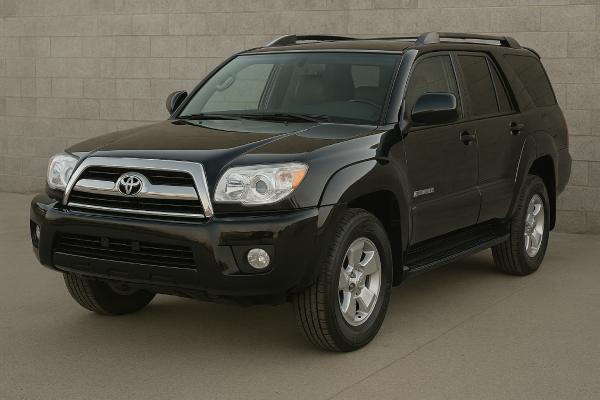
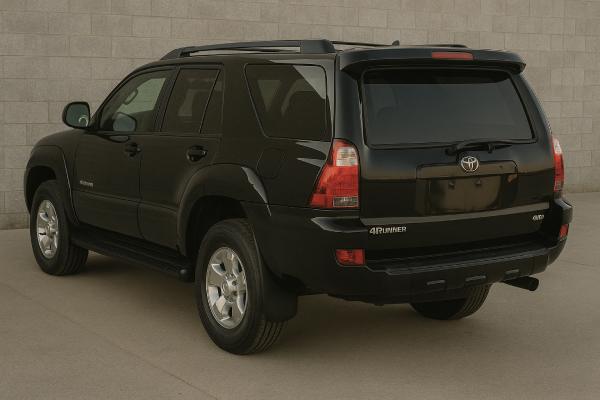
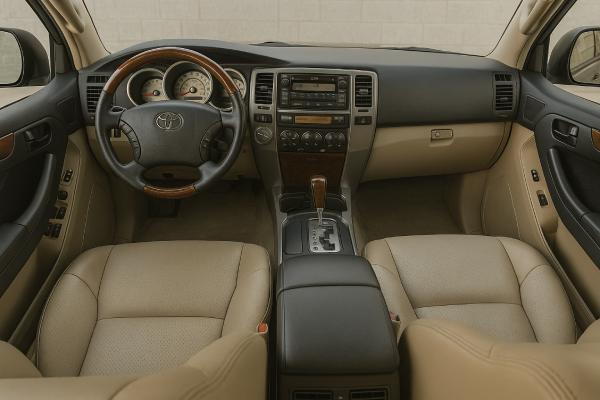
The Toyota 4Runner 2WD (UZN210) covered here is the facelifted 2006–2009 version of Toyota’s fourth-generation, midsize, body-on-frame SUV. It sits above Highlander in towing and ruggedness, and below Land Cruiser in size and luxury. In this specification you’re looking at the rear-wheel-drive V8 model using the 2UZ-FE 4.7-liter with VVT-i, rated at 260 hp after the SAE rating change, driving through a 5-speed automatic. Compared with early-run trucks, the facelift brought mild exterior updates, broader side-curtain airbag availability, and incremental feature and audio upgrades—while preserving the stout ladder frame, independent double-wishbone front suspension, and coil-sprung solid rear axle that make these trucks last. This guide focuses tightly on the 2WD V8 variant—what it is like to own, the specifications and capacities that matter, safety context from the period, the maintenance that keeps it dependable beyond 200,000 miles, and an honest buyer’s checklist two decades on. Expect calm highway manners, excellent low-rpm torque, and confident towing when set up correctly; balance that against fuel consumption, a scheduled timing belt service, and rust vigilance on salted roads.
Quick Overview
- Smooth, durable 2UZ-FE V8 (260 hp); broad low-rpm torque and relaxed highway gearing.
- 2WD (RWD) simplicity: fewer driveline parts than 4WD, easier service access, stable towing manners.
- Caveat: timing belt service (~90,000 mi / 9 years) plus careful frame and crossmember corrosion inspection.
- Typical oil interval: 5,000 miles / 6 months; coolant first at 100,000 miles, then 50,000 miles thereafter.
Navigate this guide
- UZN210 V8 2WD overview
- Specifications and technical data
- Trims, options, and safety (2006–2009)
- Reliability and service actions
- Maintenance schedule and buyer’s guide
- Driving impressions and economy
- How it compares to rivals
UZN210 V8 2WD overview
Within the fourth-generation 4Runner family, UZN210 denotes the V8, two-wheel-drive combination. For 2006–2009, Toyota’s 2UZ-FE V8 gained VVT-i (variable valve timing on intake cams), which—along with an SAE net re-rating—lands at 260 hp (194 kW) with a broad torque curve that makes the truck feel effortless at low and mid rpm. Power goes through the A750E 5-speed automatic to the rear axle. Compared with the V8 4WD models (UZN215), this 2WD setup drops the transfer case and front differential/half-shafts, trimming weight and complexity while retaining the same basic ladder-frame underpinnings and suspension geometry.
The chassis formula is classic Toyota truck: a hydroformed ladder frame for stiffness, double-wishbone front suspension for accurate steering and better camber control than torsion bars of prior generations, and a coil-sprung solid rear axle for durability and load stability. Braking is by four-wheel discs with ABS, EBD (electronic brake-force distribution), and Brake Assist. Stability control (VSC) and A-TRAC (brake-based traction aid) help the 2WD truck keep its line on wet or gravelly surfaces; with good tyres and the inherent weight on the rear axle, it’s stable on highways and competent on graded dirt. The trade-off, of course, is limited traction on deep snow or trail sections where a transfer-case low range would help; many owners mitigate with winter tyres and careful route choices.
Inside, materials wear well and controls are straightforward. The power rear window—a 4Runner hallmark—remains a daily convenience that also vents the cabin quickly. Facelift details brought updated lighting elements, small trim revisions, and expanded side-curtain airbag fitment across more trims. As a long-distance vehicle, the 2WD V8 feels calm and quiet; its value proposition is a simpler, stout truck that still tows with confidence and needs fewer driveline service items than 4WD.
Specifications and technical data
Engine and Performance (2UZ-FE VVT-i, 2006–2009)
| Item | Value |
|---|---|
| Code / architecture | 2UZ-FE; 90° V8, DOHC, 32 valves |
| Displacement | 4.7 L (4,664 cc) |
| Compression ratio | ~10.0:1 |
| Induction / fueling | Naturally aspirated; sequential multi-port injection |
| Rated power | 260 hp (194 kW) @ ~5,400 rpm |
| Rated torque | ~415 Nm (306 lb-ft) @ ~3,400 rpm |
| Timing | Belt (service on interval) |
| Fuel requirement | Regular unleaded (AKI 87 / RON ~91) |
| Fuel tank | 87 L (23.0 gal) |
| Emissions / efficiency std. | EPA window-label era values; see economy table below |
| Aerodynamics | Cd ~0.36–0.37 (typical for body style) |
Transmission and Driveline
| Item | Value |
|---|---|
| Transmission | A750E 5-speed automatic (ECT-i) |
| Drive layout | Rear-wheel drive (2WD) |
| Axle / differential | Open rear diff; A-TRAC brake logic simulates limited-slip |
| Final drive | ~3.73–3.91 (varies by build) |
| Refuel to full | Conventional gasoline; ~3–5 minutes |
Chassis and Dimensions
| Item | Value |
|---|---|
| Frame | Ladder frame (hydroformed sections) |
| Front suspension | Double wishbone, coilover shocks, stabilizer bar |
| Rear suspension | Solid axle, 4-link with coils; stabilizer bar |
| Steering | Rack-and-pinion, hydraulic assist |
| Brakes | 4-wheel discs; ABS, EBD, Brake Assist |
| Wheels/tyres (common OE) | 16–18 in alloys; P265/70R16 or P265/65R17 |
| Wheelbase | 2,790 mm (109.8 in) |
| L × W × H | ~4,800 × 1,880 × 1,750 mm (~189 × 74 × 69 in) |
| Ground clearance | ~231 mm (9.1 in) |
| Approach / departure | ~30° / 26° (tyre-dependent) |
| Turning circle | ~11.3 m (37 ft) |
| Curb weight | ~2,000–2,080 kg (4,410–4,590 lb) by trim |
| GVWR | ~2,585–2,700 kg (5,700–5,950 lb) |
| Cargo volume | ~1,190 L seats up / ~2,120 L seats down (~42 / 75 cu-ft) |
Fluids and Capacities (verify by VIN/labels)
| System | Specification | Approx. capacity / essential notes |
|---|---|---|
| Engine oil | 5W-30 (API SL/SN or later) | ~6.2 L (6.6 qt) incl. filter; drain plug ~39 Nm (29 lb-ft) |
| Coolant | Toyota LLC/SLLC (red/pink) | First 100,000 mi, then 50,000 mi; fill ~11–14 L total |
| Transmission | Toyota ATF WS (A750E) | Drain-fill ~3–4 L; temp-check fill procedure |
| Rear differential | GL-5 75W-90 | ~3.0 L |
| Brake fluid | DOT 3 (DOT 4 acceptable) | Flush every 2–3 years |
| Power steering | Dexron-type ATF | As needed (inspect annually) |
| Wheel lug nuts | — | 110–113 Nm (81–83 lb-ft) star pattern |
Performance and Economy (representative period values)
| Metric | Value (stock tyres) |
|---|---|
| 0–60 mph (0–100 km/h) | ~7.9–8.4 s |
| Top speed (governed) | ~112 mph (180 km/h) |
| EPA-style economy (V8 2WD) | ~15–16 city / 19–20 highway / ~16–17 combined mpg (US) ≈ 14–15 L/100 km |
| Real-world highway @ 75 mph | ~17–19 mpg US (12–14 L/100 km) depending on wind/tyres/load |
| Towing (properly equipped) | Up to ~7,000 lb (3,175 kg) with weight-distributing hitch; 5,000 lb weight-carrying |
| Payload (typical door label) | ~1,200–1,500 lb (545–680 kg) |
| Roof load | ~120–150 lb (54–68 kg) with OEM rack/crossbars |
Practical note: Toyota differentiates between weight-carrying (up to 5,000 lb) and weight-distributing setups for higher tow ratings. Confirm your hitch receiver label, the door-jamb sticker, and trailer tongue weight (target 10–12% of trailer mass).
Trims, options, and safety (2006–2009)
Trim overview (2WD V8 availability):
- SR5: Cloth seating, 16-inch alloys, power rear glass, cruise, keyless entry. Options: convenience packages, roof rack, moonroof, audio upgrades.
- Sport Edition: Adds X-REAS cross-linked shock system, 17-inch wheels, larger front rotors, sport exterior trim and steering-wheel audio controls; the hood scoop is a visual cue (non-functional).
- Limited: Leather and heated front seats, dual-zone automatic climate control, JBL premium audio, 17–18-inch wheels, and additional sound insulation. Some V8 Limiteds offered rear self-leveling air at the axle—useful for cargo/tongue weight, even on 2WD.
Functional differences that affect ownership
- X-REAS (Sport) reduces roll and pitch without harshness. When components leak, many owners convert to conventional shocks/struts for cost and simplicity.
- Rear self-leveling air (select Limited) keeps rake correct when loaded; inspect airbags, lines, and height sensors for leaks or corrosion.
- Stability systems (VSC, A-TRAC, EBD, Brake Assist) are standard and valuable on a 2WD truck in rain and emergency maneuvers.
Quick identifiers
- VIN/build sheets show UZN210 for V8 2WD.
- No front differential or transfer-case housings underneath (flat belly shield forward of the rear axle); dash lacks the 4WD selector and center-diff lock switch.
- Sport’s hood scoop and unique wheels; Limited’s color-keyed cladding and available 18s.
Safety context (period testing)
- The fourth-gen 4Runner performed well in moderate-overlap frontal tests of the era; head-restraint/seat whiplash evaluation scored lower under the then-current IIHS protocol.
- Dual front airbags were standard; side curtain airbags with rollover sensing became widespread post-facelift—verify presence by VIN and pillar tags.
- LATCH anchors are in the outboard second-row positions; consider seat-base geometry for large rear-facing seats.
ADAS/calibration notes
- No camera/radar ADAS in these years; post-service calibrations revolve around steering-angle and yaw-rate zero-point resets after alignments or suspension work. Windscreen replacement does not require camera calibration.
Reliability and service actions
The 2UZ-FE + A750E pairing is among Toyota’s most durable powertrains. Failures tend to reflect age, climate, and maintenance history more than design flaws. Prioritize the following by prevalence and cost.
Common (low–medium severity)
- Timing belt due/overdue → Symptoms: time/miles exceeded; occasional accessory chirp. Remedy: complete timing-system service (belt, tensioner, idlers, water pump, thermostat), fresh coolant, new accessory belt.
- Brake pulsation → Cause: rotor thickness variation and sticky slide pins. Remedy: quality rotors/pads; clean/lube pins; torque wheel nuts 81–83 lb-ft evenly.
- Accessory belt/tensioner noise → Remedy: replace belt and any rough idler/tensioner bearings.
Occasional (medium severity)
- Front lower ball joints / LCA bushings → clunks on sharp bumps, vague on-center. Fix: replace components, torque at ride height, align afterwards.
- X-REAS seepage (Sport) → oily shock bodies/lines and floaty transitions. Fix: replace assemblies or convert to standard shocks/struts.
- Rear self-leveling air leaks (Limited option) → rear sags overnight, compressor cycles frequently. Fix: replace air springs/lines/sensors; coil-conversion is a pragmatic alternative if failures repeat.
- EVAP small-leak codes (P044x) → cracked hoses, canister issues, gas-cap seal. Fix: smoke test, targeted repairs.
Cooling-system aging
- Radiator end-tank micro-seep or brittle heater “T” fittings; soft hoses with age. Fix: radiator/hoses/tees/cap; refill with Toyota coolant and purge air correctly.
Rare but high-severity
- Frame/crossmember corrosion in salt regions → significant scale or perforation near rear lower control-arm pockets, hitch crossmember, and body mounts. Fix: rust remediation/welding; walk away if perforation is significant.
Transmission/driveline (A750E, 2WD)
- Generally robust. Sluggish shifts often improve with WS drain-and-fill (repeat over several services to exchange more fluid) and adaptation relearn.
- Driveshaft slip-yoke “thunk” at stop/start is less common on 2WD than 4WD, but dry splines can still clunk—clean and grease with moly; verify U-joints and centre support (if equipped).
- Rear axle seal seep → oil at backing plates; fix with seals/bearings and ensure axle breather is clear.
Electrical and body
- Tailgate harness wire breaks cause intermittent rear glass or lock behavior—inspect for brittle conductors; repair splices cleanly.
- HVAC blend-door actuators can tick; re-index or replace.
Recalls/TSBs—verification
- Multiple airbag inflator campaigns affected many Toyota trucks/SUVs; confirm completion by VIN.
- TSBs for brake actuator logic and drivability refinements exist; ask a dealer to print your VIN’s campaign history.
Pre-purchase proof to request
- Invoices for timing belt + water pump and coolant, and WS ATF services.
- Alignment reports after suspension work.
- High-resolution photos (or in-person inspection) of frame rails, rear control-arm pockets, hitch crossmember, and body mounts.
- Confirmation of airbag recall completion.
Maintenance schedule and buyer’s guide
Practical maintenance schedule (distance/time; shorten for towing, heat, short-trip use)
- Engine oil & filter: 5,000 mi / 6 months (5W-30; ~6.6 qt / 6.2 L).
- Engine air filter: Inspect at each oil service; replace 30,000–45,000 mi (earlier in dust).
- Cabin filter: 15,000–20,000 mi or annually.
- Spark plugs (iridium): 90,000–120,000 mi; sooner if misfire or gap growth.
- Timing belt: ~90,000 mi or 9 years; do water pump, tensioner, idlers together; fresh coolant and accessory belt.
- Coolant: First 100,000 mi / 10 years, then 50,000 mi / 5 years (Toyota LLC/SLLC).
- Automatic transmission (A750E): WS drain-fill every 60,000–90,000 mi (towing → 50–60k); use temperature-check fill.
- Rear differential: 75W-90 GL-5 every 30,000–60,000 mi (shorten for heavy towing/heat).
- Brake fluid: Flush every 2–3 years; clean/lube caliper slide pins each rotation.
- Suspension/steering: Inspect ball joints, LCAs, tie-rods, shocks/struts every 30,000 mi; check X-REAS routing; verify rear air self-leveling height (if equipped).
- Tyre rotation & alignment: Rotate 5,000–7,500 mi; align annually or after impacts/parts changes.
- 12-V battery: Load-test yearly after year 4.
- A/C & cooling: Pressure/temperature check before summer; consider proactive radiator/hoses at 15–20 years if original.
Essential torque values (typical; verify for your VIN)
- Wheel lugs: 110–113 Nm (81–83 lb-ft).
- Oil drain plug: ~39 Nm (29 lb-ft).
- Front caliper bracket bolts: ~118–128 Nm (87–94 lb-ft).
- Rear shock lower bolts: ~90–100 Nm (66–74 lb-ft).
Buyer’s checklist (2WD V8 focus)
- Frame & underbody: Look inside the frame rails, especially near the rear lower control-arm mounts and hitch crossmember; tap and probe for scale. Check fuel-tank straps and body mounts.
- Engine bay: Pink crust at radiator end tanks or heater tees, brittle hoses, or coolant odor; belt/tensioner noise at cold start.
- Road test: Straight stops from 60 mph (no pulsation), stable tracking, smooth 1–2 and 2–3 shifts; listen for driveline clunks on stop/start.
- Traction aids: Confirm VSC/A-TRAC operate without warning lights; on a safe, loose surface verify controlled brake-based intervention.
- Electrical: Test power rear window, tailgate latch, mirror motors, and seat heaters (Limited). Tailgate harness flex point should be intact.
- Tyres & alignment: Even tread wear; fresh alignment after any suspension work.
- Towing setup: Receiver integrity, wiring condition, and documentation of a weight-distributing hitch if heavy towing is claimed.
What to seek vs. avoid
- Seek: Documented timing belt/water pump, fresh coolant and WS ATF, clean frame, stock-height suspension with alignment records; Sport with healthy X-REAS or Limited with healthy rear air are nice if maintained.
- Avoid/discount: Frame perforation, mixed suspension components without alignment proof, chronic EVAP codes, or neglected fluids; inoperative stability/traction systems are red flags.
Durability outlook
With routine service and rust control, UZN210 V8 2WD trucks commonly reach 200,000–300,000 miles on original long-block and transmission. Costly episodes typically stem from deferred timing-belt/cooling work, aged X-REAS or rear air components, or corrosion—not inherent engine or gearbox weaknesses.
Driving impressions and economy
Ride, handling, NVH
The 2WD V8 rides with a calm, gently controlled motion. The independent front suspension gives confident initial turn-in and stable mid-corner posture for a body-on-frame SUV; the coil-sprung solid rear keeps cargo steady and resists squat with a proper hitch setup. X-REAS trucks reduce head-toss and pitch noticeably when healthy. Steering weight is light-to-moderate with good on-center stability. At 70–75 mph (113–121 km/h), wind and tyre noise lead the cabin’s soundscape; the V8 is a distant hum at cruise.
Powertrain character
The VVT-i 2UZ-FE’s hallmark is easy torque at low rpm. In town it steps off with little throttle; on grades it holds higher gears comfortably. The A750E shifts decisively and locks the converter early to keep revs low. There’s no turbo lag to manage, and part-throttle response is linear. Passing from 50–80 mph (80–129 km/h) triggers a clean downshift, and the truck settles back to quiet cruising quickly.
Real-world economy
Plan on ~16–17 mpg (US) combined with stock tyres; at 75 mph (120 km/h) you’ll often see ~17–19 mpg in neutral winds. Aggressive all-terrain tyres, roof racks, lifts, and winter warm-ups reduce those figures. The 23-gal (87-L) tank yields ~360–400 miles (580–640 km) of highway range at moderate speeds.
Loads and towing
A correctly set weight-distributing hitch transforms stability with heavier campers/boats. Maintain 10–12% tongue weight and verify trailer-brake function. Expect a 20–40% fuel-consumption penalty when towing 4,500–6,000 lb (2,040–2,720 kg) at highway speeds. Fresh rear shocks help control porpoising; Limited models with healthy rear self-leveling air maintain rake and headlight aim. On wet ramps or gravel, the 2WD relies on tyres and A-TRAC—carry proper chocks and consider all-seasons with generous siping or true winter tyres where climate demands.
How it compares to rivals
Jeep Grand Cherokee WK (2006–2010, 2WD V8): Livelier steering and available larger V8s; long-term, the Toyota tends to deliver fewer electrical and transmission surprises and better materials aging. The Jeep can be the enthusiast’s pick for off-road build potential; the 4Runner is the safer bet for low-drama ownership.
Ford Explorer U152 (2006–2010, RWD V8): Comfortable ride and wide availability. High-mile examples often need suspension and transmission attention. The 4Runner’s V8 is quieter at cruise, interiors seem to hold up better, and resale typically favors Toyota.
Nissan Pathfinder R51 (RWD V8 arrived later in platform family): Bigger interior and three rows on many trims. Driveline and cooling concerns can rise with age. The 4Runner counters with simpler systems and stronger long-horizon durability.
Chevrolet TrailBlazer/Envoy (GMT360, RWD 5.3 V8 available): Good power and low entry prices. Interiors and bushings tend to show wear sooner; HVAC/electrical quirks are common. The 4Runner generally wins on long-term reliability and alignment stability after a suspension refresh.
Bottom line: If you want a straightforward, durable, rear-drive V8 SUV with real truck bones—but fewer driveline parts to service than 4WD—the UZN210 facelift (2006–2009) is a compelling, value-safe choice. Budget for fuel, the timing-belt service, and thorough rust checks, and it will repay with years of quiet, capable miles.
References
- 2008 Toyota 4Runner 2008 (Safety Rating)
- Vehicle Detail Search – 2008 TOYOTA 4RUNNER | NHTSA 2008 (Recall Database)
- 2008 4Runner – Owners’s Manual 2008 (Owner’s Manual)
- 2008 Toyota 4Runner 4-door SUV 2008 (EPA Fuel Economy)
Disclaimer
This article is for informational purposes and is not a substitute for professional diagnosis or repair. Specifications, torque values, intervals, and procedures can vary by VIN, market, production date, and equipment. Always confirm details in your vehicle’s official owner’s manual and Toyota service literature and follow proper safety practices. If this guide helped you, please consider sharing it on Facebook or X/Twitter to support xcar’s work.