
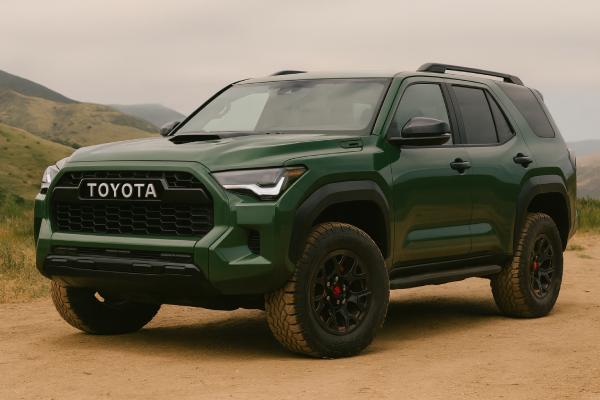
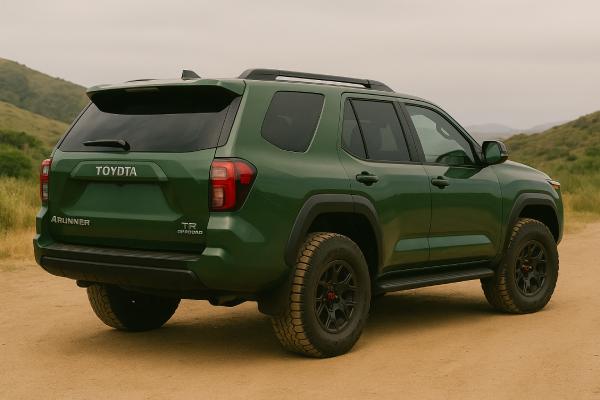
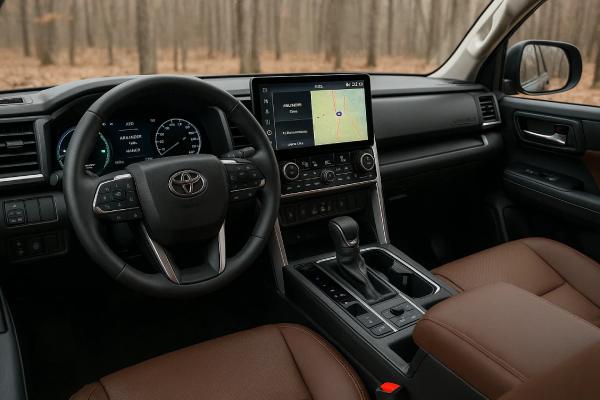
The sixth-generation Toyota 4Runner arrives as a body-on-frame, five-door midsize SUV built on the TNGA-F architecture. This article focuses on the 4WD i-FORCE MAX hybrid (N500) introduced for model year 2025 in North America. The hybrid system pairs a turbocharged 2.4-liter four-cylinder with an integrated electric motor and a conventional 8-speed automatic, delivering strong low-rpm torque and improved highway efficiency while preserving the 4Runner’s off-road character. Trim availability centers on adventure-oriented grades (TRD Pro and Trailhunter) plus upscale Limited and Platinum. The cabin moves forward with larger screens, more driver assistance, and modern infotainment, yet retains the square-shouldered practicality and configurable cargo space that long-time owners expect. If you need a durable ladder-frame SUV that tows, handles rough roads without drama, and still fits family life, the i-FORCE MAX 4WD is the heart of the new lineup. Below you will find the key specs, ownership costs, known issues, and buying guidance to help you choose the right configuration and keep it reliable for the long haul.
Fast Facts
- Robust hybrid torque: up to 465 lb-ft (630 Nm) for towing and trail work; 6,000 lb (2,722 kg) max tow rating when properly equipped.
- Modern TNGA-F frame with improved ride control, available full-time 4WD and locking center differential on higher trims.
- Standard Toyota Safety Sense 3.0 with lane support, adaptive cruise, AEB, and improved camera/radar coverage.
- Caveat: turbo-hybrid adds thermal and cooling complexity; follow oil and coolant service closely, especially under heavy loads.
- Practical interval to remember: rotate tires every 5,000–6,000 miles (8,000–10,000 km) to protect 4WD driveline and even tread wear.
Guide contents
- 4Runner i-FORCE MAX Overview
- Specifications and Technical Data
- Trims and Options, Safety and Driver Assistance
- Reliability, Common Issues and Service Actions
- Maintenance and Buyer’s Guide
- Driving and Performance
- How 4Runner Compares to Rivals
4Runner i-FORCE MAX Overview
The sixth-generation 4Runner brings a meaningful reset without abandoning the formula that made it an icon. Underneath is Toyota’s TNGA-F ladder frame—a stiff, modular architecture that also underpins Tacoma, Land Cruiser, and Tundra—paired with a multi-link rear suspension and double-wishbone front. The i-FORCE MAX hybrid powertrain is the range’s performance centerpiece: a turbocharged 2.4-liter four-cylinder (T24A-FTS) joined by a compact electric motor integrated with the 8-speed automatic. The hybrid’s combined output—up to 326 hp (243 kW) and 465 lb-ft (630 Nm)—is tuned for immediate step-off and midrange punch rather than peak-rpm theatrics. That matters when you’re towing, merging uphill, or crawling over ledges at walking speed.
All i-FORCE MAX models are 4WD; Limited and Platinum use a full-time system with an electronically controlled locking center differential for seamless on-road traction and predictable off-road behavior. Trail-focused grades (TRD Pro and Trailhunter) add 33-inch all-terrains, skid protection, and tuned dampers; Trailhunter layers on overlanding hardware (snorkel-style high-mount intake, on-board air, rack, and lights). The 4Runner remains a proper SUV with a traditional rear hatch and the beloved roll-down power rear glass, now joined by modern conveniences like an available hands-free liftgate, a 14-inch center touchscreen, and updated driver aids.
Capacity and control are central to the 4Runner’s mission. Towing is rated up to 6,000 lb (2,722 kg) with the hybrid. Payload varies by trim and options; expect figures broadly in the 1,400–1,700 lb (635–771 kg) range—enough for passengers, camping gear, and a modest tongue weight. Ground clearance, approach/departure, and underbody protection all scale with grade and tire choice; the off-road-oriented trims sit higher and accept real trail abrasion. The hybrid packaging keeps batteries within the frame to preserve cargo function and protect components, an important detail if you routinely travel washboard or rutted fire roads.
Crucially, Toyota refined everyday manners. Steering weight is calmer on the highway, the cabin is quieter with better sealing, and the suspension controls big body motions more gracefully than the prior generation. Yet the 4Runner’s core personality remains: simple to read from the driver’s seat, easy to place on a narrow path, and built to take abuse that would sideline a crossover. If you’re stepping out of a body-on-frame truck or a previous 4Runner, the learning curve is short—just more torque, more tech, and better seats.
Specifications and Technical Data
Engine and Performance
| Item | Specification |
|---|---|
| Engine code | T24A-FTS (turbocharged inline-4) + integrated traction motor (i-FORCE MAX) |
| Displacement | 2.4 L (2,393 cc) |
| Induction & fueling | Single twin-scroll turbo; direct + port fuel injection |
| Compression ratio | 10.5:1 (approx., turbo-hybrid calibration) |
| Rated system output | Up to 326 hp (243 kW) |
| Peak torque | Up to 465 lb-ft (630 Nm) |
| Timing drive | Chain (no scheduled belt replacement) |
| Fuel tank | ~21 gal (≈79 L), grade-dependent |
| Aerodynamics | Box-section SUV profile; underbody shielding on off-road grades |
Transmission and Driveline
| Item | Specification |
|---|---|
| Transmission | 8-speed electronically controlled automatic (hydraulic torque converter with integrated motor-generator) |
| Transfer case | Part-time 2-speed 4WD (many grades) or full-time 4WD with lockable center differential (Limited, Platinum) |
| Low range ratio | ~2.6:1 (typical for TNGA-F midsize trucks; verify by VIN) |
| Rear differential | Electronic locking rear diff available/standard on trail grades |
| Final drive | Ratio varies by tire package; calibrated for 33-inch options on TRD Pro/Trailhunter |
| Towing equipment | Class-appropriate receiver, 7-pin wiring, integrated trailer-sway control |
Chassis and Dimensions
| Item | Specification |
|---|---|
| Platform | TNGA-F body-on-frame, high-strength steel frame rails |
| Front suspension | Double-wishbone, coil-over shocks (tuned per grade; FOX QS3 on TRD Pro; Old Man Emu on Trailhunter) |
| Rear suspension | Multi-link solid axle with coils; available stabilizer-bar disconnect |
| Brakes | 4-wheel discs with ABS, EBD, brake assist; trail brake-hold and downhill assist available |
| Steering | Electric power steering (rack-assist) |
| Wheels/Tires | 17- or 18-in; up to 33-in all-terrain on TRD Pro/Trailhunter |
| Ground clearance | Trim-dependent; off-road grades highest (target >9.0 in / >230 mm) |
| Exterior size | Midsize SUV footprint; wheelbase shared with Tacoma (verify per trim) |
| Cargo volume | Split-fold rear; flat load floor; power rear glass maintains long-item pass-through |
Fluids and Capacities
(Always confirm by VIN in the official service manual.)
- Engine oil: SAE 0W-20 API SP, synthetic; capacity ~5–6 qt (4.7–5.7 L) with filter.
- Automatic transmission: Toyota WS (World Standard) ATF; service fill by temperature/level procedure.
- Transfer case & differentials: 75W-85/90 GL-5 gear oil (per axle spec).
- Engine/hybrid cooling: Toyota Super Long Life Coolant (pink, P-OAT).
- Brake fluid: DOT 3 or DOT 4 (per cap/label).
- Key torque examples: wheel lugs ~113 Nm (83 lb-ft); oil drain plug ~39 Nm (29 lb-ft); always verify per trim and fastener.
Performance and Economy
| Metric | Value |
|---|---|
| 0–60 mph (estimate) | Low-to-mid 6-second range depending on grade/tires |
| Towing capacity | Up to 6,000 lb (2,722 kg) when properly equipped |
| Payload | ~1,400–1,700 lb (635–771 kg), trim-dependent |
| Highway economy | Up to an estimated 24 mpg (9.8 L/100 km) for i-FORCE MAX 4WD |
| Real-world highway @ 75 mph | Expect ~10–12 L/100 km (20–24 mpg US) depending on tires/rack/load |
Trims and Options, Safety and Driver Assistance
Trim walk (hybrid availability and highlights)
- TRD Pro (i-FORCE MAX standard): 33-in all-terrain tires on 18-in wheels, TRD-tuned FOX QS3 shocks with rear reservoirs, TRD intake/exhaust calibration, skid protection, off-road cameras, and unique interior accents. The focus is sustained trail speed and control over repeated impacts.
- Trailhunter (i-FORCE MAX standard): Factory overlanding build with Old Man Emu dampers, integrated ARB roof rack, on-board air, heritage grille with LED light bar, high-mount air intake, and recovery points. Tuned for load carrying and washboard comfort.
- Limited (i-FORCE MAX available; full-time 4WD): Leather seating, larger infotainment, chrome/exterior detailing, and a focus on quietness. Full-time 4WD with lockable center differential simplifies wet/snow driving.
- Platinum (i-FORCE MAX standard; full-time 4WD): Top luxury specification with broader acoustic treatment, convenience tech, and driver-assist upgrades.
- TRD Off-Road / Off-Road Premium (i-FORCE MAX available): Part-time 4WD with 2-speed transfer case, selectable rear locker, crawl control, and Multi-Terrain Select; balance between daily use and weekend rock crawling.
Wheel/tire packages matter. The tall 33-inch all-terrains add compliance and traction at the cost of some braking distance and highway efficiency. Touring-oriented all-seasons on Limited/Platinum shorten stopping distances and feel calmer on rain-grooved pavement.
Options and identifiers
- Quick tells: TRD Pro/Trailhunter ride height, wheel/tire fitment, grille treatment, and shock brands. Limited/Platinum get distinctive brightwork and full-time 4WD badging.
- VIN/build: Engine family “T24A” and “i-FORCE MAX” identifiers appear in the emissions label and build sheet; transfer case and axle codes on the door-jamb plate decode gear ratios and locker presence.
Safety ratings and structure
The 2025 4Runner is a clean-sheet generation with updated occupant cell design, more high-strength steel, and a modern restraint strategy. Toyota Safety Sense 3.0 is standard across trims and integrates camera-based lane recognition with a long-range radar. As of this writing, IIHS lists the 2025 4Runner in its database with ongoing evaluations; final award tiers can change as additional tests (side small-overlap 2.0, pedestrian AEB night, updated moderate overlap) are completed. Airbag coverage includes front, side, curtain, and driver knee (exact count varies by seat configuration).
ADAS content and calibration notes
- Core features: Pre-Collision System with pedestrian detection, Dynamic Radar Cruise Control, Lane Departure Alert with Steering Assist, Lane Tracing Assist, Road Sign Assist, and automatic high beams.
- Parking and visibility: Panoramic view monitor (multi-camera), front-trail camera with tire path overlay, blind-spot monitor with rear cross-traffic alert, and available digital rearview mirror.
- Service implications: After windshield replacement, radar or camera removal, front-end collision repair, or ride-height changes, expect static/dynamic calibrations for radar and forward camera. Use level floors, correct tire pressures, and OE targets; off by a few millimeters can cause lane-keeping or AEB false alerts.
Reliability, Common Issues and Service Actions
It’s a new platform with a modern turbo-hybrid system, so long-term patterns are still forming. That said, the i-FORCE MAX architecture borrows heavily from Tacoma/Tundra hybrids and Toyota’s long history with nickel-metal hydride (or lithium-ion, depending on supply) traction batteries. Below are early observations and best practices based on design features and analogous Toyota hybrids.
Common/expected (low–medium cost):
- Turbo heat management: Symptoms include heat-soak after shutdown, faint coolant smell, or oil coking in severe use. Root cause is elevated under-hood temps after towing or long climbs. Remedy: observe turbo cooldown (easy driving for last few minutes), use the correct 0W-20 synthetic, and ensure grille shutters and under-trays are intact.
- Intercooler condensation (humid climates): Brief stumble on first throttle after a long cruise. Drain path and updated PCV routing usually mitigate; wide-open-throttle clears residual moisture.
- All-terrain tire cupping: Aggressive tread + soft dampers can cup on the rear axle by 8–12k miles (13–19k km) if rotations are skipped. Remedy: rotate every 5–6k miles and verify rear toe within spec after accessory loadouts.
Occasional (medium cost):
- Hybrid cooling loops contamination/cross-fill: Mixed coolants during service can gel and reduce flow to the inverter or electric motor electronics. Remedy: only Toyota P-OAT pink SLLC; vacuum-fill and bleed per manual.
- Active grille shutter faults: Ice or brush can jam shutters, flagging a check-engine or hybrid-system warning. Inspect for debris, verify shutter sweep during service, and recalibrate with a scan tool if needed.
Rare/early-build watch items (varies):
- Wiring harness abrasions off-road: Skid-plate edges and rack hardware can rub a loom. On overland builds, add spiral wrap at contact points and re-torque skid fasteners after the first trail day.
- Sensor alignment drift: Lift kits or heavy roof loads can alter radar/camera aim. Perform ADAS recalibration after suspension changes and verify vehicle thrust line.
Driveline and chassis
- Transfer case usage: Exercise 4HI/4LO monthly to circulate lubrication and prevent actuator stiffness.
- Rear locker actuation: Engage on dirt at low speed a few times per season; avoid dry-pavement use.
- Corrosion hotspots: Rocker pinch welds, rear frame cross-member near the tow receiver, and skid-plate mounting bosses. Rinse after salt exposure; consider cavity wax in snowbelt regions.
Recalls, TSBs, and updates
- ECU/TCU reflashes: Expect periodic updates to improve shift logic, engine stop/start blending, or AEB tuning. Ask the dealer to check for current calibrations at each service.
- VIN check: Run an official VIN recall search before purchase and after major service to ensure campaign compliance. Keep printed proof with your records.
Pre-purchase checklist
- Full service history (oil changes at or earlier than the severe schedule if towing/overlanding).
- Evidence of proper coolant service (pink Toyota SLLC only) and zero coolant-oil cross-contamination.
- Tire rotation records; inspect for cupping and uneven wear that hint at alignment or bushing wear.
- Function test of 4WD modes, rear locker, crawl control, and stabilizer-bar disconnect (if equipped).
- ADAS health: confirm radar cruise holds speed smoothly and lane tracing doesn’t pinball on marked highways.
- Accessory installs (racks, lights, winches): look for proper routing, fusing, and waterproof connectors.
Maintenance and Buyer’s Guide
Practical maintenance schedule (severe-service friendly)
- Engine oil & filter: Every 5,000–7,500 miles (8,000–12,000 km) or 6–12 months, whichever comes first. Use API SP 0W-20 synthetic and OE-quality filter. Heavy towing, dusty trails, or short trips → favor 5,000-mile intervals.
- Engine air filter: Inspect at 10,000 miles (16,000 km); replace 20,000–30,000 miles (32,000–48,000 km), sooner with dust or snorkel use.
- Cabin filter: 12 months/15,000 miles (24,000 km) or sooner if airflow declines.
- Spark plugs: Iridium; inspect 60,000 miles (96,000 km); replace around 100,000 miles (160,000 km).
- Coolant (engine/hybrid/inverter loops): Toyota SLLC; first drain/fill at 100,000 miles (160,000 km) or 10 years, then every 50,000 miles (80,000 km)/5 years.
- Automatic transmission fluid (WS): Inspect for temperature-based level and color by 60,000 miles (96,000 km); service 60,000–100,000 miles (96,000–160,000 km) if towing/off-road.
- Transfer case & differentials: Replace gear oil every 30,000–45,000 miles (48,000–72,000 km) if 4WD is used frequently, every 60,000 miles (96,000 km) otherwise.
- Brake fluid: Replace every 2–3 years; flush sooner after deep-water crossings or trackable moisture content >3%.
- Belts/hoses: Inspect every service; tensioner and idler pulleys by 90,000 miles (145,000 km).
- Tires & alignment: Rotate every 5,000–6,000 miles (8,000–10,000 km). Align after lift/armor installs or curb hits.
- 12-V battery: Test annually after year 3; expected life 4–6 years in mixed climates.
Fluid specs recap
- Oil: 0W-20 API SP; typical fill ~5–6 qt (4.7–5.7 L)—verify by dipstick after warm refill.
- ATF: Toyota WS; fill via overflow check at ~40–50°C fluid temp.
- Gear oils: GL-5 75W-85 or 75W-90 per axle spec and temperature range.
- Coolant: Toyota Super Long Life Coolant (pink).
- Power steering: Electric assist—no regular fluid changes.
Essential torque values (verify per VIN)
- Wheel lugs: ~113 Nm (83 lb-ft).
- Oil drain plug: ~39 Nm (29 lb-ft).
- Skid-plate fasteners: re-torque after first trail day; torque varies by plate (consult accessory guide).
Buyer’s Guide – what to look for
- Use case fit: If you primarily tow and camp, Trailhunter’s suspension and onboard air are worth the weight. Frequent snow/ice commuters benefit from Limited/Platinum full-time 4WD.
- Tires drive behavior: 33-inch A/Ts transform feel (and noise). If you want the look but commute long distances, consider a quieter A/T with better wet braking and snow 3PMSF rating.
- Options with value: Locking rear differential, surround-view cameras, trail-turn assist, and the stabilizer-bar disconnect meaningfully expand capability.
- Avoidable extras (some buyers): Roof baskets and heavy steel bumpers if you’re not truly overlanding—these cut payload and mpg and can complicate ADAS alignment.
- Long-term outlook: Toyota hybrids have excellent durability when fluids are correct and coolers stay clean. The turbo introduces heat that demands attention; good maintenance and conservative warm-up/cool-down habits are your best reliability “mods.”
Driving and Performance
Ride, handling, NVH
On pavement the new 4Runner is calmer than its predecessor. The TNGA-F frame resists twist over driveway diagonals, and the multi-link rear controls axle hop on broken surfaces. Steering effort is natural and stable at highway speeds with less on-center wander than older 4Runners. Off-road grades have firmer low-speed damping to prevent head toss on rocks; Limited/Platinum favor a plush primary ride. Cabin noise depends on tires: rugged A/Ts add hiss on coarse asphalt at 70–75 mph (115–120 km/h), while touring all-seasons keep things quiet enough for hands-free calls.
Powertrain character
The i-FORCE MAX hybrid’s defining trait is torque on demand. The integrated electric motor fills in below turbo boost, so there’s little lag leaving a junction or climbing a ramp with a trailer. The 8-speed shifts cleanly; kickdown is decisive in Sport, slurring slightly in Normal for smoothness. In low range, the hybrid’s control electronics meter torque precisely at walking speed, and the crawl control’s updated tuning is less herky-jerky over ledges than past systems.
Real-world efficiency
Expect 20–24 mpg US (12–9.8 L/100 km) on highway runs in 4WD hybrids with moderate loads and roof clear. Add a roof rack, light bar, or 33-inch tires and plan on a 10–20% penalty at 65–75 mph (105–120 km/h). Urban efficiency varies with climate; short warm-ups in winter and heavy HVAC use reduce hybrid benefit.
Key metrics
- 0–60 mph: Low-to-mid-6s on street tires and standard ride height; off-road rubber adds a few tenths.
- 50–80 mph passing: Strong; the hybrid’s midrange torque shortens uphill merges.
- 100–0 km/h braking: Tire-dependent; the Pro/Trailhunter’s A/Ts lengthen distances vs. Limited/Platinum.
- Turning circle: Tight for a body-on-frame SUV; be mindful of rack-stop spacers on 33-in setups.
Traction, control, and loads
The full-time 4WD on Limited/Platinum adds confidence on messy pavement and mixed-traction turns; lock the center differential for sustained deep snow or loose gravel. Trail mode logic relaxes brake-based traction control, and the stabilizer-bar disconnect increases front articulation at low speeds. Under tow (up to 6,000 lb/2,722 kg), the hybrid’s torque helps maintain speed on grades without screaming revs; watch transmission temps in hot headwinds and consider earlier downshifts on long climbs. With a family and camping kit aboard, the 4Runner remains composed as long as you balance rear spring preload and keep tongue weight within spec.
How 4Runner Compares to Rivals
Ford Bronco (2.7T/3.0T): Bronco offers more tire/wheel choices and detachable doors/roof, plus on-trail agility from an independent front suspension. Its turbos are rowdy fun, but long-term ownership can involve more frequent small fixes and accessory rattles. 4Runner counters with a quieter cabin, simpler cargo access, and hybrid torque that’s better for daily towing and fuel economy.
Jeep Wrangler (2.0T/3.6/4xe): Wrangler is unmatched in axle articulation and aftermarket depth, and the 4xe plug-in variant provides silent short-range trail capability. It also rides busier and can be noisier at 70+ mph. 4Runner’s fixed roof and TNGA-F tuning create an easier daily driver; Toyota’s ADAS is more consistent in poor weather.
Jeep Grand Cherokee (V6/4xe): Grand Cherokee brings a more luxurious interior and available air suspension, but long-term complexity and cost can be higher. The 4Runner’s hybrid is simpler (no plug), and Toyota’s reputation for durable trucks appeals to owners who keep vehicles past 150,000 miles (240,000 km).
Land Rover Defender (P300/P400): Defender is brilliant off-road and refined on-road, yet purchase and maintenance costs are higher. 4Runner aims for robust, repeatable performance with widely available parts and dealer support across North America.
Toyota Highlander Hybrid / 3-row crossovers: If you prioritize fuel economy, quiet commuting, and third-row passenger comfort, a unibody hybrid crossover is a better fit. But for towing stability on rough approaches and repeated trail use, the 4Runner’s frame, low range, and locker give it the edge.
References
- The All-New 2025 Toyota 4Runner: The Icon That Inspires Exploration 2024 (Press Release)
- 2025 Toyota 4Runner Refines Adventure Ready Heritage 2025 (Press Release)
- 2025 Toyota 4Runner 2025 (Safety Rating)
- 4Runner – Toyota 2025 (Model Hub)
Disclaimer
This article is for informational purposes and is not a substitute for professional diagnosis or repair. Specifications, torque values, service intervals, and procedures vary by VIN, model year, market, and equipment. Always verify details against your official owner’s manual and service documentation, and follow the latest technical bulletins. If you found this guide useful, please consider sharing it on Facebook or X/Twitter to support xcar’s work.