
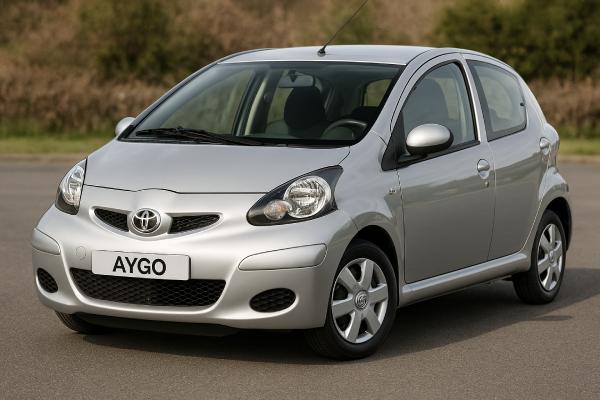
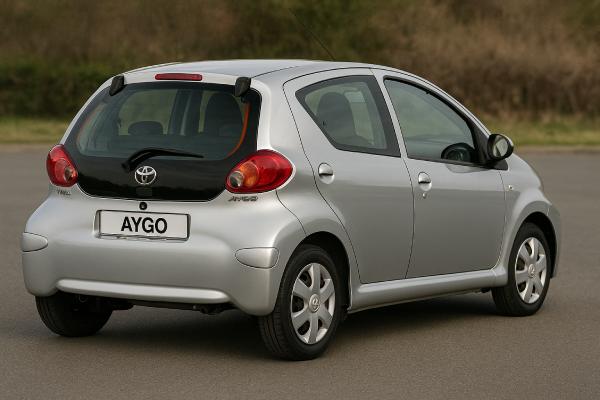
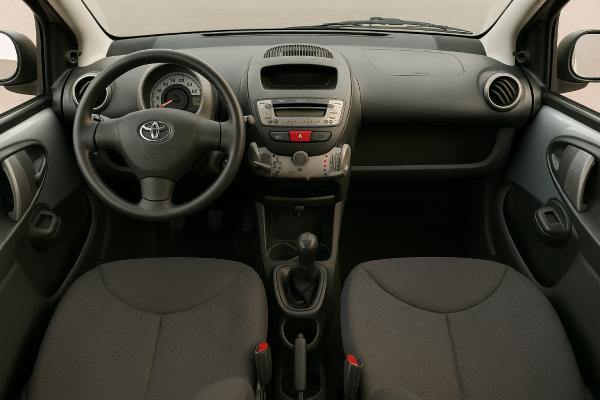
The first-generation Toyota Aygo (KGB10) is a four-seat A-segment hatchback built for European cities from 2005. It sits below the Yaris, sharing its platform with the Peugeot 107 and Citroën C1, and prioritizes low running costs, tiny exterior dimensions, and simple mechanicals that are easy to own. This guide focuses on the 2005–2008 petrol Aygo with the 1KR-FE 1.0-litre three-cylinder (rated at 68 hp), paired to either a 5-speed manual or Toyota’s MMT automated manual. Buyers typically want to know what it’s like to drive day-to-day, the real fuel use on highways, how durable the timing-chain engine is, and which common age-related issues to check before purchase. Below, you’ll find a concise, European-baseline view of specifications, equipment, safety performance, reliability patterns, maintenance choices, and a practical buyer’s checklist tailored to this exact variant and model years.
Fast Facts
- Light, frugal city car: real mixed driving often 5.0–5.5 L/100 km (43–47 mpg US) with sensible speeds.
- Tiny footprint, big value: 3.41 m long, tidy ~9.5 m turning circle, and simple hardware that keeps costs low.
- Chain-driven 1KR-FE is robust with regular oil; watch auxiliary belt and water pump by age/mileage.
- MMT gearbox can work well if healthy; poor shifts often trace to clutch wear/actuator calibration.
- Anchor interval: engine oil and filter every 15,000 km or 12 months, whichever comes first.
What’s inside
- Aygo KGB10 1.0 overview
- Aygo 1.0 specifications
- Aygo trims and safety
- Reliability and service actions
- Maintenance and buyer’s guide
- Driving and performance
- Aygo vs rivals
Aygo KGB10 1.0 overview
Toyota engineered the Aygo to be a purpose-built city car: short overhangs, tall cabin, and a wheel-at-each-corner stance that makes tight streets and parking easy. The KGB10 chassis underpins all 2005–2008 petrol Aygos; the 1KR-FE engine is a 998 cc, 12-valve, chain-driven three-cylinder with variable valve timing (VVT-i) on the intake side. It’s tuned for low weight, low friction, and quick warm-up—perfect for short trips—yet it’s durable enough for sustained motorway use if you respect its modest power.
Positioning is straightforward: it sits below Yaris in Toyota’s lineup. Compared with superminis, the Aygo trades outright refinement and space for simplicity and low total cost of ownership. The 1.0-litre suits new drivers, commuters, and anyone who values light controls and predictable running costs more than rapid acceleration. The cabin is basic but ergonomic, with four belted seats, ISOFIX child-seat provision on many trims, and a split-folding rear bench that opens up a surprisingly usable load area for the class.
Two gearboxes were offered with this engine. The 5-speed manual is conventional and reliable with occasional shift-cable and clutch-wear checks. The MMT automated manual (electro-hydraulic actuators that operate a conventional clutch and gearbox) adds two-pedal convenience; it’s smoothest when the clutch is fresh and the system is correctly calibrated. Brakes are simple—vented front discs and rear drums—and the steering uses an electric assist that’s light in town and settled at motorway speeds. Safety tech is of its era: airbags and ABS/EBD are the mainstays; full-fat modern driver aids weren’t yet part of the package on these years.
As a used buy, the Aygo thrives on routine oil changes, clean air and fuel filtration, and attention to a handful of known wear points (door and lamp seals, clutch, auxiliary belt path). Treated well, the 1KR-FE’s timing chain routinely outlives the car. Neglect, however, can show up as chain rattle, MMT shift jerk, or cooling and belt noises—topics covered later in this guide.
Aygo 1.0 specifications
Engine and Performance
| Item | Detail |
|---|---|
| Engine code | 1KR-FE (inline-3, 12-valve, DOHC, VVT-i intake) |
| Displacement | 1.0 L (998 cc) |
| Induction & fueling | Naturally aspirated, multi-point fuel injection |
| Compression ratio | ~10.5:1 |
| Rated power | 68 hp (50 kW) @ ~6,000 rpm |
| Rated torque | 93 Nm (69 lb-ft) @ ~3,600 rpm |
| Emissions/efficiency std. (period) | Euro 4 era, catalyst and OBD |
| Timing | Chain (no scheduled replacement; monitor by symptoms) |
| Fuel tank (usable) | 35 L (9.2 US gal) |
| Aerodynamics | Cd ≈ 0.30–0.31; frontal area ≈ 1.9–2.0 m² (approximate) |
| Real-world highway @ 120 km/h (75 mph) | 5.5–6.0 L/100 km (39–43 mpg US), range ~500–600 km per tank |
Transmission and Driveline
| Item | Detail |
|---|---|
| Drive | Front-wheel drive |
| Gearboxes | 5-speed manual; MMT automated manual (electro-hydraulic actuators) |
| Final drive | Open differential; city-friendly gearing |
| Notes | MMT shifts best with fresh clutch and correct actuator learn-in; manual clutch is light and inexpensive to service |
Chassis and Dimensions
| Item | Detail |
|---|---|
| Front / rear suspension | MacPherson strut / torsion-beam axle |
| Steering | Electric power steering, rack-and-pinion |
| Brakes | 247 mm ventilated front discs; 200 mm rear drums; ABS with EBD |
| Wheels/tyres (typical) | 14×4.5J steel/alloy; 155/65 R14 |
| Length × width × height | 3,405 × 1,615 × ~1,465 mm (134.1 × 63.6 × 57.7 in) |
| Wheelbase | 2,340 mm (92.1 in) |
| Ground clearance | ~150–160 mm (~6.0–6.3 in), load-dependent |
| Kerb weight (range) | ~790–890 kg (1,742–1,962 lb), by trim/gearbox |
| GVWR (typical) | ~1,180–1,245 kg (2,601–2,745 lb) |
| Turning circle (kerb-to-kerb) | ~9.5 m (~31.2 ft) |
| Cargo volume | 139 L seats up; expands substantially with rear bench folded |
| Roof load | Up to ~50 kg with approved bars (confirm per vehicle docs) |
| Towing | Not approved in some markets; verify on registration/handbook |
Fluids and Capacities
| System | Specification & capacity (typical) |
|---|---|
| Engine oil | 5W-30 meeting API SL/SM (ACEA A1/A5) common in period; capacity ~3.1 L (3.3 US qt) with filter |
| Coolant | Toyota Super Long Life Coolant (pink); system fill ~4.0–4.4 L |
| Manual transmission | API GL-4 75W/75W-80; ~1.7–2.0 L service fill |
| Brake fluid | DOT 3 or DOT 4; change on time |
| Tyre pressures (typical) | Front ~2.3 bar (33 psi) / Rear ~2.1 bar (30 psi); adjust for load/speed |
| Essential torque values | Wheel fasteners ~103 Nm (76 lb-ft); spark plugs ~18 Nm (13 lb-ft); engine drain plug ~39 Nm (29 lb-ft) (verify by VIN/year) |
Performance and Economy
| Metric | Result (typical) |
|---|---|
| 0–100 km/h (0–62 mph) | ~14.2–15.7 s (gearbox/conditions) |
| Top speed | ~154–157 km/h (96–98 mph) |
| Mixed economy (owner-observed) | 5.0–5.5 L/100 km (43–47 mpg US; 52–66 mpg UK) |
| Urban | 5.5–6.5 L/100 km (36–43 mpg US) with smooth driving |
| Extra-urban | Low 5s L/100 km achievable with steady speeds |
| Range per tank (mixed) | ~500–650 km depending on weather/grade/load |
| Payload (typical) | ~300–350 kg by trim |
Aygo trims and safety
Trims and Options (2005–2008)
Naming varied slightly by country, but the structure was broadly:
- Aygo (base): dual front airbags, ABS with EBD, basic audio (2 speakers), steel wheels, cloth seats, manual windows/mirrors.
- Aygo+: often added side airbags, ISOFIX mounts, electric front windows, improved audio (4 speakers), cosmetic trim pieces.
- Sport / Sport-oriented grade: alloys, tachometer, fog lamps, body accents; mechanical spec largely unchanged.
- Options and packs: A/C, remote locking, upgraded head unit, split-fold rear bench (market dependent), MMT automated manual for 1.0-litre.
Quick identifiers: tachometer and alloy wheels point to the Sporty grade; speaker tweeters and rear headrests can indicate higher equipment. VIN option codes on the build label confirm airbags and A/C content where country brochures differ.
Year-to-year notes (’05–’08): Early cars sometimes lacked ISOFIX as standard; later packaging made it more common. MMT availability and audio head units evolved. Cosmetic tweaks arrived before the later facelift era; chassis and powertrain stayed consistent.
Safety Ratings and Systems
- Crash performance: The Aygo achieved a solid star rating in its original mid-2000s European tests for adult protection (strong for the A-segment at the time). Results reflect the period’s protocols rather than today’s stricter standards.
- Restraints and structure: Front airbags standard; side airbags were trim/pack dependent on early cars. Front seatbelts include pretensioners and load limiters.
- Child seats: ISOFIX/LATCH anchors on many cars; always confirm presence and position on the specific vehicle.
- Braking and stability: ABS with EBD standard. Full electronic stability control generally wasn’t fitted on these early years in many markets.
- Service implications: After airbag/SRS work, follow clock-spring and sensor checks. Following front-end repairs, ensure crash-box/bumper carriers and headlamp brackets are replaced and torqued to spec; alignment should include a steering-angle sensor check on vehicles so equipped.
Reliability and service actions
The KGB10 Aygo with the 1KR-FE engine is generally durable when serviced on time with the correct oil. Age and city use concentrate wear in predictable places. Below you’ll find the most relevant patterns for 2005–2008 petrol models, mapped by prevalence and cost impact.
Common (expect on older/high-mileage cars)
- Clutch wear (manual and MMT): Symptoms: rising bite point, slip under load, shudder on take-off, or harsh MMT shifts. Root cause: friction disc wear and/or glazing; MMT actuator compensates until limits are reached. Remedy: quality clutch kit; for MMT, perform clutch kiss-point learn and gear selection calibration afterward.
- Auxiliary belt and tensioner noise: Symptoms: squeal on cold start, chirp with A/C load. Cause: aged belt or misaligned pulley; sometimes crank pulley rubber deterioration. Fix: replace belt, inspect/idler/tensioner and crank damper.
- Water ingress (tailgate/lamp/door membrane): Symptoms: damp boot carpet, misted lamps, musty cabin. Cause: aged seals, lamp gasket compression, door-membrane adhesive failure. Fix: reseal or replace gaskets; clear body vents; verify high-mount stop-lamp seal.
- Exhaust flex joint fatigue: Symptoms: raspy leak noise under load. Cause: age-related cracking. Fix: weld-in or replace section.
Occasional
- Coil-on-plug misfire (age/heat): Symptoms: rough idle, MIL, misfire codes. Cause: failing coil or plug; sometimes moisture ingress. Fix: replace affected coil; install fresh iridium plugs; check plug-well seals.
- Thermostat housing seep/leak: Symptoms: slow coolant loss, crust at housing. Fix: new thermostat and gasket; bleed with heater on.
- Front droplinks/top mounts: Symptoms: knocking over sharp bumps. Fix: replace worn links or mounts; torque with suspension at ride height.
- Rear wheel bearings: Symptoms: low rumble growing with speed. Fix: replace hub/bearing assembly; torque axle nut to spec.
Rare but high-impact
- Timing-chain rattle and correlation faults (neglect): Symptoms: rattly cold starts, cam/crank correlation codes. Cause: extended oil intervals or wrong oil; tensioner/guide wear. Fix: chain kit with guides and tensioner; enforce strict oil schedule.
- MMT actuator failure (after heavy clutch wear): Symptoms: “N” flashing, refusal to select gear, limp logic, or harsh shifts that calibration won’t cure. Fix: mechanical diagnosis; replace or overhaul clutch and, if necessary, actuator; complete teach-in.
Recalls, TSBs, and campaigns (high-level)
- Accelerator pedal action / sticking (regional campaigns in late 2000s/early 2010s): Certain Aygos were covered by safety actions.
- Miscellaneous campaigns: Washer jets, lamp sealing, and bracket updates occurred during production.
Verification workflow: For any candidate car, run the VIN through the official recall checker, ask the servicing dealer for a campaign printout, and compare invoices to ensure both recalls and customer-satisfaction programs (if any) were completed. On a short test drive, confirm smooth clutch engagement (manual or MMT), straight braking, dry boot carpet, and silent wheel bearings.
Maintenance and buyer’s guide
Practical service schedule (distance/time)
- Engine oil & filter: every 15,000 km or 12 months. Use quality 5W-30 to the stated spec; replace sump washer; recheck level after the first heat cycle.
- Engine air filter: inspect at 15,000 km / 1 year; replace by 30,000 km / 2 years (earlier in dusty climates).
- Cabin filter: 12 months (helps blower longevity and demist performance).
- Spark plugs (iridium): 60,000–100,000 km / 4–6 years depending on plug type and conditions; apply correct torque (~18 Nm) to avoid thread damage.
- Coolant (SLLC): first change around 10 years / 160,000 km, then 5 years / 80,000 km thereafter; confirm coolant type before topping up.
- Brake fluid: every 2 years regardless of mileage.
- Manual gearbox oil: “lifetime” in period literature, but a 100,000–120,000 km change (GL-4 75W/75W-80) improves shift feel and bearing life.
- Aux/serpentine belt: inspect annually; replace at first squeal/crack or ~90,000–120,000 km.
- Timing chain: no scheduled interval—inspect by symptom (noise, codes); fix root cause (oil discipline) before it becomes a chain job.
- Cooling system hoses and water pump: inspect at each service; proactive replacement with age is inexpensive insurance.
- Brakes: inspect pad/disc wear each service; clean/adjust rear drums as required.
- Tyres & alignment: rotate every 10,000–15,000 km; check alignment annually—small toe errors accelerate wear on a light car.
- 12-V battery: test annually, especially before winter; weak batteries drive nuisance faults.
Fluid specs, capacities, essential torques (quick reference)
- Oil: ~3.1 L with filter; 5W-30 API SL/SM or ACEA A1/A5 (period-correct).
- Coolant: ~4.0–4.4 L Toyota SLLC (pink).
- Gearbox oil: ~1.7–2.0 L GL-4 75W/75W-80.
- Brake fluid: DOT 3/4 as labeled.
- Torques (typical): wheel fasteners ~103 Nm, spark plugs ~18 Nm, oil drain ~39 Nm (verify for your VIN and year).
Buyer’s checklist (KGB10 1.0 petrol)
Powertrain
- Cold start from stone-cold: should fire quickly and idle cleanly with a characteristic three-cylinder thrum, not a metallic rattle.
- MMT behavior: smooth pull-away, no “N” flashing, consistent upshifts. Harsh shifts or rollback on inclines suggest clutch wear or calibration needed.
- Timing-chain health: any rattle on cold start? If yes, check oil history, cam/crank correlation, and tensioner.
- Cooling system: inspect thermostat housing and pump for pink crust; verify heater output and stable temperature.
- Exhaust: listen for flex-joint leaks; look for sooting at joints.
Chassis & body
- Rear bearings: drive at 50–80 km/h and weave gently—rumble that changes with load is suspect.
- Front end knocks: droplinks/top mounts over cobbles or speed bumps.
- Water ingress: lift boot carpet; inspect tail-lamp seams and door membranes; check the high-mount stop-lamp gasket.
- Corrosion touchpoints: rear axle beam, brake lines, exhaust hangers, and seat-mount points; overall body resists rust well when intact.
Interior & electrics
- HVAC blower noise/smell: clogged cabin filter or leaf debris causes squeal and odors.
- Instrument check: all warning lamps must prove-out; ABS lamp should extinguish after self-test.
- Keys/locks: verify two functioning keys; replacing/recoding adds cost.
What to seek / avoid
- Best bets: 2006–2008 cars with documented oil changes, recent aux belt, tidy clutch (manual) or smooth, recalibrated MMT, and no water ingress.
- Be cautious of: cars with chronic MMT jerk or “N” flashing, neglected oil history, damp boot carpets, or chain noise on cold starts.
Durability outlook
With quality oil at 12 months/15,000 km, periodic gearbox and brake fluid refreshes, and attention to seals and belts, many 1KR-FE Aygos run well past 200,000–300,000 km with only routine wear items. Most expensive surprises trace to deferred maintenance rather than inherent design flaws.
Driving and performance
Ride and refinement: Low mass is the Aygo’s friend in town—there’s an eager, almost elastic feel over speed humps and tight corners. On broken surfaces, the short wheelbase can introduce a brief choppiness, but body control is tidy and secondary ride settles quickly. On coarse motorway asphalt, tyre roar is noticeable compared with larger superminis; tyre choice (and fresh door/lamp seals that keep the cabin dry and quiet) matters.
Steering and handling: Electric assistance is feather-light for parking yet reassuringly centered at 100–130 km/h. Front grip is tyre-limited, as expected on 155-section eco rubber, but the balance is neutral and consistent. The rear torsion beam is honest—apply a touch of trail-brake and the car rotates predictably without surprises. Brakes are sized for the task; repeated high-speed stops will reveal small-car fade, so keep brake fluid fresh and pads in good condition.
Powertrain character: The 1KR-FE thrives on revs without feeling coarse. Peak torque arrives in the mid-threes (thousand rpm), so plan merges and use third or fourth for best response on two-lane roads. The manual shift is light with a positive gate; clutch take-up is easy to modulate. The MMT is smoothest when you drive it like a manual with a computer helper—lift the throttle a fraction on upshifts and allow it to complete downshifts before demanding power.
Real-world efficiency:
- City: 5.5–6.5 L/100 km (36–43 mpg US) with anticipatory driving and correct tyre pressures.
- Highway (100–120 km/h / 60–75 mph): 5.5–6.0 L/100 km (39–43 mpg US) in mild weather; strong headwinds or roof racks add 0.5–1.0 L/100 km.
- Mixed: 5.0–5.5 L/100 km (43–47 mpg US) is a realistic expectation over varied routes.
Cold weather increases consumption; quick warm-ups and a healthy thermostat help.
Key performance metrics (what changes the verdict):
- 0–100 km/h (0–62 mph): mid-14s to mid-15s depending on gearbox and load—adequate for the class.
- 50–80 km/h (3rd): responsive thanks to short gearing and low mass.
- 100–0 km/h braking: short, straight stops when tyres and pads are fresh; pedal feel remains consistent in normal use.
- Load sensitivity: Four adults and luggage make the engine work; highway gradients will require downshifts. If you routinely carry full loads at motorway speeds, consider stepping up to a B-segment supermini.
Aygo vs rivals
Citroën C1 / Peugeot 107 (2005–2008, petrol): The platform-mates share most hard parts with the Aygo, including the 1.0-litre engine and gearboxes. Equipment and pricing varied by badge and market, but driving feel and running costs are effectively the same. Choose on condition, history, and nearby dealer/parts support rather than nameplate.
Fiat Panda 1.1/1.2: Roomier cabin and a wider trim palette; some versions feel plusher, but hardware complexity and interior wear can vary with age. Economy is close in town; the Aygo tends to be simpler to service.
Hyundai i10 / Kia Picanto (first gen, petrol): Quieter cabins and longer equipment lists on many cars; real-world fuel use can be slightly higher. Parts availability is strong; prices vary widely across markets.
VW up! / Škoda Citigo / SEAT Mii (later rivals): A step up in refinement and safety tech when newer, but you won’t find these at the same price point or vintage. No direct 2005–2008 equivalent, yet worth cross-shopping if budget stretches.
Smart ForTwo (two-seater): Excellent footprint for city centers but limited to two seats and a tiny boot. The Aygo’s four seats and conventional layout are better for most buyers needing occasional rear passengers.
Bottom line: If your priorities are low cost per kilometre, simple upkeep, and easy city manners, a well-kept Aygo KGB10 delivers. If you need frequent high-speed, full-load trips, or want modern driver-assist features, consider a newer A-segment car or a B-segment supermini.
References
- 2005 AYGO DPL 2005 (Press Release)
- TOYOTA AYGO 2022 (Press Pack)
- Euro NCAP new results: Toyota Aygo and twins disappoint in safety tests 2012 (Safety Rating)
- Check if a vehicle, part or accessory has been recalled 2018 (Recall Database)
Disclaimer
This article is for informational purposes only and is not a substitute for professional diagnosis or repair. Specifications, torque values, intervals, and procedures vary by VIN, model year, market, and equipment. Always verify details against your official Toyota service documentation and follow manufacturer safety procedures.
If this guide helped, please consider sharing it with fellow owners on Facebook or X/Twitter to support xcar’s work.