
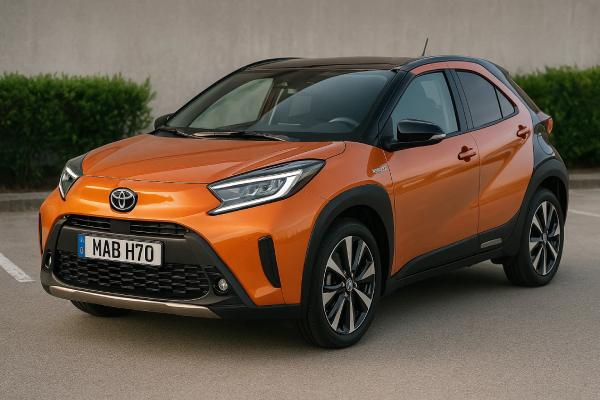
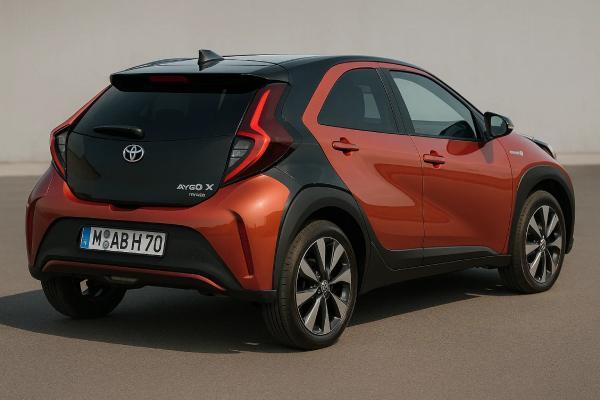
The Toyota Aygo X Hybrid is Europe’s smallest full-hybrid crossover, bringing Toyota’s proven 1.5-liter hybrid system to the A-segment. Based on the compact GA-B platform, it pairs a three-cylinder Atkinson-cycle petrol engine with an electric motor and eCVT for effortless city driving and very low running costs. This guide covers the 2025-present facelifted Aygo X Hybrid sold in Europe, where the model is designed, built, and homologated. Highlights include class-leading WLTP economy and CO₂, a tight 4.7 m turning radius, thoughtful packaging that keeps the 231 L boot, and an expanded Toyota Safety Sense suite with over-the-air update capability. For shoppers, the car’s strengths are effortless efficiency and ease of use; for owners, routine servicing is simple and affordable, with widely available parts and dealer know-how. Below you’ll find an in-depth look at specifications, dimensions, safety and driver aids, reliability patterns, maintenance, and practical buying advice—written to help you pick the right trim, care for it properly, and understand how it stacks up against rivals.
At a Glance
- Hybrid powertrain delivers very low WLTP fuel use (≈3.7 L/100 km; ~76 mpg UK / ~64 mpg US) and CO₂ from the mid-80 g/km range.
- City-friendly: GA-B platform tuning and a 4.7 m turning circle make parking and U-turns easy.
- Modern driver assistance (AEB with cyclist/pedestrian detection, lane support, full-range ACC) now supports OTA updates.
- Caveat: Modest power suits relaxed driving; choose smaller wheels/eco tyres if efficiency matters most.
- Typical service interval: every 12 months or 10,000 miles (15,000 km), whichever comes first.
What’s inside
- Aygo X Hybrid detailed overview
- Specifications and technical data
- Trims and options, safety and driver assistance
- Reliability, common issues and service actions
- Maintenance and buyer’s guide
- Driving and performance
- How Aygo X Hybrid compares to rivals
Aygo X Hybrid detailed overview
The Aygo X Hybrid takes the established Aygo X city crossover formula and adds Toyota’s 1.5-liter full-hybrid system for a large real-world efficiency gain and calmer low-speed manners. The petrol engine (M15A-FXE) operates on the Atkinson cycle for high thermal efficiency; it works with a compact permanent-magnet motor via Toyota’s power-split eCVT. Combined output is 116 hp (85 kW), comfortably outpacing the earlier 1.0-liter non-hybrid while maintaining a light footprint and familiar ease of use.
Packaging is clever: a longitudinal, two-stack lithium-ion traction battery (48 cells; ~178 V nominal) is mounted under the rear seats to preserve the short wheelbase, rear passenger space, and the Aygo X’s 231-liter luggage bay. The 12 V auxiliary battery sits under the boot floor. Up front, the facelift stretches the front overhang by ~76 mm to accommodate hybrid hardware, while a new grille, lamps, and bonnet give a broader stance. Depending on trim, 17- or 18-inch alloys fill the arches; a GR SPORT grade adds unique styling and dedicated chassis tuning.
The hybrid system’s strengths show up most around town: silent EV crawls, smooth pull-aways, and strong regenerative braking reduce brake wear and driver workload. On secondary roads and motorways, the latest eCVT control and extra system power make the car more relaxed than the old 1.0-liter. Ride/handling targets match the brief: agile, secure, and predictable, prioritizing low weight and urban maneuverability over raw grip. Toyota Safety Sense expands to include an upgraded Pre-Collision System, Lane Trace Assist, full-range adaptive cruise, Emergency Driving Stop, Proactive Driving Assist, and the key modules can receive over-the-air updates to improve features through the vehicle’s life.
For ownership, the Aygo X Hybrid follows Toyota’s simple annual service cadence and is eligible—where offered—for the brand’s service-activated warranty extensions when maintained at the network. Running costs should be among the lowest in its class thanks to outstanding WLTP economy and modest consumables (small tyre sizes, conservative brake wear, simple filtration). Insurance groups remain low, and the car’s small size eases parking and urban charging-zone compliance.
Specifications and technical data
Engine and Performance
| Item | Detail |
|---|---|
| Type / cycle | 1.5-liter inline-3 petrol, Atkinson-cycle hybrid (M15A-FXE) |
| Induction / fueling | Naturally aspirated, port/direct injection as per family spec; electronic throttle |
| Compression ratio | High, Atkinson-biased (engine family) |
| System output | 116 hp (85 kW) combined |
| Engine output | 91 hp (68 kW) @ 5,500 rpm; 120 Nm (88.5 lb-ft) @ 3,800–4,800 rpm |
| Electric motor | Permanent-magnet synchronous; 141 Nm peak torque |
| Hybrid battery | Li-ion, 48 cells (~177.6 V), longitudinal two-stack under rear seats |
| Emissions / economy (WLTP) | From ≈85–86 g/km CO₂; ≈3.7 L/100 km (≈76.4 mpg UK / ≈63–64 mpg US) combined |
| Fuel tank | 30 L (≈6.6 UK gal / ≈7.9 US gal) |
| Aerodynamics | Low-drag front design; under-covers and bonnet insulation (Cd not officially quoted for hybrid) |
Notes: Values reflect the facelifted hybrid with final homologation varying slightly by wheel/tire and grade.
Transmission and Driveline
| Item | Detail |
|---|---|
| Transmission | Toyota eCVT (power-split device) with hybrid transaxle |
| Driven wheels | Front-wheel drive (FWD) |
| Differential | Open differential with electronic brake-based torque control |
| Steering | Electric power steering (column assist) |
Chassis and Dimensions
| Item | Detail |
|---|---|
| Platform | TNGA GA-B (compact) |
| Suspension | Tuned for city agility; front MacPherson strut / rear torsion beam (typical GA-B layout) |
| Brakes | Front discs, rear drums; regenerative braking integration |
| Wheels / tyres | 17- or 18-in alloys; eco-oriented 175-section tyres common |
| Length / width / height | 3,776 / 1,740 / 1,520 mm (148.7 / 68.5 / 59.8 in) |
| Wheelbase | 2,430 mm (95.7 in) |
| Turning circle | 4.7 m (15.4 ft) kerb-to-kerb |
| Kerb / GVW | ≈1,090–1,140 kg kerb (2,403–2,513 lb); ≈1,510 kg GVW (≈3,329 lb) |
| Cargo volume | 231 L seats up (VDA); up to 829 L seats folded (to roof) |
Fluids and Capacities (owner-relevant)
| System | Specification (baseline) | Notes |
|---|---|---|
| Engine oil | Toyota Genuine Motor Oil meeting JASO GLV-1, SAE 0W-8 | Use grade specified in your VIN-matched owner’s manual; hybrids in this engine family typically specify 0W-8. |
| Coolant | Toyota Super Long Life Coolant (pink, OAT) | Long-life; replace per schedule/condition. |
| Hybrid transaxle | Toyota ATF WS | No routine change in many markets; inspect for leaks. |
| Brake fluid | DOT 4 | Replace biennially; follow ABS/ESC bleeding procedures. |
| Fuel | Unleaded petrol (E10 compatible where available) | 30 L tank. |
Essential torques (typical small-Toyota values; verify by VIN): wheel nuts ≈103 Nm (76 lb-ft); oil drain plug ≈27–30 Nm (20–22 lb-ft); spark plugs ≈18–20 Nm (13–15 lb-ft).
Performance and Economy
| Metric | Hybrid (typical figures) |
|---|---|
| 0–100 km/h (0–62 mph) | ≈9.2 s (grade/tyre dependent) |
| Top speed | Typical A-segment hybrid, motorway-capable (not the focus) |
| WLTP combined | ≈3.7 L/100 km (≈76.4 mpg UK / ≈63–64 mpg US) |
| Real-world highway @120 km/h (75 mph) | ≈4.5–5.2 L/100 km (≈52–42 mpg US), season/tyres/wind load dependent |
| Towing / payload / roof load | No factory towing rating declared at launch; payload up to ~420 kg by spec difference; roof load may be restricted—check accessories and canvas-roof compatibility. |
Trims and options, safety and driver assistance
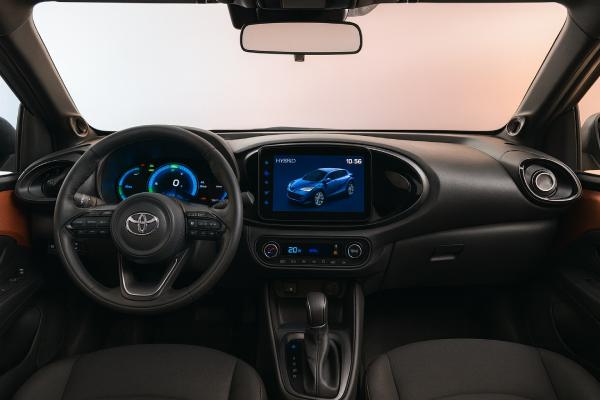
Trims and identifiers (Europe): Line-ups vary by market, but expect core “Icon/Design/Exclusive”-style grades, plus GR SPORT with unique wheels, steering and spring/damper tuning, and sporty interior accents. Quick tells include wheel size (17 vs 18 in), bi-tone paint, GR-pattern grille on GR SPORT, and interior detailing (sports seat trim, contrast stitching). All hybrids use the eCVT selector and have hybrid energy flow displays in the cluster; higher grades add a wireless charger, digital key, powered folding mirrors, and nanoe™ cabin air ionization.
Year-to-year highlights (facelift vs. earlier petrol Aygo X):
- New full-hybrid powertrain replaces the 1.0-liter petrol.
- Extended front overhang (~76 mm) for packaging, refreshed front fascia.
- OTA-updatable Toyota Safety Sense; added Emergency Driving Stop and Proactive Driving Assist.
- GR SPORT grade with chassis retune and exclusive styling.
Infotainment and connectivity: Toyota Smart Connect with a crisp touchscreen (size varies by grade), wireless Apple CarPlay/Android Auto on upper trims, USB-C ports (two), connected services for navigation/traffic, and remote features via the MyToyota app on select markets and grades.
Safety ratings: The Aygo X line is covered by Euro NCAP testing for this generation. The pre-facelift petrol Aygo X achieved a formal rating under the 2022 protocol; the hybrid inherits the body structure and Toyota Safety Sense platform with enhanced functions and OTA support. Always confirm how your exact MY/grade maps to the published tests in your country.
Airbags and structure: Front, side, and curtain bags are typical; ISOFIX/LATCH anchors are fitted outboard in the rear. The GA-B shell emphasizes a robust passenger cell with energy-absorbing front structures designed for small-car crash scenarios.
ADAS feature set (availability by trim):
- Pre-Collision System (PCS) with vehicle, pedestrian (day/night), and cyclist detection.
- Lane Trace Assist with lane centering and warning; driver-set sensitivity.
- Adaptive Cruise Control with full-range capability for stop-go traffic.
- Road Sign Assist that can interface with speed limiter functions.
- Proactive Driving Assist (gentle speed/brake inputs to help spacing and corner approach).
- Emergency Driving Stop System (stops the car safely if the driver becomes unresponsive).
- Over-the-air (OTA) updates for Toyota Safety Sense modules where available.
Service/calibration notes: Windscreen replacement and front-end collision repairs typically require forward camera/radar calibration. Wheel alignment changes on GR SPORT or 18-inch wheel cars can alter lane-keeping feel; verify steering-angle sensor zeroing after suspension work.
Reliability, common issues and service actions
Toyota’s M15A-FXE hybrid family has an excellent record in European supermini applications. The Aygo X Hybrid continues that pattern, though 2025-on specifics are still maturing. What to watch:
Common / low-severity (city use, first 0–50,000 km):
- Brake pad glaze or light vibration after long urban use with strong regeneration (rear drums see little work). Symptom: dull bite or squeal; Remedy: de-glaze/re-bed; ensure periodic firm braking to keep hardware clean.
- Cabin rattles from boot board or parcel shelf on poor roads. Remedy: adjust fasteners, felt tape contact points.
- 12 V battery weakness if the car is left unused. Remedy: health check; maintain SoC with periodic drives or a smart maintainer. The 12 V is under the boot floor.
Occasional / medium-severity (50,000–120,000 km):
- HV battery cooling fan contamination (lint, pet hair) in urban family use. Symptom: fan noise, reduced EV assist; Remedy: clean intake and fan; keep rear footwells clear.
- Wheel alignment/tyre wear on cars with 18-inch wheels. Symptom: inner shoulder wear or tramlining; Remedy: rotate at 10–12k km; use correct pressures; consider 17-inch wheels if you prioritize ride/tyre longevity.
Rare / higher-severity:
- Inverter/transaxle cooling concerns are infrequent in this low-mass application; maintain correct coolant and airflow path after body repairs.
- Front camera/radar faults after glass or body work if calibration was skipped. Remedy: dealer-level calibration.
Software and calibrations: The facelift introduces OTA updates for Toyota Safety Sense. If you see odd lane-support behavior or nuisance alerts, check for pending updates in the app/head unit or ask your dealer to apply the latest calibrations.
Recalls, TSBs, extended coverage: As a new powertrain derivative, official campaigns may roll out across MY25–MY26. Always run an official VIN recall check before purchase and at every service; keep dealer printouts with dates/mileage. Markets offering service-activated warranty allow warranty continuation up to a published age/mileage if you service on time at an authorized repairer.
Pre-purchase checks to request (used/demo cars):
- Full service history with dates/mileage, including brake-fluid change and cabin filter proof.
- VIN recall/TSB status report.
- Tyre depth and even wear (18-inch show issues sooner).
- Hybrid Health Check result (dealer printout) and 12 V battery test.
- Underbody inspection for kerb strikes (short overhangs help, but check subframe lips and radiator lower support).
- Windscreen/camera calibration proof if glass was replaced.
Maintenance and buyer’s guide
Baseline service cadence (Europe): every 12 months or 10,000 miles (15,000 km), whichever comes first. Follow your VIN-matched schedule for specifics, but the below captures owner-critical tasks.
Practical maintenance schedule
- Engine oil & filter: 12 months / 10,000 mi (15,000 km). Use the specified 0W-8 GLV-1 grade; replace the crush washer and torque the drain plug correctly.
- Cabin air filter: Inspect at 12 months, replace 12–24 months depending on environment.
- Engine air filter: Inspect at 12 months; replace 24–36 months or as required (more often in dusty use).
- Spark plugs: Iridium long-life; typical interval 90,000–120,000 km (55,000–75,000 mi). Replace as a set; torque carefully.
- Coolant (engine/inverter loops): Toyota SLLC; follow time/mileage guidance—first change commonly at 10 years / 160,000 km, then 5 years / 80,000 km (verify per market).
- Brake fluid: Replace every 2 years regardless of mileage.
- Hybrid transaxle fluid (ATF WS): Often “inspect only”; some owners choose 60,000–90,000 km drain/fill for peace of mind—use only Toyota ATF WS.
- Aux/serpentine belt & hoses: Inspect at each service; replace on condition (listen for chirps, check for cracking).
- Tyres: Rotate 10,000–12,000 km (6,000–7,500 mi); maintain door-jamb pressures; alignment check yearly or if uneven wear appears.
- HV battery & cooling fan: Visual intake check annually; fan clean if airflow noise increases or with pets in the car.
- 12 V battery: Test yearly from year 3; replace on condition (avoid odd hybrid warnings caused by low 12 V voltage).
- Brakes: Inspect pad/drum linings annually; hybrids can corrode discs with light use—perform deliberate firm stops periodically to keep surfaces clean.
- Body & underbody: Rinse road salt; check rear beam and front subframe for corrosion in harsh climates.
Fluid quantities and essentials:
- Fuel tank: 30 L.
- Oil fill: small three-cylinder capacity; consult VIN-specific manual (typical family value ~3.5–3.7 L with filter).
- Torques (verify by VIN): wheel nuts ≈103 Nm; oil drain ≈27–30 Nm; spark plugs ≈18–20 Nm.
Buyer’s guide—what to look for
- Best value trims: A mid-grade with 17-inch wheels balances comfort, tyre cost, and kit (wireless smartphone projection, safety suite). The GR SPORT looks great and feels perkier thanks to its retune, but its larger wheels can add road noise and tyre cost.
- Wheels & tyres: If efficiency and ride are priorities, avoid 18-inch wheels; 17-inch with eco tyres yields the best economy and steering feel on patchy urban tarmac.
- Options worth having: Front/rear parking sensors or camera, heated seats (cold-start comfort with minimal energy impact), wireless charger if you rely on CarPlay/Android Auto.
- What to avoid: Aftermarket windshields fitted without camera calibration proof; mis-matched tyres; cars lacking service-activated warranty continuity where available.
- Durability outlook: The M15A-FXE/eCVT hybrid set is a conservative, low-stress pairing with excellent long-term prospects when maintained annually with the correct oil and brake-fluid cadence.
Driving and performance
Character and NVH: Around town, the Aygo X Hybrid is at its best. It often pulls away in EV mode, then blends the engine in smoothly, so you glide through traffic with little fanfare. The eCVT’s latest mapping reduces the “flaring” sensation during brisk acceleration compared to older small Toyotas, and the extra system power (116 hp) gives easy 50–80 km/h step-ups. Cabin hush improves with the facelift’s added insulation (dash, bonnet, underbody) and, on higher grades, thicker glazing and more sound deadening.
Ride and handling: On 17-inch tyres, the car feels planted at city speeds and stable on the ring road, with steering light enough for dense parking but consistent off-center on faster roads. The 4.7 m kerb-to-kerb turning circle is a superpower—U-turns and tight multi-storey ramps are stress-free. The GR SPORT’s specific spring/damper and EPS tuning sharpen responses without making the ride harsh; still, wheel/tyre choice has the biggest effect on sharp-edge impacts and tyre roar.
Performance metrics that matter:
- 0–100 km/h: about 9.2 s, a big step up from the earlier 1.0-liter.
- Braking feel: firm pedal with smooth regen-to-friction handover; expect long pad life if you exploit regeneration.
- Turning circle: 4.7 m; effortless parking and three-point turns.
Real-world efficiency:
- City / suburban: Consistently in the 3.4–4.0 L/100 km window (84–70 mpg UK; 69–59 mpg US) with measured driving, thanks to frequent EV operation.
- 100–120 km/h motorway: Plan for ≈4.5–5.2 L/100 km (≈52–42 mpg US) depending on temperature, wind, passengers, and wheel size.
- Cold weather impact: Expect 10–25% consumption rise on short trips until coolant and cat are warm; pre-conditioning is limited in HEVs, so a heated seat/steering wheel is valuable.
Traction and stability: Front-drive with electronic brake-based torque control is predictable on wet cobbles or light snow with proper tyres. Stability control is sensible and unobtrusive; “snow mode” isn’t needed—correct tyres matter more.
Load and towing: The Aygo X Hybrid is engineered primarily for passengers and light cargo. No factory towing rating is declared at launch; if you need to carry bulky items, use an approved rear carrier or vehicle-specific roof system rated for your roof type (canvas-roof cars impose restrictions). Keep total load within GVW—and remember that bigger wheels/tyres raise consumption when fully laden.
How Aygo X Hybrid compares to rivals
Fiat 500 Hybrid (mild hybrid): The 1.0–1.5 mild-hybrid 500 looks chic and is easy to park, but its 12 V belt-starter system can’t match the Aygo X Hybrid’s EV creep, regen braking, or WLTP fuel figures. The Fiat’s cabin has more character; the Toyota is quieter in stop-go and usually cheaper to run.
Hyundai i10 / Kia Picanto (petrol): Practical five-doors with tidy handling and honest pricing. Without full-hybrid tech, they can’t match Toyota’s low urban consumption, but they feel punchier at motorway speeds with conventional automatics or well-geared manuals. If your driving is mostly motorway, an i10/Picanto 1.2 can be similarly frugal; in the city, the Aygo X wins easily.
Suzuki Ignis Hybrid (mild hybrid): Light, quirky, and spacious, with optional ALLGRIP on some markets. Its 12 V/48 V mild-hybrid assists, but true EV creep is rare and WLTP economy trails the Aygo X in urban cycles. The Ignis offers more upright seating and better rear space; the Toyota feels more refined and has stronger ADAS.
Fiat 500e (BEV): For drivers with home charging, the 500e is whisper-quiet and quick in town, but purchase price, insurance, and winter range management are different propositions. The Aygo X Hybrid requires no charging and remains the simpler ownership path if you lack a driveway.
Verdict on rivals: If your use is majority city/suburban and you value low running costs with minimal fuss, the Aygo X Hybrid sets the benchmark. If you’re often on the motorway with passengers and luggage, consider tyre/wheel choice (or a class-up supermini) to add longer-trip refinement.
References
- The new Toyota Aygo X: Europe’s first A-segment hybrid 2025 (Press Release & Technical Data)
- New Aygo X Hybrid: Even more fun and efficient 2025 (Press Release)
- Official Toyota Aygo X 2022 safety rating 2022 (Safety Rating)
- Check if a vehicle, part or accessory has been recalled 2025 (Recall Database)
- Servicing, MOT & Maintenance 2025 (Owner Support)
Disclaimer
This guide is for informational purposes and is not a substitute for professional diagnosis or repair. Specifications, torque values, service intervals, and procedures vary by VIN, market, model year, and equipment. Always confirm details against your vehicle’s official owner’s manual and service documentation, and follow all safety procedures.
If this article helped you, please consider sharing it with friends or owners’ groups on Facebook or X/Twitter to support xcar’s work.