
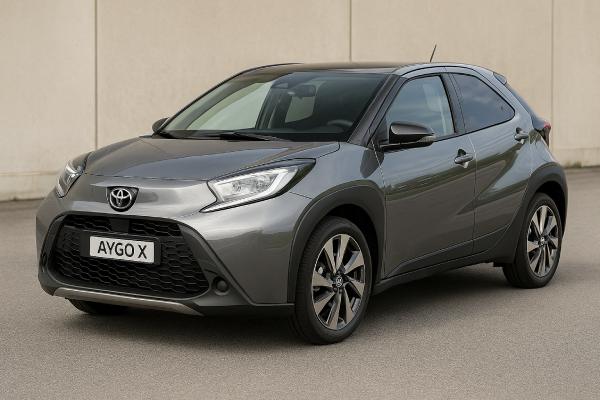
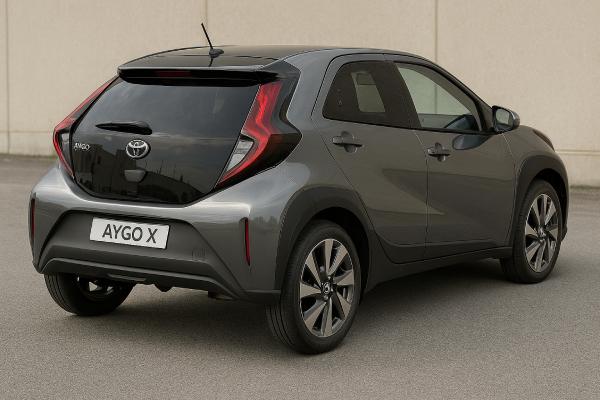
The Toyota Aygo X is a four-seat A-segment city crossover that replaced the second-generation Aygo in Europe for model years 2022–2025. Built on Toyota’s GA-B platform (shared with Yaris/Yaris Cross) and offered exclusively with a 998 cc 1KR-FE petrol three-cylinder, it pairs compact exterior dimensions with raised seating, SUV-style cladding, and a notably tight turning radius for dense urban areas. This guide covers the facelifted one-litre Aygo X through 2025, focusing on the European market where it is sold, and summarises the technical data, equipment, safety performance, running costs, known issues, and how it compares with class rivals. Owners value its durability, simple port-injection engine, efficient gearing, and straightforward maintenance. Prospective buyers should pay attention to wheel/tyre choice (17- vs 18-inch), the manual vs S-CVT behaviour in traffic, and the presence of the Toyota Safety Sense suite. If you want a thrifty, easy-to-park city car with low operating costs and excellent warranty support, the Aygo X is one of the most rounded options in its class.
Fast Facts
- Light, simple 1.0-litre three-cylinder with timing chain; low real-world fuel use and inexpensive consumables.
- City-friendly packaging: 3,700 mm long, 4.7 m minimum turning radius, good visibility, and 231 L boot.
- Toyota Safety Sense standard (AEB with pedestrian/cyclist detection, Lane Trace Assist, IACC); Euro NCAP scores are competitive for the segment.
- Watch for correct wheel/tyre choice: 18-inch rims look sharp but add road noise and can soften acceleration.
- Typical oil service: every 10,000 miles (15,000 km) or 12 months, whichever comes first.
Navigate this guide
- Toyota Aygo X detailed overview
- Aygo X specs and technical data
- Aygo X trims and safety
- Reliability, issues, and service actions
- Maintenance and buyer’s guide
- Driving and performance
- Aygo X versus rivals
Toyota Aygo X detailed overview
Toyota designed the Aygo X to solve an urban problem: maximise agility and efficiency without sacrificing the reassurance of modern safety and connectivity. Compared with the outgoing Aygo, the X sits on a wider track and longer wheelbase yet stays shorter than many superminis. The raised hip-point improves forward sightlines, while the minimal overhangs and a very small turning radius make tight parking and U-turns easy. Beneath the clamshell bonnet is the 1KR-FE, a 998 cc naturally aspirated triple with port fuel injection, dual VVT-i, and an 11.8:1 compression ratio. It produces 72 hp (53 kW) at 6,000 rpm and 93 Nm (69 lb-ft) at 4,400 rpm—numbers that won’t thrill, but they’re paired with modest mass and a clever gear spread that keeps the car eager in low-speed work.
Two transmissions are offered: a five-speed manual (5MT) and an S-CVT (continuously variable) automatic. The manual is lighter and a touch more frugal on paper; the CVT smooths out stop-start traffic and can hold revs in the engine’s sweet spot. Either way, the GA-B platform brings big-car refinement to a very small footprint. Noise suppression is helped by the more aerodynamic profile (≈ 0.32 Cd), tyre deflectors that calm airflow around the arches, and tyre designs optimised for low rolling resistance.
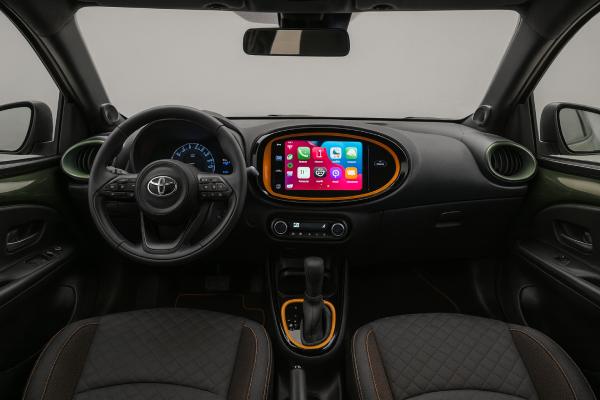
Inside, the Aygo X is a genuine four-seater with ISOFIX anchors on the rear bench, a simple instrument cluster, and Toyota’s latest multimedia options. Cabin and boot space are strong for the segment: 231 L up to the load cover (VDA) with seats up, expanding to 829 L loaded to the roof with the rear seats folded. The optional canvas roof adds welcome openness without a major weight penalty. Toyota Safety Sense comes standard across the range, with camera-radar AEB (pedestrian day/night; cyclist daytime), Lane Trace Assist and Intelligent Adaptive Cruise Control—rare equipment at this price point. Combined with Toyota’s long warranty (service-activated extensions), it’s a recipe for low stress ownership.
Aygo X specs and technical data
Engine and Performance
| Item | Detail |
|---|---|
| Engine code / type | 1KR-FE inline-3, 12-valve DOHC, dual VVT-i, chain-driven cams, port injection |
| Displacement | 998 cc (1.0 L) |
| Compression ratio | 11.8:1 |
| Output | 72 hp (53 kW) @ 6,000 rpm |
| Torque | 93 Nm (69 lb-ft) @ 4,400 rpm |
| Induction / fueling | Naturally aspirated / multipoint |
| Fuel tank | 35 L (9.2 US gal) |
| Aerodynamics | Cd ≈ 0.32 |
| Emissions & economy (WLTP combined) | Manual: 4.8–5.0 L/100 km (49–47 mpg US, 58.9–56.5 mpg UK); CVT: ≈ 5.0 L/100 km (47 mpg US, 56.5 mpg UK) |
| Real-world highway @ 120 km/h (75 mph) | 5.5–6.5 L/100 km (36–43 mpg US) typical, temperature/tyres dependent |
Transmission and Driveline
| Item | 5-speed manual | S-CVT automatic |
|---|---|---|
| Drive | Front-wheel drive (open differential) | Front-wheel drive |
| Gear ratios | 1st 3.545, 2nd 2.047, 3rd 1.310, 4th 1.027, 5th 0.850, Rev 3.214 | Continuously variable |
| Final / differential | 4.294 | 6.049 (differential) |
Chassis and Dimensions
| Item | Detail |
|---|---|
| Platform | Toyota GA-B |
| Suspension | Front MacPherson strut; rear torsion beam |
| Brakes | Front ventilated discs; rear drums; ABS/EBD |
| Steering | Electric power steering, 13.4:1 ratio, 2.88 turns lock-to-lock |
| Wheels / tyres | 17″ (175/65 R17) or 18″ (175/60 R18) |
| Length × width × height | 3,700 × 1,740 × 1,525 mm (145.7 × 68.5 × 60.0 in) |
| Wheelbase | 2,430 mm (95.7 in) |
| Ground clearance | 146 mm (5.7 in) |
| Kerb weight | 5MT: 945–995 kg (2,083–2,194 lb); CVT: 965–1,015 kg (2,127–2,238 lb) |
| GVW | 1,360 kg (2,998 lb) |
| Turning circle | ≈ 9.4 m (30.8 ft) kerb-to-kerb; minimum tyre radius 4.7 m (15.4 ft) |
| Cargo volume (VDA) | Seats up to cover: 231 L (189 L with JBL); seats down to roof: 829 L (780 L with JBL) |
Fluids and Capacities (guide values)
| System | Specification | Approx. capacity |
|---|---|---|
| Engine oil | SAE 0W-20, API SP / ILSAC GF-6 | ~ 2.8–3.1 L (3.0–3.3 qt) with filter |
| Manual transmission oil | Toyota MT Gear Oil LV, API GL-4 SAE 75W | ~ 1.7 L (1.8 qt) |
| CVT fluid | Toyota CVT Fluid FE | ~ 5.2 L (5.5 qt) service fill |
| Coolant | Toyota Super Long Life Coolant (pink) | ~ 4.1–5.4 L (4.3–5.7 qt) |
| Wheel fasteners torque | Alloy or steel wheels | 140 Nm (103 lb-ft) |
Performance and Economy
| Metric | 5MT | S-CVT |
|---|---|---|
| 0–100 km/h (0–62 mph) | 14.9 s | 14.8 s |
| Top speed | 158 km/h (98 mph) | 151 km/h (94 mph) |
| WLTP CO₂ | 109–110 g/km | 109–114 g/km |
| Towing (braked / unbraked) | Not homologated for towing | Not homologated for towing |
| Payload (typical) | ~ 365–415 kg (equipment-dependent) | ~ 345–395 kg (equipment-dependent) |
| Roof load | 50 kg typical for accessories (check specific carrier rating) |
Aygo X trims and safety
Trims and features (Europe)
Grade structure centres on Pure (entry), Edge (mid), and Exclusive (top), with occasional special editions (e.g., JBL). All versions include Toyota Safety Sense, rear-view camera, and smartphone integration. The Pure typically fits 17-inch alloys, manual A/C, and a 7–9-inch multimedia display depending on model year. Edge adds 18-inch wheels, automatic air-conditioning, and additional exterior/interior styling. Exclusive brings LED headlamps, wireless phone charging, Smart Connect with the larger, high-definition screen and connected navigation, smart entry/start, and the option of the power-operated canvas roof and Parking Pack (front/rear sensors with auto-brake).
Quick identifiers
- Pure: 17″ wheels, simpler seat trim, smaller multimedia screen (early cars).
- Edge: 18″ wheels with bi-tone/metallic paint, auto A/C, exterior contrast accents.
- Exclusive: LED headlights, nine or 10.5-inch high-definition display (MY-updates), wireless smartphone mirroring, smart entry.
- JBL edition: 300 W JBL audio, unique colour/trim details (availability varies by year/market).
Year-to-year notes (2022–2025)
- Early cars launched with 7–9″ Toyota Touch 3 or 8″ displays depending on grade; later updates introduced the Toyota Smart Connect system with a larger 10.5″ HD screen on Exclusive and over-the-air updates.
- Safety and driver-assist content stayed standard across the range, with minor calibration refinements and package naming changes.
- A JBL-branded special edition joined for MY2025 in some markets.
Safety ratings
The Aygo X achieved strong protection scores for the class in Euro NCAP (2022) testing, with category percentages around the high-70s/low-80s. Detailed results include Adult Occupant, Child Occupant, Vulnerable Road Users, and Safety Assist performance that reflects the inclusion of lane support, intelligent adaptive cruise, and enhanced Pre-Collision System features.
Airbags, child seats, structure
Six SRS airbags are standard (front, side, and curtain), with two ISOFIX anchors in the rear. The bodyshell integrates GA-B structural reinforcements and programmed load paths that manage frontal and side impacts. Rear outboard seats accept i-Size child restraints; always cross-check fitment for bulkier shells given the narrow cabin.
ADAS content and service implications
Toyota Safety Sense uses a camera and millimetre-wave radar. The suite comprises Pre-Collision System (vehicle/pedestrian/cyclist detection with Intersection Turn Assist), Autonomous Emergency Braking, Emergency Steering Assist, Intelligent Adaptive Cruise Control (IACC), Lane Trace Assist (centering), Lane Departure Alert, Road Sign Assist, Automatic High Beam, fatigue monitoring, and a speed limiter (manual transmission). After windscreen replacement or front-end repairs, camera and radar calibration is required; expect this to be part of any insurance-approved repair process. Park sensors/automatic braking, if fitted, also require post-repair functional checks to ensure no nuisance triggers.
Reliability, issues, and service actions
Overall picture
The 1KR-FE is one of Toyota’s most proven small-displacement engines. It uses port injection (no GDI carbon build-up), a timing chain rather than a belt, and modest cylinder pressures that are gentle on the bottom end. Typical ownership reports highlight low consumable costs and few serious failures when serviced on time. That said, every platform has a pattern of wear-outs and a handful of early-build campaigns you should be aware of.
Common (low–medium severity / low cost)
- 12 V battery and infrequent-use issues (short urban trips): Slow cranking or warning messages. Root cause: short-cycle use and parasitic app/connectivity loads. Remedy: battery health test annually; replace around years 4–6; keep terminals clean; if garaged, use a smart maintainer.
- Brake squeal or light surface corrosion after standing: Cause: moisture on discs and low-dust pads. Remedy: a few firm stops; clean and adjust rear drums at service time if noise persists.
- Interior rattles from boot trim/spare-well area on rough roads: Cause: panel clips/fit. Remedy: re-seat clips, add felt pads; dealer can address under warranty if early life.
- Tyre edge wear on 18″ packages in mixed city/motorway use: Cause: narrow 175-section tyres and low profile. Remedy: rotate at 10,000 miles/15,000 km; verify alignment annually; consider 17″ wheels for more compliance.
Occasional (medium severity / moderate cost)
- Clutch friction wear on manual cars used primarily in stop-start traffic: Symptoms: rising bite point, slip in higher gears under load. Remedy: clutch kit; extend life by avoiding sustained throttle at low revs in too-high a gear.
- CVT belt whine or flare when heavily loaded uphill: typically characteristic, not a failure. Remedy: observe fluid temperature limits; preventive fluid replacement helps (see maintenance section).
Rare (higher severity / dealer action)
- Brake-booster-related safety campaign(s) affecting a defined early-build window in 2022. Symptoms: pedal feel concerns; Remedy: dealer inspection and, if required, component replacement under an official recall/service campaign.
- Curtain airbag component fitment / pedal-spacing issues on small batches of early vehicles (market-specific). Remedy: recall rework where applicable.
Recalls, TSBs, extended coverage
Always run an official VIN recall check before purchase and after ownership changes. Ask the seller for proof that any outstanding campaigns were completed (dealer invoice or digital service record). For suspect vehicles, a Toyota dealer can print a campaign completion report against the VIN.
Pre-purchase checks to request
- Full service history (invoices show oil grade and date/mileage).
- Confirmation of any recall/campaign completions.
- Brake inspection results (pad thickness, drum adjustment).
- Tyre dates and even wear; evidence of alignment.
- HVAC performance and pollen filter replacement.
- Windscreen condition (ADAS camera area free of chips).
- Battery state-of-health test report (12 V).
- For CVT: confirm smooth engagement from cold; no warning lights after a long, hot drive.
Maintenance and buyer’s guide
Practical maintenance schedule (distance/time)
(Follow the stricter of distance or time and adjust for severe use such as short trips, dusty conditions, or prolonged idling.)
- Engine oil & filter: every 10,000 miles (15,000 km) / 12 months using SAE 0W-20 (API SP / ILSAC GF-6).
- Engine air filter: inspect every 10,000 miles (15,000 km); replace 20,000–30,000 miles (30,000–50,000 km) or sooner in dusty environments.
- Cabin pollen filter: replace 12 months; more often for urban allergy control.
- Spark plugs: iridium plugs typically 60,000 miles (96,000 km); check gap and torque during replacement.
- Coolant: Toyota Super Long Life Coolant (pink); first change at 10 years/100,000 miles (160,000 km), then 5 years/50,000 miles (80,000 km) thereafter; top up with the same premix only.
- Manual transmission oil: no routine interval in some schedules, but 60,000–90,000 miles (100,000–150,000 km) preventive change improves shift quality.
- CVT fluid (Toyota CVT FE): inspect for colour/odour at services; 60,000–80,000 miles (100,000–130,000 km) preventive change recommended for longevity even if “lifetime” in some guides.
- Brake fluid: replace every 2 years.
- Brake pads/discs & rear drums: inspect at every service; clean/adjust rear drums annually; replace on wear/warp.
- Aux/serpentine belt & coolant hoses: inspect annually from year 4; replace on cracks or seepage.
- Tyres/rotation: rotate every 10,000 miles (15,000 km); check pressures monthly; align yearly or on uneven wear.
- 12 V battery: test annually from year 3; typical replacement year 4–6.
- HV/reduction gear service: not applicable (non-hybrid).
Fluid specs & key torques (essentials)
- Engine oil: SAE 0W-20; capacity with filter roughly 2.8–3.1 L (3.0–3.3 qt).
- Manual gearbox: GL-4 75W; ~ 1.7 L.
- CVT: Toyota CVT FE; ~ 5.2 L service fill.
- Coolant: Toyota SLLC (pink) premixed; ~ 4–5.5 L.
- Wheel fasteners: 140 Nm (103 lb-ft).
(Always verify capacities by VIN in the official owner’s/service documentation.)
Buyer’s guide: what to look for
- Use case: If most miles are urban, CVT suits the Aygo X well; if you crave the lowest cost and more direct response, the manual is the better fit.
- Wheels/tyres: The 17″ setup rides a bit more comfortably, is quieter on coarse asphalt, and keeps repair costs down; the 18″ package looks great but can increase tyre noise and cost.
- Options that add value: Parking Pack (sensors with auto-brake), canvas roof (if you enjoy open-air feel), and LED headlamps on Exclusive enhance daily use and resale appeal.
- Service record: Prioritise cars with annual oil changes documented at or before 10,000 miles/15,000 km; check that the correct oil grade is listed.
- Body and corrosion points: Inspect rear arch lips and underfloor pinch welds; clean/grease the rear drum backing plate and handbrake linkages in salted-road regions.
- Software & multimedia: Confirm the multimedia system version and that smartphone mirroring (wired or wireless, depending on grade/year) works as expected; OTA-capable systems should update without dealer intervention.
Durability outlook
Given Toyota’s parts sharing, conservative engine tune, and light vehicle mass, the Aygo X should comfortably reach high mileages with routine care. The main variables affecting longevity are short-trip usage (oil moisture, 12 V battery health) and tyre/alignment upkeep. Choose tyres with proper load/speed ratings, rotate on time, and keep alignment in spec; the car rewards you with stability and even wear.
Driving and performance
Ride, handling, and NVH
The Aygo X’s GA-B underpinnings are a step up from the old Aygo’s joint-venture platform. Spring and damper rates are tuned for compliance over broken city surfaces, and the torsion beam rear keeps packaging tight without feeling bouncy. Straight-line stability is secure at motorway speeds for such a short car, helped by the longer wheelbase and aerodynamic front treatment. In corners, the car takes a tidy set; there is predictable roll and gradual understeer near the limit, easily managed by the stability control. Steering is light in town yet centring on the motorway is good; it’s not brimming with feedback, but the rack ratio keeps inputs small for quick manoeuvres. On 18-inch tyres, impacts are sharper and coarse-chip noise increases; the 17-inch package rides better and is quieter.
Powertrain character
Toyota’s 1KR-FE likes revs. There’s adequate step-off torque if you let it spin up, and the manual’s short lower gears make gap-filling in traffic straightforward. The CVT avoids the jerky feel of the older automated manuals and does a decent job imitating gear steps at moderate throttle; under heavy load it will hold higher revs, which can sound busy, but cabin insulation is improved over the previous generation. Throttle mapping is progressive, and stop-start (on manuals) engages smoothly if the battery is healthy and climate demands allow.
Braking
Ventilated fronts plus drums deliver consistent, linear stops in urban driving; the pedal is light with clear bite and an easy-to-modulate middle. From 100–0 km/h, stopping distance is class-typical, and ABS calibration stays unobtrusive on mixed-grip city surfaces.
Real-world economy
Expect 5.0–5.5 L/100 km (47–43 mpg US) in mixed driving with the manual, ~ 5.5 L/100 km (43 mpg US) with the CVT in typical European traffic. At 120 km/h (75 mph), plan on 5.5–6.5 L/100 km (36–43 mpg US) depending on temperature, wind, and tyre choice. Winter short-trip use will push consumption up; a longer commute that warms the oil and catalyst brings it back down.
Performance metrics that matter
- 0–100 km/h (0–62 mph): ~ 15 s (both transmissions, grade-dependent).
- 50–80 km/h (31–50 mph) in 3rd (manual): brisk enough for urban merges; dropping to 2nd gives a healthy shove.
- Turning circle: ~ 9.4 m kerb-to-kerb (tight for its size), making three-point turns rare in old-town streets.
Load and towing
The Aygo X is not homologated for towing. With four aboard and luggage, it remains composed, though you will feel steep grades; plan earlier downshifts (manual) or allow the CVT to raise revs. Cooling and braking are sized appropriately for its weight class.
Aygo X versus rivals
Hyundai i10 / Kia Picanto
Both offer broader powertrain selections (including more powerful 1.2 L options and automatic choices) and rear disc brakes on some trims. The Aygo X counters with a newer platform feel, tighter turning circle, and standard Toyota Safety Sense on every grade. If you value motorway composure at a steady 120 km/h, the Korean pair’s extra output helps; if your life is all city, the Toyota’s steering ratio and visibility are bliss.
Fiat 500 (mild-hybrid)
The 500 charms with style and a torquier mild-hybrid 1.0. The Aygo X typically uses less fuel in stop-start traffic and has a more straightforward maintenance regime (no belt-driven 48 V add-ons). Toyota’s ADAS offering is richer on lower grades, and boot practicality favours the Aygo X.
Volkswagen up! / Skoda Citigo / SEAT Mii (where available/legacy stock)
Well-packaged and refined, but largely phased out in many markets. The Aygo X is the fresher product with current-generation active safety and connected multimedia; dealer support and parts availability will tilt in Toyota’s favour over time.
Suzuki Ignis
A quirky, efficient micro-SUV with optional mild-hybrid tech and a taller body. The Ignis wins on rear headroom and oddball charm; the Aygo X feels more modern inside and has broader standard ADAS content. Both are light and cheap to keep—choose based on seating position preference and your local dealer network.
Bottom line
If your budget demands low running costs and you drive mainly in dense areas, the Aygo X is one of the easiest cars to live with: tiny outside, more grown-up than expected inside, and backed by Toyota’s long warranty and support. The key choice is manual vs CVT and 17″ vs 18″ wheels—decide those based on your roads and ears, and you’ll be happy with either specification.
References
- TOYOTA AYGO X TECHNICAL SPECIFICATIONS 2022
- THE ALL-NEW TOYOTA AYGO X 2025
- Official Toyota Aygo X 2022 safety rating 2022 (Safety Rating)
- Recalls | Owners 2025 (Recall Database)
- Take a closer look at the specifications of Toyota Aygo X 2025
Disclaimer
This guide is for informational purposes and isn’t a substitute for professional diagnosis or repair. Specifications, capacities, torque values, intervals, and procedures can vary by VIN, market, model year, and equipment. Always confirm details in your vehicle’s official owner’s manual and service documentation, and follow local regulations and safety practices.
If you found this helpful, please share it with friends or owners’ groups on Facebook or X/Twitter—your support helps xcar continue producing detailed, people-first guides.