
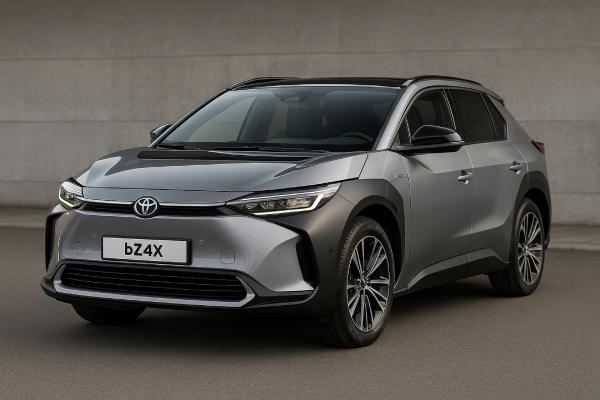
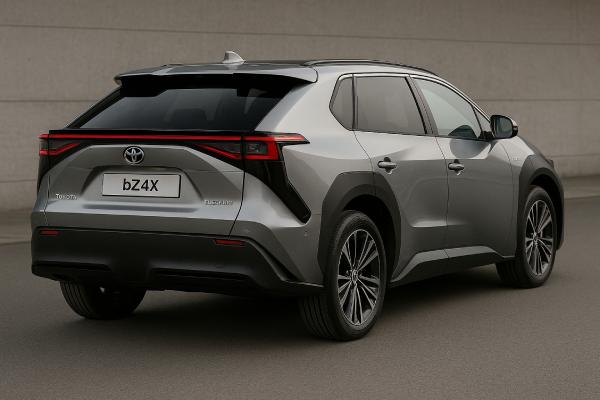
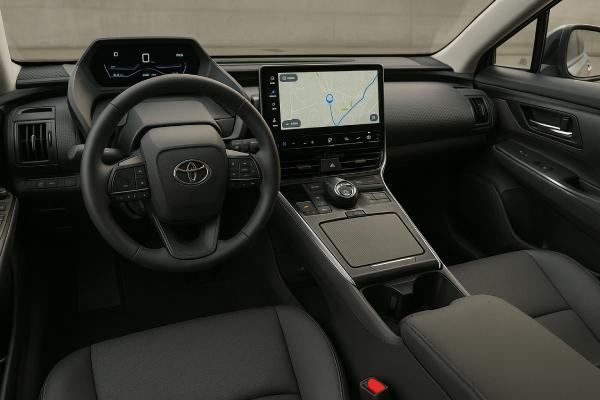
The facelifted Toyota bZ4X (XEAM10) focuses on day-to-day usefulness: quiet running, simple controls, and predictable efficiency—now paired with smarter battery preconditioning and cleaner infotainment. The single-motor 1XM eAxle drives the front wheels with relaxed, linear response that makes the bZ4X easy in traffic and steady at highway speeds. Trim content is straightforward (XLE, Limited, plus special-appearance editions depending on year), and the active-safety suite is standard across the line. Most owners will charge at home on Level 2 and use DC fast charging for trips; the facelift improves consistency and cold-weather charging behavior, though absolute peak rates remain modest next to the quickest rivals. Inside, you get comfortable seats, good outward visibility, and a heat pump that reduces winter range penalties. What matters most is the total ownership picture: a conservative thermal strategy aimed at battery longevity, widely available dealer service, and low routine maintenance. This guide distills the details that help buyers and owners make confident decisions—from specs and safety to reliability notes, maintenance intervals, and how it stacks up against competitors.
Fast Facts
- Calm, comfortable commuter: stable highway manners, smooth throttle, tidy body control on broken pavement.
- Efficient when driven steadily; improved preconditioning helps cold-weather DC charging consistency.
- Full active-safety suite standard; strong crash-test results for recent builds and trims.
- Watch tire wear and brake corrosion in salt climates; rotate every 5,000–7,500 mi (8,000–12,000 km).
Navigate this guide
- bZ4X XEAM10 overview
- bZ4X XEAM10 specs and data
- Trims, options, safety
- Reliability and service actions
- Maintenance and buyer’s guide
- Driving and real-world performance
- How bZ4X compares
bZ4X XEAM10 overview
The 2025-present facelift refines Toyota’s compact e-TNGA EV without changing its mission: easy daily driving with low running costs and conservative engineering. The XEAM10 code identifies the single-motor front-drive version that uses Toyota/BluE Nexus’s 1XM eAxle—an integrated motor, reduction gear, and inverter on the front axle. Output varies by market; in North America, single-motor bZ4X models are commonly rated near 201 hp (150 kW), while some facelifted European calibrations publish roughly 167 hp (≈125 kW). Regardless of badge math, the character is the same: clean step-off, predictable midrange, and smooth regen blending that favors comfort over one-pedal extremes.
Battery capacity and range depend on wheel/tire spec and software. The facelift’s battery preconditioning better aligns pack temperature with the next DC session, which improves charge-curve consistency in cold conditions. AC charging is straightforward at 240 V home stations; most owners will recover a full workday’s use overnight. DC fast-charging peaks remain behind the class leaders, but the curve is steadier than early builds—plan for shorter hops (e.g., 10–60%) in winter for the best results.
Inside, the cabin prioritizes clarity: physical controls for high-frequency tasks, Toyota’s latest infotainment with OTA update support, and an upright seating position with a relatively low cowl for good forward visibility. Noise isolation is competitive; tire roar rises with larger wheels. Luggage space is practical for a small family crossover, and the flat rear floor helps knee room. Active safety is comprehensive out of the box, and recent builds pair improved headlight performance with strong crash-test outcomes. If you value calm road manners, simple charging routines, and a long-term ownership mindset, the facelifted XEAM10 is aligned to that brief.
bZ4X XEAM10 specs and data
Powertrain and Efficiency (EV)
| Item | Detail |
|---|---|
| Platform / code | e-TNGA / XEAM10 (single-motor FWD) |
| Motor | 1XM eAxle (front), AC permanent-magnet synchronous |
| System output (typical) | North America ≈ 201 hp (150 kW); some EU facelift calibrations ≈ 167 hp (125 kW) |
| System torque (est.) | ~265 Nm (195 lb-ft) |
| Battery | Lithium-ion traction battery; thermal management with liquid cooling and heat pump integration |
| System voltage | ~350–400 V nominal class |
| Rated efficiency (combined) | ~18–20 kWh/100 km (≈ 290–320 Wh/mi), trim and wheel dependent |
| Rated range (combined) | Representative ratings: ~405 km (252 mi) on efficiency-oriented FWD trims; lower on larger wheels |
| Real-world highway @ 120 km/h (75 mph) | Typical 19–22 kWh/100 km (305–355 Wh/mi) in mild temps; expect 10–25% winter range reduction depending on HVAC use |
| Aerodynamics | Cd ~0.28–0.29 (varies with wheel/tire and trim) |
Notes: Power and range figures vary with market calibration, wheel size, and test cycle. Always verify by VIN and window sticker.
Charging (AC/DC) and Driveline
| Item | Detail |
|---|---|
| Drive type | Front-wheel drive (through-the-road eAxle; no mechanical rear drive) |
| Onboard AC charger | ~6.6–7.6 kW depending on model year (Level 2, 240 V) |
| DC fast-charge peak | Up to ~150 kW on single-motor versions; facelift adds preconditioning for better cold-weather performance |
| Typical replenishment | DC 10–80%: ~30–40 min in ideal temps; AC 0–100%: ~9–12 h on a 32–40 A home EVSE |
| Charge port | J1772/CCS1 (facelift years) with software support for Plug & Charge availability varying by market/provider |
Chassis and Dimensions
| Item | Detail |
|---|---|
| Suspension (F/R) | MacPherson strut / multi-link, anti-roll bars |
| Steering | Electric power steering (rack-and-pinion), ~14:1 overall (approx.) |
| Brakes (F/R) | Ventilated disc / ventilated disc; electronic brake blending with regen |
| Wheels/Tires | 18×7.5 in on efficiency-focused trims (e.g., 235/60R18); 20×7.5 in on appearance-oriented trims (e.g., 235/50R20) |
| Ground clearance | ~182 mm (7.2 in) |
| Length / Width / Height | ~4690 / 1860 / 1650 mm (184.6 / 73.2 / 65.0 in) |
| Wheelbase | 2850 mm (112.2 in) |
| Turning circle (curb-to-curb) | ~12.0–12.2 m (39.4–40.0 ft) |
| Cargo volume (seats up/down) | ~785 L / ~1600 L (27.7 / ~56–58 ft³, method VDA/SAE varies) |
| Curb weight | ~1830–1900 kg (4035–4189 lb), by trim/wheel |
Performance and Capability
| Metric | Value |
|---|---|
| 0–100 km/h (0–62 mph) | ~7.5–7.7 s (typical single-motor tests) |
| 0–60 mph (0–97 km/h) | ~7.1–7.4 s (typical) |
| Top speed | ~160 km/h (99 mph) |
| Braking 100–0 km/h | Class-typical; stable pedal with smooth regen-to-friction handoff |
| Towing capacity | Often not rated in North America for XEAM10—verify by market and VIN |
| Roof load | Check OEM crossbars; typical dynamic rating ~75 kg (165 lb) |
Fluids and Service Capacities (EV-relevant)
| System | Spec / Notes |
|---|---|
| Coolant (battery/drive) | Toyota Super Long Life Coolant (pink); sealed loops—inspect level/leaks; replacement only per official service guidance |
| Reduction gear oil | Sealed in 1XM eAxle; inspect for leaks/noise only |
| Brake fluid | DOT 3/4; replace on time (see Maintenance) |
| A/C refrigerant | HFO-1234yf; charge amount per under-hood label |
| A/C compressor oil | ND-OIL Electric type (quantity per manual) |
| Key torque | Wheel bolt torque 140 Nm (103 lb-ft); retorque after wheel service |
Electrical
| Item | Detail |
|---|---|
| 12 V battery | AGM 12 V, DC-DC from HV pack; typical replacement window 4–6 years |
| Lighting | LED headlamps; improved headlight performance on recent trims/packages |
| HV battery warranty | Typical 8 years/100,000 miles (market-dependent enhancements apply) |
Safety and Driver Assistance
| Item | Detail |
|---|---|
| Crash ratings | Recent builds show strong ratings across updated tests; see Safety section for year/trim notes |
| Headlight rating | Improved on specific 2025+ trims; verify by package |
| ADAS suite (standard) | AEB with pedestrian/cyclist detection, adaptive cruise, lane departure alert with steering assist, lane centering, blind-spot monitoring, rear cross-traffic alert, rear AEB; parking assist and 360° camera available by trim |
Trims, options, safety
Trim walk (facelift years)
- XLE (FWD): The efficiency-oriented build with 18-inch wheels, heat-pump HVAC, heated front seats/steering wheel (often packaged), wireless phone integration, and the full core active-safety suite. This configuration typically posts the longest EPA range among bZ4X single-motor variants.
- Limited (FWD): Adds larger wheels (often 20-inch), upgraded interior materials, available Advanced Park, 360° camera, and enhanced convenience/driver-assist features. Range decreases slightly versus XLE due to tires and aero.
- Appearance editions (by year): Nightshade and similar packages primarily change styling (black exterior accents, unique wheels) without altering the single-motor drivetrain.
Functional differences that matter
- Wheel/tire package is the biggest driver of range, noise, and ride feel. Choose 18-inch wheels if you prioritize efficiency, winter tire choice, and calmer NVH on rough asphalt.
- Charging hardware/software: Later builds add battery preconditioning for DC sessions, improving charge rates in cold conditions; the onboard AC charger is typically 6.6–7.6 kW.
- Lighting: Headlamp performance and ratings improve on updated trims and packages; buyers concerned with rural night driving should favor these builds.
Year-to-year highlights (single-motor focus)
- 2025 model year (facelift start): Feature additions (e.g., Traffic Jam Assist and Lane Change Assist availability on higher trims), refinement to charging behavior, and availability of special appearance grades.
- Running changes: Software updates for charging screens, temperature management, and convenience features roll out via dealer update or OTA depending on region and subscription status.
Safety ratings (concise)
Recent model years achieve strong crashworthiness across small overlap, updated moderate overlap, and updated side tests, with award applicability tied to build dates and headlamp packages. Always match the rating to your specific year, trim, and build date.
Safety systems and child-seat provisions
- Airbags: Front, side, full-length curtain, and driver’s knee (content varies slightly by region).
- LATCH/ISOFIX: Lower anchors and top tethers in outboard rear positions; check manual for weight limits and angle guidance.
- ADAS calibration after service: Windshield replacement, front-end structural repairs, or suspension/alignment work can require camera/radar recalibration—budget time and cost accordingly.
Identifiers and build codes
- VIN/parts databases list XEAM10 for single-motor FWD and YEAM15 for AWD dual-motor.
- The front eAxle is 1XM (BluE Nexus). Wheel fitment uses hub bolts rather than studs; observe proper torque and cleanliness of mating faces.
Reliability and service actions
Overall pattern: The single-motor bZ4X has shown generally uneventful driveline behavior, with most attention on software, charging consistency, and a small number of safety-related campaigns affecting climate/defog performance on specified VIN ranges. The facelift’s thermal/charging refinements help cold-weather owners the most.
Mapped issues (prevalence → cost/severity)
- HVAC failsafe can disable defog/defrost in rare fault modes (specified VIN ranges, 2023–2025 builds)
- Prevalence/Severity: Occasional; medium severity because of visibility.
- Symptom → Cause → Remedy: Limited or inoperative defog/defrost after compressor-related faults → HVAC ECU software behavior → Safety recall software update; verify by VIN and ensure campaign completion paperwork is present.
- DC fast-charge performance in cold weather (characteristic improving with updates)
- Prevalence/Severity: Common concern in sub-freezing climates; low to medium owner impact depending on trip profile.
- Symptom → Cause → Remedy: Slow or inconsistent charge until pack warms → low battery temperature and conservative taper → use preconditioning when route planning to a DC site, arrive with low SOC (10–20%), and prefer shorter hops in winter. Later software improves this behavior.
- 12 V battery complaints (occasional)
- Prevalence/Severity: Occasional; low to medium cost.
- Symptom → Cause → Remedy: No-start after sitting or repeated short trips → low 12 V state due to accessory load patterns → annual test after year 3; replace at 4–6 years with the correct AGM unit.
- Brake hardware corrosion in salt regions (EV-typical)
- Prevalence/Severity: Occasional; low to medium cost.
- Symptom → Cause → Remedy: Pulsation, sticking slides after storage → limited hydraulic use due to regen → schedule annual clean & lube; flush brake fluid on time.
- Road-noise sensitivity on 20-inch tires (characteristic)
- Prevalence/Severity: Common on coarse asphalt; low severity.
- Remedy: Choose 18-inch wheels for quieter cruising and slightly better efficiency.
Software and calibrations to ask about
- Battery temperature control / preconditioning: Improves DC charging in cold conditions and overall trip time.
- Infotainment and ADAS updates: Lane centering refinement, Traffic Jam Assist availability on select trims, and parking assist behavior.
- HVAC ECU update (visibility/defog): Ensure the applicable safety software update is complete.
High-voltage components and health
- Battery degradation: Conservative thermal management and mid-pack SOC usage typically yield modest degradation in commuter use. For pre-purchase, request a Battery State-of-Health printout from the dealer (scan tool report) and review charging history if available.
- Onboard charger (OBC) and DC-DC converter: Generally uneventful; intermittent charging faults are often wiring, EVSE, or contactor-related; check for DTCs and connector condition.
- Reduction gear / eAxle: Listen for abnormal whine or vibration during coastdown; fluid is sealed and inspected only if symptoms are present.
Recalls, TSBs, warranty extensions (headline view)
- Climate/defog software safety recall affecting specific 2023–2025 build ranges (visibility performance under certain compressor-fault scenarios). Remedy is software update.
- Wheel-hardware guidance and torque compliance: Toyota documentation emphasizes correct hub bolt torque and parts pairing; recheck torque after wheel service.
Verification: Always run the manufacturer’s VIN recall check, keep dealer repair orders in the file, and confirm campaign closure before purchase.
Pre-purchase checklist (XEAM10 focus)
- Proof of recall completion(s) and the latest charging/thermal software.
- 12 V battery test results; even tread wear (rotations recorded).
- Brake inspection (pad thickness, slider freedom); look for rotor scaling after storage.
- Alignment report and road test for straight-line stability and steering centering.
- Quick DC fast-charge test if feasible (observe preconditioning and charge curve).
Maintenance and buyer’s guide
Practical maintenance schedule (distance/time)
(Confirm by VIN and local service docs; intervals here are practical, owner-friendly guidance.)
- Tires & alignment: Rotate every 5,000–7,500 mi (8,000–12,000 km); inspect pressures monthly and before trips. Alignment annually or after impacts; uneven shoulders on FWD EVs increase noise and energy use.
- Brake fluid: Replace every 2–3 years regardless of mileage.
- Friction brakes: Inspect annually/12,000 mi (20,000 km); clean & lube in salt regions.
- Cabin air filter: Replace 20,000–30,000 mi (32,000–48,000 km) or 24 months; sooner with dust/pollen loads.
- Coolant (battery/drive): Inspect level/condition at each service; replace only per official procedures or when other repair access opens the loop.
- A/C refrigerant/leak check: Verify performance seasonally; refrigerant is R-1234yf with ND-OIL Electric compressor oil.
- 12 V battery: Test annually after year 3; typical replacement 4–6 years.
- Driveline fluids (1XM): Sealed; no routine change—inspect for leaks/noise.
- Body/seals: Wash underbody after winters; treat paint chips promptly; check door seals for wind noise.
Fluid specs and essential torques
- Wheel bolt torque: 140 Nm (103 lb-ft)—recheck after any wheel/tire work.
- Brake fluid: DOT 3/4 compatible.
- Tire pressures: Follow door-jamb label; re-set TPMS after rotations as required by procedure.
Buyer’s guide—what to prioritize
- Best daily-driver value: XLE FWD on 18-inch wheels for range, ride, and winter-tire choice.
- Cold-climate commuters: Favor facelift builds with battery preconditioning and the latest thermal software.
- Feature-seekers: Limited adds comfort and parking tech; confirm headlamp package if you drive poorly lit roads.
- Be cautious of: Cars lacking proof of the HVAC visibility recall fix; vehicles with chronic DC fast-charge complaints without logs (may indicate site or usage issues).
Durability outlook
The single-motor layout, conservative charge management, and straightforward chassis bode well for long-term ownership. Budget mainly for tires and periodic brake service; plan early 12 V battery replacement in harsh climates. With regular inspections and up-to-date software, the XEAM10 should deliver low-drama EV ownership.
Driving and real-world performance
Ride, handling, NVH
The bZ4X XEAM10 leans comfort. Steering is light at low speeds and gains reassuring on-center weight at 65–75 mph (105–120 km/h). The long wheelbase settles expansion joints, and vertical motions are well-checked. On coarse aggregate, 20-inch tires transmit more roar; 18-inch packages are noticeably quieter and more efficient. Crosswinds are a non-event thanks to the battery’s low mounting and balanced aero.
Powertrain character
The 1XM eAxle delivers smooth, predictable torque. Normal mode’s mapping is easy to modulate in traffic; Sport sharpens step-off without turning the bZ4X into a sprinter. Passing from 50–80 mph (80–129 km/h) is adequate; plan downshifts are irrelevant in a single-speed EV, but leave a beat for the inverter to deliver full output at higher road loads. Regen prioritizes smoothness; you’ll use light brake pressure for the final roll-to-stop.
Efficiency and range (observed vs rating)
In temperate mixed use, owners often meet or exceed combined ratings on 18-inch tires. At steady 120 km/h (75 mph), expect ~10–20% less than combined range—more with headwinds, rain, or winter tires. Winter reductions of 10–25% are typical; the heat pump and heated touch points help, as does preconditioning while plugged in.
Charging performance (what to expect)
- AC Level 2: A 32–40 A home EVSE restores a workday’s use in a few hours and an empty-to-full overnight.
- DC: Single-motor versions can peak near ~150 kW, but the average across the 10–80% window matters more. The facelift’s preconditioning improves cold-start sessions; for winter trips, plan shorter hops (e.g., 10–60%) to spend more time at higher power and less time in the taper.
Traction and stability
Even as a FWD EV, the bZ4X is composed in wet/snow with appropriate tires. Stability control is progressive rather than intrusive, and torque management is gentle enough to keep the steering wheel calm on slick launches. If you routinely face deep snow or steep, unplowed grades, consider winters on the 18-inch wheels—or step to the AWD variant (YEAM15) if your use case demands it.
Loads and rooftop gear
North-American FWD models are commonly not tow-rated; check your market documents if towing is critical. Roof systems carry specific dynamic load limits; large cargo boxes add cross-wind area and an efficiency penalty at speed.
How bZ4X compares
Hyundai Ioniq 5 (RWD/AWD)
- Upside: Faster DC charging (800-V), stronger acceleration, lounge-like interior.
- bZ4X edge: Quieter ride on 18-inch tires, simpler controls, conservative thermal strategy that supports battery longevity, broad dealer network.
Kia EV6 (RWD/AWD)
- Upside: Sportier chassis tuning and steering feel; robust charging curve.
- bZ4X edge: Softer everyday ride/noise balance; straightforward interfaces; favorable pricing on efficiency-oriented trims.
Volkswagen ID.4 (RWD/AWD)
- Upside: Spacious cabin, competitive pricing with incentives, updated software.
- bZ4X edge: Cleaner control layout, calmer steering, and a reputation for low-drama ownership.
Tesla Model Y (RWD/AWD)
- Upside: Excellent charging ecosystem and navigation integration; strong efficiency; frequent software features.
- bZ4X edge: Traditional control ergonomics; gentler ride; legacy-brand service model. If your charging is mostly at home, the bZ4X’s slower DC peak is less impactful.
Nissan Ariya (FWD/AWD)
- Upside: Upscale interior, smooth torque control on e-4ORCE AWD.
- bZ4X edge: Broader dealer coverage in many areas, more compliant ride on 18-inch fitments, often sharper value on XLE FWD.
Bottom line: For commuters who favor comfort, predictability, and low upkeep, the facelifted bZ4X XEAM10 is an easy EV to live with. If frequent long-distance DC fast charging is central to your use, cross-shop models with faster charge curves—or plan your winter trips around shorter, warmer charging hops.
References
- 2025 Toyota bZ4X – Toyota USA Newsroom 2024 (Manufacturer)
- 2025 Toyota bZ4X 2025 (Safety Rating)
- Part 573 Safety Recall Report 25V577 2025 (Recall Database)
- Torque Values for Alloy Wheels / Steel Wheels / Tyre & wheel assembly / Anti-Theft wheel lock nut / bolt 2025 (Technical Reference)
Disclaimer
This guide is for informational purposes and is not a substitute for professional diagnosis or repair. Specifications, torque values, capacities, and service intervals vary by VIN, market, build date, and equipment. Always confirm against your vehicle’s official owner’s manual and service documentation before performing maintenance or repairs.
If this helped, please share it with fellow owners on Facebook or X/Twitter to support xcar’s work.