
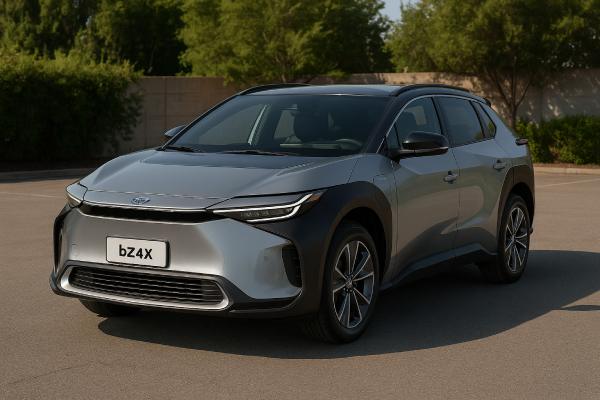
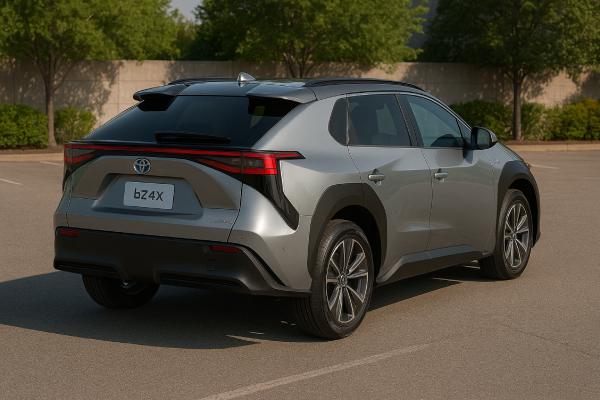
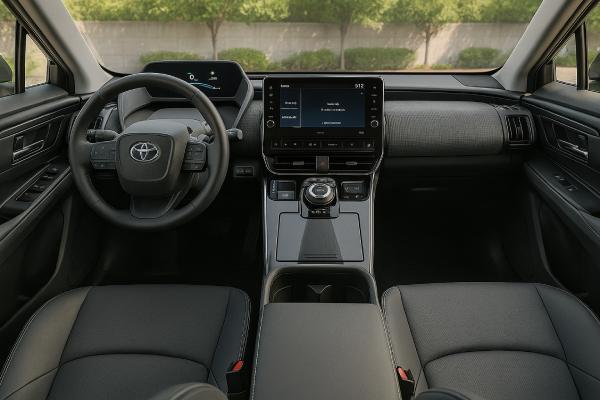
The Toyota bZ4X is a compact, two-row electric SUV that sits near the RAV4 in size but rides on Toyota’s dedicated e-TNGA battery-electric architecture. This guide focuses on the front-motor, front-wheel-drive configuration built around the BluE Nexus 1XM eAxle rated at 201 hp (150 kW). Coverage spans model years 2022–2025, with North America as the baseline for equipment, performance numbers, safety evaluations, and maintenance conventions; short European notes are added only where they change a buying or ownership decision. If you want a clear picture of range, charging, ADAS, service needs, and common ownership snags for this specific bZ4X configuration, you’re in the right place. The headline traits are predictable ride quality, straightforward controls, and Toyota’s emphasis on long-term battery management—tempered by modest DC fast-charge speed and efficiency that trails the class leaders at sustained highway speeds. Read on for the specs that matter, how it drives, what to look for used, and how it stacks up to key rivals.
At a Glance
- Comfortable, quiet commuter with easy controls and stable road manners; simple ownership experience.
- Proven Toyota safety suite and structure; strong crash-test performance in recent model years.
- Straightforward charging: Level 2 overnight; DC fast 10–80% in roughly half an hour under ideal conditions.
- Watch for: early-build wheel-hub bolt recall completion and software updates that optimize charging behavior.
- Typical care: rotate tyres every 5,000 miles / 6 months; brake-fluid inspection every 2 years; cabin filter ~15,000 miles.
Navigate this guide
- bZ4X 1XM: Detailed Overview
- Specifications and Technical Data
- Trims, Safety and Options
- Reliability and Service Actions
- Maintenance and Buyer’s Guide
- Driving and Performance
- How bZ4X Compares to Rivals
bZ4X 1XM: Detailed Overview
The bZ4X with the 1XM front eAxle is the single-motor, front-wheel-drive variant most shoppers encounter in the U.S. and Canada. Its integrated motor, inverter, and reduction gear produce 201 hp (150 kW) and 196 lb-ft (265 Nm), drawing from a lithium-ion battery pack (approx. 355 V nominal) mounted low and centered within the wheelbase. In North America, this specification pairs with 18-inch wheels on the XLE grade (optimized for range) and 20-inch wheels on higher trims (more style and features, slightly less range). Toyota’s calibration targets consistent power delivery and a mild, progressive accelerator response rather than headline acceleration.
Dimensions land squarely in the “compact SUV” class: a 112.2-inch wheelbase with an overall length of 184.6 inches helps interior space, while the 8.1-inch ground clearance and short overhangs give useful urban approach/departure angles for snow berms and driveway edges. Suspension is conventional—MacPherson-strut front and multi-link rear—and tuning emphasizes smooth body motions over aggressive cornering. Brake hardware uses ventilated discs all around with blended regenerative braking that feels natural in daily use.
Real-world ownership is defined by predictable charging and simple day-to-day routines. Most cars charge at home on Level 2 overnight; DC fast charging is best used to add range on trips. Toyota’s battery management strategy favors longevity and thermal moderation over absolute charge rates. For buyers prioritizing active safety, note that late-2024 builds onward achieve the brand’s strongest small-SUV ratings, and every trim includes a robust driver-assistance suite.
If you’re cross-shopping, remember what this configuration is (and isn’t). It’s a calm, efficient commuter and family hauler with Toyota’s service network behind it. It’s not the quickest or longest-range pick in the class, nor the fastest charger—but it’s easy to live with, especially if most miles are local and you can charge at home.
Specifications and Technical Data
Engine and Performance (Electric Drivetrain)
| Item | bZ4X FWD (1XM eAxle) |
|---|---|
| Motor / eAxle | Permanent-magnet synchronous, BluE Nexus 1XM |
| Rated output | 201 hp (150 kW) |
| Rated torque | 265 Nm (196 lb-ft) |
| Battery chemistry / voltage | Lithium-ion / ~355 V nominal |
| Battery capacity (total) | 71.4 kWh (FWD pack) |
| Usable energy | ~low-60s kWh (typical for this pack class) |
| Efficiency (EPA XLE FWD) | 131/107/119 MPGe (city/hwy/comb) |
| EPA range (XLE FWD 18″) | up to 252 miles (405 km) |
| EPA range (Limited FWD 20″) | up to 236 miles (380 km) |
| Aerodynamics (typical) | Cd ≈ 0.29; frontal area ~2.6 m² (approximate) |
Transmission and Charging
| Item | Specification |
|---|---|
| Reduction gear | Single-speed, fixed ratio (front-drive) |
| Drive | FWD (front eAxle only) |
| Onboard AC charging | 6.6–7.6 kW (model-year dependent) |
| AC 0–100% (240 V L2) | About 9–9.5 hours under moderate temps |
| DC fast-charge peak | Up to 150 kW (FWD) under ideal conditions |
| DC 10–80% | ~30 minutes in favorable conditions |
| Connectors | J1772 (AC) / CCS1 (DC) through MY2025 in NA |
Chassis and Dimensions
| Item | Specification (baseline North America) |
|---|---|
| Platform | e-TNGA (BEV-dedicated) |
| Front / rear suspension | MacPherson strut / multi-link |
| Steering | EPS rack-and-pinion; ~14.1:1; ~2.8 turns lock-to-lock |
| Brakes | Ventilated discs front/rear; ABS, EBD, Brake Assist |
| Wheels/tyres (typical) | 18″ alloys (XLE), 20″ alloys (Limited) |
| Length × width × height | 184.6 × 73.2 × 65.0 in (4689 × 1860 × 1651 mm) |
| Wheelbase | 112.2 in (2850 mm) |
| Ground clearance | 8.1 in (206 mm) |
| Turning circle (curb-to-curb) | ~40.0 ft (12.2 m) |
| Curb weight (XLE FWD / Limited FWD) | ~4,266 / 4,398 lb (1935 / 1995 kg) |
| GVWR (XLE / Limited) | 5,435 / 5,620 lb (2466 / 2549 kg) |
| Passenger volume | ~94.4 cu ft (2.67 m³) |
| Cargo (behind 2nd row) | 27.7 cu ft (0.78 m³) |
Fluids and Capacities
| System | Spec / Notes |
|---|---|
| Brake fluid | Toyota-specified brake fluid (DOT 3 family); inspect every 2 years |
| Battery/inverter/eAxle cooling | Toyota Super Long Life Coolant (pink); inspect per schedule |
| eAxle/reduction gear oil | Lifetime fill under normal service; inspect for leaks/noise annually |
| Washer fluid | All-season blend appropriate to climate |
| Wheel fasteners (critical torque) | 140 Nm (103 lb-ft) |
Performance and Economy
| Metric | bZ4X FWD (1XM) |
|---|---|
| 0–60 mph (manufacturer est.) | ~7–7.5 s depending on wheels/tires |
| Top speed (governed) | ~99 mph (160 km/h) |
| EPA energy use (combined) | ~283 Wh/mi (≈17.6 kWh/100 km) equivalent |
| Real-world highway @ 75 mph | Expect range to trail EPA by ~15–25% depending on temp/wind |
| Towing / payload / roof | No U.S. tow rating published; payload ~1,100–1,220 lb by trim; modest roof loads only (consult manual/accessory rating) |
Notes: EPA figures and baseline dimensions above correspond to U.S. specifications with standard wheels/tyres. Larger wheels reduce range slightly in practice. European WLTP range differs and is not interchangeable with EPA.
Trims, Safety and Options
Grades and key hardware
- XLE (FWD) — 18-inch wheels, cloth/synthetic trim, Toyota Audio Multimedia (12.3-inch) with wireless Apple CarPlay/Android Auto, dual-zone climate, radiant front footwell heater, Toyota Safety Sense latest suite, heated mirrors, and a full set of driver aids. Best efficiency and range.
- Limited (FWD) — 20-inch wheels, SofTex-trimmed seats with 8-way power driver seat and ventilation, surround-view camera, power liftgate, rain-sensing wipers, upgraded headlamps, optional JBL audio. Slightly lower range vs XLE due to tyres/aero.
- Nightshade (MY2025) — Blacked-out styling based on XLE content; FWD or AWD. Range follows the content/wheel package.
- Packages/Options of interest — JBL 9-speaker audio, panoramic fixed glass roof with shade, heated steering wheel, heated/ventilated front seats (availability varies by year/grade), Traffic Jam Assist/Lane Change Assist and Front Cross-Traffic Alert added to upper trims in later years (subscription/connectivity dependent).
Functional/Mechanical differences by trim
- Wheels/tyres: 18″ packages ride quieter and stretch range; 20″ packages sharpen turn-in a bit but increase consumption on the highway.
- Headlamps: upgraded projectors on Limited improve forward spread and aim; 2025+ production receives the best ratings across trims.
- Charging UX: later model years show clearer MID charge percentage and time-to-charge estimates; a dual-voltage portable cord is commonly included starting MY2024, easing Level-2 setup at home.
- AWD note: while this article centers the 1XM FWD variant, AWD cars add a second motor (total 214 hp) and an X-MODE drive program for low-μ surfaces; range and charging peak differ slightly.
Safety ratings (crash tests)
- IIHS: Recent builds (2025 model year, vehicles built after December 2024) earn Top Safety Pick+ with Good ratings in updated small overlap, moderate overlap, and side tests, plus strong headlight and pedestrian AEB performance when equipped as tested. Earlier years perform well too, but specific headlight trims may score lower.
- Airbags/structure: front, side, curtain, and driver knee coverage; robust occupant cell with effective load paths.
- Child seats: LATCH anchors with good access; belt geometry supportive of a wide range of seats.
ADAS (advanced driver assistance)
- Standard: Automatic emergency braking with pedestrian detection, lane-departure warning with lane-keeping (steering assist), adaptive cruise control, blind-spot monitor with rear cross-traffic alert, and rear automatic braking.
- Evolution: mid-cycle enhancements refine lane-centering smoothness and improve cold-weather charging logic; later cars add Traffic Jam Assist and Lane Change Assist (connectivity dependent). After windshield or radar service, expect camera/radar calibrations as part of proper repair; plan extra time and a clear, level calibration area.
Quick identifiers / build clues
- VIN/labels: Certification label on driver’s door jamb shows build month—useful for confirming late-2024+ builds that qualify for the latest headlamp ratings.
- Wheels and badging: 20-inch wheels and chrome trim typically indicate Limited; blacked-out accents indicate Nightshade.
Reliability and Service Actions
Toyota’s first mass-market BEV is conservative by design. Most owners report uneventful daily use and minimal unplanned service, especially once early software updates and recalls are closed. Map issues by frequency and cost like this:
Common / low-to-moderate severity
- Cold-weather DC charging performance → Symptoms: slow charging, early taper in low temperatures. Cause: cell temps outside ideal range, conservative thermal strategy. Remedy: pre-condition en route where supported, arrive with 10–30% state of charge, and favor warmer stations; ensure the vehicle has the latest charging logic updates.
- Range variation at highway speeds → Symptoms: highway miles fall short of EPA range. Cause: aero losses rise with speed and wheel/tire choice; HVAC loads. Remedy: plan with 15–25% buffer for 70–75 mph driving, keep 18″ tyres if efficiency matters, and manage HVAC and roof-rack loads.
Occasional / moderate severity
- Charge-port / OBC communication hiccups → Symptoms: intermittent “charge stopped” messages on some public stations. Cause: handshake quirks or station faults. Remedy: reseat connector fully, try another cable or station, and verify vehicle firmware; dealer can check for charge-control TSBs and apply updates.
- 12-V auxiliary battery sensitivity → Symptoms: slow crank-style behavior is absent on BEVs, but a weak 12-V can trigger warnings or inhibit READY. Remedy: test annually after three years, replace proactively at ~4–5 years in harsh climates.
Rare / high severity (early builds)
- Wheel hub bolts loosening (2022 recall on early production) → Symptoms: potential wheel detachment after low-mileage use. Remedy: official recall campaign replaces parts; Toyota instructed owners not to drive affected vehicles until repaired. Verify completion by VIN with a dealer.
Corrosion and underbody
- Brake hardware and regen: EVs use friction brakes less aggressively; in salt climates, surface rust can progress. Remedy: clean/grease slide pins during tyre rotations; perform periodic heavy-brake stops to keep rotors clean.
- Underbody panels: inspect aero shields after deep snow or road-debris contact; secure or replace damaged fasteners to prevent rubbing noises.
Software and calibration notes
- ECU/BMS updates: periodic updates improve charge estimation, preconditioning behavior, and charging-curve stability. If the vehicle’s displayed state-of-charge or estimated time-to-full seems erratic—or DC fast charging falls off unusually early—ask the dealer to check for the latest calibrations.
- ADAS camera/radar: after windshield replacement or front bumper work, a proper static/dynamic calibration is mandatory for correct lane-keeping and AEB performance.
Pre-purchase checklist (used)
- Full service history and recall clearance by VIN.
- Proof of charging-system software updates.
- Tyres evenly worn and correct spec (mixed or mismatched tyres can amplify torque-steer and reduce range).
- Brake hardware condition and parking-brake operation (common corrosion points).
- HV battery health scan (dealer tool) to confirm cell-voltage spread is within norms; road-test to observe charge/regen behavior.
- Check cargo area and underbody panels for moisture or damage; confirm all aero shields are intact.
Maintenance and Buyer’s Guide
Practical maintenance schedule (distance/time)
(Baseline guidance for North American ownership; always verify by VIN in your official manual.)
- Tyre rotation, inspect brakes & suspension: every 5,000 miles / 6 months.
- Cabin air filter: 15,000–20,000 miles (sooner in dusty areas).
- Brake fluid: inspect every service; replace about 2–3 years or on moisture/boiling-point test.
- Coolant loops (battery/inverter/eAxle): inspect annually; replace per manufacturer interval (long-life coolant; many Toyota systems specify first replacement near 100,000 miles/10 years, then shorter intervals).
- 12-V battery: load-test annually from year three; typical replacement 4–5 years.
- Alignment: check yearly or after impacts/tyre replacement; toe settings materially affect range.
- High-voltage (HV) system: visual inspections at scheduled visits; HV battery has no owner-serviceable parts.
- Reduction gear / eAxle oil: non-service under normal use; inspect for leaks/noise during annual checks.
- Body/underbody: inspect aero panels and splash shields after winter.
Fluid specifications and essentials
- Use Toyota-specified brake fluid compatible with the ABS/ESC system.
- Use Toyota Super Long Life Coolant (SLLC, pink) in all thermal loops.
- Avoid pressure-washing the charge port; keep the cover gasket clean.
- Wheel fasteners torque: 140 Nm (103 lb-ft) after tyre service; re-check after 50–100 miles.
Ownership costs and warranty basics (North America)
- Complimentary scheduled maintenance for 2 years/25,000 miles is common on new vehicles.
- New-vehicle and powertrain warranties are typical Toyota terms; EV drive components and traction battery carry separate longer coverage—consult your Warranty & Maintenance Guide for the exact model year.
- Expect lower routine maintenance vs ICE: no oil changes, serpentine belts, spark plugs, or emissions equipment.
Buyer’s guide – what to seek or avoid
- Seek: XLE FWD on 18-inch wheels for the best efficiency; late-2024+ builds for the latest headlamp and crash-test results; cars with documented software updates.
- Consider: Limited FWD for comfort features (accepting modest range hit).
- Avoid: Unrepaired early-build cars under the 2022 hub-bolt recall; vehicles with persistent DC-charging complaints that don’t resolve after dealer updates.
- Durability outlook: With gentle fast-charging habits and regular maintenance, the 1XM FWD bZ4X should deliver the long-term reliability Toyota owners expect, especially for drivers who primarily charge at home and cruise at moderate highway speeds.
Driving and Performance
Ride, handling, NVH
The bZ4X’s long wheelbase and stiff battery floorpan help it feel planted on uneven pavement. Spring and damper tuning prioritize comfort: it takes the sharp edges off potholes and expansion joints without float. Road noise is modest on 18-inch tyres and grows a bit with the 20s, mainly from tread roar on coarse asphalt. Straight-line stability is excellent—small steering corrections keep it centered, and crosswinds don’t unsettle it. The steering is light in parking lots and adds weight smoothly with speed; feedback is muted but predictable. Brake feel—a common weak spot in some EVs—is among the better calibrations: you sense an easy transition from regen to friction at low speeds with no abrupt handoff.
Powertrain character
With 201 hp (150 kW) and 196 lb-ft (265 Nm) at the front axle, the FWD bZ4X steps off smoothly and keeps a steady pull to typical U.S. speeds. It isn’t a stoplight sprinter, and hard launches can nudge the front tyres if the road is slick, but stability control is progressive and unobtrusive. Drive modes adjust pedal mapping and climate aggressiveness more than absolute output. One-pedal driving is conservative by design; strong lift-off regen is present, but the vehicle still expects you to use the brake pedal to come to a complete stop.
Real-world efficiency and range
In mixed suburban use at seasonal temperatures, owners regularly see results near the EPA combined figure when running 18-inch tyres. At 70–75 mph (113–120 km/h), expect range to fall below the EPA rating by roughly 15–25% depending on wind, temperature, precipitation, and roof-rack/cargo. Larger wheels and winter tyres add a further penalty. Good highway practice is to plan charging around 10–80% segments, arriving with 10–30% state-of-charge to improve DC fast-charge performance.
Charging behavior
On Level 2 (240 V), most FWD cars replenish from low to full in about 9–9.5 hours, which fits an overnight routine. On DC fast chargers, 10–80% in roughly 30 minutes is achievable in mild weather with a pre-warmed battery; expect a slower curve in cold conditions. Arrive low, pre-condition if your route allows, and avoid sitting at 100% on fast chargers—lithium-ion batteries are happiest between roughly 10–80% for daily use.
Key metrics
- 0–60 mph: ~7–7.5 s (FWD; tyre dependent).
- Passing (50–80 mph): adequate; plan a down-pedal, not neck-snapping.
- Braking: consistent pedal, stable stops; keep rotors clean with periodic firm applications.
- Turning circle: about 40 ft (12.2 m)—easy in city parking.
- Loaded driving: with passengers and cargo, acceleration softens but stability remains strong; budget extra charging time on road trips due to higher consumption.
How bZ4X Compares to Rivals
Tesla Model Y (RWD/AWD)
Leads on range and Supercharger access and is notably quicker, with a brisker charging curve. The trade-offs are firmer ride, more road noise on some tyres, and a minimalist interface that some owners love and others don’t. If you value road-trip speed above all, the Tesla is ahead; if you prefer conventional controls and a calmer chassis, the Toyota appeals.
Hyundai Ioniq 5 (RWD/AWD)
Its 800-V electrical architecture enables very fast DC charging and strong highway efficiency. Ride/handling are competent, interior packaging clever, and software rich. The bZ4X counters with simpler ergonomics and a reputation for conservative battery management. If public fast-charging is your norm, the Ioniq 5 has the advantage.
Volkswagen ID.4 (RWD/AWD)
Similar footprint and price band with comfortable seats and competitive cargo space. Software and interface have improved, but VW’s learning curve shows on some model years. Tow ratings and rear-drive dynamics favor the ID.4 for light utility use; Toyota wins on straightforward ownership and service network breadth.
Chevrolet Equinox EV (FWD/AWD)
A new-gen entry with strong value and competitive range/charge specs. Early availability and trims vary by region; dealer network support is comprehensive. Toyota’s bZ4X offers a longer track record and a very consistent day-to-day experience.
Subaru Solterra (AWD only)
A close mechanical sibling tuned for traction and light off-road confidence, always with dual motors. If you need snow performance and trail-friendly calibration, the Subaru is compelling. For efficiency and price in a simple commuter, the FWD bZ4X is the better fit.
References
- 2023 Toyota bZ4X Product Information 2023 (Specifications)
- 2024 Toyota bZ4X: Engineered for Electrifying Exhilaration 2023 (Charging/Equipment)
- 2025 Toyota bZ4X 2025 (Safety Rating)
- Part 573 Safety Recall Report 22V-444 2022 (Recall)
- Anti Theft Wheel Lock Nut / Bolt – Installation Instructions 2024 (Torque Spec)
Disclaimer
This article is for informational purposes only and isn’t a substitute for professional diagnosis or repair. Specifications, torque values, intervals, and procedures vary by VIN, model year, market, and equipment. Always verify details in your vehicle’s official Owner’s, Warranty & Maintenance, and Service documentation, and follow all safety procedures when working on high-voltage systems.
If this guide helped you, please consider sharing it with fellow owners and shoppers on Facebook, X/Twitter, or your favorite forum—thanks for supporting xcar’s work.