
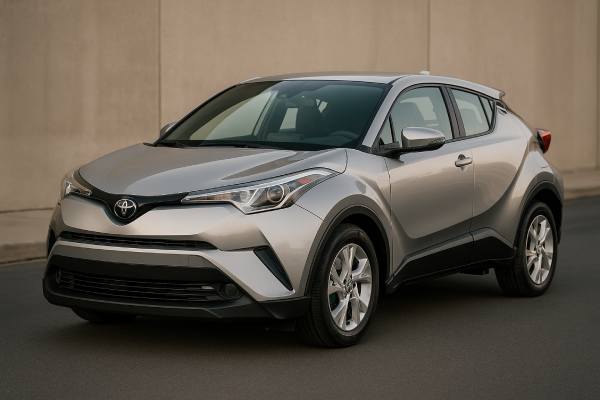
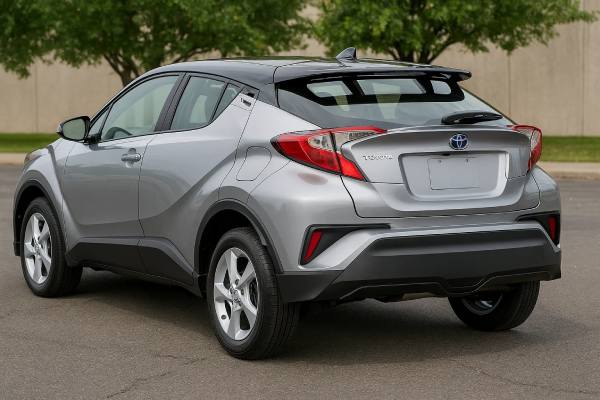
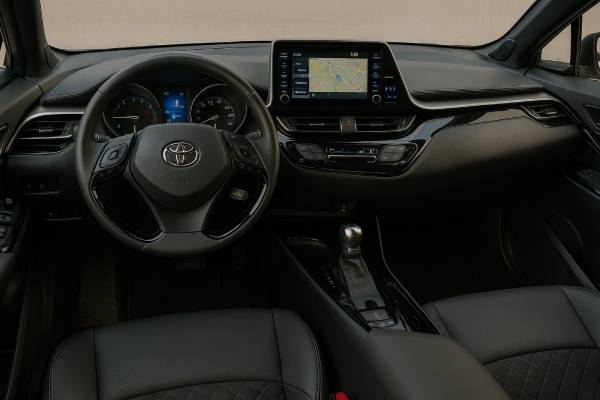
The first-generation Toyota C-HR in 1.2-litre turbo 2WD form targets buyers who want a compact crossover with distinctive style, hatchback agility, and low running costs. Built on Toyota’s TNGA-C chassis, it pairs a light, rigid structure with a small, efficient direct-injection turbo engine (8NR-FTS) and either a slick 6-speed manual or a smooth CVT. Cabin packaging is clever for the class: a high seating point, supportive front chairs, and useful cargo flexibility. Standard Toyota Safety Sense brought automatic emergency braking and lane support to many cars from launch, with a five-star Euro NCAP score underpinning its safety story. Ownership is straightforward: annual service intervals, widely available 0W-20 oil, and durable brakes and suspension. Critically, the 1.2T’s broad torque band (185 Nm) makes the C-HR feel stronger in everyday driving than its modest 116 hp figure suggests. If you prioritise style, refinement, and a calm long-distance gait over outright pace, this C-HR spec deserves a close look.
At a Glance
- Confident chassis (TNGA-C) with supple ride and secure handling; refined at motorway speeds.
- Punchy mid-range from 1.2-litre D-4T (185 Nm) and relaxed CVT; 6-MT suits keen drivers.
- Strong safety story: five-star Euro NCAP with effective Toyota Safety Sense features.
- Watch for carbon build-up on intake valves over high mileage; CVT fluid health matters.
- Typical service: engine oil and filter every 12 months or 10,000–15,000 km (check local schedule).
Explore the sections
- C-HR 1.2T overview 2016–2019
- Toyota C-HR 1.2T specs and data
- C-HR trims, options, and safety
- Reliability and common issues
- Maintenance and buyer’s guide
- Driving and performance
- C-HR vs rivals
C-HR 1.2T overview 2016–2019
Toyota engineered the C-HR to feel like a well-sorted hatchback wearing crossover clothes. The TNGA-C platform uses high-strength steel, optimised welds, and a multi-link rear suspension that is unusual in this size class. The result is calm body control over poor surfaces and consistent steering on motorways. The 1.2-litre 8NR-FTS engine is a downsized, direct-injection turbo four with VVT-iW (a wide-range variable valve system) that enables efficient, Miller-cycle-like operation at light loads for economy, yet switches to conventional timing under higher demand for power. Output is rated at 116 hp (85 kW) and 185 Nm (136 lb-ft), delivered from low revs so the car steps off willingly in traffic.
Two transmissions were offered in Europe on front-wheel-drive 1.2T cars: a 6-speed manual with rev-matching logic and a continuously variable transmission (CVT) tuned for a linear “fixed-ratio” feel during moderate acceleration. The CVT keeps the engine within its torque plateau, aiding smoothness and efficiency; the 6-MT gives better control on hilly routes and slightly sharper real-world responses. Braking hardware is sensibly sized, with ventilated front discs and solid rears; pedal feel is progressive and stable over repeated stops in typical road use.
The cabin emphasises driver focus: an elevated hip point, soft-touch dash, and simple, logical controls. Rear headroom is reasonable, though the coupé-like roofline and thick rear quarters reduce over-shoulder visibility. Luggage space is competitive, with the cargo floor optimised for width and a low lift-over. Equipment levels rose through the range to include LED lamps, JBL audio, and comprehensive driver assistance. Across mileage and years, owners value the C-HR’s durable interior materials, stable alignment, and quiet high-speed ride—attributes that make it feel like a more expensive car on long trips.
Toyota C-HR 1.2T specs and data
The data below applies to the 2WD, 1.2-litre turbo petrol Toyota C-HR (NGX10) offered in Europe for model years 2016–2019. Figures may vary slightly by trim, wheel/tire package, and test cycle.
Engine and Performance
| Item | Specification |
|---|---|
| Engine code | 8NR-FTS (D-4T direct injection turbo) |
| Layout & valvetrain | Inline-4, DOHC, Dual VVT-i/VVT-iW, 4 valves/cyl |
| Bore × stroke | 71.5 × 74.5 mm (2.81 × 2.93 in) |
| Displacement | 1.197 L (1,197 cc) |
| Induction | Single-scroll turbocharger with intercooler |
| Compression ratio | 10.0:1 |
| Max power | 116 hp (85 kW) @ ~5,200–5,600 rpm |
| Max torque | 185 Nm (136 lb-ft) @ 1,500–4,000 rpm |
| Fuel system | Direct injection (D-4T) |
| Emissions/efficiency std. | Euro 6 |
| Rated combined economy* | ~5.5–6.0 L/100 km (43–39 mpg US / 52–48 mpg UK), trim/tyres dependent |
| Real-world highway @ 120 km/h | ~6.8–7.5 L/100 km (35–31 mpg US / 42–37 mpg UK), light load |
| Aerodynamics | Cd ≈ 0.32 with aero undertrays and smooth body surfacing |
*Figures varied with early NEDC and later WLTP conversions and wheel size.
Transmission and Driveline
| Item | Specification |
|---|---|
| Transmission (manual) | 6-speed MT, cable shift; hill-start assist |
| Transmission (CVT) | Continuously Variable Transmission with step-shift logic |
| Final drive ratio | ~3.8 (varies slightly by transmission and wheel size) |
| Drive type | Front-wheel drive (2WD) |
| Differential | Open front differential; traction/stability via VSC |
Chassis and Dimensions
| Item | Specification |
|---|---|
| Front suspension | MacPherson strut, coil springs, stabiliser |
| Rear suspension | Double-wishbone/multi-link with stabiliser |
| Steering | Electric power steering; ~2.7 turns lock-to-lock |
| Brakes (front/rear) | Ventilated disc / solid disc; ABS, EBD, brake assist |
| Wheels/tyres | 17–18 in factory packages; typical 215/60 R17 or 225/50 R18 |
| Ground clearance | ~142 mm (5.6 in) |
| Length × width × height | 4,360 × 1,795 × 1,565 mm (171.7 × 70.7 × 61.6 in) |
| Wheelbase | 2,640 mm (103.9 in) |
| Turning circle (kerb-to-kerb) | ~10.4–10.8 m (34.1–35.4 ft) |
| Kerb (curb) weight | ~1,320–1,380 kg (2,910–3,042 lb), spec dependent |
| Fuel tank | 50 L (13.2 US gal / 11.0 UK gal) |
| Cargo volume (VDA) | 377 L seats up (to tonneau); 1,164 L seats down (to roof) |
Performance and Capability
| Metric | Figure |
|---|---|
| 0–100 km/h (0–62 mph) | ~10.9 s (typical CVT; MT similar) |
| Top speed | ~185–190 km/h (115–118 mph) |
| Braking 100–0 km/h | Class-typical; stable with quality tyres |
| Towing (braked/unbraked) | Light towing only where approved; check local rating |
| Payload | Trim-dependent; verify on door-jamb label |
| Roof load | Typically 50–75 kg (110–165 lb) with approved bars |
Fluids and Service Capacities
| System | Spec / Grade | Capacity* |
|---|---|---|
| Engine oil | API SN+/SP, ILSAC GF-5/6, 0W-20 preferred | ~4.0 L (4.2 US qt) service fill |
| Engine coolant | HOAT/LLC (Toyota Super Long Life Coolant, premix) | ~6.4–6.7 L (6.8–7.1 US qt) |
| Manual transmission | Toyota MT Gear Oil LV, API GL-4 75W | ~2.4 L (2.5 US qt) |
| CVT | Toyota CVT Fluid FE | ~7.4–7.5 L (7.8–7.9 US qt) incl. drain/refill cycles |
| A/C refrigerant | HFO-1234yf; ND-11/ND-12 oil | ~470 g (16.6 oz), verify under-bonnet label |
| Fuel | Unleaded petrol, min RON 95 recommended | 50 L |
| Spark plugs | Iridium (e.g., Denso VDCH22F); gap ~0.7–0.8 mm | 4 plugs |
| Wheel lug torque | ~103 Nm (76 lb-ft) typical Toyota spec** | — |
*Approximate workshop figures; always verify by VIN.
**Confirm for your wheel/bolt kit; torque may vary with accessory wheels.
Electrical
| Item | Specification |
|---|---|
| 12 V battery | 45–60 Ah AGM/EFB depending on equipment |
| Alternator | Compact high-output unit sized for LED/ADAS load |
| Plugs/ignition | Coil-on-plug; long-life iridium service interval |
Safety and Driver Assistance
| Area | Notes |
|---|---|
| Crash ratings | Euro NCAP 5 stars for first-gen C-HR with strong adult protection |
| Headlights | LED and halogen availability; performance improves with LED and AHB |
| ADAS suite | Toyota Safety Sense: AEB (vehicle/pedestrian), Lane Departure Alert with steering assist, Road Sign Assist; ACC availability grew with model years |
| Child seats | ISOFIX/LATCH outboard rear, top-tethers; door child locks |
| Structure | High-strength steel/TNGA; multiple airbags and robust occupant cell |
C-HR trims, options, and safety
European 1.2T 2WD cars were sold across familiar Toyota grades, with names and bundles varying slightly by country. The pattern below reflects common UK-style packaging (similar content across much of Europe):
Typical trims
- Icon / Active (entry): 17-inch alloys, manual air-con or basic dual-zone climate, reversing camera, Toyota Safety Sense, 7–8 in touchscreen with Bluetooth and USB, cloth seats.
- Design / Mid: Adds dual-zone climate where absent, front/rear parking sensors (or pack), enhanced interior trim, additional USBs, privacy glass, and more custom alloy designs.
- Excel / Dynamic (high): LED headlamps and DRLs, keyless entry and start, blind spot monitor and rear cross-traffic alert (often via Tech Pack), premium upholstery options, heated front seats, power lumbar, and larger 18-inch wheels.
- Option packs: Tech Pack (smart entry, BSM/RCTA, Intelligent Clearance Sonar), JBL Pack (amplified 9-speaker system), and leather/Alcantara upholstery bundles in select markets.
Mechanical/functional differences by trim
- The 1.2T 2WD hardware is uniform: same engine, final drive, and braking system. Ride/handling feel changes slightly with wheel size and tyre compound. Cars on 18-inch wheels ride a touch firmer and generate more tyre roar on coarse asphalt; 17-inch packages are quieter and more compliant.
- Lighting: LED headlights markedly improve nighttime reach and beam cut-off versus halogen reflectors; look for factory LEDs on mid/high grades.
- Infotainment: Early cars use Toyota Touch 2; later software updates brought smartphone integration in some markets—confirm the specific head unit and features.
Year-to-year notes (2016–2019)
- 2016 launch (MY2017 in many markets): 1.2T available with 6-MT or CVT; early Toyota Safety Sense suite standardised across most trims.
- 2018: Running updates to audio and navigation, plus small trim revisions.
- 2019: Pre-facelift cars continue; the range later pivots toward hybrid-only line-ups in some countries (post-2019). The 1.2T remains available in specific markets up to the changeover.
Safety ratings
- The first-generation C-HR achieved a five-star Euro NCAP rating with excellent adult occupant protection and strong active safety support. Head-protecting side curtains and front side airbags are standard; ISOFIX and top-tether provisions support safe child-seat installation. LED headlights and automatic high beam improve night driving where fitted.
ADAS and calibration considerations
- Systems include AEB (forward collision mitigation), Lane Departure Alert with steering assist, Adaptive Cruise Control (grade-dependent on early cars), and Road Sign Assist.
- After windscreen replacement or front-end repairs, camera/radar calibration is required. Choosing OEM-approved glass, correct aim procedures, and a workshop with ADAS calibration equipment prevents steering vibration, warning lights, or mis-aimed beams.
- Wheel alignment affects lane-keeping performance; ensure thrust angle is within spec after suspension work.
Reliability and common issues
The C-HR generally proves durable when maintained on time with correct fluids. Below are patterns observed across the 1.2T 2WD (NGX10), grouped by prevalence and cost impact. Mileage bands are indicative.
Engine/induction (8NR-FTS)
- Direct-injection intake valve deposits — Occasional / Medium.
- Symptoms: Rough cold idle, hesitation on gentle throttle, P0300-series misfires. Typically >60,000–100,000 km with short-trip use.
- Cause: DI engines do not wash intake valves with fuel; oil mist and EGR particulates adhere.
- Remedy: Walnut-shell blasting or chemical cleaning; update PCV if applicable. Combine with new plugs and MAF clean.
- Boost control/wastegate actuator rattle — Occasional / Low to Medium.
- Symptoms: Metallic rattle on light load/overrun, intermittent under-boost code.
- Cause: Actuator linkage wear or sticking.
- Remedy: Inspect linkage and vacuum lines; adjust or replace actuator assembly if play exceeds spec.
- Coolant tees/hoses seepage — Rare / Low.
- Symptoms: Sweet smell, low reservoir level over months.
- Remedy: Replace affected hose/clamp; pressure test cooling circuit. Use correct long-life coolant.
Fuel/ignition
- Ignition coil degradation — Occasional / Low to Medium.
- Symptoms: Misfire under load, OBD codes on one cylinder.
- Remedy: Replace affected coil(s); install new iridium plugs (correct heat range and gap).
Transmission/driveline
- CVT fluid ageing (FE) — Occasional / Medium.
- Symptoms: Driveline whine or flare during brisk throttle, slight judder on take-off beyond 80,000–120,000 km.
- Remedy: Drain and refill with Toyota CVT Fluid FE (observe fill procedure and temperature). Check mount condition and perform software resets/relearns.
- Manual gearbox clutch wear — Usage-dependent / Medium.
- Symptoms: High bite point, slip on 3rd-gear acceleration.
- Remedy: Clutch kit and release bearing; verify no rear main seal seep.
Chassis and body
- Rear brake pad corrosion ridges — Common in salted climates / Low.
- Symptoms: Light scraping noises; reduced parking-brake bite.
- Remedy: De-lip or replace discs/pads; lubricate sliders; apply anti-corrosion spray to exposed edges.
- Cosmetic corrosion on fasteners/subframes — Occasional / Low.
- Remedy: Clean and treat; ensure under-body wash after winter.
HVAC and electronics
- Cabin filter neglect → blower noise — Common / Low. Replace yearly.
- Windshield camera/radar misalignment after glass work — Occasional / Medium. Calibrate ADAS.
Recalls and service campaigns (headline items)
- Electric parking brake (EPB) control unit software — On certain early C-HR vehicles, skid-control ECU logic could prevent EPB application or release. Remedy: dealer ECU software update.
- Region-specific campaigns — Seat belt component updates and label corrections appeared later on other model years; always run a VIN recall check through the official portal.
Pre-purchase checks (what to ask for)
- Full service history with annual oil changes and correct 0W-20 spec.
- Proof of CVT fluid service by time/mileage if CVT-equipped, and evidence of any software updates.
- Intake/ignition work (plugs, coils, or valve clean) on higher-mileage cars with urban use.
- ADAS calibration certificates if the windscreen has been replaced.
- Brake condition (inner pad wear) and suspension bushings; verify quiet, straight stopping.
- Confirm any recall/software campaign completions via official VIN lookup.
Maintenance and buyer’s guide
Practical maintenance schedule (typical European pattern)
(Always verify against the service booklet for your VIN and market.)
- Engine oil & filter: Every 12 months or 10,000–15,000 km. Use 0W-20 API SN+/SP, ILSAC GF-5/6. Capacity ~4.0 L service fill.
- Engine air filter: Inspect at 20,000 km; replace 30,000–45,000 km or dusty use.
- Cabin filter: Replace 12 months (more often in urban/pollen seasons).
- Spark plugs (iridium): 90,000–120,000 km or 6–7 years; gap ~0.7–0.8 mm.
- Coolant (S-LLC): First at 10 years/160,000 km, then 5 years/80,000 km intervals (follow coolant label guidance).
- Transmission (CVT): Inspect fluid condition by 60,000–90,000 km; drain/fill with CVT FE if degraded. Manual: change around 90,000–120,000 km or clutch service.
- Brake fluid: Replace every 2 years; test for moisture content.
- Brake pads/rotors: Inspect every service; de-lip rears in salted climates.
- Serpentine belt: Inspect 60,000 km/4 years; replace on noise/cracking.
- PCV valve and induction: Check 60,000–90,000 km; clean MAF/throttle; assess intake valve deposits on DI engines.
- 12 V battery: Test annually after 4 years; replace proactively if weak (ADAS systems are voltage-sensitive).
- Tyres: Rotate every 10,000–12,000 km; maintain even wear (front-heavy FWD). Align if the car tracks off-centre or after curb strikes.
Fluid specifications and essentials
- Oil: 0W-20, API SN+/SP, ILSAC GF-5/6; OEM filter preferred for anti-drainback performance.
- Coolant: Toyota Super Long Life Coolant (pink premix).
- CVT: Toyota CVT Fluid FE only; filling requires temperature-controlled level check.
- Manual gearbox: Toyota MT Gear Oil LV, API GL-4 75W.
- A/C: R1234yf with ND-11/ND-12 oil; charge mass on under-bonnet label (~470 g typical).
- Key torque values: Wheel lugs ~103 Nm (76 lb-ft); spark plugs ~20–25 Nm (follow plug maker’s spec and crush-gasket feel).
Buyer’s guide: what to look for on a test drive
- Cold start: Smooth idle after a few seconds; no ticking beyond normal DI noise.
- Boost build: Even pull from 1,500–4,000 rpm without surging; listen for wastegate buzz on lift-off.
- CVT behaviour: No “flare” on steady throttle; quiet cruise at 120 km/h.
- Ride/noise: Minimal thumps over sharp edges; check tyre type/age (18-inch wheels can add roar on concrete).
- Brakes: Progressive bite; no pulsation. Inspect rear discs for rust lips.
- Steering/ADAS: Tracks straight with lane assist, no camera errors after windscreen work.
- Body: Even panel gaps; look under rear arches and subframes for surface corrosion if from salted regions.
- Paperwork: Recall/VIN check printout, recent brake fluid change, documented oil services, and any induction cleaning on higher-mileage urban cars.
Durability outlook
With routine annual servicing, correct fluids, and occasional DI intake cleaning on higher mileage, the 1.2T C-HR is a low-drama daily. Suspension joints and bushings wear slowly; brakes last well; and interior trim holds up. CVT longevity is strong when fluid quality is preserved and software remains current.
Driving and performance
Ride, handling, and refinement
The TNGA-C chassis gives the C-HR a planted, hatch-like feel. The multi-link rear end absorbs mid-corner bumps cleanly, and the body settles quickly after crests. Steering is light in town, gains reassuring weight on the motorway, and centres consistently. On 17-inch tyres the ride is supple and quiet; 18-inch wheels sharpen turn-in but pass more texture into the cabin. High-speed refinement is excellent for the class, with modest wind rustle around the door mirrors.
Powertrain character
Toyota tuned the 8NR-FTS for torque density rather than top-end theatrics. The engine wakes up early, pulling from ~1,500 rpm and holding its 185 Nm plateau through typical overtakes. The 6-MT has precise gates and a progressive clutch take-up that makes hill starts easy. The CVT emphasises low-rpm cruising and mimics stepped ratios under firmer throttle to avoid droning; brisk passing requires a decisive pedal input to trigger a lower “virtual ratio.” There’s minimal turbo lag in everyday use; throttle mapping is linear.
Brakes and stability
Pedal feel is predictable with good initial bite; stability control is well-judged, trimming wheelspin on wet junction launches without cutting power abruptly. Repeated hard stops are limited by tyre grip rather than fade in normal road driving.
Real-world efficiency
In mixed commuting, 6.0–6.8 L/100 km (39–35 mpg US / 47–42 mpg UK) is common for careful drivers. At a steady 120 km/h, expect ~6.8–7.5 L/100 km depending on wind, gradient, and tyre choice. Short, cold urban trips skew consumption upward; warm weather and 17-inch tyres help.
Load and long-trip comfort
With two adults, luggage, and motorway speeds, the C-HR remains composed. The rear springs handle weekend loads without excessive squat. If you regularly carry four adults and cargo, prefer 17-inch tyres for both comfort and noise. Towing is limited; check your registration for braked capacity where applicable, and budget for a noticeable consumption penalty when towing or driving fully laden.
C-HR vs rivals
Nissan Qashqai 1.2/1.3 DIG-T
The Qashqai offers a roomier rear bench and a bigger boot in some configurations, with a softer low-speed ride. Later 1.3 engines are stronger on paper, but the Toyota counters with a better-tuned chassis and a quieter cruise. The C-HR’s interior materials feel more premium in touchpoints; Qashqai infotainment is simpler to use.
SEAT Arona / Ateca small-engine variants
VAG’s 1.0/1.5 TSI options deliver crisp performance and frugal motorway numbers. However, the Toyota’s suspension polish and low cabin noise stand out on longer journeys. ADAS availability and calibration quality are strong for both; Toyota’s lane support is particularly unobtrusive.
Renault Captur 1.3 TCe
Captur brings value and customisation. The C-HR’s steering accuracy, driving position, and high-speed stability feel more mature. Reliability perceptions favour Toyota; running costs are comparable when serviced on time.
Mazda CX-3 / CX-30 2.0 NA
Mazda’s naturally aspirated engines are smooth and eager but need revs for overtakes; Toyota’s turbo torque is more relaxed in everyday driving. Both offer tidy handling; Toyota’s ride isolation is superior on coarse motorways.
Hyundai Kona 1.0/1.6 T-GDi (pre-refresh)
Kona can be quicker in 1.6 form and offers broad spec value. The C-HR brings a more sophisticated chassis, calmer NVH, and an interior that ages gracefully. Dealer network strength and resale support favour Toyota in many regions.
References
- C-HR Gen1 Press Information (Nov 2016) 2016 (Press Kit)
- Toyota C-HR (2017) – Euro NCAP Result 2017 (Safety Rating)
- Toyota C-HR Technical Specifications 2021 (Technical Specifications)
- Toyota Recall Checker 2023 (Recall Database)
- Toyota Unveils Specifications of the New C-HR for the Japanese Market 2016 (Press Release)
Disclaimer
This guide is for informational purposes and does not replace professional diagnosis or repair procedures. Specifications, torque values, service intervals, and repair steps vary by VIN, market, model year, and equipment. Always confirm against your vehicle’s official service and owner documentation before performing maintenance or repairs. If you found this helpful, please consider sharing it with friends and owners’ groups on Facebook or X (Twitter) to support xcar’s work.