
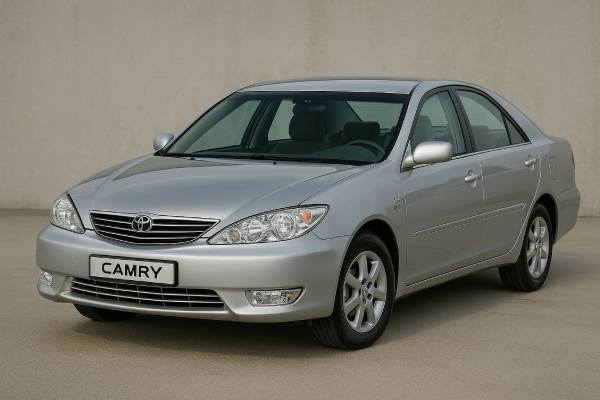
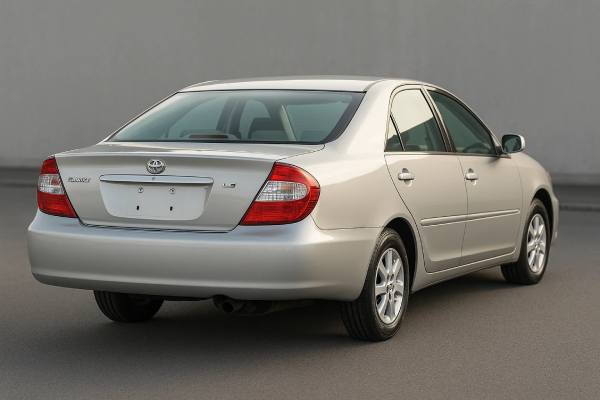
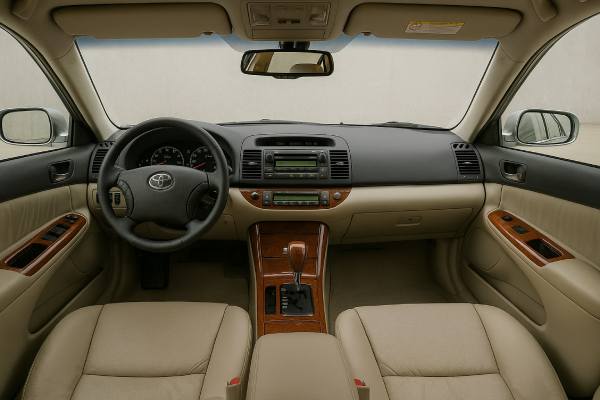
The 2005–2006 facelift of the XV30 Toyota Camry refined an already successful formula. The 2AZ-FE 2.4-litre four-cylinder remains the volume engine, tuned here for smoothness, low running costs, and relaxed highway manners. The update brought subtle exterior changes, improved cabin materials, and broader availability of side and curtain airbags. Many trims also gained a five-speed automatic that keeps revs down, pairing well with the engine’s broad midrange. Owners value the car’s roomy interior, quiet ride, and easy service access. The powertrain uses a timing chain, iridium plugs, and straightforward port fuel injection—ingredients that help these cars rack up high mileage with routine care.
Two caveats apply. First, as with earlier 2AZ-FE engines, neglect or overheating can lead to head-gasket seepage from stripped head-bolt threads; an expert inspection is worth the time. Second, transmissions that never received fluid changes may show shift flare or harshness, especially in cold weather. Find one with a paper trail, budget for age-based rubber parts and fluids, and this facelift Camry will deliver years of calm, inexpensive commuting.
Quick Specs and Notes
- Quiet, spacious midsize; wide trunk opening and generous rear legroom.
- 2AZ-FE chain-driven four is durable and efficient; five-speed automatic widely available.
- Seek cars with side and curtain airbags; 2005–2006 equipment is stronger than early years.
- Watch for coolant seep at head-to-block corner and overdue ATF; fix early to prevent bigger bills.
- Typical interval: engine oil and filter every 5,000–7,500 miles (8,000–12,000 km) or 6–12 months.
Navigate this guide
- Camry ACV30 facelift in detail
- Camry 2.4 specifications and data
- Camry trims options and safety
- Reliability issues and service actions
- Maintenance schedule and buyer’s guide
- Driving performance and economy
- How Camry compares to rivals
Camry ACV30 facelift in detail
Toyota’s 2005–2006 facelift is the XV30 Camry at its most mature. Styling tweaks—grille, lamps, and trim—are modest, but cabin touch-points, sound insulation, and option availability step up. The ACV30 code denotes the 2.4-litre four-cylinder, which is the heart of this model in North America. The engine’s character suits the brief: quiet cold starts, a calm idle, and linear torque that makes the car feel eager at low to mid rpm without ever being loud or coarse.
The powertrain’s simplicity underpins its reliability story. The 2AZ-FE uses an aluminium block with cast-in liners and a chain-driven DOHC valvetrain (VVT-i on the intake). Because there is no rubber timing belt to age out, owners typically focus on engine oil quality, coolant health, and air filtration. The pairing transmission depends on trim and option mix: many facelift cars gained a five-speed automatic that lowers cruise rpm and smooths passing downshifts; others retained the proven four-speed. Either way, the Camry’s logic tends toward early upshifts and low noise, which is the point of this car. A five-speed manual exists in small numbers if you want direct control and lighter feel.
Chassis tuning emphasises stability and comfort. Strut layouts front and rear minimise cost and complexity while delivering predictable handling. Steering is hydraulic and light-effort, which suits parking-lot manoeuvres and long highway stints. Brakes are strong for daily use; higher-spec V6 parts are not required for reliable stopping in normal driving if you run quality pads, fresh fluid, and good tyres.
Inside, the facelift adds tighter panel fit, improved fabrics, and the option of a more premium audio package. The rear bench is genuinely adult-friendly, door openings are wide, and the trunk’s large rectangular aperture makes it easy to load strollers or suitcases. Noise suppression is a highlight: at 70–75 mph the car settles into a hushed, low-frequency rumble with little wind hiss. If you prioritise quiet, straightforward transport that lasts, this is one of the most rational choices from the mid-2000s.
Camry 2.4 specifications and data
Data below reflects North American 2005–2006 four-cylinder sedans. Small differences occur by trim, wheels/tyres, and option packages. “~” indicates typical values where factory ranges exist.
Engine and Performance (ICE)
| Item | Specification |
|---|---|
| Code | 2AZ-FE |
| Layout & cylinders | Inline-4, aluminium block/head, DOHC, 16 valves, VVT-i (intake) |
| Bore × stroke | 88.5 × 96.0 mm (3.48 × 3.78 in) |
| Displacement | 2.4 L (2,362 cc) |
| Induction | Naturally aspirated |
| Fuel system | Port fuel injection (PFI) |
| Compression ratio | ~9.6:1 |
| Max power (rating method) | 154 hp (115 kW) @ ~5,600 rpm (late SAE net); earlier literature often shows 160 hp (119 kW) for 2005 |
| Max torque | ~217 Nm (160 lb-ft) @ ~4,000 rpm |
| Timing drive | Chain |
| Emissions / efficiency | Tier-2 era gasoline |
| Rated economy (auto) | ≈ 24 mpg US combined (21 city / 31 hwy) · 9.8 L/100 km combined |
| Real-world highway @ 120 km/h (75 mph) | 7.6–8.7 L/100 km (27–31 mpg US; 32–37 mpg UK), tyre/terrain dependent |
| Aerodynamics | Cd ≈ 0.28–0.29 (sedan) |
Transmission and Driveline
| Item | Specification |
|---|---|
| Automatic (common) | 5-speed U151E on many facelift trims; 4-speed U241E on others |
| Manual (rare) | 5-speed E351 |
| Gear ratios — U241E (4-spd) | 1st 2.847 · 2nd 1.552 · 3rd 1.000 · 4th 0.700 · Rev 2.343 |
| Gear ratios — U151E (5-spd) | 1st 3.943 · 2nd 2.197 · 3rd 1.413 · 4th 1.019 · 5th 0.716 · Rev 3.145 |
| Final drive | ~3.94:1 (varies slightly by trans/trim) |
| Drive type | Front-wheel drive (FWD) |
| Differential | Open |
| Refuel to full (petrol) | Typical service station: ≈ 5 min |
Chassis and Dimensions
| Item | Specification |
|---|---|
| Suspension (front/rear) | MacPherson strut / MacPherson strut |
| Steering | Hydraulic rack-and-pinion; light-effort tuning |
| Brakes | Ventilated front disc; solid rear disc (many) or drum (some lower trims); ABS widely fitted |
| Wheels/Tyres (typical) | 205/65 R15 (15-in) LE/XLE; 215/60 R16 (16-in) SE/option |
| Ground clearance | ~140 mm (5.5 in) |
| Length / Width / Height | ~4,805 / 1,795 / 1,490 mm (189.2 / 70.7 / 58.7 in) |
| Wheelbase | ~2,720 mm (107.1 in) |
| Turning circle (kerb-to-kerb) | ~11.0 m (36.1 ft) |
| Curb weight | ~1,390–1,470 kg (3,065–3,240 lb) |
| GVWR | ~1,940–2,000 kg (4,277–4,409 lb) |
| Fuel tank | ~70 L (18.5 US gal / 15.4 UK gal) |
| Cargo volume (SAE) | 473 L (16.7 ft³) |
Performance and Capability
| Metric | Value |
|---|---|
| 0–100 km/h (0–62 mph) | ≈ 9.0–9.5 s (auto) |
| Top speed | ≈ 190–200 km/h (118–124 mph) |
| Braking 100–0 km/h (62–0 mph) | ≈ 39–43 m (128–141 ft) on quality tyres |
| Towing capacity | Light utility only; conservative owners cap ≤450 kg (1,000 lb) with proper hitch/cooling |
| Payload / roof load | Varies by trim; keep roof loads conservative (45–68 kg / 100–150 lb) |
Fluids and Service Capacities
| System | Specification | Capacity (approx.) |
|---|---|---|
| Engine oil | API SL/SM; 5W-30 recommended | ~4.1 L (4.3 US qt) with filter |
| Coolant | Toyota Long Life / Super Long Life; 50/50 mix | ~6.5–7.0 L (6.9–7.4 US qt) |
| Automatic transmission | Toyota ATF Type T-IV | ~3.5–4.0 L (3.7–4.2 US qt) per drain-and-fill |
| Manual transmission | GL-4 gear oil per spec | ~2.1–2.4 L (2.2–2.5 US qt) |
| A/C refrigerant | R-134a | ~0.52–0.56 kg (18–20 oz) |
| A/C compressor oil | ND-Oil 8 (PAG46) | ~120 mL (≈4 fl oz) |
| Key torque specs | Wheel lugs 103 Nm (76 lb-ft); drain plug ~40–44 Nm (30–33 lb-ft) |
Electrical
| Item | Specification |
|---|---|
| Alternator output | ~100 A (equipment dependent) |
| 12 V battery | Group 24F typical · ≈550–650 CCA |
| Spark plugs | Iridium (e.g., Denso SK20R11) · Gap 1.1 mm (0.043 in) |
Safety and Driver Assistance
| Item | Details |
|---|---|
| Crash ratings (era) | Strong moderate-overlap frontal performance; side-impact results depend heavily on presence of side/curtain airbags and 2004+ structure |
| Headlight rating | Not graded under modern IIHS headlight protocol for this era |
| Airbags | Dual front standard; front side and side curtain widely available by 2005–2006 |
| Child seats | LATCH lower anchors and top tethers |
| ABS / TRAC / VSC | ABS common; TRAC/VSC availability varies by trim/year |
Camry trims options and safety
Trim walk, 2005–2006 (typical U.S./Canada):
- CE: The value leader. Cloth upholstery, manual tilt steering, power windows/locks, 15-inch wheels. ABS often standard by this point; side airbags typically optional. Manual transmission most likely here, but still rare overall.
- LE: The volume seller. Adds cruise control, better audio, split-fold rear (varies), keyless entry, and additional sound insulation. Most LE cars are automatic; many carry ABS and traction.
- SE: The driver-oriented choice. Firmer springs/dampers, thicker rear anti-roll bar, specific alignment targets, 16-inch alloys with 215/60 tyres, leather-wrapped wheel, and sport accents. Steering feels a touch more direct without compromising ride on rough asphalt.
- XLE: Comfort and quiet. Automatic climate control, upgraded audio (JBL on many), available moonroof, wood-tone trim, and additional acoustic damping. Popular with the five-speed automatic.
Option packages and identifiers
- Airbag content: Look for “SRS Curtain Airbag” tags in the headliner and “SRS Side Airbag” labels on seatbacks. These cars outperform non-airbag versions in side impacts and are worth seeking out.
- Stability/traction: TRAC and VSC vary by trim; a VSC button near the wheel and tell-tales at key-on are your quick checks.
- Wheels and tyres: SE’s 16-inch alloys are a visual giveaway; many LE/XLE keep 15-inch wheels, though 16-inch options exist.
- Audio/infotainment: JBL-branded systems, in-dash changers on some cars, and steering-wheel audio controls (trim-dependent).
Year-to-year highlights
- 2005: Facelift launch. Revised lamps and grille, cabin trim improvements, wider availability of five-speed automatic, and expanded side/curtain airbag options.
- 2006: End of the XV30 run. Equipment mix rationalised, safety content more common, and published 2.4 power often shown as 154 hp under the contemporary SAE rating methodology.
Safety ratings (what to know quickly)
This generation posts strong moderate-overlap frontal results. Side-impact performance is split: cars without side/curtain airbags fare poorly; cars with them (and 2004-on structure) rate far better. Head restraints are era-average. If you are shopping for a teen driver or a family car, prioritise 2005–2006 with side + curtain airbags and ABS; VSC is a welcome plus where fitted.
After-service calibration and checks
There are no camera or radar sensors to calibrate on these years. After steering-wheel, airbag, or clock-spring work, ensure the SRS lamp completes its self-check. For ABS issues, inspect tone rings and wheel-speed sensor wiring near the hubs; corrosion or debris can trigger intermittent warnings that vanish after a short drive if addressed.
Reliability issues and service actions
The facelift ACV30 is generally very reliable. Most concerns stem from age, heat cycles, deferred maintenance, or known patterns in the 2AZ-FE family. Use the map below to prioritise inspections.
Common · low to medium cost
- Water pump seep and belt chirp: Coolant residue near the pump or a short squeal after cold start. Replace the pump along with the serpentine belt and inspect the idler/tensioner bearings.
- MAF contamination / vacuum leaks: P0171 lean code, high long-term fuel trims, or a wandering idle. Clean the MAF with proper cleaner, smoke-test the intake, and check PCV valve and hoses.
- Oxygen sensor ageing: P0135/P0141 heater faults or declining fuel economy. Fit quality upstream and downstream sensors; clear codes and verify readiness.
- Strut mounts and front control-arm rear bushings: Clunks over sharp bumps, brake shimmy, or toe change over undulations. Replace mounts with struts in pairs; refresh arms/bushings and perform a four-wheel alignment.
Occasional · medium cost
- Head-bolt thread pullout / head-gasket seep: Sweet smell, coolant loss without obvious external leaks, or residue at the right-rear head-to-block corner. Proper remedy is inserting hardened thread sleeves (Time-Sert-style) for the affected fasteners or replacing the short block. Pressure-test the cooling system during pre-purchase; do not rely on visual inspection alone.
- Oil consumption on neglected engines: Top-ups between changes, blue puff at cold start. Short intervals with quality 5W-30, PCV refresh, and gentle piston soaks can help; severe cases need ring service.
- U241E/U151E shift flare or harsh engagements: More visible cold. Stage a few drain-and-fills with Type T-IV, verify mounts, and look for applicable TCM calibrations. Avoid aggressive flushes on units with unknown history.
Less common · higher cost
- Steering rack seep: Slow fluid loss over months. Replace the rack and associated lines; refill with the correct power-steering ATF.
- ABS hydraulic unit fault: Persistent ABS lamp after sensor/ring checks. Diagnose carefully; sourcing a tested unit from a reputable recycler can be cost-effective.
Corrosion hotspots (salt regions)
Rear subframe and control-arm attachment points, front radiator support, pinch welds, and lower door hems. Put the car on a lift and probe seam sealer and boxed sections with a plastic trim tool.
Recalls, TSBs, warranty extensions
Campaigns vary by VIN and production date. Use the official VIN recall lookup and ask for a dealer printout of completed actions. Keep documentation for SRS and seatbelt work, pedal/trim fixes, and any ECM/TCM reflashes. A meticulous paper trail raises confidence and resale value.
Pre-purchase requests
- Proof of regular oil changes and coolant service.
- ATF service receipts (drain-and-fill preferred on high-mileage cars).
- Cooling-system pressure test results and a recent compression or leak-down if any overheating is suspected.
- Brake measurements (pad thickness, rotor runout) and a recent alignment sheet.
- Key-on bulb check: ABS, TRAC/VSC (if fitted), and SRS lamps must illuminate and then extinguish.
- Underside photos on a lift showing subframes, seam sealer, and fuel/brake lines.
Maintenance schedule and buyer’s guide
Practical maintenance schedule (time/distance; shorten for severe use)
- Engine oil and filter: 5,000–7,500 miles (8,000–12,000 km) or 6–12 months using API SL/SM 5W-30. Age is as important as miles on low-use cars.
- Engine air filter: Inspect at 15,000 miles (24,000 km); replace by 30,000 miles (48,000 km) or sooner in dusty areas.
- Cabin filter: 15,000–30,000 miles (24,000–48,000 km); more often during pollen seasons.
- Spark plugs (iridium): 120,000 miles (193,000 km) typical; inspect earlier if misfires occur.
- Coolant: Factory long-life: often 100,000 miles/10 years initial fill, then 50,000 miles/5 years thereafter (follow the coolant type present).
- Automatic transmission (U241E/U151E): Drain-and-fill every 60,000–90,000 miles (96,000–145,000 km) or 6–8 years with Toyota ATF T-IV. Avoid “flush” machines on unknown histories; use staged services instead.
- Manual transmission: Replace gear oil at ~60,000 miles (96,000 km).
- Brake fluid: Replace every 2–3 years regardless of mileage.
- Brake system: Inspect pads/rotors at each rotation; clean and lube slide pins annually.
- Serpentine belt and tensioner: Inspect 60,000 miles; replace by 90,000–100,000 miles as needed.
- PCV valve and hoses: Inspect/refresh by 100,000 miles (160,000 km).
- Wheel alignment and tyre rotation: Rotate every 5,000–7,500 miles; align annually or after suspension/tyre changes.
- 12 V battery: Load-test yearly after year 4; expect 5–6 years life in cold climates.
Fluid specifics and capacities (decision-grade)
- Engine oil: 5W-30 · ~4.1 L (4.3 qt) with filter.
- Coolant: Toyota Long Life/Super Long Life · ~6.5–7.0 L (6.9–7.4 qt) at full fill, bleed carefully.
- ATF: Toyota Type T-IV · ~3.5–4.0 L (3.7–4.2 qt) per drain-and-fill.
- A/C: R-134a ~18–20 oz with ND-Oil 8.
- Tyre pressures: Follow door-jamb placard; commonly 30–32 psi (207–221 kPa).
- Wheel lug torque: 103 Nm (76 lb-ft).
Buyer’s guide checklist
- Cold-start behaviour: No chain rattle or belt chirp beyond a brief second; smooth idle in Drive.
- Cooling-system health: Pressure test; check for crust at the head/block corner (passenger-side rear). Verify heater output and electric fans.
- Transmission: From a stop, watch for 2–3 shift flare, harsh 1–2 when cold, or TCC shudder. Fluid should be red/pink, not burnt.
- Suspension and steering: Listen for top-mount clunks; check control-arm bushings and wheel bearings (drone that changes with steering load).
- Brakes: Even bite and straight tracking; no steering shake at 60–70 mph stops; recent fluid change is a plus.
- Safety gear: Confirm airbag labels and key-on lamp tests; prefer cars with side + curtain airbags and ABS (VSC if you can find it).
- Rust: Inspect subframes, pinch welds, radiator support, and lower door hems; look for underbody seam sealer lifting.
- Tyres and wheels: Even wear; matching brand/size across an axle; age stamps within the last 6–7 years.
- Keys and immobiliser: Ensure you receive a master key; programming spares without one is costly.
What to seek / what to skip
- Seek: 2005–2006 cars with documented fluids, side + curtain airbags, and the five-speed automatic if you do more highway miles.
- Skip or negotiate: Cars with fresh coolant smell and no paperwork, ATF that looks burned, or ABS lights that flicker during test drives.
- Durability outlook: With routine fluids and minor chassis refresh around 120k–160k miles, these cars commonly serve through 200k–300k miles (320k–480k km).
Driving performance and economy
Ride, handling, and NVH
On 15-inch tyres, the Camry glides over patched city asphalt with minimal thump and a settled body. Highway straight-line stability is excellent; the steering is light and calm on-centre, and crosswinds rarely disturb the car. The SE’s firmer dampers and stiffer rear roll control make responses tidier without adding harsh impact noise. Brake feel is progressive; good pads and fresh fluid do more for confidence than chasing larger hardware.
Powertrain character
The 2AZ-FE’s best work happens between 1,800 and 4,000 rpm. Tip-in is smooth, and there is no turbo lag to manage—just a linear swell of torque. The five-speed automatic (where fitted) keeps the engine in this sweet spot more often and drops revs at freeway speeds, improving refinement and economy. The four-speed runs a touch higher rpm in top gear but is proven and simple. Manual cars are rare and feel lighter on their feet around town.
Real-world economy
Expect 24–26 mpg US mixed (9.8–9.0 L/100 km), 28–31 mpg US highway (8.4–7.6 L/100 km) at 70–75 mph, and 20–23 mpg US city (11.8–10.2 L/100 km), depending on climate and trip length. Cold weather and short, heater-on trips can cut those figures by 10–20%. Tyre choice, alignment, and oil quality matter: keep tyres at placard pressures and use the specified low-viscosity oil.
Selective performance metrics
- 0–60 mph (0–97 km/h): around 9 seconds with the automatic, slightly quicker with the manual when launched cleanly.
- 50–80 mph (80–129 km/h) passing: needs a downshift; the five-speed’s closer ratios reduce delay.
- 100–0 km/h braking: low-40-metre stops on good all-season tyres; ceramic pads reduce dust but can trade initial bite.
- Loaded driving: With four adults and luggage, straight-line stability remains strong; expect longer braking distances and a touch more float over highway crests. For hitch use, keep to light carriers or very small trailers and watch temperatures on long grades.
Traction and control
Front-drive traction is fine in rain; winter tyres transform snow performance. If fitted, TRAC and VSC engage early and unobtrusively to cut wheelspin and help the car pull away on slick surfaces. They are conservative by modern standards but helpful for novice drivers.
How Camry compares to rivals
Honda Accord (2005–2007, 2.4 i-VTEC)
The Accord feels more alert in steering and chassis response, with a revvier engine that likes to be worked. Road and wind noise are higher at a cruise, and ride quality can be busier on 17-inch wheels. Automatic transmission concerns were more common on earlier V6 Accords than on four-cylinders, but condition varies car to car. If you value steering feel, the Accord is compelling; for serenity and low fatigue, the Camry shines.
Nissan Altima (2005–2006, 2.5 QR25DE)
Altima offers strong straight-line pace and a larger-than-life feel, but interior materials and long-term fit often lag the Camry’s. Common watch-items include pre-catalyst and MAF-related issues on the QR25DE. If you want a sportier stance and do not mind some cabin austerity, the Altima has appeal; for quiet durability, the Camry is the bet.
Mazda 6 (2005–2006, 2.3 MZR)
Lighter on its feet with more engaging steering, the Mazda trades some highway hush and rear-seat space for driver involvement. Running costs are reasonable, but inventory skews toward manual/sport trims; if you prioritise a serene commute, the Camry’s NVH and seat comfort wear better over years of daily use.
Chevrolet Malibu (2005–2006)
Often cheaper to buy and simple to service, the Malibu is a strong value play. Long-term robustness and interior durability vary more, and resale is weaker. Parts availability is broad for both cars, but the Camry tends to need fewer big-ticket items as miles stack up.
Verdict
If you want a midsize sedan that fades into the background—in the best sense—the 2005–2006 facelift Camry is hard to beat: quiet, roomy, and inexpensive to keep. Rivals can be sharper or quicker, yet few match this Toyota’s blend of comfort, predictability, and long-term durability.
References
- Gas Mileage of 2006 Toyota Camry 2006 (EPA Fuel Economy)
- 2006 Toyota Camry 4-door sedan 2006 (Safety Rating)
- Check for Recalls: Vehicle, Car Seat, Tire, Equipment | NHTSA 2025 (Recall Database)
- Scheduled Maintenance Guide 2006 (Owner’s Maintenance Schedule)
Disclaimer
This article is for informational purposes only and is not a substitute for professional diagnosis or repair. Specifications, torque values, capacities, and service intervals vary by VIN, model year, market, and equipment. Always verify procedures and values against your vehicle’s official service documentation and under-hood/door-jamb labels before performing maintenance or repairs.
If this guide helped, please consider sharing it on Facebook or X/Twitter to support xcar’s work—thank you.