
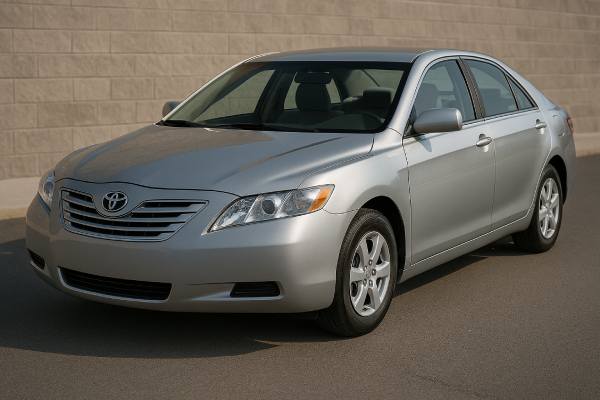
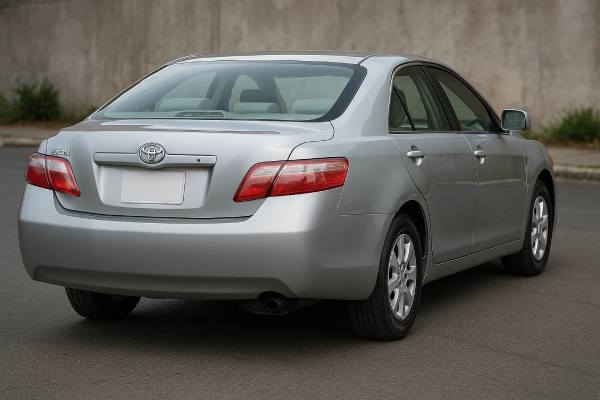
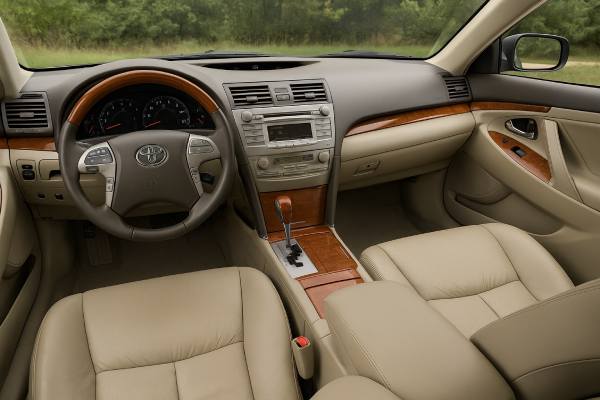
The 2007 model year (launched in 2006) marked a full redesign of the Camry for North America, moving from the XV30 to the ACV40 platform. Toyota’s goal was very clear: make the bread-and-butter 2.4-litre four-cylinder the volume leader, keep the driving experience quiet and predictable, and bring the safety and packaging up to mid-2000s expectations. For most buyers, the 2AZ-FE 2.4l with 158 hp was the obvious choice—cheaper to buy, cheaper to run, and more than adequate for commuting, school runs, and highway trips. It is also the engine you will find most often today in the used market.
What makes this generation interesting for present-day shoppers is the mix of modern layout (better crash performance, more airbags, available stability control) with Toyota’s early-2000s mechanical philosophy—straightforward, serviceable, and broadly shared across other Toyota/Lexus products. The downside is equally well known: the 2AZ-FE can develop oil consumption if neglected, and some early engines had head bolt thread issues that require attention. If you check those two items, the rest of the car is typically uneventful, which is why these Camrys remain everywhere.
Fast Facts
- 2.4l 2AZ-FE four-cylinder rated about 158 hp (118 kW) and 161 lb-ft (218 Nm), tuned for smooth daily driving rather than speed.
- ACV40 platform brought stronger structure, more airbags, and widely available stability control compared with earlier XV30 cars.
- Known ownership watch items: oil consumption on poorly serviced 2AZ-FE engines and transmission fluid never changed.
- Engine oil and filter: every 5,000 miles (8,000 km) or 6 months for mixed/short-trip use.
Jump to sections
- Detailed overview
- Specifications and technical data
- Trims, options and safety
- Reliability, common issues and service actions
- Maintenance and buyer’s guide
- Driving and performance
- How this Camry compares to rivals
Detailed overview
The ACV40 Camry replaced a very successful car, so Toyota chose evolution rather than revolution. The wheelbase grew to around 2,775 mm (109.3 in), the body became wider and roomier, and the styling adopted a more cab-forward stance. Inside, the dashboard and centre stack moved away from the slab-like XV30 design to a more vertical, two-tone layout that felt more premium at the time. Noise insulation, glass thickness, and sealing improved, so even four-cylinder cars feel quieter than many competitors of the day.
At the heart of this version is the 2AZ-FE, a 2.4-litre inline-four, aluminium block and head, DOHC with VVT-i, 16 valves, chain-driven cams, port fuel injection. In the Camry it was rated at about 158 hp (118 kW) and 161 lb-ft (218 Nm), which was entirely in line with mid-2000s family-sedan expectations. What buyers liked was the smooth, almost appliance-like character: the engine starts cleanly, idles without fuss, and pulls predictably through the rev range. Paired with the 5-speed automatic in most cars, it made the Camry an excellent “just drive it” vehicle.
Chassis-wise, Toyota stuck with what worked: MacPherson struts up front and a dual-link/strut-type arrangement at the rear, tuned for compliance. Steering is hydraulic power assist, not the early electric systems that could feel artificial. Brakes are four-wheel disc with ABS and EBD. In SE trims, damping is tighter and the wheels/tyres are more athletic, but comfort remains the priority.
Safety was a big step. 2007–2009 Camrys were offered with side torso and curtain airbags on many trims, and electronic stability control (VSC) and traction control (TRAC/TC) were widely available, sometimes standard. For a family buying used in 2025, this is a major differentiator from older Camrys and from rivals that sold stripped fleet versions.
The car’s main vulnerability in 2025 is, frankly, age. Rubber bushings, strut mounts, engine mounts, coolant hoses, and even interior plastics will show 15–19 years of use. Many cars were on “extended” oil intervals and bargain-shop fluids, which is not kind to a 2AZ-FE. That’s why the best ACV40 to buy today is the one with complete service history, especially 5,000-mile/6-month oil changes and at least one transmission fluid service.
Bottom line: this 2006–2009 Camry with the 2.4 is still one of the easiest mid-size sedans to put back into trustworthy daily service, provided you screen for the known 2AZ issues.
Specifications and technical data
The figures below reflect a typical 2007–2009 U.S./Canada Toyota Camry 2.4 (ACV40), FWD, automatic, non-hybrid. Minor year-to-year and state-emissions differences are normal. Always confirm against the under-hood emissions label and the owner’s manual for the VIN in question.
Engine and Performance
| Item | Specification |
|---|---|
| Engine code | 2AZ-FE |
| Configuration | Inline-4, aluminium block and head, DOHC, 16 valves |
| Displacement | 2.4 l (2,362 cc) |
| Bore × stroke | 88.5 × 96.0 mm (3.48 × 3.78 in) |
| Compression ratio | ≈9.8:1 |
| Induction | Naturally aspirated |
| Valvetrain | VVT-i on intake |
| Max power | 158 hp (118 kW) @ ~6,000 rpm |
| Max torque | 161 lb-ft (218 Nm) @ ~4,000 rpm |
| Fuel system | Sequential multi-port fuel injection |
| Fuel | Regular unleaded |
| Timing drive | Chain (no scheduled replacement; inspect for noise) |
| Emissions | U.S. federal / California variants 2007–2009 |
| Rated economy (period EPA) | ≈21 mpg US city / 31 mpg US highway (11.2 / 7.6 L/100 km) for AT |
| Real-world highway @ 75 mph (120 km/h) | 7.8–8.5 L/100 km (27–30 mpg US) if maintained |
| Aerodynamic Cd | ~0.28–0.29 depending on wheel/trim |
Transmission and Driveline
Most 2.4s in North America used the 5-speed automatic (U250E family); a 5-speed manual existed in limited configurations.
| Item | Specification |
|---|---|
| Transmission (common) | 5-speed automatic, U250E |
| Manual option | 5-speed manual on select trims/years |
| Gear ratios (5AT, typical) | 1st 4.24 · 2nd 2.36 · 3rd 1.52 · 4th 1.05 · 5th 0.76 · Rev 3.58 |
| Final drive | ≈3.63 (varies slightly) |
| Drive | Front-wheel drive |
| Differential | Open |
| ATF | Toyota ATF Type T-IV or WS per label/year; follow VIN/under-hood tag |
| Refuel to full | Standard fuel-pump time, 70 l tank |
Chassis and Dimensions
| Item | Specification |
|---|---|
| Platform | ACV40 (XV40 generation) |
| Front suspension | MacPherson strut, coil spring, stabilizer bar |
| Rear suspension | Dual-link/strut-type, coil spring, stabilizer bar |
| Steering | Hydraulic power rack-and-pinion |
| Brakes | Front ventilated discs / rear solid discs, ABS/EBD |
| Wheels/tyres | 16-in alloys or steels, 215/60R16 common; SE used 17-in with lower profile |
| Length | ≈4,796 mm (188.8 in) |
| Width | ≈1,820 mm (71.7 in) |
| Height | ≈1,470 mm (57.9 in) |
| Wheelbase | 2,775 mm (109.3 in) |
| Ground clearance | ≈130–140 mm (5.1–5.5 in) |
| Turning circle | ≈11.0 m (36 ft) |
| Curb weight | ≈1,500–1,560 kg (3,307–3,440 lb) depending on trim |
| GVWR | ≈2,000 kg (4,409 lb) |
| Fuel tank | 70 l (18.5 US gal / 15.4 UK gal) |
| Cargo (trunk, SAE) | ~425–450 l (15–16 ft³), split-fold on many trims |
Performance and Capability
| Metric | Value |
|---|---|
| 0–60 mph (0–97 km/h) | ≈8.6–9.0 s (AT, healthy engine) |
| 0–100 km/h (0–62 mph) | ≈9.0–9.4 s |
| Top speed | Typical sedan governor |
| 100–0 km/h braking | ≈40–43 m on good tyres |
| Towing | Light utility only; respect local rating |
| Roof load | Use OE crossbar rating, ≈68 kg (150 lb) guideline |
Fluids and Service Capacities
| System | Specification | Capacity (approx.) |
|---|---|---|
| Engine oil | 5W-30 (later 0W-20 acceptable on some revisions); API SL/SM | 4.3–4.6 l (4.5–4.9 qt) with filter |
| Cooling system | Toyota Super Long Life (pink), 50/50 | ~6.5–7.0 l (6.9–7.4 qt) |
| Automatic transmission | Toyota ATF (T-IV or WS per spec) | 3.5–4.0 l (3.7–4.2 qt) per drain |
| Manual transmission | Gear oil per manual spec | As per unit |
| Power steering | ATF-type fluid | Fill to mark |
| A/C refrigerant | R-134a | ~0.50–0.55 kg (18–19 oz), confirm on label |
| A/C oil | ND-Oil 8/PAG46 equivalent | ~120 ml |
| Key torque specs | Wheel lugs 103 Nm (76 lb-ft); engine drain plug ~40 Nm (30 lb-ft) |
Electrical
| Item | Specification |
|---|---|
| Alternator | ≈100–110 A |
| Battery | Group 24/24F typical, ~550–650 CCA |
| Spark plugs | Long-life iridium, gap 1.0–1.1 mm (0.039–0.043 in) |
Safety and Driver Assistance
| Feature | 2007–2009 ACV40 status |
|---|---|
| Dual front airbags | Standard |
| Front seat-mounted side airbags | Standard/very common |
| Side curtain airbags | Widely available, often standard on higher trims |
| ABS with EBD | Standard |
| Traction/stability (TRAC/VSC) | Available, sometimes standard by trim/year |
| LATCH child-seat anchors | Rear outboard |
| Head restraints | Front active headrests on many trims |
| Lighting | Halogen reflector; performance depends on lens clarity and aim |
Trims, options and safety
Toyota structured the 2007–2009 Camry line very clearly for North America. The 2.4 was the volume engine, available on most trims. V6 (3.5 2GR-FE) and Hybrid (AHV40) sat above it. Your article’s focus car is the 2.4, so the trim summary below follows that.
Base/CE / later simply “Camry”
- 2.4 engine, automatic more common than manual.
- Air conditioning, power windows/locks, basic audio.
- ABS standard.
- Side/curtain airbags widely present, but confirm on the specific car.
- Often steel wheels and wheel covers.
- Can lack some of the nicer interior trims—good candidate for fleet history, so check service records carefully.
LE (2.4)
- Most common retail trim.
- Adds alloys or better wheel covers, power driver seat (often 8-way), cruise, improved audio.
- Side and curtain airbags more consistently fitted.
- Good balance of price and equipment; many private-owner cars.
SE (2.4)
- Sport-flavoured: firmer suspension, lower-profile tyres, unique grille and exterior details, sometimes rear spoiler.
- Steering feel is a bit tighter.
- Interior trim is darker/sportier.
- If you want the 2.4 but dislike the floatier LE/XLE tuning, this is the one to find.
XLE (2.4)
- Highest comfort level for 4-cyl, with automatic climate control, premium audio (JBL in some), power passenger seat, sunroof on many, interior wood-tone.
- Safety kit is most complete here—side/curtain and VSC more common.
- Often dealer-maintained in early years, so timing of fluid services can be easier to verify.
Option and package notes (2006–2009):
- VSC/TRAC package is worth seeking; adds real active safety.
- JBL/Navigation: check that the unit still powers up, accepts CDs/DVDs, and that the screen is bright (some age-fade).
- Sunroof: test for smooth operation and check headliner for water trails.
- Smart key / keyless (where fitted): many cars are missing a second fob; price accordingly.
Safety ratings context:
- The ACV40 body shell was designed to meet stricter frontal and side requirements than the outgoing XV30, and with side/curtain airbags, it tests well for its time.
- Stability control becomes more widely available across 2009 model year in the U.S.
- Child-seat installation is straightforward thanks to LATCH anchors and large rear doors.
Service implications for safety systems:
- After steering or suspension work, a steering-angle or yaw-rate calibration may be required on VSC-equipped cars—use a capable scan tool.
- After SRS repairs, always check the warning lamp performs a full bulb test and verify with a scan.
- Headlight performance is often limited by lens hazing; refinishing or replacement is a simple way to restore night visibility on these cars.
Reliability, common issues and service actions
The ACV40 2.4 Camry is reliable by class standards, but it has more “you must check this” items than older 5S-FE or early 2AZ cars. Most problems are well known and easy to diagnose.
1. Oil consumption (2AZ-FE specific)
- Symptom: Uses 1 qt every 1,000–1,500 miles (1,600–2,400 km), sometimes more. Often no external leaks.
- Likely cause: Ring/cylinder wear and varnish from extended oil intervals and low-quality oil; some engines of this era are simply more prone.
- Remedy: Confirm PCV function, run shorter intervals (5,000 miles/6 months), use correct grade, and monitor. In severe cases, engine rebuild or short-block replacement is the real fix. Cars that have had oil changes every 5,000 miles from new tend to do far better.
2. Head bolt / thread concern (earlier 2AZ pattern that can appear in this era)
- Symptom: Coolant leak at rear of engine, overheat, head gasket failure, bolts that will not torque.
- Cause: Threads in the aluminium block pulling.
- Remedy: Proper thread-repair inserts to restore clamping. Inspect for overheating damage before committing.
3. Automatic transmission neglected service
- Symptom: Harsh 2–3 shift, delayed engagement when cold, or flare.
- Cause: Old ATF, never drained, clutch material in fluid.
- Remedy: Multiple gentle drain-and-fills with correct Toyota fluid. Avoid power flushing on high-mileage, unknown-history cars.
4. Cooling system age
- Symptom: Radiator tanks seeping, thermostat slow to open, coolant discoloured.
- Remedy: Cooling system refresh—radiator, hoses, thermostat, cap, and Toyota SLLC. Check water pump if coolant has not been changed in 10+ years.
5. Suspension and steering wear
- Symptom: Front-end clunk over bumps, vague steering, inside tyre wear.
- Cause: Strut mounts, stabilizer links/bushings, control-arm bushings, and sometimes inner tie-rods.
- Remedy: Replace worn parts in pairs, then align.
6. A/C and blower issues
- Symptom: Weak airflow, fan only on high, or intermittent A/C.
- Cause: Cabin filter never changed, blower resistor wear, or low charge.
- Remedy: Replace filter, test resistor, leak-test and recharge.
7. Electrical/trim ageing
- Symptom: Power window slow on driver’s door, lock actuators weak, radio backlight dim.
- Remedy: Clean/lube window channels, replace actuators or head unit as needed.
Recalls, TSBs, extended coverage worth checking:
- Engine oil consumption evaluation procedures (dealer will have guidance).
- Floor-mat and accelerator pedal interference campaigns of the era—confirm parts and software done.
- Any SRS/airbag inflator campaigns affecting 2007–2009 Camry.
- ECM/PCM reprogramming to improve driveability or shift feel.
How to verify completion:
- Run VIN through official recall portals for U.S./Canada.
- Ask the seller for dealer printouts or invoices.
- Physically inspect the pedal/floor area and airbag labels for campaign stickers.
Pre-purchase requests:
- Full service history, especially oil changes with mileage and date.
- Proof of transmission service.
- Cooling system work within the last 5 years.
- Recent brake work and tyre age (DOT code).
- Scan report showing no current SRS/ABS/VSC codes.
Maintenance and buyer’s guide
A sensible maintenance plan is what separates a long-lived 2AZ Camry from a tired, oil-burning one.
Core maintenance schedule (practical, not just marketing):
- Engine oil and filter: 5,000 miles (8,000 km) or 6 months, whichever first. Use 5W-30 (or 0W-20 if allowed for that year) and a quality filter.
- Engine air filter: Inspect 15,000 miles (24,000 km), replace 30,000 miles (48,000 km) or earlier in dusty areas.
- Cabin air filter: 15,000–30,000 miles (24,000–48,000 km).
- Coolant (Toyota SLLC): First at 100,000 miles (160,000 km) / up to 8–10 years, then every 50,000 miles (80,000 km) / 4–5 years. Older cars benefit from doing it now regardless.
- Spark plugs (iridium): 120,000 miles (193,000 km) or per manual.
- Transmission fluid (5AT): Drain-and-fill every 30,000–60,000 miles (48,000–96,000 km).
- Brake fluid: Every 2–3 years.
- Brake inspection: At every tyre rotation—clean/lube slides, check rear calipers.
- Tyre rotation: 5,000–7,500 miles (8,000–12,000 km).
- Alignment: Annually or after suspension work.
- Serpentine/drive belt: Inspect yearly after 60,000 miles, replace on cracks/noise.
- PCV valve: 60,000–90,000 miles (96,000–145,000 km) — helps with oil-use control.
- 12V battery: Test yearly after year 4; 5–7 years is typical.
Fluid specs, capacities, torques for decisions:
- Engine oil: 4.3–4.6 l (4.5–4.9 qt), 5W-30, drain plug ~40 Nm (30 lb-ft).
- ATF: 3.5–4.0 l per drain, correct Toyota spec.
- Coolant: ~6.5–7.0 l with SLLC.
- Wheel lugs: 103 Nm (76 lb-ft).
- Tyres: typically 30–32 psi (207–221 kPa).
Buyer’s guide checklist
- Cold start test: Should start immediately, idle steady. Listen for timing chain rattle—rare, but worth noting.
- Oil level/condition: Pull dipstick—dark oil or low oil is a red flag; walk if the seller cannot explain.
- Exhaust smoke: Blue at start or after idling can indicate oil consumption.
- Transmission behaviour: From cold, shift into R and D—engagement should be quick, no bang. On the road, it should upshift smoothly and lock up.
- Cooling system: Check for pink coolant, not universal green, unless fully flushed; inspect radiator end tanks.
- Brakes and suspension: Any knocking over bumps or floating at highway speed suggests struts/mounts.
- Body and underside: Check for rear subframe rust, pinch-weld crush, and previous accident repairs.
- Interior electronics: Test A/C, blend doors, radio, power windows, locks, and sunroof.
- Paper trail: Prefer 1–2 owner cars, dealer or specialist serviced, with at least the big-ticket items (trans fluid, coolant) on paper.
What to seek (2006–2009):
- LE or XLE 2.4 with side/curtain airbags and VSC.
- Cars that have had oil changes at 5,000 miles from new or at least from the last 60,000 miles.
- Cars with new tyres, new struts, and fresh brakes already done—these are standard 15–20-year replacements.
What to negotiate down:
- Oil consumption with no plan to repair.
- Original radiator/hoses on a 2007 car.
- ATF obviously old/brown.
- ABS/VSC/CEL lamps.
- Missing second key/fob.
Durability outlook:
A well-maintained ACV40 2.4 can reach 200,000–250,000 miles (320,000–400,000 km). The gating factors are oil consumption, transmission fluid neglect, and overall rust/climate exposure. Parts availability is excellent, and most jobs are DIY-friendly.
Driving and performance
The 158-hp Camry is not about excitement; it is about low-effort, low-noise transportation. On that score, it still delivers.
Engine character. The 2AZ-FE pulls cleanly from low revs and is happiest between 2,000 and 4,000 rpm. Intake VVT-i keeps it flexible, so you do not have to floor it to merge. When you do floor it, noise rises but remains smooth. Chain drive means no periodic belt changes, but it does mean you should listen for chain/tensioner noise on neglected engines.
Transmission behaviour. The 5-speed automatic suits the engine well: it has a fairly short first gear for city responsiveness and a tall fifth for highway economy. Kickdown is decisive enough for its era. If shifts are sloppy, the first fix is always fresh Toyota ATF at the right level.
Ride and NVH. ACV40 cars ride better than many rivals of the time—especially over broken urban pavement. There is some body roll in LE/XLE trims, but it is well controlled and predictable. Wind and road noise are lower than in many 2007–2009 competitors, provided tyres are not worn or oversized.
Steering and handling. Steering is light and family-friendly, ideal for parking and low-speed manoeuvres. SE models tighten things up, but this is not a sports sedan. Stability control, where fitted, is well tuned—intervenes without being too intrusive.
Braking. Brakes are easily modulated and strong enough for everyday commuting. On a 15–19-year-old car, performance is dominated by pad/rotor condition, brake fluid age, and slide lubrication.
Real-world fuel economy.
- City/short trips: 20–23 mpg US (11.8–10.2 L/100 km).
- Mixed suburban/highway: 24–28 mpg US (9.8–8.4 L/100 km).
- All-highway, steady 65–70 mph (105–113 km/h): 29–31 mpg US (8.1–7.6 L/100 km).
Cold weather, roof racks, loaded trunks, and worn tyres all shave a few mpg.
Loaded and light towing. With passengers and luggage, performance is still acceptable because the gearing is sensible. For light trailers or cargo carriers, service the transmission and cooling system first, then stay inside the factory rating.
How this Camry compares to rivals
Honda Accord (2007–2009, late 8th-gen arrival 2008)
- Accord engines (especially the 2.4 K-series) are very robust and often a bit more eager.
- Accord chassis feels a touch sportier, with firmer steering.
- Cabin noise can be slightly higher than Camry, depending on tyres.
- Camry often wins on ride comfort and on availability of a super-clean, low-miles, older-owner car.
Nissan Altima (2007–2009)
- QR25 2.5 is punchy but can be rougher.
- Many Altimas from this era used CVTs—service-history risk is higher.
- Camry’s conventional 5AT is easier to keep healthy long-term.
Hyundai Sonata (NF, 2006–2010)
- Very good value, strong corrosion protection.
- Interior ageing and resale have been weaker than Toyota’s.
- Camry parts network and technician familiarity give it the edge for 15-year ownership.
Chevrolet Malibu / Ford Fusion (mid-2000s)
- These cars improved a lot in this era, but long-term durability and “feels tight at 180,000 miles” ratings still tilt toward Camry.
- Camry is more likely to have full safety kit and a known service story.
Within Toyota’s own range
- If you need more power, the 3.5 V6 Camry of this generation is excellent, but it ties you to a bigger engine and sometimes higher insurance.
- If you want the best fuel economy and can handle HV components, the Camry Hybrid (AHV40) is the step up—but it has a different maintenance profile.
Summary: the 2006–2009 Camry 2.4 is not the most entertaining car of its class, but it is the one that most often passes a pre-purchase inspection, has parts on the shelf, and responds well to a weekend of catch-up maintenance.
References
- 2007 Camry Owner’s Manual 2007 (Owner’s Manual)
- 2008 Camry Owner’s Manual 2008 (Owner’s Manual)
- 2009 Camry Owner’s Manual 2009 (Owner’s Manual)
- Gas Mileage of 2009 Toyota Camry 2009 (Fuel Economy)
- 2009 Toyota Camry 4-door sedan 2009 (Safety Rating)
Disclaimer
This article is provided for informational purposes only. It is not a substitute for professional diagnosis, factory service literature, or model-year-specific technical bulletins. Specifications, torque values, fluid types, and maintenance intervals can vary by VIN, production date, emissions package, and market, so always confirm against the official Toyota service information and the owner’s manual supplied with the vehicle. If this guide helped you, consider sharing it on Facebook or X/Twitter to support xcar’s work.