
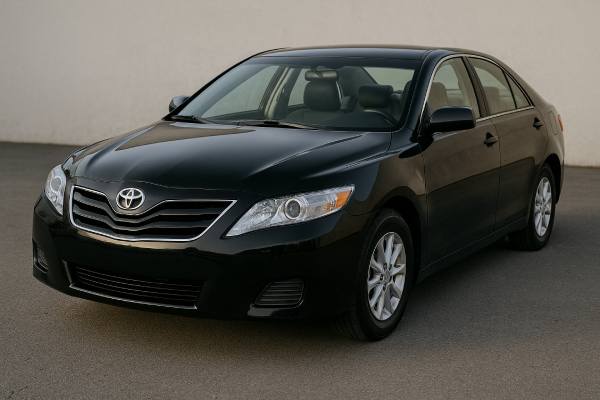
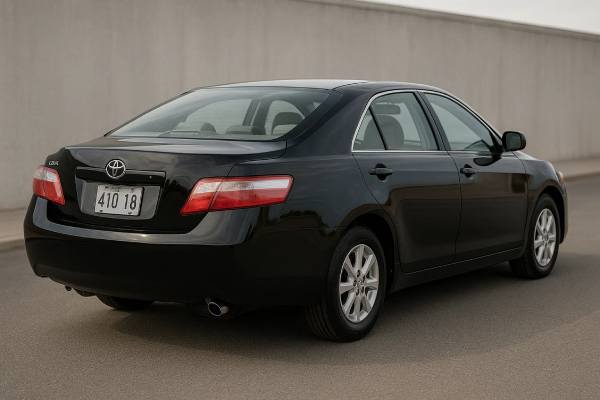
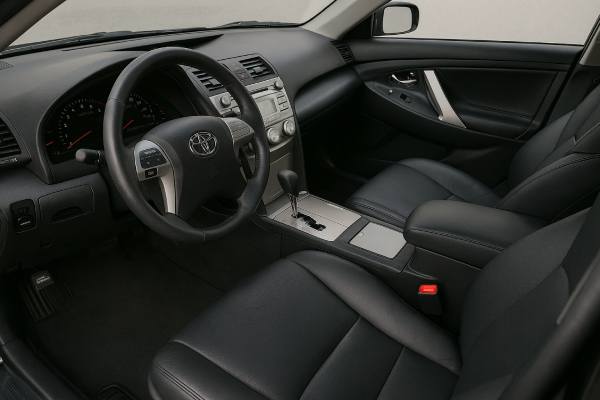
The 2010–2011 Toyota Camry with the 2AR-FE 2.5-litre four-cylinder represents the sweet spot of the XV40/ASV40 era for buyers who want quiet, uncomplicated miles with minimal drama. Toyota replaced the older 2.4 with this chain-driven, Dual VVT-i engine and paired it to new six-speed transmissions. The result is calmer highway revs, broader mid-range torque, and lower running costs. Space and comfort remain core strengths: generous rear legroom, a big 15.0 ft³ trunk, and a ride that soaks up battered pavement without float. Safety equipment is comprehensive for its time (multiple airbags, stability control), though advanced driver assistance (automatic emergency braking, lane keeping, adaptive cruise) had not yet arrived in mainstream midsize sedans. Most cars use the Aisin six-speed automatic; a low-volume six-speed manual was offered and is prized by drivers who want long-term simplicity. If you prioritize reliability, easy ownership, and a refined commute over flashy dynamics, the 2.5-litre ASV40 is an excellent, low-risk choice—especially if you verify recall completion and stay current on fluids, belts, and wear items.
Fast Facts
- Durable 2AR-FE with timing chain and port injection; smooth, quiet highway manners.
- Big-car room and visibility; 15.0 ft³ (425 L) trunk and comfortable seats.
- Six-speed automatic keeps revs low; rare six-speed manual exists for 2010–2011.
- Caveat: confirm recall/campaign completion and check for age-related water-pump seepage.
- Typical service: 0W-20 oil and filter every 10,000 miles / 12 months (severe: 5,000 miles / 6 months).
Explore the sections
- Camry ASV40 2.5 in Detail
- 2AR-FE Specifications and Data
- Camry Trims, Options and Safety
- Reliability, Issues and Service Actions
- Maintenance Plan and Buyer’s Guide
- On-Road Performance and MPG
- Camry vs Key Rivals
Camry ASV40 2.5 in Detail
Toyota’s 2010 facelift of the XV40 Camry did more than tidy the styling; it ushered in the 2AR-FE 2.5-litre inline-four and two new six-speed gearboxes. The engine’s aluminum block and head, chain-driven dual overhead cams, and Dual VVT-i (variable intake and exhaust cam timing) deliver a broad, accessible torque curve. Port fuel injection (not direct injection) keeps long-term maintenance straightforward—no intake-valve carbon build-up cycles and easier fuel-system service. Rated output depends on trim and calibration: most non-SE grades are 169 hp (126 kW), while the SE tune is higher (commonly listed as 179 hp). Many buyers and listings round that figure to 178 hp; either way, you’re getting a genuinely livable surge from 2,000–5,000 rpm with a smooth sweep to the 6,000-rpm peak.
The Aisin six-speed automatic (U760E) is the volume transmission. It keeps the engine relaxed at cruise (roughly 1,900–2,100 rpm at highway speeds) and responds crisply to moderate throttle with tidy downshifts. A six-speed manual exists in small numbers for 2010–2011 and offers a light clutch and widely spaced ratios geared toward economy. Front-wheel drive is standard; there was no factory AWD for these trims.
Comfort is the Camry’s pitch. The cabin is quiet at speed, the seats are supportive over distance, and the suspension—MacPherson struts up front, dual-link struts in back—filters out sharp edges while maintaining decent body control. The steering is light around center, easing parking-lot maneuvers, and it weights up predictably in faster corners. SE grades add firmer springs and dampers, a thicker rear bar, and 17-inch wheels for more restraint over big compressions and quicker turn-in, while LE and XLE prioritize a silkier ride.
Packaging remains a highlight of the ASV40: adults fit easily in both rows, the trunk’s 15.0 ft³ capacity swallows luggage or a stroller without drama, and cabin storage is generous. Ergonomics are intuitive and durable—big rotary knobs for climate, plainly labeled audio buttons, and clear analog gauges. Safety basics are well covered (dual-stage front, seat-mounted side, full-length curtain, and driver knee airbags; ABS with EBD and Brake Assist; stability and traction control). Advanced driver assistance was not yet common in this class at the time, so you won’t find factory AEB or lane keeping. That simplicity is part of the appeal: fewer sensors to fail, fewer calibrations after windshield or bumper work, and straightforward ownership for a second-hand buyer planning to keep the car past 200,000 miles.
2AR-FE Specifications and Data
Below are scannable tables for the 2010–2011 Camry 2.5-litre gasoline (non-hybrid) models. Small variations can occur by trim and equipment.
Engine and Performance
| Item | Detail |
|---|---|
| Code | 2AR-FE |
| Layout and cylinders | Inline-4 (I-4), DOHC, 16 valves; Dual VVT-i |
| Bore × stroke | 90.0 × 98.0 mm (3.54 × 3.86 in) |
| Displacement | 2.5 L (2,494 cc) |
| Induction | Naturally aspirated |
| Fuel system | Sequential multi-port injection |
| Compression ratio | 10.4:1 |
| Max power (LE/XLE) | 169 hp (126 kW) @ 6,000 rpm |
| Max power (SE tune) | 178–179 hp (~133 kW) @ 6,000 rpm |
| Max torque | 226–232 Nm (167–171 lb-ft) @ ~4,100 rpm |
| Timing drive | Chain (no scheduled replacement) |
| Emissions / efficiency class | ULEV-II |
| EPA economy (auto) | 22/32 mpg (city/hwy), 26 combined → 10.7/7.4 L/100 km; 9.0 L/100 km combined |
| EPA economy (manual) | 22/33 mpg (city/hwy), 26 combined → 10.7/7.1 L/100 km; 9.0 L/100 km combined |
| Real-world highway @ 120 km/h (75 mph) | ~7.6–8.4 L/100 km (31–28 mpg U.S.; 37–34 mpg U.K.) |
| Aerodynamics | Cd ~0.27 (frontal area not commonly published) |
Transmission and Driveline
| Item | Detail |
|---|---|
| Transmission | 6-speed automatic with manual gate (most common) / 6-speed manual (rare) |
| Maker / code | Aisin U760E automatic; 6-MT (low-volume; code varies by market) |
| Gear ratios | Ratio sets vary by code; consult service data when precision is required for rebuild or motorsport use |
| Final drive | ~3.6:1 (varies slightly by application) |
| Drive type | FWD; open differential |
| Refuel to full (petrol) | ~5 minutes (typical station flow and tank size) |
Chassis and Dimensions
| Item | Detail |
|---|---|
| Suspension (front/rear) | MacPherson strut / dual-link strut |
| Steering | Electric power-assist rack-and-pinion |
| Brakes | 4-wheel discs with ABS, EBD, Brake Assist; typical diameters ~296 mm (11.7 in) front / ~281 mm (11.1 in) rear |
| Wheels and tyres | 215/60R16 (LE/XLE typical); 215/55R17 (SE) |
| Ground clearance | ~155–160 mm (6.1–6.3 in) |
| Length / Width / Height | ~4,805–4,815 / 1,820 / 1,465–1,475 mm (189.2–189.6 / 71.7 / 57.7–58.1 in) |
| Wheelbase | 2,775 mm (109.3 in) |
| Turning circle (kerb-to-kerb) | ~11.0 m (36.1 ft) |
| Curb weight (range) | ~1,445–1,515 kg (3,185–3,340 lb) |
| GVWR (typical) | ~1,960–2,020 kg (4,321–4,455 lb) |
| Fuel tank | ~70 L (18.5 U.S. gal / 15.4 U.K. gal) |
| Cargo volume (SAE) | 425 L (15.0 ft³) |
Performance and Capability
| Metric | Figure |
|---|---|
| 0–60 mph / 0–100 km/h | ~8.3–8.8 s (tire and test method dependent) |
| Top speed | ~190 km/h (118 mph), electronically limited |
| Braking 100–0 km/h (62–0 mph) | ~40–42 m (131–138 ft) on quality tires |
| Towing capacity | Not factory-rated for these trims in North America |
| Payload / roof load | Not commonly published; observe tyre and GVWR limits |
Fluids and Service Capacities
| System | Specification | Capacity / Notes |
|---|---|---|
| Engine oil | SAE 0W-20, ILSAC GF-4/5 | ~4.4 L (4.7 U.S. qt) with filter; normal-service interval 10,000 miles / 12 months |
| Coolant | Toyota Super Long Life Coolant (pink, premixed 50/50) | ~6.5–7.5 L (6.9–7.9 U.S. qt) depending on heater spec |
| Automatic transmission | Toyota ATF WS | Drain-and-fill service quantity typically ~3.3–3.8 U.S. qt (full dry fill higher) |
| Manual transmission | API GL-4/GL-5 (per label) | Fill to level via side plug; replace if shift feel degrades |
| A/C refrigerant | R-134a | Charge by weight; typical total ~0.50 kg (varies by option) |
| A/C compressor oil | ND-Oil 8 or equivalent | Charge per service spec if component is replaced |
| Spark plugs | Iridium; gap 1.1 mm (0.043 in) | Replace ~120,000 miles (193,000 km) |
| Key torque specs | Wheel lugs 103 Nm (76 lb-ft); spark plugs ~18–22 Nm (13–16 lb-ft) | Use a calibrated torque wrench |
Electrical
| Item | Detail |
|---|---|
| Alternator output | ~100–130 A (equipment dependent) |
| 12-V battery | Common group sizes for midsize sedans; test annually after year 4 |
Safety and Driver Assistance
| Item | Detail |
|---|---|
| Airbags | Dual-stage front, front side, full-length curtains, driver knee |
| Stability systems | ABS, EBD, Brake Assist, Vehicle Stability Control with traction control |
| Crash testing | Strong IIHS performance for the era; 2011 NHTSA ratings reflect the newer, tougher protocol |
| Headlight performance | Halogen reflectors; typical era-appropriate output |
| ADAS suite | No factory AEB, ACC, lane keeping, or blind-spot monitoring on these trims/years |
Camry Trims, Options and Safety
Trims (2.5-litre gasoline): Base (Camry), LE, SE, and XLE. All share the 2AR-FE four-cylinder and front-wheel drive. The SE is the outlier mechanically: firmer springs and dampers, a stiffer rear anti-roll bar, 17-inch wheels/tyres, and a sport steering tune. It also carries the higher engine rating (commonly published as 179 hp; you may also see it listed as 178 hp in some materials). LE and XLE focus on comfort, sound insulation, and convenience features.
Key equipment by grade (typical):
- Base / LE: 16-inch wheels (steel with covers standard; alloys available on LE), power driver seat common, cruise control, basic 6-speaker audio, keyless entry, cloth upholstery.
- SE: 17-inch alloys and sport tyres, unique seats/trim, rear spoiler on many builds, firmer suspension calibration, higher engine output, sometimes larger brake package depending on build content.
- XLE: Added sound deadening, available leather, dual-zone climate control, available moonroof, and JBL audio on certain packages.
Option packages and identifiers:
- Convenience and audio: Bluetooth hands-free/streaming, steering-wheel controls, JBL® premium audio on higher grades.
- Moonroof and leather: Most common on XLE; check the window-sticker copy or VIN equipment report when available.
- Quick visual tells: SE models typically have 17-inch alloys and dual-exhaust finishers. Manual-transmission cars are easiest to spot by their pedal box and shift pattern; they are rare.
Year-to-year changes:
- 2010: Mid-cycle refresh, introduction of the 2AR-FE, new six-speed auto and manual gearboxes, minor interior/exterior updates.
- 2011: Broad carry-over with minor package reshuffles and housekeeping updates; safety testing moved to a tougher federal protocol, which can make direct star-to-star comparisons to older years misleading.
Safety ratings in brief: The ASV40 body and restraint system scored well in key insurance-industry tests of the era, with solid occupant protection in offset and side impacts. Federal ratings in 2011 used a revised, more stringent methodology; lower-appearing star numbers versus earlier years reflect a harder test rather than a weaker vehicle. For child seats, the sedan’s rear doors and bench shape make LATCH installation straightforward.
Driver-assistance and calibration considerations: No factory AEB, ACC, lane keeping, or blind-spot monitoring on 2010–2011 four-cylinder models. That reduces post-repair calibrations after windshields or fascia work. Stability and traction control are standard and transparent in everyday driving.
Reliability, Issues and Service Actions
The 2AR-FE Camry is renowned for low operating cost and long life. Most faults at this age are predictable wear or minor age-related leaks. Organised by prevalence and cost:
Common, low-to-moderate cost
- Water-pump seepage: Look for pink crust at the weep hole or around the thermostat housing. Symptom: faint coolant smell after shutdown, small drops under the passenger side. Remedy: replace pump and gasket; refill with Toyota SLLC and bleed air.
- Accessory belt and idler noise: Chirp or squeal on cold starts. Cause: aged belt or idler pulley bearing. Remedy: belt/pulley replacement; inspect tensioner.
- Sway-bar links and strut mounts: Clunks over speed bumps or driveway entries. Remedy: replace worn links; consider mounts and dampers if the car has high mileage.
- Wheel bearings: Low drone that changes with steering input. Remedy: replace the hub/bearing assembly; align if necessary.
Occasional, moderate cost
- EVAP small-leak faults (P0441/P0456): Age-cracked hoses or sticking purge/vent valves. Remedy: smoke test to locate; replace hoses/valves as needed; clear codes.
- Brake pulsation: Rotor thickness variation from heat cycles. Remedy: quality pads/rotors and proper wheel torque (103 Nm / 76 lb-ft).
Rare or conditional
- Oil consumption: The 2AR-FE is generally clean, but short-trip use, long intervals, or poor oil can increase consumption. Remedy: monitor usage; verify PCV function; stick to 0W-20; consider ring-soak procedure only if consumption is significant and confirmed.
- Torque-converter shudder / shift flare: Usually tied to old ATF or a software calibration that benefits from updates. Remedy: staged drain-and-fills with Toyota WS; check motor/trans mounts; apply any applicable software updates.
Corrosion hotspots (rust-belt cars): Subframe seams, rear brake backing plates, and exhaust flanges. Inspect brake lines and the rear subframe mounts on older, salted-road cars.
Recalls and service campaigns to verify by VIN:
- Floor-mat/pedal interference campaigns: Confirm that the pedal and floor-mat countermeasures are completed and that only approved mats are in use.
- Power-steering pressure hose routing (select early-build 2010 cars): Inspect for proper clearance to brake tubing and pulleys; remedy is revised routing or updated parts.
- ECU/TCU updates: Occasional calibrations improve idle quality or shift behavior; ensure the latest software is loaded when applicable.
Pre-purchase checks to request:
- Full service history with oil change timing and brand/viscosity.
- Cooling-system pressure test and close look at the water pump and radiator end tanks.
- Suspension noise evaluation on a speed-bump test loop; examine sway-bar links and strut mounts.
- Brake pad/rotor thickness and a freeway-speed brake test for pulsation.
- Transmission behavior at 35–50 mph light throttle (look for shudder) and at steady 65–75 mph (no hunting).
- Underbody corrosion inspection on lift.
- HVAC performance, including blend-door actuation and A/C vent temperature.
Maintenance Plan and Buyer’s Guide
Practical maintenance schedule (distance/time, whichever comes first):
- Engine oil and filter: 0W-20 full-synthetic every 10,000 miles / 12 months (normal) or 5,000 miles / 6 months (severe: frequent short trips, extreme cold/heat, dusty roads, heavy idling). Capacity ~4.7 qt (4.4 L) with filter.
- Engine air filter: Inspect at 15,000 miles (24,000 km); replace about every 30,000 miles (48,000 km), sooner in dusty regions.
- Cabin air filter: Replace every 15,000–20,000 miles (24,000–32,000 km) or when airflow drops.
- Spark plugs (iridium): Replace around 120,000 miles (193,000 km); verify the 1.1 mm gap.
- Coolant (SLLC, pink): First change at 100,000 miles / 10 years, then every 50,000 miles / 5 years. Maintain a 50/50 mix.
- Automatic transmission fluid (Toyota WS): Although “lifetime” in marketing, a drain-and-fill every 60,000–90,000 miles is prudent. Use only WS-spec fluid; ensure level-set at the correct temperature.
- Manual transmission gear oil: Inspect level/condition at major services; replace if shift feel deteriorates or at ~60,000 miles as preventive maintenance.
- Brake fluid: Replace every 3 years.
- Brake system: Inspect pads/rotors and slide pins at each tyre rotation; replace pads/rotors as sets.
- Drive belt and hoses: Inspect each oil change; replace when cracked, glazed, or noisy.
- Tyre rotation and alignment: Rotate every 5,000–7,500 miles; check alignment annually or after impacts/potholes.
- Timing drive: Chain with no scheduled replacement; investigate any rattle at start-up or timing-correlation codes.
- 12-V battery: Load-test annually starting in year four; typical life 4–6 years.
Fluid specifications and quick reference:
- Engine oil: SAE 0W-20 (ILSAC GF-4/5) — ~4.7 qt (4.4 L) with filter.
- Coolant: Toyota Super Long Life Coolant (premix pink) — ~6.5–7.5 L system capacity.
- ATF: Toyota ATF WS — service fill ~3.3–3.8 qt; check temperature-based level procedure.
- Brake fluid: DOT 3/4 — flush every 3 years.
- A/C refrigerant: R-134a — evacuate and charge by weight; typical total ~0.50 kg.
- Spark plugs: Iridium, 1.1 mm gap; torque ~18–22 Nm (13–16 lb-ft).
- Wheel lug nuts: 103 Nm (76 lb-ft).
Buyer’s checklist:
- Cooling system: Look for pink residue near the water-pump weep hole and around hose joints; verify stable temperatures on a long test drive.
- Suspension: Drive over a route with sharp bumps and low-speed steering inputs; listen for clunks (links/mounts) and check rear dampers for seepage.
- Brakes: Confirm a smooth, vibration-free stop from freeway speeds; inspect rotor surfaces and pad thickness.
- Transmission: With the automatic, check for clean 2-3 and 3-4 shifts and no shudder at light throttle; with the manual, test cold and warm synchros and clutch take-up.
- Electrics/HVAC: Verify window regulators, locks, lighting, and strong A/C performance at idle and while moving.
- Tires and alignment: Uneven wear suggests toe or camber issues; budget for tires if tread is low or age is 6+ years.
- Documentation: Ask for a VIN-based recall/campaign printout, service receipts, and any transmission or coolant service history.
What to buy:
- LE 2.5 automatic is the value play: comfortable, quiet, and easy to service.
- SE 2.5 automatic if you want flatter handling and the higher-output calibration; confirm that the sport dampers still control big motions.
- XLE 2.5 suits long-distance drivers who want a calmer cabin and optional premium audio.
Long-term outlook: With routine care and quality tires, a 200,000+ mile (320,000+ km) life is very realistic. The engine and transmission rarely fail catastrophically; neglect and rust are the main enemies.
On-Road Performance and MPG
Ride, handling, and NVH: The ASV40’s tuning favors serene progress. On 16-inch tires, impacts are muted and secondary motions settle quickly. Straight-line tracking is excellent, with little tramlining even on rain-grooved concrete. Steering is light at parking speeds and builds a natural, predictable weight as you turn; it is not full of road feel, but it is accurate and easy to place. Brakes offer a progressive pedal and reliable bite; fresh fluid and quality pads/rotors keep performance consistent during repeated stops.
Powertrain character: The 2AR-FE wakes up above 2,000 rpm and pulls cleanly to 6,000 rpm. There is no turbo lag to manage, and throttle response is linear. The six-speed automatic’s logic is conservative in Drive—aiming for low revs and best economy—yet it will kick down decisively with deeper throttle. Using the manual gate helps on long grades. The six-speed manual changes the car’s character from “appliance-calm” to “engaging commuter” without adding complexity or cost over time.
Real-world economy:
- City/suburban: 9.0–10.5 L/100 km (26–22 mpg U.S.; 31–26 mpg U.K.) depending on trip length, traffic, and climate control use.
- Highway 60–65 mph (100–105 km/h): 7.0–7.5 L/100 km (34–31 mpg U.S.; 41–37 mpg U.K.) in calm weather on quality tires.
- Highway 70–75 mph (113–120 km/h): 7.6–8.4 L/100 km (31–28 mpg U.S.; 37–34 mpg U.K.) typical, rising with headwinds, winter blends, or roof-rack loads.
Cold weather and short trips reduce economy significantly; block-heater use and careful warm-up can help in severe climates.
Key performance metrics (representative setups):
- 0–60 mph: ~8.4 s (automatic on 16-inch all-season tires; SE may shave a few tenths).
- 50–80 mph passing: Strong for the class; the gearbox drops two or three gears quickly.
- 100–0 km/h braking: ~40–42 m (131–138 ft) on fresh pads/rotors and good rubber.
- Noise levels: Cabin is notably quiet at cruise; tyre roar depends heavily on brand and tread design, with touring-focused tires yielding the calmest cabin.
Load and hills: With four adults and luggage, the Camry remains composed; coolant temperatures hold steady, and the automatic maintains torque converter lock-up on gentle grades. If you frequently travel steep mountain passes in summer, keep coolant and transmission services current and consider the transmission’s manual gate to pre-select gears for descents.
Camry vs Key Rivals
Honda Accord 2.4 (2008–2012): The Accord feels a touch sportier—firmer primary ride, more steering bite—and its K-series engine is similarly robust. Interior noise on coarse surfaces is usually higher, and parts prices can run slightly more. If steering feedback matters most, pick the Accord; if quiet comfort and easy ownership rank first, the Camry is stronger.
Nissan Altima 2.5 (2007–2012): Lighter and lively, but most four-cylinder Altimas pair with an early-generation CVT that demands meticulous fluid care and is less satisfying to drive. Cabin materials and long-term wear often trail Toyota’s. The Altima can be fun, yet the Camry delivers steadier long-term value.
Ford Fusion 2.5 (2010–2012): Comfortable, with solid highway manners and competitive features. Reliability is mixed for this vintage; transmission and electrical quirks appear more often than on the Camry. If you find a well-maintained Fusion, it can be a budget win, but shop carefully.
Hyundai Sonata 2.4 (2011): Strong EPA numbers and modern styling. Early-build quality variation and isolated engine issues on certain cars temper the proposition. Warranty coverage helped many original owners; for second-hand buyers, service documentation is essential.
Chevrolet Malibu 2.4 (2008–2012): Tidy styling and a calm ride, yet interior packaging and durability tend to lag. Shift quality varies, and higher-mileage examples often need more reconditioning than a comparable Camry.
Takeaway: For shoppers prioritizing quiet, space, and low risk, the 2010–2011 Camry 2.5 remains a benchmark. Choose an SE if you want tighter body control and the higher-output calibration; pick an LE or XLE for the most serene commute and straightforward upkeep.
References
- Gas Mileage of 2010 Toyota Camry 2010 (EPA FuelEconomy.gov)
- Gas Mileage of 2011 Toyota Camry 2011 (EPA FuelEconomy.gov)
- 2010 Toyota Camry 4-door sedan 2010 (Safety Rating)
- Vehicle Detail Search – 2011 TOYOTA CAMRY 2011 (Recall Database)
- 2011 Camry Owner’s Manual 2011 (Owner’s Manual)
Disclaimer
This article is for informational purposes only and is not a substitute for professional diagnosis, repair, or official service procedures. Specifications, torque values, capacities, and maintenance intervals can vary by VIN, production date, market, and equipment. Always verify against your vehicle’s official owner’s and service documentation before performing maintenance or repairs.
If this guide helped, please consider sharing it with fellow owners on Facebook or X/Twitter—your support helps xcar keep resources like this free.