
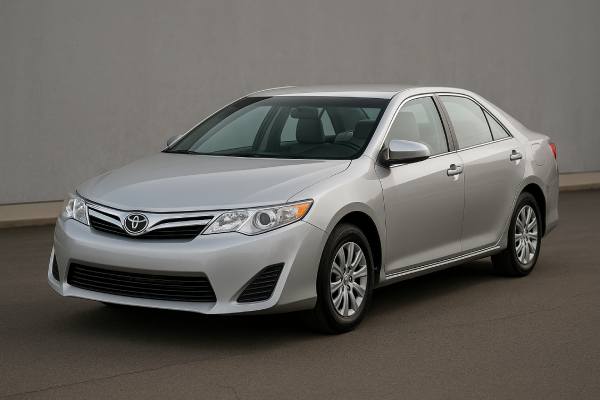
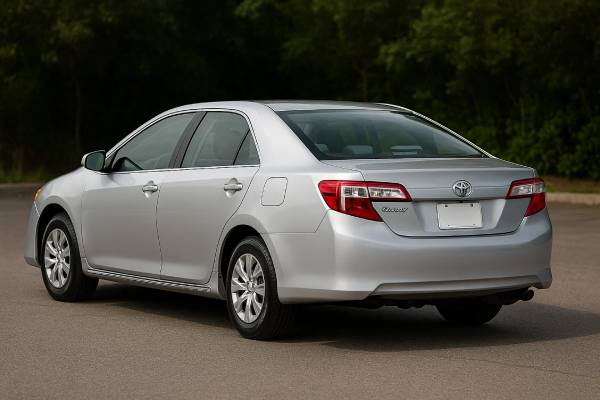
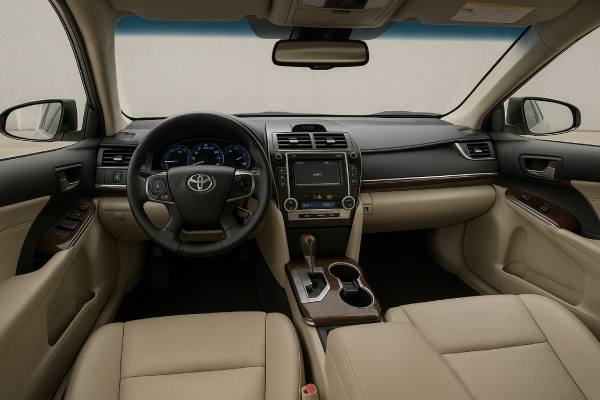
The seventh-generation Toyota Camry (chassis code ASV50 for the 2.5-litre four-cylinder) launched for the 2012 model year and ran through 2014 before its mid-cycle refresh. In this period the Camry’s mission was crystal clear: deliver quiet, dependable miles with low running costs, while the SE trim added a dash of steering feel and body control. The 2AR-FE engine—an all-aluminium, chain-driven DOHC four with Dual VVT-i—makes 178 hp and 170 lb-ft through a smooth six-speed automatic. EPA economy sits in the high-20s overall with 35 mpg highway, aided by tall gearing and a slippery body. Cabin space is generous, ride quality is relaxed, and equipment (Bluetooth, touchscreen audio, available blind-spot monitoring) meets everyday needs. Safety is strong in most IIHS tests, though early small-overlap performance is a nuance buyers should understand. As a used purchase, the 2012–2014 Camry 2.5 is compelling for commuters, new drivers, and budget-minded families who value predictable costs and abundant parts support, with the SE trim a worthwhile pick for drivers who prefer firmer damping and sharper response.
Essential Insights
- Calm ride, roomy back seat, low noise; 35 mpg highway (6.7 L/100 km) typical.
- Proven chain-driven 2AR-FE and six-speed automatic; easy parts availability.
- SE trim’s firmer suspension and 17–18 in wheels tighten handling without harshness.
- Watch for water-pump seep and rare torque-converter shudder; verify recall completion.
- Oil service: 10,000 mi/12 months with 0W-20 (many owners choose 5,000–7,500 mi / 6–12 mo).
Explore the sections
- ASV50 Camry 2.5 Overview
- Camry 2.5 Specifications
- Camry Trims, Options and Safety
- Reliability and Known Issues
- Maintenance and Buyer’s Guide
- Driving and Performance
- Camry vs Rival Sedans
ASV50 Camry 2.5 Overview
The 2012–2014 Camry 2.5 (ASV50) represents the mainstream heart of the lineup: front-wheel drive, naturally aspirated four-cylinder power, and a conventional six-speed automatic. Compared with the outgoing XV40 generation, this Camry shed mass, improved body rigidity, and adopted electric power steering and updated safety structures. It’s a family sedan first, tuned for isolation and straight-line stability on coarse highways, yet the SE variant uses firmer springs/dampers, quicker steering, and larger wheels to sharpen initial turn-in and roll control without compromising daily comfort.
Inside, the Camry prioritizes wide entry openings, a low cowl, and excellent outward visibility. Rear-seat legroom is very competitive, and the trunk’s square aperture and low liftover height make grocery, stroller, or suitcase duty easy. Material quality is pragmatic—soft-touch in high-contact zones with durable plastics elsewhere—and the switchgear follows Toyota’s simple-to-learn logic. Early cars offer straightforward Display Audio with Bluetooth and USB; later 2013–2014 models expanded connectivity and backup camera availability across more trims. The driver’s seat and wheel have broad adjustment ranges, accommodating a wide height spectrum without forcing knees into the console.
Under the hood, the 2AR-FE is engineered for longevity more than drama. It uses a timing chain (no scheduled belt replacement), piston oil squirters for thermal control, and Dual VVT-i for midrange torque and emissions. The six-speed automatic’s lock-up strategy keeps revs low in cruise, and its tall overdrive gear helps achieve mid-30s highway economy with ease. Running costs are modest: 0W-20 oil, long-life iridium spark plugs, pink Super Long Life coolant, and extended brake service intervals when driven gently. From an ownership perspective, the Camry’s real strengths are predictable maintenance, deep aftermarket support, and high parts commonality with millions of siblings—key reasons it remains a safe, low-stress used buy.
Camry 2.5 Specifications
Engine and Performance (ICE-only)
| Item | Specification |
|---|---|
| Code | 2AR-FE |
| Layout & cylinders | Inline-4, DOHC, Dual VVT-i; 16 valves (4 per cyl) |
| Bore × stroke | 90.0 × 98.0 mm (3.54 × 3.86 in) |
| Displacement | 2.5 L (2,494 cc) |
| Induction | Naturally aspirated |
| Fuel system | Sequential multi-port fuel injection (PFI) |
| Compression ratio | 10.4:1 |
| Max power | 178 hp (133 kW) @ 6,000 rpm |
| Max torque | 231 Nm (170 lb-ft) @ 4,100 rpm |
| Timing drive | Chain (no scheduled replacement) |
| Emissions/efficiency standard | EPA-rated (gasoline) |
| Rated economy (EPA) | 25/35/28 mpg US (city/hwy/combined) ≈ 9.4/6.7/8.4 L/100 km |
| Real-world highway @ 120 km/h (75 mph) | ~7.3–7.8 L/100 km (32–29 mpg US; 38–35 mpg UK) |
| Aerodynamics | Cd ≈ 0.27–0.28 |
Transmission and Driveline
| Item | Specification |
|---|---|
| Transmission | 6-speed automatic (U760E) with lock-up torque converter; manual mode |
| Gear ratios | 1st 3.300, 2nd 1.900, 3rd 1.421, 4th 1.000, 5th 0.713, 6th 0.608; Rev 4.148 |
| Final drive ratio | ~3.63:1 (varies slightly by trim/wheel package) |
| Drive type | Front-wheel drive (FWD) |
| Differential | Open |
| Refuel to full (typical) | ~5 min (gasoline pump) |
Chassis and Dimensions
| Item | Specification |
|---|---|
| Suspension (front/rear) | MacPherson strut / dual-link strut (independent) |
| Steering | Electric power-assisted rack-and-pinion (EPS) |
| Brakes | Vented front discs ~296 mm (11.7 in); solid rear discs ~281 mm (11.1 in) |
| Wheels/Tires | 205/65R16 (LE/XLE) to 225/45R18 (SE) on 16–18 in alloys |
| Ground clearance | ~150–155 mm (5.9–6.1 in) |
| Length/Width/Height | 4,805 mm / 1,820 mm / 1,470 mm (189.2 / 71.7 / 57.9 in) |
| Wheelbase | 2,795 mm (109.3 in) |
| Turning circle (kerb-to-kerb) | ~11.2 m (36.7 ft) |
| Curb weight | ~1,435–1,495 kg (3,165–3,295 lb), trim-dependent |
| GVWR | ~1,960–2,040 kg (4,321–4,497 lb), configuration-dependent |
| Fuel tank | ~64 L (17.0 US gal / 14.2 UK gal) |
| Cargo volume (SAE) | ~436 L (15.4 ft³) |
Performance and Capability
| Metric | Value |
|---|---|
| 0–100 km/h (0–62 mph) | ~8.2–8.7 s (trim/wheel/road) |
| 0–60 mph | ~8.0–8.5 s |
| Top speed | ~201 km/h (125 mph) |
| 100–0 km/h braking | ~38–40 m (125–131 ft) on quality all-season tyres |
| Towing capacity | Not factory-rated for towing (North America) |
| Payload | Approx. 385–430 kg (850–950 lb), by build |
| Roof load | Not rated (no factory rails) |
Fluids and Service Capacities
| System | Specification / Capacity |
|---|---|
| Engine oil | SAE 0W-20 synthetic (API SN/SN Plus or newer); ~4.4 L (4.6 US qt) w/ filter |
| Coolant | Toyota Super Long Life (pink), 50/50; ~6.5–7.0 L (6.9–7.4 US qt) total |
| Transmission (ATF) | Toyota ATF WS; service drain/fill ~3.5–3.9 US qt (3.3–3.7 L); dry ~7–8 US qt (6.6–7.6 L) |
| Differential/transfer | Integrated in transaxle (ATF WS) |
| A/C refrigerant | R-134a; ~500–550 g (17.6–19.4 oz) |
| A/C compressor oil | ND-OIL 8 (PAG); ~120 mL (4.1 fl oz) typical |
| Key torque specs | Wheel lugs 103 Nm (76 lb-ft); oil drain plug ~39 Nm (29 lb-ft); spark plugs ~18 Nm (13 lb-ft) |
Electrical
| Item | Specification |
|---|---|
| Alternator output | ~130 A |
| 12 V battery | Group 24F, ~65 Ah (≈550 CCA) |
| Spark plugs | Long-life iridium; gap 1.0–1.1 mm (0.039–0.043 in) |
Safety and Driver Assistance
| Category | Details |
|---|---|
| Crash ratings (IIHS) | Top Safety Pick; Moderate overlap: Good; Side: Good; Roof: Good; Small-overlap: Poor for 2012–2014 built before Jan 2014; Acceptable after structural updates in early 2014 |
| Headlights (period) | Conventional reflector/projector halogen; IIHS headlight program began later (2016) |
| ADAS availability | Stability control, traction control, ABS/EBD/Brake Assist standard; Blind Spot Monitor optional on higher trims; no factory AEB/LKA in this period |
| Child-seat provisions | Lower anchors (LATCH) and top tether points on outboard rear seats |
Camry Trims, Options and Safety
Trim walk (gas four-cylinder): L (2012), LE, SE, XLE. All use the 2.5-litre 2AR-FE and six-speed automatic with FWD.
- L (2012 only): Cloth, manual driver seat, 16-inch steel wheels, basic audio with Bluetooth/USB, cruise control, keyless entry, air conditioning. Best for pure value seekers; rare on the used market.
- LE: Adds 16-inch alloys, power driver seat, upgraded audio, better trim materials, and most of the features shoppers expect (split-fold rear seat, remote trunk/fuel releases).
- SE: Sport seats and wheel, unique fascias and side skirts, firmer springs/dampers, thicker rear anti-roll bar, 17-inch alloys (18-inch with packages), paddles/manual mode, and a modestly quicker steering ratio. The SE is the driver’s choice but rides compliantly.
- XLE: Comfort-focused: available leather/ultrasuede, dual-zone climate, sunroof, auto-dimming mirror, and premium audio. Rolling stock is typically 17-inch alloys with touring-oriented tyres.
Packages and options: Sunroof; JBL premium audio with touchscreen; navigation (Display Audio/Entune interfaces); rear camera (standardized on more trims by 2013–2014); power driver lumbar; Smart Key with push-button start; heated front seats (select trims); Blind Spot Monitor (late availability and trim-dependent). Wheel/tire packages scale from 205/65R16 to 225/45R18 (SE).
Mechanical and functional differences by trim: SE tuning brings firmer damping, stiffer bushings, and larger wheels; brake hardware remains similar across trims. Final-drive variations are minor; the six-speed’s logic and ratios are shared. The SE’s 18-inch package increases grip and steering precision but can add a touch more tyre noise and impact feel on broken pavement.
Safety ratings and structure notes: The Camry performs strongly in the IIHS moderate-overlap and side tests and achieved Top Safety Pick status. Small-overlap driver-side was Poor for 2012–2014 models built before January 2014; structural reinforcements and restraint updates delivered Acceptable thereafter. When shopping, check the driver-door jamb build date (mm/yy). NHTSA testing provides competitive star ratings across most categories in this period.
Airbags and child-seat details: Front, side, and full-length curtain airbags are standard, with active front head restraints. LATCH anchors are accessible on the rear outboard seats; the middle position offers a top tether.
ADAS and calibration implications: There is no factory automatic emergency braking or lane-keeping in 2012–2014. Vehicles with Blind Spot Monitor may require careful radar recalibration after mirror or body repairs; alignment and windshield replacement do not typically require ADAS calibration on these cars, but verify with a capable shop.
Reliability and Known Issues
The ASV50 Camry has a deserved reputation for low drama. Still, a smart buyer should understand age-related wear patterns and a few service actions typical of this generation.
Common (low–medium severity)
- Water pump seep/leak: Pink crust near the pump weep hole, occasional coolant smell, slow level drop. Cause: mechanical seal wear. Remedy: replace pump and gasket; renew SLLC coolant.
- Front brake judder or steering shimmy under braking: Often due to uneven pad deposits or rotor thickness variation, sometimes aggravated by improperly torqued wheel nuts. Remedy: true/replace rotors, use quality pads, torque lugs to 103 Nm (76 lb-ft).
- Interior blower or A/C odors: Evaporator core biofilm. Remedy: cabin filter renewal, HVAC intake cleaning, evaporator treatment; keep A/C used regularly.
Occasional (medium severity)
- Torque-converter lock-up shudder (40–60 mph light throttle): Felt as a gentle rumble. Cause: TCC clutch glazing or fluid shear in high-mileage WS fluid. Remedy: software update where applicable, fluid exchange with Toyota ATF WS, and if persistent, torque-converter replacement.
- Rear sway-bar end-link or strut-mount noise: Clunks over low-speed bumps. Remedy: inspect/replace links or mounts; alignment check afterward.
Rare (but important)
- Power Window Master Switch recall: Driver’s switch may overheat/melt due to insufficient grease, potential fire risk. Remedy: inspect/regrease/replace per official recall procedure—confirm completion by VIN.
- Early small-overlap crash performance: Not a “failure” in service, but relevant to risk. Preference: 2014 cars built after January 2014 with structural updates.
Corrosion and chassis checks: Look at front subframe seams, rear suspension arms, and exhaust hangers on cars from road-salt regions. Door bottoms and trunk seams usually hold up well; still, run a fingertip under seals for grit/moisture.
Electrics and infotainment: The basic Display Audio units are generally reliable; occasional touchscreen lag is improved by firmware updates. Ensure all steering-wheel buttons, Bluetooth pairing, and backup camera functions work before purchase.
Pre-purchase checklist
- Full, dated service history (oil with 0W-20 at sane intervals; coolant and brake fluid ages).
- Transmission service evidence (even though Toyota does not list a fixed interval, fresh WS fluid helps).
- Build date (door jamb) if prioritizing post-update 2014 structure.
- VIN recall status printout; window-switch recall completion; any TSBs for drivability/shudder.
- Road test from cold start; confirm smooth idle, silent EPS, straight tracking, and lock-up engagement without shudder.
Maintenance and Buyer’s Guide
Practical maintenance schedule (typical use; verify by VIN and manual)
- Engine oil & filter: SAE 0W-20; up to 10,000 mi / 12 months normal service. Many owners choose 5,000–7,500 mi / 6–12 months for short-trip or hot/cold extremes.
- Engine air filter: Inspect at 15,000 mi (24,000 km); replace ~30,000–45,000 mi (48,000–72,000 km) or sooner in dusty areas.
- Cabin filter: 12 months or 15,000–20,000 mi (24,000–32,000 km).
- Coolant (SLLC pink): First change ~100,000 mi (160,000 km) or 10 years, then every 50,000 mi (80,000 km) / 5 years.
- Spark plugs (iridium): ~120,000 mi (193,000 km) typical replacement window.
- Drive/serpentine belt: Inspect at each oil change after 60,000 mi; replace on cracking/noise.
- ATF (WS): No fixed interval in many guides; proactive drain-and-fill every 60,000–90,000 mi (96,000–145,000 km) is prudent for shift quality.
- Brake fluid: 3 years, then every 2–3 years.
- Brake pads/rotors: Inspect at each service; expect long life in highway use.
- Tyre rotation & alignment: Rotate 5,000–7,500 mi; align annually or after impacts/uneven wear.
- 12 V battery: Test annually after year 4; typical life 4–6 years.
- PCV, throttle body, and MAF: Inspect/clean around 60,000–90,000 mi if idle or economy degrades.
Fluid specs (quick reference)
- Oil: 0W-20 API SN/SN Plus or newer; ~4.4 L (4.6 qt) with filter.
- Coolant: Toyota Super Long Life (pink) premix, 50/50.
- ATF: Toyota ATF WS only (do not mix).
- Brake fluid: DOT 3 or DOT 4 (fresh, sealed).
- Power steering: Electric (no fluid).
- A/C: R-134a; ND-OIL 8.
Essential torques
- Wheel lugs 103 Nm (76 lb-ft); oil drain plug ~39 Nm (29 lb-ft); spark plugs ~18 Nm (13 lb-ft).
Buyer’s guide—what to look for
- Best values: LE for comfort/value, SE for chassis tuning and better seats; both widely available. XLE suits long-distance drivers wanting dual-zone climate and quieter tyres.
- Years to favour: 2013–2014 for broader rear-camera availability and infotainment improvements; 2014 built after Jan for improved small-overlap structure.
- Walk-around: Panel gaps, headlamp clarity, wheel-lip chips, windshield stars, tyre brands/age.
- Underhood/underside: Coolant crust at pump, seep at timing cover perimeter (minor film is common), axle-seal weep, cracked bushings, exhaust heat-shield rattles.
- Test drive: Cold-start noises, smooth shifts, no lock-up shudder at 40–60 mph, straight braking, stable idle in gear with A/C on, no clunks on speed bumps.
- Reconditioning budget: Cabin filter, engine air filter, brake service flush, fresh tyres if older than 6 years, ATF drain-fill if unknown, wiper blades, and alignment.
Durability outlook: With timely fluids and a gentle right foot, the ASV50 2.5 routinely surpasses 200,000 miles (320,000 km) without internal engine work. Suspension and brake components are simple and inexpensive, and body corrosion resistance is solid when washed regularly in winter climates.
Driving and Performance
Ride, handling, and NVH: In LE/XLE trims the Camry is tuned for quiet progress. On patched concrete it stays composed, with a softly controlled heave and very good straight-line stability. Road noise is modest on 16–17-inch tyres; wind rustle is well suppressed at 70–75 mph (113–120 km/h). The SE dial adds firmer primary ride and better body control through sweepers, keeping roll angles flatter and improving mid-corner confidence. Steering is light at parking speeds and settles into a natural, slightly insulated weight on the highway; there’s limited road feel, but on-centre tracking is easy.
Powertrain character: The 2AR-FE’s torque peak arrives at 4,100 rpm, but usable thrust from 1,800–3,500 rpm covers city merges without fuss. The six-speed automatic is calibrated to upshift early for economy, then lock the converter in top gears to cut revs. Kickdown to pass is prompt in D; the SE’s paddles provide predictable manual control for on-ramps. There’s no turbo lag—just linear, low-drama power. Warm starts are instant, idle is smooth, and accessory loads (A/C, alternator) barely stir the needle.
Observed efficiency: Expect 28–31 mpg US combined (8.4–7.6 L/100 km) in mixed use, with 33–35 mpg US (7.1–6.7 L/100 km) at 70 mph and ~29–32 mpg US at 75 mph depending on tyres, temperature, and traffic. Winter short-trip driving can trim 2–4 mpg (0.5–1.0 L/100 km). The SE on 18-inch wheels typically surrenders ~1 mpg to the LE/XLE at highway speeds due to rolling resistance and aero.
Key metrics that shape the verdict: 0–60 mph in roughly 8.0–8.5 s keeps pace with traffic; 100–0 km/h in ~38–40 m reflects stable braking with quality tyres. Turn-in is tidy, body motions are well damped, and the car’s balance remains safe and predictable. Under full cabin and trunk load, spring rates cope well; braking remains linear though pedal travel lengthens slightly after repeated hard stops.
Camry vs Rival Sedans
Honda Accord (2013–2014 2.4): The Accord’s direct-injected four and CVT deliver a touch better real-world economy and sharper steering response. Cabin noise is slightly higher on coarse aggregate, but chassis poise feels more athletic. Camry counters with a gentler ride, simpler six-speed automatic, and broader dealer network.
Nissan Altima (2013–2014 2.5): Light curb weight and a relaxed ride suit commuters, yet the CVT’s feel isn’t for everyone and long-term fluid maintenance is critical. Camry’s conventional automatic and sturdier interior trim age more gracefully.
Ford Fusion (2013–2014 2.5/1.6T): European-flavoured steering and design; the 1.6T offers midrange punch but demands vigilant cooling and maintenance. Camry’s naturally aspirated four is simpler and often cheaper to keep over 10 years.
Hyundai Sonata/Kia Optima (2011–2014 2.4 GDI): Competitive features and warranty; some owners report higher NVH and engine concerns in certain years. Camry’s 2AR-FE and transmission combination is widely regarded as a “known quantity” for longevity.
Mazda6 (2014 2.5 Skyactiv): Best steering feel and handling in class; firmer ride and less rear-seat width. For family duty, the Camry’s back-seat space and quieter cabin win points; for keen drivers, the Mazda delights.
References
- 2012 Toyota Camry – 2012 Press Kit 2011 (Press Kit)
- 2012 Toyota Camry 2012 (Safety Rating)
- Gas Mileage of 2012 Toyota Camry 2012 (EPA Fuel Economy)
- 2012 Toyota Camry Warranty and Maintenance Guide 2012 (Warranty and Maintenance)
- Toyota announces voluntary safety recall of certain vehicles for the driver’s side power window master switch 2012 (Recall Notice)
Disclaimer
This article is for informational purposes and is not a substitute for professional diagnosis or repair. Specifications, torque values, service intervals, procedures, and safety ratings vary by VIN, build date, market, and equipment. Always confirm against your vehicle’s official service documentation and current manufacturer publications before performing work or making a purchase decision.
If you found this guide useful, please consider sharing it on Facebook or X/Twitter to support xcar’s work. Thank you!