
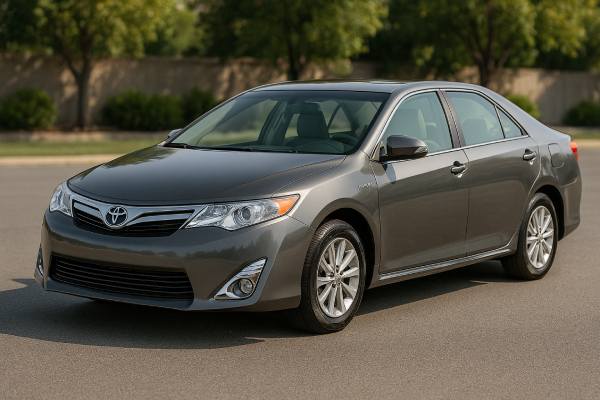
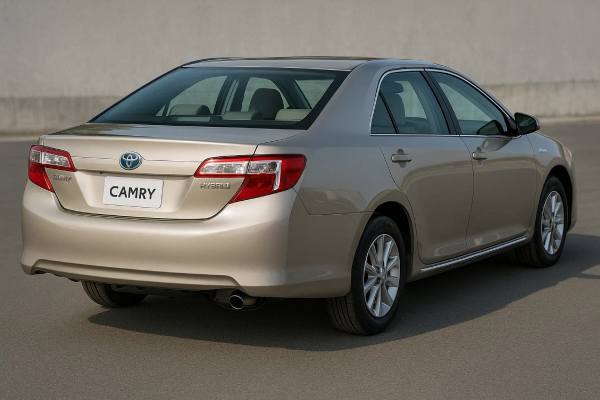
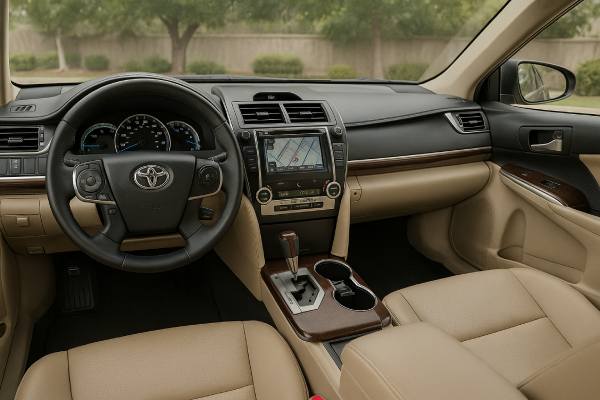
The seventh-generation Toyota Camry Hybrid (chassis AVV50) arrived with a thorough rethink of Toyota’s Hybrid Synergy Drive around the 2AR-FXE 2.5-liter Atkinson-cycle four. It pairs a refined eCVT transaxle with a compact nickel-metal hydride (NiMH) battery under the rear seat, restoring useful trunk space while improving efficiency and acceleration over the prior generation. In daily use it is quiet, predictable, and inexpensive to run. Under the skin are sensible details owners appreciate: a timing chain (no belt changes), long-life coolants, iridium plugs, and brake pads that last due to strong regenerative braking. Ride and cabin isolation are tuned for comfort, yet the car remains steady at highway speeds and confident in emergency maneuvers.
For shoppers comparing 2012–2014 midsize hybrids, the AVV50’s value equation is strong: real-world 40-mpg potential, straightforward maintenance, and a reputation for durability. There are caveats—small-overlap crash ratings evolved during the run, and the 12-V battery plus cooling system deserve regular attention—but with proper care the Camry Hybrid is one of the safest long-term bets in the segment.
Top Highlights
- Smooth hybrid drive with strong real-world economy (≈ 5.9–6.4 L/100 km / 40–37 mpg US mixed).
- Spacious, quiet cabin; battery under rear seat restores 13.1 ft³ trunk.
- Low running costs: long service intervals, robust eCVT, gentle brake wear.
- Watch items: cooling-system health (engine and inverter loops) and 12-V battery.
- Typical oil service: every 10,000 miles / 12 months with 0W-20; tire rotation every 5,000 miles.
Navigate this guide
- Camry Hybrid AVV50 overview
- Camry Hybrid specs and data
- Trims and options, safety
- Reliability and service actions
- Maintenance and buyer’s guide
- Driving and performance
- How it compares to rivals
Camry Hybrid AVV50 overview
Toyota reshaped the Camry Hybrid formula for 2012 (production began during 2011 for the 2012 model year), building the AVV50 on the lightened XV50 platform. The headline change is the 2AR-FXE 2.5-liter Atkinson-cycle engine replacing the older 2.4-liter unit, combined with a revised hybrid transaxle and a more compact NiMH battery pack relocated under the rear seat. Two important benefits follow: a net 200 hp system output with decidedly better mid-range response, and a meaningful increase in trunk volume to 13.1 ft³ because the battery no longer lives in the cargo area.
The hybrid drive (MG1, MG2, planetary gearset) functions as a continuously variable transmission (eCVT). At city speeds, the system favors electric assist and engine stop, while at highway speeds the gas engine carries most of the load with MG2 adding torque for hills and passing. Regenerative braking captures energy efficiently, extending pad and rotor life and smoothing stops when the friction system is healthy and properly bled.
Inside, the AVV50 emphasizes quietness and simple ergonomics. The structure uses high-strength steel extensively, and Toyota steadily improved crash-structure performance during the run. LE and XLE trims differ mainly in comfort and convenience features (wheels, audio, upholstery, available driver aids), while powertrain hardware remains consistent. Owners typically report low unscheduled maintenance needs: periodic fluid services, cabin filters, and tires dominate cost of ownership. The two areas that most influence longevity are the health of the cooling system—there are separate loops for the engine and the inverter—and the state of the small 12-V auxiliary battery, which powers ECUs and enables READY operation.
Camry Hybrid specs and data
Engine and Performance (HEV)
| Item | Specification |
|---|---|
| Engine code | 2AR-FXE (Atkinson-cycle) |
| Layout & cylinders | Inline-4, DOHC, 16-valve; variable valve timing |
| Valves per cylinder | 4 |
| Bore × stroke | 90.0 × 98.0 mm (3.54 × 3.86 in) |
| Displacement | 2.5 L (2,494 cc) |
| Induction | Naturally aspirated |
| Fuel system | Multi-point electronic fuel injection |
| Compression ratio | ~12.5:1 |
| ICE max power | ~156 hp (116 kW) @ ~5,700 rpm |
| ICE max torque | ~213 Nm (157 lb-ft) @ ~4,500 rpm |
| Traction motor (MG2) | ~105 kW (≈141 hp) synchronous AC; ~270 Nm (199 lb-ft) |
| System net output | 200 hp (149 kW) |
| Timing drive | Chain |
| Emissions class | ULEV/SULEV (varies by state) |
| Rated economy (LE)** | 5.6/6.2/5.9 L/100 km city/hwy/combined (42/38/40 mpg US; 50/45/48 mpg UK) |
| Rated economy (XLE)** | 5.9/6.4/6.0 L/100 km (40/38/40 mpg US; 48/45/48 mpg UK) |
| Real-world highway @ 120 km/h (75 mph) | ~6.0–6.4 L/100 km (39–37 mpg US) depending on tires and temperature |
| Aerodynamics | Cd ≈ 0.27 |
**Trim tire differences drive the EPA split: LE uses lower-rolling-resistance 16-inch tires; XLE’s 17-inch fitment typically reduces city/hwy ratings slightly.
Transmission and Driveline
| Item | Specification |
|---|---|
| Transmission | eCVT hybrid transaxle (planetary power-split, P3xx family) |
| Drive type | Front-wheel drive (FWD) |
| Final drive | ~3.54:1 equivalent |
| Differential | Open |
| Refuel to full | ~5 minutes (gasoline) |
Chassis and Dimensions
| Item | Specification |
|---|---|
| Front suspension | MacPherson strut, coil spring, stabilizer bar |
| Rear suspension | Dual-link strut (multi-link), stabilizer bar |
| Steering | Electric power steering; ~14–15:1 ratio (varies slightly by wheel/tire) |
| Brakes (front/rear) | Vented disc ~296 mm (11.7 in) / solid disc ~281 mm (11.1 in); ABS, EBD, BA |
| Wheels & tires | LE: 205/65 R16; XLE: 215/55 R17 |
| Ground clearance | ~155 mm (6.1 in) |
| Length / Width / Height | ~4,806 / 1,820 / 1,471 mm (189.2 / 71.7 / 57.9 in) |
| Wheelbase | 2,776 mm (109.3 in) |
| Turning circle (curb-to-curb) | ~11.2 m (36.7 ft) |
| Curb weight | ~1,515–1,580 kg (3,340–3,485 lb) depending on trim |
| GVWR | ~2,025–2,050 kg (4,465–4,515 lb) typical |
| Fuel tank | 64 L (17.0 US gal / 14.2 UK gal) |
| Cargo volume (SAE) | 371 L (13.1 ft³) — seats up |
Performance and Capability
| Metric | Value |
|---|---|
| 0–100 km/h (0–62 mph) | ~7.8–8.1 s |
| 0–60 mph | ~7.5–7.8 s |
| Top speed | ~185 km/h (115 mph), electronically limited |
| 100–0 km/h / 62–0 mph braking | ~38–40 m (125–131 ft) with quality tires |
| Towing | Not rated (North America) |
| Roof load | 0–45 kg (0–100 lb) with approved crossbars; check owner’s manual limit |
Fluids and Service Capacities
| System | Specification / Capacity |
|---|---|
| Engine oil | SAE 0W-20, ILSAC GF-5 or later; ~4.4–4.6 L (4.7–4.9 US qt) with filter |
| Engine coolant (ICE loop) | Toyota Super Long Life Coolant (SLLC, pink); ~5–6 L (~5.3–6.3 US qt) service fill |
| Inverter/e-motor coolant | Toyota SLLC (separate loop); ~3–4 L (3.2–4.2 US qt) service fill |
| Hybrid transaxle | Toyota ATF WS; ~3.5–4.0 L (3.7–4.2 US qt) drain-and-fill |
| A/C refrigerant | R-134a; ~520–600 g (18–21 oz) typical charge |
| A/C compressor oil | ND-11; ~120 mL (4.1 fl oz) |
| Key torque values | Wheel nuts 103 Nm (76 lb-ft); engine oil drain ~39 Nm (29 lb-ft) |
Capacities vary slightly by production date and climate package; confirm by VIN.
Electrical
| Item | Specification |
|---|---|
| High-voltage battery | NiMH, ~245 V nominal; under rear seat with ducted cooling |
| DC-DC converter | Up to ~100–120 A (replaces alternator) |
| 12-V battery | AGM type, ~45–60 Ah (trunk-mounted); inspect annually |
| Spark plugs | Long-life iridium; gap ~1.1 mm (0.043 in); 120,000-mile replacement interval typical |
Safety and Driver Assistance
| Area | Details |
|---|---|
| Crash structure | Reinforced front rails and improved occupant cell; running updates during 2012–2014 |
| IIHS results | Good in moderate overlap, side, roof strength, and head restraints on most trims. Small-overlap driver test rated Poor for 2012–2013 and early 2014 builds; later 2014 builds improved to Acceptable/Good when equipped with structural updates. |
| Headlight rating | Not rated by IIHS for these years (program began later). |
| Airbags and restraints | Dual-stage front, front side, full-length side-curtain, driver knee; active front headrests; LATCH in outboard rear seats. |
| Stability and braking | Vehicle Stability Control, Traction Control, ABS with EBD and Brake Assist; strong regen blending. |
| ADAS availability | Blind Spot Monitor optional on higher trims/years. No factory AEB/ACC/LKA in this generation for North America. |
Trims and options, safety and driver assistance
Trim walk (North America):
- Hybrid LE: 16-inch wheels with low-rolling-resistance tires, fabric seats, manual driver seat (later power), Display Audio with Bluetooth, dual-zone climate, smart key with push-button start, color MID. This trim posts the best official economy thanks to tire choice and mass.
- Hybrid XLE: 17-inch wheels and tires, leather (or SofTex) options, power driver’s seat with memory, moonroof available, premium audio with navigation/JBL on option packages, auto-dimming mirror, fog lamps, and more soft-touch interior surfaces.
Key option packages and identifiers:
- Navigation/JBL: larger touchscreen, voice command, more speakers, amplifier—look for JBL logos on grilles.
- Convenience and Safety options: auto-on/off headlights, Homelink, Blind Spot Monitor (indicator in mirrors).
- Wheels/Tires: LE 205/65R16; XLE 215/55R17—an easy visual differentiator.
- VIN/build clues: Battery under rear seat on all AVV50; hybrid-specific underhood orange high-voltage cabling; “Hybrid” badging at fenders and trunk.
Year-to-year notes:
- 2012 launch: new platform and powertrain; battery relocated; trunk space restored to 13.1 ft³.
- 2013: multimedia updates and minor trim content changes.
- 2014: running structural updates improve small-overlap performance on later builds; equipment reshuffles.
Crash-test summary:
- IIHS: Good in most main tests; early small-overlap performance lagged rivals until Toyota’s 2014 structural changes. Buyers should prefer 2014 cars built after the small-overlap update if this test is a priority.
- NHTSA: Typical five-star composite on many XV50 variants, with occasional four-star sub-scores depending on configuration.
Child-seat and cargo practicality:
Two full LATCH positions in the outboard seats and an additional tether anchor, wide door openings, and decent rear legroom. The hybrid’s trunk pass-through remains usable; battery placement under the rear cushion means the cargo bay is flat and unobstructed for strollers or luggage.
ADAS and calibration considerations:
Blind Spot Monitor (where equipped) requires correct mirror glass and post-repair calibration after mirror or radar sensor replacement. Windshield changes on models with rain sensor or camera-based features (rare on these years) may need basic recalibration; consult the service manual.
Reliability, common issues and service actions
The AVV50 hybrid powertrain is among Toyota’s most durable. Most examples deliver high mileage with little more than scheduled service. Still, age and use bring patterns:
Common (low-to-medium cost):
- 12-V auxiliary battery weakness (4–7 years): slow crank-up of control modules, random warning lights, or intermittent “Not in READY” messages. Remedy: test annually; replace with AGM unit of correct venting and capacity.
- Engine and inverter cooling (6–10 years): seepage at water pump weep hole, swollen hoses, or air in either coolant loop (heater weak at idle, inverter pump buzz). Remedy: inspect for leaks, pressure-test, and bleed both loops with the hybrid bleed procedure.
- Brake feel inconsistency at low speeds: glazed pads/rotors or contaminated slide pins can exaggerate the regen-to-friction handoff. Remedy: service pins/boots, deglaze or replace pads/rotors, perform proper brake bleed (hybrid active bleed sequence).
- Infotainment quirks: intermittent Bluetooth or touch response. Remedy: firmware update via dealer or reset; verify with part/firmware bulletins.
Occasional (medium cost):
- Wheel bearings / hub noise (high mileage, rough roads): growl increasing with speed. Remedy: replace affected hub assembly.
- A/C evaporator odor: microbial growth in humid climates. Remedy: apply HVAC cleaning procedure; replace cabin filter more often; consider evaporator treatment.
Rare (higher cost):
- Hybrid battery degradation/failure (10–15 years, high mileage, heat): DTCs for block imbalance, frequent engine cycling, reduced EV assist. Remedy: verify state-of-health via Techstream block voltages and internal resistance; recondition or replace with new OEM pack or high-quality reman; ensure cooling duct is clean and blower functional.
- Brake booster/actuator concerns: less common than on Prius of the same era but possible; symptoms include frequent pump cycling or warning lights. Remedy: diagnose for accumulator leakage; replace actuator if confirmed.
Software and calibration updates:
ECU/TCU updates are less frequent on the AVV50 than on some rivals, but dealers have released campaign and service software updates over time (e.g., drivability refinements or ABS/traction tuning). Always ask for a campaign status printout by VIN.
Safety recalls and field actions (high-level):
- Front suspension lower arm (certain 2014 Camry/Camry Hybrid): inspection/replacement to address potential separation at the arm (safety risk if ignored).
- Airbag and occupant restraints: typical supplier campaigns vary by build date—verify by VIN.
- Miscellaneous campaigns appear periodically (e.g., moisture intrusion, component supplier defects).
Verifying completion:
Request a dealer VIN inquiry printout and cross-check on the official recall portal. Keep these with service records for resale value.
Pre-purchase checks (ask the seller):
- Full service history (oil every 10k/12 mo; coolant changes; brake fluid).
- VIN recall/campaign report and any extended-warranty letters.
- Hybrid battery health evidence (scan showing block deltas within spec).
- Coolant system inspection results (both loops), no leaks, no overheating.
- Brake service records and pad thickness; test for smooth blended stops.
- 12-V battery test and date code; tires with even wear; alignment printout.
Maintenance and buyer’s guide
Practical maintenance schedule (typical North American guidance):
- Engine oil & filter: 0W-20 full synthetic every 10,000 miles / 12 months under normal service; every 5,000 miles / 6 months for severe duty (short trips, extreme cold/heat).
- Tire rotation & inspection: every 5,000 miles / 6 months; check pressures monthly.
- Cabin air filter: inspect at 15,000 miles / 12 months, replace as needed (more often in dusty or humid climates).
- Engine air filter: inspect at 30,000 miles / 3 years; replace 30–45k miles as needed.
- Brake fluid: replace every 3 years regardless of miles; use correct DOT 3 or DOT 4 per manual.
- Engine coolant (ICE loop): first change at 100,000 miles / 10 years, then 50,000 miles / 5 years; Toyota SLLC only.
- Inverter/e-motor coolant: same interval as engine coolant; 100,000 miles / 10 years initial, then 5 years/50,000 miles.
- Spark plugs (iridium): 120,000 miles / 12 years; verify gap on install.
- Hybrid transaxle fluid (ATF WS): “lifetime” in many schedules; prudent proactive drain-and-fill at 60,000–100,000 miles extends longevity.
- 12-V battery: test annually after year 4; typical replacement 5–7 years.
- HV battery: no routine service; keep cooling duct clear, cabin filter fresh, and avoid prolonged heat exposure.
- Alignment: check annually or with any tire replacement or impact.
- Belts and hoses: inspect each oil service; replace on condition. (Engine uses a serpentine belt; the hybrid pump is electric—no timing belt on engine.)
Fluid quick reference:
- Engine oil: SAE 0W-20; ~4.4–4.6 L (4.7–4.9 qt).
- Coolants: Toyota SLLC (both loops).
- Transaxle: Toyota ATF WS; ~3.5–4.0 L (drain-and-fill).
- Brake fluid: DOT 3 (or DOT 4 where specified).
- A/C: R-134a; ND-11 compressor oil.
Essential torque values:
- Wheel nuts 103 Nm (76 lb-ft); oil drain plug ~39 Nm (29 lb-ft); under-tray fasteners hand-tight + inspection (varies by style), spark plugs 18–22 Nm (13–16 lb-ft) on clean, dry threads (always check the service manual for your VIN).
Buyer’s field checklist:
- Exterior/structure: even panel gaps; front frame rails and radiator support straight; check lower control arms and bushings; inspect under-car for corrosion or impacts.
- Cooling system: cold-start and warm-idle heater performance; look for dried pink residue (SLLC) around fittings and pump weep hole.
- Hybrid system: with scan tool, confirm HV battery block deltas are tight and no historical inverter over-temperature codes; listen for steady inverter pump hum with READY on.
- Brakes: smooth, progressive stops; no low-speed judder; verify pad thickness and rotor condition.
- Electrics: 12-V holds >12.5 V engine off; >14 V when in READY (converter charging).
- Tires: even wear; no inner-edge feathering (alignment) or cupping (dampers).
- Records: oil/coolant/brake fluid intervals; recall/campaign closures; any HV battery or actuator replacement paperwork.
Recommended years/trims:
- 2014 late-build cars gain improved small-overlap crash performance.
- LE for maximum efficiency and lowest tire replacement cost; XLE suits buyers prioritizing features and highway stability from 17-inch tires.
Durability outlook:
With routine care, the AVV50 powertrain commonly exceeds 200,000–300,000 miles without major hardware work. The hybrid battery’s life depends heavily on climate and storage; many original packs remain healthy past a decade when cooling is unobstructed and the car is driven regularly.
Driving and performance
Ride and NVH:
The Camry Hybrid’s mission is calm isolation. The body structure feels stout over potholes, road roar is well-managed (especially on 16-inch tires), and the electric motor’s instant torque masks the modest engine output at low speed. At 65–75 mph, engine revs are low thanks to the Atkinson cycle and eCVT ratio control. Wind noise is subdued; tire noise increases with the 17-inch setup.
Handling and stability:
Steering effort is light but consistent, with a natural on-center feel for long freeway slogs. The chassis prefers smooth inputs; it isn’t a canyon carver, yet grip is predictable and stability control intervenes unobtrusively. Emergency lane changes are composed. The XLE’s wider, lower-profile tires add initial bite but slightly degrade ride plushness on broken pavement.
Powertrain character:
Throttle mapping in Eco is relaxed for economy; Normal provides the best everyday response. There is no conventional kickdown because the eCVT varies ratios seamlessly, blending motor and engine torque. Passing from 50–80 mph is adequate; plan a down-pedal squeeze rather than a stab for the smoothest response. Engine start/stop events are quiet and well-damped when mounts are healthy and the 12-V is strong.
Braking:
Regenerative braking handles most routine deceleration from urban speeds; the friction system joins progressively as speed falls. Pedal feel is consistent when pads and slides are serviced properly and brake fluid is fresh. Expect long pad life—often well beyond 60,000–90,000 miles.
Real-world economy:
Drivers regularly see 5.6–6.7 L/100 km (42–35 mpg US) depending on climate, speed, and tires. At a steady 120 km/h (75 mph), anticipate ~6.0–6.4 L/100 km (39–37 mpg US). Cold weather and short trips can add 10–25% to consumption until the powertrain is warm. The LE’s 16-inch LRR tires help in city use; the XLE’s 17-inch tires trade ~1–2 mpg for steering precision.
Loads and grades:
While not tow-rated in North America, the Camry Hybrid hauls four adults and luggage comfortably. On long grades, coolant temps remain stable when both loops are healthy; the eCVT keeps the engine in its efficient band, and MG2 provides extra shove early in the climb.
How Camry Hybrid compares to rivals
Ford Fusion Hybrid (2013–2014):
A sharper-feeling chassis and a more modern dashboard compete well, but early claims of class-leading EPA figures didn’t always match real-world economy at highway speeds. Ford’s complex dual-clutch-like eCVT calibration and battery cooling path have matured, yet long-term reliability costs tend to be higher than Toyota’s. If you value steering feel and cabin design over simplicity, the Fusion can appeal; for the lowest running costs, the Camry keeps the edge.
Honda Accord Hybrid (2014):
Honda’s two-motor system is efficient and quick, with excellent city economy and a lightweight feel. Early infotainment hiccups and parts pricing can offset some of the fuel savings. The Accord rides firmer and corners flatter; the Camry is quieter and more relaxed. Both are strong picks; inspect maintenance history carefully.
Hyundai Sonata Hybrid (2013–2014):
More features per dollar and an attractive design—especially in Limited trims—were the draws. The parallel hybrid system uses a conventional stepped automatic; drivability is good, but the Camry’s eCVT is smoother in stop-and-go. Long-term battery and dealer network experience tilt market confidence toward Toyota.
Nissan Altima Hybrid (discontinued earlier in this era):
Rarer on the ground and based on Toyota’s prior hybrid tech under license, making parts and service less straightforward by 2012–2014. The AVV50 is an easier ownership path.
Bottom line:
If your priorities are low total cost of ownership, a quiet commute, and predictable reliability, the AVV50 Camry Hybrid remains a benchmark. Choose a late-build 2014 for the best small-overlap performance, or an LE for maximum economy and tire longevity.
References
- 2012 Toyota Camry Hybrid – Toyota USA Newsroom 2011 (Press Kit)
- 2012 Toyota Camry Hybrid Product Information – Specifications & Features – Toyota USA Newsroom 2011 (Specifications)
- 2012 Toyota Camry Hybrid LE 2024 (EPA Ratings)
- 2012 Toyota Camry 2024 (EPA Ratings)
- 2013 Toyota Camry 4-door sedan 2024 (Safety Rating)
- Toyota Safety Recall and Service Campaign 2021 (Recall Bulletin)
Disclaimer
This guide is for informational purposes only and is not a substitute for professional diagnosis or repair. Specifications, torque values, service intervals, fluid types, and procedures vary by VIN, market, build date, and equipment. Always confirm against the official owner’s manual, warranty and maintenance guide, and service literature for your exact vehicle before performing any work.
If you found this helpful, please share it with fellow owners on Facebook or X/Twitter to support xcar’s work.