
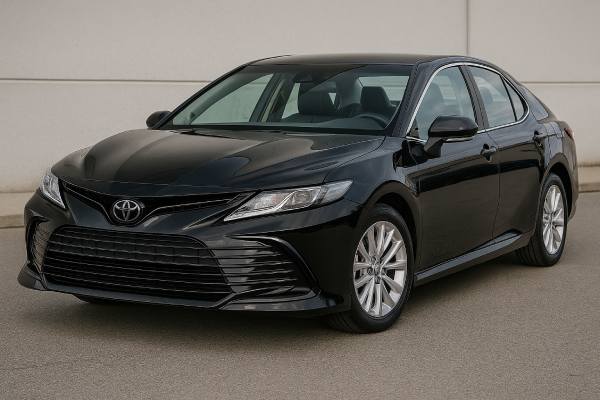
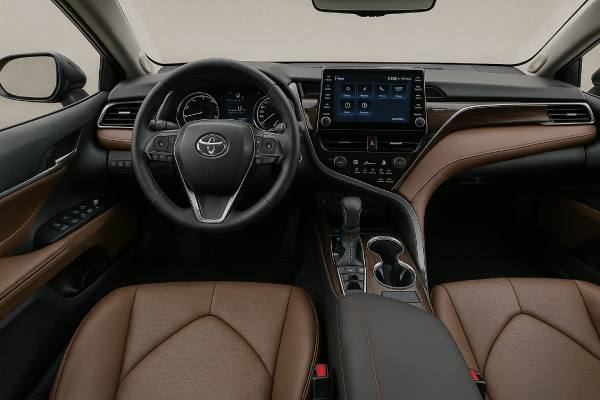
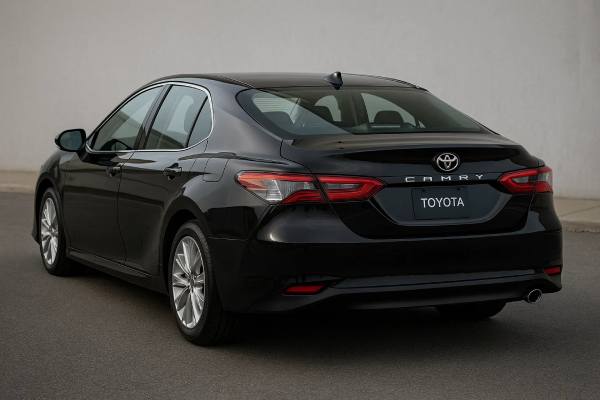
The 2021–2024 Toyota Camry (AXVA70) facelift refined a proven formula: a rigid TNGA platform, Toyota’s “Dynamic Force” 2.5-liter A25A-FKS engine, and a smart 8-speed Direct Shift automatic. In XSE trim the 2.5 makes a quoted 206 hp, with modest visual updates and an upgraded Toyota Safety Sense 2.5+ suite. Owners value its long-haul comfort, efficient highway cruising, and a cabin that has aged well. Shoppers should know how the 206-hp XSE differs from the common 203-hp trims, where AWD slightly alters outputs and economy, and how options like 19-inch wheels, JBL audio, or Driver Assist packages change the experience. This guide distills the specifications that matter, the maintenance that keeps it strong, and the few issues to watch for on pre-purchase inspections. If you want a midsize sedan that simply works—quietly, efficiently, and for a very long time—this generation Camry remains a benchmark.
Fast Facts
- Strong efficiency: XSE 2.5 FWD is rated 27/38/31 mpg (city/hwy/combined).
- High safety: standard Toyota Safety Sense 2.5+ and top crash-test results.
- Balanced ride/handling; 19-inch tires sharpen response without hurting comfort much.
- Caveat: some cars benefit from transmission/ADAS software updates after service—verify current calibration.
- Typical service cadence: rotate tires and inspect every 5,000 miles (8,000 km); engine oil and filter every 10,000 miles (12 months) when 0W-16 is used.
Explore the sections
- Camry AXVA70 2021–2024 Overview
- Camry AXVA70 Specs and Data
- Camry Trims, Options and Safety
- Reliability, Issues and Service Actions
- Maintenance Plan and Buyer Guide
- Driving Impressions and Efficiency
- Camry vs Comparable Midsizers
Camry AXVA70 2021–2024 Overview
Toyota’s 2021 model-year facelift for the eighth-generation Camry concentrated on refinement, tech and small but meaningful chassis and safety tweaks rather than powertrains. The A25A-FKS 2.5-liter four-cylinder remained the volume engine, paired with the 8-speed Direct Shift automatic driving the front wheels; available all-wheel drive returned for four-cyl trims, trading a little economy for all-weather traction. The visual update brought a cleaner front fascia, new wheel designs (up to 19 inches on XSE), and a modernized center stack with a “floating” touchscreen (7 or 9 inches depending on audio system).
More important was Toyota Safety Sense 2.5+, standard across the line. It expanded camera/radar capability and added improved pedestrian detection, intersection support and enhanced lane-centering logic, helping the Camry earn top crash-test recognition. The chassis still uses MacPherson struts up front and a multi-link rear, with steering tuning that differs slightly between comfort-oriented LE/XLE and sport-tuned SE/XSE grades. Brake hardware varies too: mainstream trims use ventilated 12.0-in front rotors with solid rears, while the V6 TRD model (outside this 2.5-liter scope) adds larger 12.9-in front rotors and specific calipers.
For the 2.5-liter, outputs depend on trim and driveline. Front-drive LE/XLE/SE are rated at 203 hp; the XSE’s freer-flowing dual exhaust bumps that to 206 hp with 186 lb-ft. Adding AWD changes the calibration and exhaust, yielding 202 hp (205 hp on XSE AWD) with a slightly lower torque peak. These deltas are modest in daily driving but explain why XSE brochures call out 206 hp.
Inside, the facelift improved user experience more than raw space. The Camry is a true five-passenger car with generous rear legroom and a 15.1 ft³ (SAE) trunk. Hybrid packaging reduces fuel-tank size, but the gas-only 2.5 keeps the 15.8-gal tank for long highway range. Sound insulation is good by class standards, and the sport-oriented SE/XSE seats hold you better without giving up long-trip comfort. As a used buy, the 2021–2024 run benefits from early-cycle fixes and software refinements that trickled in after the 2018–2020 launch years.
Camry AXVA70 Specs and Data
Engine and Performance (ICE)
| Item | Detail |
|---|---|
| Code | A25A-FKS (“Dynamic Force”) |
| Layout & cylinders | Inline-4, DOHC, 16 valves; Dual VVT-i |
| Bore × stroke | 87.5 × 103.4 mm (3.44 × 4.07 in) |
| Displacement | 2.5 L (2,487 cc) |
| Induction | Naturally aspirated |
| Fuel system | D-4S (combined direct/port injection) |
| Compression ratio | 13.0:1 |
| Max power (XSE FWD) | 206 hp (154 kW) @ 6,800 rpm |
| Max torque (XSE FWD) | 252 Nm (186 lb-ft) @ 5,000 rpm |
| Emissions/efficiency standard | SULEV rating, EPA-certified |
| Rated fuel economy (XSE FWD) | 8.7 L/100 km (31 mpg US / 37 mpg UK) combined; 10.7/6.2 L/100 km (27/38 mpg US) city/highway |
| Real-world highway @ 120 km/h (75 mph) | ~7.1–7.8 L/100 km (33–37 mpg US / 40–44 mpg UK), conditions/tires dependent |
| Aerodynamics (typical) | Cd ~0.27–0.28 depending on trim/wheels |
Notes: LE/SE/XLE FWD with the same engine are quoted at 203 hp; AWD variants are quoted at 202 hp (205 hp on XSE AWD).
Transmission and Driveline
| Item | Detail |
|---|---|
| Transmission | 8-speed “Direct Shift” automatic (ECT-i) with manual mode |
| Drive type | Front-wheel drive; optional AWD (electromagnetically controlled torque transfer) |
| Final drive ratio | Trim-dependent; typical ~3.0–3.3:1 (calibrated for economy) |
| Differential | Open (electronic brake-based torque control) |
| Refuel to full | Approx. 2–4 minutes at pump (15.8-gal tank) |
Chassis and Dimensions
| Item | Detail |
|---|---|
| Platform | TNGA-K unibody; front/rear anti-vibration sub-frames |
| Suspension (front/rear) | MacPherson strut / multi-link; SE/XSE with sport tuning |
| Steering | Electric power steering; curb-to-curb turning circle 38.0 ft (11.6 m) FWD; 39.3 ft (12.0 m) AWD |
| Brakes (mainstream 2.5 trims) | Ventilated front discs 12.0 in; solid rear discs ~11.0 in |
| Wheels/Tires | 18- or 19-in on XSE (e.g., 235/40 R19); 17-in on some lower trims |
| Ground clearance | 5.7 in (145 mm) |
| Length / Width / Height | 192.1 / 72.4 / 56.9–57.1 in (4,879 / 1,839 / 1,446–1,451 mm) |
| Wheelbase | 111.2 in (2,825 mm) |
| Track (front/rear) | Up to 63.0/63.2 in with 19-inch package (trim-dependent) |
| Curb weight | ~3,300–3,585 lb (FWD/AWD spread, by trim) |
| Fuel tank | 15.8 gal (59.8 L) |
| Cargo volume (SAE) | 15.1 ft³ (428 L) |
Performance and Capability
| Metric | 2.5 A25A-FKS (XSE FWD) |
|---|---|
| 0–60 mph / 0–100 km/h | Typically mid-7s / ~8.0–8.5 s (test-dependent) |
| Top speed | Not officially published (class-typical electronic limit) |
| Braking 62–0 mph | Class-average; rotor sizes as above and tire compound strongly affect results |
| Towing capacity | Not rated for braked trailer in North America (consult local guidance) |
Fluids and Service Capacities (essentials)
| System | Specification | Capacity (typical) |
|---|---|---|
| Engine oil | SAE 0W-16 API-rated; Toyota Genuine recommended | ~4.5–4.8 L (4.8–5.1 qt) with filter (verify by VIN) |
| Coolant | Toyota Super Long Life Coolant (pink) | Factory fill; first replacement at 100,000 miles (120 months), then every 50,000 miles (60 months) |
| Automatic transmission | Toyota WS (World Standard) ATF | Sealed unit; level/condition check only unless serviced |
| AWD rear diff / transfer (if equipped) | Toyota spec gear oil | Inspect; replace under severe use per schedule |
| A/C refrigerant | R-1234yf (model-year dependent) | Charge by label; do not guess fill mass |
| Key torque examples | Wheel lug nuts ~103 Nm (76 lb-ft); oil drain plug typical ~39 Nm (29 lb-ft)—confirm for your VIN |
Electrical (service items)
| Item | Typical detail |
|---|---|
| 12-V battery | AGM or flooded, group size per build; test annually after year 3 |
| Spark plugs | Long-life iridium; gap factory-set and non-adjustable; visual check at major service intervals |
Safety and Driver Assistance (headlines)
| Item | Detail |
|---|---|
| Crash tests (IIHS) | 2021 Camry rated Top Safety Pick + with Good crashworthiness; headlight rating varies by trim (Good/Adequate) |
| Front crash prevention | Standard system rated Superior (vehicle-to-vehicle and daytime pedestrian) |
| ADAS suite | Toyota Safety Sense 2.5+: Pre-Collision with Pedestrian Detection, Lane Departure Alert with Steering Assist, Lane Tracing Assist, Road Sign Assist, Full-Speed Dynamic Radar Cruise Control; Blind Spot Monitor with Rear Cross-Traffic Alert is standard on XLE/XSE and optional on LE/SE; Rear cross-traffic braking and parking sonar available |
Camry Trims, Options and Safety
Trim map (gas 2.5): LE, SE (and SE Nightshade), XLE, XSE. All get the A25A-FKS four-cylinder and 8-speed automatic; AWD is available on LE/SE/XLE/XSE. The XSE is the 206-hp variant (dual outlet exhaust and tuning). LE/SE/XLE FWD are 203 hp; AWD versions are 202 hp (XSE AWD 205 hp). A V6 TRD exists but sits outside this 2.5-liter scope.
What changes as you climb trims
- Chassis and wheels: LE/XLE ride on comfort-oriented springs/dampers; SE/XSE use firmer sport tuning. Wheel sizes step up from 17 inches to 19 inches on XSE (summer tires available). Larger wheels bring sharper turn-in and a small economy penalty.
- Exterior identifiers: XSE has dual exhaust finishers, unique 19-in wheel designs, and available two-tone roof on some model years. Nightshade packages add dark accents, especially on SE.
- Cabin and tech: The facelift introduced a tablet-style 7- or 9-inch screen; JBL® 9-speaker audio was optional across upper grades. XSE gets SofTex®/leather-trimmed sport seats and paddle shifters.
- Packages that matter:
- Driver Assist Package (trim-dependent): adds 10-in Head-Up Display and Bird’s Eye View Camera with perimeter scan.
- Premium Audio / Navigation: upgrades to 9-in screen and JBL.
- Panoramic glass roof (XLE/XSE): adds light and perceived space but increases weight and headroom trade-off for tall passengers.
Safety equipment by trim (highlights)
- Standard on all: Toyota Safety Sense 2.5+, 10 airbags, tire-pressure monitoring with individual readouts, hill-start assist, Star Safety System stability/traction features.
- Blind Spot Monitor with Rear Cross-Traffic Alert: standard XLE/XSE; optional LE/SE.
- Parking sonar with rear automatic braking: available.
- Headlights: performance varies by trim and option; XSE/XLE LED projectors typically scored better in testing.
Year-to-year notes (facelift span)
- 2021: Facelifted styling, new center display layout, and rollout of TSS 2.5+. Trim content reshuffled; Nightshade offered on SE.
- 2022–2023: Feature mix and color/option availability adjusted; software refinements for multimedia and ADAS.
- 2024: Last year of this body before the next-gen model; content rationalized ahead of changeover.
Safety ratings at a glance
- IIHS: Top Safety Pick+ status with Superior front crash prevention and Good/Adequate headlights depending on trim/options.
- Child-seat practicality: LATCH anchors are well-located with a Good ease-of-use rating; cabin width easily handles two child seats and a booster.
Reliability, Issues and Service Actions
The 2.5-liter Camry is known for durability, but every model has patterns worth checking. Below is a prioritized map by prevalence and cost, focused on 2021–2024 four-cylinder cars.
Common / low to medium cost
- Brake shudder/noise after sitting or short-trip use → Rotor surface corrosion or uneven pad deposits, more likely with coastal climates or gentle braking. Remedy: Clean drive and several firm stops; resurface/replace rotors and pads if thickness/run-out out of spec. Keep tires matched and torqued evenly (wheel lug torque affects brake feel).
- Infotainment or camera glitches (touchscreen, Bluetooth pairing, or 360° camera) → Early software versions. Remedy: Multimedia software update; check that campaigns/TSB updates have been applied during service.
- Wind/road noise complaints with 19-inch tires → Tread pattern and higher wheel mass transmit a touch more roar. Remedy: Tire selection matters; touring-oriented 19-inch all-seasons reduce cabin boom without sacrificing steering response.
Occasional / medium cost
- 8-speed shift quality at low speeds (early build behaviors such as low-speed lugging or abrupt downshifts) → Transmission/engine control calibration. Remedy: Confirm latest ECM/TCM software; some owners report smoother behavior after updates and adaptive relearns. Avoid mixing tire sizes and keep throttle body/MAF clean at scheduled intervals.
- A/C odor in humid climates → Evaporator core microbial growth. Remedy: Replace cabin filter on time, run A/C in fresh-air mode periodically, apply evaporator cleaner through the condensate drain, and use HVAC after-run to dry the core before garaging.
Rare / high-visibility safety actions
- Occupant Classification System (front passenger seat) sensor recall affecting specific 2020–2022 Camry builds → If the sensor was improperly manufactured, the airbag system may misclassify passenger weight, potentially altering deployment logic. Remedy: Dealer inspection and replacement per official recall instructions; verify by VIN.
- Other campaigns appear from time to time (for example, multimedia reprogramming or stability-control defaults on certain Toyota models). These are typically software-only and quick to complete.
What to verify on any candidate
- VIN recall check and printed dealer service history showing completed campaigns.
- ECU/TCU software level noted on repair orders (especially if the car had drivability or ADAS complaints).
- Recent brake service and a rotor thickness/run-out measurement.
- Matching tires with even wear (feathering suggests alignment; cupping suggests shock wear).
- Battery test and charging health (especially for cars with many short trips).
- AWD cars: evidence of rear differential and transfer case fluid inspections or replacements if used for lots of winter/cold starts.
- Front-end clunks over sharp bumps usually trace to stabilizer links or top mounts—simple but worth checking.
Long-term outlook: With routine fluids and software kept current, the A25A-FKS/8-speed powertrain is capable of very high mileage with few surprises. The D-4S dual-injection system’s use of port injection reduces carbon build-up risk seen in older DI-only engines.
Maintenance Plan and Buyer Guide
Factory maintenance rhythm (gas 2.5)
- Every 5,000 miles / 6 months: Tire rotation; inspect fluids, brakes, steering, suspension, driveshaft boots; check wiper blades; general inspection.
- Every 10,000 miles / 12 months: Replace engine oil and filter (when 0W-16 is used); replace cabin air filter at 10k/20k depending on environment; reset maintenance reminder.
- At 30,000–45,000 miles: Engine air filter; brake measurement (thickness and run-out).
- At 60,000–75,000 miles: More thorough under-body inspection; alignment check; shocks/struts evaluation; AWD propeller shaft bolt re-torque where applicable.
- At 100,000 miles / 120 months: Replace engine coolant; continue every 50,000 miles / 60 months thereafter.
- Spark plugs: Long-life iridium on the 2.5-liter typically go long intervals; inspect at major services and replace when out of spec or per VIN-specific guidance.
- AWD units (if equipped): Differential and transfer case oils inspected routinely; replace under severe service (frequent towing, extreme cold, dirty roads).
- Brake fluid: Test annually after year 3; replace when moisture/boiling-point tests fail or every ~3 years as best practice.
- 12-V battery: Load-test yearly after year 3–4; many last 4–6 years depending on climate.
- Tires and alignment: Rotate every 5,000 miles; align if steering pull or edge wear appears; keep pressures set to the door-jamb label.
Fluids and references (decision-critical)
- Engine oil: 0W-16, API-rated; use a quality filter and replace the drain-plug gasket.
- Coolant: Toyota Super Long Life Coolant (pink).
- Transmission: Toyota WS ATF; this is a sealed unit—service only when conditions or contamination warrant.
- A/C: R-1234yf refrigerant; service by weight using certified equipment.
- Torque reminders: Wheel nuts ~103 Nm (76 lb-ft); verify engine drain-plug torque for your exact VIN before tightening.
DIY friendliness: Access for filters and plugs is straightforward; under-tray removal is required for oil changes. A low-profile jack and quality stands make tire rotations easy. Follow proper battery registration and keep 12-V supply stable if disconnecting during electronics work.
Pre-purchase checklist
- Exterior/structure: Look for bumper clip misalignment, overspray, or uneven panel gaps; check sub-frames for corrosion in road-salt states.
- Chassis: Listen for clunks over speed bumps; inspect front sway-bar links and rear multi-link bushings.
- Drivetrain: Smooth take-up from rest, no hunting between 7th–8th at 45–55 mph; steady idle with A/C on.
- Brakes: Even pedal, no shimmy from 60 mph stops; examine rotor lips and pad thickness.
- Electronics: Confirm all cameras, parking sensors, and ADAS warnings initialize normally; run the infotainment through CarPlay/Android Auto and Bluetooth.
- Tires: Even wear across the set; verify size and speed/load ratings match the door-jamb label.
- Paperwork: Full service history, completed recalls, and any ADAS/ECU software updates.
Which years/trims to target
- Sweet spot: 2022–2024 XSE 2.5 FWD for 206 hp, 19-inch wheels, and strong standard safety content; choose 18-inch all-seasons if you want a calmer ride and slightly better winter performance.
- All-weather need: Any AWD 2.5, understanding the small power/economy trade-off.
- Avoid? No systemic “do-not-buy” trims in this run; simply prioritize complete records and cars with current calibrations.
Driving Impressions and Efficiency
Ride, handling, NVH: The facelift Camry remains quiet at a cruise, with well-damped body motions. SE/XSE’s firmer tune controls heave and pitch better than LE/XLE, and the 19-inch package sharpens turn-in while adding a faint edge over broken pavement. Straight-line stability is excellent, and crosswinds barely nudge it. Steering weight is natural if not brimming with feedback, and the brake pedal is consistent—firm initial bite followed by linear modulation. On rough, patch-filled highways, cabin noise stays class-competitive; road roar mainly tracks tire choice.
Powertrain character: The A25A-FKS is a high-efficiency long-stroke engine that likes to rev, with its best punch from 4,000 rpm to redline. The 8-speed Direct Shift automatic holds taller gears aggressively in Normal/Eco for fuel economy; Sport mode raises shift points and speeds downshifts for passing. Low-speed shift logic is smoother in later software builds; the transmission is happiest with moderate throttle rather than “on-off” inputs. Paddle shifters on XSE respond quickly enough for downhill braking and quick merges.
Real-world economy: With the XSE 2.5 FWD, expect around 31 mpg US (7.6 L/100 km) mixed in temperate weather. Sustained 60 mph (100 km/h) highway runs often land in the 38–40 mpg US (6.2–5.9 L/100 km) range; at 75 mph (120 km/h) you’ll typically see mid-30s mpg US. Winter fuel and short trips can drop those numbers 10–20%. AWD trims cost a couple mpg, and 19-inch summer tires add rolling resistance.
Performance metrics that matter:
- Passing confidence: 50–80 mph is strong for a naturally aspirated four, especially in Sport mode where the transmission kicks down promptly.
- Braking: With healthy tires and rotors, it stops straight with good pedal feel. Track larger rotors and dual-piston calipers are on the TRD V6 only.
- Traction/winter use: AWD provides surefooted starts on slick inclines and tighter corner exits, but quality all-seasons or dedicated winter tires remain the foundation of snow performance.
Load and road trips: The trunk’s 15.1 ft³ (428 L) is usefully square; rear folding backs expand capacity for long items. With four adults and luggage the 2.5 remains unstressed on grades; coolant and ATF temps stay in check. Expect a modest economy penalty when fully laden.
Camry vs Comparable Midsizers
Honda Accord (2.0/1.5 turbo or hybrid): The Accord leans sportier in steering feel and chassis tuning; the Camry counters with naturally aspirated simplicity, slightly better ride isolation on coarse roads, and broader long-term reliability perception. Accord’s turbo torque provides stronger midrange; Camry’s 2.5 offers steadier economy on regular fuel and no turbo hardware to service.
Nissan Altima (2.5 NA or VC-Turbo; available AWD): Altima’s AWD is a rival to Camry’s, but cabin and control feel are less cohesive. The VC-Turbo is quick but more complex; Camry’s A25A-FKS is simpler and typically thriftier at highway speeds.
Hyundai Sonata / Kia K5 (1.6T/2.5T and hybrids): Feature-rich cabins and sharp styling; the 2.5T variants are quicker, but Camry tends to hold resale better and has a longer track record for trouble-free ownership.
Mazda6 (discontinued after 2021 in North America): The Mazda6 offers engaging dynamics but older infotainment and scarcer parts support now. Camry is quieter, roomier, and still sold new through 2024.
The short of it: If you want a midsize sedan that trades a little headline speed for long-term ease—simple maintenance intervals, wide parts availability, and excellent safety scores—the 2021–2024 Camry 2.5, particularly in XSE 206-hp guise, is one of the safest bets on the market.
References
- MY21 Camry eBrochure 2021 (Specifications)
- 2021 Toyota Camry 4-door sedan 2024 (Safety Rating)
- Fuel Economy of 2021 Toyota Camry 2024 (EPA Ratings)
- Warranty & Maintenance Guide — 2021 Camry 2020 (Maintenance Schedule)
- SAFETY RECALL 23TA15 (Remedy Notice) 2023 (Recall)
Disclaimer
This guide is for informational purposes only and is not a substitute for professional diagnosis or repair. Specifications, torque values, fluid capacities, and maintenance intervals vary by VIN, market, equipment, and production date. Always verify against your vehicle’s official owner’s manual, service manual, and dealer records before performing work.
If this article helped, consider sharing it on Facebook or X/Twitter to support xcar’s independent coverage.