
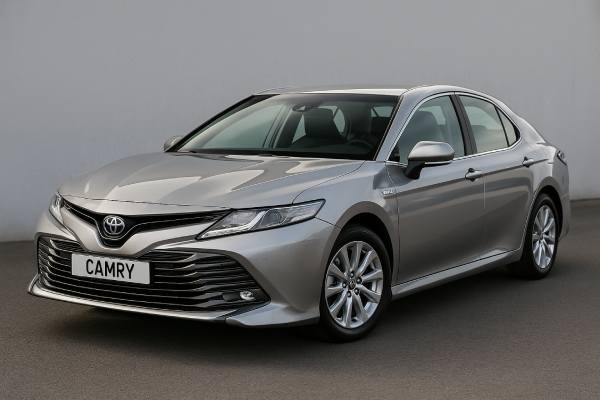
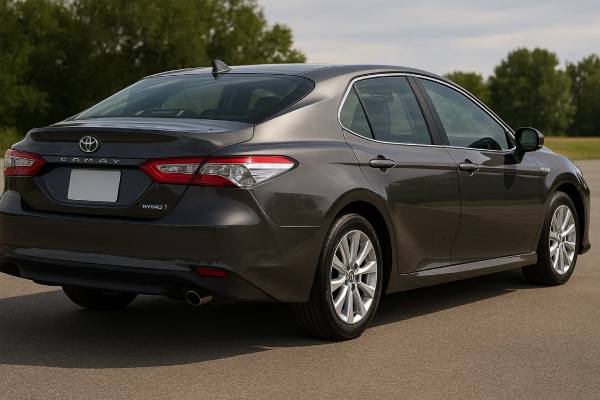
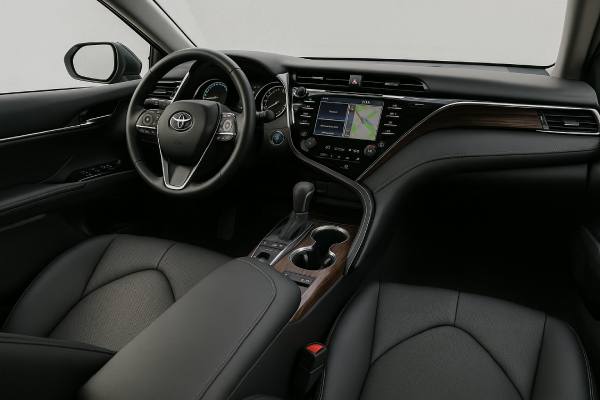
The eighth-generation Camry Hybrid pairs Toyota’s TNGA platform with the A25A-FXS 2.5-liter “Dynamic Force” Atkinson-cycle engine and a responsive eCVT. It delivers standout efficiency without sacrificing everyday pace, cabin space, or long-term durability. For this 2017–2020 period (sold mainly as 2018–2020 model years), Toyota moved the traction battery beneath the rear seat for a full-size trunk, sharpened the suspension, and made active safety standard across trims. The result: a midsize sedan that feels lighter on its feet than earlier hybrids, tracks quietly at highway speed, and returns real-world economy that rivals many compact cars. Owners appreciate low running costs and straightforward maintenance; shoppers should note trim differences that affect mpg and features. If you want a practical, quiet, efficient sedan that still feels well made at 100,000 miles, this Camry Hybrid is one of the safest bets in the segment.
At a Glance
- Efficient yet usable: LE easily returns 50+ mpg (4.7 L/100 km) mixed driving.
- Spacious and easy to live with: battery under rear seat preserves a large trunk.
- Standard active safety and strong crash scores across the range.
- Watch tire choices and alignment on SE sport suspension for best ride/noise.
- Typical oil change: 10,000 miles/12 months with 0W-16 (or 8,000–16,000 km).
Explore the sections
- AXVH70 Hybrid Detailed Overview
- Camry Hybrid Specifications 2017–2020
- Camry Hybrid Trims and Safety
- Camry Hybrid Reliability and Issues
- Maintenance and Buyer’s Guide
- Driving and Real-World Performance
- Rivals and How It Stacks Up
AXVH70 Hybrid Detailed Overview
Toyota’s AXVH70-series Camry Hybrid is built on the TNGA-K architecture, a stiffer, lower, and lighter platform than the outgoing XV50. The hybrid system pairs the A25A-FXS 2.5-liter Atkinson-cycle four-cylinder with two motor-generators inside an electronically controlled planetary eCVT. System output is 208 hp (155 kW), which is more than enough for confident city merges and sustained highway climbs. A key engineering change is the battery relocation from the trunk to under the rear seat. That improves weight distribution, allows split-folding capability depending on trim, and preserves a generous trunk—one of the few hybrids in the class without a cargo compromise in this era.
Toyota tuned steering effort to feel natural off-center and reduced body roll compared to the previous generation. The SE Hybrid adds a firmer suspension and 18-inch tires for a tauter response; LE and XLE prioritize low noise and ride comfort. Braking uses an electro-hydraulic system that blends regeneration and friction; pedal feel is steadier than many hybrids once you’re accustomed to the initial regen bite.
Fuel economy is a central reason to buy this model. The LE Hybrid, aided by lower rolling-resistance tires and a lighter lithium-ion pack, posts the headline ratings in stop-and-go and suburban driving. SE and XLE use a different tire package and, in many build years, a nickel-metal hydride pack that is robust but a bit heavier; they still deliver excellent real-world mpg, especially on highway commutes. All trims benefit from Toyota Safety Sense driver assistance as standard equipment during this period, and the body-in-white plus advanced restraints earned top crash results.
Ownership experience is straightforward. The engine uses modern dual injection and high tumble ports to boost thermal efficiency; the timing drive is a durable chain; the eCVT has no clutch packs or torque converter to service under normal conditions. Routine care centers on engine oil, filters, brake fluid, coolant, and occasional transaxle fluid changes as preventative maintenance. With normal use and basic care, many owners report the car feeling essentially “tight” well past 100,000 miles, helped by corrosion-resistant components and simple underbody geometry.
Camry Hybrid Specifications 2017–2020
Below are specifications for the AXVH70 Camry Hybrid sold in this period (noting minor trim-year variations). Values are typical for North American trims.
Engine and Performance
| Item | Specification |
|---|---|
| Code | A25A-FXS (Dynamic Force) |
| Layout and cylinders | Inline-4, 16-valve DOHC, VVT-iE (intake), VVT-i (exhaust) |
| Induction and fuel | Naturally aspirated; D-4S direct and port injection |
| Displacement | 2.5 L (2,487 cc) |
| Bore × stroke | 87.5 mm × 103.4 mm (3.44 in × 4.07 in) |
| Compression ratio | ~14.0:1 (Atkinson cycle) |
| Max engine power | ~176 hp (131 kW) @ ~5,700 rpm |
| Max engine torque | ~221 Nm (163 lb-ft) @ ~3,600–5,200 rpm |
| Traction motor (MG2) | ~88 kW (118 hp) peak; ~202 Nm (149 lb-ft) peak |
| System output | 208 hp (155 kW) combined |
| Timing drive | Chain |
| Emissions and fuel | Regular unleaded; low-evap emissions system |
| Rated economy (LE) | ~51 city / 53 highway / 52 combined mpg (4.6–4.9 L/100 km) |
| Rated economy (SE/XLE) | ~44 city / 47 highway / 46 combined mpg (5.1–5.6 L/100 km) |
| Real-world highway @ 75 mph | ~44–48 mpg (5.0–5.6 L/100 km), wind and tire-dependent |
| Aerodynamics | Cd ≈ 0.27–0.28 |
Transmission and Driveline
| Item | Specification |
|---|---|
| Transmission | eCVT (planetary power-split), electronic shift-by-wire |
| Drive type | Front-wheel drive |
| Gear ratios | Not applicable (eCVT) |
| Final drive | ~3.2–3.4 (varies slightly by trim and tire package) |
| Differential | Open front, traction control via brake and motor logic |
| Refuel to full | ~3–4 min typical at pump |
Chassis and Dimensions
| Item | Specification |
|---|---|
| Front suspension | MacPherson strut, coil springs, stabilizer bar |
| Rear suspension | Multi-link, coil springs, stabilizer bar |
| Steering | Electric rack-and-pinion, variable assist |
| Brakes | 4-wheel discs with regen blend; front ~305 mm (12.0 in), rear ~281 mm (11.1 in) |
| Wheels and tires (LE) | 205/65 R16 |
| Wheels and tires (SE/XLE) | 235/45 R18 (SE), 235/45 R18 or 215/55 R17 (XLE depending on package) |
| Ground clearance | ~145 mm (5.7 in) |
| Length × width × height | ~4,880 × 1,840 × 1,445 mm (192.1 × 72.4 × 56.9 in) |
| Wheelbase | 2,825 mm (111.2 in) |
| Turning circle (curb-to-curb) | ~11.4 m (37.4 ft) |
| Curb weight | ~1,500–1,630 kg (3,307–3,593 lb) by trim |
| GVWR | ~1,980–2,050 kg (4,365–4,519 lb) |
| Fuel tank | ~49 L (12.9 US gal / 10.7 UK gal) |
| Cargo volume (SAE) | ~427 L (15.1 ft³), rear seatbacks fold depending on trim |
Performance and Capability
| Metric | Typical Result |
|---|---|
| 0–60 mph (0–100 km/h) | ~7.5–7.9 s (tire and trim dependent) |
| Top speed | ~185 km/h (115 mph) electronically limited |
| 100–0 km/h braking | ~36–38 m (118–125 ft) on quality all-seasons |
| Towing capacity | Not rated in baseline market |
| Roof load | Not rated in baseline market |
Fluids and Service Capacities
| System | Specification | Capacity |
|---|---|---|
| Engine oil | SAE 0W-16, ILSAC low-viscosity; 0W-20 acceptable if 0W-16 unavailable, then return to 0W-16 next change | ~4.5 L (4.8 US qt) with filter |
| Engine coolant | Toyota Super Long Life Coolant (pink) | ~6.1 L engine loop (6.4 qt) |
| Inverter/drive coolant | Toyota Super Long Life Coolant (pink) | ~1.8 L (1.9 qt) |
| Hybrid transaxle | Toyota ATF WS | ~3.9 L (≈4.1 qt) for drain and fill |
| A/C refrigerant | R-1234yf; charge per under-hood label | ~0.5 kg class (typical) |
| A/C compressor oil | ND-Oil 12 (R-1234yf systems) | Per label (small quantity) |
| Key torque examples | Wheel lugs ~103 Nm (76 lb-ft); oil drain plug ~40 Nm (30 lb-ft) |
Electrical
| Item | Specification |
|---|---|
| High-voltage battery | Lithium-ion (LE in many years) or NiMH (SE/XLE in many years), ~245–259 V nominal, under-rear-seat |
| 12-V battery | AGM low-profile, typical Group H4/LN1 class; verify by VIN |
| Spark plugs | DENSO FC16HR-Q8 (or equivalent), gap ~0.8 mm (0.031 in) |
Safety and Driver Assistance
| Area | Details |
|---|---|
| Crash ratings | Top-tier results from major testing bodies during this period; strong structure and restraints |
| Headlights | LED units; rating varies by trim and package (best with adaptive LED) |
| ADAS suite | Toyota Safety Sense: Pre-Collision with Pedestrian Detection, Lane Departure Alert with Steering Assist, Dynamic Radar Cruise Control, Automatic High Beams; Blind Spot Monitor and Rear Cross-Traffic Alert available/standard by trim and year; some models add Lane Tracing Assist and Road Sign Assist in later updates |
Camry Hybrid Trims and Safety
Trim walk (typical): LE Hybrid, SE Hybrid, XLE Hybrid. All share the hybrid powertrain yet differ in tires, springs, cabin tech, and driver-assist packaging.
- LE Hybrid
Prioritizes efficiency with 16-inch wheels and low rolling-resistance tires. Many LE builds in this period use a lithium-ion traction battery that is lighter than NiMH, helping the standout economy ratings. Cabin highlights include cloth seats, a straightforward infotainment interface with smartphone integration in later years, and a quieter ride on rough pavement thanks to the taller sidewalls. Visual tells: modest wheel design, gray grille insert, and a calmer suspension tune. - SE Hybrid
The “sport” choice. A firmer suspension, thicker steering wheel rim, and 18-inch tires make steering response crisper. Tire noise can rise on coarse asphalt, and the sport tune transmits more small impacts than the LE. Many SEs of these years use a NiMH traction battery; economy is still high but typically a few mpg lower than LE. Exterior cues include a mesh grille, rocker extensions, rear spoiler, and distinct wheel design. - XLE Hybrid
The comfort and tech flagship. Depending on packages, expect leather or SofTex trim, larger displays, premium audio options, seat memory, and more driver assists bundled. Ride quality is closer to LE, but with available 18-inch wheels that split the difference. The combination of extra equipment and wheel/tire choices can trim a few mpg from the headline LE figure.
Year-to-year changes (highlights):
- Infotainment and phone-mirroring features expanded across this window, with later model years adding Apple CarPlay and improved head-unit responsiveness.
- Headlight availability and tuning improved; the best scores correspond to adaptive LED packages bundled on higher trims.
- Safety hardware remained standard across the lineup, with incremental software refinements to pre-collision braking and lane-keeping logic.
Safety ratings and child-seat notes:
Camry Hybrid’s crash structure and restraint design earn top marks in major tests, with strong driver and passenger protection in small-overlap and side impacts. LATCH anchors are easy to access in the outboard rear seats; the center position can share anchors in many configurations, but check your manual for approved pairings. The rear seatbelt pretensioners and force limiters, plus smart airbag deployment logic, reduce injury risk in a wide range of impacts.
Calibration after windshield replacement or front-end repairs is important for the forward camera and radar; plan on alignment targets and scan-tool verification if ADAS warning lights appear or if the system reports “Unavailable.”
Camry Hybrid Reliability and Issues
This generation’s hybrid hardware has a strong reputation for durability. The gasoline engine uses a timing chain and robust chain guides; the eCVT has relatively few wear items compared to a conventional automatic. Most owners see minimal degradation in battery performance within the first decade, particularly on vehicles driven regularly (which keeps the pack within a favorable state-of-charge window).
Common (low to medium cost):
- Brake pad glazing or light pulsation → Often tied to gentle driving where regen handles most slowing.
Symptom: Slight vibration on firm stops; long pad life but uneven transfer film.
Remedy: Bed-in procedure with a handful of medium-hard stops; inspect rotor thickness variation, resurface or replace if out of spec; flush brake fluid every 2–3 years for consistent ABS/ESC operation. - Wind noise from door mirrors or upper door seals (especially with roof crossbars or wider tires).
Symptom: Whistle at 60–70 mph.
Remedy: Check mirror caps and seals; reseat weatherstripping; verify door alignment. Accessory deflectors can help on long highway commutes. - Ride harshness or tramlining on SE with performance-leaning 18-inch all-seasons.
Symptom: Follow-the-groove feel on concrete; sharper impacts.
Remedy: Maintain accurate pressures; consider a grand-touring tire with softer casing; alignment to the comfort side of spec.
Occasional (medium cost):
- 12-V battery aging (AGM) on vehicles with short trips.
Symptom: Intermittent “Ready” refusal, random warning lights, sluggish locks.
Remedy: Load-test annually after year 3; replace preemptively around 4–6 years in harsh climates; ensure clean ground connections. - HV battery cooling path dust buildup (pet hair, lint).
Symptom: Louder battery-cooling fan, reduced cabin A/C efficiency, rare battery-overheat message in sustained high heat.
Remedy: Vacuum the intake grille near the rear seat base; replace cabin filter on schedule; inspect the fan at major services. - Oxygen sensor or evaporative system flags triggered by loose fuel caps or aging purge valves.
Symptom: Check engine light, stored emissions codes, minor fuel smell.
Remedy: Verify cap fitment; smoke-test EVAP if recurrent; replace the affected valve or sensor.
Rare (higher cost or attention):
- Water pump seep or coolant weep hole staining.
Symptom: Pink residue, slow coolant drop.
Remedy: Replace water pump and belt; bleed both engine and inverter loops with vacuum fill to avoid air pockets. - Wheel bearing noise on high-mileage vehicles with repeated pothole impacts.
Symptom: Speed-dependent growl.
Remedy: Replace the affected hub assembly; check alignment and tire balance.
Software and calibrations:
Hybrid control and driver-assist systems may receive ECU updates that improve drivability (e.g., smoother engine engagement at parking lot speeds) or refine AEB performance. After windshield, bumper, or radar replacements, ensure ADAS calibration in a shop with targets and scan-tool capability.
Recalls and campaigns:
Always run a VIN check before purchase; typical actions in this era addressed isolated component suppliers or calibration improvements rather than systemic hybrid-system flaws. A dealer printout plus the official VIN check provides the most reliable verification.
Pre-purchase requests:
Ask for full service history, proof of recall completion, recent brake fluid and coolant service, and a 12-V battery test. Inspect tires for even wear (outer-edge wear suggests alignment attention), review windshield for prior ADAS calibrations, and scan for stored codes even if the dash is clear.
Maintenance and Buyer’s Guide
Practical maintenance schedule (distance/time):
Intervals below reflect typical North American guidance. Severe service (extreme heat/cold, dusty routes, constant short trips) justifies shorter intervals.
- Engine oil and filter: Every 10,000 miles or 12 months with SAE 0W-16; if 0W-20 was used once, return to 0W-16 at the next change.
- Engine air filter: Inspect at 15,000 miles (24,000 km); replace 30,000–45,000 miles as needed.
- Cabin air filter: Replace every 12 months or 15,000–20,000 miles; sooner in dusty or pet-heavy use.
- Coolant (engine and inverter loops): First replacement around 100,000 miles (160,000 km) or 10 years, then every 50,000 miles (80,000 km) or 5 years.
- Hybrid transaxle ATF WS: Drain and fill at 60,000–100,000 miles as preventative care; not strictly required by all schedules but inexpensive insurance.
- Brake fluid: Replace every 2–3 years regardless of mileage to maintain consistent pedal and ABS performance.
- Spark plugs: Iridium plugs typically at 120,000 miles (193,000 km).
- Serpentine/aux belt and hoses: Inspect at major services; replace if cracking, glazing, or noise present.
- Tire rotation and balance: Every 5,000–7,500 miles; align yearly or with any tire replacement.
- 12-V battery: Load-test annually after year 3; expect replacement in years 4–6 in typical climates.
- HV battery system: No scheduled maintenance; keep the rear-seat intake clear and cabin filter fresh.
Fluid references and essentials:
- Oil: SAE 0W-16, low-SAPs ILSAC; capacity ~4.8 qt with filter.
- Coolant: Toyota Super Long Life (pink) for both ICE and inverter loops.
- ATF: Toyota ATF WS for the hybrid transaxle (drain-and-fill ~4 qt).
- Brake fluid: DOT 3 or DOT 4 from a high-quality brand; avoid mixing types.
- Wheel lug torque: ~76 lb-ft (103 Nm).
Buyer’s inspection checklist:
- Exterior and structure: Uniform panel gaps, clean windshield with ADAS camera bracket intact, no overspray near sensor covers.
- Underbody: Look for scrapes on the exhaust heat shields and subframe; surface corrosion should be minimal on TNGA cars.
- Suspension and tires: Even wear pattern; SE trims on 18-inch tires should track straight with hands-off at 40–50 mph; any tramlining suggests tires or alignment.
- Brakes: Smooth stops from 60–0 mph with no shimmy; hand-feel of the regen blend should be linear.
- Hybrid health: Quiet battery fan with A/C on; no sulfur smells; stable state-of-charge swings on a test drive.
- Electronics: Test radar cruise, lane-keeping, and pre-collision warnings on a traffic-free road; verify blind-spot and rear cross-traffic alerts.
- Service documents: Oil change proof with 0W-16, recent brake fluid, and coolant services carry weight.
Recommended trims:
- Best economy and comfort: LE Hybrid (lithium-ion battery in many years, smaller wheels).
- Balanced daily driver: XLE Hybrid with 17- or 18-inch touring tires.
- For keener handling: SE Hybrid, ideally on a quiet grand-touring tire to tame road roar.
Long-term durability outlook:
Expect the drivetrain to run quietly past 150,000 miles with basic care. The biggest quality-of-life gains come from fresh fluids on time, keeping the alignment in spec, and fitting tires that match your roads. The hybrid pack’s thermal management and conservative control strategy support slow degradation; regular use is better than long storage.
Driving and Real-World Performance
Ride, handling, and noise:
The TNGA-K body brings a lower seating position and a stiffer shell, so the Camry Hybrid feels planted on rough highways. LE and XLE trims ride quietly, with suspension tuning that swallows expansion joints and resists float on undulating interstates. The SE’s firmer shocks reduce roll and sharpen turn-in; the tradeoff is more tire slap on broken pavement, especially on wide-tread 18-inch all-seasons. Wind noise is well muted; at 70–75 mph, the cabin settles into a low hum with the engine cycling on only when needed.
Powertrain character:
From a stop, MG2 delivers immediate torque and smooth initial motion. As speed rises, the Atkinson four-cylinder spins up through the eCVT’s power-split without fixed shift points. Throttle mapping is progressive: a modest push yields electric assist for short hops, a deeper squeeze blends in the engine. Normal mode suits most drivers; Eco softens tip-in and tempers A/C load for maximum economy; Sport increases pedal gain and keeps the engine at a slightly higher operating point for quicker passing.
Transmission logic:
The eCVT is free of shift shock and hunts less than many conventional automatics on rolling terrain. Under steady 70–75 mph cruising, the system often cuts the engine on light grades, then brings it back seamlessly for small boosts. Engine engagement is softer after the first few hundred miles as the ECU adapts to driver habits.
Braking feel:
Initial pedal travel captures regeneration; the handoff to friction braking is well calibrated. Repeated 60–0 mph stops remain consistent if pads and rotors are bedded properly. In heavy rain, the ABS and stability systems intervene smoothly and early.
Efficiency and range (real world):
- City: 48–56 mpg (4.2–4.9 L/100 km) depending on traffic and temperature.
- Highway 60–70 mph: 47–52 mpg (4.5–5.0 L/100 km) on LE tires; 43–48 mpg (4.9–5.6 L/100 km) on SE/XLE 18-inch setups.
- Mixed suburban: 48–53 mpg (4.4–4.9 L/100 km).
Cold snaps can shave 10–20 percent until everything is warmed and winter fuel blends pass; using seat heaters before cranking cabin heat helps preserve economy.
Key metrics that shape the verdict:
- 0–60 mph: mid-7-second range with a normal launch.
- 50–80 mph passing: confident on-ramp and two-lane passes with a steady pull; Sport mode helps the eCVT hold a power-rich engine point.
- Braking 60–0 mph: ~120–130 ft on quality tires, straight and stable.
- Turning circle: easy U-turns at ~37 ft, a boon for daily parking.
Load, grades, and heat:
With four adults and luggage the Camry Hybrid remains calm on mountain grades; coolant and inverter temps stay controlled if the cooling loops are maintained. Expect a modest economy penalty (5–10 percent) at full holiday load, more in strong headwinds or at 75+ mph. The car is not tow-rated in this market, and roof cargo boxes will noticeably reduce range and increase wind noise.
Rivals and How It Stacks Up
Honda Accord Hybrid (2018–2020):
The Accord uses a different hybrid architecture that can feel more EV-like at city speed. It’s a touch sharper in steering feedback and may edge the Camry on passing response at highway speeds. The Camry counters with a steadier, quieter ride on rough pavement and typically lower road noise on LE tires. Both are efficient; the Camry’s battery-under-seat layout preserves trunk practicality across trims.
Hyundai Sonata Hybrid (2018–2019 generation gap, 2020 update):
Prior to the 2020 redesign, Sonata Hybrid lagged in refinement and chassis polish. The 2020 model brings aero tricks and high economy, but the Camry’s powertrain blending and long-term ownership data remain a strength. Dealers, parts availability, and residual values tilt toward Toyota.
Ford Fusion Hybrid (to 2020):
Comfortable seats and an easygoing highway demeanor, but the platform is older, interior packaging is tighter, and long-term parts outlook is less certain after discontinuation. Camry’s efficiency and projected durability give it a clearer long-horizon advantage.
Nissan Altima / Others:
No direct hybrid competitor in this era from Nissan in North America. Against non-hybrid midsize sedans, the Camry Hybrid simply out-economizes them while matching space and often beating them on safety equipment.
Bottom line:
The AXVH70 Camry Hybrid’s strengths—efficiency, practicality, standard safety, and low operating cost—make it the safest all-round choice in the class. Choose LE for maximum mpg and comfort, SE for a firmer edge, or XLE for amenities; all deliver the same core competence.
References
- 2018 Toyota Camry Hybrid Product Information Sheet 2017 (Press Kit)
- Fuel Economy of the 2018 Toyota Camry Hybrid LE 2018 (EPA Ratings)
- 2018 Toyota Camry 2018 (Safety Rating)
- Vehicle Detail Search 2018 (Recall Database)
- WARRANTY & MAINTENANCE GUIDE 2018 (Owner’s Manual Supplement)
Disclaimer
This article is for informational purposes only and is not a substitute for professional diagnosis or repair. Specifications, torque values, service capacities, and maintenance intervals can vary by VIN, model year, trim, and market equipment. Always verify procedures and values against the official service documentation for your specific vehicle and confirm any open recalls or campaigns with an authorized dealer.
If you found this guide useful, please share it with fellow owners on Facebook or X/Twitter—your support helps xcar keep producing detailed, people-first resources.