
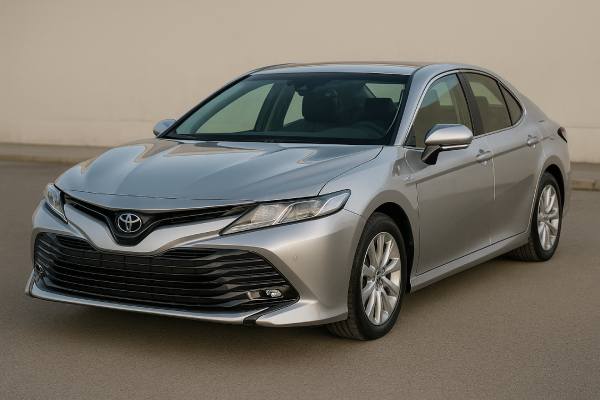
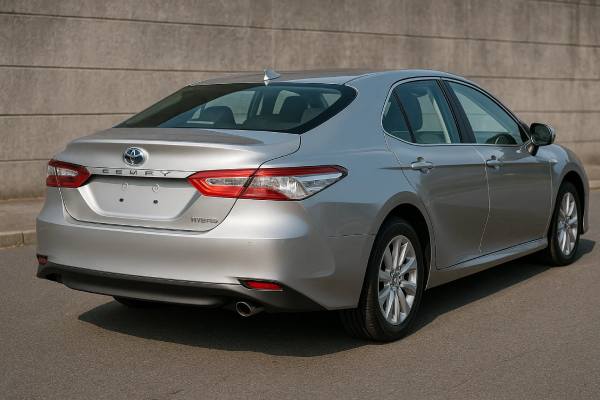
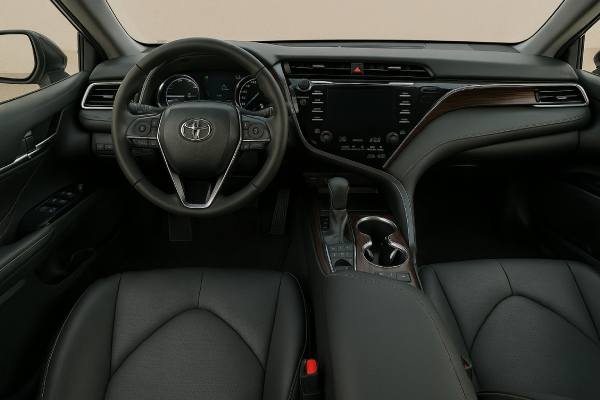
The 2019–2020 Toyota Camry Hybrid sits at the practical end of midsize sedans, wrapping Toyota’s latest TNGA-K platform, excellent safety tech, and a fourth-generation hybrid system into a roomy, efficient package. The A25A-FXS 2.5-liter Atkinson-cycle four pairs with a permanent-magnet traction motor and an eCVT to deliver confident everyday pace with standout fuel economy. In North America, the system is officially rated at 208 hp; many European sources list 215 hp (≈218 PS) due to different rating methods—use the regional figure when comparing. Real-world ownership highlights include a quiet, stable highway ride, consistently low running costs, and simple service needs. The LE uses a lightweight lithium-ion battery while SE/XLE typically use NiMH, yet both deliver trunk space on par with non-hybrid Camry models thanks to smart packaging. If you want a dependable commuter that still feels refined and secure, this generation of Camry Hybrid earns its reputation.
Owner Snapshot
- Smooth, efficient hybrid powertrain with real 45–52 mpg (US) capability; stable, quiet highway manners.
- Spacious cabin and trunk; strong safety record with robust driver aids standard.
- Predictable maintenance; most fluids at long intervals, brake wear is low thanks to regen.
- Watch for open recalls (fuel pump on some vehicles) and keep the hybrid cooling loops clean.
- Oil and filter: every 10,000 miles/12 months (16,000 km/12 months) under normal service.
Navigate this guide
- Detailed overview for Camry Hybrid
- Camry Hybrid specs and data
- Camry Hybrid trims and safety
- Reliability issues and actions
- Maintenance and buyers guide
- Driving and performance impressions
- Camry Hybrid versus rivals
Detailed overview for Camry Hybrid
Toyota’s eighth-generation Camry Hybrid (chassis AXVH70) is built on the TNGA-K architecture that also underpins the Avalon, RAV4, and Lexus ES. TNGA (Toyota New Global Architecture) focuses on a stiffer body, lower center of gravity, multi-link rear suspension, and better driving position. Those changes show up immediately on the road: the car tracks straight, steers with more precision than older Camrys, and absorbs rough pavement with fewer secondary motions.
The hybrid side is Toyota’s fourth-generation setup built around the A25A-FXS 2.5-liter four-cylinder running an efficient Atkinson cycle with cooled EGR, variable valve timing (VVT-iE on intake), a high 14.0:1 compression ratio, and the brand’s D-4S dual-injection (port plus direct). It pairs to a permanent-magnet motor/generator and a compact eCVT transaxle that blends engine and motor torque seamlessly. A compact battery—lithium-ion on most LE trims, nickel-metal hydride (NiMH) on many SE/XLEs—sits behind the rear seat without intruding into the trunk floor, so you keep useful luggage space.
Output depends on rating method. In the U.S. and Canada, the Camry Hybrid is officially 208 hp combined. In Europe, the near-identical system is widely published at 215 hp (≈218 PS). Either way, performance is similar: brisk away from lights with strong mid-range pull, particularly in city duties where the electric motor does more work. Highway passing is adequate rather than sporty, aided by the eCVT’s instant ratio changes.
Cabin design follows a driver-oriented theme with clear sightlines and a low cowl. LE models focus on simplicity and weight savings; SE stiffens bushings and adds firmer tuning; XLE layers in comfort features—leather seating, more sound-deadening, larger wheels, and upgraded audio. Toyota Safety Sense (TSS-P for these years) is standard across the range, adding forward AEB with pedestrian detection, lane departure alert with steering assist, automatic high beams, and adaptive cruise control. Blind-spot monitoring and rear cross-traffic alert are widely available.
Real-world ownership is straightforward: brake pads last long due to regeneration, spark plugs are iridium long-life, and the cooling systems (engine and hybrid inverter) are durable if serviced with the correct Toyota coolant. The transaxle uses ATF WS and does not have a traditional service schedule, though proactive drain-and-fill at long intervals is common among enthusiasts. Tires and 12-volt batteries are the main consumables.
If you’re cross-shopping, remember that the Camry Hybrid prioritizes efficiency, space, and low total cost of ownership over outright sportiness. It’s not a sports sedan; it’s a sedan that makes everyday driving feel lighter on both your wallet and your nerves.
Camry Hybrid specs and data
Below are model-specific, scannable specifications for the 2019–2020 Camry Hybrid. North American figures are presented first; where markets differ significantly, notes clarify.
Powertrain & Efficiency (HEV)
| Item | Specification |
|---|---|
| Code | A25A-FXS (ICE) + permanent-magnet traction motor (PMSM) |
| Engine layout & cylinders | Inline-4, DOHC, 4 valves/cyl, D-4S dual injection |
| Bore × stroke | 87.5 × 103.4 mm (3.44 × 4.07 in) |
| Displacement | 2.5 L (2,487 cc) |
| Induction | Naturally aspirated (Atkinson cycle) |
| Fuel system | Direct + port injection (D-4S) |
| Compression ratio | 14.0:1 |
| Max engine power | ≈176 hp (131 kW) @ ~5,700 rpm |
| Max engine torque | ≈221 Nm (163 lb-ft) @ ~3,600–5,200 rpm |
| Traction motor (MG2) | ≈88 kW (118 hp) PMSM; ≈202 Nm (149 lb-ft) |
| System net output | 208 hp (155 kW) NA rating; ~215 hp (160 kW) widely quoted in Europe |
| Timing drive | Chain |
| Emissions / Efficiency standard | SULEV30 / Tier 3 (NA); Euro 6 (EU) |
| Rated efficiency (LE) | 4.5 L/100 km (53 mpg US / 63.6 mpg UK) combined |
| Rated efficiency (SE/XLE) | ~5.1 L/100 km (46 mpg US / 55.2 mpg UK) combined |
| Real-world highway @ 120 km/h (75 mph) | ~5.0–5.6 L/100 km (47–42 mpg US / 56–50 mpg UK), temperature and wind dependent |
| Aerodynamics | Cd ≈ 0.27 |
Note: Published combined power varies by certification method; drivability is essentially identical.
Transmission & Driveline
| Item | Specification |
|---|---|
| Transmission | eCVT (planetary gearset) hybrid transaxle (commonly referred to as P710) |
| Gear ratios | Not applicable (variable by design) |
| Final drive ratio | Fixed; varies slightly by trim/build (≈3.3–3.7) |
| Drive type | FWD |
| Differential | Open (integrated in transaxle) |
| Refuel to full (typical) | ≈5 min |
Chassis & Dimensions
| Item | Specification |
|---|---|
| Suspension (front/rear) | MacPherson strut / Multi-link |
| Steering | Electric power assist; ~2.8–3.0 turns lock-to-lock |
| Brakes | 4-wheel discs with regen; front 296 mm (11.7 in) ventilated; rear 281 mm (11.1 in) solid |
| Wheels/Tires | LE: 205/65 R16; SE: 235/45 R18; XLE: 215/55 R17 or 235/45 R18 |
| Ground clearance | ≈145 mm (5.7 in) |
| Length / Width / Height | ~4,880 mm × 1,840 mm × 1,445 mm (192.1 × 72.4 × 56.9 in) |
| Wheelbase | 2,825 mm (111.2 in) |
| Turning circle (curb-to-curb) | ~11.0 m (36.1 ft) |
| Curb weight | ~1,515–1,620 kg (3,340–3,570 lb), depending on trim |
| GVWR | ~2,040–2,100 kg (4,497–4,630 lb), trim dependent |
| Fuel tank | 50 L (13.2 US gal / 11.0 UK gal) |
| Cargo volume | ~428 L (15.1 ft³), SAE |
Performance & Capability
| Metric | Value |
|---|---|
| Acceleration | 0–100 km/h (0–62 mph): ~8.0–8.4 s |
| Top speed | ~190 km/h (118 mph), limited |
| Braking distance | 100–0 km/h ≈ 38–40 m (62–0 mph ≈ 125–131 ft) |
| Towing capacity | Not rated in NA (0 kg / 0 lb) |
| Payload | Typically ~385–430 kg (850–950 lb) occupant/cargo, by placard |
| Roof load | Not rated for rails in NA; verify by VIN |
Fluids & Service Capacities
| System | Specification / Capacity |
|---|---|
| Engine oil | Toyota-approved 0W-16 (API/ILSAC); capacity ≈ 4.3–4.6 L (4.5–4.9 US qt) with filter |
| Coolant – engine (SLLC) | Toyota Super Long Life Coolant (pink) 50/50; capacity ~6.5–7.5 L (6.9–7.9 US qt) |
| Coolant – hybrid inverter | Toyota SLLC (pink); capacity ~3.0–4.0 L (3.2–4.2 US qt) |
| Transaxle (eCVT) | Toyota ATF WS; drain/fill ≈ 3.3–4.0 L (3.5–4.2 US qt) |
| A/C refrigerant | R-134a; typical charge ~500–600 g (17.6–21.2 oz) |
| A/C compressor oil | ND-OIL 11; typical ~120–150 mL (4.1–5.1 fl oz) |
| Key torque specs | Wheel lugs 103 Nm (76 lb-ft); oil drain plug ~40 Nm (30 lb-ft) |
Capacities vary by trim/build; always verify against the under-hood labels and the correct manual for your VIN.
Electrical
| Item | Specification |
|---|---|
| Alternator | Not applicable (DC-DC converter from HV battery) |
| 12V battery | 45–60 Ah AGM (form factor varies by supplier); maintain ≥12.4 V at rest |
| Spark plugs | Long-life iridium; gap ~0.8 mm (0.031 in) |
Safety & Driver Assistance
| Item | Details |
|---|---|
| Crash ratings | Strong results in major tests; see section 3 for year/trim notes |
| Headlight rating (IIHS) | Varies by headlamp type and trim; best scores on LED units |
| ADAS suite (TSS-P) | AEB with pedestrian detection, adaptive cruise, lane departure with steering assist, auto high beams; BSM/RCTA widely available |
Camry Hybrid trims and safety
Trims and options (North America, 2019–2020):
- LE: The efficiency play. 16-inch wheels and tires, cloth seats, manual lumbar, 4.2-inch cluster display (some later cars 7-inch), basic Entune 3.0 audio with Apple CarPlay (2019+) and Android Auto (2020+), single-zone climate. Typically fitted with a lithium-ion hybrid battery for slight weight savings and slightly better EPA ratings (up to 52 mpg combined).
- SE: Sport appearance with unique fascia, rear spoiler, 18-inch wheels, and firmer suspension tuning. Synthetic leather with fabric inserts, leather-wrapped steering wheel, paddle-style shifters for simulated steps in the eCVT (drive-mode mapping). Hybrid battery is commonly NiMH; EPA combined typically around 46 mpg.
- XLE: Comfort and tech. Available leather seating, 10-inch color head-up display (package), JBL premium audio, larger driver display, full-speed adaptive cruise, available panoramic roof, larger wheels/tires. Hybrid battery most often NiMH; efficiency close to SE.
Key option packages and identifiers:
- Audio/tech tiers: Base Entune 3.0, midgrade with larger touchscreen and extra USB ports, JBL with Clari-Fi on top trims. Look for JBL badging on the speaker grilles.
- Safety packages: Blind-spot monitor and rear cross-traffic alert were optional on LE/SE and commonly standard on XLE. Some cars add Rear Cross-Traffic Braking and Intelligent Clearance Sonar.
- Cosmetic tells: SE adds mesh grille and rocker trim; XLE uses brightwork and multi-spoke alloys; LE keeps simpler hubcaps or basic alloys. VIN build sheets (dealer printouts) will confirm battery type, packages, and headlamp spec.
Year-to-year changes:
- 2019: Apple CarPlay arrives across the Camry line. Minor software refinements to TSS-P and infotainment.
- 2020: Android Auto support added. Packaging shuffles (wheels, interior trims, availability of options). The hybrid powertrain remains functionally identical.
Safety ratings summary:
- The Camry family performs well in crash testing, with top tier results in moderate and small overlap crashes and strong side-impact performance. As with many cars, headlight ratings vary: LED projector units generally score higher than halogen reflectors. Availability of Top Safety Pick/Top Safety Pick+ depends on headlamp and collision-avoidance test performance by trim and year.
- Child seat provisions: Two full LATCH positions with additional tether anchors, good lower-anchor accessibility, and a wide rear bench that accommodates rear-facing seats more easily than many midsize sedans.
- ADAS calibration notes: Windshield replacement requires camera aiming. Front bumper/fascia work on cars with ICS (parking sonar) or millimeter-wave radar will require calibration; budget both time and a capable shop if you buy a car that has had front-end repairs.
Reliability issues and actions
The AXVH70 Camry Hybrid is widely regarded as very dependable. Most examples need only routine maintenance for many years. Still, any used hybrid deserves a systematic check. Use the map below to separate the rare from the routine.
Powertrain and hybrid system
- Hybrid battery chemistry: LE cars typically use lithium-ion; SE/XLE often use NiMH. Both have strong longevity when the cooling intake is kept clean. Occasional owners report fans running at high speed—often traced to lint/dust restriction. Symptom: frequent fan noise, reduced EV assist. Remedy: clean intake duct and fan; inspect for DTCs related to battery temperature.
- Inverter/electronics cooling: The hybrid has a dedicated inverter coolant loop. Symptom: warning lights, reduced power under load on a hot day. Root cause: low coolant or air pockets after service. Remedy: bleed per procedure; refill with Toyota SLLC; check for leaks at hoses and pump.
- eCVT transaxle fluid aging: Toyota does not prescribe regular service, but fluid shears over time. Symptom: none obvious before high mileage; preventative care only. Remedy: optional drain/fill at ~60,000–100,000 miles (96,000–160,000 km) with ATF WS; do not flush.
- Engine oil viscosity: This engine is designed for 0W-16. Using thicker oil can raise consumption or reduce efficiency. Symptom: rough cold starts, lower mpg. Remedy: return to 0W-16; verify level and change interval.
ICE specifics
- EGR and intake cleanliness: Long-life engine, but short-trip use can add deposits. Symptom: rough idle after cold soak. Remedy: periodic intake/EGR cleaning around 100,000 miles (160,000 km) if symptoms present.
- Thermostat/cooling components: Rare. Symptom: slow warm-up or fluctuating temp. Remedy: inspect thermostat and coolant pumps (engine and inverter).
Driveline and chassis
- Front suspension bushings / end links: Occasional knocks on rough roads after high mileage. Remedy: replace worn bushings/end links; wheel alignment.
- Wheel bearings: Uncommon, but listen for hum that rises with speed.
- EPB (electronic parking brake): Calibrate after rear pad replacement; failing to do so can trigger warnings.
Body, seals, and corrosion
- Door/window seals: Wind noise at highway speed on some cars; door seal seating or mirror caps are the usual suspects.
- Underbody corrosion: Generally well protected. Still, in snowbelt regions, inspect rear subframe and brake lines for surface rust and treat early.
Infotainment and electronics
- Head unit updates: 2019 gained Apple CarPlay; 2020 added Android Auto. Update software to cure intermittent Bluetooth/CarPlay issues.
- ADAS sensors: Post-collision or windshield work requires calibration. Misalignment shows up as lane-departure or PCS warnings.
Recalls, TSBs, and extended coverage
- Fuel pump (selected vehicles): Certain vehicles built in the relevant period may have Denso low-pressure fuel pumps subject to recall. Symptom: rough running, stalling; warning lights. Remedy: pump replacement with revised part at no cost when applicable. Always check by VIN.
- Brake booster vacuum pump (limited population): Some Toyota vehicles around this era had campaign/TSB activity for vacuum pump behavior. Remedy: software update or component replacement when applicable.
- How to verify completion: Run the VIN through the official recall lookup, keep the dealer printout with service records, and verify that campaign labels are present in the engine bay or door jamb.
Pre-purchase checks to request
- Full service history, including oil changes every 10,000 miles/12 months (or 5,000 miles/6 months for severe use).
- Proof of recall completion and any hybrid system software updates.
- Hybrid cooling system service records and a physical inspection for debris at the battery intake.
- Recent brake service with proper hybrid procedures (rear caliper EPB set-back, fluid flush timelines).
- Tire set matched to the trim (rolling resistance affects mpg and road noise).
- On the test drive, verify quiet operation from 50–75 mph (80–120 km/h) and linear brake feel during heavy deceleration (regen to friction transition should be smooth).
Maintenance and buyers guide
Practical maintenance schedule (typical conditions)
Use the intervals below as planning guidance; verify by VIN and maintenance guide.
- Engine oil & filter: 10,000 miles / 12 months (16,000 km / 12 months) with 0W-16; severe service halve the mileage.
- Engine air filter: Inspect 15,000 miles (24,000 km); replace ~30,000 miles (48,000 km) or sooner in dusty areas.
- Cabin filter: 15,000–20,000 miles (24,000–32,000 km) or annually; vital for battery cooling intake cleanliness.
- Coolant (engine & inverter): Toyota SLLC; first change typically at 100,000 miles (160,000 km) / 10 years, then every 50,000 miles (80,000 km) / 5 years.
- Spark plugs (iridium): ~120,000 miles (192,000 km).
- Fuel filter: In-tank; replace only if required (no routine interval).
- Hybrid transaxle ATF WS: Not required by schedule; optional drain/fill at 60,000–100,000 miles (96,000–160,000 km) for preventative care.
- Brake fluid: Every 3 years regardless of mileage; hybrids benefit from clean fluid for ABS/regen transitions.
- Brake pads/rotors: Inspect every 10,000–15,000 miles (16,000–24,000 km); pads last long, but rear sliders need periodic lubrication.
- Serpentine/aux belts & hoses: Inspect every 30,000 miles (48,000 km); replace on condition.
- Wheel alignment & tire rotation: Rotate 5,000–7,500 miles (8,000–12,000 km); align annually if you notice edge wear/pull.
- 12-volt battery test: Annually after year 4; replacement window commonly 5–7 years.
- Valve clearances: Hydraulic lifters—no routine adjustment.
- Hybrid battery health (scan): Optional check at major services; ensure cooling fan ducting is clean.
Fluid specifications (quick pick):
- Engine oil: 0W-16 (API SN Plus/SN-RC or later, ILSAC GF-5/GF-6).
- Coolant: Toyota Super Long Life Coolant (pink).
- Transaxle: Toyota ATF WS.
- Brake fluid: DOT 3 or DOT 4 to spec; keep moisture <2%.
- A/C: R-134a with ND-OIL 11; evacuate and recharge by weight only.
Essential torque values (decision-grade):
- Wheel lug nuts: 103 Nm (76 lb-ft).
- Oil drain plug: 40 Nm (30 lb-ft).
- Spark plugs: ~18–22 Nm (13–16 lb-ft) on aluminum heads (verify plug manufacturer’s sheet).
Buyer’s checklist (what to inspect):
- Exterior/body: Consistent panel gaps; front bumper radar emblem intact; windshield free of cracks (ADAS camera lives here).
- Undercarriage: Subframes and brake lines clean; minimal rust; no fluid seepage at transaxle or inverter.
- Cooling systems: Expansion tanks level and pink; no brown or mixed coolant.
- Hybrid intake: Battery-fan intake free of lint; cabin filter clean.
- Brakes: Smooth transition from regen to friction; no judder; rear calipers retract properly with service tool.
- Electronics: All ADAS functions toggle on/off; no warning icons after a 10-minute drive.
- Tires: Matched brand/model with correct load/speed rating; even wear patterns; check date codes.
- Records: Oil at 10k intervals, coolant changes by time/miles, recall proof (fuel pump where applicable).
Which trims to seek (and why):
- LE for maximum efficiency and the simplest spec; many use lithium-ion battery and 16-inch tires that ride quietly and last.
- XLE if you want comfort features (JBL, leather, HUD) and still excellent mpg; ensure LED headlights for the best safety ratings.
- SE if you prefer firmer tuning and 18-inch looks; note that ride is busier on broken pavement and tires cost more.
Durability outlook: Expect a long service life with ordinary care. Engines routinely surpass 200,000 miles (320,000 km), hybrid batteries commonly last a decade or more, and brake jobs are infrequent. Hybrids reward gentle warm-up, correct tires, and attentive cooling-system maintenance.
Driving and performance impressions
Ride, handling, and NVH:
On the highway, the Camry Hybrid tracks straight with little correction, helped by the TNGA body’s stiffness and the multi-link rear suspension. Road and wind noise are well controlled for the class—LEs on 16-inch tires are the quietest and most compliant; SE’s bigger wheels and firmer dampers add steering response but transmit more sharp-edge impacts. Over rough urban streets, the car stays composed with only modest head toss. At 70–75 mph (113–120 km/h), cabin conversation is easy; the engine hums quietly when needed and settles back to EV glide on gentle grades.
Powertrain character:
Throttle response is crisp off the line thanks to motor torque, and the eCVT makes low-speed driving smooth. The A25A-FXS prefers midrange rpm rather than high-rev thrash; the sound is muted and distant when accelerating onto the freeway. In Eco, throttle mapping softens and HVAC optimizes for efficiency; Normal is the default; Sport quickens pedal response and holds engine speed longer. Simulated “shift steps” in SE/XLE during strong acceleration reduce the classic CVT “drone.” The brake pedal has a natural take-up, blending regeneration and friction effectively; you only notice the hand-off during very light feathering right before a stop.
Real-world efficiency:
- City: Expect ~45–55 mpg US (5.2–4.3 L/100 km) depending on traffic, temperature, and tire package.
- Highway (60–75 mph / 100–120 km/h): ~42–50 mpg US (5.6–4.7 L/100 km). Cold weather and headwinds matter more than speed alone.
- Mixed commuting: Many owners report ~46–52 mpg US (5.1–4.5 L/100 km).
Cold climates reduce EV contribution until the engine warms; a block heater or garage parking helps in winter.
Key performance metrics:
- 0–60 mph (0–97 km/h): ~7.9–8.2 s depending on trim and tires.
- 50–80 mph (80–129 km/h) passing: Adequate; plan a down-press of the pedal to summon engine + motor torque.
- 100–0 km/h braking: ~38–40 m (125–131 ft) with quality tires; repeated stops remain consistent thanks to regen plus solid hardware.
- Turning circle: ~36 ft (11.0 m), easy for parking lots and U-turns.
Traction and control:
All 2019–2020 Camry Hybrids are front-wheel drive. Traction control intervenes smoothly from rest on wet pavement, and stability control is tuned for early, gentle corrections rather than playful slip. In snowbelt regions, a set of proper winter tires improves both take-off and stopping distances dramatically.
Load and towing:
Toyota does not rate the Camry Hybrid for towing in North America. With a full cabin and trunk, the suspension remains composed; you will notice slightly longer stopping distances and a modest mpg drop. Keep pressures at the door-jamb sticker plus +1–2 psi when fully loaded for long highway trips.
Camry Hybrid versus rivals
Honda Accord Hybrid (2018–2020): The Accord Hybrid is quicker in some tests and can feel more eager off the line. Its cargo space is excellent, and handling is a touch sharper. The Camry counters with slightly better ride isolation on rough highways, a more traditional powertrain feel under sustained throttle, and Toyota’s long, proven hybrid track record. Efficiency is a near draw in mixed use; trim-to-trim equipment matters more than the nameplate.
Hyundai Sonata Hybrid (2020): The redesigned Sonata Hybrid (for 2020) brings distinctive styling, a solar roof on some trims, and a quiet cabin. Efficiency is strong. The Camry’s steering feel and suspension composure still feel more natural, and used-market pricing for Camry tends to be steadier with deeper dealer networks for hybrid expertise.
Kia Optima Hybrid (2019–2020) / K5 HEV (later): Value-packed with long warranties and good feature density. Efficiency trails slightly in some real-world conditions. The Camry remains the safer residual-value play and tends to have more consistent calibration in its driver-assistance systems.
Ford Fusion Hybrid (2019–2020): Comfortable and planted at speed with good steering, but efficiency typically runs behind Toyota and Honda. With the Fusion discontinued after 2020, parts and dealer hybrid familiarity remain fine short-term, but long-term support favors Camry and Accord.
Nissan Altima (non-hybrid, AWD available): If you prioritize all-weather traction, the Altima’s AWD is compelling, but overall fuel economy and hybrid smoothness are Camry strengths. The Camry Hybrid’s total running costs still win for most commuters who don’t need AWD.
Verdict: If you want a sedan that’s easy to live with, sips fuel, and is built to last, the 2019–2020 Camry Hybrid is a benchmark. Choose LE for maximum mpg and the quietest ride, SE for a slightly tauter feel, or XLE to add comfort tech while keeping excellent economy.
References
- 2019 Toyota Camry Hybrid Product Information 2019 (Manufacturer Specs)
- Fuel Economy of the 2019 Toyota Camry Hybrid LE 2019 (EPA Ratings)
- 2019 Toyota Camry 2019 (Safety Rating)
- Check for Recalls: Vehicle, Car Seat, Tire, Equipment 2025 (Recall Database)
- 2019 Camry Hybrid – Toyota Manuals and Warranties | Toyota Owners 2019 (Owner’s Manual)
Disclaimer
This guide is for informational purposes only and is not a substitute for professional diagnosis, repair, or safety advice. Specifications, torque values, service intervals, and procedures can vary by VIN, market, model year, and installed equipment. Always verify against your vehicle’s official service documentation, owner’s manual, and current technical bulletins.
If this article helped you, please consider sharing it on Facebook or X/Twitter to support xcar’s work.