
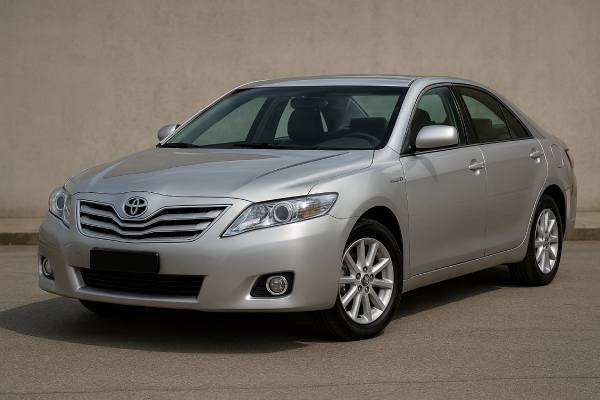
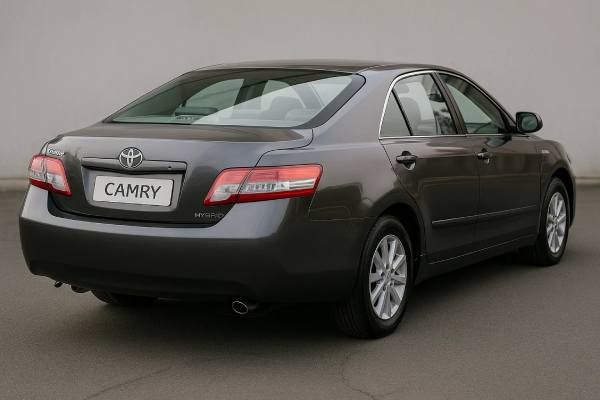
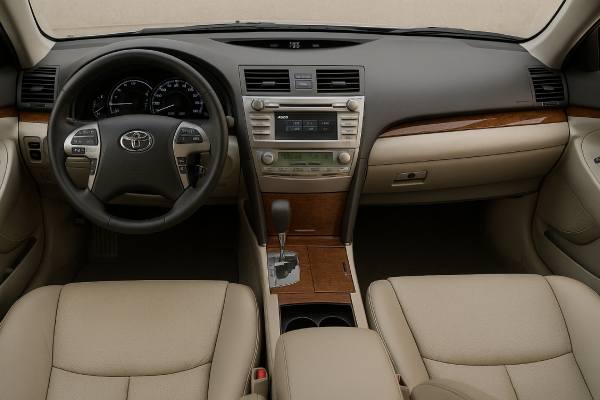
The 2010–2011 facelift of the Camry Hybrid kept the proven AHV40 hybrid powertrain but updated the bodywork, interior details, infotainment, and equipment to keep Toyota’s midsize hybrid competitive until the next full redesign. Under the skin it remained the same core formula: an Atkinson-cycle 2.4-litre 2AZ-FXE four-cylinder working with Toyota’s Hybrid Synergy Drive, an eCVT power-split transaxle, a NiMH high-voltage battery pack, and front-wheel drive. System output stayed at about 187 hp (140 kW), which meant the facelift car still accelerated better than the conventional 2.4-litre gasoline Camry of the period while beating it easily in city fuel consumption. The facelift mostly improved the user experience—revised front fascia, updated lighting, cleaner cabin design, additional standard safety content, and small NVH refinements.
Because it is the “last and newest” of this generation (2010–2011), this Camry Hybrid is often the smartest buy on the used market: it benefits from Toyota’s learnings from 2007–2009, it is newer so its high-voltage battery is likely to be in better shape, and it still uses the widely supported NiMH technology. The catch is the same as always with older hybrids—coolant, inverter pumps, 12 V battery, and brake actuator need to be healthy, and buyers should scan every ECU before money changes hands.
Fast Facts
- Facelifted AHV40 Camry Hybrid keeps 2AZ-FXE Atkinson 2.4l plus electric motor for ≈187 hp total, eCVT, FWD.
- Typical real-world mixed economy still 33–38 mpg US (7.1–6.2 L/100 km) if serviced and on LRR tyres.
- Later build = better equipment, fresher wiring/connectors, and often fewer cosmetic issues than 2007–2009 cars.
- Hybrid cooling (engine and inverter loops) and HV battery health must be checked on every 2010–2011 car.
- Engine oil and filter: 5,000 miles (8,000 km) or 6 months—do not stretch because the engine runs intermittently.
Jump to sections
- Detailed overview
- Specifications and technical data
- Trims, options and safety
- Reliability, common issues and service actions
- Maintenance and buyer’s guide
- Driving and performance
- How the Camry Hybrid compares to rivals
Detailed overview
The facelifted 2010–2011 Camry Hybrid sits at the end of the XV40-era Camry timeline. Toyota refreshed the nose with a more upright grille, cleaner headlamps, and some trim changes so the hybrid looked current next to newer competitors. Inside, materials received small improvements, the infotainment options expanded, and safety/comfort features were more often standard. But the hybrid architecture remained the same, and that is good news: Toyota did not experiment with a new battery chemistry or a new transmission at the very end of the cycle. It is still the known, widely supported AHV40 package.
At the heart is the 2AZ-FXE 2.4-litre Atkinson four-cylinder. Because the Atkinson cycle trades some peak cylinder filling for efficiency, Toyota pairs it with a strong electric motor. The motor sits in the transaxle and, together with a generator and planetary gearset, forms the eCVT. This layout lets the car start and creep on electric power, blend engine torque seamlessly, and shut the engine off at stops without sacrificing A/C because the compressor is electric. For an everyday driver in North America, the big win is in urban or suburban routes with lots of braking and coasting: regenerative braking sends energy back to the battery that a conventional Camry would simply waste as heat.
Compared with a 2007–2009 hybrid, a 2010–2011 often feels slightly tighter, slightly quieter, and better equipped. Many of the early-running changes—revised hybrid coolant pumps, updated software, better interior clips—had already arrived by this time. That makes the facelift cars a little more forgiving for second or third owners who may not be hybrid experts. The layout, however, still has the same ownership realities: the HV battery sits behind/below the rear seat, so trunk space is reduced vs a gasoline Camry; the rear seatback may not fold, or may be more limited; and hybrid components raise the curb weight to over 1,600 kg (3,500+ lb).
From an engineering point of view, this car is a bridge model. It keeps Toyota in the midsize-hybrid game until the next-generation Camry arrives with fresher styling and, later, new hybrid hardware. That is why this 2010–2011 hybrid is attractive used: it is late enough to have many fixes baked in, but old enough to be affordable and to share major parts with 2007–2009 cars.
Buyers should focus on three things: (1) hybrid health—no master warning, no stored HV battery codes, inverter coolant circulating; (2) age-related items—12 V battery, tyres, brakes that may have rusted because of high regen use; (3) proof of coolant and ATF changes. Cars that can show these will be the safest purchases.
Specifications and technical data
The following figures describe a typical North American 2010–2011 Toyota Camry Hybrid (AHV40) with eCVT and FWD. Small differences by state (emissions) or Canada are normal.
Powertrain and efficiency
| Item | Specification |
|---|---|
| Hybrid type | Toyota Hybrid Synergy Drive, full hybrid, power-split |
| Engine code | 2AZ-FXE |
| Engine layout | Inline-4, DOHC, 16 valves, VVT-i, aluminium |
| Displacement | 2.4 l (2,362 cc) |
| Bore × stroke | 88.5 × 96.0 mm (3.48 × 3.78 in) |
| Cycle | Atkinson |
| Compression ratio | ≈12.5:1 |
| Induction | Naturally aspirated |
| Fuel system | Sequential multi-port injection |
| Engine-only output | ≈147 hp (110 kW) @ ~6,000 rpm |
| Electric motor | Permanent-magnet synchronous, front, integrated |
| System total output | ≈187 hp (140 kW) |
| HV battery | NiMH, ~245 V, packaged behind/below rear seat |
| System voltage | ~245 V |
| Emissions | SULEV/PZEV variants |
| EPA fuel economy (period) | Around 33–34 mpg US city, 34–35 mpg US highway, ≈34 mpg US combined (7.0–6.9 L/100 km) |
| Real-world mixed | 33–38 mpg US (7.1–6.2 L/100 km) depending on tyres, climate, traffic |
| Aerodynamics | Cd ≈0.27–0.28, fascias updated for 2010 |
Transmission and driveline / hybrid
| Item | Specification |
|---|---|
| Transmission | eCVT hybrid transaxle (planetary power-split) |
| Drive type | Front-wheel drive |
| Final reduction | Single final drive integrated in transaxle (confirm ratio on label) |
| Inverter/converter | Integrated unit with DC–DC for 12 V |
| Electric A/C compressor | Yes, HV-driven |
| Refuel to full | Conventional fuel fill, 70 l tank range similar to 2007–2009 |
Chassis and dimensions
| Item | Specification |
|---|---|
| Platform | XV40 Camry, hybrid derivative (AHV40) |
| Front suspension | MacPherson strut, coil spring, stabilizer bar |
| Rear suspension | Dual-link/strut-type, coil spring, stabilizer bar |
| Steering | Rack-and-pinion, tuned for hybrid weight |
| Brakes | Front ventilated disc, rear solid disc, with integrated regen, ABS, EBD, brake assist |
| Wheels/tyres | 16-in alloy, 215/60R16 LRR tyres typical |
| Length | ≈4,800 mm (189.0 in) |
| Width | ≈1,820 mm (71.7 in) |
| Height | ≈1,470 mm (57.9 in) |
| Wheelbase | 2,775 mm (109.3 in) |
| Ground clearance | ≈130–140 mm (5.1–5.5 in) |
| Turning circle | ≈11.0 m (36 ft) |
| Curb weight | ≈1,620–1,670 kg (3,570–3,680 lb) |
| GVWR | ≈2,050–2,120 kg (4,519–4,674 lb) |
| Fuel tank | 70 l (18.5 US gal / 15.4 UK gal) |
| Cargo volume | Sedan trunk reduced vs gasoline Camry due to HV battery |
Performance and capability
| Metric | Value |
|---|---|
| 0–60 mph (0–97 km/h) | ≈8.4–8.8 s |
| 0–100 km/h (0–62 mph) | ≈8.8–9.1 s |
| Top speed | Typical midsize-sedan governed value |
| Braking 100–0 km/h | ≈40–43 m depending on tyres and condition |
| Towing | Generally not rated for significant towing |
| Payload | Respect GVWR, typical 400–450 kg (880–990 lb) passenger/cargo |
Fluids and service capacities
| System | Specification | Capacity (approx.) |
|---|---|---|
| Engine oil | 5W-30 (later 0W-20 acceptable if manual allows), API SL/SM | 4.3–4.6 l (4.5–4.9 qt) |
| Engine coolant | Toyota Super Long Life (pink) | ~6.5–7.0 l |
| Inverter/hybrid coolant | Toyota SLLC, separate loop | Check reservoir, ~3–4 l when fully drained |
| Hybrid transaxle | Toyota WS ATF for hybrid transaxle | ~3.5–4.0 l |
| A/C refrigerant | R-134a | ~0.50–0.55 kg (18–19 oz) |
| A/C compressor oil | Hybrid-approved oil (ND-Oil 11 / equivalent) | ~120 ml |
| Wheel nut torque | 103 Nm (76 lb-ft) | |
| Drain plug (engine) | ~40 Nm (30 lb-ft) |
Electrical
| Item | Specification |
|---|---|
| HV battery | NiMH, ~245 V |
| DC–DC converter | Built into inverter, supplies 12 V system |
| 12 V battery | Correct capacity AGM/vented type recommended |
| Spark plugs | Long-life iridium, 1.0–1.1 mm (0.039–0.043 in) gap |
Safety and driver assistance
| Feature | Status (2010–2011 Hybrid) |
|---|---|
| Dual front, side, curtain airbags | Standard |
| ABS, EBD, brake assist | Standard |
| Vehicle Stability Control (VSC) / traction control | Standard or widely equipped |
| LATCH child-seat anchors | Standard |
| Head restraints, front | Active/head-protection type on many cars |
| Headlights | Halogen reflector; lens clarity is important on used cars |
| ADAS (modern) | AEB/ACC/LKA not yet standard era—verify retrofit or dealer packages only |
Trims, options and safety
For 2010–2011, the Camry Hybrid sat in a premium spot in the lineup. It was not a stripped-down eco special; it was an efficiency-focused trim with comfort. That means shoppers can expect, even on mid-spec cars, dual-zone automatic climate control, smart-key/push-button start (market dependent), alloy wheels, power driver’s seat, and the hybrid multi-information display.
Typical equipment themes for the facelift:
- Exterior facelift with hybrid-specific grille and blue-tinged badging.
- 16-in alloy wheels with LRR tyres.
- Dual-zone automatic climate control using the electric A/C compressor.
- Multi-function steering wheel, cruise control.
- Audio choices up to premium/JBL and navigation.
- Smart Key on many builds—check that both key fobs are supplied.
Option / package identifiers:
- Navigation/JBL package: look for large central display, JBL branding, and steering-wheel audio controls. Confirm that the navigation DVD and Bluetooth (if fitted) still work.
- Leather & power package: leather seats, power passenger seat, heated seats on cold-climate cars.
- Sunroof/moonroof: inspect drain tubes and headliner for water staining.
- VSC / enhanced safety (if not standard in your market): 2010–2011 hybrids usually have it, but it is worth confirming via dashboard lights and a scan.
Safety and crash protection:
- The facelift Camry Hybrid uses the same main structure as the earlier XV40, so crash performance remains strong for its era.
- Side curtain airbags and front seat-mounted side airbags are commonly standard, giving good coverage for front and rear occupants.
- Stability control, ABS, and brake assist are integral to the hybrid system’s brake blending—this is part of why these cars feel secure in bad weather.
- Child-seat installation is straightforward thanks to LATCH anchors and wide door openings.
Calibration and service notes for safety systems:
- After front-end or suspension work, a steering-angle/yaw-rate calibration may be needed to restore full stability-control function.
- Because the hybrid integrates regenerative braking, bleeding the brakes should follow the hybrid-specific procedure (scan-tool steps, sequencing).
- Failing or weak 12 V batteries can trigger seemingly unrelated ABS/VSC/hybrid lights. Always check 12 V health before chasing bigger faults.
Reliability, common issues and service actions
By 2010–2011, Toyota had several years of field data on this hybrid system. That does not mean the cars are fault-free—only that the pattern is well understood.
Common, lower-cost items:
- 12 V battery ageing: A weak 12 V will trigger hybrid system warnings, ABS/VSC lights, or intermittent no-READY. Replace with correct spec, check DC–DC output, clear codes.
- Inverter or engine electric water pump wear: Pumps can grow noisy or slow with age. If the hybrid system gets hot or codes point to poor flow, replace the pump and flush/bleed the loop.
- Brake actuator/pump cycling often: You may hear the accumulator run more than expected. Follow the service manual to test. Sometimes a brake-bleed and fluid refresh help; in other cases, the actuator assembly needs replacement.
- A/C efficiency decline: Because the compressor is electric and tied to the HV system, owners notice cooling problems quickly. Always use hybrid-approved oil; check cabin filter first.
Occasional, moderate-to-high cost:
- HV battery capacity decline: 2010–2011 packs are newer than 2007’s, but by 2025 they are still 14–15 years old. If the car shows wide SOC swings, reduced EV-only time, or hybrid warnings, test the pack. Remedies range from module replacement/balancing to full pack replacement.
- Hybrid transaxle fluid neglected: Though Toyota often called it “lifetime,” drain-and-fill every 30,000–60,000 miles (48,000–96,000 km) is smart. Old fluid may lead to drivability complaints.
- Rust on brake rotors and calipers: Regenerative braking means the friction brakes see less use, so surface rust can build up. Periodic hard stops (when safe) and regular inspection help.
Rare but high-severity:
- Inverter/converter internal failure: Presents with multiple hybrid DTCs and no-READY. Replacement with correct part number is the fix; ensure coolant system is perfect before returning to service.
- HV isolation faults from moisture or damage: Look for water ingress in trunk/rear-seat area. Dry, repair, and re-test insulation.
Recalls, TSBs, and service campaigns to confirm:
- Accelerator pedal / floor-mat interference campaigns from the era.
- SRS/airbag campaigns that affected many 2000s/early-2010s Toyotas.
- Brake system software/hybrid brake-blending updates.
- Occasional HV/hybrid ECU reflashes to improve drivability and system readiness.
How to verify completion:
- Run the vehicle’s VIN through the official recall lookup for your region.
- Ask for dealer history printouts; many Toyota dealers will provide it.
- Confirm visually that floor-mat retainers and accelerator pedal shape match the updated parts.
Pre-purchase checks to insist on:
- Full hybrid-system scan (all ECUs).
- HV battery health or at least a test drive long enough to see SOC stability.
- Hybrid and engine coolant level and condition.
- 12 V battery test with date code.
- Brake actuator noise and regen-to-friction handoff on the road.
- A/C cold performance with engine off.
- Underbody corrosion check—lines, subframes, rear crossmember.
Maintenance and buyer’s guide
Even though the engine often shuts off in traffic, the car still needs time-based maintenance. Think of it this way: hybrid systems lower fuel use, not maintenance fundamentals.
Suggested maintenance plan:
- Engine oil and filter: 5,000 miles (8,000 km) or 6 months. Use 5W-30 or 0W-20 if allowed by your year’s manual.
- Engine air filter: Inspect every 15,000 miles (24,000 km); replace 30,000 miles (48,000 km).
- Cabin air filter: 15,000–30,000 miles (24,000–48,000 km).
- Engine coolant (SLLC): First at 100,000 miles (160,000 km) or 8–10 years, then every 50,000 miles (80,000 km) / 4–5 years. A 2010–2011 car with no record should be done now.
- Inverter/hybrid coolant loop: Service together with engine coolant. Air in this loop can cause hybrid overheating.
- Hybrid transaxle (Toyota WS): Drain-and-fill every 30,000–60,000 miles (48,000–96,000 km). Cheap insurance.
- Brake fluid: Every 2–3 years, using correct hybrid bleed procedure.
- Brake hardware: Inspect at tyre rotations; clean/lube slide pins to fight corrosion and low use.
- Tyre rotation: 5,000–7,500 miles (8,000–12,000 km); keep LRR tyres inflated to door-jamb spec for best mpg.
- 12 V battery: Test yearly after year 4; replace 5–7 years or earlier if low.
- Spark plugs (iridium): 120,000 miles (193,000 km), or sooner if misfire codes appear.
- Belts and hoses: Inspect yearly after 60,000 miles; hybrids run pumps electrically, so failures can be less obvious.
Fluid specifications and key values:
- Engine oil: 5W-30 / 0W-20, API SL/SM or later, 4.3–4.6 l.
- Transaxle: Toyota WS only, ~3.5–4.0 l.
- Coolant: Toyota SLLC pink, premixed 50/50.
- Wheel nuts: 103 Nm (76 lb-ft).
- Tyre pressures: 32–35 psi (221–241 kPa), confirm on door label.
Buyer’s guide – what to look for:
- Model year and mileage: 2010–2011 are the freshest of this design; under 150,000 miles (240,000 km) with good records is a strong candidate.
- Service records: Prior coolant change, hybrid ATF change, recent 12 V, and any HV battery work are major positives.
- Hybrid warning lights: None should be on. If any are present, scan before even test driving.
- A/C performance: Must cool at idle and when the engine is off.
- Trunk and rear-seat area: Check for water, corrosion, or smells near the HV-battery location.
- Underbody: Look for rust on brake/fuel lines; plan to protect or replace in rust-belt cars.
- Tyres: Mixed sets suggest budget maintenance; LRR replacements show a careful owner.
- Test drive: Smooth start/stop, no clunks from front suspension, predictable brake feel.
What to seek:
- Single-owner or two-owner car with full Toyota/dealer records.
- Cars from milder climates.
- Cars with documented inverter-coolant service and newer 12 V battery.
What to avoid or discount heavily:
- Hybrid battery or inverter warnings.
- Evidence of flood/water in trunk.
- No record of coolant service and pump replacement at this age.
- Brake actuator noise plus ABS/VSC lights.
- Aftermarket electronics poorly installed near hybrid wiring.
Durability outlook:
With fluids current, cooling systems sound, and either an original-but-healthy or recently refreshed HV battery, a 2010–2011 Camry Hybrid can comfortably run to 200,000–250,000 miles (320,000–400,000 km). Hybrid-specific repairs will cost more than on the gasoline Camry, so a contingency fund is sensible, but the shared-platform parts supply is broad and long-lived.
Driving and performance
The facelift Camry Hybrid drives essentially like the 2007–2009 car, but it often feels a bit tighter and quieter because it is newer.
Powertrain feel. Electric torque off the line makes the car feel more eager than its 187 hp figure suggests. The eCVT keeps the engine in its power band, and the transition from EV to ICE is smooth when the engine mounts and software are healthy. Because of the Atkinson cycle, the engine is not about high-rpm thrills—its contribution is steady, efficient power that the electric side amplifies.
Ride and handling. The Camry remains comfort-oriented: soft primary ride, good isolation from broken pavement, and low wind noise. The hybrid drivetrain’s extra weight stabilises the car on the highway. Steering is light but accurate, ideal for commuting. Body roll is present but controlled—this is not the firm SE gasoline Camry.
Braking. Regenerative braking does most of the work at low-to-moderate deceleration. The pedal is tuned to feel natural, but any issues with the actuator or contamination in the system can make the pedal feel uneven. After service, the correct bleed procedure restores feel. Rotors should be cleaned or replaced if heavy rust sets in.
Real-world efficiency.
- City: 35–40 mpg US (6.7–5.9 L/100 km) in warm weather, with patient throttle and LRR tyres.
- Highway 65–70 mph (105–113 km/h): 33–35 mpg US (7.1–6.7 L/100 km).
- Mixed commuting: 33–38 mpg US (7.1–6.2 L/100 km).
- Cold weather / short trips: expect upper-20s to low-30s mpg US (9.4–7.8 L/100 km) because the engine must run more for heat.
Performance metrics that matter:
- 0–60 mph in the high-8s is enough for freeway on-ramps.
- Passing at urban speeds is strong thanks to instant electric assist.
- Turning circle at ~11 m makes parking easy.
Load and grades. With four people and luggage, performance stays acceptable; the hybrid system can sustain power on moderate grades provided cooling systems are correct. For long mountain grades or hot climates, fresh coolant in both loops is the best insurance.
How the Camry Hybrid compares to rivals
Versus Toyota Prius (3rd gen 2010–2011):
- Prius is more efficient, especially in city driving.
- Camry Hybrid is roomier, more powerful, more conventional-feeling, and better for tall rear passengers.
- If you drive mostly highway or often carry adults, the Camry Hybrid is the easier car to live with.
Versus Ford Fusion Hybrid (2010-on):
- Fusion Hybrid arrived with strong efficiency and a modern cabin.
- Toyota’s hybrid system has deeper technician familiarity, bigger parts ecosystem, and a massive installed base.
- For a long-term, low-drama buy, the Camry Hybrid keeps the edge; for a newer-feeling drive, Fusion Hybrid can compete.
Versus Nissan Altima Hybrid (Toyota-licensed system, 2007–2011, limited markets):
- Altima Hybrid is rarer; some parts and hybrid service experience can be harder to find.
- Camry has scale and a more predictable resale market.
Versus a gasoline 2010–2011 Camry 2.5 (newer engine):
- The 2.5 gasoline Camry introduced more power and better baseline mpg than the old 2.4.
- Even so, the hybrid still wins in stop-and-go and prioritises smoothness over gear shifts.
- Gasoline 2.5 has simpler mechanicals and a bigger trunk—best for drivers who live on highways and do not need hybrid city gains.
Market positioning today:
- The facelift years (2010–2011) are the sweet spot for buyers who want this generation’s shape but want the newest possible build date, and who prefer NiMH/split-drive hybrids to later, more complex systems.
- Prices are still influenced heavily by HV-battery condition and service records—expect to pay more for a car with a documented recent battery or a clean hybrid scan.
References
- 2010 Camry Hybrid Owner’s Manual 2010 (Owner’s Manual)
- 2011 Camry Hybrid Owner’s Manual 2011 (Owner’s Manual)
- Gas Mileage of 2011 Toyota Camry Hybrid 2011 (Fuel Economy)
- 2011 Toyota Camry Hybrid 4 DR FWD 2011 (Safety Rating)
Disclaimer
This article is intended for informational purposes only and does not replace professional diagnosis, repair, or inspection. Specifications, torque values, service intervals, and safety or recall actions can vary by VIN, build date, market, and installed equipment. Always confirm against your official Toyota service documentation and current manufacturer communications. If you found this guide useful, please share it on Facebook or X/Twitter to support xcar’s work.