
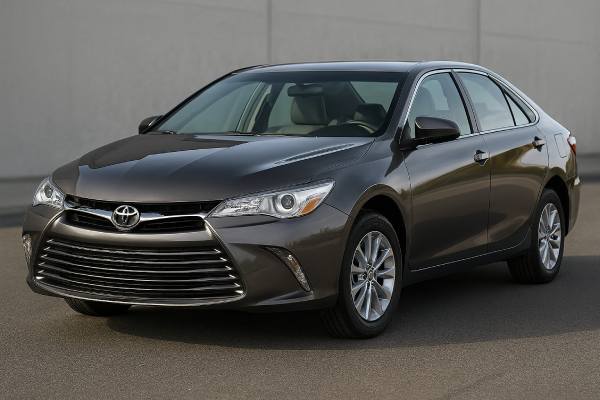
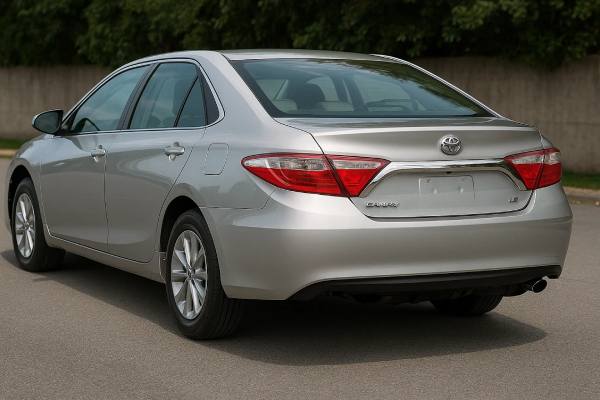
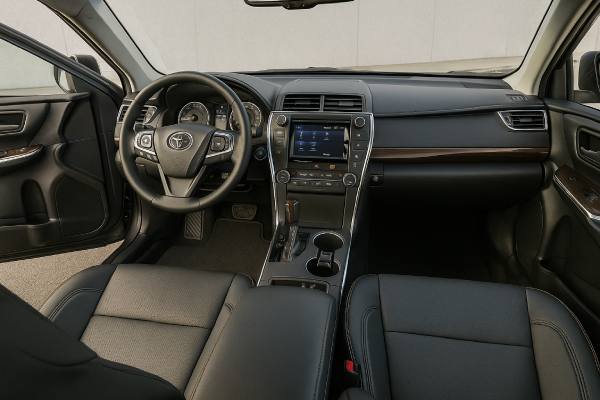
The 2015–2017 facelift brought meaningful refinements to the seventh-generation Camry without changing its core character. Toyota retuned the chassis, added more spot welds in key areas, and revised the electric power steering for a calmer high-speed feel. Inside, materials and noise suppression improved, while newly available trims—especially XSE—gave shoppers a sportier alternative to the comfort-tuned LE/XLE. Under the hood, the 2AR-FE 2.5-litre four-cylinder continues with 178 hp and 170 lb-ft, paired to a six-speed automatic that favors low-rpm cruising. Safety tech expanded, and body/airbag updates improved small-overlap crash performance compared with early pre-facelift cars. For daily miles, the facelift Camry balances quiet ride quality, roomy seating, and reliable hardware with low running costs. If you want sharper response, the SE/XSE’s firmer damping and 18-inch tires help; if you prioritize isolation, LE/XLE is the easy choice. As a used buy, these years offer excellent availability, predictable maintenance, and high parts commonality.
Fast Facts
- Calm ride, quiet cabin, and generous rear legroom; easy 35 mpg highway (6.7 L/100 km) when driven steadily.
- Proven chain-driven 2AR-FE with simple port fuel injection; long-life plugs and coolant.
- SE/XSE add firmer damping, quicker steering feel, and 17–18 in wheel options.
- Watch for water-pump seep and occasional torque-converter shudder; confirm recall/TSB completion by VIN.
- Oil service: 0W-20, up to 10,000 mi / 12 months (many owners choose 5,000–7,500 mi / 6–12 months).
Guide contents
- Camry 2.5 (2015–2017) Overview
- Camry 2.5 Technical Data
- Camry Grades, Options and Safety
- Reliability, Issues and Actions
- Maintenance Plan and Buyer’s Guide
- On-Road Performance
- How Camry Stacks Up
Camry 2.5 (2015–2017) Overview
Toyota’s 2015 refresh did more than change the face. The body-in-white received extra spot welds at the cowl and door openings, revised door and rocker structures, and additional sound insulation. The suspension geometry remained familiar, but bushing rates, spring/damper tuning, and steering assist mapping were reworked for a tighter initial response with better isolation on patched pavement. The result is a Camry that feels calmer at 70–75 mph, more tied down in lane changes, and quieter over coarse surfaces.
The cabin shows the step-up most clearly. Seat foam density, dash textures, and door-panel soft points improve perceived quality, and wind-noise paths around the A-pillars are better sealed. A backup camera spread to more trims, plus optional blind-spot monitor and rear cross-traffic alert eased daily maneuvering. The XSE trim, newly added, pairs a sportier fascia and body kit with firmer damping, thicker anti-roll bars, and 18-inch wheels on high-performance all-season tyres. It does not turn the Camry into a sport sedan, but it sharpens turn-in and reduces secondary motions through sweepers.
Mechanically, the 2AR-FE continues as a known quantity: an all-aluminium 2.5-litre inline-four with dual VVT-i and a maintenance-free timing chain. In typical commuting, it settles around 1,800–2,200 rpm on the highway thanks to tall overdrive ratios. The six-speed automatic seeks efficiency (early upshifts, frequent torque-converter lock-up), yet kickdown is decisive for passing. EPA ratings stay in the high-20s combined for most trims, and real-world highway consumption in the low-7 L/100 km range is common at 120 km/h. Ownership costs remain modest: long-life coolant, iridium spark plugs at extended intervals, and inexpensive filters/fluids. For families, the trunk’s square aperture and low liftover simplify cargo, and rear LATCH points are easy to access. Overall, the facelift Camry improves refinement and active-safety availability while preserving the line’s durability and straightforward serviceability.
Camry 2.5 Technical Data
Engine and Performance (ICE-only)
| Item | Specification |
|---|---|
| Code | 2AR-FE |
| Layout & cylinders | Inline-4, DOHC, Dual VVT-i; 16 valves (4 per cyl) |
| Bore × stroke | 90.0 × 98.0 mm (3.54 × 3.86 in) |
| Displacement | 2.5 L (2,494 cc) |
| Induction | Naturally aspirated |
| Fuel system | Sequential multi-port fuel injection (PFI) |
| Compression ratio | ~10.4:1 |
| Max power | 178 hp (133 kW) @ 6,000 rpm |
| Max torque | 231 Nm (170 lb-ft) @ ~4,100 rpm |
| Timing drive | Chain (no scheduled replacement) |
| Emissions/efficiency standard | EPA certification (gasoline) |
| Rated economy (typical EPA) | ~25/35/28 mpg US (city/hwy/combined) ≈ 9.4/6.7/8.4 L/100 km |
| Real-world highway @ 120 km/h (75 mph) | ~7.1–7.8 L/100 km (33–29 mpg US; 40–35 mpg UK) |
| Aerodynamics | Cd approx. 0.27–0.28 (trim-dependent) |
Transmission and Driveline
| Item | Specification |
|---|---|
| Transmission | 6-speed automatic (U760E) with lock-up; manual-shift mode on SE/XSE |
| Gear ratios | 1st 3.300, 2nd 1.900, 3rd 1.421, 4th 1.000, 5th 0.713, 6th 0.608; Rev 4.148 |
| Final drive ratio | ~3.63:1 (minor variations by wheel/tire package) |
| Drive type | Front-wheel drive (FWD) |
| Differential | Open |
| Refuel time | ~5 minutes (pump to full) |
Chassis and Dimensions
| Item | Specification |
|---|---|
| Suspension (front/rear) | MacPherson strut / dual-link strut (independent) |
| Steering | Electric power-assisted rack-and-pinion (EPS) |
| Brakes | Vented front discs ~296 mm (11.7 in); solid rear discs ~281 mm (11.1 in) |
| Wheels/Tires | 205/65R16 (LE), 215/55R17 (XLE/SE), 225/45R18 (XSE/SE pkg) |
| Ground clearance | ~150–155 mm (5.9–6.1 in) |
| Length/Width/Height | ~4,850 × 1,820 × 1,470 mm (190.9 × 71.7 × 57.9 in) |
| Wheelbase | 2,795 mm (109.3 in) |
| Turning circle (kerb-to-kerb) | ~11.2 m (36.7 ft) |
| Curb weight | ~1,440–1,505 kg (3,175–3,320 lb), by trim/equipment |
| GVWR | ~1,960–2,060 kg (4,321–4,544 lb) |
| Fuel tank | ~64 L (17.0 US gal / 14.2 UK gal) |
| Cargo volume (SAE) | ~436 L (15.4 ft³) |
Performance and Capability
| Metric | Value |
|---|---|
| 0–100 km/h (0–62 mph) | ~8.2–8.7 s (conditions/trim) |
| 0–60 mph | ~8.0–8.5 s |
| Top speed | ~201 km/h (125 mph) |
| 100–0 km/h braking | ~38–40 m (125–131 ft) on quality all-seasons |
| Towing capacity | Not rated for towing (North America) |
| Payload | Approx. 385–430 kg (850–950 lb) |
| Roof load | Not rated (no factory rails) |
Fluids and Service Capacities
| System | Specification / Capacity |
|---|---|
| Engine oil | SAE 0W-20 synthetic; ~4.4 L (4.6 US qt) with filter |
| Coolant | Toyota Super Long Life (pink), 50/50; ~6.5–7.0 L (6.9–7.4 US qt) total |
| Transmission (ATF) | Toyota ATF WS; drain/fill ~3.5–3.9 US qt (3.3–3.7 L); dry ~7–8 US qt (6.6–7.6 L) |
| Differential/transfer | Integrated in transaxle (ATF WS) |
| A/C refrigerant | R-134a; ~500–550 g (17.6–19.4 oz) |
| A/C compressor oil | ND-OIL 8 (PAG); ~120 mL (4.1 fl oz) |
| Key torque specs | Wheel lugs 103 Nm (76 lb-ft); oil drain plug ~39 Nm (29 lb-ft); spark plugs ~18 Nm (13 lb-ft) |
Electrical
| Item | Specification |
|---|---|
| Alternator output | ~130 A |
| 12 V battery | Group 24F, ~65 Ah (≈550 CCA) |
| Spark plugs | Long-life iridium; gap 1.0–1.1 mm (0.039–0.043 in) |
Safety and Driver Assistance
| Category | Details |
|---|---|
| Crash ratings (IIHS) | Small-overlap: Good for facelift cars; Moderate overlap: Good; Side: Good; Roof: Good; eligible for Top Safety Pick when equipped appropriately |
| Headlights | Period halogen projector/reflector; IIHS headlight program began 2016 (ratings vary by trim) |
| ADAS suite | Stability control, traction control, ABS/EBD/Brake Assist standard; Blind-Spot Monitor and Rear Cross-Traffic Alert optional; Lane Departure Alert/Pre-Collision System available on select higher trims/packages (availability varies by year) |
| Child-seat provisions | LATCH anchors (rear outboard) plus top tethers; accessible anchor geometry |
Camry Grades, Options and Safety
Trim walk (2.5-litre models): LE, SE, XSE, XLE (plus a limited SE Special Edition during the run). All use the 2AR-FE and six-speed automatic with FWD.
- LE: The comfort baseline—16-inch wheels/tires, cloth upholstery, power driver seat (varies by package), cruise, Bluetooth, and a backup camera. Ride is plush, steering light, and cabin the quietest on coarse asphalt due to taller sidewalls.
- SE: Sport-leaning calibration with firmer springs/dampers, retuned EPS, unique fascia/side skirts, and 17-inch wheels (18-inch available). Front seats add more lateral support, and paddle shifting appears on many builds.
- XSE: The sharpest-looking four-cylinder Camry of the era. Standard 18-inch alloys (225/45R18), thicker anti-roll bars, and sport seats. Chassis tuning adds discipline at turn-in while preserving daily comfort.
- XLE: Comfort flagship—17-inch wheels, leather availability, dual-zone climate, sunroof option, and premium audio. Steering is calm and straight-ahead stability excellent for long interstate runs.
Packages and signatures: Convenience bundles add Smart Key with push-button start; navigation and Entune App Suite populate mid/high trims; Blind-Spot Monitor with Rear Cross-Traffic Alert appears on SE/XSE/XLE. The SE Special Edition (2016) brings unique 18-inch wheels, blue stitching/inserts, and special gauges—easy to spot by the finish and interior accents.
Mechanical differences by trim: Brakes are similar in rotor dimensions across trims; feel varies with pad compound and tire choice. Final-drive ratio remains effectively the same; the sport-tuned cars use firmer dampers and stiffer bushings for body control. Wheel/tire packages affect NVH and steering precision—18-inch setups add grip and road feel but increase impact thump over sharp edges.
Safety ratings and structure notes: Compared with 2012–2014, facelift cars benefit from structural tweaks and revised restraints that improve small-overlap performance, a meaningful change for real-world offset crashes. Many builds qualify for Top Safety Pick status when equipped with the available forward-collision warning/mitigation features and appropriate headlights. When shopping, confirm safety-feature content by VIN and verify any recall or service campaign completion.
Child seats and family use: Rear doors open wide, LATCH anchors are easy to find, and belt buckles are well spaced for boosters. The trunk’s low liftover and wide aperture make stroller and luggage loading painless, and 60/40 split-folding rear backs expand cargo flexibility on LE/SE/XSE/XLE.
Reliability, Issues and Actions
The facelift Camry 2.5 is among the most dependable sedans in its class. Still, age and miles expose predictable wear patterns. Use the map below to prioritize checks and budget.
Common (low–medium severity; inexpensive)
- Water pump seep/leak: Look for pink crust around the weep hole or a sweet coolant smell after shutdown. Replace pump/gasket and refresh Super Long Life Coolant; budget for new belt if glazed.
- Front brake judder: Often uneven pad deposits or rotor thickness variation, not “warped” discs. Use quality pads, bed them correctly, and torque wheel lugs to 103 Nm (76 lb-ft) to avoid hub face distortion.
- HVAC odor/blower noise: Cabin filter age plus evaporator biofilm. Replace filter annually and treat the evaporator; ensure cowl drains are clear.
Occasional (medium cost/annoyance)
- Torque-converter lock-up shudder: Light throttle, 40–60 mph, gentle rumble. Fresh ATF WS via staged drain/fill and a calibration update often help; persistent cases may need a torque-converter.
- Rear suspension clunks: Sway-bar end links or upper strut mounts on high-mile cars. Replace links/mounts and re-check alignment.
- Infotainment lag or Bluetooth quirks: Firmware updates are available on many head units; confirm current software and pairing stability on the test drive.
Rare (but important to verify)
- Airbag/seat-system campaigns: Build-specific SRS or seat-track/occupant-classification campaigns may apply. Always run a full VIN check and print results for your records.
- Small-overlap structure update confirmation: The facelift’s improved structure is integral; ensure you are indeed shopping 2015–2017 and not an earlier build registered later.
Corrosion and body: Generally strong resistance, but inspect subframe seams, rear trailing arms, and exhaust hangers in salt states. Check door bottoms and trunk lip weatherstrips for grit and trapped moisture.
What to request before money changes hands
- Full service history with dates/mileage; coolant age, brake-fluid age, and any ATF servicing documented.
- VIN report showing recall/service campaign completion.
- Cold-start video (if remote purchase), showing smooth idle and no startup rattle.
- Tire DOT dates and even wear; budget if any tire exceeds 6–7 years regardless of tread.
- Professional pre-purchase inspection focusing on suspension bushings, brake thickness, seep points, and a road test that includes 40–60 mph light-throttle operation to screen for TCC shudder.
Maintenance Plan and Buyer’s Guide
Practical maintenance schedule (verify by VIN and owner’s literature; adjust for severe service)
- Engine oil & filter: 0W-20, up to 10,000 mi / 12 months in normal service. Many owners choose 5,000–7,500 mi / 6–12 months for short-trip or extreme temps.
- Engine air filter: Inspect 15,000 mi (24,000 km); replace 30,000–45,000 mi (48,000–72,000 km), sooner in dust.
- Cabin filter: Every 12 months or 15,000–20,000 mi (24,000–32,000 km).
- Coolant (SLLC pink): First change 100,000 mi / 10 years, then every 50,000 mi / 5 years.
- Spark plugs (iridium): About 120,000 mi (193,000 km).
- Serpentine belt: Inspect each oil change after 60,000 mi; replace on cracks/noise.
- Automatic transmission fluid (WS): No fixed interval listed for “lifetime” service; a 60,000–90,000 mi (96,000–145,000 km) drain-and-fill is prudent for shift quality.
- Brake fluid: Every 2–3 years regardless of mileage.
- Brake pads/rotors: Inspect every service; expect long life with highway use.
- Tyres: Rotate 5,000–7,500 mi; check pressures monthly; align annually or after impacts.
- 12 V battery: Load-test annually after year 4; typical service life 4–6 years.
- Throttle body/MAF & PCV: Inspect/clean at 60,000–90,000 mi if idle quality or fuel economy degrades.
Fluid specifications (quick reference)
- Engine oil: 0W-20 API SN/SN Plus or newer; ~4.4 L (4.6 qt) with filter.
- Coolant: Toyota Super Long Life, premixed pink.
- ATF: Toyota WS only (do not mix).
- Brake fluid: DOT 3 or DOT 4 (fresh, sealed).
- Power steering: Electric (no fluid).
- A/C: R-134a; ND-OIL 8.
Essential torque values
- Wheel lugs 103 Nm (76 lb-ft), drain plug ~39 Nm (29 lb-ft), spark plugs ~18 Nm (13 lb-ft).
Buyer’s cheat sheet—best picks and what to avoid
- Best all-rounder: SE—adds body control and better front seats without hurting comfort or economy.
- Quiet highway cruiser: XLE on 17-inch wheels and touring tyres.
- Sporty look/feel: XSE 18-inch package; expect slightly firmer impacts and ~1 mpg penalty at highway speeds.
- Years to favor: Any 2015–2017 with documented maintenance; if advanced safety is a priority, seek cars with the tech package (LDA/PCS/BSM/RCTA availability varies).
- What to scrutinize: Pump seep, any shudder in light-throttle lock-up, clunks over speed bumps (rear links/mounts), infotainment firmware level, and tyre age.
Durability outlook: With timely fluids and gentle use, the 2AR-FE/6-speed combination regularly exceeds 200,000+ miles (320,000+ km) without internal engine work. Suspension consumables are inexpensive, and body corrosion is generally well controlled with reasonable winter washing.
On-Road Performance
Ride and handling: LE/XLE prioritize serenity. Primary ride is supple, secondary motions are well damped, and the cabin stays impressively quiet on coarse aggregate. The steering is light at parking speeds and settles into a natural on-centre feel by 60–75 mph. SE/XSE add firmer damping and stiffer bushings; turn-in is tidier, roll angles lower, and mid-corner corrections demand less wheel. On broken city streets, 18-inch tyres transmit a touch more thump but remain comfortable for daily commuting.
Powertrain feel: The 2.5-litre’s best work happens from 2,000–4,000 rpm. Throttle response is linear, there’s no turbo lag to manage, and the six-speed’s calibration keeps the converter locked in steady cruise for quiet progress. In D, kickdown arrives promptly for two-lane passes; manual mode on SE/XSE is predictable for on-ramps or downhill engine braking. Hot starts are instant, and idle with the A/C on remains smooth.
Real-world efficiency: Expect 28–31 mpg US combined (8.4–7.6 L/100 km) in mixed suburban use. At 70 mph (113 km/h), many owners see 33–35 mpg US (7.1–6.7 L/100 km) in fair weather; 75 mph (120 km/h) trims a couple mpg. Winter short-trip driving can cost 2–4 mpg US (0.5–1.0 L/100 km). The 18-inch wheel/tire set typically carries a small economy penalty versus 16–17-inch packages.
Key metrics that matter: 0–60 mph in ~8.0–8.5 s is fully adequate for modern traffic. With quality tyres, the Camry consistently stops from 100 km/h in ~38–40 m and resists fade in normal use. Steering feel is filtered but precise enough, and straight-line stability is excellent in crosswinds. Under full cabin and trunk load, damping keeps the rear composed over bridge joints and freeway heaves.
How Camry Stacks Up
Honda Accord (2015–2017 2.4): The Accord’s direct-injected four and CVT return slightly better city economy and more steering feedback, but road noise can be higher on coarse aggregate. Camry counters with a simpler six-speed automatic, calmer ride, and often lower long-term maintenance variability.
Nissan Altima (2016–2017 2.5): Light on its feet with a quiet cabin; the CVT’s long-term behavior depends on fluid hygiene and thermal management. Camry’s conventional automatic and robust cooling stack make high-mile ownership simpler.
Ford Fusion (2015–2017 2.5 / 1.5T): European-tuned chassis with handsome styling and a composed highway gait. Turbo variants offer midrange punch but ask more of cooling and maintenance. Camry’s naturally aspirated four has fewer moving parts and cheaper downstream care.
Hyundai Sonata/Kia Optima (2015–2017 2.4 GDI): Great feature density per dollar, roomy cabins, and strong warranties when newer. NVH and long-term injector/valve deposit concerns can emerge in certain use cases. Camry’s port-injected 2.5 avoids GDI-specific carbon buildup.
Mazda6 (2016–2017 2.5): The driver’s benchmark for steering feel and body control; ride is firmer and cabin width tighter. For enthusiasts, the Mazda charms; for family serenity, the Camry is the safer bet.
References
- 2015 Toyota Camry and Camry Hybrid Press Kit 2014 (Press Kit)
- 2015 Toyota Camry 2015 (Safety Rating)
- Gas Mileage of 2015 Toyota Camry 2015 (EPA Fuel Economy)
- 2015 Toyota Camry Warranty and Maintenance Guide 2015 (Warranty and Maintenance)
Disclaimer
This article is for informational purposes and is not a substitute for professional diagnosis or repair. Specifications, torque values, service intervals, procedures, and safety ratings vary by VIN, build date, market, equipment level, and software version. Always confirm against your vehicle’s official service documentation and current manufacturer publications before performing work or making a purchase decision.
If this guide helped you, please consider sharing it on Facebook or X/Twitter to support xcar’s work. Thank you!