
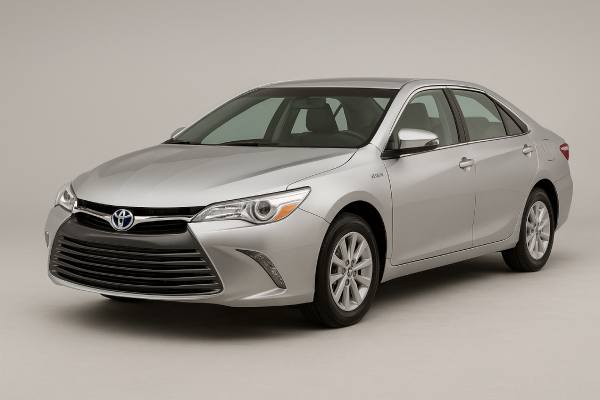
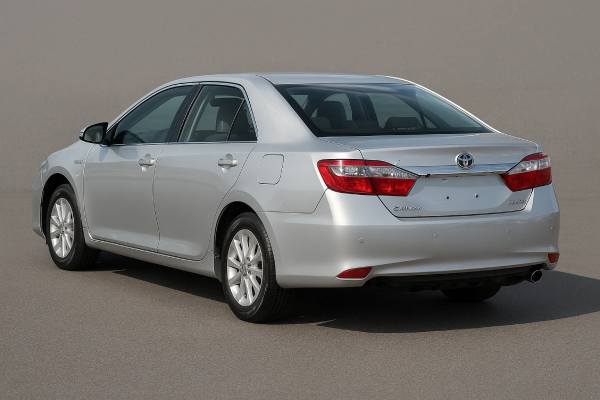
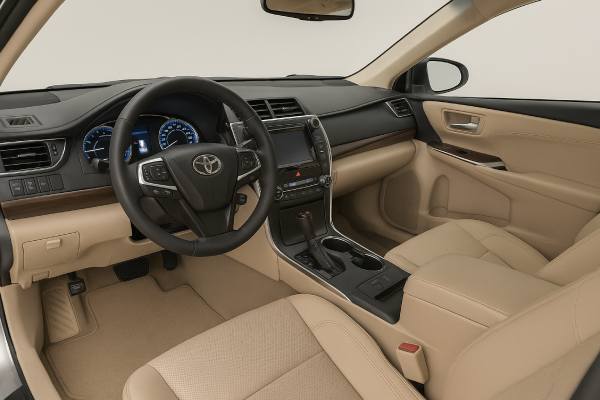
The 2015–2017 Toyota Camry Hybrid (AVV50 facelift) blends a proven Atkinson-cycle 2.5-liter four with Toyota’s Hybrid Synergy Drive to deliver calm, efficient commuting and low running costs. The facelift brought new bodywork, noise reduction, suspension retuning, and a more refined cabin without altering the fundamentals: an eCVT transaxle, a compact NiMH battery, and a net system output of 200 hp. Real-world consumption remains competitive, especially on urban routes where the hybrid system shines. Owners prize the car’s straightforward ergonomics, heavy-duty cooling and braking for hybrid duty, and the broad dealer network. Compared with non-hybrid Camry trims, the Hybrid rides a touch firmer (wheel-package dependent) and carries slightly more curb mass, but the electric torque masks that in city traffic. As these cars age, their value rests on documented maintenance, inverter and water-pump health, and the condition of the high-voltage battery and cooling paths. This guide focuses on the facelift years (2015–2017), covering the powertrain specifics, safety, reliability patterns, preventive service, and what to check before you buy.
Quick Specs and Notes
- Smooth, efficient hybrid drive with strong city economy; quiet cruising after 2015 NVH updates.
- Spacious cabin, simple controls, and large parts availability keep running costs low.
- Watch for inverter/aux water-pump seepage and aging 12 V battery; inspect HV battery cooling path.
- Oil and filter: every 10,000 miles (16,000 km) or 12 months with 0W-20; severe use 5,000 miles (8,000 km).
Navigate this guide
- 2015–2017 Camry Hybrid Overview
- Camry Hybrid Facelift Specifications
- 2015–2017 Trims, Options and Safety
- Reliability and Common Issues
- Maintenance and Buyer’s Guide
- Driving and Real-World Economy
- Camry Hybrid Versus Rivals
2015–2017 Camry Hybrid Overview
Toyota’s mid-cycle refresh for model years 2015–2017 was unusually deep. Nearly every exterior panel ahead of the A-pillars changed, the structure gained additional spot welds and adhesive, and suspension tuning was revised to improve straight-line stability and steering on center. Inside, materials stepped up a grade, the center stack simplified, and noise insulation increased at the firewall, floor, and doors. The Hybrid carried forward the proven AVV50 architecture: a 2AR-FXE 2.5-liter Atkinson-cycle inline-4 paired with an electric traction motor, a motor-generator for starting and charging, and a planetary eCVT in a single P3xx transaxle. Total system output remained 200 hp. Battery chemistry is nickel-metal hydride (NiMH) with a nominal ~245 V pack mounted behind the rear seat; trunk space stays at a usable 13.1 ft³ thanks to a compact pack and folding pass-through.
Trim strategy is simple. LE Hybrid targets comfort and maximum EPA estimates on low-rolling-resistance 16-inch tires. SE Hybrid adds firmer damping, 17-inch wheels, different seats/steering wheel, and minor aero pieces that slightly affect ratings. XLE Hybrid layers in quieter tires, premium audio, and more convenience features; with 17-inch wheels, its efficiency mirrors the SE. For 2017, Toyota expanded active-safety availability and, by year’s end, moved toward standard automated emergency braking across most trims. All models are front-wheel drive with disc brakes at each corner.
For shoppers today, the facelift Camry Hybrid is attractive because it blends the high-volume XV50 parts ecosystem with the quieter, more composed body and cabin. The key variables are maintenance history (especially coolant, brake fluid, and transaxle service), the age and health of the 12 V aux battery, and the thermal cleanliness of the HV battery cooling path. With routine care and a clean cooling system, the HV battery typically lasts well past 10 years; many fleets see 200k+ miles with only consumables and the occasional water pump.
Camry Hybrid Facelift Specifications
Engine and Performance (Powertrain & Efficiency)
| Item | Specification |
|---|---|
| Code | 2AR-FXE (Atkinson-cycle) + HSD traction motor |
| Engine layout & cylinders | Inline-4, DOHC, 4 valves/cyl |
| Bore × stroke | 90.0 × 98.0 mm (3.54 × 3.86 in) |
| Displacement | 2.5 L (2494 cc) |
| Induction | Naturally aspirated |
| Fuel system | Sequential port fuel injection |
| Compression ratio | ~12.5:1 |
| Max engine output | ~156 hp (116 kW) @ ~5700 rpm |
| Max engine torque | ~156 Nm (115 lb-ft) @ ~4500 rpm |
| Traction motor (MG2) | Permanent-magnet synchronous, ~105 kW, ~270 Nm (199 lb-ft) |
| System voltage | ~245 V nominal |
| Battery | NiMH, ~1.6 kWh usable, rear bulkhead |
| Net system output | 200 hp (149 kW) |
| Rated efficiency (LE) | ~5.5 L/100 km city / 6.0 hwy (43/39 mpg US; 52/47 mpg UK) |
| Rated efficiency (SE/XLE) | ~5.9 L/100 km city / 6.4 hwy (40/37 mpg US; 48/44 mpg UK) |
| Real-world highway @ 120 km/h | ~6.0–6.7 L/100 km (39–35 mpg US / 47–42 mpg UK), tire/package dependent |
| Aerodynamics | Cd ≈ 0.27; frontal area ~2.3 m² (24.8 ft²) |
Notes: Real-world figures vary with wheel package (16 vs 17 in), ambient temps, and HVAC load. The Atkinson cycle favors city efficiency; steady 75 mph (120 km/h) narrows the gap with non-hybrid Camry.
Transmission and Driveline
| Item | Specification |
|---|---|
| Transmission | Hybrid eCVT (planetary), transaxle P3xx family |
| Gear ratios | Not fixed (electronic power-split) |
| Final drive | ~3.54:1 |
| Drive type | Front-wheel drive |
| Differential | Open |
Chassis and Dimensions
| Item | Specification |
|---|---|
| Suspension (front/rear) | MacPherson strut / multi-link |
| Steering | Electric power steering; ~14.8:1 ratio equivalent |
| Brakes (front/rear) | 296 mm (11.65 in) vented / 281 mm (11.06 in) solid; ABS with regen blending |
| Wheels/Tires | LE: 205/65R16; SE/XLE: 215/55R17 |
| Ground clearance | ~150 mm (5.9 in) |
| Length / Width / Height | 4859 × 1820 × 1471 mm (190.9 × 71.7 × 57.9 in) |
| Wheelbase | 2776 mm (109.3 in) |
| Turning circle (curb-to-curb) | ~11.2 m (36.7 ft) |
| Curb weight | ~1540–1600 kg (3395–3530 lb) |
| GVWR | ~2100 kg (4630 lb), trim dependent |
| Fuel tank | 64 L (17.0 US gal / 14.2 UK gal) |
| Cargo volume (SAE) | 371 L (13.1 ft³) with pass-through |
Performance and Capability
| Metric | Value |
|---|---|
| 0–100 km/h (0–62 mph) | ~8.0–8.4 s (tire/package dependent) |
| 0–60 mph | ~7.6–7.9 s |
| Top speed | ~190 km/h (118 mph), limited |
| 100–0 km/h (62–0 mph) | ~38–41 m (125–135 ft) typical test reports |
| Towing / Roof load | Not rated for towing in most markets / ~45–75 kg (100–165 lb) roof, check crossbars |
Fluids and Service Capacities
| System | Spec / Capacity |
|---|---|
| Engine oil | 0W-20 (API SN/SN Plus or newer); ~4.4 L (4.6 US qt) with filter |
| Engine coolant | Toyota Super Long Life Coolant (SLLC) 50/50; ~7.0–7.5 L (7.4–7.9 US qt) engine loop |
| Inverter/drive coolant | Toyota SLLC 50/50; ~2.5–3.0 L (2.6–3.2 US qt) |
| Transaxle (eCVT) fluid | Toyota WS ATF; ~3.5–4.0 L (3.7–4.2 US qt) drain/fill |
| A/C refrigerant | R-134a; ~0.50–0.55 kg (17–19 oz) |
| A/C compressor oil | ND-Oil 11 (electric HV compressor); ~120 mL (4.1 fl oz) |
| Essential torque | Wheel nuts: 103 Nm (76 lb-ft); oil drain: ~40 Nm (30 lb-ft); spark plugs: ~18 Nm (13 lb-ft) |
Electrical
| Item | Specification |
|---|---|
| Alternator | Not fitted (DC–DC converter from HV pack) |
| 12 V battery | AGM auxiliary, ~45–55 Ah; common form factor: compact JIS/AGM (trunk-mounted) |
| Spark plugs | Iridium, long-life; gap ~1.1 mm (0.043–0.044 in) |
Safety and Driver Assistance
| Area | Details |
|---|---|
| Crash performance | Strong occupant protection; eligibility for Top Safety Pick+ when equipped with front crash prevention in these years |
| Headlight performance | Varies by trim/option; ratings range from Good to Marginal in period tests |
| ADAS availability | Pre-collision braking, lane departure alert, blind-spot with rear cross-traffic alert, adaptive cruise (availability grows through 2016–2017); 2017 models broadly aligned with Toyota’s push for standard automated braking |
2015–2017 Trims, Options and Safety
Trims and key differences.
LE Hybrid is the efficiency leader: 16-inch LRR tires, softer springs/anti-roll bars, cloth seating, and typically the highest city MPG ratings. Look for a smaller rear lip spoiler (or none), standard 6-speaker audio, and a simple black/gray interior. SE Hybrid adds a sportier tune: 17-inch wheels, firmer damping, more supportive seats, leather-wrapped wheel, and exterior styling cues (mesh grille, body-color accents). Efficiency dips slightly due to tire and aero changes. XLE Hybrid targets quietness and amenities: 17-inch alloys with touring tires, dual-zone climate, power driver seat (often with leather/SoftTex), premium JBL audio options, and additional sound deadening. XLE’s broader option catalog includes moonroof, nav, blind-spot monitoring with rear cross-traffic alert, and safety-tech bundles.
Model-year changes.
2015 introduced the facelift: new exterior, cabin, and NVH package; SE Hybrid returned to the line. 2016 saw incremental infotainment updates and wider availability of blind-spot and cross-traffic alert. 2017 brought the broad rollout of Toyota’s automated emergency braking across the lineup, aligning Camry with the brand’s corporate pledge to make AEB standard by the end of calendar 2017. Wheel, tire, and audio combinations vary slightly by build month; verify exact equipment by VIN.
Mechanical/package cues for shoppers.
- VIN/body: AVV50 denotes hybrid; build plaque lists engine 2AR-FXE.
- Wheels/tires: 205/65R16 (LE) vs 215/55R17 (SE/XLE) identify gearing and tire spec that affect fuel economy.
- Brakes: All have four-wheel discs; SE/XLE often pair with different pad compound.
- Rear seat/trunk: Hybrid pack sits behind seatback; check for intact venting and unobstructed cooling grille.
- Audio/infotainment: Base Entune touchscreens vary by year; JBL amplifier/sub are obvious in trunk or rear shelf.
Safety ratings snapshot.
Crash protection remained a strong point through these years, with notable small-overlap improvements and top ratings when the vehicle is equipped with front crash prevention. Headlight results depend on housing and aim; many owners improve night visibility with fresh bulbs and proper alignment. For families, the Camry’s rear LATCH anchors are easy to access, and the hybrid’s flat floor and strong brake-blending make for smooth stops.
ADAS evolution and service notes.
Lane departure alert and pre-collision braking expand as you move from 2015 to 2017. Adaptive cruise is more common late in the run. After windscreen replacement or front-end body work, camera/radar calibration may be required. When replacing bumpers or emblems on radar-equipped cars, use OE-spec parts and follow aiming procedures. Always re-initialize steering angle sensors and verify stability-control calibrations after alignment.
Reliability and Common Issues
The AVV50 Camry Hybrid has a well-earned reputation for low lifetime cost, but age, mileage, and climate expose patterns worth checking.
Common / low-to-medium cost
- 12 V auxiliary battery aging — Symptoms: slow READY light, infotainment glitches, odd warning lights after parking. Cause: AGM capacity loss with age/heat. Remedy: Replace with correct AGM spec and venting; clear DTCs and re-learn windows/sunroof. Expect 4–6 years in hot climates.
- Inverter/aux water pump seepage — Symptoms: pink crust around pump, intermittent inverter temp warnings under high load. Cause: seal wear. Remedy: Replace pump and bleed both engine and inverter loops; use Toyota SLLC and a vacuum fill tool to avoid air pockets.
- Front strut mounts/bushings — Symptoms: clunks over sharp bumps, steering nibble. Cause: bushing wear around 70–120k miles (110–190k km). Remedy: Struts/mounts; get a four-wheel alignment and EPS zero-point calibration.
- Warped/uneven front rotors (more often on SE with 17-inch tires) — Symptoms: highway-speed brake vibration. Cause: uneven pad transfer/heat spots. Remedy: Resurface or replace with quality rotors and hybrid-appropriate pads; bed-in properly.
Occasional / medium cost
- Brake booster/accumulator noise — Symptoms: frequent buzzing pump, extended run time, occasional warning lights. Cause: internal accumulator wear. Remedy: Booster/actuator assembly replacement and ABS bleed with scan tool. Many drive for years if only noise is present; replace if DTCs set.
- HV battery cooling path restriction — Symptoms: battery fan running high, reduced MPG in hot weather. Cause: lint/debris at intake grille or fan blades. Remedy: Clean intake and fan; inspect trunk trim fitment and cargo placement.
- Engine water pump seep — Symptoms: pink crust at pump weep hole, low coolant over months. Remedy: Replace water pump and serpentine belt; vacuum bleed.
Rare / high cost
- Hybrid inverter internal fault — Symptoms: master warning, no READY, inverter DTCs. Cause: component failure (rare on AVV50 vs earlier generations). Remedy: Inverter assembly replacement; verify cooling performance and 12 V battery health to avoid misdiagnosis.
- Transaxle bearing whine — Symptoms: speed-proportional whine in “B” and “D,” load-sensitive. Cause: internal bearing wear. Remedy: Fluid inspection; if noise persists, transaxle rebuild/replace.
Software and calibrations.
Occasional powertrain or ABS calibration updates address drivability or brake blending behavior. A dealer can check calibration IDs by VIN. After windshield replacement, recalibrate lane camera if equipped; after bumper or emblem work, aim the radar per procedure.
Corrosion and body.
Subframes and rear suspension links generally resist corrosion, but road salt can seize toe/camber adjusters; penetrating oil and replacement hardware are cheap insurance during alignments. Check rocker pinch welds where shops may have lifted the car incorrectly; hybrid fuel lines and HV cables are well-protected but inspect clips and covers.
Pre-purchase requests.
Ask for: complete maintenance records (coolant, brake fluid, transaxle drain/fill), proof of any recall/TSB completion, 12 V battery date code, and an inspection report showing leak-free pumps and a clean HV battery fan/intake. If possible, scan for hybrid/ABS DTCs and compare inverter/engine coolant freeze points.
Maintenance and Buyer’s Guide
Baseline service plan (time/distance = whichever comes first).
- Engine oil and filter: 10,000 miles / 12 months with 0W-20; severe service (short trips, extreme cold/heat) every 5,000 miles / 6 months.
- Cabin air filter: inspect 10,000 miles (16,000 km); replace 15,000–20,000 miles (24,000–32,000 km).
- Engine air filter: inspect 15,000 miles; replace 30,000–45,000 miles depending on dust.
- Coolant (engine and inverter loops): first replacement at 100,000 miles (160,000 km) / 10 years; then every 50,000 miles (80,000 km) / 5 years.
- Spark plugs (iridium): 120,000 miles (192,000 km).
- Brake fluid: replace every 3 years regardless of mileage; hybrids benefit from moisture-free fluid for ABS/booster longevity.
- Transaxle (Toyota WS): not formally required under “lifetime” fill, but a pragmatic drain/fill at 60,000–100,000 miles helps wear-metals control.
- Serpentine belt (engine accessories): inspect 60,000 miles; replace on cracking/glazing.
- Tires: rotate every 5,000–7,500 miles; maintain door-jamb pressures; hybrids are sensitive to mismatched tread depths.
- Alignment: check annually or at any new-tire fitment; seized adjusters common in salt states.
- 12 V auxiliary battery: test annually after year 4; typical replacement window 4–6 years.
- HV battery/fan: inspect intake, trunk venting, and fan cleanliness every 30,000–45,000 miles in dusty or pet-friendly households.
Fluid pointers and capacities.
Use Toyota SLLC in both coolant loops; never mix green or universal coolant. The electric A/C compressor requires the correct non-conductive oil. For the eCVT, Toyota WS is the only approved fill; avoid additives. Torque wheel nuts to 103 Nm (76 lb-ft) and re-torque after wheel service.
Buyer’s checklist.
- Underhood: look for pink residue around both water pumps; confirm clean coolant and correct level in engine and inverter reservoirs.
- Hybrid health: check that READY appears quickly, the engine stops at idle when warm, and EV creep is smooth. Fan roar in the trunk area suggests a dirty intake path.
- Brakes: during a gentle stop from 50 mph, feel for smooth regen-to-friction handoff; pulsation points to rotor issues or seized slide pins.
- Suspension and tires: uneven inner-edge wear on 17-inch tires hints at alignment neglect.
- Electronics: verify cruise, lane alert, pre-collision warnings (where fitted), and camera clarity; ask for any calibration paperwork after glass replacement.
- Body and structure: inspect front bumper/grille (radar area) for non-OE parts if equipped with ADAS; check trunk trim near battery cooling intake for missing clips.
What to favor.
One-owner cars with records, clean coolant in both loops, recent brake fluid service, and tires of matching brand/age. Late-2016 and 2017 builds often have the most active-safety content. LE trims deliver the best MPG; SE offers sharper steering feel.
Long-term outlook.
With annual fluid care and a clean battery cooling path, these cars routinely cross 200,000 miles (320,000 km) on original major components. Expect occasional pump replacements, struts, and wear items. HV battery replacements are infrequent in this generation but become more likely beyond 12–15 years in hot climates; reman and new-pack options exist.
Driving and Real-World Economy
Ride, handling, NVH.
Post-facelift Camry Hybrid is notably quieter than the 2012–2014 car. Road roar is reduced, the dash transmits less vibration, and wind control improves around the A-pillars. LE rides softly and floats a bit over big undulations; SE’s firmer tune reins in secondary motions without becoming harsh. Steering is light with predictable on-center; lane keeping on crowned highways is good after alignment and correct tire pressures. Brakes blend regeneration with friction smoothly; feel improves when brake fluid is fresh and pads are bedded correctly.
Powertrain character.
The Atkinson-cycle 2.5 does its best work from 25 to 60 mph, where the electric motor fills the torque dips and the eCVT keeps revs modest. Throttle response is clean at small openings; push past mid-pedal and the engine will climb to a steady rpm for maximum power—typical hybrid behavior. “Eco” mode softens tip-in and helps city economy; “EV” mode is useful only for short, gentle moves at low speed and warm battery temps. In cold weather, expect more engine idle for cabin heat; a block heater and seat heaters help reduce warm-up fuel use.
Real-world efficiency.
City driving is the Camry Hybrid’s forte: 45–50 mpg US (5.2–4.7 L/100 km) is reachable in mild weather on LE tires. Highway at a true 75 mph (120 km/h) typically runs 35–40 mpg US (6.7–5.9 L/100 km), depending on wind, temperature, and wheel size. Mixed commuting usually lands near 40 mpg US (5.9 L/100 km). In winter, short hops with heavy HVAC can drop results 10–20%; pre-conditioning while parked and using seat heaters mitigates losses. Roof racks and snow tires cost several mpg at speed.
Key performance metrics.
The hybrid’s 0–60 mph time in the high-7s is enough for confident merges. Passing from 50–80 mph (80–130 km/h) is steady rather than brisk; plan a longer window when fully loaded or climbing grades. Brake distances are consistent even on long descents thanks to regen; on mountain passes, shift to “B” early to augment engine braking and protect the friction brakes.
Load and grades.
With passengers and luggage, stability remains solid. On long 6–7% grades in hot weather, monitor coolant temps after service; fresh SLLC and a clean inverter loop pay dividends. Fuel economy penalties under full load run ~10–15% at highway speeds; in city use, the hybrid recoups some of that with stronger regen opportunities.
Camry Hybrid Versus Rivals
Honda Accord Hybrid (2017): The reintroduced Accord Hybrid runs a two-motor system with slightly higher combined output and excellent city economy. It feels quicker off the line and can beat the Camry in urban MPG, but early production had limited availability and higher used prices. Camry counters with broader parts supply and more consistent long-term reliability data.
Ford Fusion Hybrid (2015–2017): Sharp steering and a premium cabin design give the Fusion strong road manners. Highway MPG is comparable, but some owners report more frequent 12 V battery and electronic gremlins as cars age. Camry’s simpler interior controls and resale strength are advantages.
Hyundai Sonata Hybrid (2016–2017): Spacious and quiet, the Sonata Hybrid uses a conventional six-speed with an electric motor instead of eCVT. Some drivers prefer its more “normal” feel. Early aftermarket battery support is thinner than Toyota’s; Camry’s dealer network and reman pack options are a plus for long-term ownership.
Nissan Altima Hybrid: Not directly comparable in these years (limited availability prior), leaving Camry to dominate mainstream hybrid sedan shopping lists alongside Fusion and Sonata, with Accord joining in 2017.
Overall, the 2015–2017 Camry Hybrid stands out for predictable ownership, abundant parts, and real-world MPG that stays close to its label—especially in city/suburban duty. If you value low drama and easy serviceability, it remains a top pick in the class.
References
- New 2015 Toyota Camry – The Best Just Got Better 2014 (Press Release)
- Fuel Economy of the 2015 Toyota Camry Hybrid XLE/SE 2015 (EPA Rating)
- 2015 Toyota Camry 2015 (Safety Rating)
- Lexus and Toyota Will Make Automated Braking Standard on Nearly Every Model by End of 2017 2016 (Press Release)
Disclaimer
This article is for informational purposes and is not a substitute for professional diagnosis or repair. Specifications, torque values, service intervals, and procedures can vary by VIN, model year, market, and equipment level. Always verify against your vehicle’s official service information and follow manufacturer procedures.
If you found this guide useful, please share it on your social channels to help others and support xcar’s work. Thank you!