
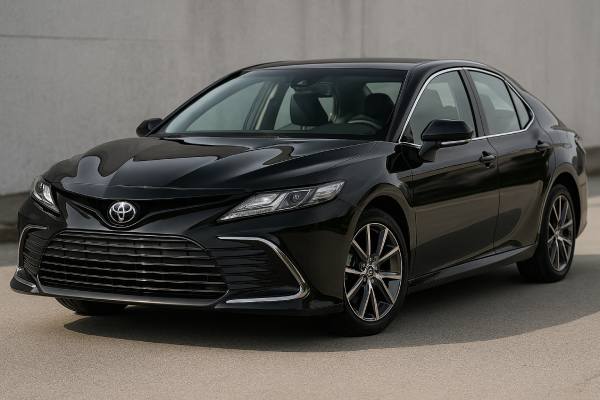
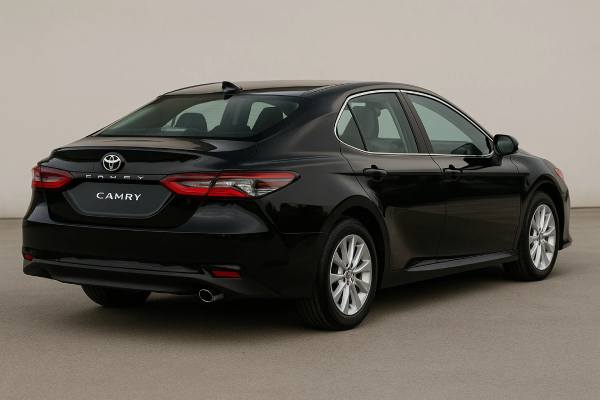
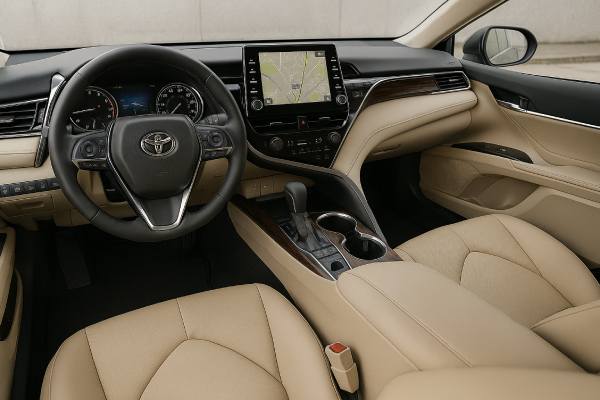
The 2021–2024 Toyota Camry Hybrid blends the eighth-generation Camry’s TNGA-K chassis with Toyota’s proven Hybrid Synergy Drive. The result is a midsize sedan that rides quietly, delivers strong real-world economy, and demands little from its owner beyond routine care. The facelift brought a tidier front fascia, larger screens, expanded Toyota Safety Sense 2.5+, and the sport-flavored XSE Hybrid. Under the hood sits the A25A-FXS 2.5-liter Atkinson-cycle four paired with a permanent-magnet traction motor and an eCVT. Net system output is 208 hp, enough for relaxed highway passing and easy merging. Trunk space remained full-size because the small hybrid battery lives under the rear seat, and the car’s straightforward packaging means good rear legroom and a low load floor. If you want a family sedan that simply works—year after year—the Camry Hybrid is one of the most predictable bets in the segment.
Fast Facts
- Excellent efficiency: LE Hybrid easily averages 50+ mpg (52 mpg combined EPA).
- Calm, comfortable ride with secure handling; eCVT is smooth and unobtrusive.
- Toyota Safety Sense 2.5+ standard on all years; strong crash-test results.
- Caveat: confirm OCS (passenger seat) safety recall completion during purchase.
- Routine service cadence: oil and filter every 10,000 miles / 12 months; tire rotation every 5,000 miles.
What’s inside
- Camry Hybrid detailed overview
- Camry Hybrid specs and data
- Trims, options, and safety tech
- Reliability, issues, and actions
- Maintenance and buyer’s guide
- Driving impressions and efficiency
- How Camry Hybrid compares
Camry Hybrid detailed overview
Toyota’s Camry Hybrid (AXVH70) sits on the TNGA-K platform, the same lightweight, stiff architecture used by Avalon, RAV4, and Lexus ES. The facelift (2021 model year) sharpened the front bumper, added new wheel designs (including 19-inch options on XSE Hybrid), and introduced updated infotainment with larger displays (7–9 in on lower trims; 9 in on many 2021+; 9 in/10 in across specific packages). The cabin favors function: big physical HVAC knobs, excellent visibility, and long-haul seats. Because the traction battery moved under the rear bench years ago, trunk capacity remains competitive and the rear seatbacks still fold (60/40 on most trims).
The A25A-FXS is an Atkinson-cycle 2.5-liter with combined direct and port injection (D-4S). It runs a high compression ratio and mates to an electric motor/generator via a planetary eCVT transaxle. This layout minimizes mechanical losses, keeps revs near the engine’s most efficient band, and allows engine-off coasting and low-speed EV creep. Net system output is 208 hp (155 kW). Real-world performance sits in the mid-7-second range to 60 mph depending on tire/wheel package and load, with passing power that feels stronger than the numbers suggest thanks to the electric motor’s instant torque.
Two battery chemistries appear in this generation depending on trim: LE Hybrid typically carries a lighter lithium-ion pack to maximize economy, while SE/XLE/XSE Hybrids often use a robust nickel-metal hydride (NiMH) pack that tolerates extreme temperatures well. Both live under the rear seat and are air-cooled. There is no external charging port; the car self-charges through regenerative braking and the engine-driven generator.
Toyota Safety Sense 2.5+ became standard during this period, bundling forward collision mitigation with pedestrian/bicyclist detection, full-speed adaptive cruise control, lane departure alert with steering assist, lane tracing assist (centering), road sign assist, and automatic high beams. Combined with strong crash performance and available “Good” headlights on specific trims/packages, the Camry Hybrid ranks among the safest midsize sedans of its era.
Daily living is where it shines: quiet at 70–75 mph, stable in crosswinds, simple to park, and cheap to run. The brake pedal is well-tuned for a hybrid, blending regenerative and friction braking smoothly. Ownership costs are low because there’s no alternator or conventional starter, accessory belts are minimal, and the eCVT has no clutches to service. For shoppers cross-shopping Accord Hybrid and Sonata Hybrid, the Camry trades a bit of cabin flash for bulletproof simplicity and a large national service network.
Camry Hybrid specs and data
Powertrain & Efficiency (HEV)
| Item | Specification |
|---|---|
| Code | A25A-FXS (engine) with Toyota Hybrid System II |
| Engine layout & cylinders | Inline-4, DOHC, 4 valves/cyl, Atkinson cycle |
| Bore × stroke | 87.5 × 103.4 mm (3.44 × 4.07 in) |
| Displacement | 2.5 L (2487 cc) |
| Induction | Naturally aspirated |
| Fuel system | D-4S combined direct + port injection |
| Compression ratio | ~14.0:1 (Atkinson cycle) |
| Max net system power | 208 hp (155 kW) |
| Engine peak power (approx.) | 176 hp (131 kW) @ ~5700 rpm |
| Engine peak torque (approx.) | 163 lb-ft (221 Nm) @ ~3600–5200 rpm |
| Traction motor (MG2) | AC synchronous permanent-magnet; ~88 kW / ~202 Nm peak |
| System voltage (max) | ~650 V |
| Hybrid battery | Lithium-ion (LE) or Nickel-Metal Hydride (SE/XLE/XSE), ~244.8 V nominal (NiMH) |
| Rated economy (EPA) | LE Hybrid: 51/53/52 mpg (city/hwy/combined) • SE/XLE/XSE Hybrid: 44/47/46 mpg |
| Rated efficiency (metric) | LE: 4.5 L/100 km combined • SE/XLE/XSE: ~5.1 L/100 km combined |
| Real-world highway @ 75 mph | ~45–50 mpg US (5.2–4.7 L/100 km), tire/wind/temp dependent |
| Aerodynamics | Cd ~0.27; frontal area ~2.3 m² (24.8 ft²) |
Notes: EPA figures vary by wheel/tire and equipment. European power ratings (218 PS) reflect a different measurement standard for essentially the same system.
Transmission & Driveline
| Item | Specification |
|---|---|
| Transmission | eCVT (planetary gearset with MG1/MG2) |
| Drive type | Front-wheel drive (no AWD on 2021–2024 HEV in NA) |
| Final drive ratio | ~3.389 (typical for this transaxle) |
| Differential | Open; brake-based torque vectoring via stability control |
| Refuel to full | ~5 minutes at pump (regular unleaded 87 AKI) |
Chassis & Dimensions
| Item | Specification |
|---|---|
| Suspension (front/rear) | MacPherson strut / Multi-link |
| Steering | Electric rack-and-pinion (EPS) |
| Brakes | Front ventilated discs ~305 mm (12.0 in); rear solid discs ~281 mm (11.1 in) |
| Wheels/Tires (common) | LE: 205/65R16; SE: 215/55R17; XLE: 235/45R18; XSE: 235/40R19 |
| Ground clearance | ~145 mm (5.7 in) |
| Length / Width / Height | 4881 / 1839 / 1445 mm (192.1 / 72.4 / 56.9 in) |
| Wheelbase | 2825 mm (111.2 in) |
| Turning circle (curb-to-curb) | ~11.4 m (37.4 ft) |
| Curb weight | ~1510–1625 kg (3330–3580 lb) depending on trim |
| GVWR | ~2045–2150 kg (4519–4740 lb), trim dependent |
| Fuel tank | 50 L (13.2 US gal / 11.0 UK gal) |
| Cargo volume (SAE) | 427 L (15.1 ft³), seats up |
Performance & Capability
| Metric | Value |
|---|---|
| 0–60 mph / 0–100 km/h | ~7.5–8.0 s depending on trim and tires |
| Top speed | ~112 mph (180 km/h), limited |
| Braking 62–0 mph | ~125–135 ft (38–41 m), tire/road temp dependent |
| Towing capacity | Not rated in North America |
| Payload / roof load | Not typically published for this segment; avoid roof loads without crossbars rated for the vehicle |
Fluids & Service Capacities
| System | Spec / Capacity |
|---|---|
| Engine oil | Toyota-approved API SP ILSAC GF-6B 0W-16; ~4.5 L (4.8 US qt) with filter |
| Engine/inverter coolant | Toyota Super Long Life Coolant (pink, silicate/borate-free); separate engine and inverter loops; capacities vary by trim (~7–8 L engine loop; ~3–4 L inverter loop) |
| eCVT (transaxle) | Toyota ATF WS; drain/fill ~3.6–4.0 L (service check only in official schedule) |
| A/C refrigerant | R-1234yf; ~500–550 g (17.6–19.4 oz) typical |
| A/C compressor oil | ND-Oil 12; ~80–120 mL (2.7–4.1 fl oz), model-specific |
| Key torque specs | Wheel lugs 103 Nm (76 lb-ft); oil drain plug ~40 Nm (30 lb-ft); always verify per VIN |
Electrical
| Item | Specification |
|---|---|
| Alternator | Not applicable (DC-DC converter from HV system) |
| 12V battery | AGM style, ~45–60 Ah (group size varies by trim), typically trunk-mounted |
| Spark plugs | Iridium; gap ~0.8 mm (0.031 in), service ~120,000 miles |
Safety & Driver Assistance
| Area | Highlights |
|---|---|
| Crash ratings | Strong IIHS results for 2021–2024 Camry; many builds qualify for Top Safety Pick/Top Safety Pick+ when equipped with Good/Adequate headlights and effective AEB |
| Headlights | Rating varies by trim/package; “Good” with specific LED projector setups |
| ADAS suite | Toyota Safety Sense 2.5+: Pre-Collision (car/pedestrian/bicyclist), Full-Speed DRCC, Lane Departure Alert with Steering Assist, Lane Tracing Assist, Road Sign Assist, Automatic High Beams; Blind Spot Monitor and Rear Cross-Traffic Alert standard/available by trim; rear cross-traffic braking on higher trims/packages |
Trims, options, and safety tech
Grades (2021–2024): LE Hybrid, SE Hybrid, SE Nightshade Hybrid (appearance), XLE Hybrid, and XSE Hybrid. All share the same 208-hp hybrid system and eCVT; differences center on wheels/tires, seats, audio, and cosmetic and lighting packages. Mechanically, sport-oriented SE/XSE add firmer springs/shocks, a rear stabilizer bar tune, and, often, larger wheel/tire packages that slightly reduce EPA ratings versus LE.
Fast identifiers:
- LE Hybrid: 16-inch wheels with higher-profile tires, cloth seats, standard LED headlamps, lighter lithium-ion battery on most builds (emphasis on fuel economy).
- SE Hybrid / SE Nightshade: 17-inch wheels (Nightshade 18-inch bronze/black on selected years), sport mesh grille, paddle shifters for simulated steps, often NiMH battery, sport-tuned suspension.
- XLE Hybrid: 18-inch wheels, SofTex® or leather seating with ventilation available, JBL® audio option, advanced driver-assist and parking packages, panoramic glass roof option.
- XSE Hybrid (from facelift): 19-inch wheels, sport body kit, contrast roof option, similar equipment level to XLE with a sport theme.
Year-to-year notes:
- 2021 facelift: refreshed fascia, larger center screens, expanded TSS 2.5+, arrival of XSE Hybrid.
- 2022: feature reshuffles (wireless device features via new head units on certain packages), color and Nightshade updates.
- 2023: Nightshade Hybrid with 19-inch bronze wheels available; tech and package tweaks.
- 2024: largely carry-over as the nameplate prepared for the next generation.
Packages & functional differences:
- Audio/infotainment tiers: base Audio with 7–9 in display → Audio Plus/JBL 9-speaker with sub.
- Lighting: LED projectors standard; adaptive/auto-leveling LEDs on upper trims improve headlight ratings.
- Driver aids: BSM/RCTA often standard beyond LE; panoramic camera and Intelligent Clearance Sonar with rear cross-traffic braking on XLE/XSE packages.
- Seats: power driver seat appears early in the range; memory/ventilated seats on XLE/XSE with packages.
- Wheels/tires: from 16 in (efficiency) to 19 in (style/handling). Bigger wheels sharpen turn-in but add noise and reduce mpg.
Safety ratings snapshot: Camry (including Hybrid) earns excellent IIHS crashworthiness with “Good” structure and effective front crash prevention; headlight rating is trim-specific (Good/Adequate/Marginal depending on lamp). Many configurations meet Top Safety Pick or Top Safety Pick+ when fitted with the better headlamps and AEB options. NHTSA testing commonly shows 5-Star overall across model years. Always verify the exact VIN’s equipment when quoting ratings.
Child-seat practicality: Outboard LATCH anchors are easy to reach; the wide rear bench accepts most rear-facing convertibles without pushing the front seats uncomfortably forward. The center position uses seatbelt plus a top tether.
Service implications after body/mechanical work: Radar/camera ADAS sensors require calibration after windshield replacement, bumper cover repair, or front structural work. Wheel alignment changes can affect Lane Tracing Assist; follow the scan tool’s centering and calibration procedures after suspension or steering service.
Reliability, issues, and actions
Overall reliability: High. The A25A-FXS/eCVT hybrid stack is one of Toyota’s most durable powertrains. The car lacks many common wear items (no alternator or conventional starter; few belts), and the hybrid battery is thermally managed and conservatively sized. Most owners report little beyond fluid and filter service through well past 100,000 miles.
Known concerns (mapped by prevalence and cost):
- Passenger seat Occupant Classification System (OCS) recall — common / high severity / covered. Certain 2020–2022 Camry and Camry Hybrid vehicles are included in a safety recall for OCS sensors that can short-circuit; this can disable passenger-airbag deployment and illuminate warnings. Action: run an official VIN check and verify recall completion on any candidate car.
- Windshield ADAS calibration after glass work — occasional / medium cost. Replacements require camera recalibration; cars with poor lane-keep performance after glass work often need a proper static/dynamic calibration.
- 12-V battery aging — occasional / low to medium cost. The AGM battery in the trunk lasts 4–6 years in typical climates; hybrids can mask a weak 12-V until push-button start fails or infotainment glitches appear. Load-test annually after year four.
- Brake booster/vacuum-assist feel — occasional / low. The blended regenerative/friction system is calibrated well, but pad glazing on cars that mostly do gentle city miles can cause initial bite to feel dull. One long, controlled stop from highway speed every few weeks helps keep rotors clean.
- Noise/vibration from large wheel packages — occasional / low. 19-inch tires on XSE Nightshade sacrifice some isolation and add impact harshness compared with LE/SE 16–17-inch setups.
Hybrid-system specifics and best practices:
- Battery chemistry by trim. LE Hybrid typically uses a lighter lithium-ion pack for peak economy; SE/XLE/XSE often use NiMH, which is more tolerant of extreme cold and steady high-load operation. Both chemistries have long service life when the battery intake duct is kept clear.
- Cooling & sealing. Periodically vacuum the rear-seat battery intake grill; pet hair and dust can restrict airflow and reduce battery longevity.
- Inverter and DC-DC thermal loops. Use only the pink Toyota Super Long Life Coolant and observe change intervals; mixing coolants or using non-approved fluids can reduce component life.
- Software updates. Occasional TSBs address infotainment stability, keyless entry behavior, and radar/PCS false-positive tuning. Dealers can check and apply calibration updates at service.
Engine & driveline durability:
- Timing chain system. The A25A family uses a chain; there is no scheduled replacement. Watch for rattle on cold starts only at very high mileage; correlation faults or cam/crank mis-alignment codes indicate inspection.
- Oil consumption. Rare when serviced on schedule with 0W-16; extended intervals or heavy highway heat can increase consumption.
- Fuel system & intake valves. D-4S port injection keeps intake valves cleaner than DI-only engines, making walnut-blasting uncommon.
- eCVT transaxle. Generally robust. Fluid service isn’t in the official schedule for normal use, but a drain/fill every 60k–100k miles can be a prudent preventive step for long-term owners.
Corrosion and underbody: TNGA-K cars resist rust well, but road-salt states can attack rear subframe fasteners, exhaust hangers, and the leading edges of the rocker panels. Inspect jacking points and rear brake lines during purchase.
Pre-purchase checklist:
- Verify all recalls/TSBs done; obtain a complete maintenance history.
- Confirm even tire wear; budget for tires if the car wears 19-inch sizes.
- Scan for stored ADAS faults and confirm proper lane-centering on a road test.
- Check for windshield replacement; ensure camera calibration is documented.
- Inspect the 12-V battery age and test results; look for water intrusion in trunk.
- Listen for suspension clunks over speed bumps (sway-bar links, top mounts).
Maintenance and buyer’s guide
Practical service schedule (North America, typical use):
- Every 5,000 miles / 6 months: Tire rotation; brake, suspension, and fluid-level inspections; top up washer fluid; inspect 12-V battery terminals; check HV battery intake for debris.
- Every 10,000 miles / 12 months: Engine oil and filter (0W-16); reset maintenance minder; inspect cabin filter.
- Every 20,000–25,000 miles / 2 years: Replace cabin air filter (more often in dusty/pollen seasons); clean HV battery intake.
- Every 30,000 miles / 3 years: Replace engine air filter; brake fluid inspection (replace if moisture content is high or fluid is dark); alignment check.
- Every 50,000–60,000 miles / ~5 years: Coolant visual check; consider eCVT drain/fill (Toyota WS) if long-term ownership; replace wiper blades; inspect water pump and hoses.
- 100,000 miles / 10 years: Replace engine and inverter coolants (Toyota SLLC); replace spark plugs (iridium, ~120k on many schedules); pressure-test cooling system.
- As needed: Brake pads/rotors (front pads often last 70k–100k+ due to regen); 12-V battery replacement at ~4–6 years; tires (16–19 in sizes).
Fluid and torque quick-reference (verify per VIN):
- Engine oil: 0W-16, ~4.5 L (4.8 qt).
- Toyota SLLC coolant: pink; separate engine/inverter loops.
- eCVT fluid: Toyota ATF WS, ~3.6–4.0 L on drain/fill.
- R-1234yf refrigerant: ~500–550 g typical; ND-Oil 12 for compressor.
- Wheel lugs: 103 Nm (76 lb-ft).
- Drain plug: ~40 Nm (30 lb-ft).
Buyer’s guide tips:
- Best value trims: LE Hybrid for maximum economy and lower tire costs; XLE Hybrid if you want full comfort features without the 19-inch ride penalty. XSE Hybrid adds style but expect slightly more road noise and a small mpg dip.
- Wheels/tires: 16–17 in packages ride quietly, wear evenly, and cost less to replace; 19 in look great but add harshness and reduce winter traction on rough roads.
- Options to seek: LED projector headlights with auto-leveling (better night visibility and safety-test optics), JBL audio if you keep cars a long time (resale and enjoyment).
- What to avoid: Modified suspension/wheels that upset lane-centering calibration; poorly repaired collision damage that can interfere with radar operation.
- Durability outlook: With routine maintenance, hybrid components commonly exceed 150,000–200,000 miles without major work. Many owners see original brake pads well past 70,000 miles thanks to regeneration. Coolant and cabin air filter neglect are the most common “ageing” issues—both inexpensive to put right.
Driving impressions and efficiency
Ride, handling, NVH: The Camry Hybrid is tuned for isolation first and foremost. LE/SE (16–17 in tires) filter joint impacts and broken pavement well, and the cabin remains composed at highway speeds with little wind rustle. The structure feels stiff over diagonal speed humps and during driveway entries, with minimal cowl shake. SE/XSE trims with firmer dampers and 18–19 in wheels feel more tied down in quick transitions but transmit more tire slap across expansion joints.
Steering and braking: EPS effort is light in parking lots and settles into a natural, medium-weight feel on the move. On-center stability at 70–75 mph is excellent. The hybrid brake blend is one of Toyota’s best calibrations: initial pedal travel triggers strong regeneration, then friction braking layers in smoothly as speed drops. Panic stops remain straight and predictable.
Powertrain character: In normal driving, the Camry eases away in EV mode up to neighborhood speeds, lights the engine quietly, and keeps revs modest. Push deeper into the pedal and the eCVT holds revs at the engine’s efficient torque plateau while the motor adds torque fill—no “hunting.” Sport mode firms the throttle map and lets the eCVT simulate steps with the paddles on SE/XSE, which can make downhill control feel more conventional. Engine noise is subdued, with only a distant growl under full load.
Real-world efficiency:
- City: Mid-50s mpg are achievable with gentle inputs (4.3–4.7 L/100 km). Short-trip winter driving can pull this into the low 40s until coolant is up to temp.
- Highway (60–75 mph / 100–120 km/h): Expect high 40s mpg at 65 mph, mid-40s at 75 mph depending on wind, grade, and wheel size.
- Mixed commuting: Most owners see high 40s to low 50s mpg in temperate weather.
Cold weather hurts any hybrid because of warm-up enrichment and cabin-heat loads; the NiMH-equipped trims tend to be a touch more consistent in sub-freezing temps, while the lighter Li-ion LE shines in mild climates.
Performance metrics that matter: 0–60 mph in roughly 7.5–8.0 s is more than adequate for two-lane passes and on-ramp merges, and the 50–80 mph surge is confident thanks to the motor’s instant torque. Braking from highway speeds is stable and repeatable. The turning circle is compact enough for easy U-turns on typical suburban streets.
Load and grades: The cooling package handles summer climbs well. With four adults and luggage, downshifted engine revs are audible but not intrusive. There is no rated conventional towing in North America; use a hitch only for light racks within tongue-weight limits. Expect a 2–4 mpg penalty with full passengers and cargo at interstate speeds.
How Camry Hybrid compares
Honda Accord Hybrid (2021–2024): Quicker and a bit more refined in powertrain blending, with a roomier back seat. The Toyota counters with simpler long-term maintenance, broader dealer coverage, and often better retained value. Highway mpg is similar; city mpg can favor Camry LE.
Hyundai Sonata Hybrid (2021–2023): High feature count and an available solar roof. Steering feel and cabin tech impress, but long-term reliability and parts pricing historically favor Toyota. Camry’s resale and national inventory of parts give it the edge for owners who keep cars past 100,000 miles.
Kia K5 Hybrid (not widely offered in NA for these years): Where available, it undercuts on price and includes generous warranty coverage; Toyota answers with proven hybrid hardware and wider support.
Toyota’s own Prius / Corolla Hybrid: If you want even higher mpg and hatchback practicality, Prius leads. If you prioritize quietness, rear-seat space, and traditional sedan manners, Camry Hybrid is the more comfortable long-haul car.
Verdict: For buyers wanting a midsize sedan that’s easy to live with, exceptionally efficient, and inexpensive to own over the long run, the 2021–2024 Camry Hybrid remains one of the safest, most rational choices—particularly in LE or XLE trim depending on your priorities.
References
- Gas Mileage of 2021 Toyota Camry 2021 (EPA Database)
- 2021 Toyota Camry 2021 (Safety Rating)
- 2021 WARRANTY & MAINTENANCE GUIDE 2021 (Owner’s Maintenance)
- MY21 Camry eBrochure 2021 (Manufacturer Brochure)
- ◄ IMPORTANT UPDATE ► 2024 (Recall Notice, 23V-865)
Disclaimer
This article is for informational purposes and does not replace professional diagnosis, repair, or manufacturer service literature. Specifications, torque values, intervals, and procedures vary by VIN, model year, market, and equipment. Always verify details against your vehicle’s official owner’s manual, service manual, and dealer records.
If you found this guide useful, please consider sharing it with friends on Facebook or X/Twitter to support xcar’s work.