
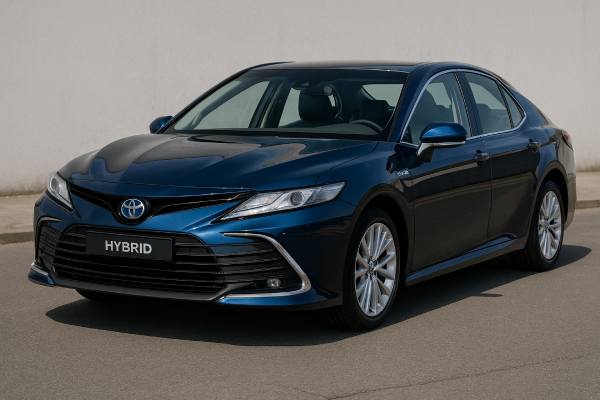
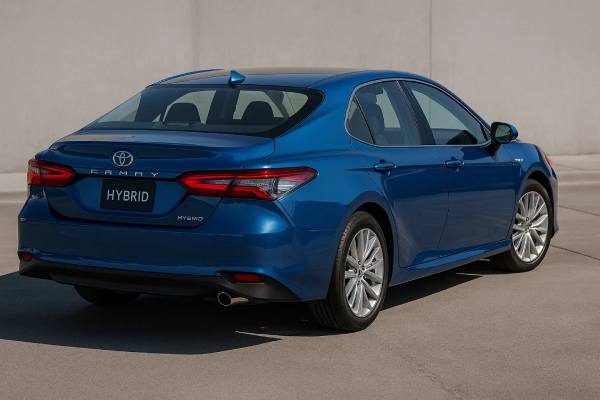
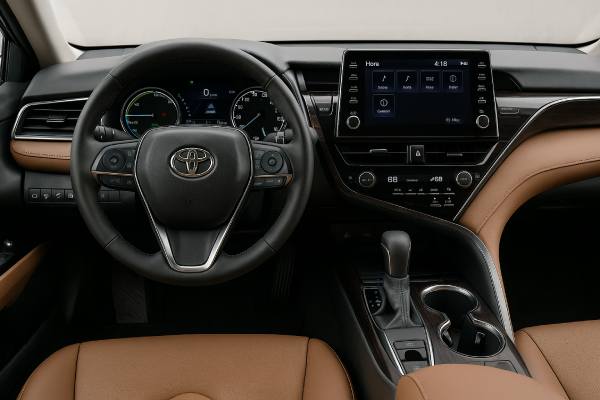
The 2021–2024 Toyota Camry Hybrid folds Toyota’s proven Hybrid Synergy Drive into a mature midsize sedan package that favors quiet progress, low operating costs, and effortless everyday use. The facelift introduced a crisper front end, a larger “floating” touchscreen layout, and Toyota Safety Sense 2.5+ across the range. Under the hood sits the A25A-FXS 2.5-liter Atkinson-cycle four working with a traction motor via an eCVT. Total system output is commonly quoted at 208 hp in North America, while some markets list 215–218 hp—differences stem from rating methods rather than hardware. The hybrid battery tucks beneath the rear seat, so trunk space stays generous and the rear seats still fold. What owners notice most is how little attention the Camry Hybrid demands: it starts, sips fuel, and shrugs off long commutes with low noise and an easygoing ride. If you want a sedan to keep for years, this is a safe, sensible choice.
Top Highlights
- Outstanding economy (LE often averages 50+ mpg / ~4.7 L/100 km) with calm highway manners.
- Strong safety story: robust structure and a comprehensive Toyota Safety Sense 2.5+ suite.
- Simple ownership: no turbo, no alternator, minimal belts; long service intervals.
- Caveat: verify passenger-seat OCS recall completion and ADAS recalibration after any windshield work.
- Typical cadence: tire rotation every 5,000 miles (8,000 km); oil and filter every 10,000 miles (12 months) with 0W-16.
Guide contents
- Camry Hybrid 2021–2024 Overview
- Camry Hybrid Specs and Technical Data
- Trims, Options and Safety
- Reliability, Issues and Service Actions
- Maintenance and Buyer’s Guide
- Driving and Efficiency
- Camry Hybrid vs Rivals
Camry Hybrid 2021–2024 Overview
Toyota’s facelift of the eighth-generation Camry sharpened the design without changing the fundamentals: a stiff TNGA-K platform, efficient hybrid power, and a cabin that prizes ease of use. The move to a “floating” infotainment screen (7–9 inches, trim-dependent) improved ergonomics, while Toyota Safety Sense 2.5+ expanded hazard detection and lane-centering performance. A sport-flavored XSE Hybrid joined the lineup alongside LE, SE (plus Nightshade), and XLE, bringing 19-inch wheels and firmer chassis tuning to those who want a bit more visual drama.
Power comes from the A25A-FXS, a long-stroke 2.5-liter working on the Atkinson cycle for high thermal efficiency. It pairs to a two-motor transaxle: MG1 functions mainly as a generator and engine starter; MG2 is the traction motor that adds torque and performs most regeneration. A planetary gearset combines engine and motor torque seamlessly—no clutches to service, no stepped shift shocks. The hybrid battery (lithium-ion on many LE builds; nickel-metal hydride on SE/XLE/XSE) mounts under the rear seat with a dedicated cooling path, keeping trunk space at a useful 15.1 ft³ (428 L).
Real-world use is where the Camry Hybrid earns loyalty. It pulls away silently in neighborhoods, merges briskly thanks to instant electric torque, and settles into a quiet, low-rpm cruise. Brake tuning—the blend of regenerative and friction braking—feels natural, with linear pedal effort and consistent stops. The cabin is straightforward: big climate knobs, clear instruments, and family-friendly storage. Packaging is thoughtful for child seats, and visibility is strong. Over thousands of miles, owners report low running costs and few surprises. Compared with turbocharged rivals, the Camry’s naturally aspirated hybrid approach trades some peak acceleration for durability and steady highway economy on regular fuel.
If you are comparing horsepower figures across sources, note the rating nuance: North American materials typically quote 208 hp net system power, while European materials often show 215–218 hp (160 kW/218 PS). The difference is largely procedural—drivability feels the same. What matters day to day is the quiet, predictable way the car moves, steers, and sips fuel.
Camry Hybrid Specs and Technical Data
Powertrain and Efficiency (HEV)
| Item | Specification |
|---|---|
| Engine code | A25A-FXS (Dynamic Force) |
| Engine layout & cylinders | Inline-4, DOHC, 16 valves; Atkinson cycle |
| Bore × stroke | 87.5 × 103.4 mm (3.44 × 4.07 in) |
| Displacement | 2.5 L (2,487 cc) |
| Induction | Naturally aspirated |
| Fuel system | D-4S (combined direct + port injection) |
| Compression ratio | ~14.0:1 |
| Net system output | 208 hp (155 kW) NA rating; ~215–218 hp in some markets |
| Engine-only output (approx.) | ~176 hp (131 kW) @ ~5,700 rpm |
| Engine torque (approx.) | ~221 Nm (163 lb-ft) @ ~3,600–5,200 rpm |
| Traction motor (MG2) | AC synchronous PMSM; ~88 kW peak; ~202 Nm peak |
| System voltage | ~600–650 V peak |
| Hybrid battery | Li-ion (often LE) or NiMH (often SE/XLE/XSE); under-seat; air-cooled |
| Rated economy (EPA) | LE Hybrid: 51/53/52 mpg (city/hwy/combined) • SE/XLE/XSE: ~44/47/46 mpg |
| Metric economy | LE: ~4.5 L/100 km combined • SE/XLE/XSE: ~5.1 L/100 km combined |
| Real-world highway @ 120 km/h (75 mph) | ~4.7–5.2 L/100 km (50–45 mpg US / 60–54 mpg UK), conditions dependent |
| Aerodynamics | Cd ~0.27 (trim/wheel dependent) |
Transmission and Driveline
| Item | Specification |
|---|---|
| Transmission | eCVT (planetary gearset with MG1/MG2) |
| Drive type | Front-wheel drive |
| Final drive ratio | ~3.39:1 (typical for this transaxle) |
| Differential | Open; brake-based torque control via stability system |
| Refuel to full | ~5 minutes at pump (regular unleaded) |
Chassis and Dimensions
| Item | Specification |
|---|---|
| Platform | TNGA-K unibody; extensive high-strength steel |
| Suspension (front/rear) | MacPherson strut / multi-link |
| Steering | Electric rack-and-pinion; on-center stability tuned for highway |
| Brakes | Front ventilated discs ~305 mm (12.0 in); rear solid discs ~281 mm (11.1 in) |
| Wheels/Tires (typical) | LE: 205/65R16 • SE: 215/55R17 • XLE: 235/45R18 • XSE: 235/40R19 |
| Ground clearance | ~145 mm (5.7 in) |
| Length / Width / Height | 4,881 / 1,839 / 1,445 mm (192.1 / 72.4 / 56.9 in) |
| Wheelbase | 2,825 mm (111.2 in) |
| Turning circle (curb-to-curb) | ~11.4 m (37.4 ft) |
| Curb weight | ~1,510–1,625 kg (3,330–3,580 lb), trim-dependent |
| GVWR | ~2,045–2,150 kg (4,519–4,740 lb) |
| Fuel tank | 50 L (13.2 US gal / 11.0 UK gal) |
| Cargo volume (SAE) | 428 L (15.1 ft³) |
Performance and Capability
| Metric | Value |
|---|---|
| 0–60 mph / 0–100 km/h | ~7.5–8.0 s (wheel/tire and load dependent) |
| Top speed | ~180 km/h (112 mph), limited |
| Braking 100–0 km/h | ~38–41 m (125–135 ft), tire/temp dependent |
| Towing capacity | Not rated in baseline market |
| Roof load | Use OEM-rated crossbars; follow accessory limits |
Fluids and Service Capacities
| System | Specification | Capacity (typical) |
|---|---|---|
| Engine oil | 0W-16 API SP, ILSAC GF-6B | ~4.5 L (4.8 US qt) with filter |
| Engine coolant | Toyota Super Long Life Coolant (pink) | ~7–8 L loop (approx.) |
| Inverter/e-drive coolant | Toyota Super Long Life Coolant | ~3–4 L loop (approx.) |
| eCVT transaxle | Toyota ATF WS | ~3.6–4.0 L drain/fill (no routine change in schedule) |
| A/C refrigerant | R-1234yf | ~500–550 g (17.6–19.4 oz) |
| A/C compressor oil | ND-Oil 12 | ~80–120 mL (2.7–4.1 fl oz) |
| Key torque specs | Wheel lugs 103 Nm (76 lb-ft); oil drain plug ~40 Nm (30 lb-ft) (verify by VIN) |
Electrical
| Item | Specification |
|---|---|
| Alternator | Not applicable (DC-DC converter from HV system) |
| 12 V battery | AGM, ~45–60 Ah (group size varies); trunk-mounted |
| Spark plugs | Long-life iridium; gap ~0.8 mm (0.031 in) |
Safety and Driver Assistance
| Area | Highlights |
|---|---|
| Crash performance | Excellent IIHS and NHTSA outcomes for this generation; ratings vary with headlight/package mix |
| Headlights | LED projectors standard; adaptive/auto-leveling LEDs on upper trims often score better |
| ADAS suite | Toyota Safety Sense 2.5+: Pre-Collision with pedestrian/bicyclist detection, Full-Speed DRCC, Lane Departure Alert with Steering Assist, Lane Tracing Assist, Road Sign Assist, Auto High Beams; Blind Spot Monitor and Rear Cross-Traffic Alert standard/available by trim; panoramic camera and rear cross-traffic braking available |
Trims, Options and Safety
Lineup (2021–2024): LE Hybrid, SE Hybrid, SE Nightshade Hybrid (appearance), XLE Hybrid, XSE Hybrid. All share the same hybrid system and eCVT; the differences are wheels/tires, seat materials, lighting, audio, parking aids, and chassis tune.
Quick identifiers and functional differences
- LE Hybrid — Efficiency special: 16-inch tires, lighter Li-ion battery on many builds, softest ride, top EPA numbers, lowest tire replacement cost.
- SE Hybrid — Sport grille, slightly firmer springs/dampers, 17-inch tires, often NiMH battery for robust cold-weather behavior; simulated “shift” steps via paddles.
- SE Nightshade Hybrid — Blacked-out trim/wheels (18–19 in by year); no mechanical change.
- XLE Hybrid — Comfort spec: 18-inch wheels, SofTex®/leather, available ventilated seats, memory, JBL® audio, panoramic camera, and parking sonar with rear auto-brake.
- XSE Hybrid — Sport-luxury: 19-inch wheels, contrast roof option in some years, firmer damping, similar features to XLE with a more athletic look.
Packages worth seeking
- Premium Audio with JBL — cleaner sound, larger screen, wired/wireless smartphone integration depending on head unit.
- Advanced lighting — adaptive/auto-leveling LED projectors on upper trims help with night visibility and can improve formal headlight ratings.
- Driver Assist bundle — panoramic camera, parking sonar with rear cross-traffic braking; great in tight garages and poor winter visibility.
Safety ratings and child-seat notes
- With the right headlamps, many Camry Hybrids qualify for top-tier safety awards in their test years. LATCH anchors are accessible and rear-seat geometry fits two child seats plus a booster in many layouts. If you swap windshields, budget for camera recalibration to maintain lane-centering performance.
Year-to-year highlights
- 2021 — Facelift styling, larger screens, Safety Sense 2.5+, introduction of XSE Hybrid.
- 2022 — Feature and color reshuffles; multimedia/ADAS calibration refinements via production and service.
- 2023 — Nightshade Hybrid with distinctive wheel finishes; minor packaging updates.
- 2024 — Largely carry-over, as the line prepared for the next generation.
Reliability, Issues and Service Actions
Overall reliability: High. The A25A-FXS/eCVT hybrid stack is one of Toyota’s most durable modern powertrains. Owners commonly report nothing beyond routine fluids and filters for the first several years, with brake life extended by regeneration.
Common (low → medium cost)
- Infotainment hiccups (Bluetooth pairing, camera flicker, intermittent audio) — typically resolved with software updates; verify the head unit’s current calibration on service records.
- Brake feel degradation on lightly driven cars — pad glazing or rotor surface rust from regen-heavy use. Remedy with several firm stops from highway speeds and, if needed, rotor/pad service and proper wheel lug torque.
- Cabin noise on 19-inch tires — stylish but louder on coarse asphalt; a touring-oriented tire choice helps.
Occasional (medium cost)
- Windshield/ADAS calibration — lane-centering wander or warnings after glass work often point to a missed or incomplete camera calibration. Ensure static/dynamic procedures are performed and documented.
- 12-V battery aging — expect 4–6 years; hybrids can hide weak 12-V symptoms until start/infotainment glitches appear. Load-test annually after year four.
Rare but high-visibility safety actions
- Occupant Classification System (front passenger seat) recall — certain 2020–2022 builds. Affected cars may misclassify passenger weight in rare sensor faults, potentially altering airbag deployment logic. Remedy is inspection/replacement; verify completion by VIN.
- Miscellaneous software campaigns — periodic ADAS and multimedia updates that improve stability or reduce false positives; quick dealer flashes.
Hybrid-system best practices
- Battery intake hygiene — vacuum the rear-seat intake grill periodically (pet hair/dust reduce cooling airflow).
- Coolant discipline — engine and inverter loops both use Toyota Super Long Life Coolant; never mix types and keep change intervals.
- Long-term transaxle care — not required in the official schedule, but a preventive drain/fill of Toyota WS ATF around 60k–100k miles is a reasonable owner choice if you plan to keep the car long term.
Driveline/chassis notes
- Timing chain — no scheduled replacement; investigate only if rattle or correlation faults appear at very high mileage.
- Suspension wear — sway-bar links and top mounts are typical wear points in salt states; easy fixes.
- Corrosion — look at rear subframe bolts, brake shields, and rocker leading edges on winter cars.
Pre-purchase essentials
- Printout of VIN recall results and completed campaign numbers with dates.
- Documented software levels (ECU/ADAS/infotainment) on recent repair orders.
- Even tire set with matching sizes and similar tread depths; mixed tires can confuse ABS/traction logic.
- Brake measurements (pad thickness, rotor run-out) and a clean test drive from 60 mph without shimmy.
Maintenance and Buyer’s Guide
Practical maintenance schedule (typical use)
- Every 5,000 miles / 6 months — Rotate tires; inspect brakes, steering/suspension joints, driveshaft boots, and underbody; check fluids; inspect 12-V battery; clear HV battery intake grill.
- Every 10,000 miles / 12 months — Replace engine oil and filter (0W-16); inspect cabin filter; reset reminders.
- Every 20,000–25,000 miles / 2 years — Replace cabin air filter; clean battery intake; inspect brake fluid condition.
- Every 30,000 miles / 3 years — Replace engine air filter; alignment check; measure rotor thickness/run-out.
- Every 50,000–60,000 miles — Consider eCVT WS ATF drain/fill (owner-choice preventative); inspect water pump and coolant hoses; replace wiper blades.
- 100,000 miles / 10 years — Replace engine and inverter coolants (Toyota SLLC); replace spark plugs (iridium, ~120k on many schedules); pressure-test cooling system.
- Brake fluid — Replace about every 3 years or when moisture/boiling-point tests fail.
- 12-V battery — Load-test annually after year 4; typical life 4–6 years.
Fluid specifications and quick decisions
- Engine oil: 0W-16, API SP, ILSAC GF-6B; ~4.5 L with filter.
- Coolants: Toyota pink SLLC only; separate engine and inverter loops.
- eCVT fluid: Toyota WS; service method requires level-check procedure at set temperature.
- A/C: R-1234yf with ND-Oil 12; charge strictly by weight.
- Essential torques: wheel lugs 103 Nm (76 lb-ft); oil drain plug ~40 Nm (30 lb-ft) (verify per VIN).
DIY friendliness
- Under-tray removal is needed for oil changes; filters are accessible; battery access is straightforward in the trunk. Use a memory saver if disconnecting the 12-V battery to avoid radio/power window relearns. Follow the service manual when opening the cooling loops to prevent air pockets—hybrid systems are sensitive to trapped air.
Buyer’s Guide: what to look for
- Records: full service history, printed recall completion, any ADAS or infotainment software updates.
- Tires: even wear across the set; avoid mismatched brands/sizes.
- Brakes: straight, shimmy-free stops from 60 mph; no pulsation.
- Windshield history: if replaced, confirm camera calibration paperwork.
- Underside: look for surface rust on subframes and exhaust hangers in salt states.
- Interior: test all cameras, sensors, and parking aids; check for water in the trunk (tail-lamp/body-seam leaks are rare but worth a glance).
Which trim to choose
- Maximum mpg and ride comfort: LE Hybrid (16-inch tires, lighter curb weight).
- Best all-rounder: XLE Hybrid (quiet, well-equipped, strong headlights with the right package).
- Style with composure: XSE Hybrid (19-inch wheels; consider touring-oriented tires for quieter highways).
Durability outlook
- Expect hybrid components to run 150,000–200,000+ miles with proper cooling and clean filters. Many owners see brakes last 70,000–100,000 miles thanks to regeneration. Neglect tends to be simple (cabin filter, coolant intervals) and inexpensive to correct.
Driving and Efficiency
Ride and handling
Ride quality is the Camry Hybrid’s calling card. LE/SE on 16–17-inch tires glide over patchy asphalt with controlled body motions and little boom. XLE/XSE tighten roll without turning harsh, though 19-inch tires transmit more thump across expansion joints. The TNGA-K structure stays composed over diagonal speed humps with minimal cowl shake. On the highway, straight-line stability is excellent, and crosswinds seldom disturb the car.
Steering and braking
Steering effort is light during parking and natural at speed, with predictable build-up off center. The brake pedal is among the better hybrid calibrations: initial travel captures plenty of regen, and the hand-off to friction braking is nearly seamless. Panic stops track straight with solid pedal feel.
Powertrain character
Around town, the car often eases forward on electric torque alone, then lights the engine unobtrusively. Press harder and the eCVT holds the engine near its efficient plateau while MG2 fills in torque, so the car just “goes” without shift shock. Sport mode sharpens the throttle and allows simulated steps (SE/XSE paddles), useful for downhill control. Engine noise climbs under full load, but it’s muted at cruise.
Real-world consumption
- City: mid-50s mpg (4.3–4.7 L/100 km) is achievable with gentle inputs and warm weather.
- Highway (100–120 km/h / 60–75 mph): expect high-40s mpg at 65 mph and mid-40s at 75 mph depending on wind, grade, and wheel size.
- Mixed: high-40s to low-50s mpg in temperate climates.
Cold snaps and short trips dent any hybrid’s numbers; NiMH-equipped trims tend to maintain consistency in deep cold, whereas the lighter Li-ion LE shines in mild climates.
Key metrics that inform the verdict
- 0–60 mph in roughly 7.5–8.0 s means confident merges and two-lane passes.
- 100–0 km/h braking around 38–41 m is class-competitive with quality tires.
- Turning circle near 11.4 m (37.4 ft) keeps U-turns easy in suburbs.
Load and long grades
With four adults and luggage, the hybrid holds speed on interstate climbs without overheating. Expect a 2–4 mpg penalty when fully laden or facing strong headwinds. North America does not rate the car for towing; if you add a hitch, use it for light racks only and stay within tongue-weight limits.
Camry Hybrid vs Rivals
Honda Accord Hybrid (2021–2024)
The Accord Hybrid feels a touch more eager off the line and blends engine/motor contribution with great polish. The Camry counters with simpler long-term maintenance, broader dealer coverage, and typically higher retained value. Highway fuel economy and cabin quiet are competitive; city mpg can favor the Camry LE.
Hyundai Sonata Hybrid (2021–2023)
Feature-rich and stylish, with an available solar roof. The Toyota’s long-term reliability record and parts pricing usually tip the scales for owners planning 100,000+ miles of use. The Camry’s ride isolation and safety-system tuning are standouts.
Kia K5 Hybrid (limited availability in NA)
Where offered, it brings strong value and warranty coverage. The Camry’s simpler powertrain, broader service network, and strong resale remain convincing.
Toyota Prius / Corolla Hybrid (cross-shop)
If outright mpg and hatchback utility top your list, Prius leads. For adult-friendly rear space, a quieter ride, and traditional sedan manners, the Camry Hybrid is easier to live with daily.
Verdict
If you want a comfortable, efficient, low-drama sedan with a decade-long ownership horizon, the 2021–2024 Camry Hybrid deserves a top-three spot on your list. LE maximizes economy; XLE adds comfort and lighting; XSE delivers the look with only a small mpg trade-off.
References
- Gas Mileage of 2021 Toyota Camry 2021 (EPA Database)
- 2021 Toyota Camry 4-door sedan 2021 (Safety Rating)
- Warranty & Maintenance Guide — 2021 Camry 2021 (Owner’s Maintenance)
- MY21 Camry eBrochure 2021 (Manufacturer Brochure)
- Manufacturer Notice — Recall 23V-865 2023 (Recall)
Disclaimer
This guide is for informational purposes only and is not a substitute for professional diagnosis or repair. Specifications, torque values, fluid capacities, intervals, and procedures vary by VIN, model year, market, and equipment. Always verify details against your vehicle’s official owner’s manual, service literature, and dealer records before performing work or making purchase decisions.
If this article helped, please consider sharing it on Facebook or X/Twitter to support xcar’s independent work.