
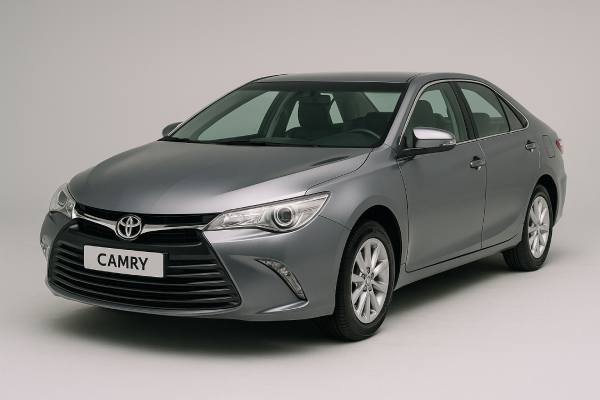
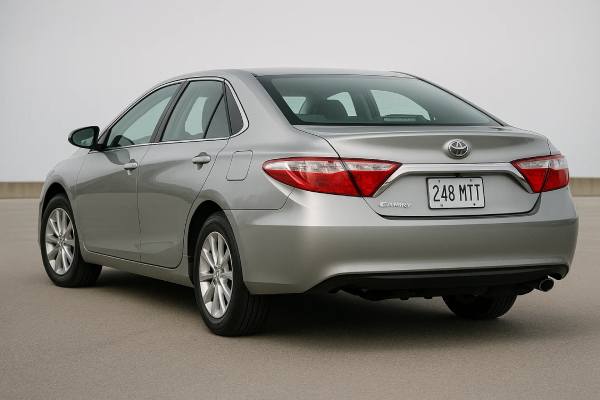
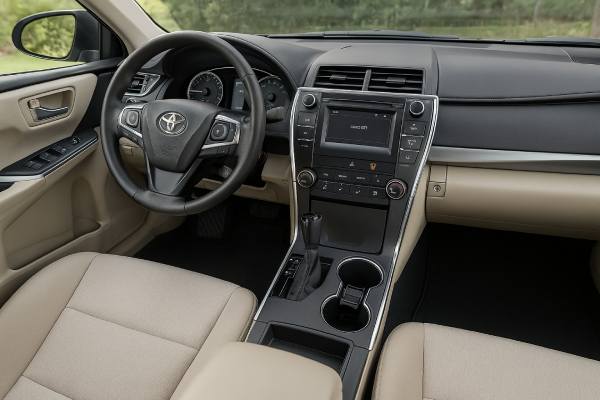
The 2015–2017 Toyota Camry V6 (GSV50) sits in a sweet spot for shoppers who want midsize comfort with near-sport-sedan pace and long-term durability. The 2GR-FE 3.5-litre V6 makes an effortless 268 hp and pairs to a smooth 6-speed automatic and front-wheel drive. The 2015 facelift sharpened the chassis and cabin, and the V6 arrived mostly in XLE and XSE trims—one tuned for comfort, the other for a firmer, more controlled ride. Running costs stay reasonable thanks to a timing chain, long-life iridium plugs, and 0W-20 synthetic intervals. Active safety features like Pre-Collision (AEB), lane departure alert, and blind-spot monitoring were available, and crash results are excellent when optioned correctly. If you want a quiet, quick highway car that will likely outlast your patience, a well-maintained XV50 V6 is hard to beat. Read on for specs, dimensions, performance, reliability patterns, maintenance intervals, and buying pointers tailored to this exact variant.
At a Glance
- Strong, refined 3.5-litre V6; effortless passing and quiet cruising.
- Comfortable, durable platform; low ownership friction and broad parts availability.
- Optional AEB and lane assist; crash results are excellent with the right package.
- Watch for water-pump seepage and aged mounts around ~100,000 mi (160,000 km).
- Oil service: 10,000 mi/12 months with 0W-20 (rotate tyres every 5,000–6,000 mi).
Explore the sections
- Camry V6 2015–2017 Overview
- Toyota Camry 2GR-FE Specs
- Trims, Options, and Safety
- Reliability and Common Issues
- Maintenance Plan and Buying Advice
- Driving Impressions and Economy
- Camry V6 Against Rivals
Camry V6 2015–2017 Overview
The 2015 refresh (still XV50/GSV50 under the skin) brought a stiffer body, retuned suspension, tighter steering, additional sound insulation, and thoroughly updated styling. The powertrain remained a proven formula: the all-aluminium 2GR-FE 60-degree V6 with Dual VVT-i delivering 268 hp (200 kW) and 248 lb-ft (336 Nm) through a 6-speed automatic. In this market window, the V6 was packaged chiefly as XLE (comfort-oriented) and XSE (sport-tuned). The XLE focuses on isolation, ride compliance, and a quieter cabin, typically on 17-inch wheels. The XSE adds firmer springs/dampers, distinct bushing and steering calibration, and 18-inch tyres for crisper response without straying into harshness.
Highway composure is a core virtue: straight-line stability is excellent; the V6 hums just above idle in top gear; and the cabin remains calm on coarse surfaces. The transmission prefers unobtrusive shifts in normal driving and will kick down readily for passing; manual mode is present but not performance-oriented. Brakes are confidence-inspiring, and pedal tuning avoids the on/off feel some competitors had in this era.
Active safety took a step up during these years. The optional Pre-Collision System (automatic emergency braking) and Dynamic Radar Cruise Control became more available, alongside lane departure alert, blind-spot monitoring, and rear cross-traffic alert. Headlight performance depends heavily on trim and options; the halogen setups with the technology package can rate acceptably, while certain LED combinations on V6 trims test poorly for glare. That nuance matters for shoppers chasing the highest IIHS awards.
For daily life, the 2GR-FE’s design choices pay dividends: a maintenance-free timing chain, long-interval iridium spark plugs, and Toyota’s pink Super Long Life Coolant reduce service frequency. Typical V6 real-world economy runs mid-20s mpg combined (about 9.8–10.7 L/100 km), and highway figures around 28–31 mpg (8.4–7.6 L/100 km) are achievable with steady 70–75 mph cruising. With a roomy back seat and a 15.4 ft³ (436 L) trunk, this generation remains family-friendly without feeling bulky.
Toyota Camry 2GR-FE Specs
Engine & Performance
| Item | Value |
|---|---|
| Code | 2GR-FE |
| Engine layout & cylinders | 60° V6, DOHC, Dual VVT-i, 4 valves/cyl |
| Bore × stroke | 94.0 × 83.0 mm (3.70 × 3.27 in) |
| Displacement | 3.5 L (3456 cc) |
| Induction | Naturally aspirated |
| Fuel system | Sequential multi-port fuel injection (SFI) |
| Compression ratio | ~10.8:1 |
| Max power | 268 hp (200 kW) @ 6200 rpm |
| Max torque | 336 Nm (248 lb-ft) @ 4700 rpm |
| Timing drive | Chain |
| Rated economy (EPA window-sticker) | ~21 mpg city / 30–31 mpg hwy / 24–25 mpg comb (varies by year/trim) |
| Real-world highway @ 120 km/h (75 mph) | ~7.6–8.4 L/100 km (31–28 mpg US / 37–34 mpg UK) |
| Aerodynamics | Cd ≈ 0.28 (frontal area n/a) |
Transmission & Driveline
| Item | Value |
|---|---|
| Transmission | U660E 6-speed automatic w/ manual mode |
| Gear ratios (1st→6th / Rev) | 3.30 / 1.90 / 1.42 / 1.00 / 0.71 / 0.61 / 4.15 |
| Final drive ratio | ~3.46:1 |
| Drive type | FWD |
| Differential | Open |
| Refuel to full (typical) | ~5 minutes (gasoline) |
Chassis & Dimensions
| Item | Value |
|---|---|
| Suspension (front/rear) | MacPherson strut / Dual-link strut, anti-roll bars |
| Steering | Electric power steering (rack-and-pinion) |
| Brakes | 296 mm (11.7 in) ventilated front discs / ~281 mm (11.1 in) rear discs |
| Wheels/Tires (common V6) | 215/55R17 (XLE); 225/45R18 (XSE) |
| Ground clearance | ~155 mm (6.1 in) |
| Length / Width / Height | 4850 / 1820 / 1470 mm (190.9 / 71.7 / 57.9 in) |
| Wheelbase | 2775 mm (109.3 in) |
| Turning circle (kerb-to-kerb) | ~11.2 m (36.7 ft) |
| Curb weight | ~1530–1580 kg (3375–3485 lb) depending on trim |
| GVWR | ~2100 kg (4630 lb) (approx., trim-dependent) |
| Fuel tank | 64 L (16.9 US gal / 14.1 UK gal) |
| Cargo volume (trunk) | 436 L (15.4 ft³) — SAE |
Performance & Capability
| Metric | Value |
|---|---|
| 0–100 km/h (0–62 mph) | ~6.2–6.5 s (street tyres) |
| Top speed | ~190 km/h (118 mph) limited |
| 100–0 km/h braking | ~38–40 m (125–131 ft), tyre-dependent |
| Towing capacity | Not factory-rated in many markets (light utility ~450 kg/1000 lb where permitted) |
| Payload | ~385–430 kg (850–950 lb), trim-dependent |
| Roof load | ~68 kg (150 lb) with approved crossbars |
Fluids & Service Capacities
| System | Specification | Capacity |
|---|---|---|
| Engine oil | API SN/RC (or newer), 0W-20 full synthetic | ~6.1 L (6.4 US qt) w/ filter |
| Coolant | Toyota Super Long Life (pink), 50/50 | ~9–10 L (9.5–10.6 US qt) total system |
| Automatic transaxle | Toyota ATF WS | ~3.7–4.0 L (3.9–4.2 US qt) drain-and-fill (significantly more dry) |
| A/C refrigerant | R-134a | ~500–550 g (18–19 oz) |
| A/C compressor oil | ND-OIL 8 (PAG46) | as required by service |
| Key torque specs | Wheel lugs 103 Nm (76 lb-ft) · Oil drain plug 39 Nm (29 lb-ft) · Spark plugs ~18 Nm (13 lb-ft) |
Electrical
| Item | Value |
|---|---|
| Alternator output | ~130 A |
| 12V battery | Group 24F, ~55–65 Ah (≈550–650 CCA) |
| Spark plug | Iridium (e.g., Denso FK20HR11 / NGK IFR6A11); gap 1.1 mm (0.043 in) |
Safety & Driver Assistance
| Area | Details |
|---|---|
| Crash ratings | IIHS: 2015–2017 models rate Good in major crashworthiness tests; Top Safety Pick or Top Safety Pick+ when equipped with optional front crash prevention and acceptable headlights. |
| Headlight rating (IIHS) | Trim/lighting dependent: halogen + Tech pkg can be Acceptable; some LED projector setups on V6 trims are Poor due to glare. |
| ADAS suite | AEB (vehicle-to-vehicle), forward collision warning; Dynamic Radar Cruise Control; Lane Departure Alert; Blind-Spot Monitor with Rear Cross-Traffic Alert; availability varies by trim and package. LATCH ease-of-use typically Acceptable. |
Notes: Numeric values vary by trim and model year; verify by VIN for exact equipment, ratings, and capacities.
Trims, Options, and Safety Tech
Trim walk (V6): In this period the V6 was packaged primarily as XLE V6 and XSE V6.
- XLE V6 (comfort-tuned): 17-inch wheels/tyres, softer damper and bushing tune, wood-tone interior accents, power/heated leather front seats, dual-zone climate, and a quieter overall ride. Navigation/JBL audio and a moonroof were commonly optioned.
- XSE V6 (sport-tuned): 18-inch wheels (225/45R18), firmer springs/dampers, specific steering calibration, mesh grille, contrast-stitched interior, and sport seats. Expect a slightly busier ride but cleaner turn-in and flatter cornering.
Key packages and equipment (vary by year/region):
- Technology Package / Safety Package: Pre-Collision System (AEB with forward collision warning), Dynamic Radar Cruise Control, and Lane Departure Alert.
- Blind-Spot Monitor with RCTA: Optional on many V6 cars; look for indicator icons etched into mirror glass and the RCTA button near the instrument panel.
- Lighting: Halogen projectors were common; certain V6 configurations used LED projectors. Headlight performance and IIHS headlight ratings vary materially by combo.
- Infotainment tiers: Entune with 6–7-inch touchscreen; available integrated navigation and JBL amplifier/speakers on upper packages.
- Wheel and tyre packages: 17-inch (XLE) for ride comfort; 18-inch (XSE) for steering precision. Snowbelt buyers may prefer a dedicated winter set in 17-inch size.
Mechanical/functional differences by trim:
- Suspension: XSE uses firmer springs/dampers and bushing specs; geometry is unchanged.
- Brakes: Rotor sizing is shared; pad compound may vary slightly by line.
- Steering: EPS calibration differs; XSE adds a touch of on-centre weight.
- Differential/final drive: Same architecture and ratio family; tyres change effective gearing.
Year-to-year highlights:
- 2015: Major refresh; retuned chassis, new interior trim themes, reshaped body panels, improved structural bracing, expanded ADAS availability via packages.
- 2016: Feature reshuffle; limited-run Special Edition (I-4 only); V6 trims continue with similar content.
- 2017: Minor package changes; ADAS availability proliferates depending on inventory. The all-new generation arrives for 2018.
Safety ratings snapshot: These XV50 V6 models test Good in most IIHS crashworthiness categories; Top Safety Pick/Top Safety Pick+ status depends on having optional front crash prevention and acceptable or better headlights. Headlights are the swing factor: certain halogen/Tech-package setups achieve Acceptable, while many V6 LED projector combinations rate Poor for glare. Government star ratings (where published) are typically 5-Star overall, with the usual caveat that frontal/side sub-scores can differ by equipment. Always confirm the exact headlight and ADAS configuration on the car you’re considering.
Calibration implications after service: After windscreen replacement, front radar or front camera service, or front-end collision repairs, expect ADAS calibrations (radar aiming, camera targeting). Wheel alignment affects lane-keeping performance; set thrust angle precisely.
Reliability and Common Issues
The XV50 V6 is one of the segment’s long-term standouts. Most issues are age-and-miles items more than design defects. Map your expectations by prevalence and cost:
Common / low-to-medium cost
- Water pump seep/leak (60k–120k mi / 96k–193k km): Sweet coolant smell, pink crust at the weep hole, minor under-tray spotting. Remedy: Replace pump, inspect belt and idlers.
- Engine mounts (80k–150k mi / 128k–241k km): Vibration at idle or thunk on shifts. Remedy: Replace hydraulic mounts as a set if budget permits.
- Valve cover gasket seep (time-based): Oil odor on warm shutdown or slight film near the rear bank. Remedy: Re-seal; inspect PCV function.
- EVAP small leak codes (e.g., P0456): Loose cap, ageing purge valve/vent components. Remedy: Smoke test, replace suspect valve/lines/canister if confirmed.
Occasional / medium cost
- Alternator wear (age, heat): Battery light flicker under electrical load. Remedy: Load test; replace alternator and belt if output is low.
- Front wheel bearings (rust belt): Growl increasing with speed, slight wander. Remedy: Replace hub/bearing assembly; verify alignment.
- Rear brake hardware corrosion (rust belt): Dragging or uneven pad wear. Remedy: Service slider pins, boots, and hardware; replace rotors if pitted.
Rare / higher cost
- U660E drivability quirks: Light part-throttle “hunt” or 1–2/2–3 flare typically responds to ECU/TCU software updates; hardware failures are uncommon if fluid is healthy. Remedy: Update calibrations; perform a drain-and-fill with Toyota WS if fluid is aged and there are no clutch-material concerns.
- Steering EPS control (specific 2015 VIN ranges): Covered by a 2015 safety recall for the EPS ECU on certain vehicles. Remedy: Verify recall completion before purchase.
Software/calibration notes (what updates fix):
- Shift logic: Updated TCU maps improve low-speed shift feel and reduce hunting under gentle throttle.
- Pre-Collision / radar alignment: After bumper or grille work, radar aiming procedures and DTC-clearing are necessary to restore AEB and adaptive cruise functions.
Corrosion hotspots: Rear brake backing plates and slider pins in salted climates; lower control arm bushings can crack with age; check pinch welds and under-tray fasteners. Body corrosion is generally low.
Recalls, TSBs, and extended coverage (headline level):
- Electric Power Steering (EPS) ECU — 2015 model year: Certain 2015 Camry (including V6) required EPS ECU remedy. Verify by VIN and dealer records.
- Power Window Master Switch (PWMS): Multi-model recall expansion during 2015; dealers inspect/grease or replace the switch module.
- Takata airbag campaigns: Not typical for this exact year range of Camry V6, but always run a VIN check.
Pre-purchase document requests:
- Complete maintenance history (oil services, coolant change, transmission service).
- VIN recall/TSB check results (printout from a Toyota dealer).
- Recent brake and tyre receipts (age, brand, tread depth).
- Battery test printout and charging system check.
- Alignment report (especially after any suspension or tyre changes).
Maintenance Plan and Buying Advice
Practical maintenance schedule (distance/time, whichever comes first):
- Engine oil & filter: 10,000 mi / 12 months (0W-20 full synthetic). Severe service: 5,000–7,500 mi.
- Tyre rotation & inspection: 5,000–6,000 mi (8,000–10,000 km). Include brake visual check.
- Engine air filter: Inspect 15,000 mi; replace ~30,000 mi (sooner in dusty use).
- Cabin filter: 15,000–20,000 mi (24,000–32,000 km) or annually in urban/pollen seasons.
- Coolant (Toyota SLLC pink): First at 100,000 mi (160,000 km) / 10 years, then every 50,000 mi (80,000 km) / 5 years.
- Spark plugs (iridium): 120,000 mi (193,000 km).
- Automatic transaxle (Toyota WS): No routine interval specified in many guides; prudent drain-and-fill every 60,000–90,000 mi (96,000–145,000 km) if towing, mountainous, or hot-climate use.
- Brake fluid: Replace every 3 years regardless of mileage.
- Serpentine/aux belt & tensioner: Inspect at 60,000 mi; replace if cracked/noisy.
- Steering/suspension: Annual alignment check; earlier with tyre wear patterns.
- 12 V battery: Test annually after year 3; typical life 4–6 years.
- PCV, throttle body, MAF: Inspect/clean around 60,000–90,000 mi as preventive care.
- Auxiliary cooling and heater hoses: Inspect from year 7 onward; replace on condition.
Fluid specs & essentials (quick reference):
- Engine oil: 0W-20 API SN/ILSAC GF-5 (or newer); ~6.1 L (6.4 qt) with filter.
- ATF: Toyota WS; avoid mixing aftermarket fluids.
- Coolant: Toyota SLLC (pink) premixed; don’t blend with green/blue types.
- Brake fluid: DOT 3 (compatible with DOT 4); flush intervals matter more than brand.
- Torques to know: Wheel lug 103 Nm (76 lb-ft); oil drain 39 Nm (29 lb-ft); plugs ~18 Nm (13 lb-ft).
Buyer’s checklist (what to inspect in person):
- Cooling system: Look for pink crystals near the water pump or radiator end-tanks.
- Transmission behaviour: From rest and at light throttle, shifts should be clean without flare. Gentle hill climbs shouldn’t induce constant up/down shifts.
- Suspension/steering: Listen for clunks over speed bumps (mounts, links), steering notchiness (column/shaft), and check for leaking struts.
- Brakes: Even pad wear and free-moving slider pins; rear caliper pins seize in rust belt.
- Tyres/wheels: Uneven inner-edge wear on 18-inch setups can hint at alignment issues.
- Electronics: Verify operation of AEB (if equipped), radar cruise, lane departure, BSM/RCTA; confirm there are no ADAS warnings.
- Headlights: Night test if possible; LED projector trims may show more glare and poorer real-world aim.
- Recalls completed: Ask for a dealer printout proving EPS/PWMS actions are closed.
- Options you may want: Technology/Safety package (for AEB and radar cruise), heated seats, JBL, moonroof. In snowy climates, a second set of 17-inch winter wheels transforms traction and ride.
Recommended picks:
- XLE V6 if quietness and plush ride matter most.
- XSE V6 if you prefer tauter body control and quicker steering response.
Prefer 2016–2017 examples with full service records, completed recalls, clean alignment reports, and recent tyres/brakes. Avoid neglected cars with shift flares, coolant smells, or mismatched tyres; they often need stacked reconditioning.
Durability outlook: With routine care and timely cooling/drivebelt service, the 2GR-FE frequently runs well past 200,000 miles (320,000 km). Transmission longevity responds to heat management and reasonable fluid hygiene. Trim and interior wear are typically mild; rust depends on climate and underbody washing.
Driving Impressions and Economy
Ride, handling, and NVH: The facelifted XV50 improved structure and isolation. XLE V6 glides over joints with rounded impacts and very low cabin boom; steering is light but accurate. XSE V6 introduces firmer initial response and better body control; you’ll feel more of the road on sharp edges, especially on 18-inch tyres, but long-trip comfort remains strong. Straight-line stability is excellent, and wind/road noise is subdued at motorway speeds. Brake pedal feel is linear and easy to modulate; repeated stops remain consistent under normal driving.
Powertrain character: The 2GR-FE is silky and torquey from low revs, with a flexible mid-range and a smooth pull to redline. Throttle mapping is conservative in Normal mode; Sport mode livens shift timing and kick-down. The U660E prefers unobtrusive shifts and relaxed cruising, with occasional gear hunting on rolling suburban roads—more a calibration quirk than a fault. Passing power is immediate: 50–80 mph (80–130 km/h) happens in a brief squeeze without drama.
Real-world efficiency:
- City: ~20–22 mpg US (11.8–10.7 L/100 km) depending on traffic and climate.
- Highway (60–75 mph / 100–120 km/h): ~28–31 mpg US (8.4–7.6 L/100 km).
- Mixed: ~24–27 mpg US (9.8–8.7 L/100 km).
Expect a 10–15% winter penalty in cold climates (dense air, snow tyres, longer warm-ups). The V6 is happy on regular unleaded; premium is unnecessary.
Key performance markers (typical street setup):
- 0–60 mph (0–97 km/h): low-6s.
- 100–0 km/h braking: ~38–40 m (tyre dependent).
- Turning circle: ~36.7 ft (11.2 m) curb-to-curb.
Traction and control: With good all-seasons the Camry V6 manages wet launches cleanly. In snow, traction control intervenes early; dedicated winter tyres markedly improve stability and braking. There is no factory AWD in this generation; hill starts benefit from gentle throttle and adequate tyre tread.
Loads and grades: Fully loaded, the car remains composed with minor additional brake and ATF heat on long grades. If you occasionally haul heavy cargo, budget for more frequent brake inspections and consider an ATF drain-and-fill at the earlier end of the suggested range.
Camry V6 Against Rivals
Honda Accord V6 (2016–2017): Slightly quicker (278 hp), engaging 6-speed automatic, and excellent chassis tune. The Accord rides a bit firmer and can transmit more road noise. Long-term reliability is strong but parts pricing and some maintenance items (e.g., active mounts) can trend higher. Camry wins for isolation and typically lower NVH; Accord counters with sharper dynamics.
Ford Fusion Sport (2.7T AWD): Big torque and AWD traction with a performance slant. Heavier, thirstier, and more complex. Running costs and long-term maintenance can be higher. Camry V6 gives you simpler hardware and better fuel economy.
Nissan Altima 3.5 (2015–2017): Strong 270 hp V6, paired to a CVT. Quick in a straight line; cabin isolation is decent. The CVT’s long-term behaviour and feel divide owners. Camry’s conventional 6-speed offers a more familiar, durable experience.
Mazda6 (2.5 I-4): No V6 option but excellent steering, handling, and cabin design. Slower but efficient. If you value pure driving feel over thrust, the Mazda6 shines; if you want easy power with minimal fuss, the Camry V6 remains the pragmatic choice.
Volkswagen Passat (VR6 in select years): Rare and quick, but running costs and parts availability can be less predictable than Camry’s wide, well-priced support network.
Bottom line: The Camry V6 balances performance, serenity, and proven longevity better than most. If your priorities are quiet comfort, strong passing power, and low ownership hassle, it’s a benchmark. If ultimate steering feel or AWD grip tops your list, cross-shop the Accord V6 or Fusion Sport accordingly.
References
- 2015 Toyota Camry 2016–2024 (Safety Rating)
- 2016 Toyota Camry 2016–2024 (Safety Rating—Headlights detail)
- 2015 Toyota Camry 2015 (EPA Fuel Economy)
- Vehicle Detail Search – 2015 TOYOTA CAMRY 4 DR FWD | NHTSA 2015–2025 (Recall Database / Ratings Portal)
- 2016 Toyota Camry Product Information 2015 (Manufacturer Product Information)
Disclaimer
This guide is for informational purposes only and is not a substitute for professional diagnosis, repair procedures, or your vehicle’s official service documentation. Specifications, torque values, capacities, safety ratings, and maintenance intervals vary by VIN, equipment, build date, and market. Always confirm details against the official owner’s manual, service manual, and dealer VIN lookup/recall records before performing work or making a purchase decision.
If you found this useful, please share it with other enthusiasts and shoppers (Facebook, X/Twitter, forums). It helps support xcar and keeps resources like this coming.