
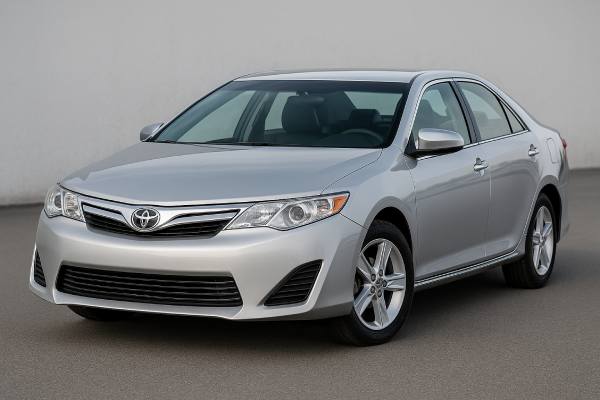
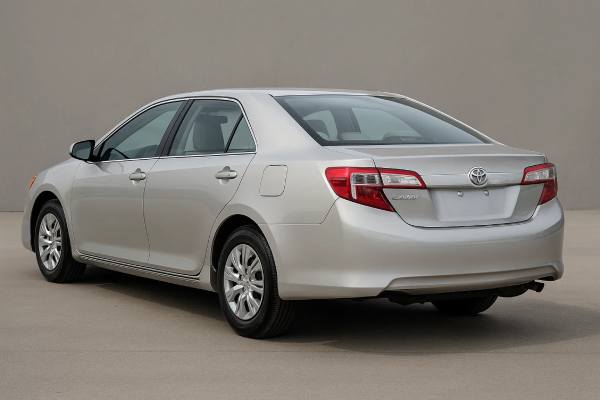
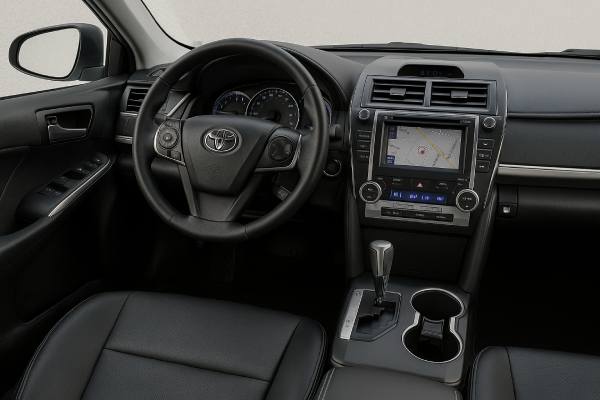
The sixth-generation Camry V6 pairs Toyota’s long-running 2GR-FE 3.5-litre engine with a 6-speed automatic and the roomy XV50 body. In North America (the baseline for this guide), it was sold mainly as SE and XLE trims from model years 2012–2014, offering rare performance for a mainstream sedan while keeping low running costs and quiet highway manners. Owners value the smooth V6, straightforward serviceability, and a cabin that wears daily miles well. Compared with the four-cylinder, the V6 adds effortless passing power, a stronger alternator, uprated brakes, and—on SE—firmer suspension and 18-inch wheels. Common ownership questions revolve around real-world fuel economy, transmission behaviour, and what to check on higher-mileage examples. This guide focuses on the practical details: verified specifications, routine maintenance, known issues and recalls, safety performance, and how the Camry stacks up against its rivals when you are shopping used today.
At a Glance
- Strong 2GR-FE V6: 268 hp (200 kW), quick 0–60 mph in ~6.0 s.
- Comfortable, quiet highway ride; SE trim sharpens handling without harshness.
- Proven driveline with timing chain (no scheduled replacement) and simple port fuel injection.
- Watch for water-pump seepage and ensure recall/TSB work is documented.
- Typical service: engine oil 0W-20 every 10,000 mi/12 months (or 5,000 mi severe), rotate tyres every 5,000 mi.
Navigate this guide
- Camry V6 2011–2014 overview
- Camry V6 specs and data
- Trims, options, and safety
- Reliability and service actions
- Maintenance and buyer’s guide
- Driving and performance
- How it compares to rivals
Camry V6 2011–2014 overview
The XV50-series Camry arrived for the 2012 model year in North America (production started in late 2011). The V6 variant—chassis code GSV50—uses Toyota’s 3.5-litre 2GR-FE, a 60-degree DOHC V6 with dual VVT-i and port fuel injection. Output is 268 hp (200 kW) at 6,200 rpm and 248 lb-ft (336 Nm) at 4,700 rpm. Power goes to the front wheels through the U660E 6-speed automatic with a tall overdrive for relaxed highway cruising.
Two trims carried the V6: SE and XLE. SE adds firmer spring/damper rates, thicker anti-roll bars, unique steering calibration, 18-inch wheels with 225/45R18 tyres, and supportive front seats. XLE prioritises comfort with 17-inch wheels (215/55R17), softer suspension, and more sound insulation. Both share the same engine, transmission, and brakes. The cabin gained better materials over the previous generation and a simpler dash layout. Entune-equipped audio with available navigation, Bluetooth streaming, and a 10-speaker JBL system were common upgrades.
Safety was a selling point—stability control (VSC), traction control (TRAC), anti-lock brakes (ABS), brake assist, and seven airbags were standard. Blind-spot monitoring became available on higher trims. In federal testing, the Camry achieved strong scores, while early small-overlap results from a different test program prompted Toyota to add structural improvements later in the run (covered below).
Running costs are low for the performance offered. The 2GR-FE is a chain-driven, non-turbo unit with an established service record across multiple Toyota/Lexus models. Typical ownership items are consumables (brakes, tyres, filters) and occasional water-pump replacement around mid-life mileage. Real-world fuel economy is competitive: high-20s mpg (US) highway is normal at legal speeds, thanks to the tall 6th gear and efficient aerodynamics.
If you are cross-shopping, the Camry V6 trades a touch of ultimate handling precision for durability, cabin quietness, and an unstressed powertrain. The SE trim narrows that gap with more engaging steering and body control while keeping the calm demeanor that makes the Camry easy to live with over long commutes.
Camry V6 specs and data
Engine and Performance (ICE)
| Item | Specification |
|---|---|
| Code | 2GR-FE |
| Layout & cylinders | 60° V6; DOHC; 24 valves (4 per cyl); Dual VVT-i |
| Bore × stroke | 94.0 × 83.0 mm (3.70 × 3.27 in) |
| Displacement | 3.5 L (3,456 cc) |
| Induction | Naturally aspirated |
| Fuel system | Sequential multi-port EFI |
| Compression ratio | 10.8:1 |
| Max power | 268 hp (200 kW) @ 6,200 rpm |
| Max torque | 336 Nm (248 lb-ft) @ 4,700 rpm |
| Timing drive | Chain |
| Emissions/efficiency standard | EPA (NA market) |
| Rated economy (city/hwy/comb) | 11.2 / 7.8 / 9.4 L/100 km (21 / 30 / 25 mpg US; 25.2 / 36.0 / 30.1 mpg UK) |
| Real-world highway @ 120 km/h (75 mph) | ~8.1–8.7 L/100 km (27–29 mpg US; 32–35 mpg UK) |
| Aerodynamics | Cd ≈ 0.28 |
Transmission and Driveline
| Item | Specification |
|---|---|
| Transmission | 6-speed automatic (U660E), gated shifter; SE adds paddle shift logic |
| Gear ratios (1st→6th, R) | 3.538 / 2.060 / 1.404 / 1.000 / 0.713 / 0.582; Reverse 3.168 |
| Final drive ratio | 3.46 |
| Drive type | FWD |
| Differential | Open |
| Refuel to full | ~3 min typical petrol pump |
Chassis and Dimensions
| Item | Specification |
|---|---|
| Suspension (front/rear) | MacPherson strut / Dual-link strut (SE: firmer tune, thicker bars) |
| Steering | Electric rack-and-pinion; ratio ~14.8:1 |
| Brakes (front/rear) | 296 mm (11.7 in) vented disc / 281 mm (11.1 in) solid disc |
| Wheels/Tyres | XLE: 215/55R17; SE: 225/45R18 |
| Ground clearance | ~160 mm (6.3 in) |
| Length / Width / Height | 4,815 / 1,820 / 1,471 mm (189.2 / 71.7 / 57.9 in) |
| Wheelbase | 2,775 mm (109.3 in) |
| Turning circle (kerb-to-kerb) | ~11.2 m (36.7 ft) |
| Kerb (curb) weight | ~1,540–1,615 kg (3,395–3,560 lb) by trim/options |
| GVWR | ~2,020–2,060 kg (4,455–4,540 lb) |
| Fuel tank (ICE) | 64 L (17.0 US gal / 14.2 UK gal) |
| Cargo volume (trunk) | 439 L (15.4 ft³) — SAE |
Performance and Capability
| Metric | Result |
|---|---|
| 0–100 km/h (0–62 mph) | ~6.2–6.4 s (0–60 mph ~5.8–6.1 s) |
| Top speed | ~210 km/h (130 mph) governor-limited (tyre dependent) |
| Braking 100–0 km/h | ~36–38 m (118–125 ft) on quality tyres |
| Towing capacity | Not rated for towing in baseline market |
| Roof load | 68 kg (150 lb) with approved crossbars |
Fluids and Service Capacities
| System | Specification / Capacity |
|---|---|
| Engine oil | API SN+ (or later), ILSAC GF-5/6; SAE 0W-20; ~6.1 L (6.4 US qt) incl. filter |
| Coolant | Toyota Super Long Life Coolant (pink), 50:50; ~8.5–9.5 L (9.0–10.0 US qt) total fill |
| Automatic transmission | Toyota ATF WS; service drain ~3.0–4.0 L (3.2–4.2 US qt); total fill ~7.0–7.5 L (7.4–7.9 US qt) |
| Differential/transfer | Integrated with transaxle (uses ATF WS) |
| A/C refrigerant | R-134a; charge ~500 g (17–18 oz) |
| A/C compressor oil | ND-OIL 8 (PAG); ~120 mL (4.1 fl oz) |
| Key torque specs | Wheel nuts 103 Nm (76 lb-ft); oil drain plug 39 Nm (29 lb-ft); spark plugs 18 Nm (13 lb-ft) |
Electrical
| Item | Specification |
|---|---|
| Alternator | ~130 A |
| 12V battery | Group 24F; ~65 Ah (≈550–600 CCA) |
| Spark plugs | Iridium, long-life; gap ~1.0 mm (0.039 in) |
Safety and Driver Assistance
| Item | Details |
|---|---|
| Crash ratings | Strong overall results in federal tests; early small-overlap performance prompted later structural updates |
| Headlight rating | Not rated in this era under newer headlight protocol |
| ADAS suite | VSC, TRAC, ABS/BA, EBD standard; BSM optional on upper trims; no AEB/ACC/Lane-keep in this period |
Notes: Official ratings and efficiencies vary slightly by model year, wheel/tyre package, and test cycle. Always verify against your specific VIN and market equipment.
Trims, options, and safety
Trims and options (V6-equipped):
- SE V6 — The enthusiast’s pick. Firmer springs/dampers, sport steering calibration, specific anti-roll bars, 18-inch alloys (225/45R18), larger rear spoiler, mesh grille, sport seats with additional bolstering, leather-wrapped wheel, paddles on some builds. Options commonly included moonroof, power driver seat with memory, Smart Key with push-button start, and the JBL/Entune audio with navigation. Mechanical differences centre on the suspension tune and wheel/tyre package; the engine/transmission are shared.
- XLE V6 — Comfort-focused. 17-inch alloys (215/55R17), softer suspension, additional acoustic glass/insulation pieces, available leather upholstery, heated seats, dual-zone auto climate control, and the full driver-comfort package. JBL/Entune and moonroof frequent.
Quick identifiers:
- SE badges on trunk, unique front/rear fascias, dual exhaust finishers, and 18-inch low-profile tyres. Seat fabric/SoftTex with patterned inserts.
- XLE badge, chrome grille accents, 17-inch wheels with taller sidewalls, more wood-tone interior trim on many builds.
Year-to-year highlights (V6):
- 2012: Launch of XV50. Entune multimedia arrives. Blind-spot monitor begins appearing on upper trims.
- 2013: Minor feature shuffles; audio head units updated.
- 2014: Running structural changes aimed at improving small-overlap protection on vehicles built after late 2013; equipment mix rationalised. (The comprehensive facelift was for 2015.)
Safety ratings and systems (summary):
- Crash tests: The Camry achieved strong overall ratings in the primary full-frontal, side, roof-strength, and head-restraint tests. Driver-side small-overlap (introduced during this generation) was a relative weak spot early on; Toyota implemented structural revisions later in the run and further improvements for the 2015 refresh.
- Airbags and structure: Seven airbags standard (dual front, front side, side-curtain, and driver’s knee). Body uses high-strength steel in critical load paths, with engineered front crash boxes.
- Child-seat provisions: Lower anchors and tethers for children (LATCH) on the outboard rear seats; wide, accessible anchor geometry; check specific seat/base fitment due to seat-cushion shape.
- Driver aids: Stability and traction control, ABS with brake assist and electronic brake-force distribution were standard. Blind-spot monitoring availability grew through the run on XLE/SE with packages. No factory auto emergency braking, adaptive cruise, or lane-keeping on North-American XV50 pre-facelift models.
Service implications (after collision or glass work):
- BSM radar (where equipped) requires correct rear-bumper cover fitment; any bracket damage or bumper re-spray thickness can affect calibration.
- Windshield replacement should preserve correct acoustic glass and camera/mirror mount geometry; although camera-based lane systems were not fitted in this era, mirror mounts and rain sensors (if equipped) still have alignment specifications.
- Sub-frame and front end repairs must follow measurement sheets; the longitudinal members incorporate crush zones that should not be straightened beyond limits.
Reliability and service actions
Across millions of Toyota/Lexus vehicles, the 2GR-FE has an excellent track record. In the Camry XV50 it benefits from chain-driven cams, non-turbo induction, and port fuel injection—all features that simplify maintenance and reduce costly failure modes found in some rivals.
Common issues (by prevalence and typical mileage):
- Water-pump seep/leak (common; 60k–120k mi; low–medium cost): Look for pink crust around the pump weep hole or smell of coolant. Replace pump, belt, and fresh SLLC coolant; inspect idler pulleys while in there.
- Front strut mounts/bushings noise (occasional; 80k–150k mi; medium cost): Clunk over sharp bumps or when turning at low speed. Replace mounts/bushings; SE suspension lives a harder life with 18-inch tyres.
- Wheel bearings hum (occasional; 90k–160k mi; medium cost): Droning that changes with road speed; confirm with loaded cornering test. Replace hub assembly on the affected corner.
- Starter contact wear (occasional; high-mileage; low–medium cost): Intermittent “click, no crank.” Contacts/solenoid kit or complete starter replacement cures it.
- U660E behaviour (rare to moderate; varies): Overall robust. Occasional complaints of flare/harsh 2–3 or 3–4 shifts when fluid is degraded or after battery disconnect. A fluid service with ATF WS, correct level check at temp, and an ECM/TCM relearn typically smooths it. True internal issues are uncommon in well-maintained vehicles.
Less common but notable:
- Oil cooler line: Earlier Toyota V6s (pre-XV50) used a rubber section that could fail; the XV50 Camry uses the updated hard-line and is not subject to that earlier concern.
- Intake manifold/PCV deposits (rare; high mileage, short-trip usage): Slight idle roughness; cleaning throttle body and PCV replacement resolves most cases.
- HVAC drain/evaporator moisture routing: Some vehicles from this era experienced water dripping onto under-dash components in very specific conditions if the drain was restricted or mis-routed. Ensure the drain is clear; check for any related service campaigns performed.
Recalls, TSBs, and extended coverages (headline summary):
- Wiper switch non-compliance / intermittent function (select 2012–2014 builds): Dealer replacement of the stalk/switch sub-assembly as required.
- Seat track/airbag sensor or wiring protection (varies by VIN): Inspection and, if needed, replacement or protective measures.
- Software updates: Powertrain ECM/TCM calibrations exist that refine shift quality or address diagnostic robustness; infotainment head-unit updates improve Bluetooth/Entune stability on certain versions.
How to verify completion:
Request a dealer printout tied to the VIN, and run an official VIN recall check. Cross-check against the service history book or digital records. For used purchases, ask the seller for proof of TSB/recall completion and recent major services (coolant, spark plugs, brake fluid, transmission service if performed).
Corrosion and body checks (salt-state cars):
Inspect front and rear sub-frame mounting points, rocker pinch welds, lower door seams, and the trunk lip under the weatherstrip. The XV50 generally resists rust well, but road-salt buildup behind plastic shields can trap moisture.
Maintenance and buyer’s guide
Practical maintenance schedule (baseline market):
- Engine oil & filter: 0W-20 full-synthetic, every 10,000 mi / 12 months; 5,000 mi under severe use (short trips, dusty, towing, extreme cold/heat).
- Tyre rotation & inspection: Every 5,000 mi with tread-depth check, brake glance, and pressure reset.
- Engine air filter: Inspect 15,000 mi; replace 30,000–45,000 mi (sooner in dusty areas).
- Cabin filter: 12 months / 15,000 mi.
- Coolant (SLLC pink): First change 100,000 mi / 10 years, then 50,000 mi / 5 years thereafter.
- Spark plugs (iridium): 120,000 mi / 12 years.
- Brake fluid: 3 years regardless of mileage.
- Automatic transmission (ATF WS): “Lifetime” under normal service; prudent owners inspect at 60,000–90,000 mi and perform a measured drain-and-fill if fluid is dark/odorous.
- Serpentine belt & tensioner: Inspect from 60,000 mi; replace on cracks/noise.
- Aux belts/hoses: Visual each oil service; replace if hardened, swollen, or cracked.
- Alignment check: Annually, or after impacts/tyre wear patterns.
- 12V battery: Test annually after 4 years; typical life 4–6 years.
- Brake pads/rotors: Inspect at each rotation; SE 18-inch packages may wear fronts a little faster.
- Air-conditioning service: Check performance yearly; ensure evaporator drain is clear.
Fluid specifications and capacities (quick list):
- Engine oil: API SN+/SP, ILSAC GF-5/6, SAE 0W-20, ~6.1 L (6.4 qt) with filter.
- ATF: Toyota ATF WS only; level set at temperature via check plug procedure.
- Coolant: Toyota SLLC (pink), premix 50:50; approx 9 L (9.5 qt) total.
- Refrigerant: R-134a, ~500 g; compressor oil ND-OIL 8.
- Torque must-knows: Wheel nuts 103 Nm (76 lb-ft); oil drain 39 Nm (29 lb-ft); spark plugs 18 Nm (13 lb-ft).
DIY friendliness:
Excellent access from above for filters and plugs; splash shields remove for lower work. The ATF level check needs a temperature-controlled procedure; if in doubt, leave it to a shop experienced with WS systems. Always use new crush washers on drains and observe fill capacities rather than blindly “pouring to spec.”
Buyer’s inspection checklist:
- Service records: Oil changes on time; proof of long-interval items (coolant, plugs, brake fluid).
- Recalls/TSBs: Ask for VIN-based dealer printout; ensure wiper switch/any sensor harness campaigns were done.
- Cooling system: Look for water-pump crust or pink staining; verify radiator fans operate correctly with A/C on.
- Transmission: Warm road test—should upshift cleanly and lock the converter smoothly; no flare or harsh engagement.
- Suspension/tyres: Even wear, no inner-edge scalloping (alignment); listen for front top-mount clunk on tight turns over bumps.
- Brakes: Straight stops, no steering shake; confirm pad life.
- Electricals: Window regulators, keyless entry, audio/Entune functions, and all lighting.
- Body: Consistent panel gaps and paint texture; check trunk seals and rocker/pinch welds on salt-state cars.
- SE specifics: Inspect 18-inch alloys for curb rash and verify quality tyres (cheap summer tyres transform NVH for the worse).
- XLE specifics: Test heated seats, dual-zone HVAC, and moonroof drains.
Recommended picks:
- SE V6 for drivers who want sharper steering and body control with minimal comfort penalty.
- XLE V6 for quiet-cruiser duty, especially if you value the softer ride and insulation.
- Avoid heavily modified cars or those with unknown transmission service history. Stock, well-maintained examples are best.
Durability outlook:
With routine fluids and timely repairs, the V6 Camry commonly surpasses 200,000–300,000 miles on original major components. Consumables and the occasional water pump or hub bearing are typical long-term costs.
Driving and performance
Powertrain character:
The 2GR-FE’s personality is smooth and linear. Throttle response is immediate, and there is no turbo lag to mask. Peak torque arrives at 4,700 rpm, but the broad midrange means strong part-throttle passing without kickdown. The U660E shifts early and quietly in normal mode; the SE’s calibration holds gears a touch longer. Kickdown from 6th to 3rd is decisive for two-lane passes, and manual selection helps keep revs in the sweet spot on grades.
Ride, handling, and NVH:
On 17-inch tyres, the XLE isolates bumps and wind noise impressively for the class. The SE’s firmer tune reduces roll and quickens responses; it feels more planted in long sweepers and better resists mid-corner heaves. Straight-line stability is a strong point, and the electric steering tracks true with moderate effort. Brakes are easy to modulate, with consistent pedal feel; high-quality pads/rotors preserve that feel over time.
Real-world economy:
Expect roughly 21–23 mpg US (11.2–10.2 L/100 km) city, 28–31 mpg US (8.4–7.6 L/100 km) highway at 65–75 mph, and 24–27 mpg US (9.8–8.7 L/100 km) mixed depending on climate, tyres, and load. In very cold weather, short trips and winter fuel can trim 1–3 mpg from those figures; conversely, steady 60-mph cruising on flat terrain can return low-30s mpg.
Key performance numbers (typical, stock tyres):
- 0–60 mph: ~5.8–6.1 s
- 50–70 mph passing: ~3.8–4.2 s
- 100–0 km/h (62–0 mph) braking: ~36–38 m (118–125 ft)
- Turning circle: ~11.2 m (36.7 ft)
Load and towing:
The V6 has ample muscle, but the North-American Camry in this era is not tow-rated. A full cabin and trunk slightly affect brake feel and acceleration; run higher tyre pressures within door-jamb recommendations when fully loaded and keep an eye on rotor condition before mountain trips.
Tyres transform the car:
- Touring all-seasons keep the Camry quiet but lengthen stopping distances.
- Quality grand-touring tyres (with higher wet grip) are a smart upgrade.
- SE owners: maintain proper alignment; the 18-inch package is sensitive to toe settings and can wear inner edges if neglected.
How it compares to rivals
Honda Accord V6 (9th gen, 2013–2017):
The Accord V6 (278 hp) is marginally quicker and offers a sportier chassis feel, especially in Coupe form. Its 6-speed automatic is similarly smooth. Interior materials and seating position feel more “driver-centric.” Long-term reliability is also excellent. The Camry counters with a quieter ride, a more compliant back seat, and lower parts pricing in many markets.
Nissan Altima 3.5 (2013–2015):
Strong 3.5-litre VQ engine, but paired with a CVT that some drivers dislike for sound/feel and that has a more mixed long-term reputation. Cabin space is competitive; highway economy can be very good. The Camry’s conventional automatic and quieter NVH make it the safer long-term bet.
Hyundai Sonata 2.0T (2011–2014):
Turbo four offers punchy midrange and good highway mpg. Early models had more variability in steering feel and some engine-related concerns as miles accrued. The Camry V6 delivers its power with less stress and simpler maintenance.
Ford Fusion 2.0 EcoBoost (2013–2014):
Sharp steering and chassis balance; interior design is modern. Real-world fuel economy varies widely, and long-term maintenance on turbo DI engines can be more involved. The Camry’s naturally aspirated V6 is simpler and generally more durable over very high mileages.
Chevrolet Malibu (2013–2014):
Comfortable cruiser with value pricing on the used market. Powertrains are adequate rather than exciting. The Camry V6 beats it on acceleration, resale value, and long-term repair probability.
Bottom line:
If you want strong, effortless acceleration with low ownership risk, the XV50 Camry V6 remains a benchmark. Choose SE for more engagement or XLE for maximum comfort; either way, insist on maintenance records and tyres/brakes in good order.
References
- 2013 Toyota Camry 2013 (EPA Fuel Economy Data)
- 2016 Toyota Camry 4-door sedan 2016 (Safety Rating and Test Details)
- 2014 Camry – Owners’s Manual 2014 (Owner’s Manual)
- 2013 Camry – Owners’s Manual 2013 (Owner’s Manual)
Disclaimer
This guide is for informational purposes only and is not a substitute for professional diagnosis or repair. Specifications, torque values, fluids, and service intervals can vary by VIN, model year, market, and equipment. Always confirm procedures and values with your vehicle’s official service documentation and follow local regulations.
If this article helped you, please consider sharing it on Facebook or X/Twitter to support xcar’s work.