
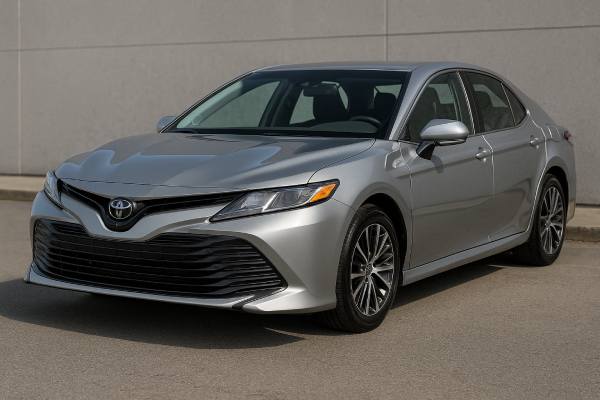
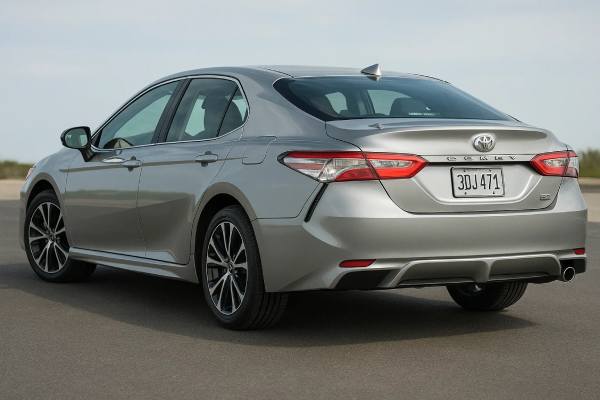
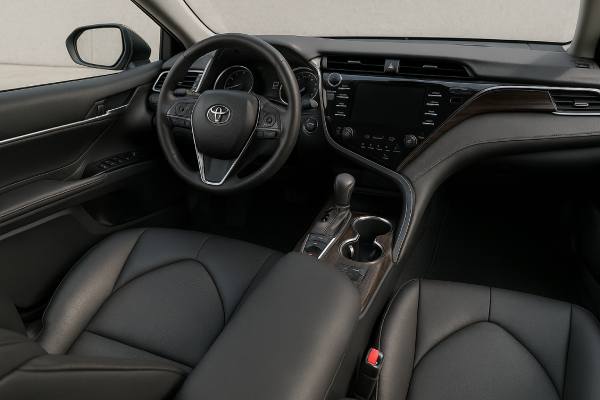
The eighth-generation Camry V6 brings genuine pace to the dependable midsize formula. Riding on Toyota’s TNGA-K platform, the GSV70 pairs a rigid body and multi-link rear suspension with the 2GR-FKS 3.5-liter V6 (D-4S dual injection) and an 8-speed automatic. The result is a sedan that is quiet and comfortable most of the time yet pulls with authority when you ask. In North America the V6 sits mainly in XLE and XSE trims (plus the 2020 TRD), with strong standard safety tech and an interior that finally feels modern. Day to day, it is easy to live with: long service intervals, generous cabin space, and predictable running costs if you keep fluids, tires, and brakes in check. If you like the idea of a smooth, naturally aspirated drivetrain with quick kickdown—and you want it wrapped in Toyota’s reputation for durability—the 2018–2020 Camry V6 belongs on your shortlist.
Fast Facts
- Smooth, naturally aspirated V6 (301 hp/267 lb-ft) with quick, decisive 8-speed; relaxed highway rpm.
- Stable ride, confident brakes, and top-tier active safety; XSE sharpens responses, XLE maximizes comfort.
- Cabin and trunk are generous; 19-inch packages look great but can add road noise over rough pavement.
- Watch for open fuel-pump recall on some vehicles; update engine/TCU software if available.
- Oil and filter: 10,000 miles/12 months (16,000 km/12 months) under normal service.
On this page
- Detailed overview for Camry V6
- Camry V6 specs and data
- Camry V6 trims and safety
- Reliability issues and service actions
- Maintenance and buyers guide
- Driving and performance
- Camry V6 compared to rivals
Detailed overview for Camry V6
Toyota’s GSV70 Camry V6 is the quick one in the range. Under the hood sits the 2GR-FKS—a 3.5-liter, all-aluminum DOHC V6 using Toyota’s D-4S system (both port and direct fuel injection) and VVT-iW on the intake cams. That hardware lets the engine run an efficient, high-compression strategy at light loads and switch smoothly into a stronger Otto cycle feel when you dig into the throttle. The soundtrack is hushed in cruise and pleasantly mechanical at wide-open throttle, without turbo lag or step-off hesitation.
The platform matters, too. TNGA-K drops the seating position, stiffens the shell, and fits a multi-link rear suspension with geometry that resists lateral hop. Steering is electric-assist but precise, with a straight-ahead on-center feel you notice on long highway runs. Brakes are strong and consistent, helped by good thermal capacity and straightforward pad choices; the V6’s extra mass is managed well, especially with the 18- and 19-inch factory tire packages.
Trims steer the character. XLE V6 is the quiet, long-legged cruiser: thicker acoustic glass in some builds, comfort-tuned springs and dampers, and touring tires. XSE V6 is firmer and a touch louder, with larger wheels (18–19 inches), quicker transmission mapping, and sportier fascia. For 2020, Toyota added the TRD V6: stiffer springs, unique dampers, larger front brakes, and a subtle exhaust—more playful without turning the Camry into something fussy to commute in.
Inside, the Camry is practical and mature. Adults fit easily in back, the trunk is wide and flat, and cabin storage is useful rather than gimmicky. Controls are simple: physical knobs where you want them, a clear instrument cluster, and infotainment that gained Apple CarPlay in 2019 and Android Auto in 2020. Toyota Safety Sense covers the basics on every car—forward collision mitigation with pedestrian detection, lane departure alert with steering assist, adaptive cruise, and automatic high beams—with blind-spot monitoring and rear cross-traffic alert commonly added.
Ownership is straightforward. Oil is synthetic 0W-20 with a 10k-mile/12-month interval in normal use. Spark plugs are long-life iridium. The 8-speed automatic (Aisin Direct-Shift) does not require scheduled fluid changes, though many owners do a gentle drain-and-fill around 60k–100k miles as cheap insurance. The water pump is mechanical and long-lived; the 2GR-series history suggests watching it as mileage climbs, but catastrophic failures are rare when coolant is correct and leaks are addressed early.
If you want midsize practicality with a genuinely quick, refined engine that should last, the Camry V6 is the safe bet that still feels special.
Camry V6 specs and data
Engine and Performance (ICE)
| Item | Specification |
|---|---|
| Code | 2GR-FKS |
| Layout & valvetrain | 60° V6, DOHC, 4 valves/cyl, D-4S (port + direct injection), VVT-iW (intake) / VVT-i (exhaust) |
| Bore × stroke | 94.0 × 83.0 mm (3.70 × 3.27 in) |
| Displacement | 3.5 L (3,456 cc) |
| Compression ratio | ~11.8:1 |
| Max power | 301 hp (224 kW) @ 6,600 rpm |
| Max torque | 362 Nm (267 lb-ft) @ ~4,700 rpm |
| Induction | Naturally aspirated |
| Timing drive | Chain |
| Emissions / efficiency std. | Tier 3 / SULEV30 (NA); Euro 6 (EU) |
| Rated efficiency (typical) | XLE/XSE ≈ 9.4–10.2 L/100 km combined (25–28 mpg US / 30–34 mpg UK) |
| Real-world highway @ 120 km/h (75 mph) | ~7.8–8.7 L/100 km (27–30 mpg US / 32–36 mpg UK) |
| Aerodynamics | Cd ≈ 0.27–0.29 (wheel/tire dependent) |
Transmission and Driveline
| Item | Specification |
|---|---|
| Transmission | 8-speed automatic (Direct-Shift); torque converter with lockup |
| Gear ratios | 1st 5.250 · 2nd 3.029 · 3rd 1.950 · 4th 1.457 · 5th 1.220 · 6th 1.000 · 7th 0.808 · 8th 0.673 · Rev 4.014 |
| Final drive ratio | ≈ 2.80 (varies slightly by trim/wheel pkg) |
| Drive type | FWD |
| Differential | Open (integrated) |
| Refuel to full (typical) | ≈ 5 minutes |
Chassis and Dimensions
| Item | Specification |
|---|---|
| Suspension (front/rear) | MacPherson strut / Multi-link |
| Steering | Electric power assist; ~2.8–3.0 turns lock-to-lock |
| Brakes | Front 305 mm (12.0 in) ventilated discs; rear 281 mm (11.1 in) solid discs |
| Wheels/Tires | XLE: 235/45 R18; XSE: 235/40 R19 (select builds 18 in) |
| Ground clearance | ≈ 145 mm (5.7 in); TRD sits lower |
| Length / Width / Height | ~4,880–4,900 × 1,840 × 1,440–1,445 mm (192.1–192.9 × 72.4 × 56.7–56.9 in) |
| Wheelbase | 2,825 mm (111.2 in) |
| Turning circle (curb-to-curb) | ~11.0 m (36.1 ft) |
| Curb weight | ≈ 1,565–1,630 kg (3,450–3,595 lb), trim dependent |
| GVWR | ≈ 2,070–2,130 kg (4,565–4,695 lb) |
| Fuel tank | 60 L (15.8 US gal / 13.2 UK gal) |
| Cargo volume (SAE) | ~428 L (15.1 ft³) |
Performance and Capability
| Metric | Value |
|---|---|
| 0–100 km/h (0–62 mph) | ~6.0–6.3 s (0–60 mph ~5.7–5.9 s) |
| Top speed | ~217 km/h (135 mph), limited |
| 100–0 km/h braking | ≈ 36–38 m (62–0 mph ≈ 118–125 ft) with quality tires |
| Towing capacity | Not rated in NA (0 kg / 0 lb) |
| Payload | Typically ~400–450 kg (880–990 lb) by placard |
| Roof load | Varies by accessories; verify by VIN/accessory guide |
Fluids and Service Capacities
| System | Specification / Capacity |
|---|---|
| Engine oil | 0W-20 (API/ILSAC to spec); ≈ 5.4–5.9 L (5.7–6.2 US qt) with filter |
| Coolant (engine) | Toyota Super Long Life Coolant (pink) 50/50; ≈ 8–9.5 L (8.5–10.0 US qt) |
| Transmission ATF | Toyota ATF WS; drain/fill ≈ 4–6 L (4.2–6.3 US qt) depending on procedure |
| A/C refrigerant | R-134a; typical charge ~500–600 g (17.6–21.2 oz) |
| A/C compressor oil | ND-OIL 11; ~120–150 mL (4.1–5.1 fl oz) |
| Key torque specs | Wheel lugs 103 Nm (76 lb-ft); oil drain plug ~40 Nm (30 lb-ft); spark plugs ~18–22 Nm (13–16 lb-ft) |
Electrical
| Item | Specification |
|---|---|
| Alternator | ~150 A (engine-driven) |
| 12V battery | ~60 Ah (CCA varies); Group size depends on supplier |
| Spark plugs | Long-life iridium; gap ~1.0–1.1 mm (0.039–0.043 in) |
Safety and Driver Assistance
| Item | Details |
|---|---|
| Crash ratings | Top results in major tests for structure and restraints; headlight scores vary by unit |
| Headlight rating | Best with LED projectors (XLE/XSE with Tech pkgs); halogens score lower |
| ADAS suite | AEB with pedestrian detection, adaptive cruise, lane departure with steering assist, auto high beams; blind-spot and rear cross-traffic widely fitted; Rear Cross-Traffic Braking and sonar available |
Camry V6 trims and safety
Trim map (North America, 2018–2020):
- XLE V6: Comfort-forward. 18-inch wheels (touring-oriented tires), available leather, ventilated seats on some builds, panoramic roof, and advanced driver display. Suspension tuning favors highway isolation; transmission calibration is smooth and relaxed. LED headlights available and recommended; they tend to score best in headlight tests.
- XSE V6: Sport posture. 18- or 19-inch wheels, firmer springs/dampers, quicker “sport” mapping in the 8-speed, mesh grille, and contrast body accents. Seats are more heavily bolstered, steering wheel is thicker, and exhaust note is slightly more present under load.
- TRD (2020): Factory-tuned with stiffer springs, unique dampers, thicker underbody bracing, larger front rotors with different pad compound, and 19-inch wheels with performance tires. Ride is taut but not punishing; body control tightens appreciably. It keeps Toyota Safety Sense and core convenience features but trims some luxury options to save weight.
Key packages and identifiers:
- Audio/infotainment tiers: Base Entune 3.0 (7-in screen), mid with larger touchscreen and extra USBs, and JBL premium audio on upper trims. In 2019, Apple CarPlay support arrived; Android Auto joined in 2020.
- Safety add-ons: Blind-spot monitor and rear cross-traffic alert common on XLE/XSE (optional on some early builds). Rear Cross-Traffic Braking and clearance sonar are bundled with parking assist on many cars.
- Visual tells: XSE’s grille is mesh with sport lower valance; XLE uses bright accents; TRD adds a subtle rear spoiler, unique front splitter, and red-accent cabin bits.
Year-to-year changes:
- 2018: Generation launch with V6 in XSE and XLE.
- 2019: Apple CarPlay added; minor headlight and package shuffles depending on trim.
- 2020: Android Auto added; TRD V6 introduced with chassis upgrades and unique styling.
Safety results in brief:
The Camry line performs at or near the top of the class in major crash tests, with strong occupant protection and effective restraints. Headlight ratings depend on the unit: LED projectors available on XLE/XSE typically score best; halogen reflectors can rate lower. Lane keeping, adaptive cruise, and auto high beams are standard; higher trims/option packages add blind-spot and rear cross-traffic functions and can include Rear Cross-Traffic Braking.
Child-seat practicality:
Wide back seat, generous lower-anchor access, and enough front-seat travel to keep a rear-facing seat comfortable. Tether anchors are easy to reach. If you install a high-back booster on the outboard positions with 19-inch tires fitted, check belt routing—the bolsters are slightly more pronounced.
Service/ADAS calibration notes:
Windshield replacements require front camera aiming; frontal repairs on cars with radar or sonar require calibration. Many dealers can complete these in a single appointment, but schedule around that if you are buying a car with recent bodywork.
Reliability issues and service actions
The 2GR-FKS/8-speed combo has a reputation for solidity. Most cars need only routine care for many years. Still, a smart buyer focuses on the few known risks and age-related items.
Engine and fueling
- Fuel-pump recall (selected vehicles): Certain cars across the Toyota range were recalled for low-pressure fuel pump impellers that could crack. What you’ll notice: intermittent stalling or rough running; warning lights. Action: run the VIN through the official recall portal; replacement is free when applicable.
- Water pump seep (age/miles): Typical of many Toyota V6s as mileage passes ~90–120k mi (145–193k km). Symptom: pink residue at the pump weep hole or faint coolant smell after shutdown. Action: replace pump and serpentine belt together; refill with Toyota SLLC and bleed thoroughly.
- Carbon deposits (DI engines): The 2GR-FKS’s dual-injection strategy uses port fuel injection routinely to keep intake valves clean, so heavy deposits are uncommon. Short-trip use can still soot the throttle body. Action: clean throttle body/MAF as needed; premium fuel is unnecessary but top-tier gasoline helps.
- Oil leaks (rare): Cam cover gaskets can sweat over time. Action: confirm during pre-purchase inspection; replacement is straightforward.
Transmission and driveline
- Shift logic feel: Early calibrations on some 8-speeds could feel busy at low speed. Action: verify current ECU/TCU software; many cars received updated mapping that improves creep, part-throttle upshifts, and kickdown timing.
- ATF aging: Not in the official schedule, but high-temperature urban use can shear fluid. Action: optional drain-and-fill at 60–100k miles (96–160k km) with Toyota ATF WS; avoid power flushes.
Chassis and brakes
- Front end links/bushings: Over rough northern roads, expect light knocks past 70–100k miles (113–160k km). Action: replace links/bushings; do a four-wheel alignment.
- Brake judder: Usually pad material transfer after hard stops with hot rotors on low-miles cars. Action: resurface/replace rotors with proper bed-in; TRD’s larger brakes resist fade better.
Electronics and ADAS
- Head unit quirks: Early infotainment versions can show Bluetooth/CarPlay hiccups. Action: apply software updates; verify USB cables and ports.
- Radar/sonar alignment: Post-repair misalignment triggers warnings or inconsistent distance control. Action: professional calibration to spec.
Body and corrosion
- Underbody surfaces: Generally excellent rust resistance. In snowbelt use, inspect rear subframe seams and brake lines at annual services.
- Wind noise: Minor wind rustle around mirror caps on some cars; verify seal seating.
Prevalence and cost tiers
- Common/low cost: Tire cupping/noise on aggressive 19-inch fitments; throttle body cleaning; front end links.
- Occasional/medium cost: Water pump with belt; rotor/pad replacement with quality parts.
- Rare/higher cost: Fuel-pump replacement when out of campaign coverage; collision-related ADAS recalibration.
Verification before you buy
Pull dealer service history, confirm recall status, check for ECU/TCU updates, inspect for coolant residue at the pump, listen for front-end knocks on broken pavement, and ensure adaptive cruise/lane assist work cleanly after a 10-minute mixed drive.
Maintenance and buyers guide
Practical maintenance schedule (typical conditions)
- Engine oil & filter: 10,000 miles / 12 months (16,000 km / 12 months) with 0W-20; halve distance for severe service (short trips, towing, extreme temps).
- Engine air filter: Inspect 15,000 miles (24,000 km); replace ~30,000 miles (48,000 km), sooner in dusty regions.
- Cabin air filter: Every 15,000–20,000 miles (24,000–32,000 km) or annually.
- Coolant (engine): Toyota SLLC; first at 100,000 miles (160,000 km) / 10 years, then every 50,000 miles (80,000 km) / 5 years.
- Spark plugs (iridium): ~120,000 miles (192,000 km).
- ATF (8-speed): Not scheduled; optional drain-and-fill at 60,000–100,000 miles (96,000–160,000 km).
- Brake fluid: Replace every 3 years; maintain moisture below 2%.
- Brake pads/rotors: Inspect 10,000–15,000 miles (16,000–24,000 km); bed new pads properly to avoid judder.
- Belts/hoses: Inspect every 30,000 miles (48,000 km); replace on condition or at pump service.
- Tire rotation and pressures: Rotate 5,000–7,500 miles (8,000–12,000 km); set pressures to door-jamb plus +1–2 psi for heavy highway loads.
- Alignment: Annually if running 19-inch tires or after any curb impact.
- 12-V battery test: Annually after year 4; 5–7 year typical life.
Fluid quick-pick
- Engine oil: 0W-20 API/ILSAC to spec.
- Coolant: Toyota Super Long Life Coolant (pink).
- Transmission: Toyota ATF WS.
- Brake fluid: DOT 3 or DOT 4 to spec.
- A/C: R-134a with ND-OIL 11; charge by weight.
Essential torque values
- Wheel lug nuts: 103 Nm (76 lb-ft).
- Oil drain plug: ~40 Nm (30 lb-ft).
- Spark plugs: ~18–22 Nm (13–16 lb-ft) on aluminum heads (verify plug maker’s sheet).
Buyer’s checklist
- Exterior/body: Even panel gaps; original glass (ADAS camera lives behind the windshield); radar emblem intact.
- Undercarriage: Dry transaxle and engine; no coolant streaking around the water pump; minimal rust on subframes and brake lines.
- Brakes/tires: Even wear; no steering shimmy at 70–75 mph (113–120 km/h); check date codes on 19-inch tires.
- Drivetrain: Smooth idle; crisp 2–3 and 3–4 upshifts; immediate kickdown from 7th/8th for highway passes.
- Electronics: Test adaptive cruise, lane assist, blind-spot, and rear cross-traffic; confirm infotainment software version.
- Records: Oil at 10k intervals, coolant at time/miles, any recall/TSB work documented.
Which years/trims to target
- 2019–2020 XLE V6 if you want the quietest ride with modern smartphone integration.
- 2018 XSE V6 if you prefer firmer tuning and 19-inch presence—budget for tires.
- 2020 TRD for the enthusiast angle: better body control, bigger brakes, and a bit more personality without sacrificing daily usability.
Long-term outlook
With ordinary care, the 2GR-FKS and the 8-speed routinely deliver well beyond 200,000 miles (320,000 km). The biggest swings in ownership cost come from tires and brake choices; use quality parts and align annually.
Driving and performance
Ride, handling, NVH
The Camry V6’s personality is confident and calm. On a steady highway cruise, the 8-speed sits in 8th with the engine barely audible; passing requires only a small throttle press to drop two or three gears. The body stays planted over broken pavement, especially on 18-inch tires. XSE tightens body control and adds steering weight; 19-inch fitments feel more immediate but transmit sharp-edge bumps. The TRD, introduced for 2020, firms things further without turning the car brittle—its damping is well judged, so the car breathes with the road instead of skittering across it.
Powertrain character
Without a turbo, response is linear and predictable. The V6 wakes up above 3,500 rpm and pulls hard to its 6,600 rpm power peak. Around town, short-shift logic keeps revs low; in Sport mode, the 8-speed holds gears longer and snaps off downshifts early in a pass. Kickdown from top gear at 70 mph (113 km/h) is decisive; 50–80 mph (80–129 km/h) passing happens quickly if you give the car a full pedal. There is little drivetrain lash, and converter lockup engages early to keep the cabin quiet.
Real-world efficiency
- City: 11–13 L/100 km (18–21 mpg US / 22–25 mpg UK) depending on traffic and tire package.
- Highway (60–75 mph / 100–120 km/h): 7.8–8.7 L/100 km (27–30 mpg US / 32–36 mpg UK).
- Mixed: 9–10.5 L/100 km (22–26 mpg US / 26–31 mpg UK).
Cold weather, short trips, and aggressive 19-inch summer tires can pull those numbers down; gentle driving and 18-inch touring tires do the opposite.
Selective metrics that change the verdict
- 0–60 mph (0–97 km/h): ~5.7–5.9 s, repeatable with decent tires.
- 100–0 km/h braking: ~36–38 m with quality pads/rotors; TRD’s larger front brakes improve repeated-stop consistency.
- Turning circle: ~36.1 ft (11.0 m), easy in tight parking decks.
Traction and control
FWD traction is strong on decent asphalt; stability control intervenes early and smoothly. In winter regions, proper snow tires transform take-off and stopping. Launching hard from a slow roll in the wet will chirp the inside front briefly on XSE/19-inch setups; the diff is open by design.
Load and long grades
With four adults and luggage the Camry remains settled. The cooling system is robust; downshift early on long mountain grades to keep transmission temps happy. Expect a modest 1–3 L/100 km (2–3 mpg US) penalty at full load on hilly interstates.
Camry V6 compared to rivals
Honda Accord 2.0T (10-speed/auto): The 2.0-liter turbo pulls hard from low revs and can feel punchier off-idle. The Camry V6 counters with a smoother, more linear build of speed and no turbo heat-soak concerns on hot days. Ride isolation slightly favors Camry; steering feel leans Accord. Long-term durability and resale historically favor Toyota, though both are strong.
Mazda6 2.5T: Excellent steering and chassis nuance, handsome interior, and a torquey engine. The Camry V6 is quicker at the top end and rides more quietly at 75 mph (120 km/h). If you prioritize driver involvement, the Mazda is tempting; for silent commuting and long-term cost control, the Camry wins.
Nissan Altima VC-Turbo / Subaru Legacy 3.6R (earlier) or 2.4T (later): Altima offers AWD on many trims, which is compelling in snowbelt states, but its CVT changes the feel. Legacy’s earlier 3.6 flat-six is smooth but less efficient and was retired; newer turbo four is stout with standard AWD. The Camry V6 remains the most refined naturally aspirated option, with stronger predicted reliability and a broader dealer network for parts and service.
Hyundai Sonata 2.0T (pre-2020) / 2020-on redesign: Good value and features, but powertrains and suspension tuning don’t feel as cohesive as the Camry’s V6/8-speed combination. Resale and long-term ownership costs still tilt Toyota’s way in most markets.
Verdict: If you want a serene, fast, and durable midsize sedan without the complexity of a turbo—or the hybrid’s different driving feel—the Camry V6 is the benchmark of “set it and forget it” performance.
References
- 2018 Toyota Camry Product Information 2018 (Manufacturer Specs)
- Fuel Economy of the 2018 Toyota Camry 2018 (EPA Ratings)
- 2019 Toyota Camry 2019 (Safety Rating)
- Check for Recalls: Vehicle, Car Seat, Tire, Equipment 2025 (Recall Database)
- 2018 Camry – Toyota Manuals and Warranties | Toyota Owners 2018 (Owner’s Manual)
Disclaimer
This article is for informational purposes only and is not a substitute for professional diagnosis, repair, or safety advice. Specifications, torque values, service intervals, and procedures vary by VIN, market, model year, and equipment. Always verify against your vehicle’s official service documentation, owner’s manual, and current technical bulletins.
If this guide helped you, please consider sharing it on Facebook or X/Twitter to support xcar’s work.