
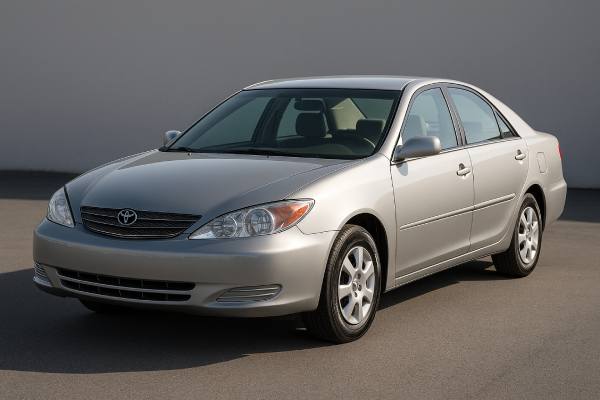
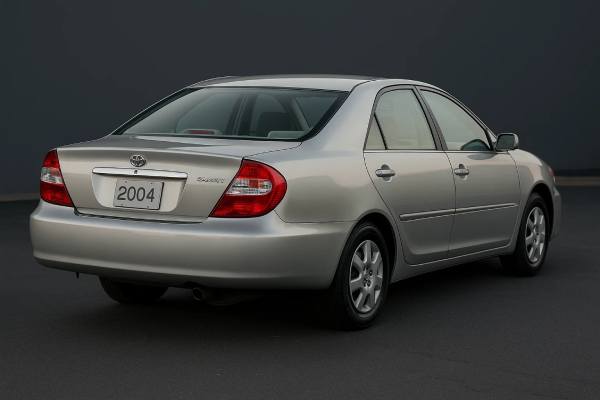
When Toyota slipped the 3.3-litre 3MZ-FE V6 into the XV30-generation Camry for the 2004 model year, it created the most effortless version of this platform. Compared with the earlier 1MZ-FE 3.0 V6, the 3.3 offers more displacement, more torque, and a broader powerband, yet it preserves the quiet, low-vibration character Camry buyers value. The engine pairs with an automatic transmission and front-wheel drive, and it was typically found in better-equipped trims—think XLE or SE with luxury or sport packages. This makes surviving examples desirable on the used market: they tend to have the right safety features, the right interior, and the stronger engine.
The story is not only power. By 2004 the Camry’s side-structure and airbag offering were better than the earliest XV30s, and stability/traction options were more common. Serviceability stayed Toyota-simple: drain-and-fill ATF, accessible front-bank plugs, straightforward cooling system, and parts that are easy to source. The ownership key is to stay on top of fluids, address any early oil seep, and verify recall and TSB completion. Do that, and the MCV31 is a durable, very comfortable family sedan.
Fast Facts
- 3MZ-FE 3.3-litre V6 with VVT-i delivers strong midrange and quieter highway cruising than many rivals.
- Typically bundled with richer trims and safety options (curtain/torso airbags, ABS, sometimes VSC/TRAC).
- Roomy cabin and large trunk; ride tuned for comfort, SE for mild sport.
- Watch for timing-belt age, coolant-condition, and small oil leaks around covers/seals.
- Oil and filter every 5,000–7,500 miles (8,000–12,000 km) or 6–12 months, depending on use.
Guide contents
- Camry MCV31 overview
- Camry 3.3 specs and data
- MCV31 trims, options and safety
- Reliability issues and service actions
- Maintenance plan and buyer guide
- Driving performance and economy
- Camry 3.3 vs rivals
Camry MCV31 overview
The MCV31 is, functionally, the “turned up” XV30 Camry—same body shell, same basic MacPherson-strut chassis, same packaging philosophy, but with the newer 3MZ-FE 3.3-litre V6 under the hood. Where the 3.0-litre 1MZ-FE was about serenity, the 3.3 adds authority. The extra displacement and revised internals let the engine reach about 225 hp (168 kW) and a healthy torque figure, so the car pulls more confidently from low speeds and needs fewer kickdowns for highway passes. Because this is still a Camry, the power delivery is smooth and polite, not rowdy.
The 3MZ-FE is a 60° aluminium V6 with DOHC and 24 valves. It uses Toyota’s VVT-i on the intake side for better efficiency and responsiveness. Like the 1MZ-FE, it relies on a timing belt, not a chain, so age and mileage matter; most owners plan on 90,000–105,000 miles / 144,000–168,000 km or 7–8 years, whichever comes first. The belt service is also the moment to install a new water pump, inspect and reseal cam and crank areas, and refresh the thermostat. Because the engine bay layout is familiar to most Toyota techs, labor is well understood and parts are easy to get.
Chassis tuning remains comfort-first. Even in SE form, the Camry is not a hardcore sport sedan; instead, it’s a stable, quiet, long-legged car. Body control is tidy enough, and noise levels are low enough, that the extra V6 thrust feels completely in character—there is no sense of the powertrain outgunning the platform. Brakes are sized appropriately for the higher-output engine, and ABS is widely fitted. Steering is light and accurate, ideal for urban use and commuting.
Another advantage of the 2004 timing is safety. By this point, side and curtain airbags were far more common than in the early XV30 years, and Toyota had refined side structures to perform better in contemporary tests. This is crucial if the car is for a family or teen driver: the right 2004 V6 Camry can combine power, space, and very good passive safety for its era.
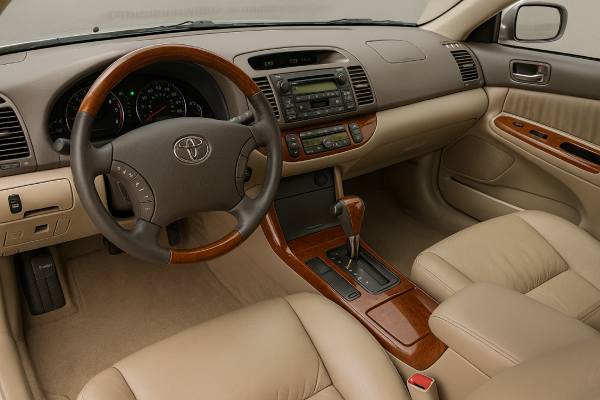
Inside, the MCV31 keeps the XV30’s generous dimensions. Five passengers fit realistically, rear legroom is strong, and the trunk remains one of the easiest to load in the class. Higher trims can have auto climate, upgraded audio (including JBL), and soft-touch or wood-tone accents. The overall impression is of an inoffensive, comfortable interior that ages well if cleaned and protected. The plastics and fabrics chosen for these cars resist wear better than many domestic competitors of the same era.
Camry 3.3 specs and data
Below is a consolidated spec set for the 2004 Camry V6 in its 3.3-litre MCV31 form. Figures can vary slightly by trim, market, emissions family, and wheel/tire package; always confirm by VIN and under-hood label.
Engine and Performance
| Item | Specification |
|---|---|
| Engine code | 3MZ-FE |
| Configuration | 60° V6, aluminium block and heads, DOHC, 24 valves |
| Displacement | 3.3 l (3,311 cc) |
| Bore × Stroke | 92.0 × 83.0 mm (3.62 × 3.27 in) |
| Induction | Naturally aspirated |
| Fuel system | Sequential multi-port fuel injection |
| Variable valve timing | VVT-i on intake side |
| Compression ratio | ~10.8:1 (varies slightly with market/emissions) |
| Max power | 225 hp (168 kW) @ ~5,600 rpm |
| Max torque | ≈ 325 Nm (240 lb-ft) @ ~3,600–3,800 rpm |
| Timing drive | Belt (service item) with inter-cam drive |
| Rated economy (auto) | ~19–20 mpg US city / 27–29 mpg US highway · ~12.4–8.1 L/100 km |
| Real-world highway @ 120 km/h (75 mph) | 8.5–9.5 L/100 km (25–28 mpg US) depending on tires/load |
| Aerodynamics | Cd ≈ 0.28–0.29 (sedan) |
Transmission and Driveline
| Item | Specification |
|---|---|
| Transmission | 5-speed automatic (U151E family, widely used with the 3.3) |
| Gear ratios (typical) | 1st 3.94 · 2nd 2.19 · 3rd 1.49 · 4th 1.00 · 5th 0.73 · Rev 3.14 |
| Final drive | ~3.29–3.48 depending on calibration |
| Drive type | FWD |
| Differential | Open |
| Refuel to full | Standard gasoline fill, typically under 5 minutes |
Chassis and Dimensions
| Item | Specification |
|---|---|
| Platform | XV30 Camry |
| Suspension (front/rear) | MacPherson strut / MacPherson strut |
| Steering | Power rack-and-pinion, light-effort tuning |
| Brakes | Front ventilated discs; rear solid discs (on most V6 trims); ABS widely fitted |
| Wheels/Tires | 16-in alloys common; 215/60R16 typical; SE may have sport wheel/tire |
| Ground clearance | ≈ 140 mm (5.5 in) |
| Length | ≈ 4,815 mm (189.6 in) |
| Width | ≈ 1,795 mm (70.7 in) |
| Height | ≈ 1,480 mm (58.3 in) |
| Wheelbase | 2,720 mm (107.1 in) |
| Turning circle | ≈ 11.3 m (37 ft) |
| Curb weight | ~1,520–1,590 kg (3,351–3,505 lb) depending on trim/options |
| GVWR | ~2,000 kg (4,409 lb) |
| Fuel tank | 70 l (18.5 US gal / 15.4 UK gal) |
| Cargo volume (SAE) | 473 l (16.7 ft³) sedan trunk |
Performance and Capability
| Metric | Value |
|---|---|
| 0–60 mph (0–97 km/h) | ≈ 7.0–7.4 s (healthy engine, 5AT, typical load) |
| 0–100 km/h (0–62 mph) | ≈ 7.4–7.8 s |
| Top speed | Governed to class-appropriate level |
| Braking 100–0 km/h | Low 40 m on good tires; ABS helps maintain control |
| Towing | Light-duty only; respect cooling limits; consult local rating |
| Roof load | Follow OE crossbar rating; keep below ~68 kg (150 lb) for stability |
Fluids and Service Capacities
| System | Specification | Capacity (approx.) |
|---|---|---|
| Engine oil | 5W-30, API SL/SM | ~5.0 l (5.3 US qt) with filter |
| Coolant | Toyota Super Long Life (pink), 50/50 premix | ~7.0 l (7.4 US qt) total system |
| ATF | Toyota ATF Type T-IV (for 5AT of the period) | ~3.5–4.0 l (per drain-and-fill) |
| Power steering | ATF-type fluid per label | Fill to sight mark |
| A/C refrigerant | R-134a | ~0.55 kg (19 oz), verify under-hood label |
| A/C compressor oil | ND-Oil 8 / PAG46 | ~120 ml (4 fl oz) |
| Key torque specs | Wheel lugs 103 Nm (76 lb-ft); drain plugs 40–44 Nm (30–33 lb-ft) |
Electrical
| Item | Spec |
|---|---|
| Alternator | High-90s to low-100 A output, trim-dependent |
| 12V battery | Group 24/24F typical, ≈550–650 CCA |
| Spark plugs | Iridium long-life, 1.0–1.1 mm (0.039–0.043 in) gap |
Safety and Driver Assistance
| Item | Detail |
|---|---|
| Airbags | Dual front standard; side/curtain often optional but desirable |
| ABS | Standard/widely available on V6 |
| TRAC/VSC | Available or included on higher trims/packages |
| Child-seat | LATCH anchors, top tethers |
| Lights | Halogen; no era-specific adaptive systems |
MCV31 trims, options and safety
Because the 3.3 V6 tended to sit at the top of the Camry lineup, equipment is usually better than on four-cylinder cars.
Typical trims with 3.3 V6:
- XLE V6 (3.3): Comfort config. Automatic climate control, power driver/passenger seats, upgraded audio (JBL on many), wood-tone trim, and 16-in alloys. Sunroof often bundled. Many XLEs also have side/curtain airbags and, where ordered, vehicle stability control.
- SE V6 (3.3): Sporty config. Firmer suspension, larger wheels/tires, sport interior accents, leather-wrapped wheel, and sometimes a rear lip spoiler. Still quiet and compliant, but with better transient response.
- LE V6 (3.3): Rarer pairing; equipment sits between LE 2.4 and XLE 3.3, but the point is power over gadgets.
Options and identifiers to look for:
- Airbag content: Look for “SRS Side Airbag” labels on front seats and “SRS Curtain Airbag” tags near the headliner. This is worth paying for.
- Stability/traction: TRAC/VSC switches or indicator lights on start-up; confirms the car has the enhanced stability package.
- Wheels/tyres: SE-specific alloys, sometimes 17-in in some markets; XLE keeps comfort-oriented wheels.
- Audio: JBL-branded systems and steering-wheel audio controls were common on upper trims.
Safety performance and structure:
- By 2004 the Camry XV30 family benefited from structural and equipment updates that significantly improved side-impact outcomes when airbags were present.
- Moderate-overlap frontal performance stayed strong.
- Head-restraint performance was typical for the era; not bad, not class-leading.
- ABS was expected on V6, and brake-assist / EBD logic supported emergency stops.
Service and calibration implications:
- No radar/camera-based ADAS to calibrate in 2004; post-repair steps mostly involve SRS lamp checks, ABS/traction light scans, and steering-angle resets only if suspension/steering components were replaced.
- After airbag work, ensure all SRS codes are cleared and a key-on, key-off bulb check passes.
- After wheel-speed sensor or hub replacement, road-test to confirm ABS/TRAC/VSC engagement is normal.
Reliability issues and service actions
The 3MZ-FE is one of Toyota’s more mature V6s of the era. It builds on the 1MZ-FE architecture but adds displacement and VVT-i tuning. Most problems you will see on a 2004 MCV31 today are age-and-use problems, not hard design flaws.
Common / low-to-medium cost:
- Timing belt overdue: Cracking, glazing, or simply unknown history. Replace belt, tensioner, idler, and water pump together; inspect cam and crank seals; refill with Toyota SLLC.
- Valve-cover gasket seep: Oil smell near the rear bank, dampness around the covers. Replace gaskets, check PCV system, and clean the area.
- Motor mounts/torque strut wear: Excessive engine movement or thump on gear engagement. Replace mounts in sets where possible.
- Front struts and upper mounts: Clunk over low-speed bumps, floaty highway ride. New struts and mounts return the Camry feel.
Occasional / medium cost:
- Power-steering seep at pump or lines: Moisture or drops at the pump body or return lines. Replace affected components and refill with the specified fluid.
- Alternator fatigue: Dim lights at idle with accessories running. Replace with quality reman or new unit; clean battery and chassis grounds.
- A/C relay or clutch-gap issues: Intermittent cooling on hot days. Diagnose relay, check clutch gap, ensure proper refrigerant charge.
Less common / higher cost but important:
- Transmission complaints (5AT): Harsh 2–3 or 3–4, especially cold, or delayed engagement into Drive/Reverse. Stage several drain-and-fills with ATF Type T-IV, verify engine/trans mounts, and check for applicable transmission ECU calibrations.
- Cooling-system neglect: Radiator end-tank ageing, thermostat sticking, or heater-hose junction leaks. A full refresh—radiator, hoses, thermostat, cap—stabilizes operating temp and protects head gaskets.
- ABS wheel-speed sensor corrosion (snow-belt): Intermittent ABS/VSC lights. Inspect tone rings for rust swelling and sensor mounting faces for debris.
Recalls/TSBs to confirm by VIN:
- Airbag and seatbelt-related updates in the 2004 timeframe.
- Occasional ECM/engine-control calibrations for driveability or emissions.
- Any campaign referencing side-curtain installation or routing.
Pre-purchase checks to request:
- Timing-belt proof (invoice with date/mileage, showing water pump included).
- ATF history (drain-and-fill, not just “inspected”).
- Coolant type (pink Toyota SLLC preferred) and age.
- Brake system report (pad thickness, rotor condition, fluid age).
- SRS/ABS/VSC key-on bulb check video or in-person demonstration.
- Undercarriage photos of subframes, pinch welds, and rear suspension arms for corrosion.
- Recall printout from Toyota’s official lookup.
Maintenance plan and buyer guide
Service schedule (practical):
- Engine oil + filter: 5,000–7,500 miles (8,000–12,000 km) or 6–12 months, 5W-30 API SL/SM.
- Engine air filter: Inspect 15,000 miles (24,000 km); replace 30,000 miles (48,000 km) or earlier in dusty regions.
- Cabin filter: 15,000–30,000 miles (24,000–48,000 km).
- Spark plugs (iridium): 120,000 miles (193,000 km) typical.
- Coolant (Toyota SLLC): First at 100,000 miles (160,000 km) or 8–10 years, then every 50,000 miles (80,000 km) / 4–5 years.
- Timing belt + water pump: 90,000–105,000 miles (144,000–168,000 km) or 7–8 years, whichever comes first.
- Serpentine/aux belt: Inspect at every oil service after 60,000 miles; replace by condition.
- ATF (5AT): Drain-and-fill every 30,000–60,000 miles (48,000–96,000 km). Avoid aggressive flushes on high-mileage, unknown-history units.
- Brake fluid: Every 2–3 years.
- Brake hardware: Inspect pads/rotors every rotation; clean/lube slide pins annually.
- Tyre rotation and alignment: 5,000–7,500 miles (8,000–12,000 km); align yearly or after suspension work.
- 12 V battery: Load-test yearly after year 4; expect 5–7 years of life.
Fluid specs for decision-makers:
- Oil capacity: ~5.0 l (5.3 qt) with filter.
- ATF fill (drain): ~3.5–4.0 l (3.7–4.2 qt), Toyota ATF Type T-IV.
- Cooling system: ~7.0 l (7.4 qt) of Toyota SLLC (pink).
- Tyre pressures: As per door-jamb, often 30–32 psi (207–221 kPa).
- Wheel lug torque: 103 Nm (76 lb-ft).
Buyer’s inspection checklist:
- Cold start: Should idle smoothly, no belt squeal beyond a brief chirp, no V6 lifter tick.
- Transmission engagement: Quick, clean shift into R and D, no flare.
- Highway test: Tracks straight, no steering wheel shake under braking, no booming from rear.
- Suspension: No clunks over speed bumps, no front-end dive asymmetry.
- Cooling system: Fans cycle correctly, coolant clean and pink, no crust at radiator necks or thermostat housing.
- Interior: Check HVAC blend doors, auto climate operation, and audio backlighting—age can dim displays.
- Safety gear: Airbag labels present; ABS/VSC lights illuminate and go out at key-on.
What to seek:
- 2004 Camry 3.3 with side/curtain airbags, VSC/TRAC, and documented timing-belt service.
- SE V6 if you want slightly sharper driving without losing comfort.
- XLE V6 if you want maximum equipment and the quietest cabin.
What to avoid or price down:
- No record of belt/pump work on a 20-year-old car.
- Brown or burnt ATF and slow engagement.
- Active coolant leaks or mixed coolant types.
- ABS or SRS warning lamps—these can be simple, but you should assume diagnosis costs.
Durability outlook: A looked-after MCV31 can comfortably reach 200,000–250,000 miles (320,000–400,000 km) with only predictable wear items—belts, struts, mounts, brakes, and cooling parts. The 3MZ-FE handles mileage well if oil stays clean and cooling is kept stable.
Driving performance and economy
The 3.3 V6 is the first XV30 Camry that feels genuinely brisk in modern traffic. Throttle response is clean, and the strong midrange means you can merge, overtake, or climb grades without wringing the engine out. The 5-speed automatic helps, keeping revs low at a cruise but allowing quick downshifts when you need power. Kickdowns are decisive rather than abrupt, which suits the Camry’s comfort brief.
Ride and handling. On standard suspension, the car stays very composed over poor city surfaces. Body roll is present but well controlled; the car is tuned for stability, not sharp rotation. SE versions tighten this up, reducing roll and improving turn-in, at the slight expense of impact softness. Steering is light but accurate, with enough on-centre feel for highway work. Straight-line stability is excellent—crosswinds and freeway grooves don’t upset it.
Noise and vibration. The 3MZ-FE is quiet at idle and impressively smooth above 3,000 rpm. Compared with the 2.4 four-cylinder, the V6 creates less cabin buzz under load, especially with passengers and luggage aboard. Road and wind noise remain low for a 2004 sedan; fresh door seals and correct tyres keep it that way.
Real-world economy. Expect about 19–21 mpg US (12.4–11.2 L/100 km) in mixed, stop-and-go use, 24–28 mpg US (9.8–8.4 L/100 km) on the highway at 65–70 mph, and slightly worse in winter with short trips. Tyre rolling resistance, alignment, and transmission fluid condition all matter; a well-maintained car is noticeably more economical than a neglected one.
Load and towing. With four or five occupants, the extra torque is noticeable—it keeps the car from feeling strained on long grades, and downshifts are fewer. For very light towing or hitch-mounted carriers, the V6 is the one to get, but stay within ratings, keep speeds moderate, and consider an ATF service beforehand.
Camry 3.3 vs rivals
Honda Accord V6 (2004). The Accord’s 3.0 V6 is lighter on its feet and more eager to rev. Its chassis feels more athletic, and transmissions of this era are good when maintained, but some years were more sensitive to fluid neglect. Cabin space is similar, ride is a bit firmer, and noise is a tick higher. For daily calm and easier parts sourcing, the Camry wins.
Nissan Altima 3.5 (2004). Considerably stronger straight-line pace from the VQ35 and a sportier stance, but interior quality and long-term trim durability trail the Camry. Altima can be more fun; Camry is better if you want to hand the keys to any driver in the household and not worry.
Mazda 6 V6 (2004). More engaging steering and chassis, but smaller interior and often higher noise. Good if the driver cares about feedback; Camry if the household cares about comfort and quiet.
Hyundai Sonata / Kia Optima V6 (period). Lower initial and used prices, improving quality, and decent equipment, but the Camry still has the edge in perceived solidity and long-run parts availability.
Verdict. If you want the quietest, least dramatic way to get midsize space with real V6 shove from this era, the 2004 Camry 3.3 is the sweet spot. You get the matured structure, the big engine, the better gearbox, and often the better safety kit, all tied to Toyota’s serviceability.
References
- 2004 Camry Owner’s Manual 2004 (Owner’s Manual)
- 2004 Camry Scheduled Maintenance Guide 2004 (Maintenance Guide)
- 2004 Toyota Camry 4-door sedan 2004 (Safety Rating)
- Gas Mileage of 2004 Toyota Camry 2004 (EPA Fuel Economy)
Disclaimer
This article is for informational purposes only and is not a substitute for professional diagnosis or repair. Specifications, capacities, torque values, procedures, and maintenance intervals can vary by VIN, production date, market, and installed equipment. Always confirm against the official service manual, under-hood labels, and current manufacturer publications before performing work. If this guide helped you, please share it on Facebook or X/Twitter to support xcar’s technical coverage.