
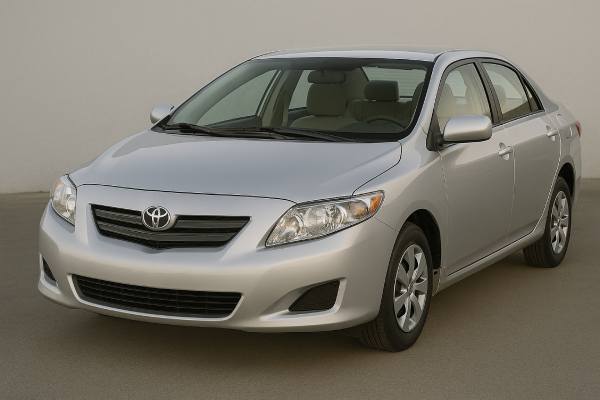
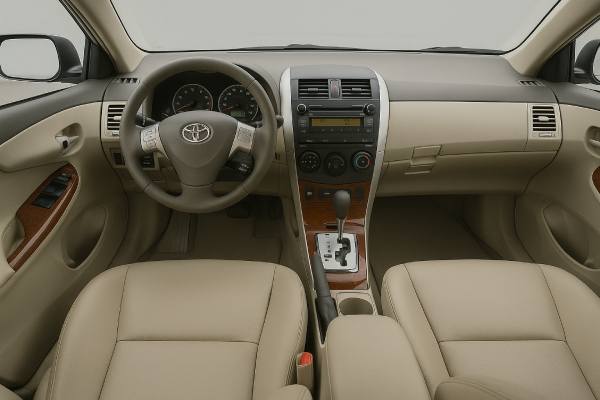
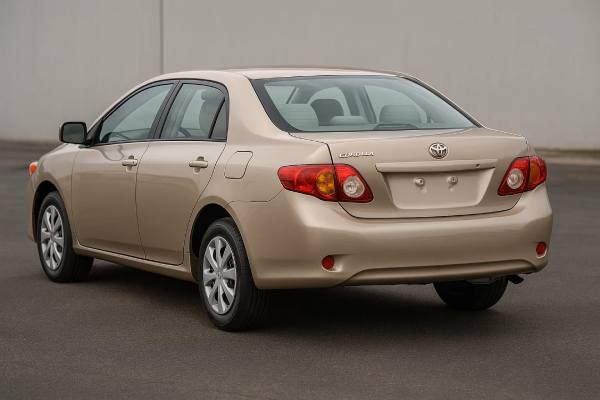
The 2009–2010 Toyota Corolla XRS (chassis AZE142) is a rare twist on a household name. It pairs Toyota’s 2.4-litre 2AZ-FE four-cylinder—shared with larger models—with a sport-tuned chassis, bigger brakes, and a choice of five-speed manual or five-speed automatic. The result is a compact sedan with everyday comfort and Corolla-grade durability, but livelier mid-range torque and more confident passing power than the common 1.8-litre trims. In daily use it remains simple to service, frugal for its output, and roomy for a small car. Shoppers should understand a few 2AZ-FE maintenance priorities (oil consumption monitoring, cooling system health, and accessory-drive upkeep), and that fuel economy trails the 1.8-litre. If you want a practical commuter that doesn’t feel winded merging or climbing grades, the 2.4-litre Corolla is a quietly smart pick.
Fast Facts
- Strong mid-range torque (162 lb-ft / 220 Nm) gives easy passing and hill climbs.
- Sport-tuned XRS chassis, 17-inch wheels, and rear discs improve confidence.
- Proven timing chain (no belt) lowers long-term service complexity.
- Watch for rising oil consumption on high-mileage 2AZ-FE; keep 5,000–7,500-mile (8,000–12,000 km) oil changes.
- Typical interval: engine air filter every 30,000 miles (48,000 km) or 3 years; sooner in dusty use.
Quick navigation
- Detailed Overview
- Specifications and Technical Data
- Trims and Options, Safety and Driver Assistance
- Reliability, Common Issues and Service Actions
- Maintenance and Buyer’s Guide
- Driving and Performance
- How Corolla 2.4 Compares to Rivals
Detailed Overview
The AZE142 Corolla (model years 2009–2010 in North America; sometimes described as 2008–2010 by build date) brought a meaningful power bump to the compact-sedan class. The 2AZ-FE 2.4-litre DOHC engine delivers 158 hp (118 kW) and, more importantly, 162 lb-ft (220 Nm) of torque at a usable 4,000 rpm. That extra twist is what you feel when pulling away with passengers, climbing long grades, or overtaking from 50–70 mph. Compared to the 1.8-litre trims, the XRS uses larger front brakes and adds solid rear discs, a firmer suspension tune with a front strut-tower bar, and standard stability/traction control. Visually, it stands apart with 17-inch alloys, subtle aero add-ons, and specific badging.
Inside, the cabin is classic Corolla: straightforward controls, generous front headroom, and a rear seat that fits adults without acrobatics. The XRS spec typically includes sport seats, a leather-wrapped wheel, full gauges, and available Smart Key and automatic climate control depending on market packaging. Trunk volume remains practical for family duty, and the 60/40 split seat expands cargo length for bulky items.
Ownership-wise, the 2AZ-FE is chain-driven (no timing belt replacement), uses widely available fluids and filters, and is easily serviced by independent shops. It does, however, demand attention to oil level as miles accumulate, particularly if prior owners stretched change intervals. The rest of the chassis is predictable Toyota: bushings, links, and wheel bearings last well with normal use; alignment and tire rotation keep it tracking straight and quiet.
Fuel economy is the 2.4’s tradeoff. Expect mid-20s mpg (US) combined, with highway numbers around 30 mpg if driven gently—several mpg lower than the 1.8-litre but still respectable for the torque on tap. Safety is a bright spot: multiple airbags, active head restraints, and strong crash-test performance for the era. For shoppers who want a sensible Corolla with extra muscle and better braking, the AZE142 XRS is the sweet spot.
Specifications and Technical Data
Engine and Performance (ICE-only)
| Item | Detail |
|---|---|
| Engine code | 2AZ-FE |
| Layout & valvetrain | Inline-4, DOHC, 16 valves, Dual VVT-i (intake/exhaust) |
| Displacement | 2.4 L (2,362 cc) |
| Bore × stroke | 88.5 × 96.0 mm (3.48 × 3.78 in) |
| Compression ratio | ~9.8:1 |
| Induction | Naturally aspirated |
| Fuel system | Sequential multi-port fuel injection |
| Max power | 158 hp (118 kW) @ 6,000 rpm |
| Max torque | 220 Nm (162 lb-ft) @ 4,000 rpm |
| Timing drive | Chain |
| Emissions certification | Tier 2 Bin 5 era (USA) |
| Rated efficiency (EPA) | 25 mpg combined (22/30 city/hwy) — both 5MT and 5AT |
| Real-world highway @ 75 mph (120 km/h) | ~7.8–8.7 L/100 km (27–30 mpg US / 32–36 mpg UK), wind/grade dependent |
| Aerodynamics (approx.) | Cd ~0.29–0.30 (trim-dependent) |
Transmission and Driveline
| Item | Detail |
|---|---|
| Drive type | Front-wheel drive |
| Manual | 5-speed (XRS) |
| Automatic | 5-speed automatic with sequential mode (XRS) |
| Final drive | ~3.94–4.31 (variant-dependent) |
| Differential | Open (traction/stability control standard) |
| “Refuel to full” time | ~5 min typical pump stop |
Chassis and Dimensions
| Item | Detail |
|---|---|
| Front / rear suspension | MacPherson strut / torsion beam; XRS with sport-tuned calibration and front strut-tower bar |
| Steering | Electric power rack-and-pinion |
| Brakes | Ventilated front discs; solid rear discs (XRS) |
| Wheel / tire packages | 215/45R17 on 17×7 in alloys (XRS); 195/65R15 or 205/55R16 on other trims |
| Ground clearance | ~150 mm (5.9 in) |
| Length × width × height | ~4,540 × 1,760 × 1,465 mm (178.7 × 69.3 × 57.7 in) |
| Wheelbase | 2,600 mm (102.4 in) |
| Turning circle (curb-to-curb) | ~10.4 m (34.1 ft) |
| Curb weight | ~1,245–1,265 kg (2,745–2,790 lb), equipment-dependent |
| GVWR | ~1,730–1,770 kg (3,814–3,902 lb) |
| Fuel tank | 50 L (13.2 US gal / 11.0 UK gal) |
| Cargo volume (SAE) | ~348–368 L (12.3–13.0 ft³), seatbacks up |
Performance and Capability
| Metric | Estimate / Typical Test Result |
|---|---|
| 0–60 mph (0–97 km/h) | ~7.9–8.3 s (trim, trans, surface) |
| 0–100 km/h (0–62 mph) | ~8.3–8.7 s |
| Top speed | ~190–205 km/h (118–127 mph), limiter-dependent |
| 100–0 km/h (62–0 mph) braking | ~37–40 m (121–131 ft) on quality tires |
| Towing (light duty) | Up to ~680 kg (1,500 lb) with proper equipment (check local guidance) |
| Payload | ~385–430 kg (850–950 lb), configuration-dependent |
| Roof load | ~45–75 kg (100–165 lb), rack-system dependent |
Fluids and Service Capacities
(Always confirm by VIN and manual.)
| System | Spec / Grade | Capacity (approx.) |
|---|---|---|
| Engine oil | API/ILSAC 5W-20 or 5W-30 (climate-dependent) | ~4.1–4.3 L (4.3–4.5 US qt) w/ filter |
| Coolant | Toyota Super Long Life (pink), premix 50/50 | ~5.7–6.6 L (6.0–7.0 US qt) total system |
| Manual transmission | API GL-4/GL-5 (per manual) | ~2.1–2.4 L (2.2–2.5 US qt) |
| 5-speed automatic | Toyota WS ATF | ~6.5–7.6 L (6.9–8.0 US qt) service fill (varies) |
| A/C refrigerant | R-134a | ~430–500 g (15–18 oz) |
| A/C compressor oil | ND-Oil 8 (PAG) | ~120–150 mL (4–5 fl oz) |
Electrical
| Item | Detail |
|---|---|
| Alternator output | ~100–120 A |
| 12-V battery | Group 35/24F common; ~45–60 Ah (CCA varies) |
| Spark plugs | Iridium, long-life; gap ~0.7–0.8 mm (0.028–0.031 in) |
Safety and Driver Assistance
| Area | Detail |
|---|---|
| Airbags | Dual-stage front, front side, full-length curtains; active head restraints |
| Brakes and stability | ABS, EBD, Brake Assist; stability and traction control |
| IIHS | Strong results across moderate overlap, side, roof strength, and head restraints |
| Headlight rating (IIHS) | Not applicable for this era (headlight program launched years later) |
| Child-seat | LATCH anchors in outboard rear positions; top tether points |
Trims and Options, Safety and Driver Assistance
Trims and powertrains (North America): The 2.4-litre engine was exclusive to the XRS grade. Other grades (Standard/CE, LE, XLE, S) used the 1.8-litre. The XRS pairs the 2AZ-FE with a five-speed manual or five-speed automatic. Key XRS mechanical upgrades include the sport-tuned suspension with a front tower bar, larger front discs with a firm pedal, and rear disc brakes. Seventeen-inch alloys wearing 215/45R17 tires and a rear spoiler are typical visual tells.
Feature highlights (XRS-typical equipment and options):
- Sport front seats, leather-wrapped wheel, and full analog gauge cluster.
- Stability and traction control, ABS with EBD/Brake Assist.
- Optional Smart Key with push-button start and automatic climate control depending on package.
- Upgraded audio (some markets with additional speakers), fog lamps, and the larger wheel/tire package.
Year-to-year notes:
- 2009 (launch year): Two engines introduced (1.8 and 2.4). Stability/traction typically standard on XRS; specific packaging varies by market.
- 2010: Feature shuffles for non-XRS trims; continued availability of the XRS with the 2.4 and both transmissions.
Safety ratings summary: This generation achieved strong crash-test outcomes for the period, with robust cabin structure, good side-impact protection thanks to standard side curtains and torso airbags, and very good roof strength metrics. Active head restraints were standard to mitigate whiplash risk. While modern advanced driver-assistance systems (AEB, adaptive cruise, lane centering) were not offered, stability control was standard on XRS and became common across the line as the model progressed.
Child-seat and calibration considerations: Lower anchors are readily accessed. After any airbag, seat sensor, or windshield replacement, ensure required calibrations and zero-point resets are performed (yaw rate/steering angle for stability control) to restore proper system operation.
Quick identifiers for XRS:
- “XRS” badging, 17-inch alloys, fog lamps, discreet aero trim.
- Rear disc brakes visible through wheels.
- Tachometer redline and sport seat bolsters.
- VIN/option code references in the build label (dealer can decode).
Reliability, Common Issues and Service Actions
The AZE142 Corolla platform is generally durable, with the 2AZ-FE offering long service life when fluids are maintained and cooling is healthy. The list below maps typical concerns by prevalence and impact so buyers can plan inspections and budgets accordingly.
Engine (2AZ-FE)
- Oil consumption (common / medium–high impact): Higher-mileage engines can consume oil between changes. Symptoms include low dipstick readings, blue exhaust on startup, and fouled plugs. Causes range from stuck oil-control rings to PCV issues. Remedy: Monitor level every 1,000 miles (1,600 km); use correct viscosity; replace PCV valve; if severe, plan a ring job or short-block replacement.
- Water pump seep/noise (occasional / medium): Look for pink coolant crusting or bearing noise. Remedy: Replace pump and drive belt; bleed cooling system thoroughly.
- Accessory belt and tensioner wear (occasional / low–medium): Chirps or belt slip under load. Remedy: Replace belt and tensioner; verify pulley alignment.
- Thermostat and radiator cap aging (occasional / low): Slow warm-up or fluctuating temp. Remedy: Replace with OEM-spec parts.
Fuel/air systems
- Mass airflow sensor contamination (occasional / low): Rough idle or lean codes. Remedy: Clean or replace MAF; confirm air filter seal and intake ducting.
- Throttle body deposits (occasional / low): Sticky pedal or idle flare. Remedy: Clean throttle bore; perform idle relearn as required.
Ignition
- Coil-on-plug misfire (occasional / low–medium): Misfire under load, stored P030X. Remedy: Replace individual coils and plugs (iridium), check for oil in plug tubes.
Exhaust and emissions
- Exhaust manifold/catalyst heat-shield rattles (occasional / low): Buzzing at specific rpm. Remedy: Re-secure or replace fasteners/isolators.
- O2 sensor aging (common / low): Reduced fuel economy and CEL. Remedy: Replace upstream sensor; check wiring.
Transmission and driveline
- 5-speed automatic (occasional / medium): Harsh 2–3 shift when fluid is old. Remedy: Partial drain/fill with Toyota WS; consider multiple services to refresh fluid.
- Manual (occasional / medium): Clutch wear or release-bearing noise with high miles. Remedy: Clutch kit and bearing; inspect rear main seal while open.
- CV axle boots (occasional / low): Cracked boots flinging grease. Remedy: Reboot early; replace axle if joint noisy.
Chassis and steering
- Front sway-bar links/bushings (common / low): Clunks over small bumps. Remedy: Replace links/bushings; verify torque at ride height.
- Rear torsion-beam bushings (occasional / medium): Rear-end thump; uneven tire wear if alignment neglected. Remedy: Replace bushings; align.
- Wheel bearings (occasional / medium): Growl that rises with speed. Remedy: Replace hub assembly.
Brakes
- Rear caliper slide corrosion (occasional / low–medium in salt regions): Dragging or uneven pad wear. Remedy: Clean/lube slides; replace hardware and boots; flush fluid.
Electrical and body
- Blower motor resistor (occasional / low): Limited fan speeds. Remedy: Replace resistor pack; check cabin filter restriction.
- Door lock actuators (occasional / low): Weak or intermittent. Remedy: Replace actuator.
Recalls/TSBs and verification: Always run an official VIN recall check and request dealer service history. Airbag inflator campaigns, pedal/trim interference updates, and ECU reflashes have existed across Toyota lines in this era; completion is important for safety and resale.
Pre-purchase requests:
- Proof of regular oil changes; oil-consumption notes.
- Cooling-system service record (pump/thermostat/coolant).
- Transmission service (WS ATF drain/fill history or clutch work).
- Recent brake service measurements and evidence of slide maintenance.
- Alignment/tire rotation history and current tread depth printout.
Maintenance and Buyer’s Guide
Practical service schedule (typical use; verify by VIN and manual):
- Engine oil and filter: Every 5,000–7,500 miles (8,000–12,000 km) or 6–12 months. Shorter intervals for city/short-trip use.
- Engine air filter: Inspect 15,000 miles (24,000 km); replace ~30,000 miles (48,000 km) or sooner in dust.
- Cabin air filter: 15,000–20,000 miles (24,000–32,000 km) or annually.
- Spark plugs (iridium): ~120,000 miles (192,000 km) or 10 years; inspect earlier if misfire/oil use.
- Coolant (SLLC pink): First at 100,000 miles (160,000 km) or 10 years; then every 50,000 miles (80,000 km) or 5 years.
- Accessory/serpentine belt and tensioner: Inspect every 30,000 miles (48,000 km); replace at first cracking/noise.
- Brake fluid: Flush every 3 years regardless of mileage.
- Manual transmission oil: Inspect 30,000 miles; replace ~60,000–90,000 miles (96,000–144,000 km).
- Automatic transmission (WS ATF): Drain/fill ~60,000–90,000 miles (96,000–144,000 km) based on use/heat; avoid “power flush.”
- Alignment and rotation: Rotate every 5,000–7,500 miles; align annually or with any tire wear/suspension work.
- PCV valve: Inspect 60,000 miles; replace if restricted.
- Battery: Load-test annually after year 3; typical replacement window 4–6 years.
- Timing chain: No fixed replacement interval. Inspect for correlation codes, rattle at warm restart, or guide debris; service only if out of spec/symptomatic.
Fluid quick picks (decision-oriented):
- Oil: Quality synthetic 5W-20/5W-30 meeting ILSAC.
- ATF: Toyota WS only.
- Coolant: Toyota SLLC (pink) premix.
- Brakes: DOT 3 or DOT 4; flush interval matters more than brand.
- PS fluid: Electric power steering—no fluid service.
Buyer’s inspection checklist (on-car):
- Engine: Cold start, listen for top-end tick, verify no coolant smell; monitor oil level after test drive.
- Cooling: Steady needle, strong cabin heat, no pearly coolant residue at pump or tank.
- Transmission: Manual—clutch take-up smooth, no chatter; Automatic—clean shifts, no flare or harsh kickdown.
- Suspension/steering: Quiet over ripples; no steering vibration at 65–75 mph.
- Brakes: Even bite, no rear drag, firm pedal.
- Tires: Even wear across 17-inch set; budget for quality rubber to unlock chassis balance.
- Body: Rocker panels and rear subframe surface rust in salt regions; inspect brake and fuel-line clips.
- Electrics: All windows/locks, HVAC blower speeds, and instrument illumination.
What to seek or avoid:
- Seek: Documented oil-change history; recent cooling and brake service; tires with correct load/speed rating; alignment printout.
- Caution: Engines showing quart-per-1,000-mile consumption without documentation; neglected ATF; uneven tire wear (possible alignment or bushing issues).
- Durability outlook: With routine fluids and attention to oil level, 200k+ miles (320k+ km) is realistic with original powertrain internals.
Driving and Performance
Ride, handling, and noise: The XRS calibration retains Corolla civility while dialing down body roll. On 17-inch tires, it feels planted at highway speed with reassuring straight-line stability. Over broken city pavement you will notice sharper impacts than on 15/16-inch trims, but it avoids harshness if tires are properly inflated and balanced. Cabin noise is modest for the class; wind rustle around the A-pillars and tire thrum over coarse asphalt are typical at 70–75 mph (113–120 km/h).
Steering and braking: Electric power steering is light at parking speeds, gaining weight linearly as speed rises. There is enough on-center feel to cruise without constant corrections. The larger brake package offers confident emergency stops; pedal travel is short and the bite is progressive. Brake feel improves noticeably with fresh fluid and properly sliding rear calipers.
Powertrain character: The 2AZ-FE’s advantage is accessible torque. Throttle response is crisp off-idle, and the engine pulls cleanly from 2,000–5,500 rpm. The five-speed manual’s gearing makes the most of the mid-range; the five-speed automatic’s manual mode is responsive enough for overtakes and grade holds. The engine sounds workmanlike rather than racy; it settles down at cruise with modest vibration.
Observed efficiency: In mixed commuting, many owners see 24–27 mpg US (9.8–8.7 L/100 km). At a steady 70–75 mph, 29–31 mpg (8.1–7.6 L/100 km) is attainable with light cargo and proper tires. Cold weather or short trips will trim a few mpg; sustained high speed or headwinds will too. Compared with the 1.8-litre, expect 3–5 mpg less under similar conditions.
Key metrics (what changes verdicts):
- 50–70 mph passing: Confident without downshifts in manual; 5AT drops one or two gears quickly.
- Braking consistency: Strong heat tolerance for a compact; quality pads and clean slides matter.
- Turning circle: Tight enough for urban U-turns; 17-inch tires slightly increase scrub at full lock.
- Load sensitivity: With four adults and luggage, the 2.4 remains composed; fuel economy dips 5–10%.
Traction and winter notes: Stability/traction control are conservative but effective. All-season tires are adequate for mild snow; in regular winters, a dedicated set of 16-inch winter tires transforms confidence and braking distances.
How Corolla 2.4 Compares to Rivals
In 2009–2010, shoppers cross-shopped the Corolla XRS with Honda Civic EX/Si, Mazda3 2.5, Hyundai Elantra, and emerging compacts touting efficiency. The Corolla 2.4 sits between “economy” and “hot” trims: quicker than most 1.8–2.0 rivals, calmer and more practical than full sport models.
Against Honda Civic: Civic EX (1.8) is thriftier and more playful steering-wise; Civic Si is quicker but revvier and firmer. The Corolla XRS counters with stronger low-end torque, simpler maintenance, and a more relaxed commute.
Against Mazda3 2.5: The Mazda3 (new for 2010) brings sharper handling and cabin flair. The Corolla answers with better ride isolation on rough highways, lower NVH at cruise, and a reputation for long-term parts availability.
Against economy-focused compacts: Models tuned strictly for mpg beat the XRS at the pump but can feel strained in mountains or with full loads. If you value effortless daily torque, the Corolla 2.4’s balance is compelling.
Ownership calculus: Insurance and running costs are modest, parts are abundant, and independent shops know the platform well. If you can accept mid-20s mpg and keep up with fluids, the XRS offers meaningful performance without sacrificing the Corolla virtues that keep resale strong.
References
- Gas Mileage of 2009 Toyota Corolla 2009 (EPA/FuelEconomy.gov)
- 2009 Toyota Corolla 2009 (Safety Rating)
- Toyota 2009 Corolla Owner’s Manual (OM12C16U) 2009 (Owner’s Manual)
- The all-new 2009 Corolla: building upon a 40-year, global reputation for quality and value with new levels of performance, styling, safety and comfort 2008 (Manufacturer Release)
Disclaimer
This guide is for informational purposes and is not a substitute for professional diagnosis or repair. Specifications, torque values, fluid types and capacities, and service intervals can vary by VIN, market, model year, and equipment. Always confirm procedures and numbers against your official service documentation and follow all safety precautions when working on a vehicle.
If you found this helpful, please consider sharing it with other owners on Facebook or X/Twitter to support xcar’s work.