
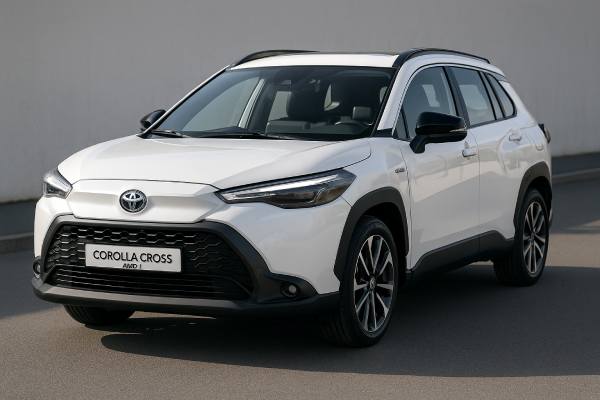
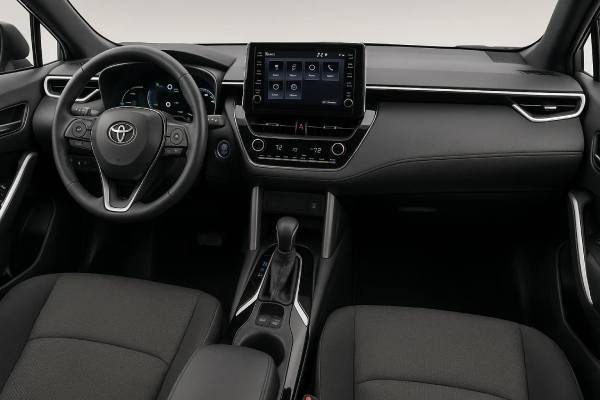
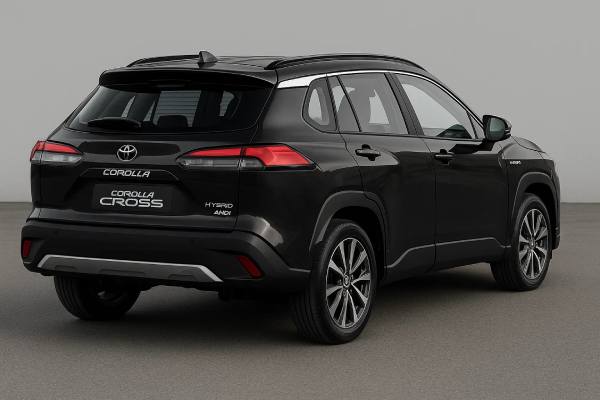
The refreshed 2025–present Toyota Corolla Cross Hybrid AWD-i pairs Toyota’s fifth-generation hybrid hardware with an efficient 2.0-liter Atkinson-cycle four-cylinder and an electric rear axle for all-weather traction without a driveshaft. The facelift sharpens exterior styling, updates the Toyota Audio Multimedia system, and adds refinements to driver assistance, while keeping a pragmatic footprint, roomy second row, and the brand’s reputation for low running costs. Owners value the confident commuter torque from the electric motors, easy maneuverability, and strong predicted reliability. If you want a compact crossover that still feels car-like in the way it steers and sips fuel, this Hybrid AWD-i is a smart pick. Below you will find clear specs, dimensions, performance notes, real-world maintenance guidance, and buyer tips tailored to this exact variant so you can shop and own with confidence.
Fast Facts
- Strong efficiency for an AWD crossover; relaxed highway manners and easy city maneuvering.
- Practical cabin with simple controls, good visibility, and flexible cargo floor.
- Toyota Safety Sense with broad standard ADAS coverage; excellent crash-test pedigree.
- Watch for brake pad glazing if mostly urban use; rotate tyres every 8,000–10,000 km (5,000–6,000 miles).
- Oil and filter service: every 10,000 miles / 12 months (16,000 km / 12 months) under normal schedule.
Explore the sections
- Corolla Cross Hybrid AWD-i brief
- Corolla Cross Hybrid specs
- Corolla Cross trims and safety
- Reliability and known issues
- Maintenance and buying guide
- Driving impressions and efficiency
- Rivals and alternatives
Corolla Cross Hybrid AWD-i brief
The Corolla Cross Hybrid AWD-i (chassis code MXGH15) is the all-wheel-drive member of the Corolla Cross family, using Toyota’s e-Axle layout: a gasoline engine and hybrid transaxle up front plus a compact electric motor at the rear. There is no mechanical driveshaft—rear traction is delivered instantly by the rear motor when slip is detected or when drive modes call for it, enhancing stability in rain and snow while preserving efficiency.
The 2025 facelift focuses on everyday improvements owners notice first. Exterior updates modernize the front and rear fascias and refine aero details. Inside, the latest Toyota Audio Multimedia brings quicker responses, a larger touchscreen in most trims, native cloud-based navigation in supported regions, and wireless smartphone mirroring. Material choices reduce glare and fingerprints, and small but thoughtful touches—like extra console storage and clearer climate readouts—improve daily usability. Toyota Safety Sense continues to evolve with expanded detection ranges and lane support polish.
From a packaging standpoint, the Hybrid AWD-i keeps the compact exterior footprint that makes it easy to park, but the tall roof and square cargo opening remain. The rear motors and hybrid battery occupy space under the floor; cargo capacity is lower than the non-hybrid FWD model yet still useful for strollers or a week’s groceries. Seating position is upright with generous headroom for taller drivers. Ride tuning aims for quiet competence rather than sportiness, though the rear multi-link suspension and a modest curb weight give it a settled, predictable feel on imperfect pavement.
Ownership appeal centers on dependable economy, low scheduled maintenance, and Toyota’s broad dealer network. If you want plug-free hybrid efficiency with snow-belt reassurance, the AWD-i configuration hits a sweet spot. Shoppers prioritizing maximum cargo volume or brisk acceleration may find larger non-hybrid rivals faster or roomier, but few match the Corolla Cross Hybrid AWD-i’s blend of traction, thrift, and pricing.
Corolla Cross Hybrid specs
Below are concise, market-appropriate figures for the 2025–present facelift Corolla Cross Hybrid AWD-i. Values can vary slightly by trim and equipment.
Engine and Performance (ICE-hybrid system)
| Item | Detail |
|---|---|
| Engine code | M20A-FXS (Atkinson-cycle) |
| Layout & valvetrain | Inline-4, DOHC, 16-valve, Dual VVT-i |
| Bore × stroke | 80.5 × 97.6 mm (3.17 × 3.84 in) |
| Displacement | 2.0 L (1,987 cc) |
| Induction | Naturally aspirated |
| Fuel system | Toyota D-4S (direct + port injection) |
| Compression ratio | ~14.0:1 |
| System net power | 178 hp (133 kW) |
| Engine torque (approx.) | 188 Nm (139 lb-ft) @ ~4,400–5,200 rpm |
| Timing drive | Chain |
| Emissions/efficiency std. | EPA class: hybrid gasoline |
Hybrid Motor-Battery Details
| Item | Detail |
|---|---|
| Front traction motor (MG2) | Permanent magnet synchronous (PMSM) |
| Rear motor (e-Axle) | Permanent magnet synchronous (PMSM), on-demand AWD-i |
| Hybrid battery | Lithium-ion |
| System voltage | ~600 V nominal |
| Rated economy (typical) | ~5.6 L/100 km combined (42 mpg US / 50 mpg UK) |
| Real-world highway @ 120 km/h (75 mph) | ~6.2–6.7 L/100 km (38–34 mpg US / 46–41 mpg UK), weather and tyres dependent |
| Aerodynamics | Cd ~0.33–0.34 (trim dependent) |
Transmission and Driveline
| Item | Detail |
|---|---|
| Transmission | Electronically controlled continuously variable transaxle (eCVT) with fixed ratios and motor-generator split |
| Final drive (front) | ~3.6–3.9:1 (varies by calibration) |
| Drive type | AWD-i (front hybrid transaxle + independent electric rear axle) |
| Differential(s) | Open; traction control via braking and torque modulation |
| Refuel to full (gasoline) | ~5 minutes typical |
Chassis and Dimensions
| Item | Detail |
|---|---|
| Platform | Toyota TNGA-C |
| Suspension (front / rear) | MacPherson strut / Multi-link |
| Steering | Electric power steering; rack-assist |
| Brakes | Front ventilated discs ~305 mm (12.0 in); rear solid discs ~281 mm (11.1 in) |
| Wheels/Tires (typical) | 215/65 R17 or 225/55 R18 |
| Ground clearance | ~206 mm (8.1 in) |
| Length × width × height | ≈ 4,460 × 1,825 × 1,645 mm (175.6 × 71.9 × 64.8 in) |
| Wheelbase | 2,640 mm (103.9 in) |
| Turning circle (curb-to-curb) | ~10.4 m (34.1 ft) |
| Curb weight | ~1,600–1,650 kg (3,530–3,640 lb), by trim |
| GVWR | ~2,050–2,100 kg (4,520–4,630 lb) |
| Fuel tank | ~40 L (10.6 US gal / 8.8 UK gal) |
| Cargo volume (seats up / down) | ~608 L (21.5 ft³) / ~1,237 L (43.7 ft³), SAE |
Performance and Capability
| Metric | Value |
|---|---|
| 0–100 km/h (0–62 mph) | ~8.2–8.8 s (road test range) |
| Top speed | ~180 km/h (112 mph), governor limited |
| 100–0 km/h braking | ~37–40 m (121–131 ft), tyre-dependent |
| Towing capacity | Not rated (North America) |
| Payload | ~385–430 kg (850–950 lb), trim-dependent |
| Roof load | ~68–75 kg (150–165 lb) with factory rails/crossbars |
Fluids and Service Capacities (key items)
| System | Spec (baseline) | Capacity |
|---|---|---|
| Engine oil | 0W-16 API SP / ILSAC GF-6B | ~4.5 L (4.8 US qt) with filter |
| Engine coolant | Toyota Super Long Life Coolant (pink) 50/50 | Refer to service manual (hybrid loops vary) |
| eCVT (hybrid transaxle) | Toyota Genuine ATF WS | Drain/fill quantity varies; service only as required |
| Rear e-Axle / reduction gear | Toyota WS (where specified) | Inspect per schedule; capacity small (refer to manual) |
| A/C refrigerant | R-1234yf | Charge per label; typical 400–500 g (14–18 oz) |
| A/C compressor oil | ND-OIL 12 (R-1234yf) | Per service label |
| Wheel lug torque | 103 Nm (76 lb-ft) |
Electrical
| Item | Detail |
|---|---|
| 12-V battery | AGM or flooded, compact form factor (trunk/under-floor mounted), ~35–45 Ah |
| DC-DC converter | Converts HV to 12-V (no conventional alternator) |
| Spark plugs | Iridium, long-life; gap ~0.7–0.8 mm (0.028–0.031 in) |
Safety and Driver Assistance
| Area | Detail |
|---|---|
| Crash testing | Strong performance in IIHS testing for Corolla Cross line; facelift models continue with similar structure and restraint strategy |
| Headlights | Trim-dependent; best performance with LED projector units |
| ADAS suite | Toyota Safety Sense: AEB with pedestrian/cyclist detection, full-speed adaptive cruise (ACC), lane departure alert with steering assist/Lane Tracing Assist, blind-spot monitor with rear cross-traffic alert (availability by trim), road sign assist |
Corolla Cross trims and safety
Trims and options. In North America, the Hybrid AWD-i is typically offered across popular grades (for example: LE, SE, XSE). Mechanical hardware—2.0-liter hybrid with rear e-Axle—remains consistent; feature content, lighting, wheels/tyres, interior materials, and audio packages scale with trim.
- LE: Cloth upholstery, 17-inch wheels, LED headlights, smart key (often on driver door), 8-inch infotainment with wireless smartphone mirroring, six speakers.
- SE: Adds 18-inch wheels/tyres, sport-accent exterior trim, upgraded gauge cluster, and in many cases roof rails.
- XSE: SofTex-trimmed seats with power driver adjustment, larger display or enhanced multimedia features depending on package, premium lighting, and convenience options (heated front seats/steering wheel in cold-weather packages).
Packages may add a power moonroof, JBL premium audio, adaptive front lighting, and a power rear door on certain builds. Quick identifiers: SE/XSE carry different wheel designs and darker exterior accents; XSE interiors generally have contrast stitching and additional soft-touch surfaces.
Year-to-year changes. The 2025 facelift introduces revised front and rear styling, updated Toyota Audio Multimedia software, and refinements to Toyota Safety Sense tuning. Wheel designs and color palette are refreshed. Expect occasional running changes to standard equipment (e.g., wireless charging availability, USB-C counts) as model years progress.
Safety ratings. The Corolla Cross line has tested well with IIHS in key crashworthiness and crash-avoidance categories. Headlight ratings vary by trim and headlamp, so shoppers should confirm the specific build if aiming for the very highest rating combinations. Child-seat provisions include lower anchors in the outboard rear positions; top tethers are provided at all rear seats.
Safety systems and ADAS. Standard Toyota Safety Sense provides forward collision warning with automatic emergency braking (day/night pedestrian and daytime cyclist detection), lane departure alert and Lane Tracing Assist, and adaptive cruise control. Blind-spot monitoring with rear cross-traffic alert is commonly standard above base and available via packages on entry trims. Calibration matters after service: windscreen replacements, front radar/grille work, and front/rear bumper repairs can require camera/radar or sonar calibrations. Wheel alignment accuracy supports Lane Tracing Assist performance; ensure steering angle sensor zero-point is set after suspension work.
Child seat and family notes. The rear bench is broad enough for two child seats with space between buckles; boosters fit well on the flat cushions. The hatch opening is wide and square, but the hybrid’s higher floor slightly reduces vertical cargo height; a compact stroller fits best wheels-first. With AWD-i and 18-inch tyres, consider dedicated winter tyres for snow-belt families—adding significant traction while keeping the hybrid’s efficiency advantage.
Reliability and known issues
Toyota’s TNGA-C hybrids have a strong reliability record, and the Corolla Cross Hybrid AWD-i benefits from widely used components shared with Corolla/Corolla Hatchback and Prius families. Below are patterns to watch, organized by prevalence and cost.
Common (low to medium cost).
- Brake pad glazing / uneven wear (urban driving): Repeated light-pressure stops and heavy regen can leave the friction brakes under-used, causing glazing or rust lip on the rotor edges. Symptom → Squeal or reduced bite after highway exit. Fix → Clean/bed pads, de-glaze rotors, ensure periodic firm stops; schedule brake service/inspection annually in wet or salted climates.
- Windshield camera/radar calibration drift after glass work: Symptom → Lane Tracing Assist warnings, erratic lane centering. Fix → Static/dynamic calibration using factory targets; verify wheel alignment.
- 12-V battery aging (3–5 years typical): Hybrids rely on a healthy 12-V for ECUs and relays. Symptom → Intermittent “Ready” refusal, warning messages. Fix → Load test; replace with correct AGM/flooded spec; check DC-DC charge rate.
Occasional (medium cost).
- Noises from rear suspension bushings or stabilizer links: More noticeable with 18-inch tyres on rough pavement. Fix → Inspect links/bushings; replace worn parts; re-torque to spec with vehicle at ride height.
- HVAC performance variation (R-1234yf sensitivity): Slight under-charge or contamination reduces cooling. Fix → Recover/evacuate and recharge to label weight; use ND-OIL 12 only.
Rare (higher cost but covered when applicable).
- DC-DC converter or inverter service actions: Select Toyota field actions/recalls have addressed HV electronics on certain VINs. Symptoms → Warning lamps, reduced hybrid performance, or no-start. Fix → Dealer repair per campaign with updated parts/software; verify by VIN before purchase and at each service visit.
Software and calibrations. Toyota regularly issues module updates that improve drivability (e.g., smoother low-speed engine start/stop), address specific DTCs, or refine ADAS behavior. A reflash is the official remedy when TSBs call it out—ensure dealers check campaign/TSB applicability at service.
Driveline and chassis. The eCVT is robust when serviced with correct WS fluid if/when required. Wheel bearing noise is uncommon at low mileage, but tyre cupping from under-inflation or infrequent rotations can mimic bearing sounds—keep tyres rotated on schedule. Corrosion hotspots are limited; still inspect rear subframe interfaces and exhaust hangers in salt-belt regions.
Pre-purchase checks.
- Full dealer service history and VIN campaign/recall printout.
- Brake service condition (rust ridge, pad thickness) and hybrid cooling fans free of debris.
- Tyre set age and even wear; AWD-i prefers matched circumferences.
- Evidence of ADAS sensor calibrations after any collision or windshield work.
- Cabin electronics: verify all USB-C ports, wireless charging (if fitted), and camera views.
Maintenance and buying guide
Practical maintenance schedule (distance/time, baseline conditions).
- Engine oil and filter: Every 10,000 miles / 12 months (16,000 km / 12 months) with 0W-16; severe use or frequent short trips—halve interval.
- Tyre rotation and inspection: Every 5,000–6,000 miles (8,000–10,000 km); check pressures monthly; align annually or after impacts.
- Cabin air filter: Inspect 12 months / 15,000 miles (24,000 km); replace 15–24 months depending on environment.
- Engine air filter: Inspect 15,000 miles (24,000 km); replace 30,000–45,000 miles (48,000–72,000 km).
- Brake fluid: Replace every 3 years regardless of mileage.
- Spark plugs (iridium): 120,000 miles (192,000 km) typical.
- Coolant (SLLC pink): First replacement around 100,000–120,000 miles (160,000–192,000 km) or 10 years; then every 5 years (confirm by VIN).
- eCVT / rear e-Axle fluids: “Inspect” under normal schedule; replace if heavy towing (if rated locally), taxi/ride-share, or contamination.
- Serpentine/aux belt and hoses: Inspect every service; replace on condition.
- 12-V battery test: Annually after year 3; typical replacement 4–6 years.
- Hybrid system: Keep battery cooling paths clear; inspect fans and filters where equipped.
- Rust prevention (snow-belt): Undercarriage wash in winter; inspect rear brake hardware for corrosion and clean/lube annually.
Fluids and specs at a glance.
- Oil: SAE 0W-16, API SP / ILSAC GF-6B; ~4.5 L with filter.
- Coolant: Toyota Super Long Life Coolant (pink), 50/50 premix.
- Transaxle / e-Axle: Toyota ATF WS (where specified); change only if directed by service information or severe use.
- A/C: R-1234yf; label weight; ND-OIL 12.
Essential torque values (decision-level).
- Wheel lugs: 103 Nm (76 lb-ft).
- Caliper bracket bolts: typically ~100–120 Nm (74–89 lb-ft) front; verify by VIN.
- Spark plugs: ~18–22 Nm (13–16 lb-ft) on clean, dry threads (always confirm spec).
Buyer’s short list.
- Best value trims: SE for equipment/price balance; XSE for comfort features and top lighting.
- What to avoid: Poor-quality windshield replacements without camera calibration; mismatched or uneven tyres on AWD-i; neglected brake service in rust-belt use.
- Inspection focus: Evidence of software updates/recall completion, straight-tracking test drive (no lane-keep drift), clean ADAS sensor views (no aftermarket grille obstructions), strong A/C performance at idle, even tyre wear.
- Durability outlook: With regular fluids and brake service, expect hybrid components and eCVT to deliver long service life; consumables (tyres, pads) last well when rotated and de-glazed periodically.
Driving impressions and efficiency
Ride, handling, and noise. The Corolla Cross Hybrid AWD-i feels planted and predictable, prioritizing comfort over sport. The multi-link rear keeps the body tidy over broken pavement, and electric power steering is light in town with steady on-center around 70–75 mph (113–120 km/h). Road noise is modest on 17-inch wheels; 18s add grip but transmit a bit more texture. Brake feel is typical Toyota hybrid: regen dominates the first part of the pedal with a smooth handoff to friction at lower speeds once pads are bedded properly.
Powertrain character. Electric assist fills in low-rpm torque, so step-off is quick in traffic and hill starts are easy. The Atkinson-cycle 2.0 wakes unobtrusively; full-throttle climbs will raise revs as the eCVT holds the engine near its power peak, but cabin isolation keeps drone well-controlled for the class. Drive modes adjust pedal mapping and A/C logic more than outright output. The AWD-i rear motor engages seamlessly when slip is sensed or under strong acceleration, helping rotation on wet or snowy on-ramps.
Observed economy. Owners see 5.3–6.7 L/100 km (44–35 mpg US / 53–42 mpg UK) across mixed driving depending on climate, tyres, and load.
- City: 4.7–5.6 L/100 km (50–42 mpg US) with gentle throttle and warm temps.
- Highway 100–120 km/h (60–75 mph): 5.6–6.9 L/100 km (42–34 mpg US).
Cold weather, roof boxes, and soft winter compounds can reduce economy by 10–20%. Keep tyres at door-label pressures and use ECO climate settings for best results.
Metrics that matter. Real-world 0–60 mph sits in the high-7s to mid-8s depending on surface and tyre; 50–80 mph (80–130 km/h) passing is confident with a firm pedal push, as the electric motor provides instant torque while the eCVT sets the engine into its power band. Braking from 100–0 km/h in the mid-30-meter range is typical on fresh all-season tyres; winter tyres add a few meters.
Load and towing. The North American Corolla Cross Hybrid AWD-i is generally not tow-rated; occasional light-duty utility pulls may be allowed elsewhere with specific hitches and ratings, but follow local guidance. With passengers and luggage, stability remains solid; steep grades in hot weather see the cooling fans work harder but without drama. Expect a 5–10% fuel-economy penalty with a full cabin and luggage; roof boxes cost more (drag).
Rivals and alternatives
If you are cross-shopping compact hybrids with all-weather traction, these competitors are the most relevant:
- Honda CR-V Hybrid AWD: Larger cabin and stronger highway pull; higher price and size.
- Kia Sportage Hybrid AWD / Hyundai Tucson Hybrid HTRAC: Punchier acceleration and tech-heavy cabins; more complex feature stacks and larger exterior footprints.
- Subaru Crosstrek (non-hybrid) AWD: Trail peace-of-mind with ground clearance; fuel economy trails Toyota’s hybrid at similar performance.
- Toyota RAV4 Hybrid AWD: Bigger, faster, and costlier; if you regularly fill all seats and cargo, RAV4’s space may be worth it.
- Nissan Rogue (VC-Turbo) AWD: Strong efficiency for a non-hybrid and comfortable ride; hybrid-like economy without hybrid hardware, but long-term CVT perceptions vary.
Why choose the Corolla Cross Hybrid AWD-i? It’s the right-sized, low-drama option: easy to park, frugal in traffic, notably secure in poor weather, and backed by Toyota’s hybrid experience. Rivals can be quicker or roomier, but few match its combination of traction, thrift, and straightforward ownership.
References
- 2025 Toyota Corolla Cross 2024 (Press Release)
- 2025 Toyota Corolla Cross 2025 (Safety Rating)
- TECHNICAL INSTRUCTIONS FOR SAFETY RECALL 25TA02 MULTI-MODEL MULTI-MY MID-TYPE DCDC CONVERTER REPLACEMENT 2025 (Recall)
- 2023 – 2024 Toyota Corolla Cross 2024 (Fuel Economy)
Disclaimer
This guide is for informational purposes only and is not a substitute for professional diagnosis, repair, or the official service literature for your exact VIN. Specifications, torque values, capacities, ratings, and maintenance intervals vary by model year, market, trim, and equipment. Always verify procedures and numbers against your vehicle’s owner’s manual, service manual, and local regulations.
If you found this useful, please consider sharing it on Facebook or X/Twitter to support xcar’s work.