
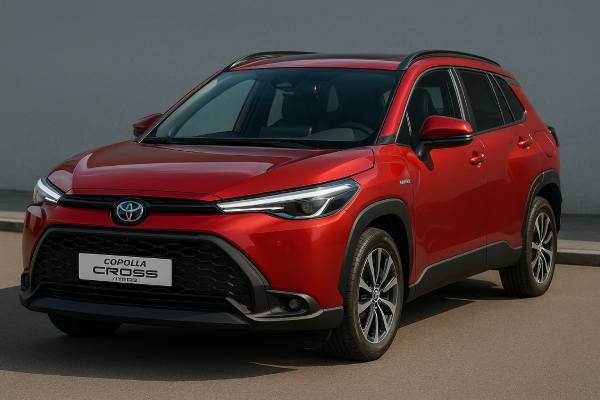
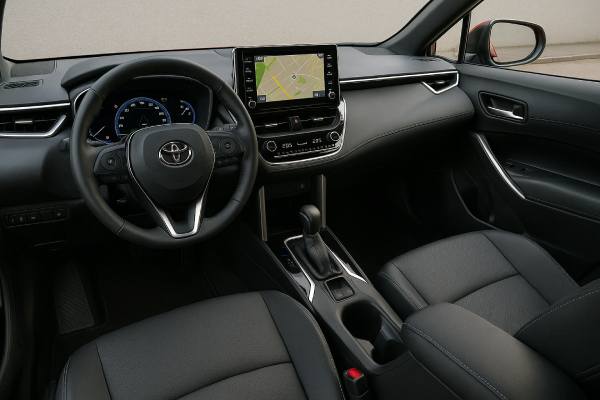
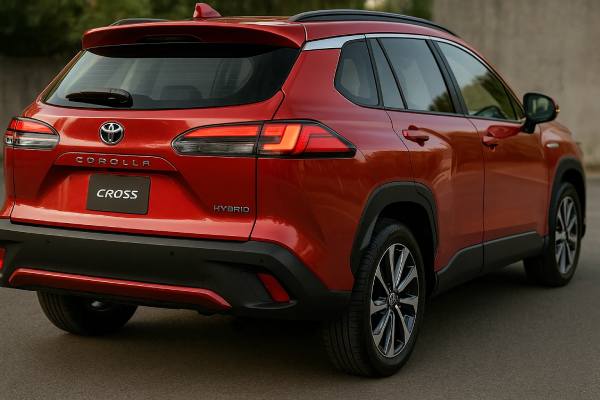
The 2025 facelift brings the fifth-generation Toyota hybrid system to the Corolla Cross in 1.8-liter, front-wheel-drive form. It keeps the everyday usability that made the model popular—easy step-in height, compact exterior footprint, and a calm ride—while refining efficiency, cabin tech, and driver assistance. The powertrain pairs Toyota’s 2ZR-FXE Atkinson-cycle engine with a compact PMSM e-motor and lithium-ion pack for a 140 hp (103 kW) system output, tuned for smooth urban response rather than raw speed. Inside, updated infotainment and active-safety functions reduce friction in daily use, and packaging remains a strength: adult-friendly rear room and a square cargo bay. Ownership costs are predictable, with simple annual service and long replacement intervals for plugs, coolant, and brake fluid. If you want a small SUV that favors certainty—quiet efficiency, approachable ergonomics, and a broad service network—the 1.8 Hybrid FWD facelift hits that brief with minimal drama.
Fast Facts
- Real-world frugality: typically 4.7–5.5 L/100 km mixed (50–43 mpg US; 60–52 mpg UK) with gentle driving.
- City-friendly: light steering, tight packaging, and smooth e-CVT response; generous active-safety spec.
- Proven hardware: chain-driven 2ZR-FXE and fifth-gen hybrid components prioritize longevity over peak output.
- Watch for: brake-service corrosion in damp climates; keep the hybrid cooling loops clean and bled.
- Service rhythm: oil and filter every 15,000 km / 12 months (10,000 miles / 12 months).
Explore the sections
- Detailed look: Corolla Cross Hybrid 1.8
- Specs and technical data — ZVG10
- Trims, options and safety tech
- Reliability, issues and service actions
- Maintenance plan and buyer’s guide
- Driving impressions and efficiency
- Corolla Cross vs rivals
Detailed look: Corolla Cross Hybrid 1.8
Toyota’s facelifted Corolla Cross Hybrid FWD (ZVG10) is the rational choice in the brand’s small-SUV lineup for buyers prioritizing comfort, economy, and low running costs over brisk acceleration or all-weather traction. The fifth-generation hybrid drive lowers internal losses, improves low-speed EV creep, and broadens the engine’s efficient operating window. The 2ZR-FXE four-cylinder runs the Atkinson cycle with long expansion, cooled EGR, and high tumble ports for lean burn stability; the electric motor supplies the step-off torque that an Atkinson ICE lacks, smoothing launches and filling in transients. A compact lithium-ion battery sits under the rear seat to preserve cargo height and keep mass centered.
The 2025 update also tidies the cabin tech: crisper graphics, quicker wake-up, and expanded cloud-nav and voice functions on higher trims. Toyota Safety Sense adds refinements to its forward collision detection and lane support logic, plus proactive driving assist features in some markets. Packaging is familiar TNGA-C: a body just long enough for comfortable adult knees in row two, wide-opening rear doors, and a square boot floor. FWD models keep a torsion-beam rear axle that favors ride steadiness and cargo space; it’s tuned soft-medium to keep broken-surface chatter out of the cabin.
On ownership, the Corolla Cross Hybrid’s strengths are predictability and coverage. Annual service, long-life fluids, and widely available parts keep costs reasonable. The e-CVT is a mechanical power-split device without clutches that wear in normal use, and the timing drive is by chain. Most routine maintenance is fluids, filters, and inspections. If your use-case is school runs, mixed commutes, and the odd motorway trip, the 1.8 Hybrid FWD’s calm manners and low thirst align neatly with that reality.
Specs and technical data — ZVG10
Engine and Performance (ICE-Hybrid)
| Item | Value |
|---|---|
| Code | 2ZR-FXE (Atkinson cycle) |
| Layout & valvetrain | Inline-4, DOHC, 16-valve |
| Bore × stroke | 80.5 × 88.3 mm (3.17 × 3.48 in) |
| Displacement | 1.8 L (1798 cc) |
| Induction | Naturally aspirated |
| Fuel system | EFI with direct-to-port injection strategy for Atkinson |
| Compression ratio | ~13.0:1 |
| Max system power | 140 hp (103 kW) |
| Engine peak power (approx.) | 96–103 hp (72–76 kW) |
| Engine peak torque (approx.) | ~142 Nm (105 lb-ft) |
| Front traction motor | PMSM, single front e-axle, ~70 kW class |
| Hybrid battery | Lithium-ion, compact under-seat pack |
| Timing drive | Chain |
| Rated efficiency (WLTP combined) | 4.7–5.2 L/100 km (50.0–45.2 mpg US; 60.1–54.3 mpg UK) |
| Real-world highway @120 km/h | ~5.5–6.0 L/100 km (42–39 mpg US; 50–47 mpg UK) |
| Emissions standard | Euro 6d equivalent |
Transmission and Driveline
| Item | Value |
|---|---|
| Transmission | e-CVT planetary power-split (hybrid transaxle) |
| Drive type | FWD |
| Final drive (typical) | ~3.4–3.7:1 (varies by wheel/tire) |
| Differential | Open (front) |
Chassis and Dimensions
| Item | Value |
|---|---|
| Platform | TNGA-C |
| Suspension (front/rear) | MacPherson strut / torsion beam |
| Steering | Electric power steering; ~14–15:1 overall |
| Brakes | Ventilated front discs; solid rear discs |
| Wheels/Tires | 215/60 R17 or 225/50 R18 (market/trim dependent) |
| Ground clearance | ~160 mm (6.3 in) |
| Length / Width / Height | ~4460 × 1825 × 1620 mm (175.6 × 71.9 × 63.8 in) |
| Wheelbase | 2640 mm (103.9 in) |
| Turning circle (kerb-to-kerb) | ~10.8–11.2 m (35.4–36.7 ft) |
| Curb weight (approx.) | 1410–1470 kg (3109–3241 lb) |
| GVWR (approx.) | 1900–1960 kg (4189–4321 lb) |
| Fuel tank | ~47 L (12.4 US gal / 10.3 UK gal) |
| Cargo volume (seats up/down, VDA) | ~433 L / ~1337 L (15.3 / 47.2 ft³) |
Performance and Capability
| Metric | Value |
|---|---|
| 0–100 km/h (0–62 mph) | ~10.2–10.8 s |
| Top speed | ~170 km/h (106 mph) |
| Braking 100–0 km/h | Class-typical; tire-dependent |
| Towing capacity (braked/unbraked) | ~1300 / 750 kg (2866 / 1653 lb) |
| Payload | ~430–510 kg (948–1124 lb) |
| Roof load | ~75 kg (165 lb) with approved bars |
Fluids and Service Capacities (guide)
| System | Spec / Capacity |
|---|---|
| Engine oil | 0W-16 (API SP / ILSAC GF-6B); ~4.2 L (4.4 US qt) with filter |
| Engine coolant | Long-life OAT; ~6–7 L (6.3–7.4 US qt) total system |
| Hybrid transaxle | Toyota WS ATF (lifetime fill in normal use) |
| Brake fluid | DOT 3 or DOT 4 (as labeled) |
| A/C refrigerant | R-1234yf; typical charge ~420–500 g (14.8–17.6 oz) |
| A/C compressor oil | ND-OIL 12; ~100 mL (3.4 fl oz) |
| Key torque examples | Wheel nuts: ~103 Nm (76 lb-ft); oil drain plug: ~40 Nm (30 lb-ft) |
Electrical
| Item | Value |
|---|---|
| 12 V battery | 45–60 Ah, AGM/flooded per market |
| Spark plugs | Iridium long-life; gap ~0.8–0.9 mm (0.031–0.035 in) |
Safety and Driver Assistance
| Item | Value |
|---|---|
| Crash ratings (EU) | Euro NCAP tested (2022) with five stars (vehicle spec-dependent) |
| IIHS (US reference) | 2024 Corolla Cross: strong crashworthiness; headlight rating varies by trim |
| Headlight tech | LED; auto high-beam; adaptive on upper trims |
| ADAS suite (TSS) | AEB with pedestrian/cyclist detection, adaptive cruise, lane centering, lane departure alert, road-sign assist; blind-spot monitoring and rear cross-traffic alert commonly fitted |
Notes: Figures vary with wheel/tire packages, options, and local homologation. Always verify by VIN and market literature.
Trims, options and safety tech
Trim naming in Europe varies by country, but the structure is consistent: an entry model with 17-inch wheels and fabric, a mid grade that adds convenience and driver-assist content, and a high grade with larger wheels, adaptive lighting, and premium interior touches. Many markets also offer a GR Sport appearance-and-chassis package. Feature availability also depends on infotainment screen size and audio tier; the larger screen often brings a better camera suite and embedded services.
Quick trim cues (typical EU pattern)
- Entry: 17-inch alloys, manual seats, cloth, basic LED headlights, parking sensors, rear camera, wireless CarPlay/Android Auto, TSS core functions.
- Mid: adds smart key, dual-zone climate, enhanced interior trim, front fogs, power driver lumbar, BSM/RCTA, larger infotainment screen.
- High: 18-inch wheels, adaptive LED headlights, ambient lighting, power tailgate (market-dependent), advanced parking aids, upgraded audio.
- GR Sport: unique bumpers, darker trim, sport seats, and a slightly firmer damper tune; performance unchanged.
Functional differences to watch
- Wheel/tire: moving to 18s can raise WLTP consumption and lengthen braking distances on rough surfaces; 17s ride more pliantly.
- Headlights: adaptive LED units typically test better for glare and reach than base LEDs.
- Tow pack: factory prep and cooling shrouds may be bundled with a rated hitch; confirm coding requirements after installation.
Child-seat and restraint notes
- Two ISOFIX/LATCH positions with top tethers in the outboard rear seats; center seatbelt is three-point. Buckle stalk heights accommodate many high-back boosters without belt path interference.
ADAS and calibration
- Front radar/camera modules need aim checks after windscreen replacement, collision repairs, or alignment changes. Radar angle and camera yaw/pitch must be set per service manual; some markets require a dynamic verification drive.
- Parking sonar and blind-spot radar calibrations are straightforward but still require scan-tool confirmation. If you retrofit wheels/tires or lift kits, re-run calibration to preserve AEB and lane-keeping performance.
Year-to-year (facelift 2025)
- Infotainment processing and voice recognition improved; some grades gain cloud-nav and expanded connected services.
- Safety Sense algorithms adjusted for better cut-in response and cyclist detection in poor light; proactive driving assist appears on upper grades.
- Minor trim reshuffles: availability of adaptive headlights, tailgate options, and audio tiers may move between mid and high grades.
Reliability, issues and service actions
Overall outlook: The 2ZR-FXE hybrid system is one of Toyota’s most field-proven combinations. With regular fluid changes and filter care, high-mileage examples typically age well. Most concerns are minor annoyances rather than structural failures.
Common → rare, by system (with cost sense):
- Brakes (common, low/medium): Hybrids regenerate often, so rear discs can rust and pads glaze from disuse. Symptoms include scraping after rain and reduced bite. Remedy: periodic “friction-brake exercise,” clean and lubricate slide pins at every service, replace pads/discs when pitted beyond spec.
- 12 V battery (common, low): Short, infrequent trips and accessory use can drain the small auxiliary battery. Symptom: sluggish startup or random warning lights. Remedy: battery health check annually; replace proactively around 5–7 years, or fit a maintainer if garaged.
- Cabin blower filter clog (common, low): Reduced HVAC flow and fan noise; swap cabin filter yearly (sooner in dusty or pollen-heavy regions).
- EGR and intake deposits (occasional, medium): Less frequent on fifth-gen than earlier hybrids, but cold-city cycles can accumulate soot in EGR passages. Symptom: rough cold starts, light ping, or EGR flow codes. Remedy: inspect EGR cooler/valve; clean and update ECU calibration if available.
- Wheel-bearing hum (occasional, medium): More likely with larger wheels/rough roads. Confirm by load-shift on sweepers; replace affected hub.
- Water leaks through tailgate seals (rare, low/medium): Check spare-well and quarter panels after heavy rain; ensure grommets and seals are seated; reseal as needed.
Software calibrations to know:
- Hybrid ECU/TCU updates: Periodic reflashes can refine engine start/stop smoothness, idle stability, and AEB false-positive behavior. Ask the dealer to check for open campaigns and the latest software during annual service.
- Infotainment OTA: Map/voice and bug fixes arrive over-the-air on some grades; set Wi-Fi or data properly and allow installation windows.
Corrosion watchpoints:
- Rear brake hardware (pins, abutments), exhaust hangers, subframe welds at the rear beam mounts, and lower door seams in salted regions. Apply anti-seize and cavity wax where appropriate; wash underbody after winter.
Pre-purchase checks:
- Full service history, proof of software/recall completion, tire tread evenness (indicates alignment), brake thickness/rotor condition, HVAC performance, and a scan for hybrid system DTCs. Inspect the cargo area for water ingress and verify all ADAS sensors are damage-free.
Maintenance plan and buyer’s guide
Practical service schedule (typical EU guidance)
- Engine oil and filter: every 15,000 km or 12 months (10,000 miles / 12 months). Use 0W-16 meeting API SP / ILSAC GF-6B.
- Engine air filter: inspect 15,000 km; replace ~30,000–45,000 km (sooner in dust).
- Cabin filter: replace every 12 months (6 months if pollen/dust sensitive).
- Brake fluid: replace every 2 years; test annually for moisture content.
- Coolant (engine & hybrid loops): first replacement ~10 years/160,000 km, then every 5 years/80,000 km; verify exact interval by VIN.
- Spark plugs (iridium): ~190,000 km / 120,000 miles or 12 years.
- Hybrid transaxle fluid (Toyota WS): lifetime fill; consider lab-verified change around 150,000–200,000 km for severe duty.
- Serpentine/aux belt and hoses: inspect 60,000 km; replace on condition.
- Tires: rotate 10,000–15,000 km; align yearly or at tire changes.
- 12 V battery: test annually after year 3; plan replacement in years 5–7.
- HV battery: health check during routine service; ensure cooling path is clear.
Fluid call-outs and capacities (decision aids)
- Oil ~4.2 L with filter; drain-plug ~40 Nm.
- Coolant total ~6–7 L; bleed with hybrid pump assist per service procedure.
- A/C R-1234yf; typical 420–500 g charge; evacuate and weigh—no guessing.
- Wheel nuts ~103 Nm; verify stickered value for your wheels.
DIY vs pro shop
- DIY-friendly: engine/cabin filters, wipers, tires (rotation), washer fluid, 12 V battery.
- Pro-only: hybrid cooling service/bleed, ADAS calibration after glass/alignment, A/C work, HV system diagnostics.
Buyer’s checklist
- Walkaround: panel gaps even, headlight lenses clear, no windshield damage around the camera area.
- Underbody: surface rust OK; avoid flaking on subframes or beam mounts.
- Road test: listen for rear brake scrape after light regen use; ensure steering tracks straight; check for wheel-bearing hum on 80–100 km/h sweepers.
- Tech: verify all ADAS toggles work; test adaptive cruise and lane centering on a marked road.
- Paperwork: service stamps/invoices, software campaign proofs, two keys, and user guides.
Durability outlook
- With annual service and clean cooling circuits, the 1.8 Hybrid FWD typically delivers long, low-drama ownership. Brake maintenance and 12 V care are the two keys to keeping it “silent and cheap” year-to-year.
Driving impressions and efficiency
Ride, handling, NVH
The FWD Corolla Cross Hybrid is tuned for calmness. The torsion-beam rear keeps the back of the car planted over patchy tarmac, and primary ride is supple on 17-inch wheels. Eighteens add grip and visual stance, but also a touch more impact sharpness. Straight-line stability is excellent for the class, helped by a 2640 mm wheelbase, and crosswinds rarely disturb it. Steering is light, precise enough around center, and naturally weighted in town. Brake feel is good for a hybrid: Toyota’s blended regen/friction handoff is mostly invisible, with only the occasional step at parking speeds.
Powertrain character
System output of 140 hp is adequate rather than urgent. In city work it feels brisk because the motor handles the first half-turn of the throttle; at motorway merges the e-CVT lets the engine climb to a steady note while speed builds. The facelift’s software makes the engine’s step-in and step-out cleaner, so there’s less “flaring” sensation than earlier generations. Normal/Eco/Sport modes mainly reshape tip-in and climate strategy; Sport pulls revs a little higher and tightens steering assist.
Real-world economy
In mixed suburban driving, expect 4.7–5.2 L/100 km (50–45 mpg US). At a steady 120 km/h motorway cruise, 5.5–6.0 L/100 km (42–39 mpg US) is typical, drifting higher with big wheels or strong headwinds. Cold weather increases consumption until coolant and the catalytic converter are up to temperature; short-trip users will benefit from using the remote preheat logic where available and keeping tires at the placard pressure. Gentle drivers often beat WLTP around town because the hybrid spends more time in EV creep.
Towing and loads
With a braked rating around 1300 kg (market-dependent), the Corolla Cross Hybrid is fine with a light camping trailer or small box. Expect a 20–35% consumption penalty at motorway speeds. Stability is predictable provided the tongue weight is set correctly and tires are inflated to the load table. Uphill grades in hot weather are uneventful; the hybrid system prioritizes coolant flow and will reduce power briefly if temperatures climb.
Traction and control
Snowbelt drivers should pair winter-rated tires with the FWD hybrid; the smooth torque application helps, and the stability control is unobtrusive. There’s no center coupling to pre-heat as in AWD variants; hill starts rely on traction control and throttle finesse rather than torque split.
Corolla Cross vs rivals
Honda HR-V e:HEV (FWD hybrid)
- Why pick it: slick packaging, quiet cabin, and a frugal two-motor hybrid.
- Where Toyota wins: simpler power-split, broader service network, and more confident long-term parts availability.
- Watch-outs: HR-V interior finishes and seat comfort are class-leading.
Hyundai Kona Hybrid / Kia Niro HEV
- Why pick them: generous infotainment features, long warranties, and efficient 1.6 hybrid systems.
- Where Toyota wins: smoother low-speed calibration and historically stronger residual values.
- Watch-outs: DCT-based hybrids can feel more “gear-changey” in traffic; service needs differ.
Nissan Qashqai e-Power
- Why pick it: smooth “series-hybrid” feel with linear torque and roomy back seat.
- Where Toyota wins: better long-term hybrid field record and often lower real-world consumption.
- Watch-outs: Qashqai’s cabin tech is polished and cabin width feels a size up.
Renault Arkana E-Tech / Captur E-Tech
- Why pick them: keen pricing and efficient multi-mode hybrid.
- Where Toyota wins: simpler ownership journey and higher predicted resale.
- Watch-outs: Renault’s latest cabins are stylish; test both for seating comfort.
Volkswagen T-Roc eTSI (mild hybrid)
- Why pick it: punchy turbo response and Germanic steering feel.
- Where Toyota wins: full-hybrid efficiency in stop-start traffic and fewer turbo-GDI maintenance considerations.
- Watch-outs: if you mostly do long motorway slogs, the VW’s conventional torque build can feel livelier.
References
- COROLLA CROSS 2025 (Brochure)
- Toyota Corolla Cross: da oggi disponibile con il nuovo 1.8 full hybrid di 5a generazione 2023 (Press Release)
- 2024 Toyota Corolla Cross 2024 (Safety Rating)
- Manufacturers have Euro NCAP’s Vision 2030 in sight, as fifteen cars score the maximum star rating 2022 (Euro NCAP News)
Disclaimer
This guide is for informational purposes and is not a substitute for professional diagnosis or repair. Specifications, torque values, fluid types, and service intervals vary by VIN, market, model year, and equipment. Always verify details against your vehicle’s official service documentation and follow local regulations. If you found this helpful, please share it with fellow owners on Facebook or X/Twitter to support xcar’s work.