
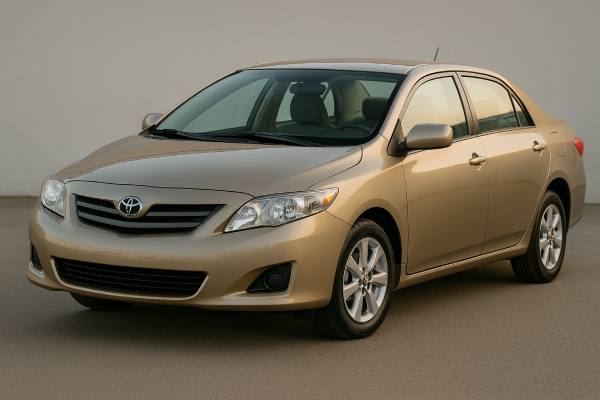
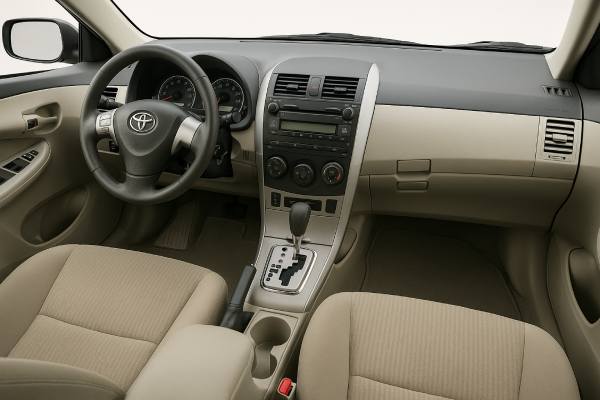
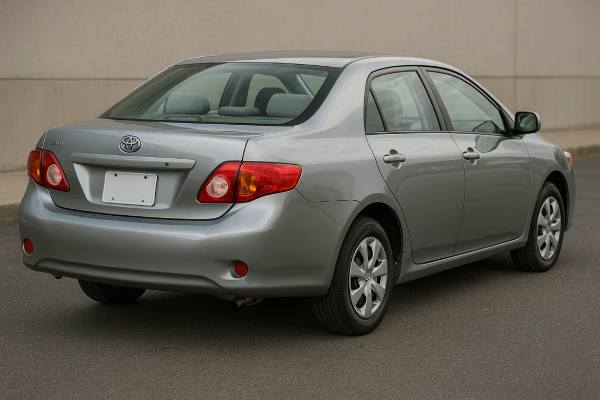
The 2007–2010 Toyota Corolla 1.4 D-4D (code NDE150 with the 1ND-TV diesel) targeted European drivers who wanted Corolla dependability with long-range economy. It pairs a compact, chain-driven 1.4-litre common-rail turbodiesel with a tidy chassis and thoughtfully simple cabin. Performance is modest, yet the car’s relaxed gearing, clean aero, and light controls make daily commuting, intercity trips, and dense urban errands easy. Running costs are helped by realistic fuel use under 6 L/100 km when maintained and driven sensibly. Owners rate the drivetrain’s durability highly, provided EGR and intake deposits are kept in check and service intervals aren’t stretched. Safety kit improved through the run, with stability control and side/curtain airbags widely available. If you are shopping for a low-stress, wallet-friendly compact that still feels tight after years of use, this diesel Corolla is a smart short-list add—especially when equipped with the six-speed manual, proper records, and fresh fluids.
Fast Facts
- Frugal long-distance cruiser: real-world 4.8–5.8 L/100 km (49–59 mpg US) mixed driving.
- Proven 1.4 D-4D (1ND-TV) with timing chain, simple turbo, and robust common-rail hardware.
- Roomy back seat and 450 L (15.9 ft³) sedan trunk; easy 195/65 R15 tyre size keeps costs low.
- Watch for EGR/DPF soot build-up on short-trip cars; budget for periodic cleaning.
- Oil and filter every 15,000 km or 12 months (shorter if many cold starts/urban cycles).
Navigate this guide
- Corolla 1.4 D-4D overview
- Corolla 1.4 D-4D specs
- Corolla trims and safety
- Reliability and service actions
- Maintenance and buying guide
- Driving and real-world economy
- How it compares
Corolla 1.4 D-4D overview
This generation of Corolla (E150) brought a quieter, stiffer body shell and cleaner engines to Europe, with the 1.4 D-4D diesel positioned as the high-mileage choice beneath larger (and rarer) diesel options. The 1ND-TV four-cylinder uses an aluminium head, cast-iron block with deep skirts, a timing chain for lifetime service under normal use, and a fixed-geometry turbo (model-year and market dependent) with intercooler. It delivers 90 hp (66 kW) and ample low-rpm torque for light loads and steady motorway pacing.
Cabin fundamentals are typical Corolla: upright seating, generous front storage, clear dials, and excellent visibility. Materials emphasise durability over flash, and switchgear has a precise, unfussy action. Wind and road isolation are solid for the class, helped by conservative tyre sizes and careful sealing. Owners moving from petrol models will notice diesel clatter at cold start, but once warm the engine hums quietly at cruise. The six-speed manual is the best partner for relaxed highway running; some markets kept a five-speed, which works fine around town but turns slightly higher revs at speed.
Safety content varies by trim and year. ABS with EBD and Brake Assist is standard, as are dual front airbags; many cars add side/curtain airbags, active head restraints, ISOFIX anchors, and Vehicle Stability Control (VSC). The car’s simple torsion-beam rear suspension prioritises stability, tyre life, and boot space; it is not sporting, yet it’s predictable and planted on poor surfaces.
Running costs are where the Corolla diesel shines. Genuine parts are widely available, independent specialists know the platform, and service access is straightforward. The main ownership watch-items are soot-related (EGR/intake and, on later cars, DPF), clutch/dual-mass flywheel fatigue if driven heavily in town, and age-related cooling and braking wear—each manageable with upfront inspection and a realistic maintenance plan.
Corolla 1.4 D-4D specs
Engine and Performance (ICE)
| Item | Specification |
|---|---|
| Code | 1ND-TV (D-4D common-rail) |
| Layout & cylinders | Transverse inline-4, DOHC, 4 valves/cyl |
| Bore × stroke | 73.0 × 81.5 mm (2.87 × 3.21 in) |
| Displacement | 1.364 L (1,364 cc) |
| Induction | Turbocharged, intercooler (fixed-geometry on most trims) |
| Fuel system | Common-rail direct injection (solenoid injectors) |
| Compression ratio | ~18.5:1 (market/year dependent) |
| Max power | 90 hp (66 kW) @ ~3,800 rpm |
| Max torque | 205 Nm (151 lb-ft) @ ~1,800–2,800 rpm |
| Timing drive | Chain (no scheduled replacement) |
| Emissions class | Euro 4; late cars with DPF meet Euro 4/5 local variants |
| Rated economy (combined) | ~4.7–5.4 L/100 km (50–60 mpg US / 60–72 mpg UK) |
| Real highway @ 120 km/h | ~5.2–5.9 L/100 km (40–45 mpg US / 48–54 mpg UK) |
| Aerodynamics | Cd ≈ 0.29–0.30 (body-style dependent) |
Transmission and Driveline
| Item | Specification |
|---|---|
| Transmission | 6-speed manual (most markets); some early cars 5-speed manual |
| Drive type | Front-wheel drive |
| Final drive | ~3.7–3.9 (varies with gearbox) |
| Differential | Open (electronic traction via ABS) |
| Refuel to full | ~3–5 minutes at pump |
Chassis and Dimensions
| Item | Specification |
|---|---|
| Front suspension | MacPherson strut, coil spring, anti-roll bar |
| Rear suspension | Torsion beam axle, coil spring |
| Steering | Electric power steering (rack-and-pinion) |
| Brakes | Front ventilated discs (~273 mm / 10.7 in); rear solid discs or drums (trim dependent) |
| Wheels/Tyres | 195/65 R15 (typical); some trims 205/55 R16 |
| Ground clearance | ~140 mm (5.5 in) |
| Length / Width / Height | ~4,540 / 1,760 / 1,465 mm (178.7 / 69.3 / 57.7 in) |
| Wheelbase | ~2,600 mm (102.4 in) |
| Turning circle | ~10.4 m (34.1 ft) |
| Curb weight | ~1,235–1,310 kg (2,723–2,888 lb) |
| GVWR | ~1,740–1,800 kg (3,836–3,968 lb) |
| Fuel tank | ~55 L (14.5 US gal / 12.1 UK gal) |
| Cargo volume (sedan) | ~450 L (15.9 ft³), VDA |
Performance and Capability
| Metric | Value |
|---|---|
| 0–100 km/h (0–62 mph) | ~12.0–13.0 s (body/gearbox dependent) |
| Top speed | ~175–185 km/h (109–115 mph) |
| 100–0 km/h braking | ~38–40 m (125–131 ft) on quality tyres |
| Towing capacity | Up to ~1,200 kg (2,646 lb) braked; ~450 kg (992 lb) unbraked |
| Payload | ~430–520 kg (948–1,146 lb) |
| Roof load | ~75 kg (165 lb) with approved bars |
Fluids and Service Capacities
| System | Specification / Capacity |
|---|---|
| Engine oil | ACEA C2 low-SAPs 5W-30; ~3.7–4.0 L (3.9–4.2 US qt) with filter |
| Coolant | Super Long Life Coolant (pink OAT), ~6–7 L (6.3–7.4 US qt), 50/50 mix |
| Manual trans oil | API GL-4 75W-90 (OEM spec), ~2.0–2.3 L (2.1–2.4 US qt) |
| Brake fluid | DOT 4 |
| Power steering | Electric (no fluid service) |
| A/C refrigerant | R134a, ~450–500 g (15.9–17.6 oz) |
| A/C compressor oil | ND-OIL 8, ~120 mL (4.1 fl oz) typical service fill |
| Key torque specs | Wheel nuts ~103 Nm (76 lb-ft); oil drain plug ~39–40 Nm (29–30 lb-ft) |
Electrical
| Item | Specification |
|---|---|
| Alternator | ~100–110 A (1.2–1.4 kW) |
| 12 V battery | ~60 Ah (540–600 CCA), Group H5/L2 size (varies) |
| Glow plugs | 11 V ceramic/metal (market dependent) |
Safety and Driver Assistance
| Area | Details |
|---|---|
| Structural safety | High-strength steel in key load paths; energy-absorbing steering column |
| Airbags | Dual front standard; many cars add side thorax and side curtain airbags |
| Child seats | ISOFIX/LATCH points on outer rear seats; top tether anchors |
| Stability | ABS/EBD/BA standard; VSC (stability control) standard or optional by trim/year |
| Headlights | Halogen reflector; height adjuster; headlamp performance varies by bulb/aim |
| ADAS | No AEB, adaptive cruise, or lane support on this generation |
Corolla trims and safety
Trims and options (typical European markets, 2007–2010)
Naming differs by country, but the content map is consistent:
- Base/Active/Terra (entry) – Steel wheels, manual A/C, cloth seats, basic audio with AUX, remote locking, height-adjust driver’s seat, split-fold rear bench. ABS/EBD/BA, dual airbags. Some markets: rear drums.
- Mid/Luna/Sol – 15–16-inch alloys, leather wheel/shift knob, front armrest, upgraded audio (CD/MP3), steering-wheel buttons, body-color mirrors/handles, fog lights, rear discs common. Side and curtain airbags usually standard; VSC available in safety pack.
- High/Executive/Sol+ – Automatic climate control, cruise control (market dependent), multi-info display, better trim materials, auto lights/wipers, 16-inch wheels, folding mirrors. VSC commonly standard; rear disc brakes standard; supportive front seats.
Packages and identifiers
- Safety Pack: VSC + side/curtain airbags on mid trims; look for VSC switch near steering column and “VSC OFF” telltale during bulb test.
- Winter Pack: Heated seats/mirrors, headlamp washers (cold-weather markets).
- VIN/build codes: Diesel 1.4 cars often show engine code 1ND and model code NDE150 in registration data; the gearbox code on the build plate helps identify 5- vs 6-speed.
Year-to-year notes
- Early cars may lack VSC on base trims; later cars more often include it or offer it widely.
- Late-run vehicles in stricter-emission markets add a DPF and corresponding differential-pressure sensor and exhaust-temperature probes; calibration updates target regeneration behaviour.
- Wheel and audio variants change by market, but wiring looms generally support upgrades within trim families.
Safety ratings
- European-spec bodies with appropriate airbags and VSC score well in period crash tests for adult occupants, with strong frontal and side performance and weaker pedestrian protection typical of the era.
- Seat-mount and curtain airbags materially improve head/thorax metrics; confirm presence via the airbag labels on seat sides and headliner and via the ignition bulb test.
- Child-seat usability is solid: accessible ISOFIX bars, clear belt geometry, and a deactivatable passenger airbag in many cars (check glovebox switch).
ADAS and service considerations
- No factory AEB, ACC, or lane-keeping; alignment of the steering angle sensor is required after certain suspension/steering repairs on VSC-equipped cars.
- Headlight performance depends on bulb choice and aim. Age-clouded lenses benefit from a proper refinish.
- Tyre Pressure Monitoring (direct) was not standard; check valve stems for aftermarket sensors.
Reliability and service actions
At-a-glance risk map
- Common / low–medium cost: EGR/intake soot build-up; sticky EGR valve; intercooler/oil misting at joints; front drop-link bush wear; rear brake caliper slide pin corrosion; clutch wear on urban cars.
- Occasional / medium cost: DPF saturation on short-trip cars; dual-mass flywheel (DMF) chatter; turbo actuator stiffness; coolant weep at water pump; injector copper washer seep.
- Rare / higher cost: Timing-chain elongation with poor oil history; head-gasket failure from chronic overheating or extreme soot/oil neglect; ABS module fault.
Known patterns and remedies
- EGR/Intake deposits → rough idle, stalling, P0400-range codes
Root cause: Soot/oil vapour accumulation from EGR duty cycles and short trips.
Remedy: Remove and clean EGR valve and intake elbow; clear codes; update calibration where applicable; adopt highway runs to keep soot in check. - DPF high differential pressure → limp mode, frequent regens (late cars)
Root cause: Short cycles prevent complete regeneration; pressure sensor hoses can clog.
Remedy: Inspect hoses/sensor, verify exhaust temp sensor readings, perform forced regeneration after addressing root causes; refresh oil (low-SAPs) if fuel dilution suspected. - DMF/clutch chatter → vibration at idle and take-up
Root cause: High stop-start urban load and repeated slipping.
Remedy: Replace clutch and DMF as a set; ensure rear main seal is dry; confirm gearbox input-shaft splines are clean and lightly greased with specified lubricant. - Water pump seep → pink crust near pulley, slow coolant loss
Remedy: Replace pump with new gasket; renew coolant; bleed carefully. - Injector seal leak (“black death”) → chuffing sound, diesel smell
Remedy: Remove injector, clean seat, fit new copper washer/bolt to torque, confirm no blow-by. - Turbo actuator stiffness → underboost, P0299
Remedy: Check vacuum lines and boost control, free actuator linkage if safe; inspect vanes (if VNT fitted on specific sub-variants); confirm no intake or boost leaks.
Recalls, TSBs, extended coverage (Europe)
- Airbag inflators (Takata): Many E150s were recalled for passenger and/or driver inflators. Verify completion by VIN via official brand channels; look for inflator labels showing replacement.
- Pedal/trim interventions: Selected cars had campaigns addressing pedal feel or mats; always verify by VIN.
- Diesel calibration updates: In markets with DPF, dealers issued ECM reflashes to improve regeneration logic and soot-loading estimates after sensor/hose fixes.
Verification
- Ask for a VIN-based recall printout and dealer repair history.
- Inspect EGR/inlet cleanliness, recent DPF data (ash/soot grams where readable), and clutch/DMF behaviour on a cold start and warm take-up.
- A simple cooling-system pressure test and combustion leak check help screen for early head-gasket problems on neglected cars.
Maintenance and buying guide
Core service schedule (typical European guidance)
- Engine oil & filter: Every 15,000 km / 12 months (severe use: 10,000 km / 12 months). Use ACEA C2 5W-30 low-SAPs to protect the DPF.
- Fuel filter: Inspect at 30,000 km; replace by 60,000 km / 4 years, sooner with questionable fuel.
- Engine air filter: Inspect at 15,000 km; replace 30,000–45,000 km depending on environment.
- Cabin filter: 15,000 km / 12 months; faster in dusty or allergy seasons.
- Coolant (SLLC): First change at 10 years / 160,000 km, then 5 years / 100,000 km.
- Manual gearbox oil: Check level every service; replace 90,000–120,000 km or when shift feel degrades.
- Brake fluid: Every 2 years regardless of mileage.
- Aux/serpentine belt: Inspect each service; replace 90,000–120,000 km or at cracks/noise.
- Timing chain: No fixed interval; monitor chain-stretch via cam/crank correlation and audible rattle on hot restarts; replace guides/chain/tensioner when out of spec.
- Glow plugs: Test at 100,000–150,000 km or on cold-start misfire; replace as a set if any are weak.
- DPF health (if fitted): Read soot/ash loading annually; verify successful regen history.
- 12 V battery: Load-test annually after year 4; typical life 5–7 years.
Essential fluids/capacities (quick list)
- Engine oil: ~3.7–4.0 L (ACEA C2 5W-30).
- Coolant: ~6–7 L (pink SLLC, 50/50).
- Gearbox: ~2.0–2.3 L (GL-4 75W-90).
- A/C: R134a ~450–500 g; oil ND-OIL 8 ~120 mL.
- Wheel-nut torque: ~103 Nm (76 lb-ft).
Buyer’s checklist
- Service history: Look for annual oil changes on ACEA C2, documented fuel-filter replacements, and coolant changes on schedule.
- Soot system: Remove intake hose to inspect EGR elbow; heavy tar suggests overdue cleaning. Verify DPF data on later cars (soot grams, ash).
- Clutch/DMF: Listen for idle chatter; feel for shudder on take-up. High, gritty bite point hints at wear.
- Leaks: Check injector seats for black deposits; inspect turbo oil lines and intercooler joints for misting.
- Cooling: Confirm stable temps under load; look for crusting at water pump weep hole.
- Brakes and suspension: Free rear caliper sliders; quiet front drop links; no steering knock; straight-line braking with even pad contact.
- Corrosion hotspots: Rear subframe mounts, exhaust hangers, inner rear arch lips, and door bottoms. Lift carpets to check for damp.
- Tyres: Even wear across front shoulder edges; inside-edge wear suggests toe/geometry drift.
- Electrical: All glow-plug and engine lights should illuminate then go out; VSC lamp proves out on cars so equipped.
What to pay extra for
- Documented EGR/intake clean in the last 30–50k km.
- New clutch/DMF within the last 40k–60k km on high-mileage urban cars.
- Fresh brake fluid and recent coolant.
- VSC and side/curtain airbags for best passive/active safety mix.
- 6-speed manual for quieter motorway rpm.
Long-term outlook
With correct oil, fuel filtration, and soot-system care, the 1ND-TV commonly exceeds 300,000 km without major internal work. Chassis hardware is simple and affordable. Late-run cars with DPFs demand more disciplined oil and driving patterns but reward with cleaner exhaust and low NOx/PM.
Driving and real-world economy
Ride, handling, NVH
This Corolla aims for stability, not sport. The front strut/rear torsion setup rides quietly on 15-inch tyres, shrugging off patched tarmac and speed humps. Body control is tidy, with gentle roll and predictable understeer when pressed. Steering is light at parking speeds and accurate on the motorway, though feedback is modest. Brake feel is linear; repeated stops stay consistent with healthy pads and fluid. Wind rustle is low at 120 km/h thanks to careful sealing; tyre roar depends more on brand and tread pattern than on the car itself.
Powertrain character
The 1.4 D-4D has useful shove from 1,500 rpm, best between 1,800 and 3,000 rpm. It pulls cleanly from low revs, making short-shifting rewarding in traffic. The six-speed’s taller top gear drops noise on long drives; the five-speed keeps the engine a little busier. Throttle response is calm and progressive, with no turbo “hit” to upset traction in wet conditions. Cold starts sound diesel-typical; once warm, the note fades into the background.
Real-world efficiency
Expect 4.8–5.8 L/100 km (49–59 mpg US / 59–70 mpg UK) in mixed use for a well-maintained car on quality tyres. Pure motorway at 120 km/h lands near 5.2–5.9 L/100 km (40–45 mpg US / 48–54 mpg UK) depending on wind, load, and wheel size. Short urban cycles raise consumption and accelerate soot build-up; one weekly 20–30 minute run at stable speeds helps keep EGR/DPF happier. Winter diesel and frequent regens can add 0.5–0.8 L/100 km temporarily.
Selective performance metrics
- 0–100 km/h: ~12–13 s with a typical driver and half tank.
- 80–120 km/h (5th/6th): safely adequate for motorway merging; downshift improves response.
- 100–0 km/h: ~38–40 m on quality tyres; budget pads can lengthen this by several metres.
- Towing: up to ~1,200 kg braked is realistic on level routes; reduce target in hilly terrain and watch EGTs under sustained climbs.
Traction and control
Front-drive with conservative tyre sizing makes winter tyres particularly effective. VSC-equipped cars intervene smoothly; without VSC, the chassis remains forgiving if you lift gently to tighten a line. There are no terrain modes; snow performance hinges on tyre choice and smooth inputs.
How it compares
Volkswagen Golf 1.9 TDI (105 hp)
Stronger mid-range torque and a more upscale cabin feel, but more complex emissions hardware in later years and higher parts pricing. Corolla counters with simpler ownership and typically fewer big-ticket surprises when serviced on time.
Ford Focus 1.6 TDCi (90/110 hp)
Sharper steering and chassis poise, yet injector and DPF attention can be more frequent on neglected cars. Corolla gives up some cornering fun for better long-term durability reputation and simpler maintenance access.
Opel/Vauxhall Astra 1.7 CDTI (100/110 hp)
Competitive efficiency and motorway comfort; parts availability is good. Corolla’s interior is plainer but tends to rattle less with age, and the 1ND-TV’s timing chain is a plus for buyers seeking belt-free upkeep.
Honda Civic 2.2 i-CTDi (140 hp)
Best performance and long-legged refinement, balanced by higher purchase prices and bigger tyres/consumables. Corolla uses less fuel in dense urban use and is easier to park, with cheaper routine consumables.
Bottom line
Choose the Golf/Civic for pace or polish; the Focus for dynamics; the Astra for value. Choose the Corolla 1.4 D-4D if you prioritise reliability, predictable costs, and calm long-distance economy over outright speed or sport.
References
- Euro NCAP Official Site 2025 (Safety Rating)
- TOYOTA-Service Information (Europe) 2025 (Service Manual)
- Toyota Europe Recall Information 2025 (Recall Database)
- Toyota Online Owners Manuals 2025 (Owner’s Manual)
Disclaimer
This guide is for informational purposes only and is not a substitute for professional diagnosis or repair. Specifications, torque values, intervals, and procedures vary by VIN, market, and equipment. Always verify data and procedures against your vehicle’s official service documentation and local regulations. If you found this helpful, please consider sharing it with fellow enthusiasts on Facebook or X/Twitter—it helps support xcar’s work.