
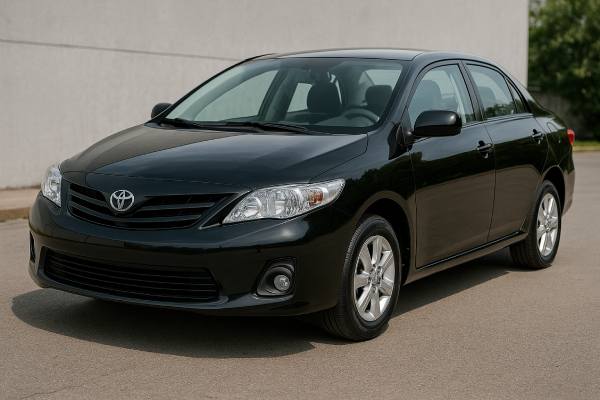
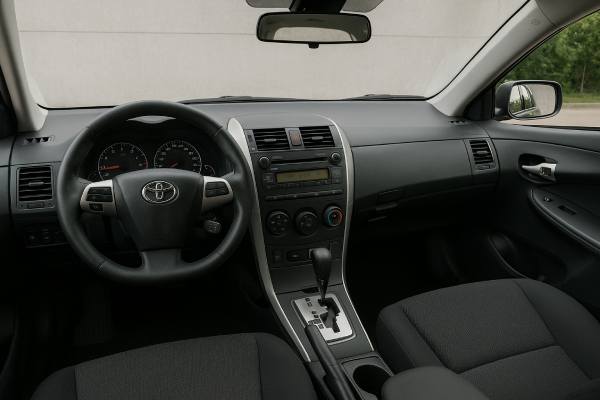
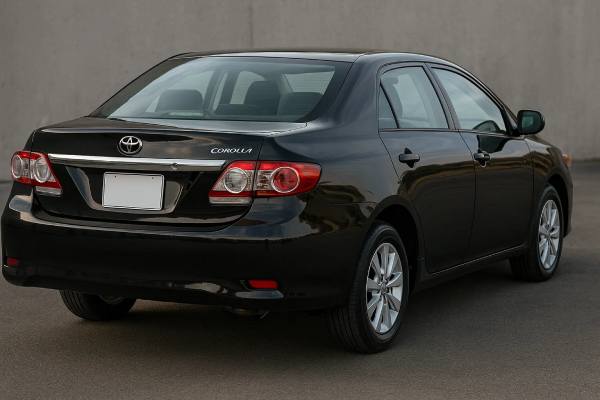
The 2010–2013 facelifted Toyota Corolla sedan (NRE150) with the 1NR-FE 1.33-litre petrol sits at the pragmatic end of compact motoring: simple, well packaged, and inexpensive to keep in top form. The all-aluminium DOHC engine uses Dual VVT-i and a timing chain to deliver 101 hp (75 kW) with modest thirst, while the chassis favors quiet progress over sharp edges. This refresh added cleaner styling, improved cabin materials, and more integrated audio/phone features in many markets. As a used buy, its appeal is consistency: predictable servicing, abundant parts, and a reputation for trouble-free commuting when maintained. The trade-off is pace—this is an efficient, durable commuter, not a weekend sprinter. If your miles are mostly urban and suburban with occasional motorway runs, and your priorities are reliability and total cost of ownership, the 1.33-litre Corolla remains a sensible, calm choice that asks little of its owner beyond routine care.
Owner Snapshot
- Proven 1.33 Dual VVT-i with a chain; smooth, low running costs.
- Quiet, comfortable ride; practical 450 L boot and easy visibility.
- Strong parts availability; most jobs are straightforward for independents.
- Watch for age-related water pump seep and worn suspension links.
- Oil and filter: every 10,000–15,000 km or 12 months (shorter if mostly short trips).
Guide contents
- NRE150 Corolla detailed overview
- NRE150 1.3 specs and data
- NRE150 trims, options, and safety
- Reliability and service actions
- Maintenance and buyer’s guide
- Driving and performance
- How it compares to rivals
NRE150 Corolla detailed overview
Toyota’s 2010–2013 refresh of the E150-series Corolla gently refined a formula that already worked for millions of owners. Outside, reshaped bumpers, grille, and lamps bring a tidier stance without chasing fashion. Inside, the dashboard and door cards gained cleaner textures and tighter panel fit, while infotainment integration improved via AUX/USB and, on more trims, Bluetooth. The ergonomic story is classic Toyota: clear instruments, large HVAC knobs, and a seating position that works for a wide range of body types. Visibility is better than many contemporaries, thanks to restrained pillar bulk and a bonnet you can place easily in the city.
Under the bonnet, the 1NR-FE 1.33-litre four-cylinder is a lightweight, chain-driven unit with Dual VVT-i on intake and exhaust cams. It prioritizes friction reduction and thermal management—oil control rings, narrow bearings, and efficient cooling passages—over headline numbers. Output is a modest 101 hp (75 kW), but the engine’s civility and willingness to rev to 6,000 rpm keep day-to-day driving stress-free. The factory calibration is conservative, designed to drink regular unleaded and pass Euro 5 without direct injection or turbocharging. In practice, that means fewer complex components to age and a broad pool of independent specialists who know the layout.
Chassis tuning in this facelift emphasizes calm progress. The front MacPherson struts and rear torsion beam are specified for durability and packaging efficiency; they also free up a square boot of roughly 450 L (VDA). On poor surfaces, damping is supple rather than sporty; steering is light at parking speeds and suitably weighted on the motorway. Braking is predictable with ventilated front discs and solid rears on most trims. Tyres make a big difference: 195/65 R15 favors comfort and lower replacement cost, while 205/55 R16 brings slightly crisper response at a small ride penalty.
Ownership considerations mostly revolve around age rather than design flaws. Rubber components (drop links, top mounts, bushings), the accessory belt system, and the water pump are the common wear items after a decade or more. Electronics are simple—no radar-based driver aids to calibrate—so post-repair setup usually means aligning the steering angle sensor, checking wheel geometry, and verifying zero fault codes. For buyers seeking a predictable, low-drama sedan that simply works when asked, the 1.33-litre Corolla retains its quiet appeal.
NRE150 1.3 specs and data
Engine and Performance (ICE)
| Item | Specification |
|---|---|
| Code | 1NR-FE (Dual VVT-i) |
| Layout and cylinders | Inline-4, DOHC, 16 valves (4 per cylinder) |
| Bore × stroke | 72.5 × 80.5 mm (2.85 × 3.17 in) |
| Displacement | 1.33 L (1,329 cc) |
| Induction | Naturally aspirated |
| Fuel system | Multipoint fuel injection (PFI) |
| Compression ratio | ~11.0:1 |
| Max power | 101 hp (75 kW) @ 6,000 rpm |
| Max torque | 132 Nm (97 lb-ft) @ ~3,800 rpm |
| Timing drive | Chain |
| Emissions standard | Euro 5 |
| Rated economy (mixed) | ~5.8–6.1 L/100 km (41–39 mpg US / 49–47 mpg UK) |
| Real-world highway @ 120 km/h (75 mph) | ~6.2–7.0 L/100 km (38–34 mpg US / 46–41 mpg UK) |
| Aerodynamics | Cd ≈ 0.29 (E150 sedan typical) |
Transmission and Driveline
| Item | Specification |
|---|---|
| Transmission | 6-speed manual (EC6x-series); selected markets offered an automated manual (MMT) |
| Gear ratios (6-MT, typical) | 1st 3.538 • 2nd 1.913 • 3rd 1.310 • 4th 0.971 • 5th 0.815 • 6th 0.725 • Rev 3.250 |
| Final drive (6-MT, typical) | ~4.31 |
| Drive type | Front-wheel drive (open differential) |
| Refuel time | Petrol refuel ~5 minutes (55 L tank) |
Chassis and Dimensions
| Item | Specification |
|---|---|
| Platform | Toyota MC / E150 series |
| Suspension (front/rear) | MacPherson strut / torsion beam |
| Steering | Electric power rack-and-pinion |
| Brakes | Front ventilated discs; rear solid discs (most trims) |
| Wheels and tyres | 195/65 R15 (common) • 205/55 R16 (select trims) |
| Ground clearance | ~150 mm (5.9 in) |
| Length × width × height | ~4,540 × 1,760 × 1,470 mm (178.7 × 69.3 × 57.9 in) |
| Wheelbase | 2,600 mm (102.4 in) |
| Turning circle (kerb-to-kerb) | ≈10.4 m (34.1 ft) |
| Kerb (curb) weight | ~1,220–1,290 kg (2,689–2,844 lb) |
| GVWR | ~1,760–1,800 kg (3,880–3,968 lb) |
| Fuel tank | ~55 L (14.5 US gal / 12.1 UK gal) |
| Cargo volume | ~450 L (15.9 ft³), VDA |
Performance and Capability
| Metric | Figure |
|---|---|
| 0–100 km/h (0–62 mph) | ~12.0–13.0 s (spec/tyre dependent) |
| Top speed | ~180 km/h (112 mph) |
| Braking 100–0 km/h | Class-typical for the era; depends heavily on tyre/pad condition |
| Towing (braked/unbraked)* | Up to ~1,200 kg / 450 kg (2,646 / 992 lb), where approved |
| Roof load | Typically 50–75 kg (110–165 lb) with rated crossbars |
*Always confirm the VIN plate and local type-approval before towing.
Fluids and Service Capacities
| System | Specification | Capacity (approx.) |
|---|---|---|
| Engine oil | 0W-20 (preferred) or 5W-30 to Toyota spec | ~3.7–3.9 L (3.9–4.1 US qt) with filter |
| Coolant | Toyota Super Long Life Coolant (pink, premixed) | ~5.4–5.8 L (5.7–6.1 US qt) |
| Manual transmission oil | 75W–90 GL-4/GL-5 to Toyota spec | ~2.0 L (2.1 US qt) |
| Brake fluid | DOT 3 or DOT 4 | Fill to reservoir marks |
| A/C refrigerant | R-134a | ~450–550 g (15.9–19.4 oz) |
| A/C compressor oil | ND-OIL 8 (PAG) | ~120–150 mL (4.1–5.1 fl oz) |
| Key torque specs | Wheel nuts 103 Nm (76 lb-ft); spark plugs ~18–22 Nm (13–16 lb-ft); drain plug ~39–40 Nm (29–30 lb-ft) |
Electrical
| Item | Specification |
|---|---|
| Alternator output | ~90–100 A (variant dependent) |
| 12V battery | ~55–60 Ah, DIN form factor |
| Spark plug | Iridium long-life; typical gap ~0.8 mm (0.031 in) |
Safety and Driver Assistance
| Area | Notes |
|---|---|
| Structure and airbags | Front, side, curtain airbags; ISOFIX rear outboard; driver’s knee airbag on select markets |
| Stability control | ESC widely fitted (standard in late production, market dependent) |
| Crash ratings | Strong results for the generation under the earlier Euro NCAP protocol |
| Headlights | Halogen reflectors; headlamp aim and bulb choice make a large difference |
| ADAS | Era-typical: no factory AEB/lane assist; cruise control availability varies by trim/market |
NRE150 trims, options, and safety
Trim walk (typical European markets)
Names vary by country, but the content hierarchy is consistent and easy to spot at a glance:
- Entry grade: 15-inch wheels (steel or basic alloys), manual A/C, cloth seats, height-adjustable driver seat, front electric windows, remote locking, CD/radio with AUX (USB/Bluetooth arrived on more cars as the facelift matured).
- Mid grade: 15–16-inch alloys, leather steering wheel, steering-wheel audio controls, Bluetooth/USB integration, rear parking sensors in popular packs, split-fold rear bench, and additional soft-touch interior pieces.
- High grade: 16-inch alloys, automatic climate control, fog lamps, auto-dimming mirror, and, in some markets, a mirror-integrated reversing camera or embedded navigation.
Quick identifiers
Entry cars often have unpainted or body-color mirrors without fog lamps, simple head units, and 15-inch wheels. Mid-grade adds alloys and more steering-wheel buttons. High-grade cars gain climate control and extra exterior garnishes. On the inside, the top trims tend to have richer dash textures and additional silver or piano-black accents around the center stack.
Mechanical differences by trim
Across the 1.33-litre range the fundamentals remain the same: same engine tune, same brake hardware, and identical steering ratio. The most tangible mechanical delta is the wheel/tyre package. The 205/55 R16 setup gives a crisper initial turn-in and slightly firmer ride. The 195/65 R15 setup is quieter and cheaper to replace, with a small comfort advantage on broken surfaces. Gearboxes are predominantly 6-speed manuals; an automated manual (MMT) appeared in select markets and requires careful calibration after any clutch-related work.
Year-to-year highlights (2010–2013)
- 2010: Exterior refresh, improved interior materials, better AUX/USB integration, and wider availability of Bluetooth.
- 2011: Stability control standardised in more countries; rolling NVH tweaks (door seals and dash insulators).
- 2012–2013: Package simplification and more dealer-fit camera/navigation options. Late-build cars often have the most complete connectivity and the quietest cabins.
Safety ratings and equipment
This generation scored highly in Euro NCAP testing under the earlier protocol, reflecting robust cabin integrity and effective restraints. Expect multiple airbags, pretensioners, and ISOFIX with user-friendly access. Headlight performance is typical of halogen reflector units—bulb quality and beam aim matter. Electronic safety coverage is comprehensive for its time: ABS with EBD and Brake Assist, plus ESC on most cars (standard toward the end of production). There are no radar/camera ADAS features to calibrate.
Workshop calibration notes
After wheel alignment or steering work, re-zero the steering angle sensor and verify ESC behavior on a safe, straight road. If the car has a mirror-based reversing camera, confirm image orientation and wiring integrity after mirror replacement. For MMT-equipped cars, follow the clutch/actuator learn procedures precisely to restore smoothness.
Reliability and service actions
Overall reliability verdict
The 1NR-FE Corolla is generally a low-drama companion. Most issues are the predictable by-products of age, mileage, and mixed urban use—not design flaws. Sticking to conservative service intervals and using correct-spec fluids preserves the drivetrain impressively well.
Common issues (low–medium cost)
- Water pump seepage: Look for pink crystallised coolant at the pump weep hole or hear a light chirp from the belt area when cold. Replace the pump and gasket; refill with Toyota SLLC and bleed properly.
- Aux/serpentine belt noise: Glazing and tensioner wear present as short-lived squeals at start-up. Fit a quality belt and inspect idler/tensioner bearings.
- Coil-on-plug misfires: Occasional single-cylinder misfire under load; often age-related. Replace the failing coil and install fresh iridium plugs if due.
- Brake slider pin corrosion: Inner pad wears faster than outer; pedal feel gets “long.” Clean and lubricate pins; replace boots; fit quality pads/discs.
Occasional issues (medium cost)
- Thermostat stuck open: Slow warm-up and below-normal gauge reading, hurting winter mpg. Replace thermostat and seal; confirm bleed.
- Top mounts and drop links: Creaks while steering at low speed or knocks on sharp edges; renewing both restores the calm ride.
- Clutch wear (6-MT): High bite point or judder in traffic. Replace with a quality kit; inspect rear main seal and release bearing.
Rare issues (higher cost)
- Oil consumption: Uncommon on well-maintained 1NR-FE engines, but extended intervals or poor oil quality can accelerate ring varnish. Verify PCV function and compression; consider shorter intervals if usage is mostly short-trip.
- Timing chain noise: The chain is designed for life; persistent rattle or timing-correlation faults warrant inspection of tensioner, guides, and VVT-i actuators.
Electrics and HVAC
- Aging 12 V battery: Expect a 5–7 year lifespan; weak batteries produce odd warning lights and slow cranks in winter.
- Blower resistor: Loss of intermediate fan speeds; inexpensive to replace.
- A/C seepage at condenser or O-rings: Gradual performance fade; confirm with dye/pressure testing and recharge to the correct mass after sealing leaks.
Body and corrosion
- Subframe and hardware surface rust: Particularly in salt regions; wire-brush and treat early.
- Boot seam edges/lower door hems: Touch-up prevents creep; check rubber seals and drain slots.
Recalls, TSBs, and extended coverage
This era may intersect with airbag inflator campaigns in some markets—always confirm by VIN and retain proof of completion. Some cars also fell under power window switch cleaning/replacement campaigns. A quick dealer printout or official portal check establishes status. Keep documentation with the service file; it helps resale and aligns with best practice for safety-critical items.
Pre-purchase checklist to request
- Complete service history (oil, coolant, brake fluid, spark plugs).
- Recall printout and receipts for all completed campaigns.
- Recent inspection reports for brakes, tyres, and suspension.
- Two working keys and, if applicable, audio security codes.
- Cold-start video and a full-throttle pull in 3rd gear to screen for misfire/surge.
Maintenance and buyer’s guide
Practical maintenance schedule (distance/time, whichever comes first)
(Use the shorter interval if your driving is mostly short-trip urban.)
- Engine oil and filter: Every 10,000–15,000 km or 12 months; 0W-20 preferred (use approved 5W-30 where climate or manual permits).
- Engine air filter: Inspect at 15,000 km; replace 30,000–45,000 km.
- Cabin filter: Replace 15,000–20,000 km or 12 months (more often in dusty/pollen-heavy areas).
- Spark plugs (iridium): 120,000 km or 6–8 years; always torque correctly and avoid anti-seize on plated plugs.
- Coolant (Toyota SLLC pink): First at 160,000 km or 10 years, then 80,000 km or 5 years.
- Brake fluid: Every 2 years, regardless of mileage.
- Manual transmission oil: Inspect at 60,000 km; replace by 90,000–120,000 km or if shift feel degrades.
- Aux/serpentine belt and pulleys: Inspect each service; expect 90,000–120,000 km replacement.
- PCV valve and throttle body: Inspect/clean around 60,000–90,000 km.
- Tyre rotation and pressures: Rotate 10,000–15,000 km; check pressures monthly.
- Alignment check: Annually or after any suspension/tyre work.
- 12 V battery: Test annually after year 4; typical life 5–7 years.
Essential torque values (decision helpers)
- Wheel nuts: ~103 Nm (76 lb-ft).
- Spark plugs: ~18–22 Nm (13–16 lb-ft).
- Engine drain plug: ~39–40 Nm (29–30 lb-ft).
- Front caliper guide pins: ~30–35 Nm (22–26 lb-ft).
Fluid and parts tips
Use oil that meets the manufacturer’s latest spec; for the 1NR-FE, low-viscosity 0W-20 helps cold-start wear and economy. Toyota Super Long Life Coolant is premixed—do not add water. For brakes and suspension, OE or reputable aftermarket (ATE, TRW, Textar, KYB) preserve pedal feel and NVH. Stick with OE-spec iridium plugs and quality coils for reliable ignition.
Buyer’s on-site inspection checklist
- Engine bay: Check for pink crust near the water pump; listen for belt chirp; scan for codes.
- Test drive: Smooth idle, linear throttle, no hesitation; gearshift should be positive with a consistent clutch bite.
- Steering and suspension: No knocks over small bumps; tracking straight; no steering wheel shake at 100–120 km/h.
- Brakes: Even bite, no pull; no pulsation from motorway-speed stops.
- Bodywork: Inspect subframe, fasteners, and lower door edges; look for fresh underseal that might hide corrosion.
- Electrics: All windows/locks/HVAC modes; blower works on all speeds; no warning lights after the bulb check.
- Tyres: Even wear across an axle; avoid cars with mixed, budget tyres masking alignment wear.
What to seek or avoid
- Seek: Full records, recent brake/coolant services, documented plug change, and mature tyres from a reputable brand.
- Be cautious: Cars with long-stretched oil intervals, weak batteries, or obvious alignment issues; automated-manual (MMT) cars with lurchy take-up and no calibration history.
- Durability outlook: With routine care, 250,000–350,000 km is realistic for the drivetrain and chassis; most replacements are routine wear components.
Driving and performance
Ride, handling, and NVH
This Corolla favors comfort, composure, and predictability. The suspension keeps body motions tidy over patchwork tarmac, and the cabin stays impressively quiet for the class when fitted with decent grand-touring tyres. Straight-line stability is good even in crosswinds; the steering self-centers naturally, and the on-center window is easy to hold on the motorway. Around town, light steering effort and a friendly turning circle (≈10.4 m kerb-to-kerb) make tight car parks and narrow streets painless. Brake feel is linear; a periodic slider service maintains a firm, consistent pedal.
Powertrain character
The 1.33-litre isn’t fast, but it’s agreeable. It starts cleanly, warms quickly, and delivers its best between 3,000 and 6,000 rpm. Throttle mapping is progressive, and the chain-driven cams mean no belt service interval. The 6-speed manual is the best pairing: short lower gears make the car easy to launch and thread through city gaps, while a tall 6th holds revs down at speed. If you encounter an MMT automated manual, judge it carefully—when calibrated and clutched correctly it’s workable, but it isn’t as smooth as a torque-converter automatic or later CVTs. There are no turbos to spool and no GDI injectors to coke up—just straightforward, durable hardware.
Real-world efficiency
Expect 6.2–7.0 L/100 km at a steady 120 km/h (75 mph) depending on wind, gradient, and tyre compound, and 6.0–7.2 L/100 km in mixed use. Urban short-hop driving in winter can push consumption into the mid-7s; a gentle A-road commute on summer tyres can dip into the high-5s. Keeping tyres at spec pressures, using the correct low-viscosity oil, and replacing a clogged engine air filter make visible differences. The 1.33 favors anticipatory driving—maintain momentum and use the gearbox rather than deep throttle stabs.
Key performance notes
- 0–100 km/h: Typically ~12–13 s, with lighter trims and good tyres on the quicker side.
- Passing (80–120 km/h): Plan a downshift to 4th or 3rd; the engine responds cleanly once in its mid-band.
- Braking: Quality pads/tyres and fresh fluid keep 100–0 km/h stops short and consistent; budget pads or aged fluid will lengthen distances.
- Load/towing: With passengers and luggage, expect longer merge distances. Where towing is approved, downshift early on grades to keep temperatures in check and maintain catalyst light-off.
How it compares to rivals
Honda Civic 1.4 i-VTEC (2010–2012)
Civic offers a revvier engine and, in some trims, a more adventurous cabin. Ride quality can be firmer, and some owners report higher cabin noise on coarse surfaces. Corolla counters with simpler upkeep, a calmer highway demeanor, and generally lower parts pricing.
Volkswagen Jetta/Skoda Octavia 1.2 TSI (EA111/EA211 era)
The turbocharged 1.2 TSI delivers stronger mid-range torque and quicker overtakes, and long gearing keeps revs low. However, timing-chain concerns (early EA111) and intake valve deposits (on direct injection) add complexity. Corolla’s naturally aspirated 1.33 trades outright pace for long-term simplicity and a deep, inexpensive parts pool.
Ford Focus 1.6 Ti-VCT (Mk2/Mk3)
Focus steering precision and front-end bite are class benchmarks, with communicative chassis tuning. Fuel economy is competitive, but some trims age noisier inside. Corolla gives up a bit of agility in exchange for quieter cruising, friendlier ergonomics, and a stronger durability record in high-mileage service.
Hyundai i30/Kia Ceed 1.4 MPI (FD/JD)
Value and equipment levels are strong; warranties were generous. As the miles stack up, Corolla interiors often rattle less, and braking/suspension consumables tend to be cheaper. If you plan to keep a car a decade, Corolla’s conservative engineering and smooth aging can edge it.
Bottom line
If you prize predictable reliability, low total cost of ownership, and quiet, easy manners, the 1.33-litre Corolla remains a smart buy. Drivers who want more mid-range punch should sample a rival’s small turbo—but factor in the extra complexity. For many daily commuters, the Corolla’s simplicity is the winning feature.
References
- Owner’s Manual | Toyota Europe 2025 (Owner’s Manual)
- Toyota Corolla (2007) 2007 (Safety Rating)
- Corolla 2010 2010 (Press information)
- Check if a vehicle, part or accessory has been recalled – GOV.UK 2017 (Recall Database)
Disclaimer
This guide is for informational purposes and is not a substitute for professional diagnosis or repair. Specifications, torque values, capacities, and service intervals vary by VIN, model year, market, and equipment. Always confirm figures and procedures with your official Toyota service documentation and observe all safety precautions. If this article helped, please consider sharing it on Facebook or X/Twitter to support xcar’s work.