
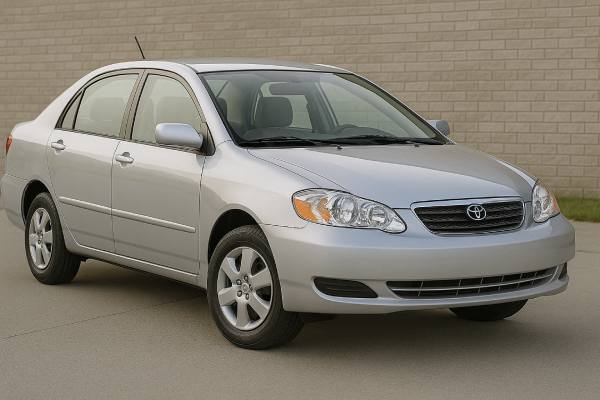
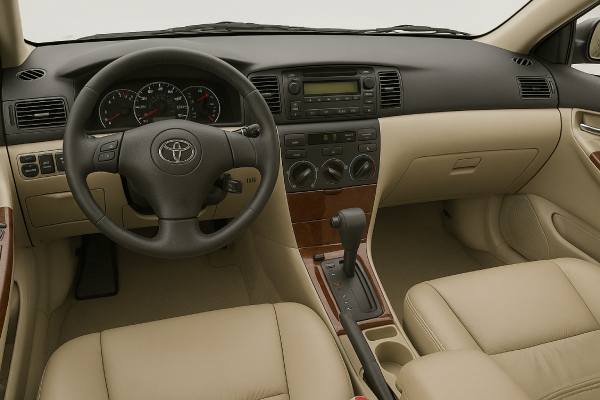
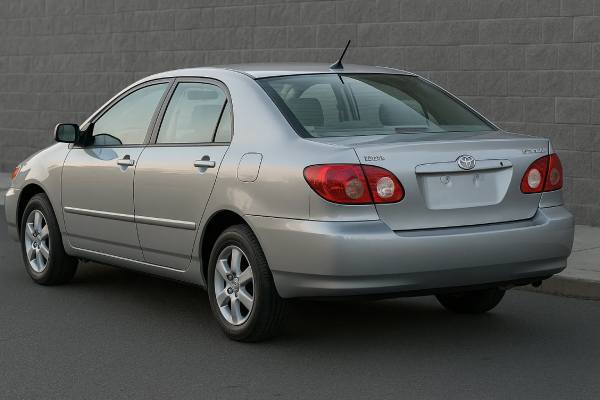
The facelifted ninth-generation Corolla (model years 2005–2008) blends Toyota’s proven 1ZZ-FE 1.8-liter engine and long-legged gearing with a tidier exterior and incremental feature updates. It remains one of the most economical small sedans to run, with widely available parts, straightforward DIY service, and a spacious, quiet cabin for its class. The all-aluminum 1ZZ-FE uses VVT-i on the intake cam, a timing chain (no scheduled belt), returnless fueling, and conservative compression that favors regular gasoline and long service life. Post-2005 cars gained broader airbag availability and detail refinements to audio, trim, and options. On the road, the Corolla prioritizes comfort and stability over sharp turn-in, yet it tracks confidently at highway speed and delivers excellent real-world fuel economy. For shoppers, the facelift cars are desirable for their later build quality, better rust protection in many plants, and improved side-impact protection when equipped with the optional side-torso and curtain airbags.
At a Glance
- Proven 1ZZ-FE with timing chain, easy access service points, strong longevity.
- Excellent economy: typically high-20s to mid-30s mpg US (≈9.0–6.7 L/100 km) in mixed driving.
- Roomy back seat and 14 ft³ (≈396 L) trunk; calm highway manners for a small sedan.
- Watch for rear brake hardware and line corrosion in salted climates; some cars consume oil if service is neglected.
- Oil and filter every 5,000–7,500 miles (8,000–12,000 km) or 6 months; brake fluid every 2–3 years.
Guide contents
- Facelift Corolla 1ZZ-FE overview
- Corolla 2005–2008 technical specs
- Corolla trims, options, safety
- Reliability and known issues
- Maintenance and buyer’s guide
- Driving and performance
- How Corolla compares to rivals
Facelift Corolla 1ZZ-FE overview
The 2005–2008 update keeps the fundamentals that made the ninth-gen Corolla a long-term favorite: a light, stiff body; efficient four-cylinder; and simple, durable driveline. The 1.8-liter 1ZZ-FE is an aluminum block and head design with cast-in cylinder liners, DOHC, four valves per cylinder, and Toyota’s VVT-i on the intake cam for a broader torque curve. In this era it’s rated at roughly 126–130 hp (94–97 kW) at ~6,000 rpm and 122 lb-ft (165 Nm) at ~4,200 rpm, tuned for regular gasoline and low emissions. A timing chain, coil-on-plug ignition, long-life iridium plugs, and a large air filter support long service intervals when the car is driven and maintained regularly.
Trims typically include CE (value), S (sport-appearance), and LE (comfort features). The chassis is tuned for compliance: MacPherson struts up front, a torsion-beam rear axle, and conservative sway bar sizing. Most cars carry front ventilated discs and rear drums; ABS was package-dependent and worth prioritizing in snow belts. Wheels are commonly 15-inch with 185/65 or 195/60 tires, while the S trim adds body-color bits, a leather-wrapped steering wheel (on many), and a tachometer if not standard.
Inside, the Corolla offers upright seating, excellent sightlines, and a 14.0 ft³ (≈396 L) trunk with a wide, low sill. Road and wind noise are kept in check at 65–75 mph (105–120 km/h) if tires are in good shape and alignment is correct. The facelift years expanded side-airbag availability (side-torso from early years, curtains widely offered from 2005 onward). Electronic stability control was not broadly available; winter tire selection and fresh brake fluid matter more for safety in this generation.
Ownership virtues are straightforward: parts are inexpensive and plentiful; most jobs require basic hand tools; and the engine bay is roomy enough for easy access to filters, plugs, belts, and sensors. Reliability depends on regular oil changes and cooling system attention—habits that also minimize the small but real risk of oil consumption on neglected examples. Kept stock and serviced, these cars routinely exceed 200,000 miles (322,000 km) with original major components.
Corolla 2005–2008 technical specs
Engine and Performance (1ZZ-FE)
| Item | Specification |
|---|---|
| Code | 1ZZ-FE (aluminum block/head) |
| Layout & valvetrain | Inline-4, DOHC, VVT-i (intake); 4 valves/cyl |
| Bore × stroke | 79.0 × 91.5 mm (3.11 × 3.60 in) |
| Displacement | 1.8 L (1,794 cc) |
| Induction | Naturally aspirated |
| Fuel system | Sequential multi-port injection |
| Compression ratio | ~10.0 : 1 |
| Max power | 126–130 hp (94–97 kW) @ ~6,000 rpm |
| Max torque | 165 Nm (122 lb-ft) @ ~4,200 rpm |
| Redline / fuel cut | ~6,500–6,800 rpm (calibration dependent) |
| Timing drive | Chain (no scheduled replacement) |
| Fuel requirement | Regular unleaded (87 AKI) |
| Rated economy (EPA window) | ~28 city / 37 hwy mpg US (8.4 / 6.4 L/100 km) typical combos |
| Real-world highway @ 75 mph | ~33–35 mpg US (7.1–6.7 L/100 km) on proper tires |
| Emissions class | Tier 2 Bin 5 / LEV-equivalent (varies by state equipment) |
| Aerodynamics | Cd ≈ 0.30–0.31 (trim/tire dependent) |
Transmission and Driveline
| Item | Specification |
|---|---|
| Manual | 5-speed (C59 family) |
| Automatic | 4-speed electronic (U341E) with lockup |
| Final drive (typical) | ~4.31 (M/T); ~2.86–3.94 overall (A/T in top gear) |
| Drive type | FWD |
| Differential | Open |
| Clutch (M/T) | Single-plate, hydraulic actuation |
Indicative gear ratios (typical):
- 5-MT: 3.17 / 1.90 / 1.31 / 0.97 / 0.82; final ~4.31
- 4-AT: 2.85 / 1.55 / 1.00 / 0.70; final ~2.86–3.94 by variant
Chassis and Dimensions
| Item | Specification |
|---|---|
| Front suspension | MacPherson strut, coil springs, anti-roll bar |
| Rear suspension | Torsion beam, coil springs |
| Steering | Hydraulic rack-and-pinion |
| Brakes | Front ventilated discs; rear drums (most trims) |
| Wheels/tires (common) | 185/65 R15 or 195/60 R15; steel or alloy |
| Ground clearance | ~150 mm (5.9 in) |
| Length / Width / Height | ~4,530 / 1,700 / 1,485 mm (178.3 / 66.9 / 58.5 in) |
| Wheelbase | 2,600 mm (102.4 in) |
| Turning circle (curb-to-curb) | ~10.4–10.8 m (34–35.5 ft) |
| Curb weight | ~1,180–1,250 kg (2,600–2,755 lb) |
| GVWR | ~1,650–1,700 kg (3,637–3,748 lb) |
| Fuel tank | 50 L (13.2 US gal / 11.0 UK gal) |
| Cargo volume (SAE) | ≈396 L (14.0 ft³) |
Performance and Capability
| Metric | Typical Result |
|---|---|
| 0–60 mph (0–97 km/h) | ~8.9–10.0 s (tire/transmission dependent) |
| Top speed | ~180–190 km/h (112–118 mph) |
| 100–0 km/h braking | ~39–43 m (128–141 ft), heavily tire-dependent |
| Payload | ~385–430 kg (850–950 lb), by trim |
| Towing | Light utility only where permitted; not factory-rated for heavy tow |
| Roof load | ~45–50 kg (100–110 lb) with rated crossbars |
Fluids and Service Capacities (typical references)
| System | Specification | Capacity |
|---|---|---|
| Engine oil | API SL/SN 5W-30 (quality synthetic recommended) | ~3.9–4.2 US qt (3.7–4.0 L) with filter |
| Coolant | Toyota Super Long Life (SLLC), 50/50 | ~6.5–7.0 L (6.9–7.4 US qt) |
| Manual transmission | 75W-90 GL-4/GL-5 per service literature | ~1.9–2.0 L (2.0–2.1 US qt) |
| Automatic transmission | Toyota ATF Type T-IV | ~6.9–7.6 US qt (service method dependent) |
| A/C refrigerant | R-134a | ~430–500 g (15–18 oz) |
| A/C compressor oil | ND-Oil 8 | ~120–150 mL (4–5 fl oz) |
Key torque references (typical):
- Wheel lug nuts: ~103 Nm (76 lb-ft)
- Spark plugs: ~18–22 Nm (13–16 lb-ft) into aluminum head
- Oil drain plug: ~30–40 Nm (22–30 lb-ft)
Electrical
| Item | Specification |
|---|---|
| Alternator | ~80–90 A |
| 12 V battery | ~45–55 Ah, Group 35 common (CCA varies) |
| Spark plugs | Long-life iridium; gap ~1.0–1.1 mm (0.039–0.043 in) |
Safety and Driver Assistance
| Item | Detail |
|---|---|
| Period crash tests | Good moderate-overlap frontal on post-Dec-2002 builds; side rating Acceptable with optional side/curtain airbags, Poor without |
| Airbags | Dual front standard; side-torso available earlier; curtain airbags widely available from 2005 |
| ABS | Often packaged; confirm at key-on bulb check |
| Stability/traction | Not broadly available in 2005–2008 |
| Child restraints | LATCH lower anchors (rear outboard), top tether anchors |
| Headlights | Halogen reflector; aim/condition strongly influences performance |
Corolla trims, options, safety
Trim structure and identifiers
- CE: Steel wheels, manual windows/locks on many, basic audio. Look for a simple gauge cluster and unadorned exterior.
- S: Sport-appearance package (body-color trim, rocker extensions, small spoiler on many), leather-wrapped wheel on many cars, tachometer, and 15-inch alloys/trim rings by package.
- LE: Power windows/locks, upgraded audio, optional moonroof, and more sound deadening in some builds.
Functional differences to note
- Brakes: Most CE/S/LE keep rear drums; ensure even shoe adjustment and check wheel cylinders for seepage.
- Tires/wheels: 185/65R15 is common; S/LE may see 195/60R15. Upsizing to quality 195/65R15 all-seasons can improve ride with minimal speedometer change.
- ABS: Bundled with other features; seek it if you drive on snow/ice.
- Steering wheel/tach: Some CE cars lack a tach; LE/S usually include.
Year-to-year changes affecting equipment
- 2005: Facelift; broader availability of side-curtain airbags; audio and trim updates.
- 2006–2007: Package reshuffles; Bluetooth was not common from factory—many cars rely on aftermarket head units.
- 2008: Final year of the platform; equipment packages simplified in some regions before the generation changeover.
Safety ratings context (period tests)
Moderate-overlap frontal results are strong for cars built after December 2002. Side-impact results diverge sharply: cars with optional side-torso and curtain airbags rate much better than those without. Rear-impact (head restraints/seats) typically scored low; correct head-restraint adjustment and healthy seatback foam are important.
Child-seat and ADAS notes
LATCH anchors are accessible but benefit from plastic guides. There was no factory autonomous emergency braking or lane-keeping in this generation; collision-avoidance depends on brakes, tires, and driver visibility—all serviceable with good maintenance.
Reliability and known issues
The facelift Corolla is fundamentally durable. Most age-related faults are inexpensive if handled early. Below is a prevalence-and-severity map with practical remedies.
Common / Low–Medium cost
- Oil consumption on neglected engines
Symptoms: Low oil between services; occasional VVT-i performance variability.
Cause: Stuck oil control rings from extended intervals/poor oil quality.
Remedy: Shorter intervals with quality synthetic; top-engine clean only with proper method; verify PCV function; monitor consumption. Well-maintained engines rarely suffer. - MAF/throttle body deposits
Symptoms: Rough idle, hesitation, higher fuel use.
Remedy: Clean MAF with electronics-safe cleaner; remove and clean throttle body; relearn idle. - Rear brake hardware wear/corrosion
Symptoms: Uneven shoe wear, weak parking brake, dragging drum.
Remedy: Replace shoes/return springs; clean/adjust; inspect backing plates and wheel cylinders. - Exhaust flange and gasket corrosion (mid-pipe)
Symptoms: Ticking/rasp on acceleration; exhaust smell.
Remedy: Replace hardware and gasket; check hangers and heat shields.
Occasional / Medium cost
- Wheel bearings (age/mileage)
Symptoms: Growl rising with road speed, not engine speed.
Remedy: Replace hub/bearing assembly; torque axle nut to spec. - Engine mounts
Symptoms: Vibration at idle in Drive (A/T) or harsh take-up (M/T).
Remedy: Replace torn mounts; torque with vehicle at ride height. - Evap system faults (loose caps, vent valves)
Symptoms: EVAP leak codes; readiness monitor incomplete.
Remedy: Smoke test; verify cap seal; test canister vent/ purge valves.
Rare / Higher consequence
- Coolant neglect leading to water-pump seepage or radiator decay
Symptoms: Pink crust at pump weep hole; slow coolant loss.
Remedy: Replace pump/radiator as needed; flush and refill with SLLC. - Fuel line/hard-line corrosion (salt belts)
Symptoms: Fuel smell; visible corrosion on underbody lines.
Remedy: Replace corroded sections with OEM or approved repair lines; apply corrosion protection.
Recalls, TSBs, and verification
Many ninth-gen Corollas fall within various airbag inflator campaigns and other actions. Always run the VIN through the official portals and retain printed proof of completion. For side-airbag and frontal-airbag work, confirm the correct inflator module part numbers are installed and documented.
Pre-purchase requests
- Full service file with oil change intervals, coolant history, and any transmission fluid services.
- Recent brake inspection (shoe thickness, drum condition) and a brake fluid change within 2–3 years.
- Battery test printout and alternator output.
- Evidence of recall compliance (VIN printouts).
- Cold start video and a full test drive including highway speeds and multiple panic-stop checks.
Maintenance and buyer’s guide
Practical schedule (distance/time = first reached)
- Engine oil & filter: 5,000–7,500 miles (8,000–12,000 km) or 6 months. Check level monthly; top to the full mark.
- Engine air filter: Inspect yearly/12,000 miles; replace 30,000–45,000 miles (48,000–72,000 km) or sooner in dust.
- Cabin filter: Every 12 months / 15,000 miles (24,000 km).
- Spark plugs (iridium): 90,000–120,000 miles (145,000–193,000 km). Confirm correct heat range and ~1.0–1.1 mm gap.
- Coolant (SLLC): First at 100,000 miles (160,000 km) or 10 years; then 50,000 miles (80,000 km) or 5 years.
- Automatic transmission fluid (U341E): 60,000–90,000 miles (96,000–145,000 km) drain-and-fill, sooner in severe service.
- Manual transmission gear oil (C59): 60,000–90,000 miles (96,000–145,000 km).
- Brake fluid: Replace every 2–3 years.
- Brake service: Inspect pads/shoes at each rotation; clean and adjust rears; lube slide pins on front calipers.
- Serpentine belt & tensioner: Inspect at 60,000 miles; replace on cracks/noise.
- PCV valve: Inspect/replace at 60,000 miles.
- Alignment & tire rotation: Rotate with every oil service; align yearly or when wear appears.
- Timing chain: No routine replacement—investigate only for noise, leaks at the tensioner, or timing correlation faults.
- 12 V battery: Load test annually after year 4; typical life 4–6 years.
Fluid quick list and capacities
- Engine oil: 5W-30 API SL/SN; ~3.9–4.2 qt (3.7–4.0 L) with filter.
- ATF: Toyota Type T-IV (U341E); refill volume depends on service method.
- M/T oil: 75W-90 GL-4/GL-5 per service literature; ~1.9–2.0 L.
- Coolant: Toyota SLLC, 50/50; ~6.5–7.0 L system fill.
- Brake fluid: DOT 3/4.
- A/C: R-134a ~430–500 g; ND-Oil 8 ~120–150 mL.
Buyer’s inspection checklist
- Engine: From cold, listen for brief chain rattle (tensioner) and idle smoothness. Warm, check for steady idle and quick restart. Inspect valve cover perimeter and chain-tensioner area for seepage.
- Cooling system: Coolant color (pink SLLC), radiator tank condition, heater performance, fans cycling normally.
- Transmission: A/T should upshift smoothly and lock the converter in 3rd/4th at light throttle; M/T should not grind, especially 2→3.
- Brakes: Even, straight stops; rear drums properly adjusted; parking brake holds on a grade.
- Suspension/steering: No clunks over sharp bumps; examine sway-bar links and strut mounts; check for inner-edge tire wear.
- Body/rust: Rocker seams, rear subframe mounts, brake/fuel hard lines, and pinch welds—especially in salted climates.
- Electrics: All cluster bulbs prove out at key-on (including ABS); HVAC blower speeds; headlight aim/clarity.
- Paperwork: VIN recall printout, service receipts, and any coolant/plug/transmission service documentation.
Which cars to target
Later-year (2007–2008) LE or S with ABS and side-curtain airbags, stock ride height, and documented oil and coolant services. Avoid heavily modified cars or those with mismatched tires/alignment issues unless budgeted for reconditioning.
Long-term outlook
With regular oil and coolant service, the 1ZZ-FE and its supporting systems are remarkably durable. Expect routine wear items—struts, mounts, bushings, and brake hardware—rather than major engine or transmission work. Keep the throttle body and MAF clean, refresh fluids on time, and the facelift Corolla will deliver another decade of reliable commuting.
Driving and performance
Ride and handling
The Corolla is tuned for quiet stability over absolute grip. Compliance over broken pavement is excellent, body motions are well-checked, and straight-line tracking inspires confidence at 70–75 mph (113–120 km/h). The hydraulic steering is light at parking speeds and steadier at highway pace, with modest on-center feel. Turn-in is deliberate; high-quality tires and a fresh four-wheel alignment sharpen responses appreciably.
Braking
The front ventilated discs and rear drums are sized for daily duty. Pedal feel is consistent when the fluid is fresh; a two-year fluid interval keeps the pedal firm and corrosion at bay. In panic stops, stopping distance is overwhelmingly tire-limited—choose rubber accordingly.
Powertrain character
The 1ZZ-FE emphasizes midrange. It pulls cleanly from 1,500 rpm and is happiest between 2,500 and 4,500 rpm in city driving. The 5-speed manual is light and friendly, geared for relaxed cruising; the 4-speed automatic shifts early and locks the converter in top gear for economy. Passing requires a downshift, but the engine is smooth and quiet up to its redline.
Efficiency
In mixed driving, expect high-20s to low-30s mpg US (≈9.0–7.6 L/100 km); steady 70–75 mph highway runs can return 33–35 mpg US (7.1–6.7 L/100 km) if alignment and tire pressures are correct. Winter fuel blends, short trips, and aggressive all-season or winter tires can trim 10–20%.
Loads and grades
With four passengers and luggage, the Corolla remains composed but demands earlier braking. On long grades in hot weather, watch coolant temp and downshift the automatic to keep revs in the efficient band.
How Corolla compares to rivals
Honda Civic (2006–2008)
The Civic offers crisper steering and a more modern dashboard, with similar cabin space. Real-world economy is a wash. Rear brake hardware and suspension bushings can age faster on some Civics; the Corolla’s long-term cost of ownership is typically lower if both are maintained equally.
Mazda3 (2004–2008)
The Mazda3 is the driver’s pick, with a more communicative chassis and stronger steering feel. It can be louder on coarse pavement and is more rust-prone in snow belts. Corolla wins for NVH and long-term durability.
Nissan Sentra (B15/B16 overlap)
Engines vary; some offer better midrange torque than the 1ZZ-FE, but cabin materials and resale trail Toyota. Corolla’s interior quality and reliability record generally prevail.
Hyundai Elantra (2007–2010)
Strong value and a long warranty when new. Early build quality and interior wear vary. Corolla feels more refined at highway speed and tends to hold value better.
Bottom line
For buyers prioritizing low running costs, dependable hardware, and comfortable highway manners over hot-hatch reflexes, the facelifted 2005–2008 Corolla is a standout. Choose a later-year car with ABS and side/curtain airbags, keep up on fluids and brakes, and it will deliver inexpensive miles with minimal drama.
References
- Fuel Economy of the 2007 Toyota Corolla 2007 (EPA Fuel Economy)
- 2007 Toyota Corolla 2007 (Safety Rating)
- Vehicle Detail Search – 2007 TOYOTA COROLLA 2025 (Recall Database)
- Look up Safety Recalls & Service Campaigns by VIN 2025 (Recall Database)
- Toyota Issues DO NOT DRIVE Advisory for Certain 2003–2005 Models with Recalled Takata Airbags 2024 (News Release)
Disclaimer
This article is for informational purposes and is not a substitute for professional diagnosis or repair. Specifications, torque values, intervals, and procedures vary by VIN, model year, market, and equipment. Always verify numbers and procedures against your vehicle’s official service documentation. If this guide helped you, please consider sharing it on Facebook or X/Twitter to support xcar’s work.