
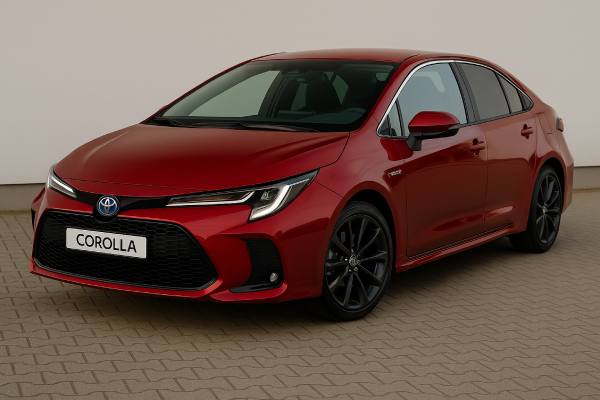
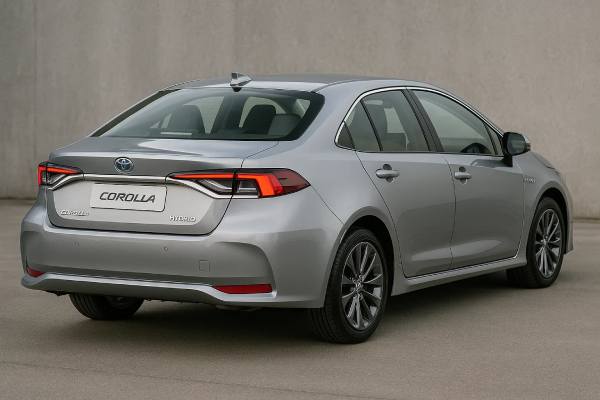
The facelifted Toyota Corolla 2.0 Hybrid pairs Toyota’s fifth-generation hybrid system with the TNGA-C platform to deliver brisk everyday performance, excellent real-world economy, and low running costs. The M20A-FXS 2.0-litre Atkinson-cycle engine works with a strong traction motor and compact lithium-ion battery to produce a system output of 196 hp, yet the car remains calm and quiet in town. A tightly packaged multi-link rear suspension supports stable highway manners and confident braking. Inside, the updated infotainment suite and active-safety stack are more responsive and feature-rich than the pre-facelift car. Ownership is straightforward: annual service intervals, long-life fluids, and a robust hybrid drive unit that typically shows little wear. This guide focuses on the Europe-spec Corolla 2.0 Hybrid hatchback (MZEA12) launched for 2023, with practical detail for shoppers and owners—what changed, what to expect in efficiency and durability, and how to select the right trim and wheel package for your roads.
Fast Facts
- Strong system output (196 hp) with relaxed cruising and quick 30–70 mph passes.
- Real-world mixed economy typically 4.6–5.7 L/100 km (49–61 mpg UK; 41–51 mpg US) depending on wheels and route.
- Safety technology is comprehensive; automatic braking, lane support, and adaptive cruise are standard.
- Watch cargo capacity on 2.0 Hybrid hatchbacks; 18-inch tyres add cost and can increase road noise.
- Routine service: engine oil and inspection every 12 months or 10,000 miles (15,000 km).
Explore the sections
- Facelift Corolla 2.0 Hybrid overview
- Corolla 2.0 Hybrid technical data
- Trims, options, and safety
- Reliability and common issues
- Maintenance and buyer’s guide
- Driving and performance
- How Corolla Hybrid compares
Facelift Corolla 2.0 Hybrid overview
Toyota’s 2023 refresh sharpened the Corolla’s efficiency and responsiveness without changing its easy-to-own character. The headline upgrade is the fifth-generation hybrid system: lighter, with revised power electronics and a higher-output traction motor. Paired to the M20A-FXS 2.0-litre Atkinson-cycle four-cylinder (dual VVT-i and D-4S dual injection), the combined output rises to 196 hp (up from the pre-facelift 180). In practice, it steps off smartly in EV mode, blends power smoothly when the engine joins, and sustains motorway speeds with lower revs than earlier hybrids.
Chassis tuning benefits from the TNGA-C platform’s inherently stiff structure. A multi-link rear suspension gives the hatch a planted rear axle over broken surfaces. Toyota calibrates ride/handling differently across wheels: 16-inch tyres give the plushest ride; 18-inch packages (Design/GR Sport/Excel, market-dependent) add steering bite and visual presence but transmit more coarse-chip noise.
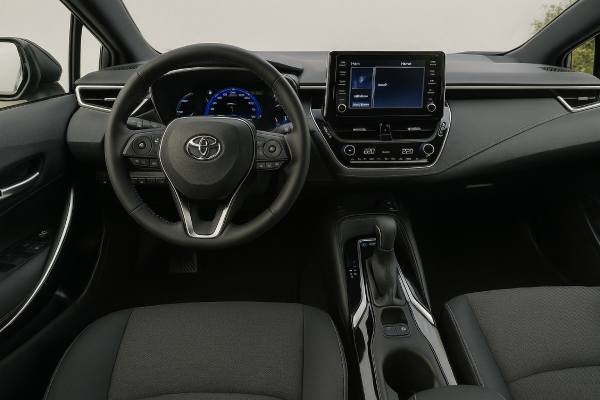
Inside, you’ll find Toyota’s latest multimedia with quicker boot times, crisper maps, cloud navigation availability, and natural-language voice control. The digital instrument cluster supplies hybrid-system information (energy flow, EV ratio, brake-regeneration score) with clearer graphics than the pre-facelift car.
Practicality trade-offs remain: the 2.0 Hybrid hatch’s boot is smaller than some rivals due to battery packaging and the multi-link rear. For most owners the space is adequate for weekly shopping or carry-on suitcases; if you regularly haul bulky items, consider a Touring Sports (wagon) variant in markets where the 2.0 Hybrid TS is offered.
Running costs are one of the car’s strongest suits. Annual service intervals, long-life coolant, and modest brake wear (thanks to regeneration) keep workshop visits infrequent. Insurance and tyres are the main variables: 18-inch tyres cost more and wear faster under enthusiastic driving; 16-inch tyres are cheaper and quieter.
Finally, active safety is a key selling point. The Corolla’s structure and restraint systems tested strongly at launch, and Toyota has kept the driver-assist suite current with enhancements to lane tracing, traffic-sign reading, junction-assist braking, and proactive driving assist functions.
Corolla 2.0 Hybrid technical data
Powertrain and Efficiency
| Item | Detail |
|---|---|
| Engine code | M20A-FXS (Dynamic Force) |
| Layout & valvetrain | Inline-4, DOHC, 16-valve, dual VVT-i, Atkinson cycle |
| Bore × stroke | 80.5 × 97.6 mm (3.17 × 3.84 in) |
| Displacement | 2.0 L (1,987 cc) |
| Induction & fuel | Naturally aspirated; D-4S (direct + port) |
| Compression ratio | 14.0:1 |
| ICE max power | 152 hp (112 kW) @ 6,000 rpm |
| ICE max torque | 190 Nm (140 lb-ft) @ 4,400–5,200 rpm |
| Traction motor (MG2) | PMSM, front axle, 83 kW max, 206 Nm (152 lb-ft) |
| Generator (MG1) | PMSM (starts ICE, manages system voltage) |
| System voltage | ~600 V |
| Battery | Lithium-ion, approx. 4.08 Ah, under rear seats |
| System output | 196 hp (146 kW) |
| Rated economy (WLTP combined) | ~4.6–5.7 L/100 km (61–50 mpg UK; 51–41 mpg US), varies by wheels/trim |
| Real-world highway @ 120 km/h (75 mph) | ~5.5–6.2 L/100 km (43–38 mpg US; 52–46 mpg UK), weather/tyres dependent |
Transmission and Driveline
| Item | Detail |
|---|---|
| Transmission | eCVT, planetary power-split (hybrid transaxle) |
| Drive type | Front-wheel drive (FWD) |
| Differential | Open front; brake-based torque vectoring via VSC |
| Refuel to full | ~3–5 min at pump (43 L tank) |
Chassis and Dimensions (Hatchback)
| Item | Detail |
|---|---|
| Front/rear suspension | MacPherson strut / multi-link |
| Steering | Electric rack-and-pinion; column assist |
| Brakes | Ventilated front discs; solid rear discs; electronic parking brake |
| Wheels/tyres (typical) | 205/55 R16; 225/45 R17; 225/40 R18 (market/trim dependent) |
| Ground clearance | ~135 mm (5.3 in) |
| Length × width × height | ~4,370 × 1,790 × 1,435 mm (172.0 × 70.5 × 56.5 in) |
| Wheelbase | 2,640 mm (103.9 in) |
| Turning circle (kerb-to-kerb) | ~10.4 m (34.1 ft) |
| Kerb weight (range) | ~1,430–1,500 kg (3,153–3,307 lb), by trim/wheels |
| GVWR | ~1,850–1,900 kg (4,079–4,189 lb), by trim |
| Fuel tank | ~43 L (11.4 US gal / 9.5 UK gal) |
| Cargo volume (VDA) | ~313 L (11.1 ft³) seats up (hatch) |
Performance
| Metric | 2.0 Hybrid Hatchback |
|---|---|
| 0–100 km/h (0–62 mph) | ~7.4 s |
| Top speed | ~180 km/h (111 mph) |
| 50–80 mph (80–130 km/h) | Strong mid-range; quick eCVT kickdown with motor assist |
| Braking feel | Progressive; regen blends smoothly into friction in normal use |
Fluids and Service Capacities (owner-planning guidance)
| System | Specification | Typical capacity |
|---|---|---|
| Engine oil | 0W-16, ILSAC GF-6B (Toyota Genuine preferred) | ~4.5 L (4.8 US qt) with filter |
| Engine coolant | Toyota Super Long Life Coolant (pink), premix 50/50 | ~6–7 L (6.3–7.4 US qt) |
| Hybrid transaxle | Toyota WS ATF (lifetime fill; service if contaminated/severe use) | ~3.5–4.0 L (3.7–4.2 US qt) drain-and-fill |
| A/C refrigerant | R-1234yf | ~400–500 g (14–18 oz) |
| A/C compressor oil | ND-11 (PAG for electric compressors) | As required by service procedure |
| Essential torques | Wheel nuts ~103 Nm (76 lb-ft); oil drain ~40 Nm (30 lb-ft) |
Values vary by VIN, market and equipment; always verify in the service manual before work.
Electrical
| Item | Detail |
|---|---|
| 12-V battery | 45–50 Ah AGM or flooded, compact European form factor (often LN1) |
| Spark plugs | Iridium, long-life; gap ~0.8 mm (0.031 in) |
Safety and Driver Assistance
| Area | Detail |
|---|---|
| Crash performance | Five-star rating under Euro NCAP (current generation body/airbag design) |
| Headlights | LED; automatic high beam; adaptive on upper trims |
| ADAS suite (Toyota Safety Sense) | Pre-Collision System (vehicle/pedestrian/cyclist, junction-turn assist), adaptive cruise control, lane departure alert and lane tracing assist, road sign assist, emergency steering assist, proactive driving assist, blind spot monitor and rear cross-traffic alert (trim-dependent), parking support brake on upper trims |
Trims, options, and safety
Trim structure (examples, market-dependent): Icon/Active, Design, GR Sport, and Excel are common grade names. All include the 2.0 Hybrid powertrain, eCVT, and Toyota Safety Sense as standard. Key differences lie in wheels/tyres, seats, lighting, and infotainment features.
- Icon/Active (entry): 16-inch wheels for the quietest ride and lowest tyre cost. Cloth seats, LED headlights, core Safety Sense features, and the updated infotainment with smartphone mirroring. Best economy.
- Design (mid): 17-inch wheels, privacy glass, front/rear parking sensors, reversing camera with better resolution. Adds convenience without compromising ride too much.
- GR Sport (style/suspension tune): 18-inch wheels, sport seats and trim, dark exterior accents, and a slightly tauter suspension feel. It looks the part and turns in keenly, but the tyre roar on coarse surfaces is higher.
- Excel (top): Matrix LED lights (where fitted), leather or mixed upholstery, heated front seats, advanced parking aids, JBL audio option, and wider ADAS availability.
Mechanical notes by trim: The powertrain is the same across the range. Brakes, steering ratio, and suspension layout do not change, though spring/damper tuning varies slightly with wheel size and grade. 18-inch packages typically ship with 225/40 tyres and can drop WLTP economy vs 16-inch tyres.
Infotainment and audio tiers: Standard multimedia supports Apple CarPlay/Android Auto; higher grades add cloud navigation, larger screen size, and JBL premium audio. Over-the-air map and software updates appear on later cars.
Year-to-year changes (facelift vs pre-facelift):
- Powertrain: increase from ~180 to 196 hp system output; revised motor and software calibration for snappier response.
- Efficiency: modest WLTP gains with updated battery and control logic.
- Cabin tech: new screens, faster processor, improved voice assistant.
- Safety: expanded detection scenarios (oncoming/junction) and better lane-centering behaviour.
Safety ratings overview: The current body structure earned five stars under Euro NCAP testing, with strong adult-occupant protection and robust safety-assist scores for automatic braking, lane support, and speed assistance. Headlight performance improves with matrix LED units on upper trims. Child-seat anchors (ISOFIX/LATCH equivalents) are fitted on the outer rear seats; top-tether points are clear and accessible. After windscreen or bumper repairs, radar/camera recalibration is mandatory—budget time and cost for a dealer calibration.
Reliability and common issues
The 2.0 Hybrid Corolla is generally low-drama to own. Most issues are minor, software-related, or usage-dependent. Below is a practical map by prevalence and impact; remedies assume out-of-warranty owner decisions.
Common (low/medium cost):
- 12-V battery weakness (short-trip use): Symptoms include slow boot-up of electronics or repeated “Accessory mode only.” Cause: limited alternator-like charging because hybrids rely on the traction battery/DC-DC converter, and short trips keep charge low. Remedy: test after year 3; maintain with a smart charger if the car sits; replace with correct AGM/LN1 size when reserve capacity drops.
- Infotainment glitches or lag after updates: Occasional freezes or slow map loads. Remedy: apply the latest software; perform a hard reset; dealer can reflash head unit if needed.
- Tyre roar and wear on 18-inch packages: Low-profile tyres transmit more road texture and can wear faster on rough tarmac. Remedy: rotate every 10,000–12,000 km; consider a quieter touring tyre; align annually.
Occasional (medium cost):
- Brake noise after storage/rain: Hybrids use regen heavily, so friction discs can flash-rust; light squeal appears after wet parking. Remedy: a few firm stops to clean; periodic caliper-slide lubrication in salted climates.
- Windscreen camera or radar misalignment after glass/body work: Lane tracing or pre-collision warnings may trigger. Remedy: professional calibration; many insurers cover recalibration with glass replacement.
Rare (medium/high cost):
- Hybrid cooling airflow restriction: Cabin pet hair/dust can partly obstruct the battery-cooling intake. Symptoms: fan noise, reduced EV operation in heat. Remedy: clean intake grille and duct; inspect fan; maintain cabin filter changes.
- Water ingress into rear light housings (isolated cases): Remedy: replace affected lamp; ensure gaskets are properly seated.
Software and calibrations that matter:
- Hybrid ECU updates may refine start-stop smoothness, improve EV-mode availability at low speeds, and optimize engine warm-up; dealers can apply the latest calibration during annual service.
- ADAS updates periodically enhance object detection and reduce false alerts. After software changes, verify that lane-centering and ACC behave normally on a known route.
Corrosion and underbody: TNGA-C shells are well-protected, but owners in salt regions should wash wheel arches and the rear subframe regularly. Inspect brake shields and fasteners for early surface rust.
Pre-purchase checks (used):
- Full service history with hybrid health checks.
- Evidence of ADAS recalibration after any windscreen or bumper repair.
- Even tyre wear and recent alignment sheet (important on 18-inch wheels).
- Cabin and engine filters replaced on schedule; clean battery-cooling intake.
- Infotainment on the latest software; test all cameras and parking sensors.
Maintenance and buyer’s guide
Practical maintenance schedule (typical Europe practice)
- Engine oil/filter: Every 12 months or 10,000 miles (15,000 km) using 0W-16, ILSAC GF-6B; replace crush washer; verify for leaks.
- Engine air filter: Inspect 12 months/15,000 km; replace 30,000–45,000 km depending on environment.
- Cabin filter: Replace 12 months/15,000 km; sooner with pets/dust.
- Coolant (ICE and hybrid loop): First change 10 years/160,000 km (100,000 miles), then every 5 years/80,000 km.
- Spark plugs (iridium): 120,000 miles (192,000 km).
- Hybrid transaxle fluid (Toyota WS): “Lifetime” under normal service; many owners choose 90,000–120,000 km drain-and-fill for peace of mind—use only WS and correct torque procedure.
- Brake fluid: 24 months regardless of mileage; hybrid regen still leaves the fluid hygroscopic.
- Brakes: Inspect pads, discs, and slider pins each service; perform a few firm stops weekly to keep disc surfaces clean.
- Drive belt and hoses: Visual inspection annually; replace if cracked or noisy.
- Tyres: Rotate 10,000–12,000 km; check pressures monthly (including the spare if fitted).
- Wheel alignment: Annually or after impacts; critical for 18-inch packages.
- 12-V battery: Test annually after year 3; typical life 4–6 years.
- HV battery cooling intake: Inspect/clean every 30,000–45,000 km if you carry pets or drive in dusty conditions.
Fluid picks and essentials (owner-decision planning):
- Engine oil: 0W-16 GF-6B; capacity ~4.5 L with filter.
- Coolant: Toyota Super Long Life (pink) premix 50/50; bleed per repair manual.
- Transaxle: Toyota WS ATF; use level-check temperature procedure.
- A/C: R-1234yf refrigerant; compressor uses ND-11 oil (electric-compressor-safe).
- Key torques: Wheel nuts ~103 Nm (76 lb-ft); oil drain ~40 Nm (30 lb-ft); always confirm per VIN.
Buyer’s guide highlights
Best value sweet spots:
- Design grade with 17-inch wheels balances comfort, cost, and kit.
- Excel adds desirable lighting and driver aids if you travel at night or on rural B-roads.
- GR Sport for buyers who prioritize style and turn-in feel, understanding the tyre/noise trade-off.
What to inspect on a test drive:
- Steering straight-ahead feel and return-to-centre on a smooth dual carriageway (detects alignment issues).
- Brake transition from regen to friction at low speed; it should be smooth and predictable.
- Hybrid warm-up behaviour: cold-start revs should settle quickly; EV creep should feel linear.
- Infotainment responsiveness and camera image quality; check all sensors.
Common reconditioning items on used cars:
- Fresh cabin and engine filters; brake service and slider-pin lubrication; wheel alignment; two-tyre replacement on 18-inch cars showing inner-edge wear.
Long-term durability outlook:
The M20A-FXS and Toyota’s hybrid transaxle have a strong reliability record when serviced annually with the correct fluids. Battery thermal load is modest in temperate climates; with normal use and annual health checks, HV battery degradation is typically small over 8–10 years. Rust prevention is good; regular underbody rinses are smart in salt regions.
Driving and performance
Ride, handling, and NVH:
On 16-inch wheels the Corolla flows over patched city streets, with high-frequency chatter well damped. Multi-link rear geometry keeps the car composed through quick lane changes and off-camber bends. 18-inch tyres increase grip and steering bite but raise cabin roar on coarse asphalt. Straight-line stability is excellent; crosswinds bother it less than some rivals thanks to a stiff TNGA-C shell and careful aero management around the pillars and underbody.
Powertrain character:
Step-off torque is immediate in EV mode, making urban gaps effortless. Press deeper and the engine engages cleanly; revs climb proportionally instead of the “rubber-band” effect older eCVTs showed. In Normal mode, the car prefers efficiency and smoothness; Sport sharpens throttle mapping and sustains motor assistance longer. Kickdown for motorway overtakes is decisive, with the traction motor filling the torque valley while the ICE reaches its sweet spot.
Braking feel and consistency:
Regeneration handles light deceleration; the handoff to friction braking is well-masked unless you brake very hard at low speed. Heat tolerance is adequate for brisk back-road work; repeated heavy stops are helped by the car’s stable rear axle and straight tracking.
Real-world economy:
Expect 4.6–5.0 L/100 km in gentle mixed driving on 16/17-inch wheels (52–46 mpg US; 62–56 mpg UK). On fast motorways at 120 km/h (75 mph), plan for ~5.5–6.2 L/100 km (43–38 mpg US; 52–46 mpg UK). Winter and short trips increase consumption; pre-conditioning and smooth throttle tip-in help. 18-inch tyres typically add 0.2–0.4 L/100 km (≈1–2 mpg US penalty).
Traction and control:
FWD grip is secure with good all-season tyres; stability control intervenes progressively. There’s no dedicated snow-mode programming, but the fine control of the eCVT and electric torque makes low-μ launches easy with gentle inputs. Hill starts are smooth thanks to the electric parking brake’s auto-hold and blended brake logic.
Load and towing:
The hatchback is tuned for passengers and luggage rather than heavy towing. If you must tow a light trailer or bike rack, confirm the homologated limits and tongue weight for your VIN and fit the correct wiring/charging module for trailer lighting.
How Corolla Hybrid compares
Honda Civic e:HEV (11th-gen):
The Civic hybrid is the Corolla’s most direct rival in Europe. It’s quicker in passing manoeuvres and a touch roomier in the rear, with a larger boot. Its e:HEV system keeps the engine decoupled more often, so it can sound quieter under moderate load. However, Toyota’s predicted reliability and dealer footprint are advantages, and many owners prefer the Corolla’s calmer low-speed ride and straightforward annual service plan.
Kia Niro Hybrid (new gen):
A crossover rather than a hatch, but often cross-shopped. The Niro rides higher, has a larger cargo bay, and a longer warranty, but typically returns similar economy only if driven gently. The Corolla is more stable at speed and more engaging on a twisty road; it also tends to cost less to insure on comparable trims.
Volkswagen Golf eTSI (mild-hybrid):
The Golf’s mild-hybrid eTSI engines are smooth, but they can’t match the Corolla’s EV creep, low-speed efficiency, or urban refinement. The VW counters with an upscale cabin feel and a wide engine range. The Corolla wins on fuel spend and predicted long-term durability; choose the Golf if you value a broader drivetrain choice or specific interior ergonomics.
Renault Mégane (ICE/mild-hybrid) and Peugeot 308 Hybrid (PHEV):
The 308 PHEV can run electric-only for short commutes if you charge daily; if not, its advantage fades and ownership costs rise. The Corolla’s self-charging setup suits drivers without home charging and prioritizes simplicity and resale appeal.
References
- Specifications – Toyota Corolla Hatchback 2024 (Specifications)
- Corolla 2024 Brochure 2024 (Brochure)
- Toyota Announces Prices and Specifications for the All-New Corolla Hatchback and Touring Sports 2018 (Press Information)
- Seven Earn the Highest Rating in Latest Safety Tests 2019 (Safety Rating)
Disclaimer
This guide is for informational purposes and is not a substitute for professional diagnosis or repair. Specifications, torque values, fluid types, and service intervals vary by VIN, model year, trim, and market. Always confirm procedures and values against your vehicle’s official service documentation and follow all safety instructions.
If you found this helpful, please share it with fellow owners and shoppers on Facebook or X/Twitter to support xcar’s work.