
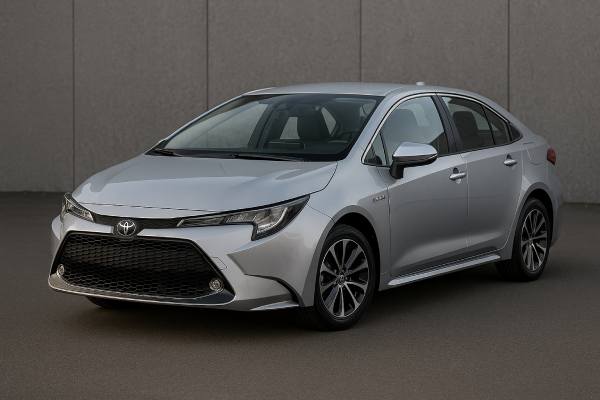
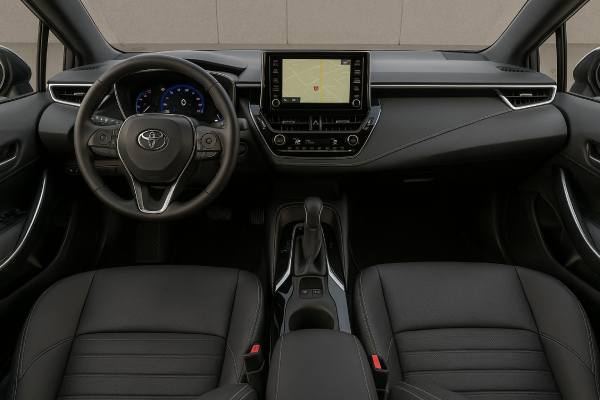
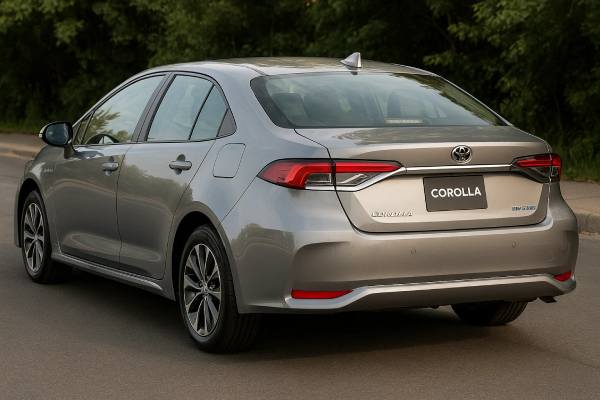
The Toyota Corolla Hybrid introduced electrification to a long-running compact benchmark without disrupting what owners value most: low running costs, simple ergonomics, and reputation for longevity. Built on Toyota’s TNGA-C platform, the ZWE211 pairs the Atkinson-cycle 2ZR-FXE 1.8-liter engine with a compact e-CVT and a proven hybrid system. The result is outstanding efficiency (often over 50 mpg), calm commuting manners, and easy maintenance intervals. Ride quality leans comfortable, cabin noise is well controlled for the class, and the trunk remains practical because the traction battery lives under the rear seat. It is not a performance hybrid, but throttle response around town is smooth and predictable. Standard Toyota Safety Sense adds active safety tech that was optional or unavailable in older Corollas. If you want a compact sedan that sips fuel and asks little in return, this generation hits the sweet spot—especially for high-mileage drivers and rideshare duty.
At a Glance
- Real-world economy commonly 48–55 mpg (4.9–4.3 L/100 km); quiet, relaxed ride; straightforward ownership.
- Proven hybrid hardware (2ZR-FXE + e-CVT) with strong parts availability and high reliability record.
- Standard active safety suite; crash scores among the segment leaders when equipped with the better headlights.
- Watch for open recalls (brake booster pump on early builds; OCS sensor campaign) and keep the hybrid battery fan clean.
- Routine oil service: every 10,000 miles / 12 months with 0W-16 (rotate tires at 5,000 miles / ~8,000 km).
What’s inside
- Corolla Hybrid ZWE211 overview
- Corolla Hybrid specs and data
- Trims, options, and safety tech
- Reliability, issues, and service actions
- Maintenance and buyer’s guide
- Driving and real-world efficiency
- How Corolla Hybrid compares
Corolla Hybrid ZWE211 overview
The 2019–2022 Corolla Hybrid (ZWE211) brought Toyota’s fourth-generation Hybrid Synergy Drive to the compact-sedan mainstream. Under the hood sits the 2ZR-FXE—an Atkinson-cycle, chain-driven 1.8-liter four—paired to an integrated transaxle with two motor-generators and a planetary gearset that behaves as an electronic continuously variable transmission (e-CVT). In North America it was offered primarily as the LE Hybrid trim, focused on value and efficiency rather than sport. System output is roughly 120–121 hp (90 kW), yet the car feels punchier off the line than the number suggests thanks to electric torque filling the first few feet of motion.
The TNGA-C platform is stiffer than the prior generation, which pays off in ride isolation and crash performance. Multi-link rear suspension, standard on all sedans in this generation, improves compliance over broken pavement and keeps body motions in check without resorting to harsh damping. Noise paths are better sealed than older Corollas, so the hybrid’s typical low-rpm engine droning under heavy throttle is muted most of the time.
Packaging is a strong point. The hybrid battery’s under-seat placement preserves a conventional trunk opening and back-seat fold-down utility. Most wear items are shared with the non-hybrid Corolla—useful for parts pricing and availability—while hybrid-specific components (inverter, DC-DC converter, transaxle) have long service lives when cooling systems are kept clean.
For shoppers, the pitch is simple: if you drive average or above-average annual miles, the Hybrid repays itself quickly through fuel savings, extended maintenance intervals, and high retained value. It is less compelling for drivers who prioritize acceleration or manual-transmission engagement, and it is intentionally conservative in cabin flair. But as a dependable, efficient daily with modern safety tech, the ZWE211 hybrid sits near the top of its class.
Corolla Hybrid specs and data
Powertrain and Efficiency (HEV)
| Item | Specification |
|---|---|
| Engine code | 2ZR-FXE (Atkinson-cycle) |
| Layout & valvetrain | Inline-4, DOHC, 16-valve, VVT-i |
| Displacement | 1.8 L (1,798 cc) |
| Bore × stroke | 80.5 × 88.3 mm (3.17 × 3.48 in) |
| Compression ratio | ~13.0:1 |
| Induction & fuel | Naturally aspirated; electronic fuel injection |
| Electric motor(s) | PMSM, dual motor-generator set within e-CVT transaxle |
| System output | ~121 hp (90 kW) |
| Engine torque (reference) | ~142 Nm (105 lb-ft) @ ~3,600–4,000 rpm |
| Timing drive | Chain |
| Emissions/efficiency standard | EPA (North America) |
| Rated economy (EPA) | ~53/52/52 mpg city/hwy/combined (4.4/4.5/4.5 L/100 km) |
| Real-world highway @ 120 km/h (75 mph) | ~5.0–5.3 L/100 km (47–44 mpg US / 56–53 mpg UK) |
| Aerodynamics (typical Cd) | ~0.28–0.30, depending on trim/wheels |
Note: Toyota marketing commonly cites 121 hp combined. Some materials round to 120 hp; drivability is unaffected.
Transmission and Driveline
| Item | Specification |
|---|---|
| Transaxle | e-CVT planetary hybrid transaxle (P610 family) |
| Drive type | Front-wheel drive |
| Gear ratios | Not applicable (electronic split via planetary gearset) |
| Final drive | Fixed reduction within transaxle (not driver-selectable) |
| Differential | Open (traction/stability control via ABS) |
| Refuel time | ~5 minutes (gasoline) |
Chassis and Dimensions
| Item | Specification |
|---|---|
| Platform | TNGA-C |
| Suspension (F/R) | MacPherson strut / Multi-link |
| Steering | Electric power assist; compact rack; good on-center stability |
| Brakes | Front ventilated discs ~276 mm (10.9 in); rear solid discs ~260 mm (10.2 in) with regenerative blending |
| Wheels/Tires (typical) | 195/65 R15 on 15-in wheels |
| Ground clearance | ~135 mm (5.3 in) |
| Length / Width / Height | 4,630 / 1,780 / 1,435 mm (182.3 / 70.1 / 56.5 in) |
| Wheelbase | 2,700 mm (106.3 in) |
| Turning circle (curb-to-curb) | ~10.9 m (35.8 ft) |
| Curb weight (approx.) | ~1,290–1,385 kg (2,840–3,050 lb) depending on equipment |
| Fuel tank | ~43 L (11.4 US gal / 9.5 UK gal) |
| Cargo volume (trunk) | ~371 L (13.1 ft³), 60/40 split-fold rear seat |
Performance and Capability
| Metric | Value |
|---|---|
| 0–60 mph (0–97 km/h) | ~9.2–9.5 s (typical media tests) |
| 0–100 km/h (0–62 mph) | ~9.5–9.8 s |
| Top speed | ~180 km/h (≈112 mph) |
| Braking 100–0 km/h | ~36–39 m (118–128 ft), tire-dependent |
| Towing capacity | Not rated in North America |
| Roof load | Not rated by Toyota for US market (use Toyota-approved crossbar loads only) |
Fluids and Service Capacities (owner-use essentials)
| System | Specification / Notes |
|---|---|
| Engine oil | Toyota-approved 0W-16 (ACEA/API per manual); ~4.2 L (4.4 qt) with filter |
| Coolant | Toyota Super Long Life Coolant (pink); hybrid components share dedicated cooling circuits—service by procedure |
| Transaxle fluid | Toyota WS ATF; drain/fill by level-check temperature method |
| A/C refrigerant | R-1234yf (most North American builds); charge by label |
| Key torque values | Wheel lugs ~103 Nm (76 lb-ft); oil drain plug ~27 Nm (20 lb-ft) |
Electrical
| Item | Specification |
|---|---|
| 12-V system | DC-DC converter from HV battery (no alternator) |
| 12-V battery | Compact AGM, trunk-adjacent mounting; test annually in cold climates |
| Spark plugs | Long-life iridium, ~0.7–0.8 mm (0.028–0.031 in) gap; typical replacement ~120,000 miles (193,000 km) |
Safety and Driver Assistance
| Area | Details |
|---|---|
| Active suite | Toyota Safety Sense 2.0: AEB with pedestrian detection, Lane Departure Alert with Steering Assist/Lane Tracing Assist, Adaptive Cruise Control, Road Sign Assist, Auto High Beams |
| Crash tests | Strong results; among class leaders for this era |
| Headlights | Ratings vary by headlamp version; better packages score higher |
| Child seats | LATCH provisions with good access; verify position-specific borrowing rules in manual |
Trims, options, and safety tech
Trim walk (North America, 2019–2022): The Corolla Hybrid was primarily sold as LE Hybrid. Mechanical spec stayed consistent: 1.8-liter 2ZR-FXE, e-CVT, FWD, 195/65 R15 tires. Toyota bundled features via small option packages rather than multiple grades.
- Core features (LE Hybrid): keyless entry with push-button start, automatic climate control, 8-inch touchscreen with Apple CarPlay (Android Auto added with running changes), fabric seats with 60/40 split-fold rear, LED headlamps/taillamps, Toyota Safety Sense 2.0, electronic parking brake with auto-hold.
- Common packages/options:
- Convenience/Driver Assist: Blind Spot Monitor with Rear Cross-Traffic Alert, smart-key on more doors.
- Premium/Audio Plus: upgraded audio head unit, additional USBs, and sometimes moonroof.
- All-weather protection: floor liners/cargo tray; cold-weather regions may see heated mirrors and seats via package.
- Wheels/tires: Most LE Hybrids ship with 15-inch steel wheels and aero covers—light and low-rolling-resistance. Aftermarket 16–17-inch sets are popular but can cost 1–3 mpg combined.
Year-to-year notes:
- 2020: Corolla Hybrid launches in North America, LE grade only, TSS 2.0 standard.
- 2021: Android Auto integration rolls in; minor feature shuffles.
- 2022: Running updates to infotainment and safety calibrations; equipment bundles vary slightly by region and distributor.
Safety ratings and equipment:
- Crashworthiness: Structure and occupant protection tested very well for this generation. Headlight ratings vary by lamp package; trims with upgraded LED projectors typically score higher.
- Front crash prevention: Standard AEB systems achieve top-tier results in vehicle-to-vehicle and pedestrian evaluations for this era.
- Airbag array: Front, side, curtain, and driver’s knee airbags; passenger sensing via the Occupant Classification System (subject to later recall campaign on some 2020–2021 vehicles).
- Child seats: Two full LATCH positions plus an additional top tether; anchors are accessible but observe borrowing rules for the center position.
Service/ADAS calibration considerations:
- Windshield replacements may require camera recalibration.
- Radar sensor alignment (behind the badge) must follow Toyota procedures after front-end repairs.
- Wheel alignment and steering angle resets can affect lane-keeping smoothness; ensure a shop with Toyota scan-tool capability.
Reliability, issues, and service actions
The ZWE211 Corolla Hybrid’s powertrain is among Toyota’s most durable. Most owners report little beyond routine service for many years. Still, a few patterns and official actions are worth knowing:
Common to occasional items (low to medium cost):
- 12-V battery aging (3–6 years): Slow cranking equivalents do not apply on hybrids, so symptoms are random warning lights or refusal to “Ready.” Remedy: test annually; replace with correct AGM spec and register if required.
- Cabin/traction-battery cooling fan dust: Cars used for rideshare or with pets can clog the battery fan inlet (rear seat area), leading to louder fan operation and potential battery temperature derates. Remedy: periodic inspection/cleaning; keep inlet grills unobstructed.
- Brake pad glaze/rust ridges: Hybrids use regenerative braking, so friction brakes can under-use and develop surface corrosion or glazing. Remedy: occasional firm braking to clean rotors; inspect/lube slide pins during tire rotations.
Less common (medium to higher cost):
- Inverter/ECU software updates: Address drivability quirks or diagnostic edge cases; dealers perform these during campaigns or TSBs. Remedy: ask the dealer to check for calibration updates at oil-change visits.
- Electric water pump noise/leak (rare): Listen for coolant smell or noise at high mileage. Remedy: replace pump; refill and bleed coolant loop via hybrid-safe procedure.
Key recalls/campaigns affecting some vehicles in this generation:
- Brake booster pump—potential loss of assist (early builds): Certain 2020 Corolla Hybrid vehicles were covered by a campaign to inspect/replace the brake booster pump assembly; symptoms include multiple warning lights and a hard pedal after repeated presses. Action: verify completion through the official recall lookup (VIN).
- Occupant Classification System (OCS) sensor—airbag may not deploy (2020–2021 Corolla): Campaign to inspect/replace front passenger OCS sensors due to potential short circuit and misclassification risk. Action: check status by VIN and schedule remedy when parts are available.
- Airbag control ECU noise filter (broader Toyota campaign touching various models/years): Some Corollas from this era were checked for ECU filtering to ensure proper deployment logic.
How to verify: Always confirm by VIN using the official recall portal and keep proof of completion in the service file. Dealer service departments can print a warranty/field action history upon request.
Pre-purchase checks to request:
- Full service history (especially annual engine-oil and brake-fluid entries).
- Recall/campaign printout (VIN-verified).
- Recent brake service measurements (pad thickness/rotor condition).
- Cooling system inspection notes (no leaks; correct coolant).
- Hybrid battery health scan (temperature sensor plausibility; fan clean).
- Tires: match set, correct load/speed rating, no uneven wear from low tire pressures.
Maintenance and buyer’s guide
Practical maintenance schedule (North America, owner-friendly shorthand):
- Engine oil and filter: Every 10,000 miles / 12 months with 0W-16; severe use or frequent short trips: consider 5,000-mile interim changes.
- Tire rotation, brake inspection: Every 5,000 miles / ~8,000 km; clean/lube slide pins annually to prevent hybrid-related corrosion/glazing.
- Cabin air filter: Inspect 10,000–15,000 miles; replace 15,000–20,000 miles (more often with pets/rideshare).
- Engine air filter: Inspect 15,000 miles; replace 30,000–45,000 miles depending on environment.
- Spark plugs (iridium): Typically 120,000 miles / 193,000 km.
- Coolant (engine and hybrid loop): First replacement around 100,000 miles / 10 years, then 50,000 miles / 5 years; follow hybrid bleed procedures.
- Brake fluid: Replace every 3 years regardless of mileage (moisture control helps ABS modulators).
- e-CVT (Toyota WS) fluid: “Lifetime” in the book; pragmatic approach is inspect at 60,000 miles, drain/fill 90,000–120,000 miles if dark/contaminated.
- 12-V battery: Test annually after year 3; typical replacement window 4–6 years.
- Alignment check: Annually or with any tire wear/pothole impact.
- HV battery cooling path: Inspect/clean fan/intake every 30,000–45,000 miles in dusty or pet-hair environments.
Fluids and fasteners cheat-sheet (owner-use):
- Oil: 0W-16, ~4.2 L (4.4 qt).
- Drain plug torque: ~27 Nm (20 lb-ft).
- Wheel lug torque: ~103 Nm (76 lb-ft).
- Coolant: Toyota SLLC (pink); do not mix types.
- A/C: R-1234yf (charge by label on radiator support).
Buyer’s quick checklist:
- Road test: Smooth hybrid “Ready” engagement; no warning lights; seamless e-CVT behavior; consistent regen and friction-brake handoff (no grabby feel).
- Brakes: Check for rotor lip and uneven pad deposits (common on lightly driven hybrids).
- Tires: Even wear; LRR (low-rolling-resistance) tires maintain the advertised economy.
- Interior electronics: Verify ADAS status lights; try DRCC, LTA, and AHB on a safe route.
- Body/chassis: Look under for plastic aero-panel damage (parking curbs) and front radar cover alignment after any bumper repairs.
- Battery hygiene: Inspect rear-seat area for blocked vents; listen for loud battery fan.
Best years/options to target: Any well-maintained 2020–2022 LE Hybrid with completed recalls and clean history is a safe pick. Cars with the upgraded LED headlamps (where fitted) earn better nighttime visibility and stronger safety-test headlight scores. Avoid neglected examples with mismatched tires or poor alignment—fuel economy and lane-keeping smoothness will suffer.
Durability outlook: With routine fluid changes and clean cooling paths, 200,000-mile (320,000-km) lifespans are common for Toyota’s 1.8-liter hybrid systems. Suspension wear parts (bushings, end links) and 12-V batteries are typical mid-life replacements; hybrid transaxles and traction batteries rarely fail when maintained and kept cool.
Driving and real-world efficiency
Ride, handling, and NVH: The TNGA-C chassis and multi-link rear suspension give the Corolla Hybrid a settled, mature ride. Impacts are rounded off rather than sharp, and straight-line stability at highway speeds is excellent for a compact. Steering is light but predictable, with accurate on-center tracking. Cabin noise is low in urban driving; at highway speeds tire roar depends heavily on tire choice and pressure. The hybrid’s engine is quiet at steady cruise; under full throttle the 1.8-liter can be heard, but Toyota’s sound insulation keeps it from droning.
Powertrain character: Around town, blended electric torque makes tip-in smooth and responsive. The e-CVT holds the engine near its efficient band during hard acceleration; there are no shift shocks, just a steady rise in speed. Eco/Normal/Sport modes mostly adjust pedal mapping and AC aggressiveness; Sport helps in short merges but doesn’t change peak output.
Braking feel: Regenerative braking handles most deceleration below moderate pedal pressure. The transition to friction brakes is well tuned; only on long downhill grades or very rough pavement might you notice a handoff. Because regen does so much work, periodic firm stops keep rotors clean.
Observed efficiency: In mixed suburban use, 50–54 mpg (4.7–4.3 L/100 km) is typical with OEM tires and correct pressures. Sustained 75-mph (120-km/h) freeway cruising lands near 44–47 mpg (5.3–5.0 L/100 km). Cold weather and winter tires can reduce those numbers by 10–20%. Urban stop-and-go favors the hybrid: 53+ mpg (≤4.4 L/100 km) is common with gentle driving.
Key performance metrics: Most independent tests place 0–60 mph near the low-to-mid-9-second range; passing from 50–70 mph is adequate rather than brisk, so plan merges and two-lane passes accordingly. Brake performance aligns with class norms, and fade resistance is excellent because regen shoulders a meaningful share of energy on descents.
Load and tow: Toyota does not rate towing for North American Corolla Hybrids. With a full cabin and trunk, the car remains composed; keep tires at door-placard pressures and allow longer stopping distances if the trunk is full (regen contribution decreases as speeds fall and weight rises).
How Corolla Hybrid compares
Honda Insight (2019–2022): The Insight feels a touch more upscale and slightly quicker in passing thanks to Honda’s two-motor system, but trunk pass-throughs can be tighter and long-term parts pricing tends to favor Toyota. Corolla’s real-world mpg is comparable or a hair better in highway use.
Hyundai Ioniq Hybrid (2017–2022): The Ioniq posts stellar highway economy and offers a hatchback body for cargo flexibility. Ride quality is firmer and some owners report more brake blending quirks. Corolla counters with a quieter cabin and simpler long-term ownership.
Toyota Prius (Gen 4): Prius is the efficiency champ with a more aerodynamic profile and hybrid-specific packaging. Corolla Hybrid feels more like a conventional sedan, with traditional trunk, lower insurance in some regions, and familiar driving position. If you value maximum mpg, Prius wins; if you want “just a Corolla” that happens to be a hybrid, this is it.
Hyundai Elantra Hybrid (2021–): Newer tech and strong feature content, sometimes at lower transaction prices. Corolla often holds value better and enjoys a broader dealer network for hybrid expertise; long-term dependability reputation still tilts Toyota’s way.
References
- 2020 Toyota Corolla 2019 (Pressroom Overview)
- 2020 Toyota Corolla 2020 (Safety Rating)
- Fuel Economy of the 2020 Toyota Corolla Hybrid 2020 (EPA Data)
- Vehicle Detail Search – 2020 TOYOTA COROLLA HYBRID 2020–2025 (Recall Database)
Disclaimer
This guide is for informational purposes and is not a substitute for professional diagnosis or repair. Specifications, torque values, intervals, procedures, and equipment vary by VIN, market, model year, and options. Always verify against your vehicle’s official owner’s manual, service information, and recall status before performing work or making a purchase decision.
If this helped, please consider sharing it with fellow owners on Facebook or X/Twitter to support xcar’s work. Thank you!