
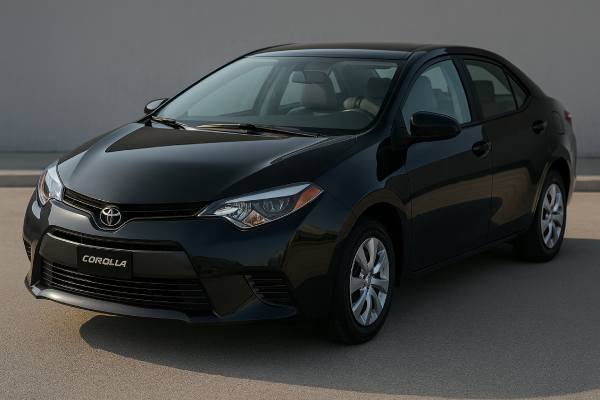
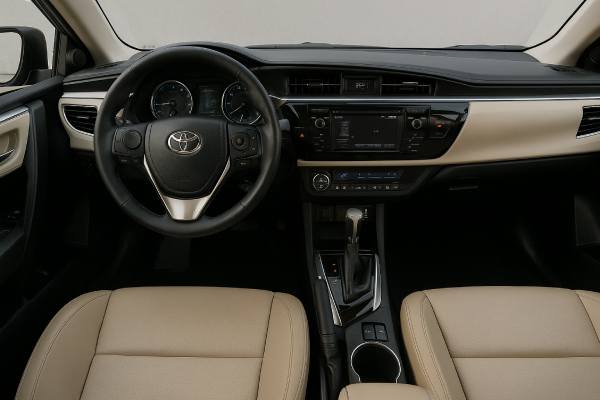
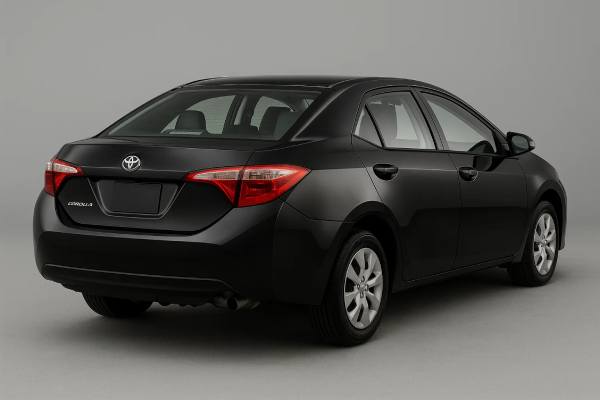
The eleventh-generation Corolla marked a step change in cabin space, refinement, and long-term usability. In this 2013–2016 span (2014–2016 for most North American cars), the mainstream 1.8-liter 2ZR-FE is the one most shoppers will find: 132 hp, chain-driven DOHC with Dual VVT-i, and Toyota’s calm, low-maintenance demeanor. Trims with this engine skew toward simple ownership—conventional port injection, no turbo, and an efficient CVT tuned for relaxed commuting. A roomier rear seat and improved highway stability make this generation feel grown-up versus the E150 before it. The cabin is straightforward and durable, the driving controls are light, and running costs stay low with long service intervals on coolant and spark plugs. As with any high-volume compact, the best examples shine when maintenance has been kept current. This guide zeroes in on the 132-hp cars (L, LE, S and related packages), clarifies where they differ from the 140-hp LE Eco variant, and details specs, upkeep, reliability patterns, and what to check before you buy.
At a Glance
- Spacious back seat, simple 1.8-liter engine, and excellent fuel economy (≈31–32 mpg combined / 7.6–7.4 L/100 km).
- Calm highway manners; CVTi-S keeps revs low, S trim adds firmer tuning and paddles without hurting comfort.
- Cabin materials wear well; maintenance schedule is straightforward with long spark-plug/coolant intervals.
- Watch early-life CVT calibration feel (software updates) and routine belt/pump/strut wear around 60–100k miles.
- Oil change: 10,000 miles / 12 months with 0W-20 (or 5,000 miles / 6 months if driven short-trip or severe).
Guide contents
- Corolla ZRE172 Detailed Overview
- Specifications and Technical Data
- Trims and Options, Safety and Driver Assistance
- Reliability, Common Issues and Service Actions
- Maintenance and Buyer’s Guide
- Driving and Performance
- How Corolla Compares to Rivals
Corolla ZRE172 Detailed Overview
The ZRE172 is the core eleventh-gen Corolla many buyers know: a compact sedan sized and tuned for daily life. The 2ZR-FE 1.8-liter four-cylinder (132 hp, 128 lb-ft / 174 Nm) uses an aluminum block and head, chain-driven camshafts, and Dual VVT-i on intake and exhaust. It runs port fuel injection (not direct injection) for simpler carbon management and generally predictable long-term reliability. Most cars pair this engine with Toyota’s CVTi-S continuously variable transmission, tuned to keep revs low and emulate stepped shifts in “Sport” logic; a 6-speed manual appears in select trims and model years, while an older 4-speed automatic was limited to base configurations early in the cycle.
This generation rides on a longer wheelbase than its predecessor, improving rear legroom and highway stability. Steering is electrically assisted and tuned for low effort; the S trim uses slightly firmer damping, available 17-inch tires, and paddle shifters for livelier response without compromising the Corolla’s calm demeanor. Brakes are front disc/rear drum on most models, with four-wheel discs appearing on specific packages or markets—either setup is adequate for the car’s modest mass and everyday use.
Inside, controls are simple, sightlines are friendly, and the trunk is a usable cube with a wide opening. Materials emphasize durability; the seats hold up well, and the cloth is easy to keep clean. The audio/HVAC interface is straightforward; Bluetooth and USB were commonly specified, and available navigation lived within Toyota’s Entune-era head units. Safety equipment includes multiple airbags and electronic stability control. Advanced active safety (automatic emergency braking and lane functions) arrived broadly in this line for 2017; for the 2013–2016 window, you shop primarily for conventional safety fundamentals and crash-test performance rather than modern ADAS.
A key buying nuance: LE Eco models use a different tune (and in many cases a related 2ZR-FAE Valvematic engine at 140 hp). This article focuses on the 132-hp 2ZR-FE cars—L, LE, S, and their equipment packages—because they represent the largest share of real-world listings and maintain the simplest service profile. If you are comparing fuel economy numbers, note that the LE Eco’s ratings are higher; its mechanicals and aerodynamics differ from the baseline cars covered here.
In short, the ZRE172 with 2ZR-FE is the dependable, low-drama Corolla formula: light maintenance needs, calm road manners, and running costs that make sense for commuters, students, and households that value predictable ownership.
Specifications and Technical Data
Engine and Performance (2ZR-FE / 1.8 L, 132 hp)
| Item | Specification |
|---|---|
| Code | 2ZR-FE (Dual VVT-i, aluminum block/head) |
| Layout & cylinders | Inline-4, 16 valves, DOHC; 4 valves/cyl |
| Displacement | 1.8 L (1,798 cc) |
| Bore × stroke | 80.5 × 88.3 mm (3.17 × 3.48 in) |
| Induction | Naturally aspirated |
| Fuel system | Port fuel injection |
| Compression ratio | ~10.0:1 |
| Max power | 132 hp (98 kW) @ 6,000 rpm |
| Max torque | 174 Nm (128 lb-ft) @ 4,400 rpm |
| Timing drive | Chain (no routine replacement interval) |
| Emissions/efficiency std. | EPA fuel-economy ratings (North America baseline) |
| Rated efficiency (typical) | 31–32 mpg US combined (7.6–7.4 L/100 km) |
| Real-world highway @ 120 km/h (75 mph) | ≈34 mpg US (6.9–7.0 L/100 km), tire/wind/temp dependent |
| Aerodynamics | Cd ≈ 0.29–0.30 (varies by trim/wheels) |
Note: LE Eco uses a different calibration/engine (often 2ZR-FAE, 140 hp) and distinct aero/tires; values above target the 132-hp 2ZR-FE.
Transmission and Driveline
| Item | Specification |
|---|---|
| Transmission | CVTi-S CVT (most trims); 6-speed manual (limited availability); 4-speed automatic (early base L) |
| Final drive ratio | ~4.76 (CVT typical; varies slightly by trim/year) |
| Drive type | Front-wheel drive |
| Differential | Open (stability and traction control standard) |
| Refuel time | ~5 minutes (typical gasoline fill) |
Chassis and Dimensions
| Item | Specification |
|---|---|
| Front suspension | MacPherson strut, coil springs, stabilizer bar |
| Rear suspension | Torsion beam axle, coil springs, stabilizer bar (trim-dependent) |
| Steering | Electric power assist; light/linear effort |
| Brakes | Front ventilated discs; rear drums on most trims (four-wheel discs on select packages/markets) |
| Wheels/Tires | 195/65R15 (L/LE), 205/55R16 (LE/S), 215/45R17 (S) |
| Ground clearance | ~140 mm (5.5 in) |
| Length × width × height | ≈ 4,640 × 1,775 × 1,455 mm (182.6 × 69.9 × 57.3 in) |
| Wheelbase | 2,700 mm (106.3 in) |
| Turning circle (curb-to-curb) | ~10.8 m (35.6 ft) |
| Curb weight (approx) | 1,270–1,330 kg (2,800–2,930 lb), by trim/transmission |
| Fuel tank | 50 L (13.2 US gal / 11.0 UK gal) |
| Cargo volume (SAE) | ~368 L (13.0 ft³) |
Performance and Capability
| Metric | 2ZR-FE 132-hp models |
|---|---|
| 0–100 km/h (0–62 mph) | ~10.0–10.5 s (CVT); ~9.5–10.0 s (6-MT) |
| Top speed | ~185–190 km/h (115–118 mph), speed-limited |
| 100–0 km/h braking | ~38–40 m (varies with tires/condition) |
| Towing capacity | Not rated for heavy towing; light utility only (owner’s manual guidance) |
| Roof load | Check crossbar rating; typical compact-car loads 45–68 kg (100–150 lb) with proper rails/crossbars |
Fluids and Service Capacities (decision-useful highlights)
| System | Specification |
|---|---|
| Engine oil | 0W-20, API SN or later; ~4.2–4.4 L (4.4–4.6 US qt) with filter |
| Coolant | Toyota Super Long Life (pink), premix 50/50; long-life interval |
| Transmission (CVT) | Toyota CVT fluid (consult label/service manual); service on condition or specified interval if severe use |
| Brake fluid | DOT 3 (DOT 4 acceptable if mixing rules followed); replace ≈ every 3 years |
| A/C refrigerant | R-134a; charge quantity varies slightly by year/trim |
| Spark plugs | Iridium, long-life; gap ≈ 1.0–1.1 mm (0.039–0.043 in) |
| Key torque (lug nuts) | ~103 Nm (76 lb-ft) |
Always verify fluid specs and capacities by VIN and build year; packaging and regional differences exist.
Electrical
| Item | Specification |
|---|---|
| Alternator | ~100–130 A (equipment-dependent) |
| 12-V battery | Group size varies by climate package; maintenance-free lead-acid |
| Spark/ignition | Coil-on-plug; iridium plugs (120k-mile typical replacement) |
Safety and Driver Assistance
| Item | 2013–2016 132-hp trims |
|---|---|
| Crash ratings (overview) | Strong fundamental scores in moderate overlap and side; small-overlap varies by test year; head restraints/roof strength competitive for class |
| Airbags | Front, side, curtain, and driver knee (coverage may vary by year/trim) |
| ADAS availability | No factory AEB/lane centering in this span; stability control, traction control, ABS, brake assist, and tire-pressure monitoring standard |
| Headlights | Halogen reflector or projector by trim; performance varies with aim/bulb condition |
Trims and Options, Safety and Driver Assistance
Trims with the 132-hp 2ZR-FE. In this window the mainstream grades are L, LE, and S (plus Plus/Premium packages depending on year). The LE Eco uses distinct hardware and tuning and is outside this article’s scope. The L is the simplest configuration—steel 15-inch wheels, basic audio, and either the early 4-speed automatic or CVT depending on model year. LE adds convenience items (touchscreen audio, Bluetooth, backup camera, cruise control), 16-inch tires, and the CVTi-S as standard. S is the sport-themed trim: firmer suspension tune, available 17-inch wheels with lower-profile tires, front sport seats with contrasting fabric, a leather-trimmed steering wheel, and paddle shifters on CVT cars. S models often include a sport instrument cluster and cosmetic changes (grille, spoilers).
Option packages and identifiers. Popular combinations include an LE Premium bundle (moonroof, upgraded infotainment, sometimes heated seats) and S Plus/S Premium (17-inch wheels, moonroof, Smart Key, SofTex-trimmed seats in some years). Quick tells: wheel/tire size (15/16/17), steering-wheel material (urethane vs leather), presence of paddles (S CVT), and seat fabric patterns. In the bay, look for the emissions label and engine cover marking “VVT-i” rather than “Valvematic” to confirm 2ZR-FE on non-Eco cars.
Year-to-year changes. Across 2014–2016, feature content and infotainment updates evolved (screen size, Entune features, USB inputs). The base L’s transmission specification varies early in the run; by 2015, CVTi-S becomes the common pairing on LE and S. Special Edition packages appear toward the end (e.g., 2016 S Special Edition with unique wheels/trim). Active safety suites (Toyota Safety Sense) arrive for 2017 in this line, so the cars covered here rely on conventional safety content.
Safety ratings and child-seat support. These Corollas provide ISOFIX/LATCH anchors in the outboard rear seats with clear labeling and reasonable access. Front-seat airbag coverage and side curtains protect a wide range of occupant sizes; check that recall and software updates are current (airbag control ECU recall affects many model years across multiple nameplates). For families, verify the condition and labeling of lower anchors and the top tether points on the rear shelf; test-fit bulky rear-facing seats, as 17-inch-wheel S trims can slightly stiffen the ride over broken pavement.
ADAS and service notes. Because AEB and lane-keeping were not fitted here, collision repairs generally require fewer ADAS calibrations than newer cars. After windshield replacement, re-aim halogen headlights and confirm beam cutoff to maximize nighttime visibility. If your car has the available backup camera, a clear lens and good screen brightness make a meaningful difference—clean the lens periodically and check for moisture intrusion after heavy rain.
Reliability, Common Issues and Service Actions
The 2ZR-FE Corolla is broadly dependable. Most aging seen today ties to time-and-mileage wear rather than design defects. Map your expectations using prevalence (common/occasional/rare) and cost (low/medium/high):
Engine and fueling (ICE specifics).
- Common / low: Water pump seepage or noise around 60–100k miles. Symptom → coolant traces near the pump or faint bearing noise. Cause → pump seal/bearing wear. Remedy → replace the pump and belt; bleed system and verify thermostat operation.
- Occasional / low: Serpentine belt glazing or chirp. Symptom → brief cold-start squeal. Cause → belt wear or pulley alignment. Remedy → new belt; inspect idler/tensioner.
- Occasional / low-medium: PCV valve aging and oil mist in intake. Symptom → slight idle roughness or increased oil usage. Remedy → replace PCV and check hose integrity.
- Rare / medium: Coil-on-plug misfire (moisture intrusion or age). Remedy → swap test, replace coil/plug as needed.
Cooling and HVAC.
- Common / low: Cabin evaporator odor in humid climates. Remedy → HVAC cleaner, cabin filter hygiene, and using fresh-air mode before shutdown.
- Occasional / medium: Radiator cap/thermostat fatigue with age; overheating on steep grades. Remedy → replace cap/thermostat, verify fan operation and coolant concentration.
CVTi-S transmission and driveline.
- Common / low: Rubber-band feel or flare on light throttle—often software-tuning behavior rather than failure. Remedy → ensure latest calibration; road-test in Sport/manual mode to compare behavior.
- Occasional / medium: Fluid degradation under severe service (heat, urban stop-and-go). Remedy → condition-based CVT fluid exchange with the correct Toyota fluid; reset adaptation if procedure calls for it.
- Rare / high: Bearing/belt damage following ignored service or contamination. Remedy → professional rebuild or replacement.
Suspension, brakes, body.
- Common / low: Front strut top-mount clunk over speed bumps at higher mileage. Remedy → inspect mounts/bearings; replace components as needed.
- Common / low: Rear drum brake shoe hardware noise or uneven adjustment. Remedy → clean, re-lubricate contact points, adjust; replace worn hardware.
- Occasional / medium: Wheel-bearing growl (especially with pothole or curb impacts). Remedy → replace hub assembly.
- Occasional / low: Underbody and bolt surface corrosion in road-salt regions. Remedy → clean and protect; check brake lines and subframe seams.
Electrical and infotainment.
- Occasional / low: Aging 12-V battery voltage dips causing intermittent warning lights. Remedy → load-test and replace battery; clean grounds.
- Occasional / low-medium: Early Entune head unit lag or Bluetooth pairing issues. Remedy → firmware update or module reset.
Recalls, TSBs, and extended coverage.
- Airbag control unit recall (multi-model campaign): Certain 2014–2019 vehicles received an SRS ECU update or replacement to ensure proper deployment logic during specific electrical interference events. Action → verify by VIN on the official site and confirm completed remedy in dealer records.
- Infotainment/firmware bulletins: Dealers can update head unit/backup-camera software to address stability or compatibility issues.
- CVT software updates: Where applicable, updated shift logic improves low-speed feel; many cars were flashed during regular service.
Pre-purchase checks.
- Full service history (oil, coolant, brake fluid, CVT fluid where applicable).
- Proof of recall completion and any firmware updates.
- Tire condition and even wear (alignment on S 17-inch trims matters).
- Suspension noise over speed bumps and tight turns.
- Cooling system pressure test and A/C performance.
- Brake hardware condition (drum shoe hardware, caliper sliders), especially in salty climates.
- Interior electronics (steering-wheel controls, camera, USB/12-V power outlets).
Maintenance and Buyer’s Guide
Practical maintenance schedule (baseline)
- Engine oil and filter: 10,000 miles / 12 months with 0W-20 synthetic; 5,000 miles / 6 months if driven short-trip, dusty, or extreme temperature cycles.
- Engine air filter: Inspect every 15,000 miles; replace ~30,000 miles (sooner if dusty).
- Cabin filter: 15,000–20,000 miles or annually.
- Coolant: Toyota Super Long Life first change around 100,000 miles / 10 years, then ~50,000 miles / 5 years.
- Spark plugs (iridium): 120,000 miles (or sooner if misfire/fuel economy drop).
- Serpentine/aux belt: Inspect from 60,000 miles; replace on cracks, glazing, or noise.
- CVT fluid (CVTi-S): Not always listed for fixed interval; inspect/replace based on condition or severe service at ~60,000–90,000 miles using the correct Toyota fluid and procedure.
- Manual transmission fluid: ~60,000–90,000 miles (check level/condition).
- Brake fluid: Every 3 years.
- Brake pads/rotors: Inspect at each tire rotation; replace based on thickness/runout and pulse/heat-check.
- Tires and alignment: Rotate every 5,000 miles; check alignment annually or after impacts; keep pressures set to door-placard values.
- 12-V battery: Load-test annually after year three; typical replacement window 4–6 years.
- PCV valve and hoses: Inspect at ~90,000 miles; replace if sticky or oil-fogging in intake appears.
- Timing chain: No interval; inspect on symptoms (noise/correlation faults, metal in oil) and repair as needed.
Fluids and capacities (quick decisions).
Engine oil ~4.4–4.6 US qt with filter; use API-approved 0W-20. Coolant is Toyota Super Long Life 50/50; drain/fill volume depends on service method. CVT requires Toyota’s specified CVT fluid; fill/drain and temperature procedures are exact—follow factory steps. Brake fluid DOT 3 (DOT 4 compatible); flush with clean fluid during pad/rotor service.
Buyer’s checklist
- Powertrain: Cold-start idle quality, warm restart, steady-state cruise at 65–75 mph with no surging. Manual cars: clutch engagement smoothness; CVT: low-speed creep and steady acceleration free of high-rpm flares.
- Cooling: Check for pink residue around the water pump and radiator end tanks; confirm fans cycle correctly with A/C.
- Suspension and brakes: Quiet strut mounts; even braking with no pulse; no humming from wheel bearings on a 45–55 mph sweep.
- Steering and tires: On-center stability at highway speed; observe feathering/cupping (alignment).
- Body and corrosion: Wheel-arch lips, subframe seams, brake lines in salt regions; trunk seals for water ingress.
- Interior and electrics: All window switches, steering-wheel controls, backup camera clarity, 12-V accessory power, USB ports.
- Paper trail: One-owner or well-documented multi-owner history, evidence of regular oil service, brake fluid flushes, and any CVT fluid service under severe use.
Trims/years to target.
A well-equipped LE with CVTi-S offers the best value balance. Enthusiasts may prefer an S with 6-MT or CVT paddles for brake/turn-in feel and aesthetic touches. If fuel economy is your top goal, consider an LE Eco—but note it uses different hardware (outside this article’s 132-hp scope). For the 2013–2016 window, pick the newest, cleanest, best-maintained car you can find; an updated head unit and a fresh set of tires often improve day-to-day satisfaction more than chasing a rare package.
Durability outlook.
With regular service, these Corollas frequently run well past 150,000–200,000 miles (240,000–320,000 km). The 2ZR-FE’s chain-drive and port injection help avoid some aging patterns seen in DI/turbo competitors. Longevity hinges on oil quality, cooling system health, and staying ahead of consumables (belts, brake hardware, strut mounts). CVT life responds well to clean fluid and gentle thermal loads.
Driving and Performance
Ride and handling. This Corolla prioritizes calm, predictable responses. The longer wheelbase improves straight-line stability, while the torsion-beam rear keeps reactions tidy and space-efficient. On 15- or 16-inch tires, impacts are well filtered; the 17-inch S setup sharpens initial turn-in but adds a trace of edge over broken pavement. Steering is light and consistent; it won’t chase steering-feel awards, but it’s accurate and honest. Brake pedal travel is moderate with a clean, linear build—perfectly fine for the car’s mission.
Powertrain character. The 2ZR-FE is tuned for quiet efficiency rather than fireworks. Throttle response is smooth, and the torque plateau around 3,500–4,500 rpm suits urban traffic. The CVTi-S holds revs low at cruise and simulates upshifts under brisk throttle to reduce the classic CVT “drone.” Sport mode speeds response and, with paddles on S trims, lets you pick stepped ratios for hills and passing. The 6-speed manual wakes the engine’s modest top-end and keeps the cabin quieter than you might expect at 120 km/h (75 mph).
Real-world efficiency. Owners typically see 31–36 mpg US (7.6–6.5 L/100 km) in mixed driving depending on climate, terrain, and tire package. City-heavy commutes land around 28–31 mpg (8.4–7.6 L/100 km); steady highway at 65–75 mph returns ~34 mpg (6.9–7.0 L/100 km) when properly inflated on all-season tires. Winter blends and short trips lower those numbers; summer highway runs often beat the label.
Key performance metrics. Expect 0–60 mph in ~9.5–10.5 seconds depending on transmission and tires. Passing from 50–70 mph (80–113 km/h) takes roughly the mid-7s to low-8s seconds when you floor it in Sport mode (CVT) or drop two gears in the manual. Braking from 100–0 km/h spans the high-30s meters with healthy tires and rotors. These are confidence-inspiring daily-driver figures, not performance benchmarks; the payoff is noise control and low consumption at cruise.
Traction and control. Front-drive traction is adequate even in wet conditions with decent tread depth. Stability control intervenes gently; snow performance improves markedly with quality winter tires and a light right foot. With a trunk full of luggage, the suspension remains composed and resists wallow; braking distances lengthen predictably with load.
Load and light towing. This generation is not aimed at towing. Roof-rack loads for bikes/skis work well so long as crossbars are properly torqued and total weight stays within accessory ratings. Expect a 5–10% fuel-economy penalty with a full cabin and trunk at motorway speeds; 15–20% with a roof box.
How Corolla Compares to Rivals
Honda Civic (2013–2015). Civic offers a slightly more connected steering feel and, with the 1.8-liter, similar straight-line performance. The Corolla’s rear seat is roomier, its ride calmer, and its maintenance simplicity (port injection, conservative tune) appeals to long-term owners. Civic infotainment of this era can be fussier; both cars are reliable when serviced, though Corolla parts pricing is often friendlier.
Mazda3 (2014–2016). The driver’s choice: tighter body control, more feedback, and attractive interiors. The tradeoff is firmer ride and sometimes higher noise on coarse surfaces. Mazda’s Skyactiv 2.0/2.5 engines are efficient; direct injection adds some intake-valve deposit risk with short-trip use. Corolla counters with smoother low-speed manners and less attention-seeking dynamics.
Hyundai Elantra (2014–2016). Good value and generous features; powertrains are adequate and warranties attractive. Cabin space trails the Corolla’s rear legroom, and ride control is more variable across trims. Long-term serviceability slightly favors Corolla thanks to conservative hardware and huge parts availability.
Ford Focus (2014–2016). Excellent chassis and steering; however, dual-clutch transmission issues shadow many cars. The Corolla’s CVTi-S, while not exciting, is calmer and tends to age more gracefully with fluid care. For shoppers prioritizing minimal drama, Corolla usually wins on ownership peace of mind.
Bottom line. If you want intuitive controls, low running costs, and a back seat that actually fits adults, the ZRE172 132-hp Corolla remains a benchmark. Rivals may steer sharper or offer richer dashboards, but few match the Corolla’s mix of simplicity, space, and long-term value.
References
- 2016 Toyota Corolla Product Information – Toyota USA Newsroom 2015 (Product Information)
- 2014 Toyota Corolla – Toyota USA Newsroom 2013 (Press Kit)
- Gas Mileage of 2014 Toyota Corolla 2014 (Fuel Economy Ratings)
- 2014 Toyota Corolla 2014 (Safety Rating)
- Part 573 Safety Recall Report 20V-024 2020 (Recall Database)
Disclaimer
This article is for informational purposes and does not replace professional diagnosis or repair. Specifications, torque values, service intervals, and procedures can vary by VIN, market, equipment, and running changes. Always verify against your vehicle’s official service documentation and follow manufacturer instructions.
If this guide helped you, please consider sharing it with fellow owners on Facebook or X/Twitter to support xcar’s work.