
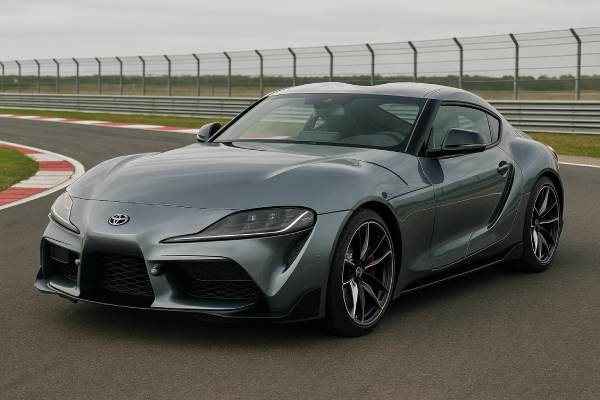
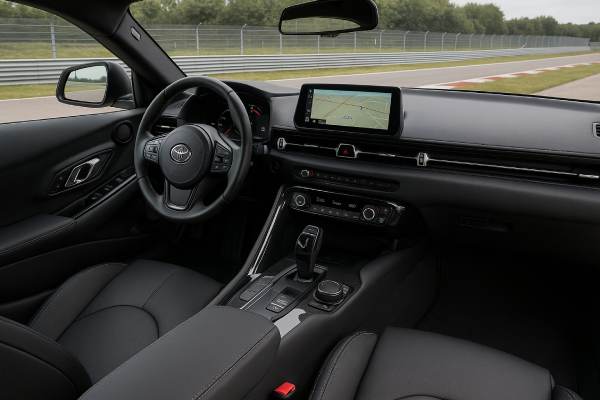
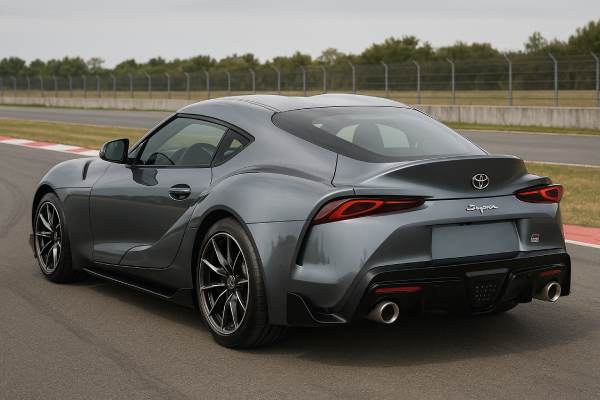
The 2.0-litre Toyota GR Supra (J29) with the B48B20 engine and 194 hp is the “lightweight” member of the fifth-generation Supra family. It blends BMW’s modern turbocharged four-cylinder technology with Toyota Gazoo Racing chassis tuning, delivering a car that feels agile and precise rather than brutally fast. In markets such as Japan, this 145 kW SZ variant sits below the more powerful 2.0 and 3.0 trims but keeps the same basic rear-drive layout, compact wheelbase and sophisticated suspension hardware.
For an owner or prospective buyer, the appeal is a combination of relatively low running costs, reduced front-end weight and a very capable, neutral chassis that rewards smooth inputs. At the same time, this is a complex, tightly packaged sports car sharing parts with BMW’s Z4, so understanding its service needs, known recalls and realistic reliability expectations is important if you want to enjoy it without surprises over a 10- to 15-year life.
Fast Facts
- Front-engine, rear-drive 2.0-litre turbo four with 194 hp and 320 Nm, tuned for quick mid-range response rather than headline power.
- Around 100 kg lighter than the 3.0-litre GR Supra, improving turn-in, balance and braking feel on tight roads and circuits.
- Toyota Safety Sense systems (AEB, lane assist, road-sign recognition) are standard in most markets despite the car’s pure two-seat layout.
- BMW-sourced B48 engine and ZF 8-speed automatic are generally robust but sensitive to oil quality and heat; hard-driven cars benefit from more frequent fluid changes.
- As a practical rule of thumb, change engine oil every 10,000 km or 12 months, even where longer intervals are allowed, especially if you track the car or drive it hard.
Explore the sections
- GR Supra 2.0 SZ overview
- GR Supra 2.0 technical specs
- GR Supra 2.0 trims and safety
- GR Supra 2.0 reliability issues
- GR Supra 2.0 maintenance guide
- GR Supra 2.0 driving performance
- GR Supra 2.0 rivals comparison
GR Supra 2.0 SZ overview
The 194 hp Toyota GR Supra 2.0 (often badged SZ in Japan) is the entry point to the fifth-generation Supra line, but it is not a “poverty” model. It shares the same J29 platform, double-joint MacPherson front suspension, multi-link rear suspension and 50:50 weight distribution target as the 3.0-litre cars. The crucial difference is the BMW-sourced B48B20 2.0-litre single-twin-scroll turbo four-cylinder, tuned here to 145 kW (194 hp) and 320 Nm. This lower output, combined with smaller wheels and simpler equipment, trims roughly 100 kg from the curb weight compared with the 3.0.
In practice that means a Supra that feels more playful and forgiving. With less mass over the front axle and a slightly narrower tyre package, the car rotates readily on tight roads and makes more of its chassis before the speeds become antisocial. You still get the same ZF 8-speed automatic gearbox, limited-slip differential available via option packs in many markets, and the signature long-bonnet fastback silhouette.
The 194 hp tune is mainly a Japan- and Asia-focused proposition; Europe and North America lean towards the higher-output 2.0 versions. However, from an engineering standpoint the 145 kW B48 is simply a different calibration of the same core engine. That makes parts support and future servicing relatively straightforward, because the B48 family is used widely in BMW and Toyota applications.
For ownership, the big picture is this: the 2.0 Supra gives you the styling and core dynamics of the GR-badged flagship with more approachable performance, slightly better fuel consumption and lower insurance in many regions. It is still a compact, low two-seat coupe with a firm ride and limited luggage space, so it works best as a focused daily driver or weekend car rather than a family workhorse.
GR Supra 2.0 technical specs
This section focuses on the 194 hp B48B20-powered GR Supra 2.0 SZ/J29. Figures can vary slightly by market and year.
Engine and performance
| Item | Specification |
|---|---|
| Engine code | BMW B48B20 (Toyota B48L designation in some markets) |
| Type | Inline-4, DOHC, 16 valves, aluminium block and head |
| Induction | Single twin-scroll turbocharger, intercooler |
| Displacement | 1,998 cc (2.0 l) |
| Bore × stroke | 82.0 mm × 94.6 mm |
| Compression ratio | ~10.2:1 (market-dependent mapping) |
| Max power | 145 kW (194 hp) @ 4,500–6,500 rpm |
| Max torque | 320 Nm (236 lb-ft) @ ~1,450–4,200 rpm |
| Fuel system | Direct injection, high-pressure pump (about 35 MPa) |
| Fuel type | Premium unleaded (typically RON 95–98) |
| Emissions standard | Euro 6 / equivalent regional standards |
| Official combined consumption | Around 6.0–7.5 l/100 km (31–39 mpg US, 37–47 mpg UK), depending on test cycle |
| Real-world highway (steady 120 km/h) | Typically 7.0–8.0 l/100 km (29–34 mpg US) if stock and driven sensibly |
| Timing drive | Chain, single-side timing module |
| Engine firing order | 1-3-4-2 |
Transmission and driveline
| Item | Specification |
|---|---|
| Transmission | ZF 8HP torque-converter automatic (8-speed) with paddle shifters |
| Gear ratios | Close-ratio lower gears, tall overdrive 7th and 8th (similar to BMW B48 applications) |
| Final drive ratio | ~3.46:1 (varies slightly by market/ECU tune) |
| Drive type | Rear-wheel drive (RWD) |
| Differential | Open differential standard; electronically controlled active/differential available in Sport or equivalent pack |
| Drive modes | Normal, Sport, plus separate Traction/VSC configurations |
Chassis, steering and brakes
| Item | Specification |
|---|---|
| Platform | Toyota–BMW joint sports car architecture (shared with BMW Z4 G29) |
| Front suspension | Double-joint type MacPherson strut, aluminium control arms, anti-roll bar |
| Rear suspension | Five-link independent, lightweight subframe, anti-roll bar |
| Adaptive dampers | Available via Sport pack in many markets; fixed-rate dampers otherwise |
| Steering | Electric power steering (rack-assist), variable weighting by drive mode |
| Front brakes | Ventilated discs with single-piston floating calipers (Brembo 4-piston with larger rotors in Sport pack) |
| Rear brakes | Ventilated discs with single-piston floating calipers |
| Parking brake | Electric, rear axle actuation |
Dimensions and weights
| Item | Specification |
|---|---|
| Body style | 2-door, 2-seat fastback coupe |
| Length | ~4,380 mm (172.4 in) |
| Width (excluding mirrors) | ~1,865 mm (73.4 in) |
| Height | ~1,290 mm (50.8 in) |
| Wheelbase | 2,470 mm (97.2 in) |
| Front/rear track | ~1,594 / 1,589 mm, depending on wheels |
| Ground clearance | About 115–120 mm (4.5–4.7 in) |
| Turning circle | ~10.4 m (34 ft) kerb-to-kerb |
| Kerb (curb) weight | Approx. 1,410–1,430 kg (3,108–3,153 lb), depending on spec |
| Fuel tank | ~52 l (13.7 US gal, 11.4 UK gal) |
| Cargo volume | Around 290 l (10.2 ft³), measured to roof |
Performance
| Item | Specification |
|---|---|
| 0–100 km/h (0–62 mph) | About 6.5 s in 194 hp tune |
| Top speed | Electronically limited ~250 km/h (155 mph) |
| 80–120 km/h (50–75 mph) | Roughly 4–5 s in kickdown, depending on mode |
| Braking 100–0 km/h | Typically low- to mid-30 m range on quality tyres, with healthy brakes |
Fluids, capacities and key torques (typical)
| Item | Specification (approximate) |
|---|---|
| Engine oil spec | 0W-20 or 5W-30 meeting BMW LL-17 FE+ / Toyota approvals, depending on climate |
| Engine oil capacity | ~5.0–5.5 l (5.3–5.8 US qt) including filter |
| Coolant | Long-life ethylene glycol HOAT; pre-mixed or 50:50 with demineralised water, ~7–8 l system capacity |
| ATF | ZF 8HP-spec fluid; changeable even if labelled “lifetime” |
| Differential oil | 75W-90 synthetic gear oil, ~1–1.2 l |
| Wheel bolt torque | Typically around 120 Nm (89 lb-ft); always confirm per manual |
| Spark plugs | Fine-wire iridium, gapped around 0.7–0.8 mm (0.028–0.031 in) |
Electrical and safety systems
| Item | Specification |
|---|---|
| Alternator | High-output alternator sized for modern loads (ballpark 150–180 A) |
| 12V battery | AGM battery in rear, capacity around 70–80 Ah, high CCA rating |
| Airbags | Front, side, curtain and knee airbags (market-dependent count) |
| Stability systems | ABS, EBD, Brake Assist, VSC, Traction Control, Hill-start Assist, Active Cornering Assist |
| Driver assistance | Pre-Collision System with pedestrian/cyclist detection, Lane Keep Assist / Lane Departure Alert, Road Sign Assist, Intelligent Speed Assist; Blind-Spot Monitoring and Rear Cross-Traffic Alert via option packs in many markets |
| Crash test data | As of 2025 the GR Supra itself has not been tested by Euro NCAP; safety expectations are partly inferred from the related BMW Z4 and Toyota’s own internal testing rather than public star ratings. |
GR Supra 2.0 trims and safety
Because this 194 hp tune is targeted mainly at Japan and selected Asian markets, the trim structure looks a little different from European “Live/Connect/Premium/Sport pack” naming, but the underlying equipment logic is similar.
In Japan, the SZ is the entry 2.0 model. It usually comes with 17-inch or simpler 18-inch wheels, fabric or Alcantara upholstery, manual seat adjustment and a more basic audio system. Even at this level you still get the core mechanical package: B48B20 with 194 hp, ZF 8-speed automatic, rear-wheel drive and the same basic suspension geometry. There is no manual gearbox option for the 2.0 as of the 2019–2024 period, in contrast with the later 3.0-litre models that gained a 6-speed manual.
Above it in Japan sits the SZ-R, with the more powerful 258 hp tune of the same engine. In Europe, Toyota usually references the power level (258 hp) rather than SZ/SZ-R branding, and many cars there mirror the SZ-R’s higher equipment grade: 18-inch or 19-inch wheels, power seats, JBL audio, head-up display and the optional Sport pack combining adaptive dampers, active differential and larger Brembo brakes. While this article focuses on the 194 hp version, it is helpful to recognise that many interior and options discussions also apply to the 258 hp 2.0.
From a safety and driver-assistance perspective, the 2.0 Supra is surprisingly well equipped for a two-seat sports coupe. Standard Toyota Safety Sense-type systems commonly include:
- Pre-Collision System with autonomous emergency braking and pedestrian/cyclist detection.
- Lane Keep Assist or Lane Departure Alert with steering assist.
- Road Sign Assist and an intelligent speed limiter linked to sign recognition in some markets.
- Adaptive cruise control or at least dynamic radar cruise in many regions.
Blind-Spot Monitoring, Rear Cross-Traffic Alert, parking sensors and parking camera systems are often bundled in higher trims or option packs. For track-oriented drivers, note that more aggressive alignment settings or very low ride heights can require re-calibration of lane and radar sensors after geometry changes.
Because the GR Supra has not yet been independently crash-tested by Euro NCAP or IIHS, there is no public star rating or Top Safety Pick status to quote. In practice, owners benefit from a modern crash structure, multi-airbag setup and the strength of a relatively compact cabin cell, but you should not assume the same passive safety as a larger saloon or SUV. The related BMW Z4 achieved strong Euro NCAP scores, which offers some indirect reassurance, yet the Supra’s fixed-roof body and slightly different crash kinematics mean the result would not necessarily be identical.
GR Supra 2.0 reliability issues
The GR Supra’s mechanical core is built from components with a lot of field history: the BMW B48 four-cylinder, the ZF 8HP automatic and the Toyota-tuned chassis. Overall reliability for the 194 hp 2.0 has been good so far, but there are some patterns worth highlighting.
Engine and fuel system
The B48 family is generally robust if kept on quality oil and fuel. Most reported issues on Supra and BMW platforms centre around:
- High-pressure fuel system and injectors – occasional rough running, misfires or hard starting at higher mileages. Symptoms usually show up as a check-engine light and stored fuel-trim or misfire codes. Proper diagnosis and, if necessary, injector or pump replacement solves it.
- Oil leaks – less common than on older BMW engines, but cam cover and front timing cover seals can mist with age and heat, especially on track-driven cars. Catching these early keeps them cheap to fix.
- Thermal load – repeated track use without enough cooldown laps can push coolant and oil temperatures high. The system is well designed, but frequent high-heat cycles accelerate ageing of plastics, hoses and turbo components.
Driveline and chassis
The ZF 8HP gearbox itself is known for high durability, but “lifetime fill” is not ideal if you keep the car long-term. Harsh shifts, flaring or delayed engagement are often improved or prevented by fluid and filter changes around 80,000–100,000 km.
Suspension wear is typical of a stiffly sprung sports car: front lower arm bushes, rear toe links and drop links can show play or noise after repeated hard use. None of this is exotic or unusually expensive, but the parts are more costly than on a Corolla because of the performance-car hardware.
Wheel bearings seem to hold up well under normal use, though frequent track days on sticky tyres can accelerate wear; listen for rumbling that changes with load as a sign of trouble.
Body, electronics and trim
The Supra’s cabin borrows heavily from BMW’s iDrive ecosystem, which is mature and stable. Common owner complaints tend to be minor:
- Occasional infotainment glitches that are usually resolved with software updates.
- Sensor warnings (parking sensors, tyre-pressure monitoring) after wheel changes or alignment work, usually solved by proper re-initialisation.
- Water ingress into rear light clusters or condensation, particularly in harsh climates, which may require resealing or replacement units.
Recalls and service actions
GR Supra models, including the 2.0, have been involved in a few key recalls over the 2019–2024 period. Highlights include:
- Seat belt guide welds on early cars, where BMW (as the manufacturer) and Toyota arranged inspection and, in some cases, vehicle replacement or structural repair.
- Fuel tank weld quality on certain 2020–2021 cars, requiring tank replacement to eliminate leak and fire risk.
- Engine starter relay fire-risk recalls affecting BMW B48-equipped vehicles, including some Supras, where owners are advised to park outside until the relay is replaced.
These are handled free of charge, but they underscore the importance of running a VIN check through Toyota’s recall system or your local distributor before buying and periodically during ownership.
In broad terms, if you treat the 2.0 Supra like the precision machine it is — warm it properly, keep fluids fresh, avoid cheap tuning shortcuts and respect the cooling limitations on track — you can expect solid reliability with most costs tied to consumables and normal wear rather than catastrophic failures.
GR Supra 2.0 maintenance guide
Because the GR Supra 2.0 combines a highly stressed turbo engine with performance-car suspension and electronics, a proactive maintenance mindset pays off. Manufacturer schedules vary by market, but the following is a practical baseline for 2019–2024 cars, especially if you care about long-term durability.
Core service intervals (typical, or more conservative than official)
- Engine oil and filter: every 10,000 km or 12 months (whichever comes first). Shorten to 7,500 km if you track the car regularly or drive in very hot climates.
- Engine air filter: inspect at 20,000 km, replace by 40,000 km, sooner in dusty areas.
- Cabin filter: every 20,000–30,000 km or 2 years to keep HVAC efficiency and prevent odours.
- Spark plugs: every 60,000–80,000 km; track cars may need them sooner. Always use the correct fine-wire iridium type.
- Coolant: long-life coolant typically lasts 8–10 years from factory fill, then every 5 years thereafter. Track-focused cars benefit from shorter intervals.
- ATF (ZF 8HP): change fluid and pan/filter every 80,000–100,000 km, even if the official schedule says “lifetime.”
- Differential oil: every 60,000–80,000 km; more often if you use an active diff and track the car.
- Brake fluid: every 2 years regardless of mileage; annually for heavy track use using a high-temperature DOT 4 fluid.
- Brake pads and rotors: inspect at least annually; high-performance driving can wear the front pads surprisingly quickly.
- Tyre rotation and alignment: rotation is limited by staggered tyres, but a full alignment check every 20,000–30,000 km, or after any serious pothole/kerb strike, is sensible.
- Auxiliary belts and hoses: inspect at each service, replace around 100,000–120,000 km or earlier if cracked or glazed.
- 12 V battery: load-test from around year 4 annually; replace at first signs of weakness to avoid electronic gremlins.
Timing chain and internal engine components
Unlike belt-driven engines, the B48 uses a chain designed for life of the engine. There is no fixed replacement interval, but you should:
- Listen for cold-start rattles or chain “whirring” that persists when warm.
- Scan for timing correlation codes if misfires or rough running appear.
If any of these show up, chain, guides and tensioner inspection is recommended; preventative replacement is cheaper than repairing internal damage if the chain slips.
Fluids and specs to note
- Stick to oils that meet BMW LL-17 FE+ or the Toyota-specified equivalent to maintain protection and emissions control.
- Use the correct coolant type; mixing random coolants can cause silicate drop-out and internal corrosion.
- For braking, choose DOT 4 fluids with clear dry/wet boiling point data if you ever go on track; generic DOT 4 may not cope with repeated high-speed stops.
Buyer’s guide checklist
When assessing a used GR Supra 2.0:
- Service history: look for documented annual oil changes, not just long-interval maintenance. Verify ATF, diff and brake fluid services on cars over 60,000 km.
- Recall completion: run the VIN through Toyota’s official recall checker and ask the seller for dealer printouts. Confirm fuel tank and seat belt-related campaigns are complete where applicable.
- Signs of tuning: aftermarket downpipes, ECUs or piggyback modules can stress the B48 and emissions systems. If you want a long-term keeper, stock or lightly modified cars are safer bets.
- Track use clues: uneven tyre wear, heat-stained brakes, stone-chipped rear arches and a strong burnt-pad smell can indicate hard circuit work. A well-maintained track car can still be fine, but budget accordingly.
- Corrosion and body checks: inspect undertrays, rear subframe mounts and exhaust hangers, especially in salted-road climates. The aluminium panels resist rust, but steel components and fasteners do not.
- Interior and electronics: ensure iDrive-style infotainment responds cleanly, parking sensors and cameras work, and no permanent dash warnings are present.
If you find a car with clean history, complete recalls and evidence of attentive maintenance, the 2.0 Supra is very capable of high-mileage service without major surprises.
GR Supra 2.0 driving performance
On the road, the 194 hp GR Supra feels more “balanced momentum car” than overwhelming straight-line monster. With 320 Nm available from relatively low revs, it pulls strongly out of tight corners and overtakes confidently in the mid-range, but it never feels brutally fast the way the 3.0-litre variant does. For many drivers, that is an advantage: you can explore more of the chassis on public roads without constantly brushing licence-losing speeds.
Engine character and gearbox behaviour
The B48B20 starts quietly and idles smoothly, with a clean, modern four-cylinder thrum that becomes more purposeful in Sport mode. Throttle response is crisp, helped by the single twin-scroll turbo and relatively low inertia. In the 194 hp calibration the tune is conservative, prioritising mid-range torque and reliability over peak numbers. With the standard exhaust, noise levels are modest; aftermarket systems can add drama but may increase drone.
The ZF 8HP automatic is a major strength. In Normal mode it shifts early and unobtrusively, keeping revs low and fuel consumption reasonable. Flick into Sport and the calibration holds gears longer, downshifts more assertively and responds well to paddle inputs. On twisty roads you can leave it in Sport and let it work, or use manual mode to keep the engine in its torque band between 3,000 and 5,500 rpm where it feels most energetic.
Ride, handling and brakes
Compared to the 3.0-litre Supra, the 2.0 is lighter over the nose and often runs slightly narrower tyres, which makes it feel more eager to turn. Initial steering response is quick and accurate, with decent weight and a natural self-centring feel. You can sense the development work done at the Nürburgring and on European roads: the car settles well in medium- and high-speed corners, resists roll and feels planted over crests so long as the road is reasonably smooth.
Ride quality is on the firm side, especially on poor urban surfaces, but the fixed-damper SZ tune is still usable for daily driving. Cars with adaptive suspension broaden the bandwidth: Normal mode remains firm but more compliant, while Sport tightens body control for track or very fast road work.
Braking performance is strong and easy to modulate. The standard system is more than adequate for spirited road use. The optional sports brakes with larger Brembo front calipers and rotors offer higher thermal capacity for repeated hard stops, important for long sessions on track where the lighter 2.0 invites you to carry speed.
Noise, vibration and comfort
At highway speeds, wind noise is modest and road roar depends heavily on tyre choice. Touring-oriented tyres make the car liveable on rough asphalt; aggressive track compound tyres amplify noise and tramlining. Engine noise at cruise is subdued thanks to tall gearing: at 120 km/h in 8th gear the engine spins at relatively low rpm, which also helps fuel economy.
Cabin ergonomics are very BMW-like, with a driver-focused dash, clear instruments and supportive seats. Taller drivers generally fit well, though helmet clearance on track days can be tight. Visibility is acceptable for a coupe but rear three-quarter views are limited; the optional parking sensors and camera ease daily manoeuvring.
Real-world economy and range
In mixed driving, owners typically see:
- City: 9–11 l/100 km (21–26 mpg US) depending on traffic and climate.
- Highway (100–120 km/h): 6.5–8.0 l/100 km (29–36 mpg US) if you resist constant boosts.
- Mixed: 7.5–9.0 l/100 km (26–31 mpg US) for a stock car on standard tyres.
On a calm highway run, the 52-litre tank can yield 600–700 km (370–435 miles) between fills. Hard mountain driving or track days can easily double consumption; planning fuel stops is wise on remote routes.
GR Supra 2.0 rivals comparison
The 194 hp GR Supra 2.0 sits in an unusual niche: a rear-drive, two-seat coupe with premium hardware but modest headline power. Its closest competitors vary by market, but cross-shopping usually includes:
- BMW Z4 sDrive20i / sDrive30i (and sometimes the M40i).
- Porsche 718 Cayman (base and T).
- Alpine A110 in Europe.
- Nissan Z, Ford Mustang EcoBoost and similar coupes in some markets.
Versus BMW Z4 four-cylinder models
Mechanically, the Supra and Z4 share much: platform, engines, transmissions and a lot of electronics. The Supra 2.0, however, locks you into a coupe body and more focused chassis tuning, while the Z4 emphasises open-top cruising with its soft top and slightly softer calibration. The Z4 tends to offer more comfort-oriented options and a more relaxed ride; the Supra rewards drivers who prioritise steering feel and track days over top-down motoring. If you want a more practical interior and better roof-down visibility, the Z4 20i or 30i may suit better. If you want a hard-edged, single-purpose sports car, the Supra feels more special.
Versus Porsche 718 Cayman
The 718 Cayman is benchmark-sharp in steering feel, brake consistency and mid-engine balance. Even the base 2.0-litre Porsche offers very high chassis limits and a more “pure” sports-car feel. However, it is usually more expensive to buy and run, and many options that are standard or cheap on the Supra are extra on the Cayman. For track-day addicts chasing lap times and steering purity, a well-specced Cayman is hard to beat. For owners who value a distinctive look, a strong warranty package and a more comfortable driving position for daily use, the Supra 2.0 makes a strong case.
Versus Alpine A110
In markets where the Alpine A110 is available, it is an ultra-light, mid-engine alternative. The A110 feels more delicately balanced and more “old-school” in its interaction, but it is also more fragile in perception and has a smaller dealer network. The Supra is heavier and less exotic, yet more robust and easier to service globally.
Versus turbo four-cylinder muscle coupes (Mustang EcoBoost, etc.)
Cars like the Ford Mustang EcoBoost offer similar or greater power in a larger, more practical package, with small rear seats and bigger boots. They also have strong aftermarket support and a different character: more relaxed grand tourers with a muscle-car vibe. The Supra 2.0 counters with a much tighter footprint, sharper steering and a more premium cabin finish. If you regularly carry passengers or luggage, the Mustang or similar may win. If your priority is precision on a back road and compact size for city use, the Supra fits better.
Overall, the Toyota GR Supra 2.0 with the B48B20 194 hp engine stands out as a driver-focused coupe with modern safety systems, strong everyday performance and a chassis that rewards skill. It may not have the straight-line fireworks of its six-cylinder sibling, but for many owners, its blend of balance, manageable running costs and unique styling make it the sweet spot of the range.
References
- Toyota Rolls Out New Supra 2019 (Newsroom Overview)
- 2020 Toyota GR Supra 2.0L 2020 (Technical and Equipment Data)
- 2020 Supra – manuals & warranties 2020 (Owner’s Manual Portal)
- Look up Safety Recalls & Service Campaigns by VIN 2025 (Recall Database)
- Important BMW Park Outside Recall for Fire Risk 2025 (Safety Recall Notice Covering Supra)
Disclaimer
This article is for informational purposes only and is not a substitute for professional diagnosis, repair or official service literature. Specifications, torque values, maintenance intervals and procedures can vary by VIN, model year, market and option package. Always confirm critical data against your vehicle’s official owner’s manual, workshop manual and technical service bulletins, and consult a qualified technician before performing repairs or modifications.
If you found this guide helpful, consider sharing it with fellow enthusiasts or prospective buyers on platforms such as Facebook or X (Twitter). It helps other owners make better decisions and supports the creation of more in-depth technical content.