
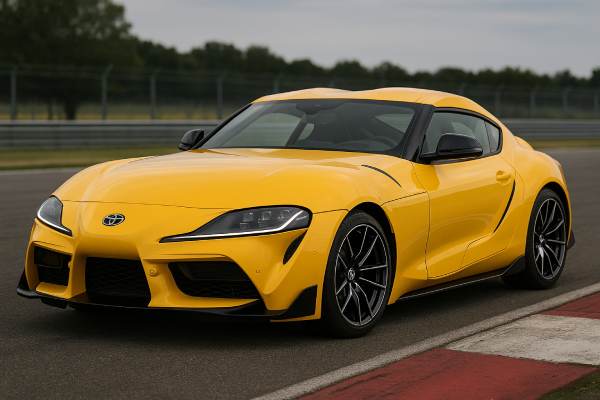
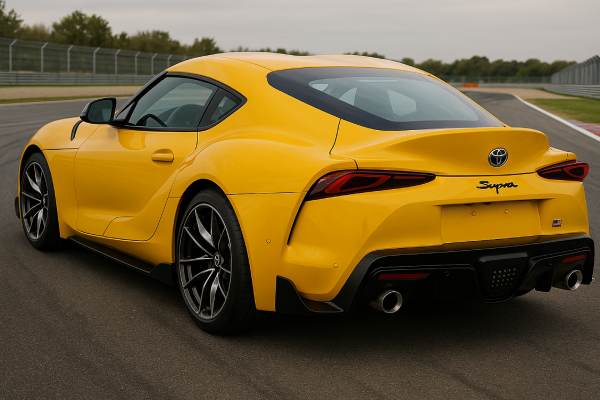
The 3.0-litre Toyota GR Supra with the B58B30O1 engine marks the point where the reborn Supra fully steps into modern performance territory. Developed in partnership with BMW but tuned by Toyota Gazoo Racing, this 382 hp straight-six coupe blends everyday usability with serious pace and a surprisingly polished ride. Key changes versus the launch-year 335 hp model include higher boost, revised engine programming, and chassis tweaks that make the car sharper yet more composed.
For owners and shoppers, the 3.0 382 hp Supra sits in a sweet spot: it is fast enough to challenge traditional sports cars, but still manageable in traffic, on long highway trips, and on tight city streets. Running costs are in line with other premium turbo sixes, and the underlying B58 family has built a reputation for strong reliability when serviced on time. This guide focuses on the 2020–2026 3.0-litre, 382 hp GR Supra in global markets, with practical detail for day-to-day ownership and long-term planning.
Fast Facts
- 3.0-litre B58B30O1 turbocharged inline-six with around 382 hp and 500 Nm gives 0–100 km/h in the low-4-second range with launch control.
- Balanced chassis with active differential, adaptive suspension, and Michelin performance tyres makes the car both agile and stable at high speed.
- Shared BMW/Toyota hardware means generally robust mechanicals, but electronics, sensors, and cooling components demand diligent maintenance.
- Typical engine oil change interval is 10,000–15,000 km or 12 months, but many enthusiasts prefer 7,500–10,000 km for long-term durability.
Section overview
- GR Supra 3.0 382 hp overview
- Engine specs and dimensions
- Trims, equipment and safety tech
- Reliability and common issues
- Maintenance and buying advice
- Driving experience and performance
- How the GR Supra compares to rivals
GR Supra 3.0 382 hp overview
When Toyota updated the GR Supra’s 3.0-litre engine to 382 hp, it addressed early criticism that the car was quick but not quite class-leading. The B58B30O1 engine sits in a compact, stiff J29 chassis (shared with the BMW G29 Z4), driving the rear wheels through an 8-speed ZF automatic, with a 6-speed manual added later in the lifecycle for enthusiasts.
Power is routed through an electronically controlled active rear differential, allowing the car to transition smoothly from secure grip to playful oversteer depending on drive mode and throttle input. Adaptive dampers further tailor the car’s character, softening the ride in Comfort and firming things up in Sport and Sport+. The result is a coupe that feels serious on a track but is still livable on uneven roads.
From a product-planning perspective, the 382 hp Supra bridges a gap: it is more focused than a hot hatch or warm coupe, yet less extreme than full-fat track specials. Its rivals include the BMW M240i, Porsche 718 Cayman S/GTS, Nissan Z, and high-spec versions of the Ford Mustang and Chevrolet Camaro in some markets.
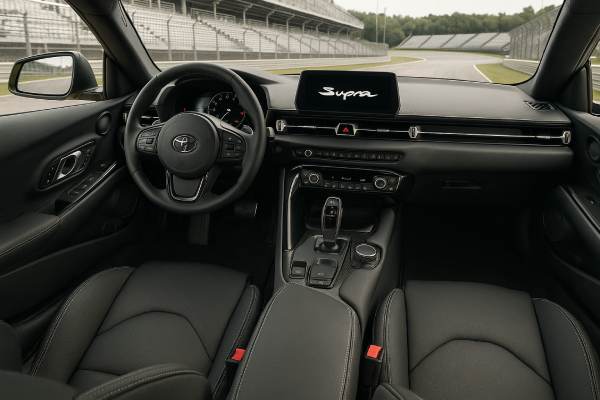
The cabin reflects the car’s mixed parentage. Much of the infotainment, switchgear, and UI come directly from BMW, which means intuitive controls and solid ergonomics, but also a visual language that feels more Bavarian than Toyota. Build quality is generally very good, with tight panel gaps and robust materials in high-touch areas, though some hard plastics remain in lower sections.
Practicality is better than the coupe profile suggests. Two occupants have ample head and legroom, even for taller drivers, thanks to low-mounted seats and a long bonnet that pushes the dash forward. The hatchback cargo area can handle weekend bags, folded camera gear, or a compact set of track wheels and tools if you pack smartly. Noise levels at highway speeds are acceptable for a sports car, with some tyre roar from the wide rear rubber.
For 2020–2026, Toyota has refined the Supra incrementally: software updates, special editions, suspension tuning revisions, and minor equipment changes. The core mechanical package, however, remains consistent: turbocharged straight-six, rear-wheel drive, and a tight, two-seat body designed more for engagement than everyday family work. That simplicity is part of its appeal.
Engine specs and dimensions
Engine and performance
| Item | Specification |
|---|---|
| Engine code | B58B30O1 |
| Type | Turbocharged inline 6, DOHC, 24 valves |
| Displacement | 2,997–2,998 cc (3.0 l) |
| Bore × stroke | 82.0 × 94.6 mm |
| Compression ratio | ~11.0:1 |
| Induction | Single twin-scroll turbocharger, intercooler integrated into intake manifold |
| Fuel system | Direct injection (high-pressure) |
| Max output (typical higher-spec markets) | ~382 hp (285 kW) @ ~5,800 rpm |
| Max power (Toyota data, PS) | 387 PS (285 kW) @ 5,800 rpm |
| Max torque | 500 Nm (approx. 369 lb-ft) @ 1,800–5,000 rpm |
| Emissions standard | Euro 6 / equivalent, depending on market |
Toyota Gazoo Racing’s own data lists the partially upgraded Supra RZ (B58B30O1) at 285 kW and 500 Nm, with WLTC fuel consumption around 11.1–12.2 km/l depending on transmission. Power figures in North America are typically quoted as 382 hp SAE. The engine uses a closed-deck aluminum block, integrated charge-cooler, and BMW’s Valvetronic and dual-VANOS variable timing systems.
In practical terms, this translates into a very broad torque plateau and strong mid-range thrust. The car feels responsive from as low as 1,500 rpm, with a noticeable but modest surge as boost builds. Unlike older turbo sixes, there is very little classic “lag” in everyday driving.
Transmission and driveline
| Item | Specification |
|---|---|
| Transmission | 8-speed torque-converter automatic (ZF 8HP); 6-speed manual on later years/markets |
| Drive type | Rear-wheel drive (RWD) only |
| Final drive ratio | Approx. 3.15–3.46 (varies slightly by market/year) |
| Differential | Electronically controlled active rear differential |
| Launch control | Yes (on auto models; manual availability varies by market) |
The 8-speed automatic is a familiar ZF unit used in many performance cars. In the Supra it offers quick, decisive shifts in Sport mode, with smooth behavior in daily driving. The later-introduced 6-speed manual changes the character of the car significantly: ratios are shorter, and the clutch take-up requires more attention but adds involvement for track and back-road use.
Chassis and dimensions
| Item | Specification |
|---|---|
| Platform | J29 / BMW CLAR-based sports-car platform |
| Length | ~4,380 mm |
| Width | ~1,865 mm |
| Height | ~1,295 mm |
| Wheelbase | 2,470 mm |
| Front / rear track | ~1,595 / 1,590 mm |
| Curb weight | ~1,520 kg (manual) / ~1,530 kg (automatic), market-dependent |
| Seating | 2 seats |
| Fuel tank | 52 l |
| Suspension (front) | MacPherson strut, coil springs, adaptive dampers |
| Suspension (rear) | Multilink, coil springs, adaptive dampers |
| Brakes (front) | 4-pot Brembo calipers, ~348–374 mm ventilated discs (market-spec) |
| Brakes (rear) | Single-piston calipers, ~345 mm ventilated discs |
| Wheels/tyres (typical) | 19-inch forged alloys; 255/35ZR19 front, 275/35ZR19 rear Michelin Pilot Super Sport or equivalent |
The short wheelbase and wide tracks contribute to a planted stance and very quick turn-in. The adaptive dampers do a lot of work here: in Comfort they take the edge off sharp bumps, while Sport modes keep body movement tightly controlled on track and fast roads.
Performance and capability
Approximate performance for the 382 hp GR Supra (automatic) in typical independent tests:
- 0–100 km/h (0–62 mph): ~4.1–4.3 seconds
- 0–60 mph: often quoted at around 3.9–4.0 seconds with launch control
- Top speed: electronically limited to about 250 km/h (155 mph)
Real-world braking performance is strong, with repeated high-speed stops possible before noticeable fade if the brakes are in good condition. For track days, performance brake pads and high-temp fluid are sensible upgrades.
Fluids, service capacities and key specs (typical values)
Always confirm against market-specific service data for your VIN.
- Engine oil:
- Spec: BMW Longlife-01/04 or equivalent high-quality 0W-30 / 5W-30 fully synthetic
- Capacity: ~6.5–7.0 l including filter
- Coolant:
- Spec: BMW/Toyota HOAT or equivalent; mixed 50:50 with distilled water
- Automatic transmission:
- Fluid: ZF-approved ATF (e.g., Lifeguard 8); “lifetime fill” in factory literature, but many owners service at 60,000–80,000 km
- Manual transmission:
- Fluid: BMW/Toyota specified MTF; often changed around 60,000–80,000 km in enthusiast use
- Differential:
- Fluid: Hypoid gear oil with friction modifiers as specified for active diff; change around 60,000–80,000 km if driven hard
Electrical system:
- Alternator output: ~170–190 A depending on market
- 12 V battery: AGM type, typically ~70–80 Ah; coding/registration needed when replaced
Trims, equipment and safety tech
Trims and options
Trim structures vary by market, but common themes emerge:
- Base / GR Supra 3.0 (382 hp)
- Core engine and chassis hardware
- Adaptive suspension, active differential, 19-inch wheels
- Dual-zone climate control, keyless entry/start
- BMW-based infotainment with rotary controller and screen in the 8.8–10.25-inch range
- Premium / RZ / Pro-style grades
- Upgraded audio (e.g., JBL 12-speaker in some markets)
- Leather or Alcantara upholstery with contrasting stitching
- Head-up display, wireless charging, larger infotainment screen
- Additional driver-assist features (front/rear parking sensors, more camera views)
- Special editions (market-dependent)
- Unique paint (matte, heritage colors)
- Distinct wheels and interior trims
- Sometimes minor suspension or steering calibrations, but no major mechanical change from the 382 hp spec
Visually, higher trims can be identified by interior materials (leather seats, additional stitching, carbon-look accents), wheel designs, and sometimes badging. VIN decoders and build sheets from Toyota dealers can reveal exact packages, including whether the car has optional safety packs or upgraded audio.
Safety equipment
All 382 hp GR Supras share a robust passive-safety base:
- Front, side, and curtain airbags (two-seat coverage)
- Strong passenger cell with multi-load path front and rear structures
- Standard stability and traction control, ABS with electronic brake-force distribution, brake assist
- Tyre-pressure monitoring, ISOFIX/LATCH anchors on the rear bulkhead for compatible child seats (check local rules and car’s manual)
Because the platform is closely related to the BMW Z4, it benefits from BMW’s modern safety engineering, though the Supra itself has not always been tested separately by Euro NCAP or IIHS. In many markets, there is no standalone official crash-test score published for Supra; buyers often look at the Z4’s data for a rough indication while acknowledging structural and equipment differences.
Driver-assistance systems (ADAS)
Availability depends on model year and region, but typical ADAS features include:
- Pre-collision system with pedestrian detection (forward AEB)
- Lane departure warning with steering assist
- Adaptive cruise control (often radar-based, sometimes only on automatic models)
- Road sign assist (traffic sign recognition)
- Blind-spot monitoring and rear cross-traffic alert (common in higher trims)
- Parking sensors front and rear, reversing camera, and sometimes a 360° camera view
In some markets, early cars were relatively light on ADAS compared with newer Toyota models. Later years tend to add or refine systems through hardware updates and software tuning. After body or glass repairs, radar and camera systems may require calibration; a Toyota or BMW-capable specialist should perform this, as incorrect calibration can lead to false warnings or reduced assistance effectiveness.
Safety ratings and real-world protection
Because official ratings are limited, the best indicators of safety are:
- Shared crash structures and restraint technologies with modern BMW platforms
- Robust standard ADAS on later cars
- Owner reports suggesting good protection in real-world high-speed crashes (where data exists)
For a two-seat sports coupe, the Supra provides a high level of passive and active protection, but it will never match the practicality or crash redundancy of a larger sedan or SUV. Drivers should view ADAS as support, not a substitute for attention and smooth driving.
Reliability and common issues
The 382 hp GR Supra benefits from the BMW B58 engine family’s generally strong reputation. Compared with older turbo sixes like the N54 and N55, the B58 is more robust in both design and materials. That said, no performance car is issue-free, and the Supra adds its own Toyota-specific body, electronics, and calibration layers.
Below is a structured look at common patterns as these cars age.
Engine and cooling
Common or occasional issues:
- Coolant level drops (occasional)
- Symptoms: Low coolant warnings, gradual loss without obvious puddles.
- Likely causes: Expansion tank cap issues, minor seepage at hose connections or plastic fittings.
- Remedy: Pressure test the system, check for staining around joints, replace expansion cap if weak, repair leaks promptly to avoid overheating.
- Oil seeping from gaskets (occasional, with mileage)
- Symptoms: Light oil misting around valve cover or oil filter housing area, faint burning smell.
- Likely causes: Age-related hardening of gaskets and seals.
- Remedy: Replace affected gaskets; use correct torque and pattern.
- High intake temperatures on track (common under hard use)
- Symptoms: Power fades after several hot laps, ECU pulls timing.
- Likely causes: Heat-soak in integrated intercooler and cooling system.
- Remedy: Cool-down laps, upgraded radiators or auxiliary coolers for frequent track work, fresh coolant, and correct bleeding.
Timing chain issues that plagued some previous BMW engines are less common on the B58, but chain condition should still be monitored at high mileage via noise checks and scan tools for timing correlation errors.
Fuel and induction
- High-pressure fuel pump wear (occasional at high mileage or tuned cars)
- Symptoms: Long cranking, misfires under load, fuel-pressure codes.
- Remedy: Diagnose with fuel-pressure logs; replace pump if out of spec.
- Carbon build-up on intake valves (long-term, direct-injection trait)
- Symptoms: Rough idle, loss of low-rpm smoothness, misfires.
- Remedy: Walnut-shell blasting of intake valves around 100,000–150,000 km if symptoms appear; fuel system cleaners mostly help injectors, not valves.
Driveline and chassis
- ZF 8HP automatic (generally robust)
- Potential issues: Harsh or delayed shifts if fluid is degraded, or if adaptation data is confused by frequent tuning changes.
- Mitigation: Fluid and filter service around 60,000–80,000 km for hard use; correct adaptation resets using proper tools.
- Active differential (occasional noise or fault codes)
- Symptoms: Clunking, binding sensation at low speed, diff-related warnings.
- Remedy: Check fluid, scan for codes, inspect harness and actuators; dealer software updates can resolve some calibration faults.
- Suspension wear (expected with age and track days)
- Common items: Front lower control-arm bushings, rear toe links, and damper wear.
- Remedy: Regular inspection, replacement with OE or higher-spec components if you track the car.
Electronics and software
Because of the BMW-based electronics, the Supra may exhibit:
- Occasional sensor or module faults (oxygen sensors, NOx sensors where fitted, parking sensors)
- Infotainment glitches resolved by software updates or module resets
- Instrument cluster or head-unit quirks after low battery voltage events
Toyota and BMW periodically release software updates that address drivability, emissions, and ADAS behavior. A reflash is sometimes the official fix for hesitation, odd shift logic, or false sensor flags.
Recalls and campaigns
Specific recall campaigns vary by region and model year, but examples include:
- ECU or safety-system software updates for issues like incorrect diagnostic behavior or stability-control logic
- Seatbelt or seat mount inspections on early cars where anchor or guide components might not meet specification
- Fuel system or wiring harness checks in limited VIN ranges
Owners should always:
- Run their VIN through their local Toyota recall/check portal.
- Check national databases (such as government safety sites) for open safety campaigns.
- Ask the dealer for a printout of completed and outstanding campaigns during pre-purchase inspections.
Overall reliability so far has been good for a high-output turbo engine, provided servicing is timely and modifications are done professionally.
Maintenance and buying advice
Practical maintenance schedule (typical guidance)
Always confirm against your market’s official maintenance schedule, but a sensible baseline for the 382 hp GR Supra is:
- Engine oil and filter:
- Every 10,000–15,000 km or 12 months in normal use.
- Every 7,500–10,000 km or annually for hard use or frequent short trips.
- Engine air filter:
- Inspect every 15,000 km; replace every 30,000–45,000 km or sooner in dusty conditions.
- Cabin (pollen) filter:
- Replace every 20,000–30,000 km or 2 years.
- Coolant:
- First change around 5 years or 100,000 km, then every 3–5 years depending on climate and coolant type.
- Spark plugs:
- Every 60,000–80,000 km, more often on tuned engines or heavy track use.
- Fuel filter:
- Integrated in-tank on many modern systems; typically not a regular service item unless there are issues.
- Brake fluid:
- Every 2 years or annually for track use.
- Brake pads and rotors:
- Inspect every 10,000–15,000 km; track cars may need pads as often as each event or every few events.
- Automatic transmission fluid:
- Service around 60,000–80,000 km in enthusiast use, even if labelled “lifetime”.
- Manual transmission fluid:
- 60,000–80,000 km; more frequent if shifting feels notchy.
- Differential fluid:
- 60,000–80,000 km, or sooner if the car sees drift/track sessions.
- Serpentine/aux belts and hoses:
- Inspect from 60,000 km onwards; replace around 100,000–120,000 km or at signs of wear.
- Alignment and tyre rotation:
- Check alignment annually or after impacts; tyres are staggered, so rotation is mostly front-to-rear swap only if you have a square setup for track use.
- 12 V battery:
- Test annually after 4–5 years; replace proactively around 5–7 years.
Enthusiast owners often go beyond the factory schedule, especially for oil, differential, and transmission fluids, to preserve long-term health and keep the car feeling crisp.
Fluids and torque values (examples)
Confirm these for your exact market and VIN:
- Wheel bolts: typically ~120 Nm (89 lb-ft)
- Engine drain plug: often ~25–30 Nm (18–22 lb-ft), with new washer
- Spark plugs: ~23–30 Nm (17–22 lb-ft), following manufacturer spec
Use a high-quality torque wrench for suspension and brake fasteners, and consult factory procedures whenever removing critical components such as control arms, steering racks, or subframes.
Buyer’s guide: what to look for
When shopping for a used 382 hp GR Supra:
- Service history
- Look for documented oil changes at least annually or at sensible mileages.
- Confirm brake fluid and coolant changes; many cars are under-driven and miss time-based services.
- Recalls and campaigns
- Ask for a dealer printout showing completed recalls and software updates.
- Avoid cars with outstanding safety campaigns unless the seller agrees to rectify them.
- Signs of tuning or track abuse
- Extra wiring to the ECU, aftermarket intakes or downpipes, non-OEM exhaust, or visible reflashing tools.
- Heavy tyre wear at the outer shoulders, blued or cracked brake discs, or multiple sets of mismatched tyres suggest regular track use.
- Body and chassis checks
- Inspect panel gaps, overspray, and uneven paint as hints of crash repair.
- Check underside for damaged floorpans, crushed jacking points, or bent suspension arms.
- Interior and electronics
- Ensure infotainment, cameras, and all ADAS systems operate as expected.
- Test keyless entry, seat adjustments, and steering controls.
- Test drive impressions
- Engine should start quickly, idle smoothly, and pull strongly without flat spots.
- Transmission shifts should be clean and decisive; no clunks from the diff on light throttle transitions.
- Listen for knocks over bumps or vibration through the steering, indicating suspension wear or wheel imbalance.
Long-term outlook
With sensible maintenance and moderation on tuning, the 382 hp GR Supra should offer a long service life comparable to other modern BMW/Toyota performance cars. The B58’s design gives it a solid foundation: closed-deck block, robust internals, and conservative factory power output relative to its tuning headroom. Body and interior materials also hold up well if cared for, though UV-exposed plastics and leather still need conditioning over time.
Driving experience and performance
Ride, handling and NVH
On the road, the GR Supra feels compact, dense, and planted. The steering is quick and precise, with a light but accurate feel in Comfort and more weight in Sport modes. Body control is strong: the car rolls very little in corners, yet the adaptive suspension avoids the harshness sometimes found in stiff sports coupes.
Noise, vibration and harshness (NVH) are well controlled for the segment. Engine sound in the cabin is a mix of genuine straight-six tone and some synthesized augmentation through the audio system. Tyre and wind noise are noticeable on coarse highways, but not excessive for a two-seat sports car on 19-inch tyres.
Powertrain character
The 382 hp tune transforms the car into something that feels genuinely fast in any gear:
- Throttle response is crisp in Sport, with a slightly softer, more manageable mapping in Comfort.
- The torque plateau from 1,800–5,000 rpm makes overtakes effortless; you rarely need to downshift more than once.
- The automatic’s shift strategy is smart enough to hold gears under spirited driving and to drop ratios decisively for quick passes.
The 6-speed manual changes the feel significantly. It introduces more driver involvement, especially in matching revs and choosing gears, but also requires more concentration in traffic. The clutch is moderate in weight, and the shifter travel is short and mechanical rather than ultra-light.
Real-world efficiency and range
Fuel economy depends heavily on driving style:
- City driving: 11–13 l/100 km (18–21 mpg US, 21–25 mpg UK) is typical for normal urban use.
- Highway cruising (100–120 km/h / 60–75 mph): 7.5–9.0 l/100 km (26–31 mpg US, 31–37 mpg UK) is achievable with gentle driving.
- Mixed use: Many owners see 9–11 l/100 km (21–26 mpg US, 25–31 mpg UK).
The 52-litre tank gives a realistic mixed-use range of 400–550 km depending on how hard you drive. Long, high-speed autobahn or motorway runs will push consumption upward.
On track and in spirited driving
On a circuit or mountain road, the Supra feels eager and adjustable:
- Turn-in is sharp and predictable; the short wheelbase brings agility, while the wide rear tyres provide serious traction on corner exit.
- The active differential lets you lean on the throttle to rotate the car rather than simply washing wide into understeer.
- Stability control has relatively permissive modes that allow some slip before stepping in, and a full-off mode for experienced drivers on closed courses.
Brake and tyre wear increase quickly with repeated hard laps, so track drivers often upgrade pads, fluid, and sometimes cooling, and keep a separate set of wheels and tyres for track use.
Load and long-distance driving
Although not designed as a tow vehicle, the Supra can handle sustained highway trips with ease:
- Straight-line stability at high speed is excellent.
- The seats are supportive enough for several hours at a stretch, especially in higher trims with more adjustment.
- Climate control, infotainment, and driver-assist features reduce fatigue on long journeys.
Carrying capacity is limited to two passengers and their luggage. For track days or weekend trips, soft bags and careful packing make the most of the hatch space.
How the GR Supra compares to rivals
In the 2020–2026 period, the 382 hp GR Supra sits among a strong field of performance coupes and roadsters.
Versus BMW M240i / M240i xDrive
The BMW M240i shares the B58 engine family and often similar outputs. Compared with the Supra:
- Pros (Supra):
- Sharper, more focused chassis and lower driving position.
- Lighter overall package (especially versus xDrive).
- More distinctive styling and “event” factor.
- Pros (M240i):
- Usable rear seats and larger boot.
- Quieter, more refined cabin; more mature ride tuning.
If you need practicality, the BMW is easier to live with. If you want a purer sports-car feel, the Supra is preferable.
Versus Porsche 718 Cayman S / GTS
The Cayman offers a mid-engine layout and, in many trims, a more delicately balanced chassis:
- Pros (Supra):
- Typically lower purchase and maintenance cost.
- Strong straight-line performance that can match or beat some Cayman trims in a drag race.
- Turbo straight-six soundtrack and smoothness.
- Pros (Cayman):
- Exceptional steering and mid-corner balance.
- Very high-quality interior and extensive options.
Choosing between them often comes down to budget, brand preference, and whether you prioritize ultimate chassis finesse (Cayman) or value and straight-line punch (Supra).
Versus Nissan Z
The latest Nissan Z targets a similar buyer: two-seat, RWD coupe with a turbocharged six:
- Pros (Supra):
- More modern platform and cabin tech.
- Generally higher perceived refinement in ride and noise isolation.
- Stronger ADAS and safety suite in many markets.
- Pros (Z):
- Distinct styling and heritage cues.
- Manual transmission availability from the start.
The Supra feels more “German-premium” in its dynamics and interior execution, while the Z leans into a more classic, slightly raw sports-car feel.
Versus Mustang GT / Camaro SS (where sold)
Traditional V8 coupes offer a different flavour:
- Pros (Supra):
- Smaller footprint and better visibility in tight streets and parking.
- Typically better fuel economy.
- More sophisticated chassis electronics and often superior interior materials at similar price points.
- Pros (V8 rivals):
- V8 sound and character.
- Rear seats that can be used occasionally.
- Broad aftermarket and tuning scene.
If you want a compact, modern, efficiency-aware sports car, the Supra is compelling. If you crave V8 thunder and more space, the American coupes make sense.
Overall, the 382 hp Toyota GR Supra (J29, B58B30O1) offers a balanced and well-rounded package. It combines serious performance, a strong reliability base, and usable everyday comfort in a stylish, compact body—making it a smart choice for drivers who want a real sports car that can also do the commute.
References
<a href="https://toyotagazooracing.com/gr/supra/specs/">GR SUPRA | SPECS | GR | TOYOTA GAZOO Racing</a> 2024 (Technical Specifications)<a href="https://global.toyota/en/newsroom/toyota/42475735.html">TGR Launches Partially Upgraded Supra RZ Grade and Special-edition Supra “A90 Final Edition”</a> 2025 (Technical Update)<a href="https://global.toyota/pages/news/images/2021/02/23/210223M/210223M_GR_Supra_tech_spec_en.pdf">Microsoft Word - 210223M - GR Supra full release</a> 2021 (Technical Specifications)<a href="https://www.bmwz3club.fr/site/faq/z4g29/BMW_B58_Engine.pdf">Technical training. Product information. B58 Engine</a> 2016 (Service Manual)<a href="https://www.nhtsa.gov/vehicle/2020/TOYOTA/GR%2520SUPRA/C%25202WD">2020 TOYOTA GR SUPRA C 2WD</a> 2024 (Safety Rating and Recalls Database)
Disclaimer
This article is for informational purposes only and is not a substitute for professional diagnosis, repair, or official service information. Specifications, torque values, maintenance intervals, and repair procedures can vary by VIN, market, model year, equipment level, and later technical updates. Always verify critical details against the official owner’s manual, workshop manual, and service bulletins for your specific vehicle, and consult a qualified technician when in doubt.
If you found this guide helpful, please consider sharing it on your preferred social platforms (such as Facebook or X/Twitter) to support our work and help other enthusiasts make informed decisions about the Toyota GR Supra.