
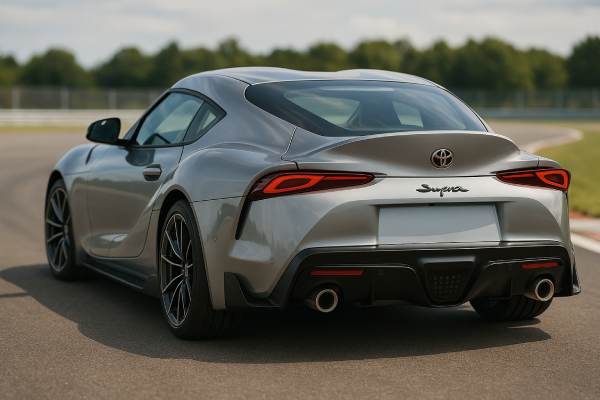
The late-run Toyota GR Supra 3.0 is the most polished version of the MkV generation. By 2025–2026, the car benefits from years of calibration tweaks, stronger hardware, and a more focused Final Edition package, even as production winds down. Officially, the Supra’s turbocharged 3.0-litre B58 inline-six remains rated at about 382 hp in most markets, but tuners and speculative future updates often quote outputs in the 430–435 hp range using the newer B58 calibrations and mild hardware changes.
For owners and buyers, the appeal is clear: compact dimensions, a short wheelbase, and a BMW-derived powertrain give the Supra a mix of reliability, tuning headroom, and genuine track capability. At the same time, it is a low, two-seat coupé with limited cargo space and a firm ride, so it suits enthusiasts more than casual commuters. This guide focuses on the 3.0-litre B58GR Supra in its final model years, with an emphasis on real-world ownership, service, and how it compares to rivals.
Owner Snapshot
- Turbocharged 3.0-litre B58 inline-six offers strong mid-range torque and easy 400+ hp tuning headroom.
- Final-years cars gain refined suspension, stronger front brakes, and improved stability and traction tuning.
- Cabin quality and parts sharing with BMW support good long-term parts availability and diagnostic support.
- Ride is firm, visibility is tight, and tyre and brake wear can be high if driven hard on track.
- Plan engine oil and filter changes every 10,000 km or 12 months (or 5,000–7,500 km for heavy spirited use).
Navigate this guide
- GR Supra 435 hp overview
- GR Supra 435 hp specs
- Trims, safety and options
- Reliability and common issues
- Maintenance and buying advice
- Driving dynamics and performance
- GR Supra rivals compared
GR Supra 435 hp overview
By 2025–2026, the Toyota GR Supra (J29) has matured from a controversial BMW-based comeback into a well-regarded driver’s car. It shares its basic platform, powertrain family, and some interior hardware with the BMW Z4, but Toyota’s tuning and suspension calibration give the Supra its own character: sharper turn-in, more playful balance, and a more focused coupe identity.
Under the bonnet sits the B58 3.0-litre single-turbo inline-six. In current production trim it is rated at around 382 hp and 368 lb-ft, with power sent to the rear wheels via either an 8-speed ZF torque-converter automatic or a 6-speed manual. Enthusiast discussions around the “B58B30M1 / 435 hp” Supra usually refer to uprated calibrations or mild hardware changes based on newer 324 kW B58 tunes seen in BMW’s own models. In practice, the hardware in the GR Supra is very similar, so 430–435 hp is realistic with conservative software changes and good fuel quality.
Toyota’s Final Edition and late-production tweaks focus less on raw power and more on chassis control: stiffer bushings, revised dampers, additional underbody bracing, and (on some trims) larger front brake rotors and retuned stability control. These changes aim to preserve daily usability while improving consistency at the limit.
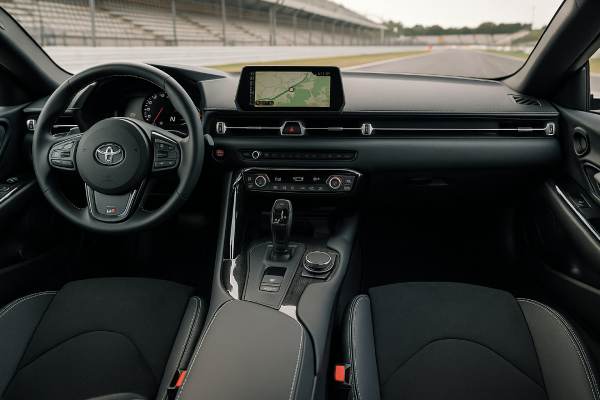
The trade-offs are typical of a focused sports coupé. The Supra seats only two, with a small boot and limited rearward visibility. The driving position is low and snug, and getting in and out can be awkward for taller or older drivers. On the upside, the car’s compact footprint makes it easy to place on a tight road or in city parking, and the interior quality is generally strong thanks to BMW switchgear and infotainment.
In short, the 2025–2026 GR Supra 3.0 is best viewed as a well-sorted final evolution of the MkV platform. The stock car remains extremely fast, and the underlying B58 engine and driveline provide a robust foundation if you want to pursue the notional 435 hp target with mild tuning.
GR Supra 435 hp specs
This section focuses on the 3.0-litre GR Supra in its final evolution, using the common 382 hp factory rating as a baseline and highlighting where a 430–435 hp tune would realistically change performance. Most hardware specifications are shared between the standard 3.0 Premium and limited Final Edition-type models.
Engine and performance (B58 inline-six)
| Item | Specification (late GR Supra 3.0) |
|---|---|
| Engine code | B58B30 family (single-turbo I6) |
| Layout and cylinders | Longitudinal inline-6, DOHC, 24 valves |
| Displacement | 3.0 L (2,998 cc) |
| Bore × stroke | 82.0 mm × 94.6 mm (3.23 in × 3.72 in) |
| Valvetrain | DOHC with VANOS (variable cam timing) and Valvetronic (variable lift) |
| Induction | Single twin-scroll turbocharger, intercooler |
| Fuel system | High-pressure direct injection |
| Compression ratio | ~11.0 : 1 |
| Factory max power | ~382 hp (285 kW) @ ~5,800–6,500 rpm |
| Typical tuned power (uprated) | ~430–435 hp (approx. 320–324 kW) on 98 RON / 93 AKI |
| Factory max torque | ~500 Nm (369 lb-ft) @ ~1,800–5,000 rpm |
| Timing drive | Chain-driven camshafts |
| Emissions standard | Euro 6 / LEV III equivalent, depending on market |
| Rated combined consumption | Around 9.4 L/100 km (25 mpg US / 30 mpg UK) for 3.0 auto, slightly lower for manual |
| Real-world highway (120 km/h) | Roughly 8.0–8.8 L/100 km (27–30 mpg US) when stock |
| Aerodynamics | Cd ~0.27–0.29, small frontal area for its class |
Transmission and driveline
| Item | Specification |
|---|---|
| Transmission options | 8-speed automatic (ZF 8HP) or 6-speed manual |
| Drive type | Rear-wheel drive (RWD) only |
| Differential | Electronically controlled active LSD |
| Final drive (approx.) | Around 3.15 (auto), shorter in manual applications |
| Launch control | Standard on automatic; manual relies on driver skill and traction control settings |
Chassis and dimensions
Values vary slightly by wheels, options, and market, but the following is representative for a 3.0-litre GR Supra.
| Item | Specification |
|---|---|
| Front suspension | MacPherson strut, aluminium control arms, adaptive dampers (on most trims) |
| Rear suspension | Multi-link independent, adaptive dampers |
| Steering | Electric power steering, quick ratio, roughly 2.1–2.2 turns lock-to-lock |
| Front brakes | Ventilated discs, ~348–374 mm (13.7–14.7 in) depending on trim |
| Rear brakes | Ventilated discs, ~345 mm (13.6 in) |
| Wheel / tyre packages | Typically 19-inch wheels; staggered tyres (approx. 255 front / 275 rear) |
| Length | ~4,380 mm (172.4 in) |
| Width (excl. mirrors) | ~1,865 mm (73.4 in) |
| Height | ~1,295 mm (51.0 in) |
| Wheelbase | ~2,470 mm (97.2 in) |
| Turning circle (kerb) | ~10.4–10.8 m (34–35 ft) |
| Kerb weight | ~1,520–1,570 kg (3,350–3,460 lb) depending on transmission |
| Fuel tank capacity | ≈ 52 L (13.7 US gal / 11.4 UK gal) |
| Cargo volume | ≈ 290 L (10.2 ft³), seats fixed |
Performance and capability
Factory numbers below reflect roughly 382 hp; a healthy 430–435 hp tune typically improves them modestly in good conditions.
| Metric | 382 hp baseline | ~435 hp tuned expectation* |
|---|---|---|
| 0–100 km/h (0–62 mph) | ~4.1–4.3 s (manual slightly slower, auto slightly quicker) | High 3-second range with good tyres |
| 0–60 mph | ~3.9–4.0 s auto | ~3.5–3.7 s |
| Top speed (limited) | 250 km/h (155 mph) electronically limited | |
| 100–0 km/h braking | ~33–35 m (108–115 ft) with performance tyres |
*Tuned expectations assume a safe ECU calibration, stock turbo, and good quality fuel. They are estimates, not official ratings.
Fluids, electrical, and service-relevant data
Values are representative for B58-powered Toyota/BMW applications; always verify against the exact service manual for your VIN and market.
| System | Typical specification (check local manual) |
|---|---|
| Engine oil | BMW LL-01/LL-04 or equivalent 0W-30 / 5W-30; capacity ~6.5–6.8 L (6.9–7.2 US qt) including filter |
| Coolant | HOAT / BMW G11/G12-type; 50:50 mix; capacity ~8–9 L (8.5–9.5 qt) for engine loop |
| ATF (8-speed auto) | “Lifetime fill” ZF fluid; practical service ~6–7 L with pan/filter change |
| Manual gearbox oil | Synthetic MTF; typically ~1.5–2.0 L |
| Differential oil | Synthetic gear oil with LSD friction modifiers; ~1.1–1.3 L |
| A/C refrigerant | R-1234yf; charge ≈ 500–600 g (17.6–21.2 oz) |
| 12 V battery | AGM, ~70–80 Ah; coded to vehicle on replacement |
| Spark plugs | Fine-wire iridium; change interval ~60,000–100,000 km depending on usage |
Trims, safety and options
In its final model years, the GR Supra 3.0 range is relatively simple. Exact naming varies slightly by market, but you can think of three main layers: a base 3.0, a more feature-rich 3.0 Premium (or similar), and a limited Final Edition or appearance package at the top. All use the same basic B58 powertrain and rear-drive layout.
On lower trims, you generally get the core mechanical package: the 3.0-litre engine, adaptive dampers, active rear differential, and a staggered wheel setup on 18- or 19-inch wheels. Interiors feature a mix of cloth or leather/Alcantara, basic BMW-sourced infotainment with Apple CarPlay (Android Auto availability depends on year), and manual seats on some markets to save weight.
Moving up to the Premium-type grade, equipment typically adds:
- Full leather or leather/Alcantara upholstery.
- Upgraded audio (JBL in some regions).
- More complete driver-assistance suite.
- Larger wheels and more aggressive tyres.
- Comfort touches such as power seats with memory and additional interior lighting.
Late-run special or Final Edition models are primarily about chassis and cosmetic upgrades rather than more power. Common elements include:
- Larger front brake rotors and sometimes different pad compounds.
- Increased negative front camber and stiffer suspension bushings.
- Extra underbody bracing for better torsional rigidity.
- Unique wheels, colours, aero add-ons, and interior trims.
From a safety perspective, the Supra uses a modern crash structure shared with its BMW cousin, with a strong passenger cell and multiple load paths front and rear. Front, side, and curtain airbags are standard, along with an active bonnet in some markets to reduce pedestrian impact severity.
Driver-assistance (ADAS) availability varies by year and trim. Typical systems include:
- Forward collision warning with automatic emergency braking.
- Lane departure warning (often with steering assist).
- Adaptive cruise control on higher trims.
- Blind-spot monitoring and rear cross-traffic alert.
- Parking sensors and camera, sometimes with parking assist functions.
Calibration is generally conservative. Lane-keeping is more of a gentle nudge than a strong steering intervention, and adaptive cruise control is tuned for comfort rather than ultra-aggressive following. After repairs that affect radar, camera, or alignment (windscreen replacement, front bumper work, suspension changes), ADAS calibration procedures should be followed using factory or OEM-equivalent tools.
Crash-test coverage is limited because of the Supra’s relatively low production volumes, but its BMW-derived platform and equipment place it competitively against other modern sports cars. Buyers should verify specific ratings and airbag configurations for their market and model year.
Reliability and common issues
The GR Supra benefits from the BMW B58 engine’s strong reputation. In stock form and with regular maintenance, the B58 is generally regarded as durable, even at moderate power increases. Most issues on Supra 3.0 cars relate to ancillary systems, electronics, or wear items rather than catastrophic engine failures.
You can think of issues in three broad categories:
1. Engine and cooling
- Minor oil leaks (occasional, low–medium cost): Valve cover gaskets, oil filter housing seals, and oil pan gaskets can seep as the car ages, especially with repeated heat cycles. Symptoms include burning oil smells and light residue on the block or undertray. The usual remedy is gasket or seal replacement.
- Cooling system components (occasional): Plastic or composite coolant fittings and expansion tanks can age prematurely under high heat, especially on tuned cars or those tracked often. Watch for low coolant warnings, visible crusting, or sweet smells; replacing tanks, hoses, and clamps prevent bigger failures.
- High-boost tuning stress (linked to use, potentially high cost): Pushing 500+ hp on stock internals and stock fuel can stress pistons, rods, and the turbo if tuning is aggressive or knock control is exceeded. Conservative calibrations, good fuel quality, and frequent oil changes are key.
2. Fuel and induction
- High-pressure fuel pump and injectors (occasional, medium cost): Direct-injection systems operate at very high pressures. On higher-mile cars or hard-driven examples, HPFP issues or injector leaks can appear as misfires, rough cold starts, or lean codes. Replacement with updated parts and correct coding usually resolves things.
- Carbon build-up (long-term): Like most direct-injection engines, the B58 can slowly accumulate carbon on intake valves. For high-mileage cars, or those frequently short-tripped, walnut blasting of the intake ports every 100,000–150,000 km can restore airflow.
3. Driveline, chassis, and electronics
- ZF 8-speed and manual gearbox (generally robust): The automatic is strong and widely used across BMW models. Issues tend to come from neglected fluid, overheating under track use, or harsh aftermarket tuning. Early fluid and pan/filter services reduce risk. The manual gearbox is simpler but can show clutch wear and occasional synchro balking if repeatedly abused.
- Active differential and wheel-speed sensors (occasional): Track use, kerb strikes, or corrosion can cause sensor faults that disable stability systems and the active diff. Diagnostic scanning will show which sensor or module is affected; replacement and re-initialisation are routine but not trivial.
- Suspension bushings and alignment (common wear): The Supra’s short wheelbase and stiff setup mean front control arm bushes and rear suspension joints can wear faster than on a softer GT. Symptoms include tramlining, clunks, and unstable tracking at speed. Proactive bushing replacement and regular performance alignments are worthwhile, especially for track cars.
- Electronics and infotainment niggles (low–medium annoyance): Because the car uses BMW’s electronic architecture and infotainment, occasional software glitches, sensor errors, and connectivity quirks can appear. Factory software updates often improve stability and add features.
Owners should also keep an eye on corrosion in typical areas: brake components (especially if the car sits outside in wet climates), underbody hardware, and exposed aluminium components where road salt is used. The body shell itself tends to resist rust well if the paint and undercoating are maintained.
Overall reliability is favourable for a modern turbo sports car, but running costs rise if you heavily modify the engine or use the car extensively on track without matching maintenance.
Maintenance and buying advice
A 2025–2026 GR Supra 3.0 is still a relatively young car, but getting the maintenance right from day one is the easiest way to ensure it ages well—especially if you plan to explore the 430–435 hp tuning range.
Below is a practical service rhythm (distance or time, whichever comes first). Always check your market’s manual for official intervals, then treat this as enthusiast-grade guidance:
- Engine oil and filter:
- Normal use: every 10,000 km or 12 months.
- Hard or track use: every 5,000–7,500 km or after 2–3 track days.
- Engine air filter: Inspect at 20,000 km; replace by 40,000–50,000 km, sooner in dusty climates.
- Cabin filter: Replace every 20,000–30,000 km or 2 years.
- Coolant: Replace every 5 years / 80,000–100,000 km, or sooner if components are changed.
- Spark plugs: Replace around 60,000 km on tuned / heavily driven cars, up to 100,000 km on lightly used stock examples.
- Fuel filter: Integrated with the pump in many modern systems; follow service manual or replace proactively if fuel-pressure issues occur.
- Transmission fluid:
- 8-speed auto: service pan, filter, and fluid around 60,000–80,000 km if keeping the car long-term or tracking it.
- Manual: change gearbox oil around 60,000–80,000 km.
- Differential oil: Replace around 60,000 km, or after repeated track use.
- Brake fluid: Flush every 2 years minimum; yearly if tracking.
- Brake pads and rotors: Check at every service; performance driving can consume pads quickly.
- Tyres and alignment: Rotate front-to-rear is not possible with staggered setups, but you can swap left-right if tyres are non-directional. Check alignment annually or after pothole hits/track events.
- Aux belts and coolant hoses: Inspect from 60,000 km onward; replace if cracked, glazed, or noisy.
- 12 V battery: Test annually from year 4 onwards; expect replacement around 5–7 years depending on climate and use.
For a prospective buyer, a sensible checklist includes:
- Service history: Look for regular oil changes, documented brake and fluid services, and any transmission or diff maintenance.
- Recall and campaign completion: Verify via official VIN lookup and dealer records.
- Evidence of tuning: Check for aftermarket intakes, downpipes, charge pipes, or piggyback ECUs. A tuned car is not automatically bad, but ask who did the work, which fuel it ran on, and whether supporting hardware (intercooler, plugs, maintenance) matches the claimed power.
- Undercarriage and chassis: Inspect for track kerb damage, bent arms, leaking dampers, or cracked wheels. A proper alignment report is a bonus.
- Brakes and tyres: Uneven wear can indicate poor alignment or hard track life; budget for new tyres and pads if tread or thickness is low.
- Body and paint: Look for overspray, mismatched panels, or corrosion in door sills, hatch openings, and underbody seams.
From a long-term durability point of view, a stock or lightly tuned Supra 3.0 with diligent maintenance should be capable of high mileage. The B58 has already built a reputation for handling moderate power increases without the widespread failures seen in some earlier turbo inline-six families, provided fuelling and tuning are sensible.
Driving dynamics and performance
On the road, the GR Supra 3.0 feels compact, dense, and eager. The short wheelbase and wide track give it a pointy front end, while the adaptive dampers and active rear differential help manage traction and body control. At normal speeds, the steering is light but precise, and the car tracks cleanly with minimal correction. As speeds rise, the chassis reveals a playful, rear-biased balance: ease off the throttle mid-corner and the nose tucks in; feed in power and the rear helps rotate the car, especially in the sportier stability control modes.
Ride quality is firm but not punishing over decent surfaces. In the softer damper settings, it copes with daily commuting and highway cruising, though sharp potholes and expansion joints are still noticeable through the low-profile tyres. Road roar from the wide rear tyres is more prominent on coarse asphalt, and wind noise around the frameless doors increases at motorway speeds, but overall refinement is respectable for a focused sports coupé.
The B58 engine is a highlight. Turbo lag is minimal in stock form, and torque arrives early, giving strong mid-range shove even without downshifting. In Sport modes, throttle response sharpens, and the exhaust adds more overrun crackle (depending on year and market). A conservative 430–435 hp tune maintains this character while adding a noticeable extra pull above 4,500 rpm; the Supra feels stronger at the top of third and fourth gears without becoming unmanageable in the wet if traction control is left on.
Transmission behaviour depends on your choice:
- 8-speed automatic: Quick, smooth shifts, almost dual-clutch-like in Sport mode with manual paddles. It downshifts willingly and holds gears in manual mode without second-guessing the driver.
- 6-speed manual: More involving but less objectively quick. Throws are moderate, and clutch weight is reasonable for traffic. On track, rev-matching and heel-and-toe are straightforward thanks to the responsive engine.
Braking performance is strong, especially on cars with the larger front rotors and performance pads. Repeated hard stops can generate heat, and track drivers often switch to higher-temperature pads and fresh high-boiling-point fluid to prevent fade. Steering feel is filtered, as with most modern EPAS systems, but you still get a reasonable sense of front-tyre load.
In terms of efficiency, expect something like:
- City: 11–13 L/100 km (18–21 mpg US) depending on traffic and driving style.
- Mixed commuting: 9–11 L/100 km (21–26 mpg US).
- Steady motorway at 110–120 km/h: 7.5–8.5 L/100 km (28–31 mpg US) in stock form.
A mild 430–435 hp tune will typically increase consumption slightly when you use the extra power, but steady-state cruising efficiency is largely unchanged.
The Supra is not rated for serious towing, but it handles full cabin and boot loads without complaint. On spirited mountain drives or track days, oil and coolant temperatures should be monitored; the factory cooling package is decent, but repeated high-temperature laps and hot climates may justify upgraded intercoolers or additional cooling if you add significant power.
GR Supra rivals compared
In 2025–2026, the GR Supra 3.0 sits in a shrinking but highly competitive group of performance coupés. Typical cross-shop rivals include the Nissan Z, BMW M240i or M2, Porsche 718 Cayman, and in some regions, the Ford Mustang and Chevrolet Corvette. Each offers a slightly different mix of price, character, and practicality.
Versus Nissan Z
The latest Nissan Z also uses a turbocharged 3.0-litre V6 with similar straight-line performance in stock guise. The Z often undercuts the Supra on price and offers a more traditional, slightly roomier cabin. However, the Supra counters with:
- A more modern interior with better materials in many markets.
- A more refined and flexible B58 straight-six.
- Sharper chassis calibration and a shorter, more agile wheelbase.
For buyers who value outright value and a more old-school feel, the Z is attractive. For those who want a more polished and BMW-like experience, the Supra usually wins.
Versus BMW M240i / M2
Given the shared engineering, comparing a GR Supra to a BMW M240i or M2 is natural. The M240i offers similar power and a more practical 2+2 layout with better rear-seat access. The M2 steps things up with a more aggressive engine tune, broader performance envelope, and track focus, but with a higher price and more complex options.
The Supra’s strengths in this comparison are:
- Lower overall weight and shorter wheelbase for a more playful feel.
- A two-seat coupe cabin that feels more intimate and focused.
- Distinctive styling that stands out more than a small BMW coupe.
If you need occasional rear seats and more storage, the BMWs are easier to live with. If you want a purer sports-car vibe and do not need rear seating, the Supra delivers that with fewer compromises.
Versus Porsche 718 Cayman
The 718 Cayman (especially in S or GTS trims) is the Supra’s handling benchmark rival. The Porsche offers mid-engine balance, sublime steering, and a highly polished driving position. It can, however, be significantly more expensive when optioned, and running costs (tyres, brakes, servicing) are often higher.
Supra advantages include:
- Lower purchase price for similar straight-line performance.
- A strong aftermarket and easier access to tuning on the B58.
- More forgiving ride on poor surfaces, especially in softer damper modes.
The Cayman is the connoisseur’s choice for track and precision driving; the Supra offers 80–90% of that capability with more everyday usability and a lower entry cost.
Versus Mustang and Corvette
In markets where Mustang GTs or smaller-engined Corvettes are available, the comparison shifts towards power and theatre. American V8s deliver more noise and often more straight-line speed for the money. However, they are larger, heavier, and less compact in tight cities or on narrow roads.
The Supra feels like a precision instrument by comparison: easier to park, lighter on its feet, and more efficient. If your roads are wide open and you love V8 soundtracks, the Mustang/Corvette pairing is compelling. If you spend more time on twisty B-roads, track days with tight complexes, or in dense urban environments, the Supra’s size and agility are a major plus.
Overall, a 2025–2026 GR Supra 3.0—whether kept stock at 382 hp or tuned toward the 435 hp target—occupies a sweet spot between raw performance, day-to-day usability, and long-term reliability. It is not the absolute fastest or most practical option, but it is one of the few modern cars that still feels like a focused two-seat sports coupé in the classic sense.
References
<a href="https://www.toyota-europe.com/world-of-toyota/heritage/gr-supra">Toyota GR Supra</a> 2024 (Model Overview)<a href="https://www.euroncap.com/en/results/toyota/gr-supra/39140">Toyota GR Supra</a> 2019 (Safety Rating)<a href="https://www.nhtsa.gov/vehicle/2024/TOYOTA/GR%252520SUPRA/2%252520DR/RWD">2024 TOYOTA GR SUPRA 2 DR RWD</a> 2024 (Recall and Safety Data)<a href="https://www.toyota.com/owners/resources/owners-manuals">Toyota Owners Resources: Manuals and Warranties</a> 2024 (Owner’s Manual Portal)<a href="https://www.fueleconomy.gov/feg/bymodel/2024_Toyota_GR_Supra.shtml">2024 Toyota GR Supra</a> 2024 (Fuel Economy Data)
Disclaimer
This article is intended for general informational purposes only. It is not a substitute for professional diagnosis, repair advice, or safety guidance from a qualified technician or an authorised Toyota or BMW dealer.
Specifications, torque values, service intervals, and repair procedures can vary by VIN, model year, market, and equipment level. Before performing any work or making purchase decisions, always confirm details against your vehicle’s official owner’s manual, workshop manual, and current technical service information.
If you found this guide useful, you are welcome to share it on social platforms such as Facebook or X/Twitter to help other enthusiasts and support further in-depth technical content.