
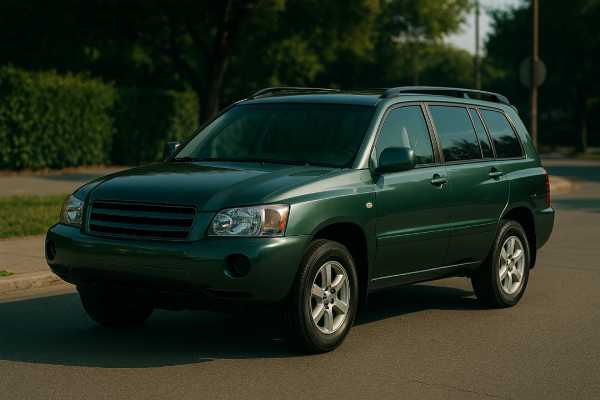
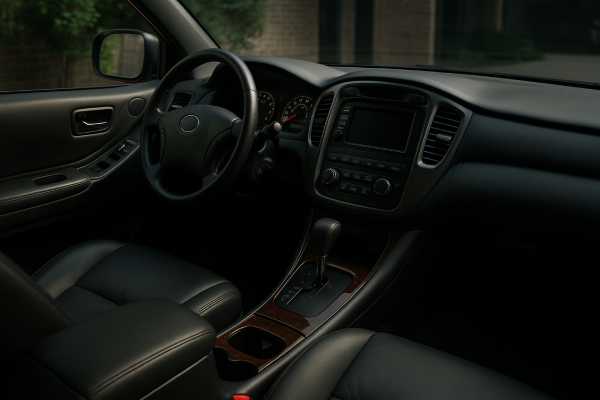
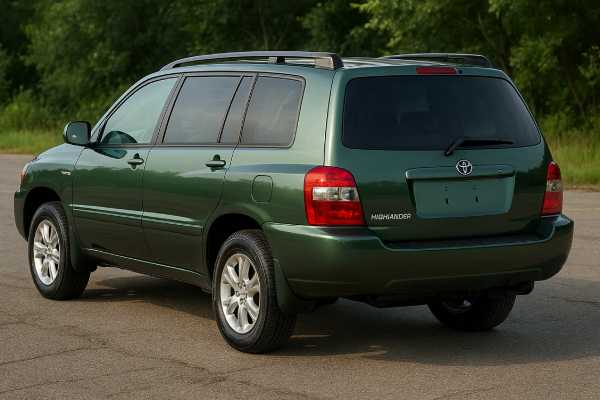
The 2006–2007 Toyota Highlander 4WD (internal code MCU25) represents the final, refined phase of the first-generation, Camry-based crossover. This facelift pair combines a proven 3.3-liter 3MZ-FE V6 with a full-time AWD system, a quiet cabin, and family-friendly packaging. In 2006 Toyota adopted the revised SAE J1349 standard, and the V6 was re-rated to 215 hp (160 kW) with 222 lb-ft (301 Nm) of torque—numbers that pair well with the 5-speed automatic for effortless daily driving and confident highway passing. Owners value the Highlander for its smooth ride, strong reliability history, and easy serviceability, while the simple mechanicals (belt-driven cams, non-GDI fuel system) keep long-term costs predictable. Standard stability control, available side/curtain airbags, and a 3,500-lb towing rating round out a balanced package. If you want an all-weather, low-drama midsize SUV with seven-seat flexibility, this late-run Highlander is a smart, durable choice.
Fast Facts
- Smooth, durable 3.3-liter V6; relaxed gearing; quiet highway manners.
- Full-time AWD helps traction in rain/snow without driver intervention.
- Cabin packaging is simple and robust; seats fold flat for 81.4 ft³ (2,305 L) cargo.
- Watch for age-related rubber/plastic wear (hoses, bushings) and ATF service history.
- Timing belt typically paired with water pump at ~90,000–105,000 miles (145,000–170,000 km) or ~9–10 years, whichever comes first.
Navigate this guide
- Highlander 3.3 AWD detailed overview
- Highlander specs and technical data
- Highlander trims, options, and safety tech
- Reliability, issues, and service actions
- Maintenance plan and buyer’s guide
- Driving impressions and performance
- Highlander vs key rivals
Highlander 3.3 AWD detailed overview
Toyota’s first-gen Highlander carved out the template for the modern family crossover: a car-like unibody, Camry-derived running gear, and a cabin laid out for real everyday use. The facelifted 2006–2007 4WD (MCU25) version is the most sorted of the run. The 3.3-liter 3MZ-FE V6 (aluminum block/heads, DOHC 24-valve with VVT-i on the intake cams) delivers an easygoing surge from low rpm, and the U151F 5-speed automatic keeps revs low at cruise for refinement and economy. Toyota’s full-time AWD system uses a front-biased transaxle with a center coupling that apportions torque almost invisibly; stability control and brake-based traction intervention help pull the vehicle straight on slick surfaces.
Inside, the Highlander is straightforward and quiet. The driving position is natural, sightlines are generous, and the controls are durable and logically arranged. With the 50/50 third row folded, the load bay becomes long and flat; with both rear rows down you unlock 81.4 cu ft of cargo volume. Ride tuning favors comfort over theater: compliant springs/struts, sensible tire sizes, and relaxed steering lend the sort of calm, low-stress feel owners keep for a decade plus.
For 2006, horsepower was re-stated under the updated SAE standard (from nominal “230 hp” to 215 hp without a hardware change). EPA-label economy sits around 16/22 mpg US (14.7/10.7 L/100 km) for V6 AWD models, matching the vehicle’s gearing and gentle aerodynamics (Cd ≈ 0.34). Towing up to 3,500 lb (1,588 kg) is supported when equipped with the factory tow prep. Safety hardware includes standard stability control and four-wheel disc brakes with ABS/EBD/Brake Assist, plus available side airbags and side curtain airbags (commonly standard on Limited in many markets). The overall story is one of low drama ownership: predictable service items, easy parts availability, and a chassis that stays tight when maintained.
Highlander specs and technical data
Engine & Performance (ICE)
| Item | Detail |
|---|---|
| Code | 3MZ-FE |
| Layout & cylinders | 60° V6, DOHC, 24v, VVT-i (intake) |
| Valves / cyl | 4 |
| Bore × stroke | 92.0 × 83.0 mm (3.62 × 3.27 in) |
| Displacement | 3.3 L (3,311 cc) |
| Induction | Naturally aspirated |
| Fuel system | Sequential multi-port EFI |
| Compression ratio | ~10.8:1 |
| Max power | 215 hp (160 kW) @ ~5,600–5,800 rpm |
| Max torque | 301 Nm (222 lb-ft) @ ~3,600–4,400 rpm |
| Timing drive | Belt (cam belt drives exhaust cams; intake cams via gears) |
| Emissions/Efficiency standard | EPA era rating |
| Rated efficiency (V6 AWD) | 14.7/10.7 L/100 km (16/22 mpg US, 19/26 mpg UK) city/highway |
| Real-world highway @ 120 km/h (75 mph) | ~11.8–12.4 L/100 km (19–21 mpg US), wind/grade dependent |
| Aerodynamics | Cd ≈ 0.34 |
Transmission & Driveline
| Item | Detail |
|---|---|
| Transmission | 5-speed automatic U151F (AWD) |
| Gear ratios | 1st 4.235 · 2nd 2.360 · 3rd 1.517 · 4th 1.047 · 5th 0.756 · Reverse 3.378 |
| Final drive ratio | ~3.478 (typical Highlander V6 calibration) |
| Drive type | Full-time AWD (Toyota “4WD”) |
| Center coupling / differentials | Front transaxle with center coupling; open diffs with brake-based traction aid |
| Refuel to full (min) | ~5–10 min (conventional gasoline) |
Note: Production differences and service bulletins can vary calibrations. Confirm exact ratios by VIN if critical.
Chassis & Dimensions
| Item | Detail |
|---|---|
| Front / rear suspension | MacPherson struts / MacPherson struts |
| Steering | Hydraulic rack-and-pinion |
| Brakes | Ventilated front discs / solid rear discs (ABS, EBD, BA) |
| Wheels / tires | 225/65 R17 (typical) |
| Ground clearance | 185 mm (7.3 in) |
| Approach / departure angles | 29° / 22° |
| Length × width × height | 4,690 × 1,826 × 1,735 mm (184.6 × 71.9 × 68.3 in) |
| Wheelbase | 2,715 mm (106.9 in) |
| Turning circle (curb-to-curb) | 11.4 m (37.4 ft) |
| Curb weight | ~1,785 kg (3,935 lb) (equipment dependent) |
| GVWR | ~2,430 kg (5,360 lb) |
| Fuel tank | 72.3 L (19.1 US gal / 15.9 UK gal) |
| Cargo volume | 297 L / 2,305 L (10.5 / 81.4 ft³) seats up / down (SAE) |
Performance & Capability
| Metric | Value |
|---|---|
| 0–100 km/h (0–62 mph) | ~8.5–9.0 s (typical V6 AWD) |
| Top speed | ~180 km/h (112 mph) (governed; conditions dependent) |
| Braking 100–0 km/h (62–0 mph) | ~38–42 m (125–138 ft) with healthy tires/brakes |
| Towing capacity (braked) | 1,588 kg (3,500 lb) |
| Payload (typical max) | ~646 kg (1,425 lb) |
| Roof load | Up to 68 kg (150 lb) with OEM rack/crossbars (verify accessory rating) |
Fluids & Service Capacities
| System | Spec / Capacity (typical) |
|---|---|
| Engine oil | API SL/SN 5W-30; ~4.7 L (5.0 US qt) with filter |
| Coolant | Toyota Super Long Life (pink), premixed; ~8–10 L (8.5–10.6 US qt) depending on rear heater |
| Automatic transmission (U151F) | Toyota ATF (T-IV or WS depending on build; check dipstick/label/manual); service fill ~4–5 qt |
| Rear differential | GL-5 75W-90; ~1.0–1.2 L (1.1–1.3 US qt) |
| Transfer case | GL-5 75W-90; ~0.5–0.8 L (0.5–0.8 US qt) |
| A/C refrigerant | R-134a; charge amount varies by option (rear A/C higher) |
| A/C compressor oil | ND-Oil 8 (typical); quantity per service procedure |
| Key torque examples | Oil drain plug ~45 Nm (33 lb-ft); spark plug ~25 Nm (18 lb-ft); wheel nuts 103 Nm (76 lb-ft) |
Verify by VIN: Capacities and ATF spec transitioned by production date and equipment (rear heater, tow package). Always confirm on the under-hood labels and owner/service documentation.
Electrical
| Item | Detail |
|---|---|
| Alternator output | ~100–130 A (equipment dependent; heated seats/JBL may up-rate) |
| 12V battery | Group 35 (typical), ~550–650 CCA |
| Spark plugs | Iridium (e.g., Denso SK20R11 / NGK IFR6A11); gap 1.0–1.1 mm (0.039–0.043 in) |
Safety & Driver Assistance
| Item | Detail |
|---|---|
| Crash ratings (IIHS) | Good in moderate overlap frontal (applies 2001–2007); head restraints & seats Marginal/A–P depending on seat type |
| Headlight (IIHS) | Not rated for this generation |
| ADAS / safety systems | ABS, EBD, Brake Assist, Vehicle Stability Control (stability), Traction Control; front airbags standard; front side and side curtain airbags standard/optional by trim; LATCH anchors; tire pressure monitoring |
Highlander trims, options, and safety tech
Trims (2006–2007 V6 AWD): Base, Sport (introduced for 2006), and Limited. All offered 5- or 7-passenger seating. The Sport adds cosmetic touches (unique grille/wheels, darker trim) and firmer damping; Limited leans toward comfort and equipment density.
Key mechanical/functional differences
- Wheels/tires: 17-in alloys common; Limited often features unique wheel designs.
- Suspension: Sport gets slightly firmer tuning; Base/Limited ride soft.
- Brakes: Four-wheel discs with ABS/EBD/BA across the board.
- Towing: Tow prep package (auxiliary cooler, wiring) supports the 3,500-lb rating; verify presence if you intend to tow regularly.
- Seating: Third row (50/50 split) widely available; Limited tends to bundle leather and power seats.
Cabin/infotainment tiers
- Audio: Base systems are functional; JBL premium audio available/standard on Limited in many markets.
- Convenience: Sunroof, heated seats, auto-dimming mirror, and power driver seat are common Limited features; navigation and rear entertainment were options.
Quick identifiers
- Badging: “Sport” and “Limited” fender/hatch badges; Sport grille treatment and interior trim accents.
- VIN/build clues: VIN pattern confirms engine/driveline; build plate lists paint/trim codes; tow prep appears in option codes.
- Year-to-year notes: 2006 brings Sport trim and the SAE hp re-rating to 215 hp; 2007 is largely a continuity year before the second-generation overhaul.
Safety ratings & equipment
- IIHS: Moderate-overlap Good; head restraints range Marginal to Poor/Acceptable depending on seat version.
- NHTSA: Individual star ratings vary by airbags/equipment; rollover resistance is typically mid-pack for segment.
- Airbags/child seats: Dual front airbags standard; front seat-mounted side and side curtain airbags available/standard by trim and package. LATCH lower anchors in second row; top tether anchors for child seats.
- ADAS calibration: Post-collision or alignment work may require yaw rate/steering angle sensor checks; keep battery voltage stabilized during scan tool procedures.
Reliability, issues, and service actions
The late first-gen Highlander V6 AWD has an excellent reliability record when maintained. The items below summarize what experienced techs and high-mileage owners encounter on 3MZ-FE/MCU25 vehicles, with prevalence and cost impact to help prioritize.
Engine & fuel (ICE)
- Timing belt aging (common / medium): belt, idlers, tensioner, and water pump replacement around 90k–105k mi (145k–170k km) or 9–10 years. Symptoms: belt age, seep at water pump, coolant crusting. Remedy: full kit, fresh SLLC coolant.
- Valve cover & cam seals seep (occasional / medium): age-related weeping at gaskets; smells of burning oil on exhaust. Remedy: reseal; inspect PCV.
- Throttle body/MAF contamination (common / low): rough idle or hesitation. Remedy: clean MAF/throttle, ensure fresh air filter.
- Coil-on-plug misfires (occasional / medium): intermittent under load. Remedy: replace failing coil(s) and plugs (iridium) if aged.
Cooling & HVAC
- Radiator/trans cooler end-tank seep (occasional / medium): plastic/aluminum joint aging; watch for pink crust. Remedy: new radiator; renew hoses/clamps.
- A/C performance (occasional / medium): condenser fin corrosion or small leaks; verify charge weight; check rear HVAC lines if equipped.
Transmission / AWD
- ATF neglect (common / medium): old fluid causes harsh 2-3 flare or shudder on U151F. Remedy: staged drain-and-fills with the correct ATF (per label/manual); software updates were issued for shift feel in some applications.
- Rear differential/transfer case seep (occasional / low–medium): aging seals; address early, renew with GL-5 75W-90.
- Front axle seals (occasional / low): dampness at transaxle outputs; replace seals, check venting.
Chassis & body
- Strut mounts/bushings (common / low–medium): clunks over sharp bumps; refresh strut tops, sway-bar links/bushings with mileage.
- Steering intermediate shaft noise (occasional / low): tick/knock at small inputs; lubricate or replace shaft.
- Exhaust flange studs (occasional / low): rust and noise; repair with hardware kit.
Electrical
- Window regulators / lock actuators (occasional / low–medium): slow or intermittent.
- Aging 12V battery / grounds (common / low): slow cranking or sporadic warning lamps; test/replace battery, clean grounds.
Recalls, TSBs & extended coverage (highlights)
- Brake Master Cylinder Cup (Safety Recall A0M, 2004–2006 Highlander, non-Hybrid): Rubber seal could dry/curl with non-polymer brake fluid, leading to gradual fluid leak and warning lamp; remedy is seal replacement. Always check recall completion by VIN.
- Floor mat/accelerator entrapment era: Later Highlanders were prominent in this campaign; verify any pedal/floor mat service history even though 2006–2007 first-gens were not core to the highest-profile actions.
- Software updates: Periodic ECM/TCM calibrations improved shift quality and driveability; confirm campaign/TSB status in dealer history.
Pre-purchase checks to request
- Full maintenance log (oil, coolant, brake fluid, ATF, diff/transfer oils).
- Timing-belt kit + water pump proof within time/mileage window.
- Brake master cylinder recall status; dealer service printout.
- Tire age and even wear; alignment sheet.
- Rust inspection at strut towers, subframe mounts, exhaust flanges.
- AWD service: evidence of recent diff/transfer oil changes.
- Battery state and charging test; HVAC performance (front/rear if equipped).
Maintenance plan and buyer’s guide
Practical maintenance schedule (time/distance = whichever comes first)
- Engine oil & filter: 5W-30, 5,000 mi / 6 months typical for mixed driving; adjust shorter for severe duty (short trips, towing, extreme cold/heat).
- Engine air filter: Inspect 12 months / 12,000 mi; replace as needed.
- Cabin filter: Replace 12–24 months based on environment.
- Coolant (SLLC pink): Factory fill often 100,000 mi/10 years first, then 50,000 mi/5 years thereafter; test pH/freeze point annually after year 8.
- Spark plugs (iridium): 120,000 mi (193,000 km) or when gap exceeds spec; replace all six.
- Fuel filter: In-tank, typically lifetime; test fuel pressure before condemning.
- Timing belt, tensioner, idlers, water pump: 90,000–105,000 mi / 9–10 years; replace serpentine belt concurrently.
- Serpentine belt & hoses: Inspect annually; replace at first cracking/age hardening.
- ATF (U151F): Conservative 30,000–60,000 mi drain-and-fill cadence; avoid high-mileage flushes. Use the exact Toyota-specified ATF per under-hood label/manual.
- Rear differential & transfer case oils: 60,000 mi (or sooner under towing/snow duty) with GL-5 75W-90.
- Brake fluid: 2–3 years regardless of mileage (moisture absorption).
- Brakes: Inspect pads/rotors every 12 months; clean/relube slide pins (road-salt regions need extra care).
- Tires: Rotate 5,000–7,500 mi; align annually; maintain even tread across AWD.
- Valve clearances: Hydraulic lash adjusters—no routine adjustment.
- 12V battery: Load test annually after year 4; typical life 5–7 years.
Fluid specs & handy numbers
- Engine oil: API SL/SN 5W-30; ~4.7 L (5.0 qt) with filter.
- Coolant: Toyota Super Long Life, premixed; ~8–10 L depending on rear heater.
- ATF: Toyota T-IV or WS as specified by your vehicle’s labels; service fill ~4–5 qt.
- Diff/transfer: GL-5 75W-90; see capacities above.
- Spark plugs: Denso SK20R11 / NGK IFR6A11, gap 1.0–1.1 mm.
DIY tips
- Use a torque wrench on drain/fill plugs and wheels.
- For ATF, perform serial drain-fills to refresh gradually (each cycle exchanges ~35–40% of fluid).
- When doing the timing belt, replace cam/crank seals only if they’re seeping; otherwise leave undisturbed.
Buyer’s checklist
- Cold start test (listen for belt idler/tensioner noise).
- Gentle to firm 2–3 upshifts once warm (assess flare).
- AWD lot-test: tight circles listening for binding (should be smooth).
- Roof rack, hatch struts, and rear HVAC (if equipped) operation.
- Underside inspection for diff/transfer seep, radiator end-tank pink crust, and exhaust flange corrosion.
- Prefer vehicles with documented timing-belt service, fresh coolant, recent brake fluid change, and ATF/diff oils done within the last 3 years.
Durability outlook
With oil changes on time, coolant and ATF cared for, and rubber parts refreshed as they age, the MCU25 Highlander commonly runs 200,000–300,000 miles with minimal drama. The fundamental engine/transmission design is understressed, and parts availability is excellent.
Driving impressions and performance
Ride, handling, NVH: The Highlander’s mission is serenity. Spring/damper rates are comfort-biased; body control is tidy at family speeds, and larger imperfection isolation is excellent for this era. Steering is light and consistent with moderate self-centering, and there’s little kickback. At 60–70 mph (100–113 km/h) the cabin remains calm; wind and road noise are well-managed on stock 17-inch tires. The brake pedal is medium-effort with a progressive top half and firm bottom end; repeated stops remain stable when rotors are fresh.
Powertrain character: The 3.3 V6 is silk-smooth, with useful torque from 1,800 rpm upward. There’s no turbo lag to manage; throttle response is linear. The U151F 5-speed usually shuffles unobtrusively, with a tall overdrive keeping revs near 2,000 rpm at 70 mph. Kickdown is timely; Sport trim’s calibration feels a shade crisper. Post-service shift quality improves when ATF is clean and software is current.
Real-world economy: In mixed suburban/highway commuting, V6 AWD owners often report 18–21 mpg US (13.1–11.2 L/100 km), with steady 75 mph (120 km/h) highway cruising near 19–21 mpg US (12.4–11.8 L/100 km). Winter on snow tires can trim 1–2 mpg (US).
Traction and control: Full-time AWD plus stability control yields confident start-off on wet or packed-snow surfaces. There’s no driver-selectable low range; this system is tuned for all-weather road use, not rock crawling. Brake-based traction mimics limited-slip behavior effectively with appropriate throttle moderation.
Load and towing: With the tow package and fresh fluids, the Highlander handles 1,500–3,000 lb trailers comfortably on rolling terrain, provided you use a properly adjusted weight-distributing hitch above ~2,000 lb. Expect a 15–30% fuel-economy penalty while towing. Temperature stability is good when coolers are clean and the radiator is healthy.
Selective metrics (typical, V6 AWD on 225/65R17 all-seasons)
- 0–60 mph: ~8.5–9.0 s
- 50–80 mph: ~6–7 s (kickdown to 3rd)
- 100–0 km/h braking: ~38–42 m (125–138 ft)
- Turning circle: 37.4 ft (11.4 m)
Highlander vs key rivals
Honda Pilot (2006–2008): The Pilot offers a tougher-feeling chassis and slightly roomier third row, with comparable V6 power and often tighter steering. Its AWD (VTM-4) adds a low-speed lock mode that helps in deep snow. The Highlander counters with quieter ride, an easier-to-service engine bay, and typically lower NVH. For pure family comfort and long-term serenity, the Highlander edges it; for occasional light off-pavement or more direct steering, the Pilot appeals.
Nissan Murano (2006–2007): Sportier steering and a more expressive interior, but the early CVT can raise long-term questions. Highlander’s conventional 5-speed auto and simpler hardware are big wins for worry-free ownership.
Subaru B9 Tribeca (2006–2007): Symmetrical AWD and stable handling, yet the flat-six is thirstier and packaging is tighter. Highlander’s service access and real-world mpg are generally better.
Ford Explorer (2006–2007): Traditional BOF SUV with more towing headroom but heavier and thirstier. If you don’t need 5,000-plus pounds of towing, Highlander drives more like a refined car, with fewer big-truck compromises.
Verdict: If your priorities are quiet comfort, predictable maintenance, and all-weather confidence, the 2006–2007 Highlander V6 AWD remains one of the most balanced picks in its class. Seek examples with documented belt service, clean fluids, and intact safety equipment.
References
- 2007 Toyota Highlander 2025 (Safety Rating)
- 2006 Toyota Highlander 2025 (EPA Fuel Economy)
- 2006 TOYOTA HIGHLANDER 4 DR FWD/AWD 2025 (NHTSA Ratings/Recalls)
- Safety Recall A0M – Rubber Seal (Brake Master Cylinder Cup) Replacement 2010 (Recall Database)
- 2006 Highlander Specifications 2006 (Manufacturer Specifications)
Disclaimer
This guide is for informational purposes only and is not a substitute for professional diagnosis, repair, or your vehicle’s official service procedures. Specifications, torque values, capacities, and maintenance intervals can vary by VIN, market, options, and production date. Always verify against your owner’s manual, service manual, and official bulletins before servicing, and follow all safety precautions.
If this article helped, consider sharing it with fellow owners on Facebook or X/Twitter—thank you for supporting xcar’s work.