
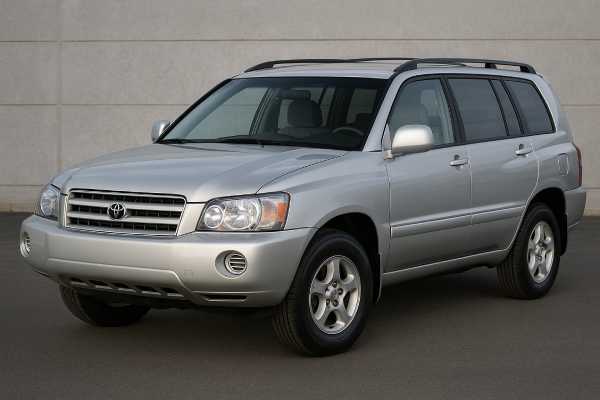
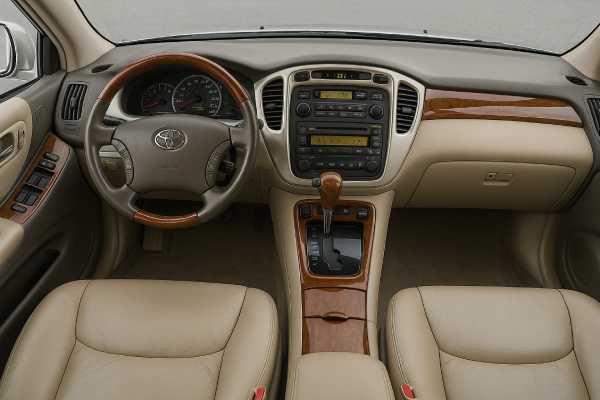
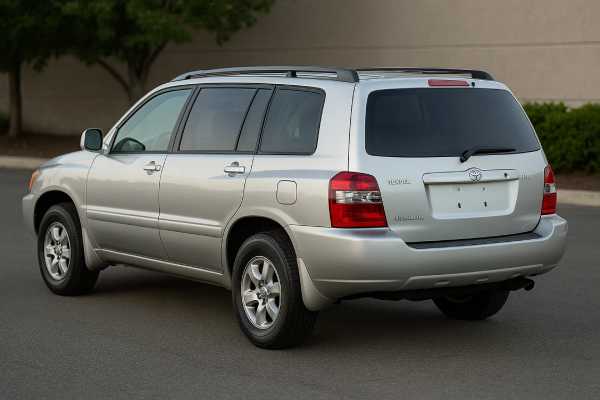
The first-generation Toyota Highlander with the 3.0-litre 1MZ-FE V6 and full-time 4WD (MCU25) blends sedan civility with year-round traction. It rides on a Camry-related unibody with independent struts at each corner, so it steers and rides like a car, not a truck. The V6 is quiet and flexible, and the Aisin 4-speed automatic is tuned for smoothness. Toyota’s centre differential with a viscous coupling shares torque front-to-rear without driver input, making winter driving simple and stable. Ownership is straightforward: fluids are widely available, service access is decent, and parts support is excellent. The big asks from buyers are proof of timing-belt service and a healthy cooling system—both central to long-term reliability on the V6. If you want a comfortable, low-drama family SUV that feels at home on snowy commutes and long highways, the 2001–2003 Highlander V6 4WD remains an exceptionally rational choice.
Owner Snapshot
- Calm ride, quiet V6, and predictable full-time 4WD with viscous centre coupling.
- Spacious cargo box and low load floor; easy-fold second row for bulky items.
- Known-good Aisin gearbox; routine ATF and differential/transfer services pay dividends.
- Watch timing-belt/water-pump age and radiator end-tanks; address leaks before overheating.
- Oil and filter: 5W-30 every 5,000–7,500 miles (8,000–12,000 km) or 6–12 months.
Section overview
- MCU25 V6 4WD overview
- Highlander 3.0 4WD specs
- MCU25 trims and safety
- Reliability, issues, and actions
- Maintenance schedule and buyer’s guide
- Driving performance and economy
- How Highlander stacks up
MCU25 V6 4WD overview
Toyota designed the first-gen Highlander to feel familiar to sedan drivers. In MCU25 form you get a transversely mounted 1MZ-FE 3.0-litre V6 (VVT-i), an Aisin 4-speed automatic, and a full-time 4WD layout with an open centre differential plus a viscous limited-slip coupling. The viscous unit progressively links front and rear axles when slip develops, so the system is transparent in the dry and quietly helpful on snow, mud, or wet leaves. There is no low range; the calibration favours stability and ease over rock-crawling.
Inside, the Highlander majors on packaging: a low cargo floor, wide hatch, and a second row that folds flat. With seats up, the box swallows family gear; with seats down, long items slide in easily thanks to the low lift-over height. The cabin is simple and durable, with ergonomic controls and large glass for excellent visibility. Most examples run 16-inch wheels on tall-sidewall tyres, which further calm impacts and cut noise. The driving position is upright without feeling truck-like, and the steering is light but precise enough for city traffic and highway cruising.
On the road, the 1MZ-FE prioritises smoothness over theatrics. It pulls readily from low revs and settles into an unobtrusive hum at 65–75 mph (105–120 km/h). The four-speed’s ratios are conservative: shorter lower gears for step-off and an overdrive for relaxed cruise. Stability and traction control availability varies by package and year, but ABS is standard and the full-time 4WD hardware itself is the star in bad weather. Towing capability with the right equipment reaches mid-class numbers for the era, and—crucially—maintenance is approachable. The timing-belt service is the big scheduled item; beyond that, regular fluids and routine suspension/brake wear items keep costs predictable.
For used-market shoppers, the MCU25 V6 4WD’s value proposition is its balance: confident winter behaviour without a penalty in ride quality, a quiet cabin, and Toyota’s reputation for parts availability two decades on. The main ownership caveats involve age-related cooling hardware, rubber bushings, and the belt service interval. Choose on history and current condition and the platform rewards with long, largely uneventful service.
Highlander 3.0 4WD specs
Engine and Performance (ICE)
| Item | Detail |
|---|---|
| Code | 1MZ-FE (VVT-i) |
| Layout & cylinders | 60° V6, DOHC, 24 valves |
| Bore × stroke | 87.5 × 83.0 mm (3.44 × 3.27 in) |
| Displacement | 3.0 L (2,995 cc) |
| Induction | Naturally aspirated |
| Fuel system | Multi-port electronic fuel injection |
| Compression ratio | ≈10.5:1 |
| Max power | 220 hp (164 kW) @ ~5,800 rpm |
| Max torque | 301 Nm (222 lb-ft) @ ~4,400 rpm |
| Timing drive | Belt (cams) |
| Emissions/efficiency era | LEV calibration (varies by state certification) |
| EPA-style economy (typical 4WD V6) | ~13.8 L/100 km combined (17 mpg US / 20.4 mpg UK); ~15.7/11.8 L/100 km city/hwy (15/20 mpg US), tyre/load sensitive |
| Real-world highway @ 120 km/h (75 mph) | ~11.2–12.4 L/100 km (19–21 mpg US), wind/temperature dependent |
| Aerodynamics | Cd ≈ 0.36–0.37 (period estimate) |
Transmission and Driveline
| Item | Detail |
|---|---|
| Transmission | Aisin 4-speed automatic (ECT), AWD variant |
| Typical code | U140F (centre diff + viscous coupling) |
| Gear ratios (1/2/3/4/Rev) | 3.94 / 2.19 / 1.41 / 1.02 / 3.14 |
| Final drive (typical) | ~3.29–3.48 (model/year dependent) |
| Drive type | Full-time 4WD (open centre diff + viscous LSD) |
| Differentials | Open front and rear; viscous coupling across centre |
| Refuel to full | ~3–5 min at typical pump flow |
Chassis and Dimensions
| Item | Detail |
|---|---|
| Structure | Unibody |
| Suspension (front/rear) | MacPherson strut / MacPherson strut |
| Steering | Power rack-and-pinion |
| Brakes (F/R) | Ventilated disc / disc (rear drums on some early builds); ABS standard |
| Wheels/Tyres | 225/70 R16 (16×6.5 in rims typical) |
| Ground clearance | ~185 mm (7.3 in) |
| Length / Width / Height | ≈4,690 / 1,825 / 1,685 mm (184.6 / 71.9 / 66.3 in) |
| Wheelbase | 2,715 mm (106.9 in) |
| Turning circle (curb-to-curb) | ~11.0 m (36.1 ft) |
| Curb weight | ~1,700–1,780 kg (3,750–3,925 lb), equipment dependent |
| GVWR | ~2,250–2,350 kg (4,960–5,180 lb) |
| Fuel tank (ICE) | ~72–75 L (19.0–19.8 US gal / 15.8–16.5 UK gal) |
| Cargo volume (SAE) | ≈1,100 L seats up / ≈2,280 L seats down (≈38.5 / 80.5 ft³), configuration dependent |
Performance and Capability
| Metric | Value |
|---|---|
| 0–100 km/h (0–62 mph) | ≈9.9–10.5 s (V6 4WD) |
| Top speed | ≈180–190 km/h (112–118 mph), governed/gear limited |
| 100–0 km/h / 62–0 mph | ≈41–44 m (≈135–145 ft), tyre/condition dependent |
| Towing capacity | Up to 1,588 kg (3,500 lb) with Tow Prep + hitch; base ≈907 kg (2,000 lb) |
| Payload | ~450–600 kg (990–1,325 lb) |
| Roof load | ~68–75 kg (150–165 lb) incl. rack hardware |
Fluids and Service Capacities
| System | Specification | Capacity (approx.) |
|---|---|---|
| Engine oil | API SJ/SL (later SN acceptable), SAE 5W-30 | ~4.7–5.0 L (5.0–5.3 US qt) incl. filter |
| Coolant | Toyota Long Life (red), 50/50 mix | ~8.5–9.5 L (9–10 US qt) |
| Automatic transaxle | Toyota ATF Type T-IV | ~6.8–7.2 L (7.2–7.6 US qt) total; ~3–4 L (3.2–4.2 qt) drain/fill |
| Transfer case | Toyota ATF Type T-IV | ~0.9–1.1 L (0.95–1.2 qt) |
| Rear differential | 75W-90 GL-5 gear oil | ~0.9–1.1 L (0.95–1.2 qt) |
| A/C refrigerant | R-134a | ~500–600 g (18–21 oz) |
| A/C compressor oil | ND-OIL 8 (PAG46) | ~120–150 mL (4.1–5.1 fl oz) |
| Key torque specs | Wheel lugs 103 Nm (76 lb-ft); spark plugs ~18 Nm (13 lb-ft); drain plug ~39 Nm (29 lb-ft) |
Electrical
| Item | Detail |
|---|---|
| Alternator output | ~100–120 A (equipment dependent) |
| 12V battery | Group 24F/35 common; ~55–65 Ah; ~550–650 CCA |
| Spark plug | Iridium (e.g., SK20R11); gap 1.1 mm (0.044 in) |
Safety and Driver Assistance
| Item | Detail |
|---|---|
| Crash ratings | Strong moderate-overlap frontal result for early 2000s testing |
| Headlight rating | Halogen reflector; performance depends on aim/lens clarity |
| Airbags | Dual front; side-torso airbags available/packaged; curtain airbags arrived later in generation |
| ADAS suite | ABS standard; traction control and stability control available on many V6 builds; no AEB/ACC/LKA in this era |
| Child-seat provisions | LATCH lower anchors (rear outboard) and top tethers |
Notes: Figures vary by year, equipment, and market; verify by VIN and service documentation for precise values.
MCU25 trims and safety
Trim walk (2001–2003, V6 4WD focus). The Highlander V6 4WD was typically sold in Base and Limited grades, with options allowing Base to be configured near-Limited. Base brings ABS, power accessories, cruise control, tilt wheel, manual HVAC, cloth seats, and 16-inch wheels. Limited adds leather on many units, automatic climate control, premium audio, fog lamps, and additional convenience items. Roof rack, power driver’s seat, heated front seats (package-dependent), and privacy glass were common options. A Tow Prep package—enhanced cooling and wiring—was critical for the 3,500-lb (1,588-kg) tow rating; without it, tow capacity defaults nearer 2,000 lb (907 kg).
Mechanical/functional differences. Limited models more often pair with traction/stability control, side-torso airbags, and upgraded audio. Brake hardware can differ: some early builds use rear drums; many later/optioned trucks have four-wheel discs. Wheel/tire options remain conservative to preserve ride quality. Stability control (VSC) and traction control (TRAC) materially improve slippery-road confidence; verify via dash indicators and option stickers.
Year-to-year notes (within 2001–2003). Toyota shuffled packages incrementally: availability of side airbags and stability functions slowly broadened; cosmetic and audio updates appeared; and rear disc adoption increased. The major facelift and the 3.3-litre engine/5-speed automatic arrived for 2004—outside this article’s scope but relevant for cross-shopping.
Safety systems and child-seat considerations. Dual front airbags are standard. Seat-mounted torso airbags are common on well-optioned V6s by 2003. Curtain airbags were not yet universal in this period. The second row provides LATCH lower anchors at the outboard positions plus top tethers; the centre position typically has a top tether only. As with any early-2000s vehicle, child-seat fit depends on shell width and belt path; a hands-on test fit is best.
Quick identifiers and build tells.
- VIN/Type: MCU25 = V6 4WD (this article); MCU20 = V6 FWD; ACU20/25 = four-cylinder.
- Driveline: Rear differential and prop shaft are obvious visual confirms; many MCU25s have “4WD” badging.
- Tow Prep clues: Auxiliary cooler presence and harness pigtail near the radiator support; check radiator core thickness and shroud labels.
- Safety options: Seat-side airbag tags; stability/traction indicator lamps at key-on; ABS module label.
Service calibration notes. After suspension or steering work, vehicles with VSC may need a steering-angle and yaw/zero-point calibration. ABS/traction lights after bearing or brake service often trace to wheel-speed sensor bores with rust scale; clean the seat and confirm sensor gap. SRS work requires proper initialization and a DTC-free check before delivery.
Reliability, issues, and actions
Big picture. With routine care, the MCU25 V6 4WD is a long-distance companion. The 1MZ-FE is renowned for smoothness and durability; the Aisin 4-speed is conservative; the 4WD hardware is robust if fluids are fresh and tyre circumferences match. Two decades on, most “failures” are the predictable results of age and heat rather than inherent design flaws.
Common (low–medium cost).
- Timing-belt overdue. The 1MZ-FE uses a belt. Best practice is a full kit: belt, water pump, tensioner, idlers, and new coolant, typically around the 90k–105k-mile (145k–170k-km) window or 7–9 years. Overdue belts risk pump leaks or noise more than sudden catastrophic failure, but you should not gamble.
- Water pump seepage. Often discovered during belt service: coolant crust at the weep hole or pump snout. Replace pump with the belt; confirm thermostat and cap health.
- Valve cover gasket/cam seal seep. Aged rubber hardens, especially at the rear bank. A fresh PCV valve and correct torque during reseal minimise recurrence.
- Cooling stack fatigue. Radiator plastic end-tanks and original hoses age out. Replace proactively if discoloured, brittle, or swelling. A new cap restores pressure curve and boiling margin.
- Front suspension wear. Strut top mounts/bearings, lower control-arm rear bushings, and sway-bar links/bushings clunk or wander. Replace in sets where possible and align at ride height.
Occasional (medium cost).
- Coil-on-plug and A/F-O2 sensors. Heat cycles age boots and sensors, causing misfires, poor trims, or CELs. Quality parts restore smoothness and economy.
- Wheel bearings. A road-speed growl hints at bearing wear. Replace hubs, torque axle nuts correctly, and verify alignment.
- HVAC blend actuators. Clicking under the dash or stuck airflow modes; actuator motor/gear fixes it.
Rare (medium–high cost).
- Transmission neglect outcomes. The U140F responds well to periodic drain-and-fills with Toyota ATF T-IV. Prolonged neglect can show as 2–3 shift flare or harsh cold shifts. Valve-body service is the next step if staged fluid refreshes and line-pressure checks do not normalise shifts.
- Viscous coupling stress. Running mismatched tyres (brand/size/tread depth) can preload the viscous coupling and rear diff. Always fit four matched tyres and rotate regularly.
Corrosion hotspots (salt-belt). Front subframe seams, rear brake backing plates (dust shields), exhaust flanges, and hard brake lines near body clamps. Address early with rust-treatments, and replace lines if pitted.
Recalls/TSBs themes (2001–2003). Rear-door child-lock mechanism updates on some early units; fuel-system hose clamp orientation/collision-standard campaigns; various drivability/idle feel calibrations; and widespread floor-mat/pedal interference guidance years later. Always run a VIN check and confirm dealer documentation; look for under-hood campaign labels and service history entries.
Pre-purchase checklist.
- Proof of timing-belt/water-pump service (date and mileage).
- Cooling-system pressure test; check radiator seams and hose condition.
- ATF colour/odour and evidence of drain-and-fill history; transfer and rear diff fluid dates.
- Even tyre brand/size/tread depth on all four corners; ask about rotations.
- Suspension/brake inspection, especially strut mounts, control-arm bushings, and slide pins.
- Cold-start and hot-restart behaviour, plus a long test at freeway speeds and a steep-grade pull.
Maintenance schedule and buyer’s guide
Practical maintenance schedule (distance/time; severe use = short trips, hot/cold extremes, towing).
- Engine oil + filter: 5W-30, every 5,000–7,500 miles (8,000–12,000 km) or 6–12 months.
- Engine air filter / cabin filter: Inspect 12 months / 15,000 miles (24,000 km); replace 30,000–45,000 miles depending on dust and city driving.
- Coolant: If original Toyota Long Life (red), plan a full exchange at ~100,000 miles (160,000 km) or 10 years, then ~50,000 miles (80,000 km) / 5 years thereafter.
- Spark plugs (iridium): 90,000–120,000 miles (145,000–190,000 km); inspect sooner if misfires occur.
- Fuel filter: Integrated in tank; replace only for pressure/contamination faults or during pump service.
- Timing belt + water pump: 90,000–105,000 miles (145,000–170,000 km) or 7–9 years, with tensioner/idlers.
- Accessory (serpentine) belt + hoses: Inspect at each oil change; replace on cracks, glazing, or noise.
- ATF (U140F): Drain-and-fill every 30,000–60,000 miles (50,000–100,000 km); staged exchanges preferred to avoid shock to aged fluid.
- Transfer case and rear differential: Every 30,000–60,000 miles; sooner after water crossings or towing.
- Brake fluid: Every 2–3 years; bleed sequence per service guide.
- Pads/rotors/drums (if equipped): Inspect each rotation; clean/lube slide pins annually in salt regions.
- Tyre rotation/alignment: Rotate 5,000–7,500 miles; align yearly or after impacts/part replacement.
- 12V battery: Load-test yearly after year 4; typical life 4–6 years.
- HVAC: Replace cabin filter regularly; verify condenser fin cleanliness; weigh in R-134a by spec after repairs.
Fluid specs and quick numbers.
- Engine oil: 5W-30, ~5.0 US qt with filter; drain plug ~29 lb-ft (39 Nm).
- ATF: Toyota Type T-IV only on this vintage (do not substitute WS).
- Diff/transfer: 75W-90 GL-5 (rear); Type T-IV (transfer).
- Coolant: Toyota Long Life (red) 50/50; ~9–10 US qt total.
- Spark plugs: SK20R11 (or equivalent) at 1.1 mm (0.044 in); ~13 lb-ft (18 Nm).
- Wheel lug torque: 76 lb-ft (103 Nm).
DIY and shop-smart tips.
- Use matched tyres (brand/size/tread depth) to protect the viscous coupling; rotate on schedule.
- For ATF, several drain-and-fills with short intervals between are gentler than a single full exchange on old fluid.
- Cooling refills benefit from a spill-free funnel and heater-on bleed; confirm hot-soak level stability before release.
- Brake feel often improves dramatically after slide-pin cleaning and a proper fluid flush; don’t judge pads/rotors alone.
Buyer’s guide highlights.
- Best bets: 2002–2003 trucks with documented belt/pump service, Tow Prep (if you plan to tow), and stability/traction control.
- What to avoid: Mixed tyres, brown coolant, ATF that smells burnt, and any hint of overheating history.
- Reconditioning budget: A comprehensive “baseline” (belt/pump, radiator/hoses/coolant, ATF + diff/transfer fluids, strut mounts/links, brake fluid, tyres) can run $1,500–$3,000 depending on parts choice and DIY appetite.
Durability outlook. A cared-for MCU25 frequently exceeds 200,000 miles (320,000 km). The platform’s simplicity and parts ecosystem keep it viable well into high mileage if the cooling system and timing-belt cycles are kept current.
Driving performance and economy
Ride/handling/NVH. The Highlander’s tuning is comfort-first. Tall sidewalls and compliant struts take the edge off broken pavement; vertical motions are well controlled on highways, and cabin noise is subdued for a vehicle of its era. Steering is light with a small on-centre deadband; high-speed tracking is stable. On winding roads, the chassis leans modestly and defaults to safe understeer. Tyre quality has an outsized impact on feel and stopping distance.
Powertrain character. The 1MZ-FE’s strengths are smooth idle, linear throttle, and a broad midrange. Around town, the Aisin 4-speed short-shifts into third quickly for quietness; passing manoeuvres trigger a decisive but gentle kickdown to third. There’s no turbo lag to consider—just a steady, predictable surge. With passengers and cargo on grades, the gearbox will hold third longer, but the engine remains refined.
Metrics that matter. Expect 0–60 mph in roughly 9.9–10.5 s for a healthy MCU25 on good fuel. 100–0 km/h stops in the low-140-to-mid-130-ft range are achievable with fresh tyres and true rotors. The turning circle near 36–37 ft (≈11 m) makes parking straightforward for a midsize footprint.
Real-world economy. Owners typically report 17–19 mpg US mixed (13.8–12.4 L/100 km) for V6 4WD trucks. At 65–75 mph (105–120 km/h) on level ground with light load, 19–21 mpg US (12.4–11.2 L/100 km) is common. Winter blends, short hops, roof racks, and aggressive winter tyres can pull numbers down several mpg. Keeping alignment true, tyres properly inflated, and plugs/coils healthy preserves economy.
Traction and control. The full-time 4WD with viscous coupling is transparent but effective. On slick launches it trims wheelspin and pulls the truck straight. Stability control (if equipped) steps in early on wet curves, nudging the vehicle back into line with gentle braking. Remember: 4WD helps you go; stopping and turning still depend on tyres—dedicated winter tyres transform confidence in snow.
Load and towing. With Tow Prep, the MCU25 handles small travel trailers, pop-ups, and utility loads up to 3,500 lb (1,588 kg). Plan earlier braking, dial back speed on long descents, and consider an auxiliary trans cooler for frequent mountain towing. Expect a 15–30% fuel-economy penalty when towing or running at near-max payload.
How Highlander stacks up
Against Honda Pilot (first year 2003). Pilot adds a third row and more peak output, but early transmission concerns give some buyers pause. The Highlander’s Aisin 4-speed is slower yet typically steadier long-term. Highlander rides quieter; Pilot carries more people and cargo at once.
Against Subaru Outback/Forester (H6/2.5 AWD). Subaru’s symmetrical AWD and lower stance feel planted in snow, and wagons are easy to load to roof height. Highlander fights back with taller cargo space, higher tow headroom, and a quieter highway experience.
Against Ford Explorer (body-on-frame). Explorer tows more and offers low-range four-wheel drive. Highlander is lighter, smoother, and easier on fuel; parking and everyday manoeuvres are simpler.
Against Nissan Murano (2003). Murano’s V6 and early CVT deliver quick step-off, but CVT complexity and cost are part of the used-market calculus. Highlander trades outright pace for conventional, durable hardware.
Versus Highlander V6 FWD (MCU20). FWD is lighter and slightly thriftier; 4WD (MCU25) adds all-weather confidence and better launch traction. If you live with real winters or gravel driveways, MCU25 is worth the small economy penalty.
Bottom line. Choose the MCU25 V6 4WD if you prioritise a calm ride, robust winter capability, and predictable maintenance. It is not a rock-crawler and it is not fast, but few early-2000s midsize SUVs are as easy to live with for so long.
References
- Gas Mileage of 2003 Toyota Highlander 2003 (EPA Fuel Economy)
- 2001 Toyota Highlander 4-door SUV 2001 (Safety Rating)
- Vehicle Detail Search – 2001 TOYOTA HIGHLANDER 2001–2003 (Recall Database)
- 2001 – 2007 Toyota Highlander [First (1st) Generation] 2019 (Manufacturer Images/Archive)
Disclaimer
This guide is for informational purposes only and is not a substitute for professional diagnosis or repair. Specifications, torque values, fluid capacities, and service intervals vary by VIN, model year, market, and equipment. Always verify against your vehicle’s official owner’s manual and service documentation before buying parts or performing maintenance.
If this article helped, please consider sharing it on Facebook or X/Twitter to support xcar’s work—thank you.