
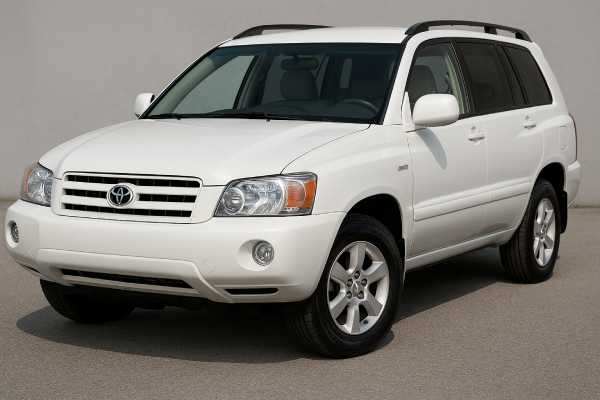
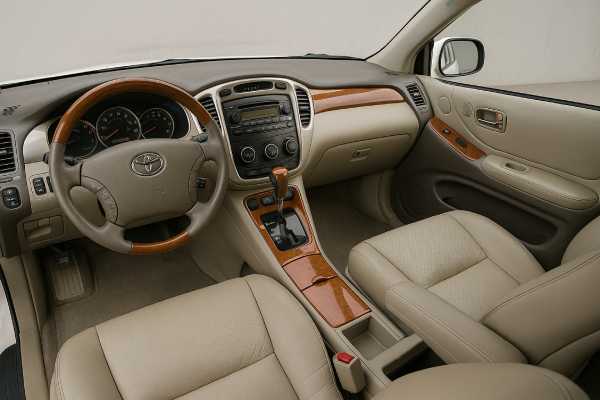
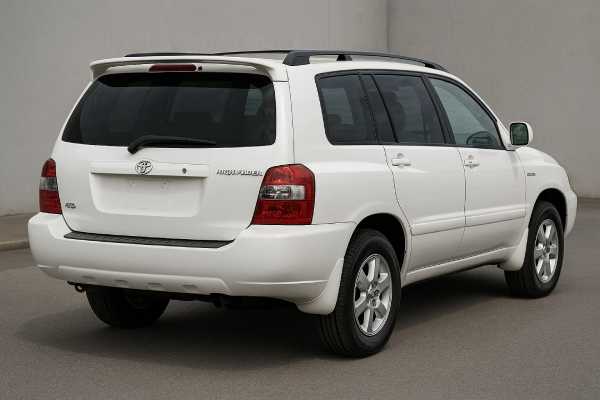
The 2006–2007 facelift Toyota Highlander 4WD (ACU25) with the 2AZ-FE 2.4-liter engine sits in a sweet spot for owners who want the durability of the Camry-based platform but also need extra traction for snow, wet roads, or light trails. Compared with the FWD version, the 4WD layout adds a rear differential and a viscous-coupling–type system that quietly sends torque to the rear axle when the front wheels slip. Power is modest at 155 hp, but the powertrain is simple, chain-driven, and proven. The cabin still offers family-friendly space, optional three-row seating, and straightforward controls that age well. Where this model really shines is total ownership effort: most critical services are DIY-friendly, parts are widely available, and common issues are well documented. If you want a first-gen Highlander that can confidently leave the pavement in winter without jumping to the thirstier V6, this is the one.
Fast Facts
- All-wheel-capable layout (ACU25) improves traction over FWD while keeping car-like road manners.
- 2AZ-FE 2.4-liter, 155 hp (116 kW) engine is chain-driven and easy to service.
- Stability control, ABS with EBD, and side/curtain airbags widely available after the facelift.
- Watch for age-related 2AZ-FE oil consumption and service history gaps on AWD fluids.
- Typical oil change: 5,000 miles / 6 months with correct API grade.
What’s inside
- Highlander 2.4 4WD detailed overview
- Specifications and technical data
- Trims, safety and driver assistance
- Reliability, common issues and service actions
- Maintenance and buyer’s guide
- Driving and performance
- How it compares to rivals
Highlander 2.4 4WD detailed overview
When Toyota added four-wheel capability to the four-cylinder Highlander, the goal was not rock-crawling but all-weather security. The ACU25 variant takes the same Camry-based XU20 structure and adds a driveshaft to the rear, a rear differential, and a coupling system that can send torque backward when the front wheels begin to slip. You get the confident, high-seating crossover feel, plus traction in slushy shoulders, gravel drives, and winter commuting. Because the system is mostly automatic, drivers do not have to select a mode or worry about engaging 4WD at speed.
The 2AZ-FE engine is identical in broad specification to the FWD version: a 2.4-liter, DOHC, 16-valve aluminum inline-four with VVT-i on the intake side and a chain-driven timing system. Rated at 155 hp, it is not a powerhouse, and the added AWD weight (and extra driveline drag) makes the 4WD model slower than the FWD equivalent. Still, the character is smooth and predictable, especially when paired with the conservative 4-speed automatic. Drivers who keep to normal suburban speeds and who value stability on wet highways will find the power adequate.
Cabin packaging remains one of the Highlander’s advantages. The tall roof, large glass area, and low, flat load floor make it easy to load strollers, DIY materials, or band gear. Five-seat layouts are the most comfortable for adults, but seven-seat versions were available, mainly for families that only occasionally need the third row. The facelift (2006) refined interior trim pieces, updated audio, and, crucially, brought more vehicles with side and curtain airbags plus stability control—very important on an AWD family SUV.
From an ownership perspective, the 4WD Highlander is just as approachable as the FWD one, but with two extra items to remember: transfer/center unit fluid and rear differential fluid. Both should be inspected and serviced on a repeatable schedule, especially if the vehicle has towed, been used in snow, or lived where road salt accelerates corrosion on vent tubes and fasteners. Otherwise, it is the same reliable, easy-to-live-with crossover that gave Toyota a dominant position in the segment.
Specifications and technical data
Engine and performance (ICE-only)
| Item | Detail |
|---|---|
| Engine code | 2AZ-FE |
| Configuration | Inline-4, aluminum block and head, DOHC, 16 valves |
| Displacement | 2.4 L (2,362 cc) |
| Induction | Naturally aspirated |
| Fuel system | Sequential multi-port fuel injection (SFI) |
| Compression ratio | ≈ 9.6–9.8:1 |
| Max power | 155 hp (116 kW) @ ~5,600 rpm |
| Max torque | ~220 Nm (162 lb-ft) @ ~4,000 rpm |
| Timing drive | Chain (no routine belt service) |
| Emissions/fuel economy | Approx. 18–22 mpg US combined depending on use (13.1–10.7 L/100 km) |
| Real-world highway @ 120 km/h (75 mph) | Typically 21–23 mpg US (11.2–10.2 L/100 km) due to AWD drag |
| Aerodynamics | Cd around 0.34–0.35, body dependent |
Because the AWD system adds mass and rotating components, fuel economy is slightly lower than on the FWD ACU20. Drivers in cold climates, with winter tires, or with roof racks may see numbers slip into the high teens mpg.
Transmission and driveline
| Item | Detail |
|---|---|
| Transmission | 4-speed automatic, electronic control (typical U241F / AWD variant) |
| Drive system | Full-time/on-demand-style 4WD with center coupling to rear axle |
| Front differential | Integrated with transaxle |
| Rear differential | Standalone rear final drive, open type |
| Final drive ratio | Varies by build; AWD often slightly shorter than FWD |
| Traction/stability | TRAC and VSC coordinate brake application to manage wheelspin |
| Refuel to full | ~5 minutes (gasoline) |
How the system works: Under normal conditions drive is primarily to the front wheels, but when slip is detected, torque is sent to the rear through the coupling. Stability control can also brake spinning wheels to make the most of available traction.
Chassis and dimensions
| Item | Detail |
|---|---|
| Platform | XU20 Highlander / Kluger unibody |
| Suspension (front) | MacPherson strut, lower A-arm |
| Suspension (rear) | MacPherson strut, trailing links |
| Steering | Power-assisted rack-and-pinion |
| Brakes | Front ventilated disc; rear solid disc; ABS with EBD and Brake Assist |
| Wheels/tires | Commonly 225/70R16; some trims with 17 in alloy |
| Ground clearance | ~185 mm (7.3 in) |
| Length | ~4,689 mm (184.6 in) |
| Width | ~1,826 mm (71.9 in) |
| Height | ~1,700–1,750 mm (67–69 in) depending on roof rails |
| Wheelbase | 2,715 mm (106.9 in) |
| Turning circle | ≈ 11.4–11.6 m (37.4–38.0 ft) |
| Curb weight | Heavier than FWD: roughly 1,700–1,780 kg (3,750–3,920 lb) depending on seats |
| GVWR | Check door-jamb label; typically 2,300–2,400 kg (5,070–5,290 lb) |
| Fuel tank | 72.5 L (19.1 US gal / 15.9 UK gal) |
Performance and capability
| Metric | Value |
|---|---|
| 0–100 km/h (0–62 mph) | ~12.0–12.5 s (AWD, loaded) |
| Top speed | ~175–180 km/h (108–112 mph) |
| Braking 100–0 km/h | Dependent on tire quality and rotor condition; ABS standard |
| Towing capacity | 1,500 lb (680 kg) typical; up to ~3,000 lb (1,360 kg) with tow package/cooling |
| Payload | ~390–520 kg (860–1,150 lb) depending on seat and options |
| Roof load | Follow OE rails/crossbar limits; often 68–75 kg (150–165 lb) max while moving |
Fluids and service capacities
| System | Specification / Notes |
|---|---|
| Engine oil | 5W-30 (check cap/manual); ≈ 4.3–4.5 L (4.5–4.8 US qt) with filter |
| Engine coolant | Toyota Super Long Life Coolant (pink), premixed; ≈ 6–7 L |
| Automatic transmission | Toyota ATF WS; level set at temperature via overflow method |
| Transfer/center unit | Toyota hypoid gear oil or ATF per service manual for ACU25 AWD unit; change at 60,000–90,000 miles if driven in snow/towing |
| Rear differential | 75W-90 GL-5 (Toyota spec); change 60,000–90,000 miles or sooner in severe use |
| Brake fluid | DOT 3 |
| A/C refrigerant | R-134a (see under-hood label) |
| Key torque specs | Wheel lugs ~103 Nm (76 lb-ft); drain plug ~37 Nm (27 lb-ft) |
Electrical
| Item | Detail |
|---|---|
| Alternator | Output sufficient for HVAC, heated mirrors, rear defogger, and 4WD electronics |
| 12V battery | Maintenance-free group size per build; test annually in cold climates |
| Spark plugs | Long-life iridium, gap ≈ 1.0–1.1 mm (0.039–0.043 in) |
Safety and driver assistance
- Dual front airbags, front seat-mounted side airbags, and front/rear side curtain airbags widely available on 2006–2007 units.
- ABS with Electronic Brakeforce Distribution and Brake Assist standard.
- Vehicle Stability Control (VSC) and Traction Control (TRAC) fitted on most AWD units; especially valuable on snow/ice.
- LATCH points for second-row child seats; verify the third-row belt routing if equipped.
- Headlight performance is halogen-based; aim and bulb quality influence results strongly.
Trims, safety and driver assistance
For these years, the 2.4-liter Highlander with 4WD was generally aligned with the Base equipment grade, while V6 and Hybrid models offered Sport and Limited trims with more content. That makes AWD four-cylinders pleasantly uncomplicated: one core powertrain, a small group of option packages, and few mechanical surprises.
Typical AWD 2.4 equipment set:
- 4WD/AWD driveline (ACU25) with automatic engagement.
- 16-inch wheels with all-season tires.
- Fabric seats, manual front seat adjustment.
- Manual A/C; some with rear ventilation when the third row is present.
- Power windows/locks, remote keyless entry, tilt steering, cruise control on many builds.
- Audio: CD player, 6 speakers; JBL or upgraded head unit available as option.
- Second-row 60/40 split and tumble; optional third row (50/50) with fold-flat function.
Option and package differences that matter:
- Third-row/7-passenger package: adds seating, sometimes rear HVAC outlets; slightly higher curb weight.
- Cold-weather/winter: heated mirrors, possibly heated front seats, and more corrosion exposure—check brake and subframe condition.
- Tow or heavy-use prep: extra cooling, hitch, and wiring—desirable if you plan to tow up to 3,000 lb.
Safety and crash test context:
Facelifted Highlanders from this period earned solid results in frontal tests and good structural scores for their class. Side-impact performance depends heavily on having both seat-mounted side airbags and side curtain airbags—buyers should visually confirm the presence of airbags (labels on seats and B-pillars) and run the VIN through the official recall portal for any outstanding safety campaigns. Stability control was a strong addition for these years and is especially worthwhile on 4WD models with winter tires.
Driver assistance and calibrations:
This generation predates camera- and radar-based ADAS like automatic emergency braking or lane keeping. Instead, it relies on a sensor-based VSC system tied to wheel-speed sensors, steering-angle sensor, and a yaw sensor. After suspension or steering work, a zero-point calibration may be required to restore proper VSC operation. ABS/VSC lights after hub/brake service usually trace back to a damaged wheel-speed sensor or corroded tone ring—address these before parts swapping.
Year-to-year notes (2006 → 2007):
- More vehicles in 2007 have tire pressure monitoring.
- Airbag and stability equipment became more standardized.
- Audio/head-unit updates and minor trim changes appear; none alter the AWD hardware.
Reliability, common issues and service actions
The AWD four-cylinder Highlander is typically a high-mileage survivor, but adding the rear driveline introduces two more service points. Most in-service failures that owners report come down to age, neglected fluids, or well-known 2AZ-FE traits.
1. Engine-related
- Oil consumption (common, medium cost): Many 2AZ-FE engines of this era can develop elevated oil use because of piston ring design and deposit formation. Symptom: oil level drops between 5,000-mile services, sometimes a quart every 1,200 miles. Remedy: perform official consumption test, verify PCV function, clean or replace PCV, and where applicable apply the updated piston/ring repair from the service bulletin. In mixed driving, disciplined level checks largely neutralize the issue.
- Valve cover/timing cover seep (occasional, low cost): Oil film down the front of the engine. Remedy: reseal during other top-end work.
- Throttle body and IAC deposits (occasional): Rough idle, minor shift flare because engine load values are off. Remedy: clean throttle body and perform idle relearn.
2. Transmission and AWD
- ATF aging (occasional): Even though Toyota listed WS fluid as “lifetime” in some documentation, age, heat, and moisture all degrade it. Harder shifts or delayed engagement are cues to do a gentle drain-and-fill and recheck in 1,000 miles.
- Rear differential / transfer unit neglect (common in snowy regions): Hum or growl from rear, or fluid that drains out dark and metallic. Remedy: change fluids with correct Toyota specs at 60,000–90,000 miles, sooner if towing or in deep snow. Inspect vent tubes for clogging, which can force fluid past seals.
- Front axle/CV boot wear (age-related): Steering shudder on lock or grease sling inside the wheel. Remedy: reboot or replace half-shaft.
3. Suspension and brakes
- Strut mount noise (common): Clunks over speed bumps; ride still acceptable. Remedy: strut assemblies and top mounts, preferably in matched pairs.
- Rear control arm or bushing wear (occasional): Uneven tire wear or wandering. Remedy: replace worn bushings/arms and align.
- Brake rotor corrosion (climate-dependent): Pulsation and rusty hats. Remedy: quality rotors/pads and correct lug torque.
4. Electrical/HVAC
- Blower motor or resistor (occasional): Loss of fan speeds or noise.
- Oxygen sensors (age): MIL on with mixture/catalyst codes. Use OE-grade sensors to avoid repeat repairs.
5. Recalls, TSBs, warranty extensions
- 2AZ-FE oil consumption TSB: important for high-mileage vehicles—check via VIN and dealer history.
- Airbag/seat belt and other safety campaigns: run a current VIN check on the official portal; don’t assume completion.
- VSC/ABS sensor concerns: check for TSBs on zero-point calibration or sensor replacement after suspension work.
Pre-purchase requests
- Ask for a full oil-change log (dates and mileages), not just stamps.
- Request proof of AWD/transfer and rear diff fluid service—this is often missing.
- Inspect underbody for rust on the rear subframe, brake lines, and fasteners.
- Confirm that ABS, VSC, TRAC, and TPMS lights all go out after startup.
- On a road test, do tight circles in a parking lot to listen for CV or rear-diff noises.
Maintenance and buyer’s guide
A small, repeatable maintenance plan keeps the ACU25 AWD Highlander trouble-free. The idea is to keep engine oil clean (mitigating consumption risk), refresh all AWD fluids on time, and stay ahead of cooling and brake-service items that fail with age.
Suggested maintenance schedule (practical)
- Engine oil and filter: Every 5,000 miles / 6 months. Use the recommended viscosity (commonly 5W-30) and a quality filter. Check level monthly.
- Engine air filter: Inspect 15,000 miles / 12 months, replace 30,000–45,000 miles.
- Cabin air filter: Replace 15,000–20,000 miles / 12–18 months.
- Coolant (Toyota SLLC): Factory long-life interval 100,000 miles / 10 years, then 50,000 miles / 5 years. Inspect hoses at every oil change after year 10.
- Spark plugs (iridium): 120,000 miles / 10–12 years. Check for oil in plug tubes.
- Serpentine belt: Inspect 30,000 miles / 3 years; replace 60,000–90,000 miles or at first cracking.
- Automatic transmission (ATF WS): Drain-and-fill 60,000–90,000 miles as a proactive measure.
- Transfer/center unit and rear differential: Change 60,000–90,000 miles; reduce to 45,000–60,000 miles if towing or frequent snow operation.
- Brake fluid: Replace every 3 years.
- Brake inspection: At each tire rotation; lube slide pins, check backing plates for corrosion.
- Tire rotation and alignment: Rotate 5,000–7,500 miles to prevent cupping on AWD; align annually.
- 12V battery: Test annually after 3 years; replace at signs of slow cranking.
- Throttle body/PCV cleaning: 60,000–90,000 miles.
Fluid specs (quick view)
- Engine oil: 5W-30, ~4.3–4.5 L
- ATF: Toyota WS
- Transfer/rear diff: Toyota gear oil 75W-90 GL-5 (per manual)
- Coolant: Toyota SLLC pink
- Brake: DOT 3
- Wheel lug torque: ~103 Nm (76 lb-ft)
Buyer’s checklist
- Underbody: Look for rust on rear diff, subframe, and fuel/brake lines (AWD components can rust faster).
- AWD operation: On a wet or gravel surface, accelerate moderately—there should be no grinding or severe delay in rear engagement.
- Oil consumption: Ask the seller point-blank: “How often do you add oil between changes?” Any answer other than “never” means you will need to monitor.
- Cooling system age: Original radiator, hoses, and water pump around 15–18 years old are due.
- Suspension: Knock over bumps or uneven tire wear suggests immediate reconditioning.
Best years/trims to seek
- 2006–2007 AWD 2.4 with stability control and curtain airbags.
- Documented fluid services and recent brakes/cooling.
- Optional third row only if you really need it.
Durability outlook:
With this plan, a Highlander 4WD (ACU25) can realistically see 200,000–300,000 miles of service. The limiter is seldom the engine or transmission—it is corrosion, neglected AWD fluids, and owners ignoring low oil levels.
Driving and performance
The ACU25’s driving personality is calm and secure. Ride quality is tuned for families: compliant over potholes, not floaty, and with good isolation from tire impacts. The extra weight of the AWD hardware is noticeable mainly in how the vehicle squats on acceleration and in slightly slower steering response, but the Highlander still feels more car-like than traditional body-on-frame SUVs.
Powertrain character:
The 2AZ-FE pulls cleanly from low rpm but must rev to make meaningful power. With the 4-speed automatic, kickdowns are logical and predictable, but the transmission will not mask the fact that you have 155 hp moving close to two tons. Passing at highway speeds requires planning, and long grades may trigger repeated downshifts. The upside is that this transmission family is robust, simple to service, and well understood by independent shops.
All-weather traction:
On snow, wet leaves, and gravel, the AWD Highlander is genuinely confidence-inspiring. The system engages smoothly—no clunks, no driver input. Vehicle Stability Control keeps things straight if you lift in a corner or hit a slick patch. Good all-season or winter tires make more difference than anything else; the AWD system only works with the grip the tires can deliver.
Efficiency:
Expect 18–22 mpg US mixed (13.1–10.7 L/100 km). City stop-and-go, winter warmups, roof boxes, and off-brand tires will push you to the lower end. Highway at 65–70 mph can still show 23–24 mpg (10.2–9.8 L/100 km) if the vehicle is healthy, aligned, and lightly loaded.
Towing and load behavior:
With the standard 1,500 lb rating, the Highlander 4WD tows small utility or camping trailers without drama, and the extra driven axle improves stability on wet ramps. At the higher ~3,000 lb rating (with proper package), braking distances increase and transmission temperatures run higher; stick to conservative speeds and service the ATF and AWD fluids afterward. Fuel consumption can rise 20–30% under moderate tow.
NVH:
Even at this age, well-maintained examples stay quiet. What you will hear is worn strut mounts or cupped tires—both common, both fixable. Fresh engine mounts and good tires restore the original refinement.
How it compares to rivals
Versus Highlander 2.4 FWD (ACU20):
The 4WD ACU25 trades a small amount of performance and economy for much better winter confidence. If you live where it snows, or you tow on wet ramps, the 4WD is the smarter choice. If you live in a warm, flat region, the FWD is cheaper to run.
Versus Highlander V6 AWD:
The V6 is clearly quicker and tows better, but it is thirstier and has more cylinders, more ignition components, and, in some cases, a different service profile. For commuters and light-duty family users, the 2.4 4WD gives you 80–90% of the capability with lower fuel bills.
Versus Honda CR-V (2006–2007) and Toyota RAV4 (2006–2007):
Both are smaller. The Highlander wins on cabin width, seat height, and highway composure. The RAV4 V6 will outrun it, but the Highlander rides better loaded.
Versus Honda Pilot (2006–2008):
The Pilot has more V6 power and seating, but runs a timing belt and uses more fuel. For buyers who don’t need genuine eight-seat capacity, the Highlander 4WD is easier to park and service.
Versus Subaru Outback/Forester (contemporary):
Subaru’s full-time AWD is excellent, but cargo height and three-row flexibility favor the Highlander. Toyota’s parts availability and long-term corrosion performance (outside severe salt areas) also appeal to used buyers.
Bottom line:
If the mission is “carry family, drive year-round, spend little, fix easily,” the 2006–2007 Toyota Highlander 4WD (ACU25) is unusually well aligned. Its few weak points—oil consumption and neglected AWD fluids—are known, diagnosable, and fixable.
References
- Toyota Owner’s Manuals 2007 (Owner’s Manual)
- 2007 Toyota Highlander 2007 (Fuel Economy)
- 2007 Toyota Highlander 2007 (Safety Rating)
- Toyota Safety Recall and Service Campaign Lookup (Recall Database)
Disclaimer
This article is for informational purposes only. It is not a substitute for professional diagnosis, repair procedures, or safety inspections. Specifications, torque values, service intervals, and even available equipment can vary by VIN, production date, market, and installed options. Always confirm against the official Toyota service information and current technical bulletins before performing work.
If this guide helped you, please share it with other Highlander owners on Facebook or X/Twitter to support xcar’s work.