
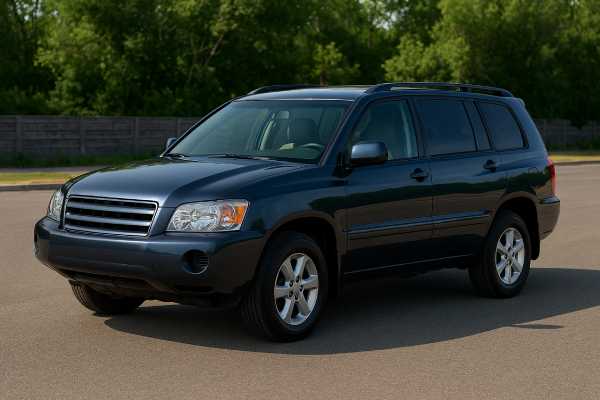
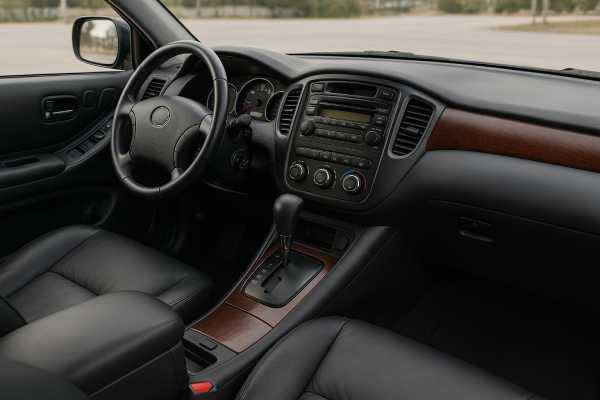
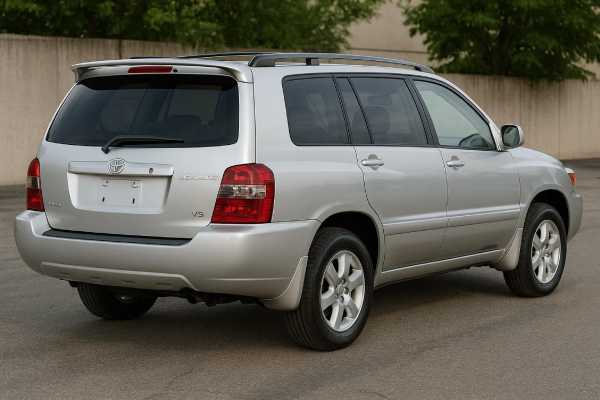
The facelifted first-generation Toyota Highlander with the 2AZ-FE 2.4-liter four-cylinder is the pragmatic pick of the range. In 2006–2007 form, it blends a durable transverse FWD layout, roomy cabin packaging for five or seven passengers, and straightforward serviceability. The 155-hp four isn’t fast, but it’s smooth, thrifty for its class, and teamed to a conventional 4-speed automatic that favors longevity over novelty. Safety remains a strong suit for the era, and the post-refresh interior brought better materials and features like standard stability control on most builds. Owners value the low running costs and the way the Highlander shrugs off hard family miles when maintained on time. If you need an honest, easy-to-own midsize crossover for commuting, school runs, and light road trips, the 2.4 FWD Highlander remains a sensible short list candidate.
At a Glance
- Proven 2AZ-FE four-cylinder and simple 4-speed automatic keep long-term costs low.
- Spacious, flexible cabin; flat load floor and useful third-row option.
- Stability control, side and curtain airbags common; solid crashworthiness for its era.
- Watch for 2AZ-FE oil consumption on high-mileage engines; verify TSB work and monitor levels.
- Typical engine oil interval: 5,000 miles / 6 months (use API-approved oil and correct viscosity).
Navigate this guide
- Highlander 2.4 FWD overview
- Highlander 2.4 specs and data
- Highlander trims, safety and ADAS
- Reliability and common issues
- Maintenance and buyer’s guide
- Driving, performance, efficiency
- Rivals and market context
Highlander 2.4 FWD overview
Toyota’s first-generation Highlander (chassis family XU20; FWD code ACU20) helped define the modern, car-based midsize SUV. The 2006 refresh sharpened the styling and simplified the lineup while maintaining the underlying Camry-derived hardware owners appreciate for reliability. The 2AZ-FE 2.4-liter inline-four makes 155 hp (116 kW) and pairs with a 4-speed automatic. While six-cylinder models exist, the four-cylinder FWD is the budget-friendly sweet spot: fewer components, less weight over the nose, and better real-world economy. Factor in lower insurance and tire costs compared with larger, heavier rivals and it adds up to a smart daily-driver equation.
Inside, the Highlander’s square-shouldered body aids visibility and cargo utility. Most FWD four-cylinder examples seat five; a compact third row was optional in many markets, raising capacity to seven for short trips. With the 2006–2007 facelift, stability control and side/curtain airbags became common, and the cabin gained subtle trim updates and additional small-item storage. Ride tuning leans comfort, with long-travel MacPherson struts at both ends soaking up broken pavement well.
Ownership strengths are predictable: straightforward service access (spin-on oil filter location, under-tray with large service ports), a timing chain rather than a belt, and long-life fluids (Toyota Super Long Life Coolant, iridium spark plugs). The platform accepts modest DIY tasks—engine and cabin filters, front brakes, serpentine belt—without drama. The biggest decision is whether you need AWD; in mild climates and mostly-paved use, the FWD variant saves fuel and complexity while remaining sure-footed with good all-season tires.
Highlander 2.4 specs and data
Engine and performance
| Item | Detail |
|---|---|
| Code | 2AZ-FE (inline-4, DOHC, VVT-i) |
| Displacement | 2.4 L (2,362 cc) |
| Induction / Fuel | Naturally aspirated / Sequential multi-port fuel injection |
| Valvetrain | DOHC, 16 valves (4 per cyl) |
| Compression ratio | ~9.6–9.8:1 (typical 2AZ-FE) |
| Max power | 155 hp (116 kW) @ ~5,600 rpm |
| Max torque | ~220 Nm (162 lb-ft) @ ~4,000 rpm |
| Timing drive | Chain |
| Emissions/fuel economy (EPA) | 22 mpg combined; 19 city / 25 highway (10.7 L/100 km combined) |
| Aerodynamics | Cd ≈ 0.34 |
Real-world economy (typical): mixed 22–25 mpg US (10.7–9.4 L/100 km) at moderate speeds with proper maintenance and tires. Cold weather and short trips can lower figures.
Transmission and driveline
| Item | Detail |
|---|---|
| Transmission | 4-speed automatic, electronically controlled (ECT), typical unit U241E |
| Drive type | FWD (transverse) |
| Differential | Open front; brake-based traction and stability control |
| Final drive | FWD gearing matched to economy; verify by VIN/build data |
| Refuel time | ~5 minutes (gasoline) |
Chassis and dimensions
| Item | Detail |
|---|---|
| Platform | XU20 (Camry-based unibody) |
| Suspension | MacPherson strut (front); MacPherson strut (rear) |
| Steering | Rack-and-pinion with power assist |
| Brakes | Front ventilated disc; rear solid disc; ABS with EBD and Brake Assist |
| Wheels/tires (typical) | 225/70R16 (4-cyl); alloy options by trim |
| Ground clearance | ~185 mm (7.3 in) |
| Length | ~4,689 mm (184.6 in) |
| Width | ~1,826 mm (71.9 in) |
| Height | ~1,690–1,745 mm (66.5–68.7 in), roof rack dependent |
| Wheelbase | 2,715 mm (106.9 in) |
| Turning circle | ~11.4 m (37.4 ft) |
| Fuel tank | 72.5 L (19.1 US gal / 15.9 UK gal) |
| Cargo volume* | Generous, flat load floor; third row folds flush (if equipped) |
*Cargo measurement method varies by seat configuration; verify to SAE/VDA standards as applicable.
Performance and capability
| Metric | Figure (typical) |
|---|---|
| 0–100 km/h (0–62 mph) | ~11–12 s (driver, load, and conditions dependent) |
| Top speed | ~175–180 km/h (108–112 mph), electronically limited by gearing/tires |
| Braking 100–0 km/h | Sizable front rotors and ABS deliver stable stops; distance varies with tire condition |
| Towing capacity | 680 kg (1,500 lb) standard; up to ~1,360 kg (3,000 lb) when equipped with tow package (engine/trans cooling and hitch) |
| Payload | See door-jamb label; typical “vehicle capacity weight” approx. 390–526 kg (860–1,159 lb) depending on seats |
Fluids and service capacities
| System | Spec / Capacity |
|---|---|
| Engine oil | API grade; typical 5W-30 (check cap/manual); ~4.3–4.5 L (4.5–4.8 US qt) with filter |
| Coolant | Toyota Super Long Life Coolant (pink, pre-mix 50/50); capacity ~6–7 L (6.3–7.4 US qt) |
| Automatic transmission | Toyota Genuine ATF WS; drain/refill quantity varies by service method |
| Brake fluid | DOT 3 (Toyota spec) |
| A/C refrigerant | R-134a (charge quantity per label under hood) |
| Key torque values | Oil drain plug ≈ 37 Nm (27 lb-ft); wheel lug nuts ≈ 103 Nm (76 lb-ft) |
Electrical
| Item | Detail |
|---|---|
| Alternator | Amperage varies by equipment; sized for HVAC and defroster loads |
| 12V battery | Group size per build; maintenance-free; test annually in cold climates |
| Spark plugs | Iridium (long-life); gap ~1.0–1.1 mm (0.039–0.043 in) |
Safety and driver assistance
- Crash testing: Strong moderate-overlap performance for the era; head-restraint/seat whiplash protection rated marginal.
- Airbags: Dual front, front seat-mounted side, and front/rear curtain airbags commonly fitted on facelift models.
- Active safety: ABS with EBD and Brake Assist; Vehicle Stability Control (VSC) with traction control (TRAC) widely equipped; tire pressure warning on many 2007 models.
- Child seats: LATCH lower anchors and top tether points; check positions for third-row vehicles.
- Headlight performance: Halogen reflectors; aim adjustment and fresh bulbs improve output.
Highlander trims, safety and ADAS
U.S./Canada lineup (2006–2007): The four-cylinder FWD Highlander was typically sold in the Base trim. V6 models added Sport and Limited grades with larger wheels and additional convenience features. That simplifies shopping: for the 2.4 FWD, most equipment differences center on seat count (5 vs. 7), audio options, and cosmetic packages rather than mechanical changes.
Base identifiers (2.4 FWD):
- 16-inch wheels with 225/70R16 tires (steel or alloy by package).
- Manual A/C (automatic climate control became more common with option packages).
- Five passengers standard; optional compact third row for seven.
- Stability control (VSC/TRAC), ABS/EBD/Brake Assist on most facelift cars; confirm by feature list and dashboard indicators.
- Fabric seating; simple instrument cluster; outside temperature readout varies by package.
Option/package highlights (market dependent):
- Third-row seat package: Adds 50/50 split folding rear bench and rear HVAC ducting.
- Audio tiers: Base 6-speaker CD; premium JBL upgrades on higher trims and packages.
- Convenience adds: Power driver seat, heated front seats (cold-weather packages), moonroof on some bundles.
Functional/Mechanical differences by trim:
- The 2.4 FWD Highlander uses the same core suspension and brake layout across Base equipment; wheel/tire packages and curb mass shift ride/handling modestly.
- Tow package availability and rating vary; factory towing prep adds cooling capacity and wiring.
Safety ratings (facelift years):
- Frontal moderate overlap: Good overall structure and injury measures for driver.
- Head restraints & seats: Marginal whiplash protection in IIHS testing typical of the era.
- Side impact: Performance depends on presence of side and curtain airbags; verify equipment.
- TPMS: Many 2007 vehicles have a tire-pressure warning light; confirm with ignition-on bulb check.
ADAS and calibration notes:
- These models predate camera/radar ADAS. Stability control uses yaw rate and wheel-speed sensors; after suspension or steering work, a zero-point calibration (steering angle/yaw) may be needed using a compliant scan tool.
- ABS/VSC sensor ring corrosion or wiring damage after hub work can trigger warning lights; inspect connectors and tone rings during brake service.
- Airbag system: Always disconnect the battery and observe SRS wait times before seat or trim removals.
Year-to-year changes affecting equipment:
For 2006–2007, stability control and side/curtain airbags became common on non-hybrid models in North America, and a tire-pressure warning system appears on many 2007 builds. Always decode the VIN and inspect the option sticker or window label in the service packet to confirm.
Reliability and common issues
The 2.4-liter FWD Highlander has an excellent reputation when serviced on time. Most examples exceed 200,000 miles with routine consumables. That said, certain age- and mileage-related issues recur:
Engine (2AZ-FE)
- Oil consumption (common; medium severity): High-mileage engines may consume oil due to piston ring wear/sludge in early 2AZ builds. Symptoms include frequent top-offs between oil changes, plug fouling, or blue smoke on startup. Remedy: confirm consumption rate (e.g., quart/1,200 mi threshold), perform official consumption test procedure, and apply the piston/ring update where applicable. Many vehicles previously received a warranty enhancement/TSB correction; verify by records.
- Valve cover and timing cover seep (occasional; low severity): Oil film on the timing cover or valve cover perimeter. Remedy: reseal using updated sealant/ gasket during spark-plug or chain-tensioner service.
- Cooling system aging (occasional; low–medium): Plastic tanks on radiators can weep, and original hoses harden around the 15-year mark. Remedy: preventive radiator and hose replacement, coolant exchange with Toyota SLLC, and new cap.
Transmission/driveline
- 4-speed automatic longevity: Typically robust with WS fluid and normal loads. Occasional shift flare or harshness may track to old fluid or throttle-body deposits confusing load signals. Remedy: staged drain-and-fill (not power flush), throttle-body cleaning, and ECM adaptive reset when appropriate.
- Axle seals and CV boots (age-related): Inspect for sling on subframes; replace boots or half-shafts as needed.
Chassis/suspension
- Strut mounts and bushings (common with age): Clunks over sharp bumps or steering shudder at parking speeds. Remedy: strut assemblies and top mounts; consider all four corners if mileage is high.
- Wheel bearings (occasional): Growl that changes with steering load; replace hub assemblies.
- Rust hotspots (region-dependent): Rear subframe fasteners, exhaust flanges, and brake backing plates in salted climates. Remedy: underbody inspection; anti-corrosion treatment and hardware replacement.
Brakes
- Pulsation and corrosion (common in rust belts): Front rotors can develop thickness variation; rear rotor hats rust. Remedy: quality rotors/pads, proper torque on lugs (avoid impact-gun over-torque), and periodic brake-fluid exchanges.
Electrical/HVAC
- Blower motor resistors or fan noise (occasional): Aged bearings cause squeaks; replace blower assembly or resistor pack if speeds fail.
- Oxygen sensors/catalyst efficiency codes (age-related): Use OEM-quality sensors; check for exhaust leaks before condemning the catalyst.
Recalls/Service actions to verify
- Airbag/seat or hybrid-specific items: Use the VIN recall portal to confirm completion; hybrid inverter campaigns do not apply to the 2.4 FWD but can appear on mixed model searches.
- 2AZ engine oil consumption warranty enhancement/TSB: Confirm by dealer records; not a recall but important.
Pre-purchase checklist
- Warm compression and idle vacuum (if testing), crankcase pressure check if consumption suspected.
- Service history with oil changes at 5,000-mile intervals and coolant at the long-life schedule.
- Transmission fluid color/smell; staged drain-and-fills noted.
- Suspension wear items, brake rotor condition, and any ABS/VSC warning lights.
- Underbody corrosion inspection, especially rear subframe and brake lines.
- Verify third-row hardware (if fitted), seat belts, and LATCH anchor integrity.
Maintenance and buyer’s guide
Baseline service plan (practical):
- Engine oil & filter: Every 5,000 miles / 6 months with API-approved oil (commonly 5W-30 for this era). Check level monthly; top off as needed.
- Engine air filter: Inspect 15,000 miles / 12 months; replace 30,000–45,000 miles (sooner in dusty regions).
- Cabin air filter: Replace 15,000–20,000 miles / 12–18 months.
- Coolant (Toyota SLLC, pink): Factory fill often rated to 100,000 miles / 10 years initial, then 50,000 miles / 5 years thereafter. Inspect level and cap at each oil change.
- Spark plugs (iridium): 120,000 miles / 10–12 years. Verify gap and coil-boot condition.
- Serpentine (aux) belt: Inspect 30,000 miles / 3 years; replace 60,000–90,000 miles or if cracked/noisy.
- ATF (WS): No fixed interval specified under “normal” conditions. For longevity, a drain-and-fill every 60,000–90,000 miles is a prudent owner practice; avoid power flushing.
- Brake fluid (DOT 3): Replace every 3 years; more often in humid climates.
- Brake pads/rotors: Inspect at every tire rotation; measure rotor thickness/ runout.
- Power steering system: Inspect pump/hoses for seep; top with Toyota-specified fluid if applicable.
- Wheel alignment & tire rotation: Rotate 5,000–7,500 miles; align annually or after any suspension work/tire replacement.
- 12V battery: Load-test annually after year three; typical life 4–6 years.
- PCV valve & throttle body: Clean 60,000–90,000 miles to stabilize idle/shift feel.
- Timing chain: No scheduled replacement; inspect for rattle, correlation codes (VVT/CKP-CMP), and tensioner seep—address if symptoms present.
Fluid specs and quick references
- Oil: 5W-30 (check cap/manual for viscosity updates); capacity ~4.3–4.5 L with filter.
- Coolant: Toyota Super Long Life Coolant (pink, premixed).
- ATF: Toyota WS.
- Brake fluid: DOT 3.
- A/C: R-134a; charge per under-hood label.
- Spark plug gap: ~1.0–1.1 mm (0.039–0.043 in).
- Torque essentials: Oil drain plug ~37 Nm (27 lb-ft); wheel lugs ~103 Nm (76 lb-ft).
Buyer’s guide: what to seek/avoid
- Best bets: Clean, one-owner Base 2.4 FWD with documented 5k-mile oil changes, transmission drain-and-fills, and recent cooling/brake service. Third-row is a plus if you occasionally need seven seats; otherwise, five-seat models offer more cargo space and slightly lower weight.
- What to avoid: Neglected examples with frequent low-oil warnings, VSC/TRAC/ABS lights on, or uneven tire wear (alignment/suspension issues).
- Negotiation checklist: Date-stamped service receipts, proof of coolant and plug replacement, status printout from the VIN recall tool, and any TSB documentation related to 2AZ oil consumption.
- Durability outlook: With attentive maintenance, expect 200k–300k miles of reliable service. Most replacements will be consumables (struts, bushings, brakes, radiator, alternator) rather than core engine or transmission failures.
Driving, performance, efficiency
Ride, handling, NVH: The Highlander prioritizes comfort. Long-stroke struts and compliant bushings deliver a plush ride over cracked city pavement and highway expansion joints. Body motions are well-controlled if you stay within the tire’s grip envelope. Steering is light and consistent, trading on-center feel for easy parking-lot maneuvering. Wind and road noise are moderate for the class; engine noise is subdued at cruise but rises under full throttle.
Powertrain character: The 2AZ-FE’s torque curve is friendly to everyday driving. Off-idle response is smooth, and the four-speed automatic avoids busy hunting thanks to tall second and third ratios. Kickdown is predictable; manual “2” and “L” gates help with engine braking on grades. There’s no turbo lag to manage, and throttle calibration is conventional. Cold starts are quick; warm restarts are instant.
Performance metrics that matter:
Expect ~11–12 seconds 0–60 mph (driver, load, grade, and weather affect results). Passing from 50–70 mph takes planning on steep grades, but downshifts land the engine in its useful midrange. Braking pedal feel is reassuring, and stability control is conservative on wet surfaces—intrusive to some, but confidence-building for most.
Efficiency in the real world:
Owners typically see 22–25 mpg US mixed. Highway numbers in the 26–28 mpg range are attainable at 65–70 mph with light cargo, proper tire pressure, and fresh filters. At 75 mph (120 km/h), expect a 1–2 mpg drop. Winter blend fuel, short trips, and remote starts will further reduce economy. Proper wheel alignment and rolling-resistance tires make measurable differences.
Load and towing:
With the standard tow rating (1,500 lb) and available tow package (up to ~3,000 lb), the Highlander can handle a small utility trailer or pair of dirt bikes. Stability remains good when tongue weight is correct and tires are fresh; braking distances lengthen under load, so keep speeds conservative and leave room. Expect 15–30% higher fuel consumption when towing or running with a full cabin and cargo area.
Rivals and market context
Honda Pilot (2006–2008): The Pilot’s V6 is stronger, and eight-passenger seating is more adult-friendly. However, real-world economy is lower than the four-cylinder Highlander, and timing belt service adds cost. Ride quality skews firmer.
Ford Explorer (2006–2010): Body-on-frame strength and towing favor the Explorer, but it’s heavier and less efficient. Ride is quieter at highway speeds; city fuel use is notably higher.
Subaru Tribeca (2006–2007): Standard AWD and a smooth flat-six, yet thirsty and tight on cargo for its footprint. Interior materials are pleasant, but packaging is less flexible than the Highlander.
Nissan Murano (2006–2007): Stylish and more powerful V6 with a CVT that some owners love and others avoid. The Highlander’s conventional automatic and simpler four-cylinder are easier to service long-term.
Why the 2.4 FWD Highlander still makes sense: If your priorities are low operating cost, uncomplicated maintenance, and practical space, the four-cylinder FWD Highlander stands out. It gives up outright acceleration and tow muscle to V6 rivals, but returns value with reliability, parts availability, and a cabin that still works day to day.
References
- 2007 Toyota Highlander (Safety Rating)
- 2007 Toyota Highlander FWD (Fuel Economy)
- 2007 HIGHLANDER from July ’06 Prod. (OM48682U) (Owner’s Manual)
- Look up Safety Recalls & Service Campaigns by VIN (Recall Database)
- 2AZ-FE Engine Oil Consumption Inspection Procedure 2014 (TSB)
Disclaimer
This guide is for informational purposes only and is not a substitute for professional diagnosis or repair. Specifications, torque values, capacities, and service intervals can vary by VIN, market, equipment, and production date. Always verify against your vehicle’s official service documentation and safety notices before performing work.
If you found this helpful, please consider sharing it with fellow owners on Facebook or X/Twitter—it helps support our work on xcar.