
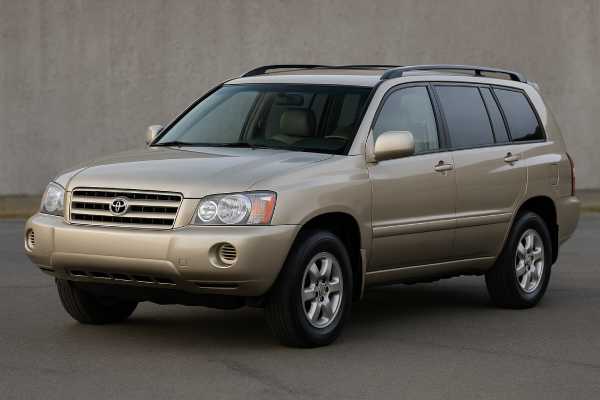
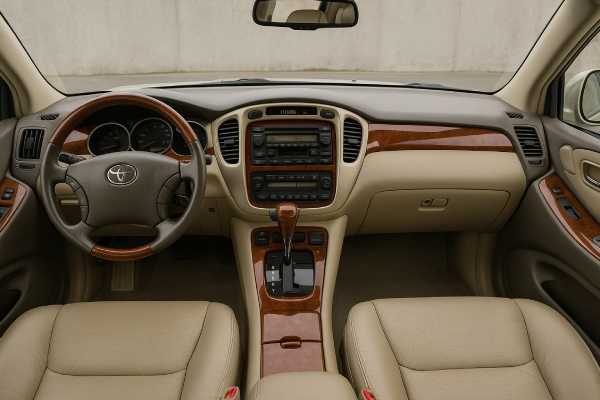
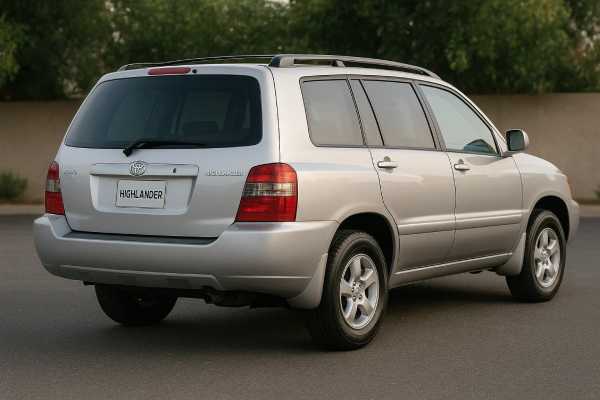
The first-generation Toyota Highlander in base front-wheel-drive ACU20 form pairs the 2AZ-FE 2.4-litre four-cylinder with a simple, durable driveline and a roomy two-row cabin. For shoppers and owners, this early Highlander sits at a sweet spot: a car-like unibody and independent suspension for ride comfort, familiar Toyota controls, and straightforward serviceability. Performance is modest but predictable, and the 4-speed automatic prioritises smoothness. Where it shines is daily usability—excellent cargo flexibility, low cabin noise for its era, and long component life if fluids and wear items are kept on schedule. Safety equipment is basic by modern standards, yet structural crash results were strong for the time. If you value low operating costs over outright speed—and you want a midsize SUV that feels more Camry than truck—the 2001–2003 FWD Highlander remains a sensible pick, provided you verify maintenance history and recall completion.
At a Glance
- Calm ride, quiet cabin, and generous cargo space (up to 81.4 ft³ / 2.30 m³ seats folded).
- Proven 2AZ-FE timing-chain engine; easy parts access and broad aftermarket support.
- Good IIHS frontal crash result for 2001–2003; predictable handling with optional stability control.
- Watch for head-gasket seep at the firewall-side corner and transmission shift-flare—both diagnosable and fixable.
- Typical oil service: 5W-30 every 5,000–7,500 miles (8,000–12,000 km) or 6–12 months, depending on duty cycle.
Navigate this guide
- ACU20 FWD overview
- Highlander 2.4 specs and data
- Highlander trims, options and safety
- Reliability, issues and service actions
- Maintenance plan and buyer’s guide
- Driving, performance and efficiency
- How Highlander compares to rivals
ACU20 FWD overview
The 2001–2003 Toyota Highlander in ACU20 specification is the front-wheel-drive, four-cylinder version of Toyota’s first midsize crossover SUV. Built on a unibody platform closely related to Camry, it trades body-on-frame toughness for car-like refinement, low floor height, and predictable manners. Power comes from the 2AZ-FE 2.4-litre DOHC inline-four (timing chain, VVT-i on the intake cam), paired with a 4-speed electronically controlled automatic. Output is 155 hp (115 kW) at 5,600 rpm and 163 lb-ft (221 Nm) at 4,000 rpm—adequate for light loads and suburban use.
Cabin packaging is a strength: two rows, five seats, and a broad, low cargo bay with a split-fold rear bench. Most examples ride on 16-inch wheels with all-season tyres, and the suspension—MacPherson struts with subframes front and rear—filters rough surfaces better than truck-based SUVs of its era. Brake hardware varies by build (see Specs), but ABS was common; optional Vehicle Skid Control (VSC) and traction control (TRAC) enhanced winter confidence.
Ownership experience hinges on routine care more than heroics. The engine is tolerant of long mileage if serviced on time; the transmission appreciates periodic drain-and-fill using the correct ATF. Early-2000s safety tech is basic (no modern ADAS), yet the structure earned a strong moderate-overlap result. For used-market shoppers, the 2001–2003 four-cylinder FWD Highlander is a low-drama, low-cost way to get a quiet, useful family hauler—best when equipped with the stability-control package and documented fluid services.
Highlander 2.4 specs and data
Below are market-relevant specifications for the 2001–2003 FWD four-cylinder Highlander (ACU20). Where figures differed by model year or build configuration, the ranges reflect common North American data for this variant.
Engine and Performance
| Item | Data |
|---|---|
| Code | 2AZ-FE |
| Layout & cylinders | Inline-4, DOHC, 16 valves (4 per cyl) |
| Bore × stroke | 88.5 × 96.0 mm (3.48 × 3.78 in) |
| Displacement | 2.4 L (2,362 cc) |
| Induction | Naturally aspirated |
| Fuel system | Sequential multiport fuel injection (SFI) |
| Compression ratio | 9.6:1 |
| Max power | 155 hp (115–116 kW) @ 5,600 rpm |
| Max torque | 221 Nm (163 lb-ft) @ 4,000 rpm |
| Timing drive | Chain (no scheduled replacement) |
| Emissions class (period) | LEV/ULEV depending on state certification |
| Rated efficiency (EPA, typical 2003 FWD) | 10.7 L/100 km combined (22 mpg US / 26 mpg UK); 12.4 city / 9.4 highway L/100 km (19 / 25 mpg US) |
| Real-world highway @ 120 km/h (75 mph) | ~9.8–10.5 L/100 km (20–24 mpg US), load and weather dependent |
| Aerodynamics (typical) | Cd ≈ 0.34 (approximate for early Highlander) |
Transmission and Driveline
| Item | Data |
|---|---|
| Transmission | 4-speed automatic, electronically controlled (U241E) |
| Gear ratios (1st / 2nd / 3rd / 4th / Rev) | 3.943 / 2.197 / 1.413 / 1.020 / 3.145 |
| Final drive ratio | ~2.74:1 (typical U241E calibration) |
| Drive type | Front-wheel drive (FWD) |
| Differential | Open |
| Refuel to full (typical) | ~5 minutes at standard pump flow |
Chassis and Dimensions
| Item | Data |
|---|---|
| Suspension (front/rear) | MacPherson strut with subframe, coil springs, anti-roll bars (front and rear) |
| Steering | Rack-and-pinion with variable power assist |
| Steering ratio / turns (typical) | ~16.1:1 / ~3.0 turns lock-to-lock |
| Brakes | Front ventilated discs; rear discs on most builds; some early U.S. FWD cars used rear drums (verify by VIN) |
| Wheels/Tyres (tires) | 225/70 R16 all-season; full-size spare |
| Ground clearance (FWD) | 175 mm (6.9 in) |
| Length / Width / Height (FWD w/roof rack) | 4,685 mm / 1,825 mm / 1,735 mm (184.4 / 71.9 / 68.3 in) |
| Wheelbase | 2,715–2,719 mm (106.8–106.9 in) |
| Turning circle (curb-to-curb) | ~11.4 m (37.4 ft) |
| Curb weight (4-cyl FWD) | ~1,580 kg (3,485 lb) |
| GVWR | ~2,260 kg (4,985 lb) |
| Fuel tank | 75 L (19.8 US gal / 16.5 UK gal) |
| Cargo volume (SAE) | 1,090 L / 2,304 L (38.5 / 81.4 ft³) seats up / seats down |
Performance and Capability
| Item | Data |
|---|---|
| 0–60 mph / 0–100 km/h (typical) | ~10–10.8 s (lightly loaded) |
| Top speed (governed/indicative) | ~180 km/h (112 mph) |
| Braking 100–0 km/h | Typical class performance for the era (tyre-dependent) |
| Towing capacity (4-cyl) | 680 kg / 1,500 lb (standard); 1,360 kg / 3,000 lb with tow package |
| Payload (4-cyl FWD) | ~576 kg (1,270 lb) |
| Roof load | 75 kg (165 lb) with factory rails/crossbars |
Fluids and Service Capacities
| System | Specification | Capacity (approx) |
|---|---|---|
| Engine oil | API SL or better; 5W-30 preferred | ~3.8–4.0 L (4.0–4.2 US qt) with filter |
| Coolant | Toyota Long Life (red) 50/50 premix or concentrate mixed 50/50 | ~6.4 L (6.8 US qt) system fill (without rear heater) |
| Automatic transmission | Toyota ATF Type T-IV | ~3.5–3.7 L (3.7–3.9 US qt) drain and refill |
| Power steering | ATF Dexron II/III equivalent (period spec) | As needed (flush by exchange) |
| A/C refrigerant | R-134a | ~550–650 g (19–23 oz) |
| A/C compressor oil | ND-OIL 8 (PAG) | ~120 mL (4.0 fl oz), service-dependent |
| Key torque specs | Wheel nuts: 103 Nm (76 lb-ft); spark plugs: ~18–22 Nm (13–16 lb-ft) |
Electrical
| Item | Data |
|---|---|
| Alternator output | ~80–100 A (model/option dependent) |
| 12V battery | Group 35 typical; ~48–60 Ah; ~500–600 CCA |
| Spark plug | Iridium (Denso SK20R11 / NGK IFR6A11), gap 1.1 mm (0.043–0.044 in) |
Safety and Driver Assistance
| Item | Data |
|---|---|
| Crash ratings | IIHS moderate-overlap frontal: Good (applies to 2001–2007) |
| Headlight rating | Not rated under later IIHS headlight protocol |
| ADAS availability (period) | ABS standard on most; optional TRAC and VSC depending on package; no AEB/ACC/LKA/BSM/RCTA |
| Child-seat provisions | Rear outboard lower anchors and top tether points; verify LATCH hardware by VIN and year |
Notes: Some early U.S. FWD four-cylinder builds used rear drum brakes; Canadian-market 2003 spec sheets list four-wheel discs. Always verify by VIN and physical inspection.
Highlander trims, options and safety
Trims and option structure (2001–2003): In North America, the FWD four-cylinder Highlander was sold primarily as a well-equipped base model with popular options, alongside higher-content packages and the V6 line. Typical packages added alloy wheels, roof rack, fog lamps, power driver seat, JBL audio, leather, heated seats, moonroof, and—importantly—Vehicle Skid Control (VSC) with TRAC. Side torso airbags for the front seats were optional in this period. Tow-prep (engine-oil cooler, upgraded wiring) enabled the 3,000-lb (1,360-kg) rating; without it, the rating is 1,500 lb (680 kg).
Quick identifiers and build codes:
- ACU20 = 2.4L, FWD (this article’s focus).
- ACU25 = 2.4L, full-time 4WD.
- MCU20/25 = 3.0L V6, FWD/4WD.
- VIN plate and under-hood emissions label will show the 2AZ-FE engine family; towing package is often visible via auxiliary coolers and harness provision near the radiator support.
Year-to-year highlights:
- 2001 (launch): Two rows only; 2.4L I-4 standard, 3.0L V6 optional; stability control offered as an option in many regions.
- 2002: Equipment shuffle; side airbags remained optional; continued focus on quiet ride and ride compliance.
- 2003: Minor trim, colour and package changes; Canadian spec sheets call out four-wheel discs broadly; tow-prep availability expands. (The major facelift and third-row option arrived for 2004, outside this article’s scope.)
Safety ratings in context: The structure performed well in the moderate-overlap frontal test for 2001–2003. Federal star ratings for side impacts were sparse or not consistently published for all early years. If you need precise NHTSA star data, run a VIN-based query; results can vary with airbags and equipment. Side-curtain airbags were not offered in these years; the most meaningful upgrade is the VSC/TRAC package, which materially improves stability on slick roads.
Child seats and restraints: Rear outboard lower anchors and top tethers are provided; the centre position typically has a top tether only. Always verify anchor locations and routing in the owner’s manual, and note that bulky child seats may limit three-across use due to shoulder-belt geometry.
ADAS and service implications: No active safety features in the modern sense. For vehicles equipped with VSC, a yaw-rate/accel sensor zero-point calibration is required after ride-height changes or certain alignment/suspension operations—your service manual outlines the short-pin procedure. If TRAC/VSC MILs appear after battery disconnect or alignment, re-calibration often resolves them.
Reliability, issues and service actions
Overall durability: With routine care, the ACU20 Highlander commonly sees 200k–300k miles (320k–480k km) without major powertrain work. The 2AZ-FE uses a timing chain and a simple port-injection system—both robust. The automatic is conservative and responds well to fluid care. Below are issues organised by prevalence and cost/severity, with typical mileage/age bands and practical remedies.
Engine and cooling (ICE specifics):
- Cylinder-head bolt thread pull-out (occasional / high / 120k–200k mi): Coolant seep at the rear (firewall-side) corner, sweet smell, or prolonged bubbles in the overflow can indicate failed block threads allowing the head to lift. Root cause: Aluminium block threads fatigued or corroded. Remedy: Timesert/solid-bush thread repair for affected bolts, new head gasket and bolts; verify deck flatness. A careful repair returns full life; avoid temporary sealants.
- Oil consumption (occasional / medium / varies): Most early 2AZ-FE units are fine, but some develop higher-than-expected consumption with age (stuck oil rings, PCV flow). Symptoms: Frequent top-offs, sooty tailpipe. Remedy: Use high-detergency oil, confirm PCV function, and perform compression/leak-down. Ring service is the ultimate fix; many owners manage with 5,000-mile intervals and monitoring.
- Cooling system neglect (common / medium / 10–20 years): Radiator or heater-core restriction if original coolant has aged out. Remedy: Proper drain-and-fill with Toyota LLC (red) or SLLC (pink) as specified, thorough burp, and inspection of radiator caps and hoses. Cooling capacity is adequate when clean.
Fuel/air/exhaust and sensors:
- Upstream/downstream O₂ sensors (common / low / 100k–200k mi): CEL with lean/rich codes or slow switching. Remedy: Replace with quality parts; inspect for exhaust leaks ahead of sensors.
- Idle quality (occasional / low): Carbon on throttle body (cable throttle era) or IAC stepper leads to unstable idle. Remedy: Clean throttle plate and IAC passages; perform idle learn.
Transmission and driveline:
- U241E 2–3 shift flare or harshness (occasional / medium / 100k+ mi): Root cause: Ageing ATF or valve-body wear; some ECM calibrations shift too softly, generating heat. Remedy: Multiple drain-and-fills with Toyota ATF T-IV, check line pressure, and consider valve-body service if flare persists. Transmission survives a long time if fluid remains clean.
- Inner CV boots (occasional / low / age): Heat cracking near the joint. Remedy: Replace boot or axle; re-grease and clamp properly.
Chassis, suspension, and steering:
- Front strut mounts/top bearings (common / low / age): Clunk over sharp bumps or when turning at low speed. Remedy: Replace mounts and inspect struts; align afterward.
- Lower control arm rear bushings (common / medium): Vibration or brake shimmy. Remedy: Press-in bushings or complete arms; torque at ride height.
- Wheel bearings (occasional / medium): Growl increasing with speed. Remedy: Hub replacement; check tyre wear and alignment.
Brakes and hydraulic system:
- Rear hardware variation: Some early U.S. FWD 2.4s left the factory with rear drums; most others (and Canada 2003 spec) use rear discs. Parts and service procedures differ—check your VIN.
- ABS wheel speed sensors (occasional / low): Corrosion at the sensor seat causing intermittent signal. Remedy: Clean bores and use new O-rings; avoid prying on the tone ring.
Body and corrosion hotspots (salt-belt):
- Subframe and brake line corrosion (occasional / medium): Inspect front subframe seams and the fuel/brake line clusters under body clamps. Remedy: Clean, rust-treat, and protect; replace lines if pitted.
- Liftgate struts (common / low): Sag in cold weather. Remedy: Replace both struts; easy DIY.
Recalls, campaigns, and TSBs (high-level):
- Child protection lock system (2001–early 2004 builds): Campaign addressed rear door child lock reliability; verify completion.
- Floor-mat/accelerator pedal interference (multi-model campaign years later): Owner guidance and hardware updates were provided; ensure your VIN shows completed remedy and use only approved mats.
Verification: Always run your VIN through the official recall lookup; dealer service history and the under-hood campaign stickers (where used) are valuable proof.
Pre-purchase checklist (what to request):
- Full maintenance file (oil, coolant, ATF, brake fluid).
- VIN recall printout and any ECM/TCM calibration updates.
- Cooling-system pressure test and block-test if there’s any hint of coolant loss.
- Transmission road-test (look for flare, delayed engagement).
- Suspension/brake inspection with tyre measurements and alignment report.
- Underbody corrosion photos (subframes, seams, line brackets).
Maintenance plan and buyer’s guide
Service philosophy: These early Highlanders reward preventive maintenance. Use the correct fluids, keep intervals short if mostly short-trip or hot-climate driving, and inspect rubber parts annually.
Practical maintenance schedule (distance/time):
- Engine oil and filter: 5W-30, every 5,000–7,500 miles (8,000–12,000 km) or 6–12 months. Severe use (short trips, towing, extreme cold/heat) → 5,000 miles/6 months.
- Engine air filter: Inspect at 15,000 miles (24,000 km); replace every 30,000 miles (48,000 km) or sooner in dusty areas.
- Cabin filter: 12 months/10,000–15,000 miles (16,000–24,000 km).
- Coolant: If filled with Toyota Long Life (red) typical of this era: every 30,000 miles / 2 years. If system has been updated to Super Long Life (pink): first at 100,000 miles (160,000 km), then every 50,000 miles (80,000 km). Confirm coolant type by colour and label.
- Spark plugs (iridium SK20R11/IFR6A11): 120,000 miles (192,000 km).
- Fuel filter: Integrated with the in-tank pump module; no routine replacement—replace when pressure or flow is out of spec.
- Serpentine/aux belt: Inspect every 30,000 miles/3 years; replace if cracked, glazed, or noisy.
- Timing chain: No interval; inspect if correlation codes, rattle on cold start, or metal in oil.
- ATF (U241E): Toyota ATF Type T-IV; though not always listed with a fixed interval, a drain-and-fill every 60,000 miles (96,000 km) is a cost-effective life extender.
- Brake fluid: 2–3 years regardless of mileage.
- Front/rear brakes: Inspect at each tyre rotation; typical pads 30k–60k miles depending on use.
- Tyre rotation and alignment: Rotate every 5,000–7,500 miles; check alignment annually and after any suspension work.
- 12V battery: Test yearly after year 3; many last 4–6 years.
- Steering/suspension: Annual inspection of strut mounts, control arm bushings, CV boots, and sway-bar links.
Fluid quick-reference (decision-making):
- Engine oil: API SL/SN or later; 5W-30; capacity ~4.0 qt (3.8–4.2 qt with filter).
- Coolant: Toyota LLC (red) or SLLC (pink); fill to radiator neck, burp via heater-on warm-up; capacity ~6.4 L (6.8 qt) typical without rear heater.
- ATF: Toyota Type T-IV only for U241E; drain-and-fill volume ~3.5–3.9 qt.
- Power steering: ATF Dexron II/III equivalent (period spec).
- A/C refrigerant and oil: R-134a ~550–650 g; ND-OIL 8 ~120 mL service fill (follow service manual after component replacement).
- Torque essentials: Wheel nuts 103 Nm (76 lb-ft). Use a torque wrench on aluminium wheels.
DIY tips:
- Transmission fluid: Multiple drain-and-fills are better than a single exchange; use the pan plug, then re-check hot level on a level surface.
- Cooling system: Use a spill-free funnel; massage upper radiator hose to purge air; verify hot-soak level stability.
- Brake pedal feel: If spongy after pad replacement, bleed in the correct sequence and ensure slide pins move freely with high-temp grease.
Buyer’s guide highlights:
- Best picks: Later 2002–2003 FWD four-cylinder examples with VSC/TRAC and documented coolant/ATF maintenance.
- What to avoid: Neglected coolant (brown fluid), CEL with P0420/P0430 (catalyst efficiency; often exhaust leaks or aged cats), and any sign of head-gasket seep at the rear of the block.
- Reconditioning budget: Struts, top mounts, control-arm bushings, tyres, brake refresh, and fluids can easily total $1,500–2,500 if due; factor this into pricing.
Long-term outlook: Treated well, the ACU20 Highlander is a long-haul companion with parts availability and easy service. The absence of turbocharging and the use of port injection simplify ownership, and the timing chain reduces scheduled costs.
Driving, performance and efficiency
Ride and handling: The Highlander feels like a tall Camry of its time: light steering effort, stable tracking, and predictable understeer when provoked. The strut suspension is softly sprung but reasonably controlled; impacts are muted, though tall-sidewall tyres and 16-inch wheels contribute some sidewall flex. Wind and road noise are impressively low for an early-2000s SUV, one reason these trucks feel less tiring on long drives than body-on-frame competitors.
Powertrain character: With 155 hp and a broad 4,000 rpm torque peak, the 2AZ-FE offers smooth, linear response rather than punch. The 4-speed auto favours early upshifts; kickdown is decisive but not hurried. Around town, it keeps revs low and the cabin quiet. On freeway grades with passengers or cargo, expect downshifts and a modest climb in revs to maintain 70–75 mph (113–120 km/h). The calibration’s gentleness is easy on hardware and tyres.
Braking and steering feel: Pedal travel is medium-long but consistent. Braking distances depend heavily on tyre condition; fitting fresh quality tyres and servicing slide pins yield a noticeable improvement. Steering is light with on-centre calm—excellent for commuting and long trips, less engaging on winding roads.
Real-world efficiency: Owners typically see 21–24 mpg US mixed (11.2–9.8 L/100 km), 18–21 mpg US city (13.1–11.2 L/100 km), and 23–26 mpg US highway (10.2–9.0 L/100 km) in mild weather. Cold starts, short trips, roof-rack loads, and winter tyres can pull highway numbers into the high-teens mpg; careful warm-weather cruising can crack the mid-20s.
Load and towing: The FWD four-cylinder is happiest with people and luggage. It will tow a small trailer (1,500 lb / 680 kg) without drama; the tow-prep package brings cooling margin for 3,000 lb (1,360 kg). Expect a 15–30% fuel-economy penalty when towing or carrying a full load. On long grades, moderate speed and leave a gap to manage brake temperatures.
Traction notes: With good all-season or dedicated winter tyres, the FWD configuration is composed in rain and light snow; VSC/TRAC, if fitted, trims wheelspin and yaw neatly. Tyre choice dominates winter confidence far more than the powertrain here.
How Highlander compares to rivals
Against Ford Explorer (2001–2003): Explorer’s body-on-frame layout tows more but rides busier and is heavier. Highlander’s unibody smoothness, lower NVH, and cargo flexibility make it easier to live with if you rarely tow.
Against Honda Pilot (2003): Pilot adds a third row and more V6 power, but early Pilots can feel louder over coarse pavement. A four-cylinder Highlander is quieter and simpler to service; the Pilot offers more seats and pace.
Against Nissan Murano (2003): Murano’s V6/early CVT feels quicker, yet the CVT brings complexity. Highlander trades speed for durability and straightforward maintenance.
Against Subaru Outback (2001–2003): Outback’s lower centre of gravity and standard AWD help in snow; Highlander counters with a quieter cabin, more upright seating, and a larger cargo box.
Bottom line: If you want low running costs, quietness, and easy serviceability, the ACU20 Highlander FWD is a better fit than most contemporaries. If you routinely carry seven or tow often, consider a V6 or a different platform.
References
- Gas Mileage of 2003 Toyota Highlander 2003 (EPA Fuel Economy)
- 2001 Toyota Highlander 4-door SUV 2001 (Safety Rating)
- Vehicle Detail Search – 2001 TOYOTA HIGHLANDER | NHTSA 2001 (Recall Database)
- 2001 – 2007 Toyota Highlander [First (1st) Generation] 2019 (Manufacturer Images and Background)
Disclaimer
This guide is for informational purposes only and is not a substitute for professional diagnosis or repair. Specifications, torque values, capacities, and maintenance intervals can vary by VIN, market, build date, and equipment. Always verify procedures and figures against your vehicle’s official owner’s manual and service documentation before service.
If you found this useful, consider sharing it on Facebook or X/Twitter to help other Highlander owners and support xcar’s work.